
6,000 Years of World History Under Sin and Year 2027
Slawomir Gromadzki
“One saying of the Saviour must not be made to destroy another. Though no man knoweth the day nor the hour of His coming, we are instructed and required to know when it is near. We are further taught that to disregard His warning, and refuse or neglect to know when His advent is near, will be as fatal for us as it was for those who lived in the days of Noah not to know when the flood was coming.” — The Great Controversy, p. 370, para. 2 (GC 370.2)
There are good reasons to believe that the approximate time of the end may be indicated by several different sources: the prophetic periods of Daniel 12:11–12, the cosmic-week principle, the final Jubilee and Sabbatical years, and the Spirit of Prophecy. Remarkably, although these lines of reasoning are different, they all appear to lead to the year 2027.
Before dismissing this idea as improper time-setting, please read the entire article—especially its final conclusion. The article does not claim to establish the exact day or hour of Christ’s return, nor does it state with certainty that He must return in 2027. It presents 2027 only as a possible year in or around which the final events may begin.
Some readers may immediately quote Christ’s statement that no one—not even the Son—knows the day or hour. However, James White understood this statement to mean that no one except the Father will make known the exact time of Christ’s return. Shortly before the Second Advent, the Father Himself will announce the definite day and hour. This does not mean that God’s people cannot recognise the approximate period when the final events are approaching and Christ’s return is near. As Adventist pioneers such as James White believed, Christ gave us the signs of the times precisely so that His watchful people could recognise when His coming was “near, even at the doors” (Matthew 24:33).
Please read the complete article and its final conclusion before deciding whether its argument constitutes improper time-setting.
1. Spirit of Prophecy and 6000 Years of World History
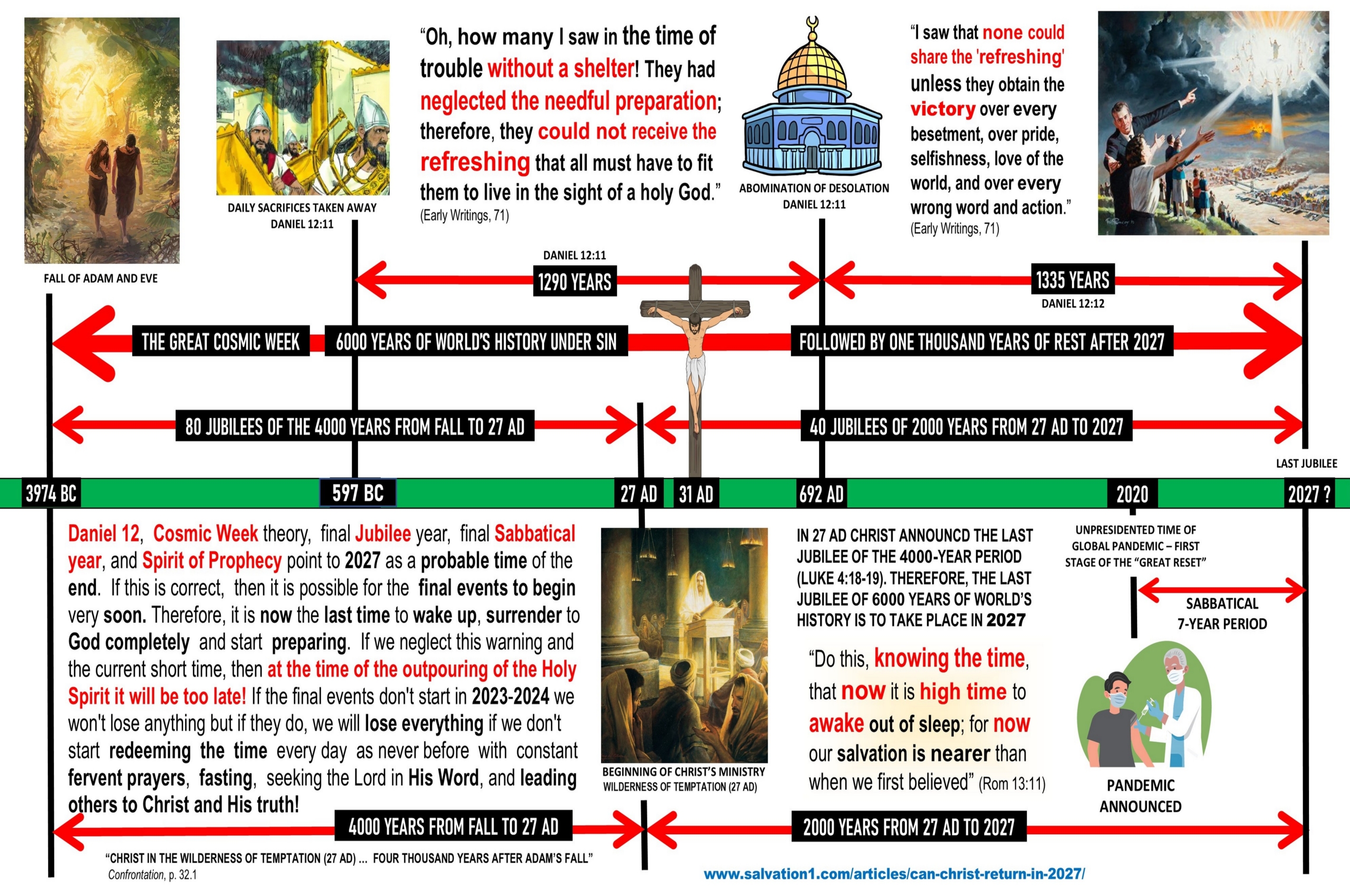
In her writings, Ellen White repeatedly stated that this world was to exist for 6000 years. For instance, in the book Patriarchs and Prophets (Chapter 29—Satan’s Enmity against the Law), she wrote that Satan was given a specific period of six thousand years to demonstrate the results of the sin of “iniquity” introduced by him (Ezek 28:15), which refers to life independent of God and governed by the principle of egocentric love:
“The great plan of redemption results in fully bringing back the world into God’s favor. All that was lost by sin is restored. Not only man but the earth is redeemed, to be the eternal abode of the obedient. For six thousand years Satan has struggled to maintain possession of the earth. Now God’s original purpose in its creation is accomplished. The saints of the Most High shall take the kingdom, and possess the kingdom forever.”
Since the Spirit of Prophecy tells us that this world, in its sinful state and under the rulership of Satan (from the fall of Adam till the second coming of Christ), was to last 6000 years, we need to find the beginning of this period of time. The next statement (found in the book Confrontation, p. 32.1) seems to be the most helpful in providing the required time setting:
“Christ, in the wilderness of temptation (it took place immediately after His baptism, in 27 AD), stood in Adam’s place to bear the test he failed to endure. Here Christ overcame on the sinner’s behalf, four thousand years after Adam turned his back upon the light of his home.”
We are told that approximately four thousand years passed from the fall of Adam to Christ’s temptation in the wilderness, which occurred immediately after His baptism in AD 27.
Luke 3:23 states that Jesus was “about thirty years of age” when He began His public ministry. This may initially seem confusing: how could Jesus be about thirty years old in AD 27? The answer is that AD 27 identifies the calendar year, not Christ’s age.
Jesus was born approximately four years before AD 1, probably around 4 BC. This apparent discrepancy exists because the calendar now used throughout much of the world was created centuries after Christ’s birth, and its designer placed His birth several years too late. Furthermore, there is no year zero: the calendar moves directly from 1 BC to AD 1.
According to the traditional Seventh-day Adventist chronology:
Jesus was born around 4 BC.
He was baptised and tempted in the wilderness in AD 27, when He was about thirty years old (Luke 3:23).
He was crucified in the spring of AD 31, when He was approximately thirty-three and a half years old.
Therefore, Christ was not twenty-seven years old at His baptism and did not die at the age of thirty-one. The numbers 27 and 31 refer to the calendar years AD 27 and AD 31, not to His age.
This distinction is important for understanding the following calculation. If approximately four thousand years passed from the fall of Adam to Christ’s temptation in AD 27, another two thousand years would bring us to 2027:
AD 27 + 2,000 years = 2027
According to this calculation, 2027 may mark approximately six thousand years of world history under sin: four thousand years from the fall of Adam to Christ’s temptation in the wilderness, followed by another two thousand years.
2. Biblical Jubilee and Year 2027
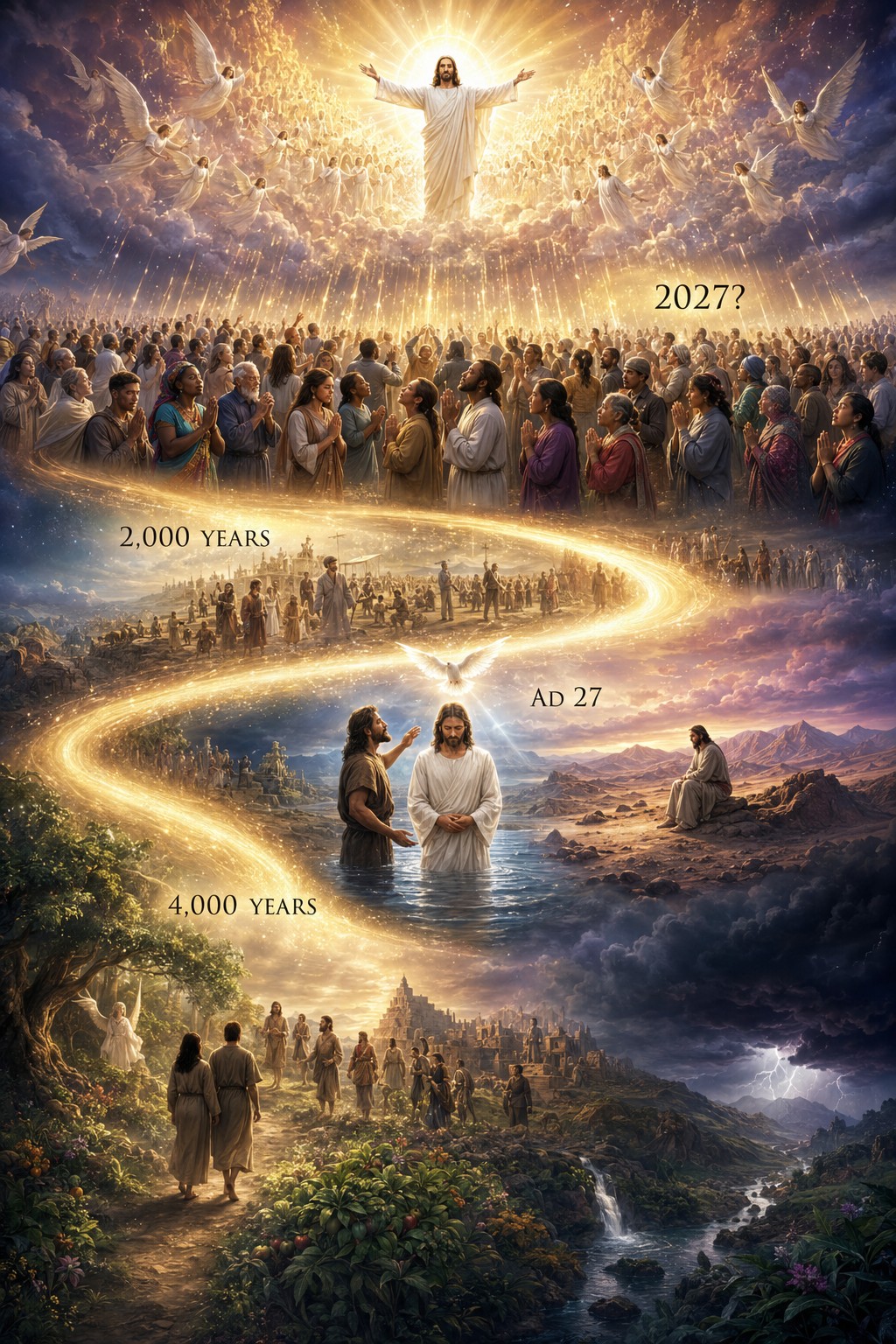
Another possible reason for regarding 2027 as significant is its connection with the biblical Jubilee. In Luke 4:18, shortly after His baptism and temptation, Christ proclaimed “the acceptable year of the Lord.” These words come from Isaiah 61:1–2 and contain language associated with the Jubilee described in Leviticus 25.
If Christ’s proclamation in AD 27 marked the final Jubilee of approximately four thousand years of Old Testament history, then 2027—two thousand years later—could mark the final Jubilee of approximately six thousand years of world history under sin.
3. Prophetic Periods of Daniel 12 and Year 2027
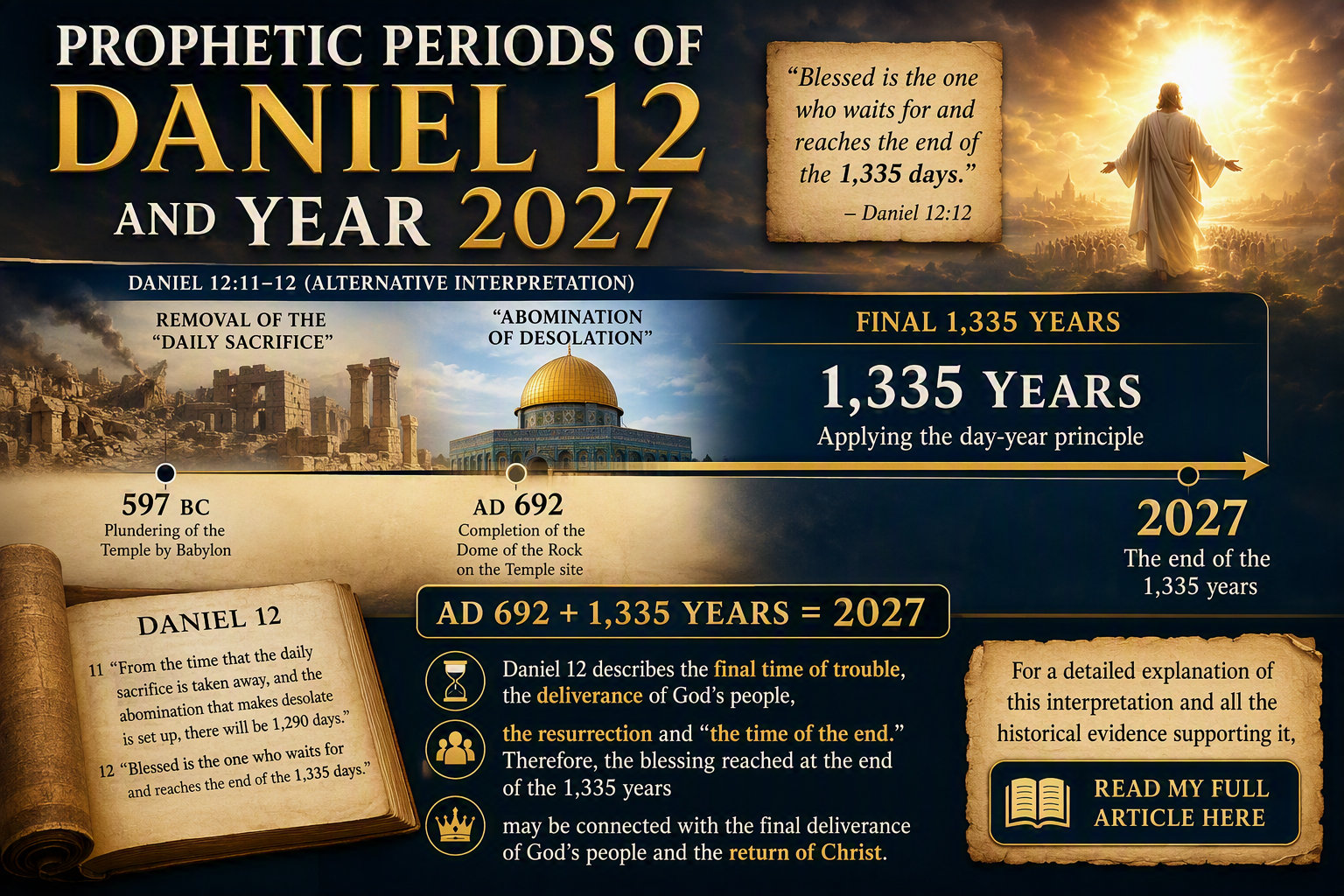
A third argument pointing to 2027 comes from the prophetic periods of Daniel 12:11–12. An alternative interpretation connects the removal of the “daily sacrifice” with the plundering of the Temple in 597 BC and the “abomination of desolation” with the completion of the Dome of the Rock on the Temple site in AD 692. Daniel then says: “Blessed is the one who waits for and reaches the end of the 1,335 days” (Daniel 12:12).
Applying the day-year principle and counting the final 1,335 years from AD 692 leads directly to 2027:
AD 692 + 1,335 years = 2027
This interpretation is especially significant because Daniel 12 describes the final time of trouble, the deliverance of God’s people, the resurrection and “the time of the end.” Therefore, the blessing reached at the end of the 1,335 years may be connected with the final deliverance of God’s people and the return of Christ.
For a detailed explanation of this interpretation and all the historical evidence supporting it, read my full article here.
CONCLUSION
However, even if these calculations are correct, they do not allow us to set the exact year of Christ’s return or the beginning of the final events. We cannot be certain whether the interpretation of Daniel 12:11–12 is correct or whether Sister White’s expression “four thousand years” refers to a precise chronological period or an approximate one. Six thousand years is a very long time, and even if Christ returns five or ten years before or after 2027, His return could still reasonably be described as occurring after approximately six thousand years of sin.
Nevertheless, these three lines of reasoning give us good reason to believe that we are living very near the end and that the final events could begin very soon. These events include the outpouring of the Holy Spirit in the latter rain. We are told that unless we prepare for this great event by receiving the early rain, we may fail to recognise the latter rain and may even oppose it—with spiritually fatal consequences.
In addition, we should never forget that none of us is guaranteed another day—or even another hour of life. Therefore, we should always be spiritually ready, fully devoted to God, and live each day as though it were our last.
“We should watch and work and pray as though this were the last day that would be granted us. How intensely earnest, then, would be our life. How closely would we follow Jesus in all our words and deeds.”—Testimonies for the Church, vol. 5, p. 200; God’s Amazing Grace, p. 261.