
Written by Slawomir Gromadzki
INTRODUCTION
The “in Christ motif” plays the most important role in Paul’s writings. According to Michael Parsons, “Any thoughtful reader of the Pauline epistles will be struck by a dominant idea which runs through the apostle’s teaching: the recurrent theme of the believer’s close and indissoluble union with the Lord Jesus Christ. For Paul, union with Christ is summed up in the short phrase in Christ and its various equivalents. It is supposed by many to be original with Paul, and the idea appears in different ways about two hundred and sixteen times in his writing!”
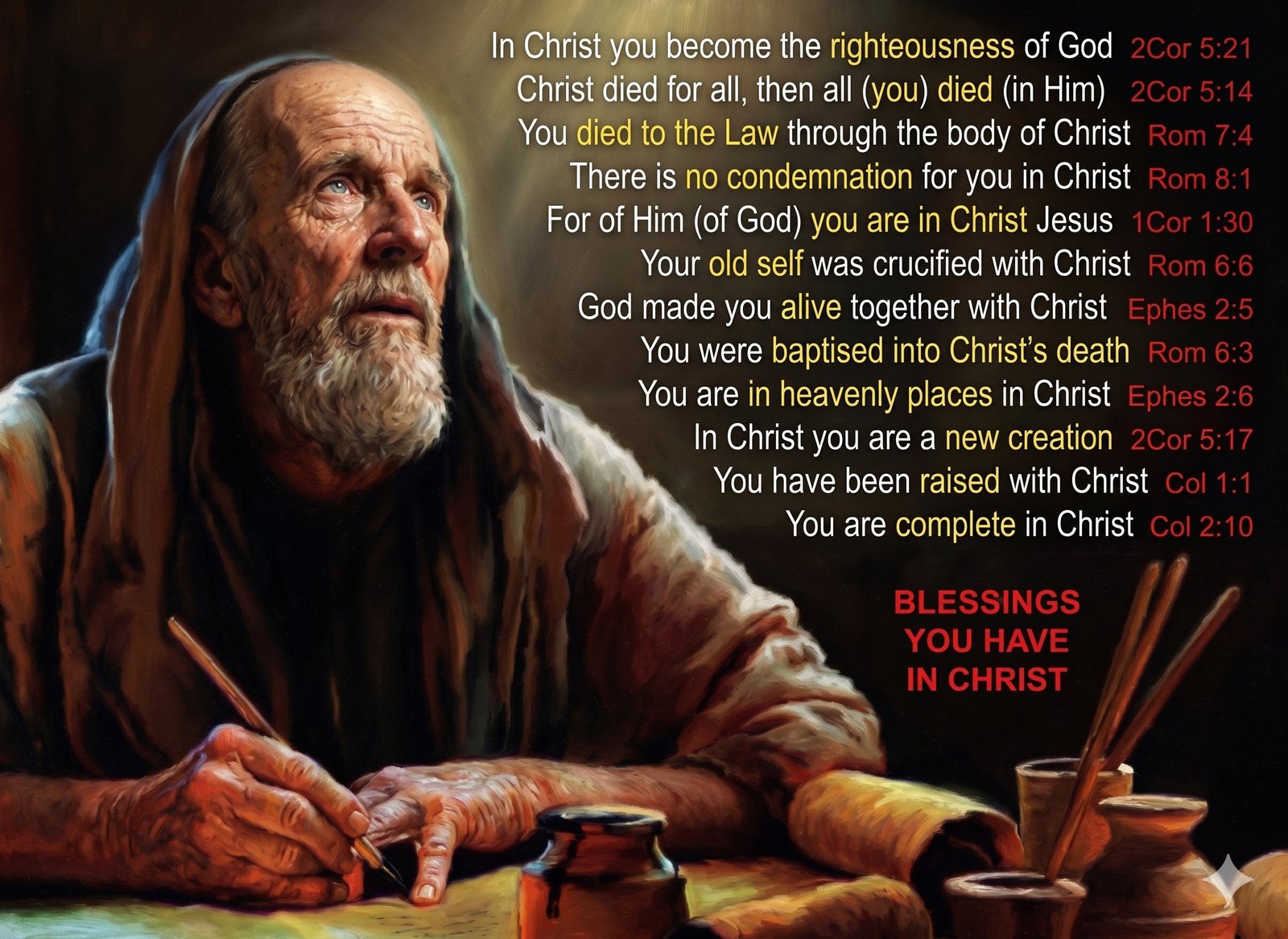
In the book “Beyond Belief”, Jack Sequeira describes the meaning of this phrase in the following way: “If we do not understand what the New Testament means by the term ‘in Christ,’ we will never be able to fully understand the message of the gospel. There is nothing we have as Christians except we have it ‘in Christ.’ Everything we have, enjoy, and hope for as believers is ours always ‘in Christ.’ Apart from Him we have nothing but sin, condemnation, and death. What does Scripture mean when it tells us that we were together with Christ in His death, burial, and resurrection? What did Paul mean when he tells us that we are already ‘sitting in heavenly places in Christ’ (Ephesians 2:6)? The ‘in Christ’ motif is based on the Biblical teaching of solidarity or corporate oneness, a concept that is unfortunately to a large degree foreign to the Western mind.
According to the plain teaching of the Bible, the whole of mankind is linked together by a common life and therefore is considered a unit or corporately one. This is because God created all men in one man – Adam (Genesis 2:7; Acts 17:26). By a divine act initiated and carried out by God alone, the corporate life of the whole human race in its fallen condition was incorporated into Christ at His incarnation when by a divine miracle the divinity of Christ and our corporate humanity that needed redeeming were united into one person—Jesus Christ (1 Corinthians 1:30). It is through this mystery that God qualified Christ legally to be the second or last Adam (Adam in Hebrew means mankind), our representative and substitute. Then, by His life and death, which fully met the positive demands of God’s holy law as well as its justice, Christ became forever our righteousness and surety. This, in a nutshell, is the ‘in Christ’ motif, and is what constitutes the good news of the gospel (Ephesians 1:3-12; 2:4-7). It is for this reason that the humanity of Christ is said to be ‘everything to us’.”


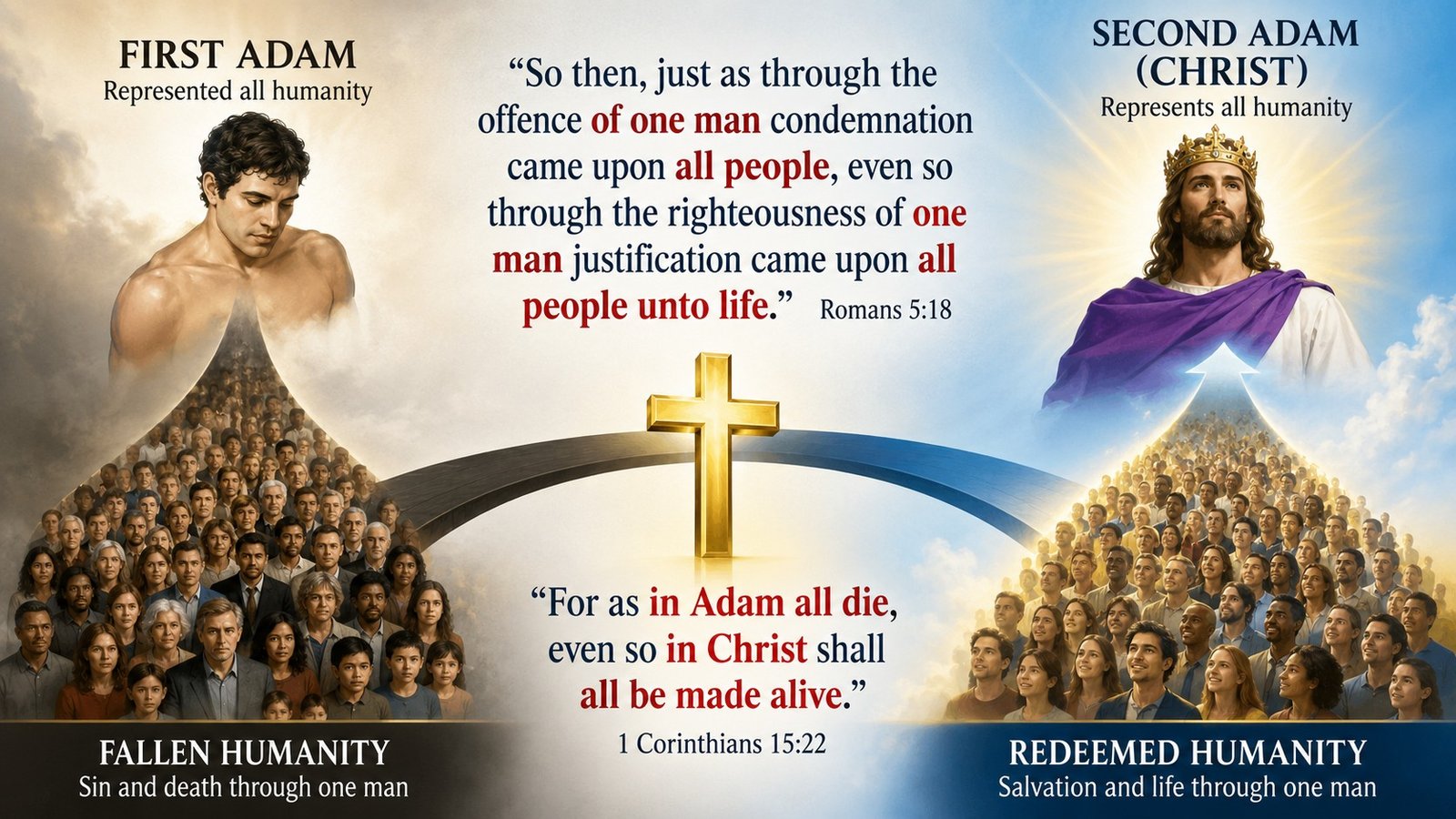
For the inspired Apostle Paul this idea is so important for proper understanding of the Gospel that in Romans 5:12-19 he repeats the very same great truth of universality of condemnation in Adam and universality of salvation in Christ (Last Adam) over and over again at least six times! Never in the entire Bible can we find another important principle or idea repeated so many times in one chapter. It means that this “in Christ motif” must had been regarded by the Apostle as the foundation of the Gospel and our salvation.
According to Jack Sequeira, “For four hundred years, Protestant Christianity has been divided into two camps regarding salvation. The first, Calvinism, confesses that Christ actually saved human beings on the cross but that this salvation is limited only to the elect–those whom God has predetermined to be saved. The second view, Arminianism, holds that on the cross Christ obtained salvation for all humanity, but that this salvation is only a provision; a person must believe and repent for the provision to become a reality. Both these views are only conditional good news. I believe that neither camp presents the full truth about salvation. The Bible teaches that God actually and unconditionally saved all humanity at the cross so that we are justified and reconciled to God by that act…
Within Arminian theology, no one is deemed saved or justified unless they first do ‘something’ like believe, and repent… Historically we (Adventists) belong to the Arminian camp. As a result, most, if not all, Adventists have been raised up to believe that Christ did not actually save anyone on the cross, but simply made provision for the salvation of all mankind; that unless we take the initiative and believe, repent (i.e., turn away from sin), and confess all our sins, we stand as lost or condemned sinners before God. In practice, this concept of the gospel has done two things to our people. Since we are still struggling with the sin problem, no matter how hard we try, many Adventists question whether their repentance has been genuine.
This, in turn, has robbed our people of the assurance of salvation. Hence, most Adventists are very insecure about their salvation. Value Genesis confirmed this fact, when the majority of our youth admitted they had no assurance of salvation because their conduct was not meeting God’s high standard. Added to this problem is the fact that every time one sins one becomes unjustified until confession of that sin has been made. This has added to the problem of having no assurance of salvation.
Because of this twofold problem, we have produced a people who are experiencing no joy of salvation and who are trying to live the Christian life, either out of fear of the judgment, or a desire to make it to heaven. But the greatest tragedy of all is that this Arminian mindset has become a real stumbling block to many Adventists. When they hear the true good news of the gospel, to them it sounds like heresy, or it is too good to be true…
According to the clear teaching of the Bible, the entire human race was placed into Christ, the second Adam, at the incarnation. Thus by His obedience, the entire human race was objectively justified unto life at the cross (Romans 5:18). But this actual or objective salvation does not become ours personally or subjectively until we accept it with a genuine faith, experiencing the new birth (read Jn. 3:3)”. (Read the full article here)
NON-ADVENTISTS SUPPORTING ULJ
There have been many theologians and popular preachers whose writings prove that they accepted and proclaimed the truth about the Biblical “In Christ” Motif and the Corporate Salvation in Christ.
Samuel Huber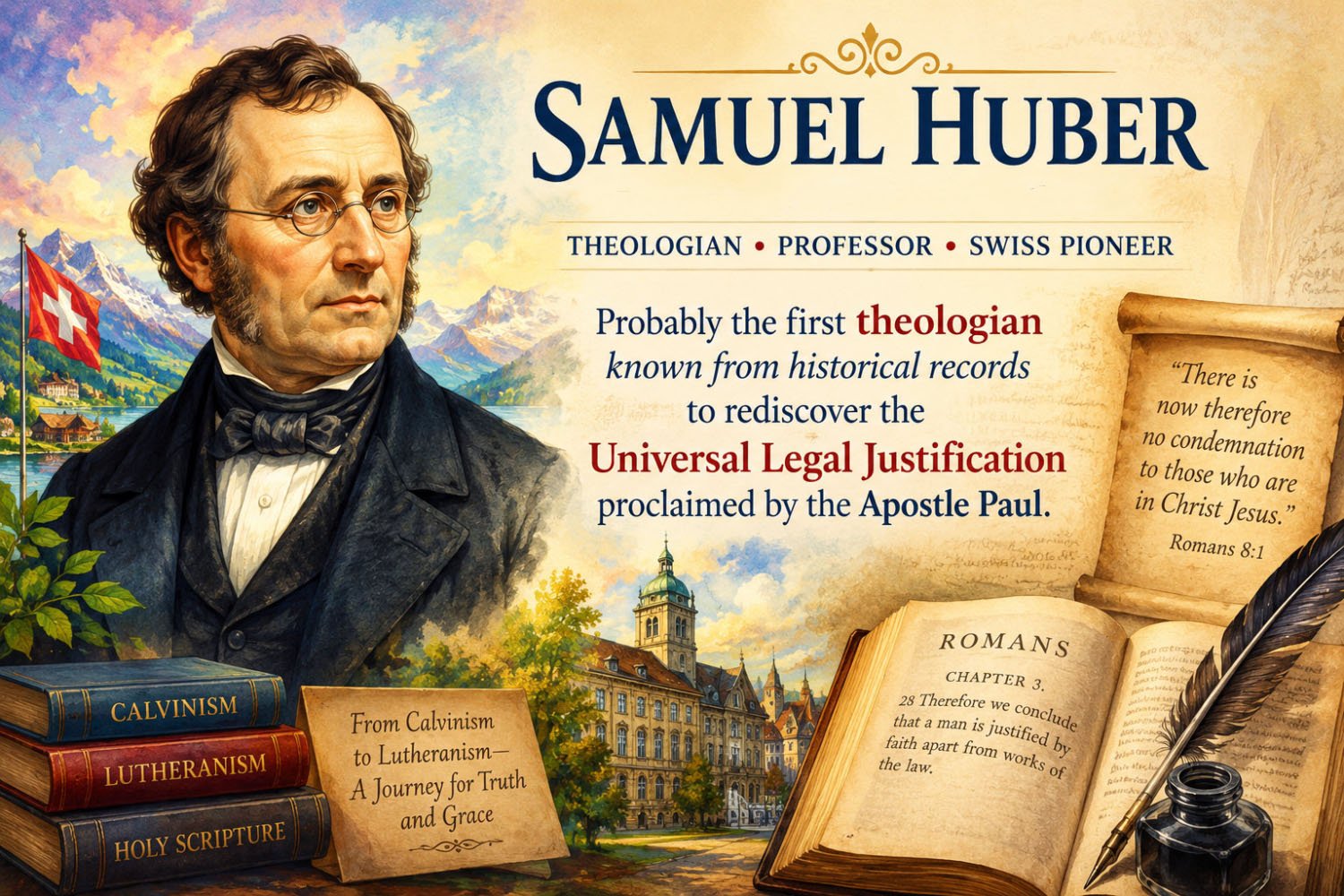
As far as historical records indicate, Samuel Huber (1547–1624), Swiss convert from Calvinism to Lutheranism, was probably the first theologian to rediscover the Universal Legal Justification proclaimed by the Apostle Paul. Unfortunately, Huber’s works are difficult to obtain, and most of what survives comes through his opponents. His doctrine was summarized by Aegidius Hunnius:
“All men individually have been justified through Christ, whether they believe or not (2 Cor. 5:19).” (Aegidius Hunnius, Theses Opposed to Huberianism, 1593, summary of Huber’s doctrine)
“God has already forgiven the sins of all men and justified them.” (Aegidius Hunnius, Theses Opposed to Huberianism, 1593, description of Huber’s teaching)
NOTE: Samuel Huber clearly taught that all humanity had been justified in Christ prior to faith. However, it is less clear whether he taught this in exactly the same way as later proponents of Universal Legal Justification. The surviving evidence comes largely from his opponents, who accused him of teaching that all people had already been forgiven and justified through Christ. At the same time, there is insufficient evidence to conclude that Huber taught universal salvation (the belief that all people will ultimately be saved). Therefore, while Huber appears to have taught universal justification, it cannot simply be assumed that he denied the necessity of faith or that he believed all people would finally enter heaven.
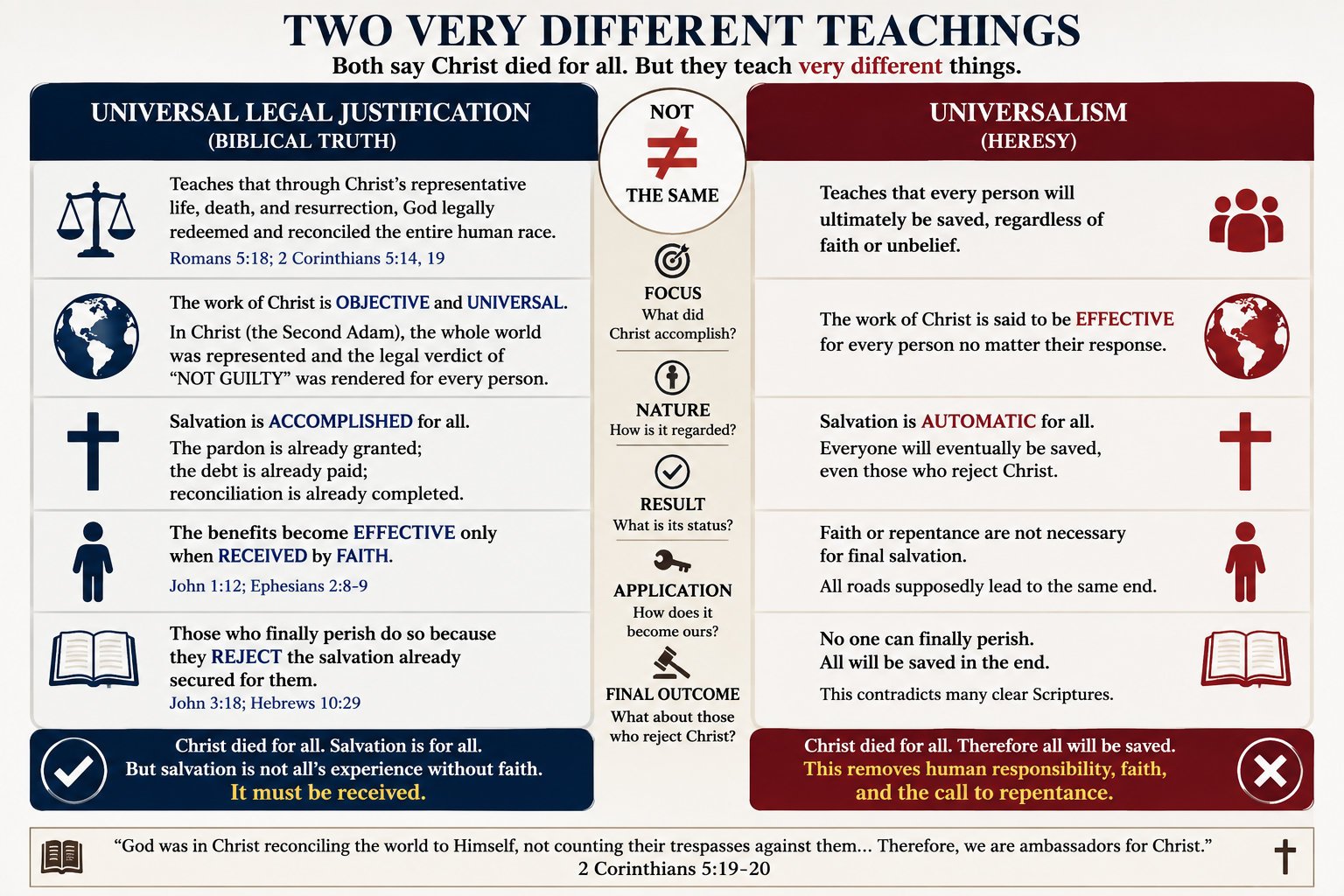
Universal Legal Justification vs Universalism
The biblical truth of Universal Legal Justification must never be confused with the heresy of universalism. Universalism claims that all people will eventually inherit eternal life regardless of their response to Christ. In contrast, Universal Legal Justification proclaims that Christ already accomplished the legal redemption of the entire human race 2000 years ago. However, it doesn’t mean that all will be automatically saved. Since it is a supreme gift of God for entire humanity, as like any gift it still requires acceptance of the gift through faith. In order to benefit from the salvation history all sinners already have in Christ, it must be accepted with a genuine faith. The evidence of acceptance is converted born from the Spirit life.
Nikolaus Ludwig (Count) von Zinzendorf 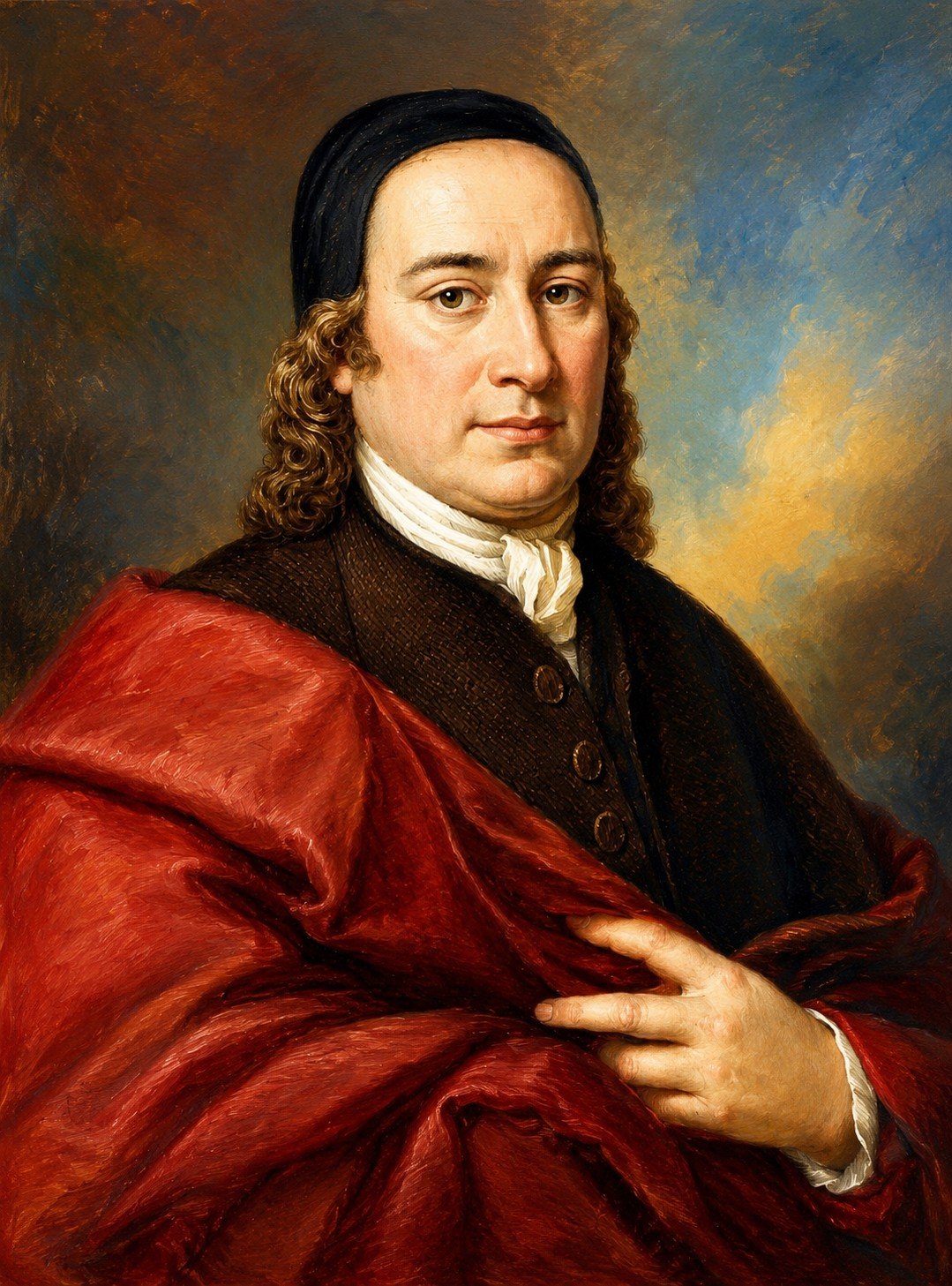
Nikolaus Ludwig (Count) von Zinzendorf (1700–1760), German Lutheran nobleman, bishop, and leader of the Moravian Church:
“Before we believed, before we were born, before the foundation of the world, we were reconciled to God by the death of His Son.” (Zinzendorf, Sermons)
“The whole world is forgiven; but he who does not believe it has no benefit from the forgiveness.” (Zinzendorf, sermon tradition frequently cited in Moravian sources)
Moravian Brethren (18th century)
Protestant evangelical movement originating from the Bohemian Brethren and renewed under Count Zinzendorf in Germany:
“The whole world is already reconciled unto God.” (Moravian preaching formula, eighteenth-century Moravian sermon literature)
“The forgiveness of sins is already pronounced over the whole human race.” (Moravian preaching formula cited in Moravian theological literature)
Thomas Erskine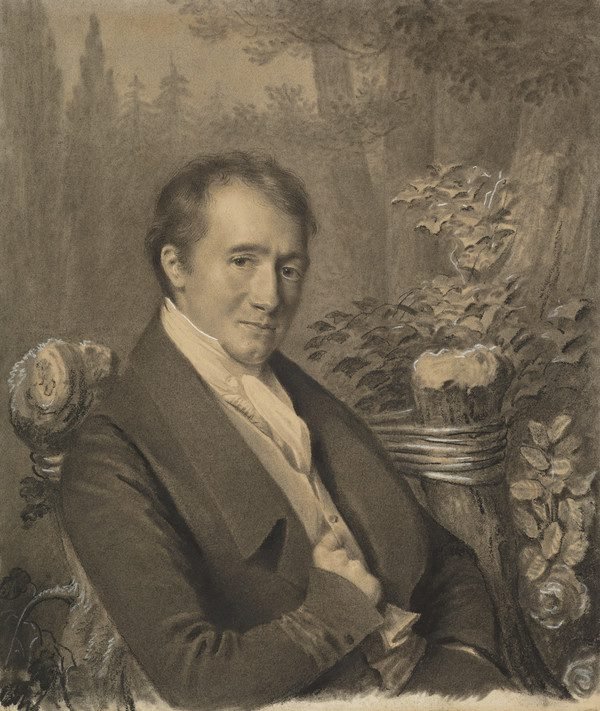
Finding the “In Christ” motif in the 19th century requires looking at the “Scottish School” of theology. These men were the ones who broke away from the idea that Christ died only for a “chosen few” or that His death was merely a “conditional offer.” To them, the Cross was a finished legal transaction for the entire human race. Here are the specific quotes from theologians before Prescott (1895) that prove they taught the “World in Christ” and “Universal Legal” reality:
Thomas Erskine of Linlathen (1788 – 1870) was the primary architect of what we now call Universal Legal Justification. He argued that the “pardon” was a finished fact for every human being 2,000 years ago: “The Gospel is a proclamation of a pardon already granted to every child of Adam. This pardon is not a thing to be done; it is a thing already done. It is not a gift offered on a condition; it is a gift already bestowed… The work of Christ was not to make God a Father, but to show that He was a Father.” — The Unconditional Freeness of the Gospel (1828), p. 14, 21. “The whole race of man was represented in Christ; and his death was the death of the whole race. The verdict of ‘Not Guilty‘ was passed upon the nature of man in the person of the Second Adam.” — The Unconditional Freeness of the Gospel (1828), p. 76.
John McLeod Campbell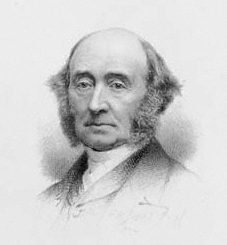
John McLeod Campbell (1800 – 1872) was the one who provided the “Corporate” logic that W.W. Prescott later used. He taught that Christ did not just die for us, but as us—the entire race: “Christ, in our nature, and as the Universal Brother, offered a perfect ‘Amen’ to the mind of the Father concerning our sin… His life and death were the life and death of every man in Him.” — The Nature of the Atonement (1856), Chapter 6. “We must see that the work of Christ was a finished work for all mankind, and that the barrier between the Father and the prodigal was legally removed for the entire world at the Cross.” — The Nature of the Atonement (1856), p. 134.
Frederick Denison Maurice
Frederick Denison Maurice (1805–1872) was a massive influence on the “Agape” movement in England. He taught that Christ is the legal centre of every human being, whether they know it or not:
“Christ is the Root of every man. He is the Head of the whole race. The justification of the world is not a future hope, but an accomplished reality in the person of Jesus Christ.” — Theological Essays (1853), p. 199.
Edward Irving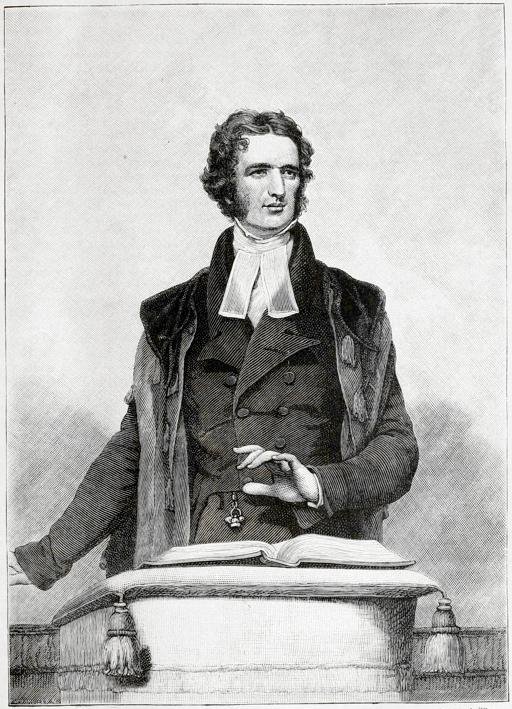
Edward Irving (1792 – 1834) was the bridge between the “Nature of Christ” and the “Outpouring of the Spirit.” He explicitly taught that Christ took the “lump” of humanity and redeemed it legally:
“When Christ took our fallen nature, He took the entire human race into Himself. He was the ‘Head of every man‘ (1 Cor. 11:3) in a literal sense. In His victory, the whole world was legally brought back to God.” — The Collected Writings of Edward Irving (1864 edition of his 1820s sermons), Vol. 5, p. 115.
“The redemption of the world is a past fact. The work of the Cross was the re-creation of the human race in Christ. Faith does not make it so; it only acknowledges what is already true in the Second Adam.” — The Incarnation of the Word (1828), Sermon 1.
Robert S. Candlish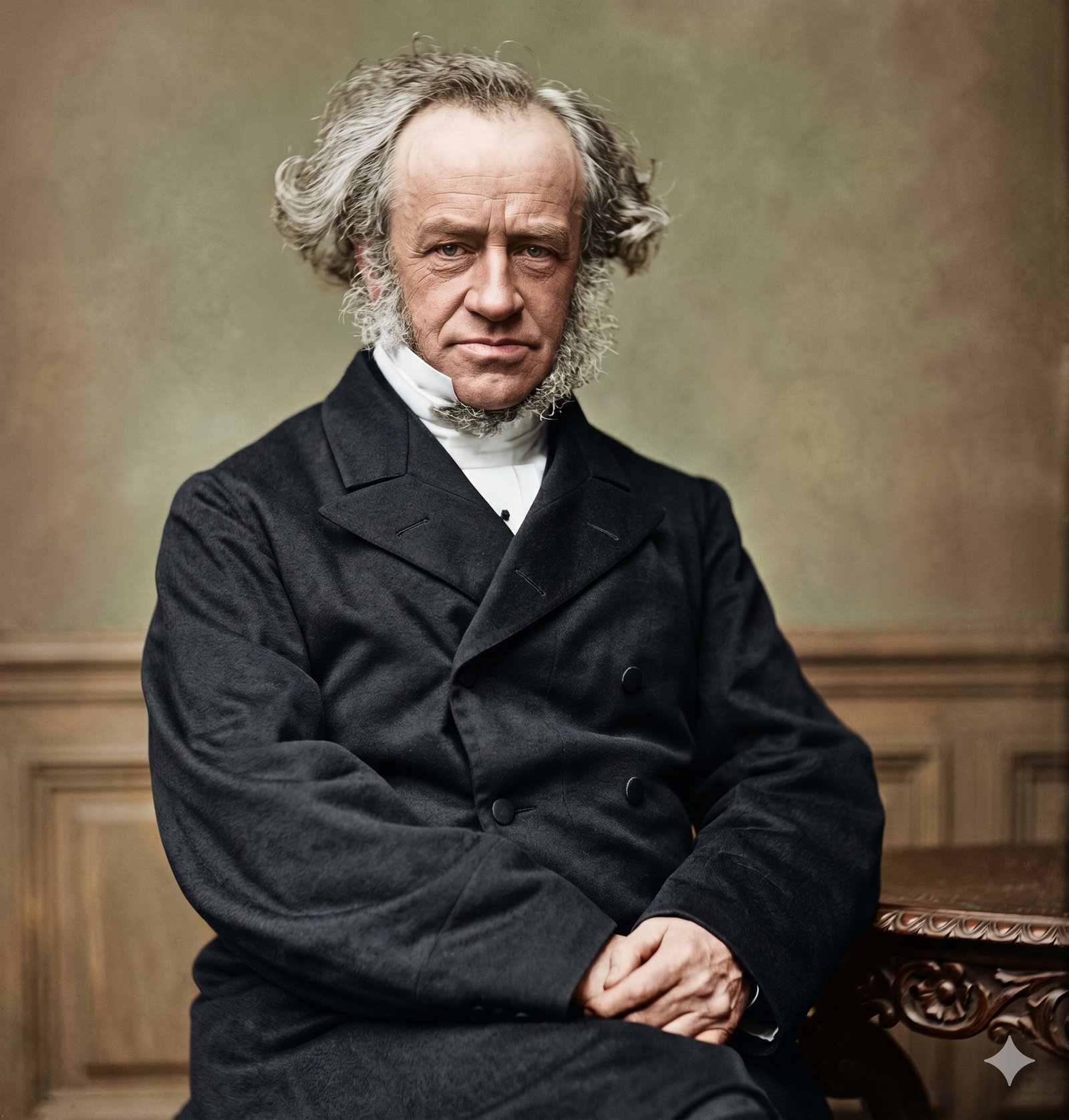
Robert S. Candlish (1806–1873), contemporary of the Scottish School, a leader in the Free Church of Scotland who argued for a representative headship that was inherently inclusive:
“The union of Christ with the whole body of His people is such that every act of His is theirs. His circumcision was theirs; His fulfilling of the law was theirs; His death was theirs.” — The Fatherhood of God (1865)
To the above list of what is ours in Christ we can also add baptism. His baptism was out baptism (for more on this, read chapter on baptism in the book “Desire of Ages”).
Brooke Foss Westcott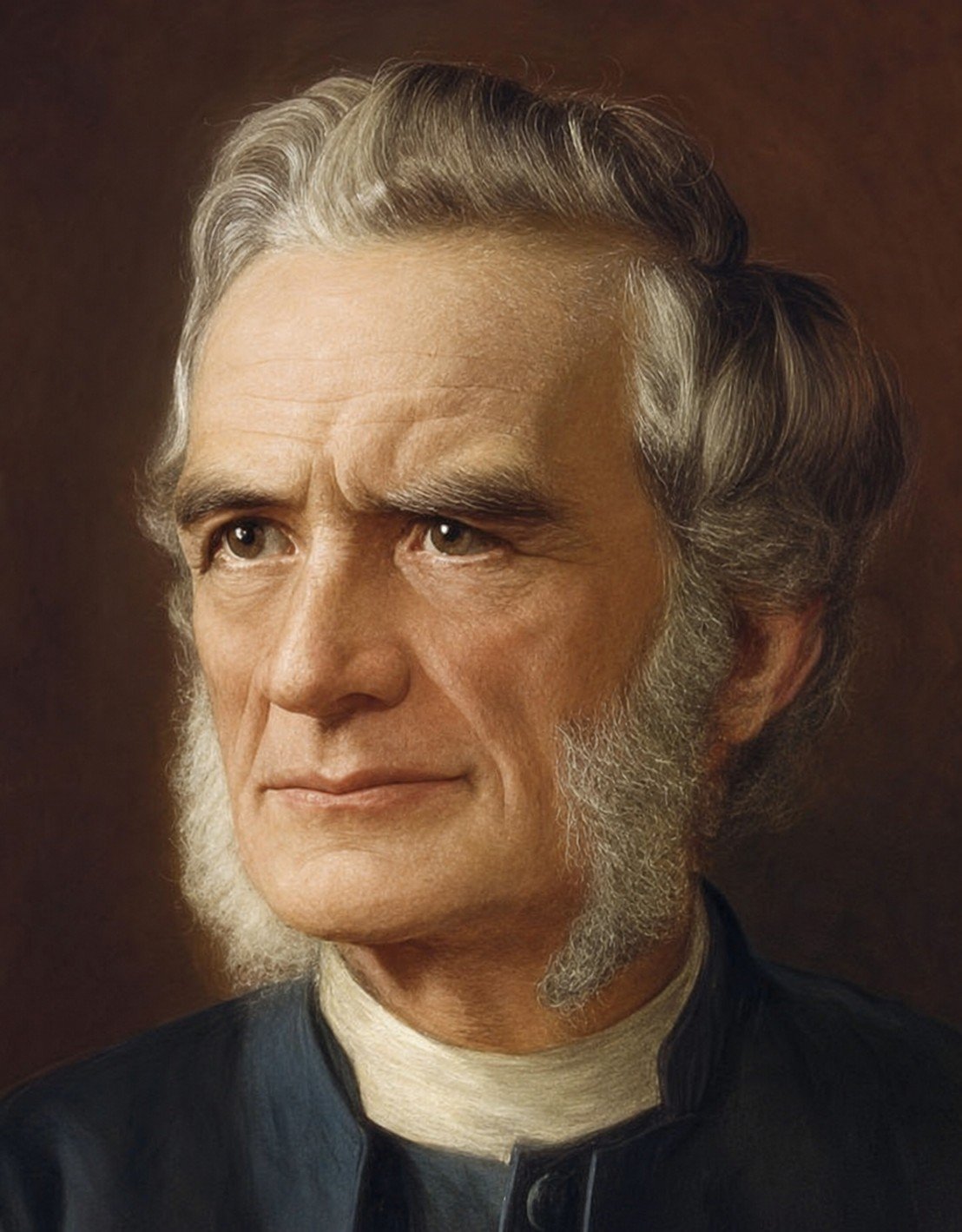
Brooke Foss Westcott (1825 – 1901), the renowned 19th century New Testament British scholar, expressed this truth in the following way:
“If Christ took our nature upon Him, as we believe, by an act of love, it was not that of one but of all. He was not one man only among many men, but in Him all humanity was gathered up. And thus now, as at all time, mankind are, so to speak, organically united with Him. His acts are in a true sense our acts, so far as we realize the union, His death is our death, His resurrection our resurrection.” (The Gospel of the Resurrection, Chap. 2, p. 39).
James Denney
James Denney (1856–1917) was one of Scotland’s greatest evangelical theologians, preacher, and Professor of New Testament at the Free Church College, Glasgow. His classic work The Death of Christ greatly influenced later evangelical scholars, including John Stott.
Denney taught that Christ represented the entire human race, writing: “Christ comprehended in Himself the whole human race, as Adam did.” (The Death of Christ, p. 303).
He further explained: “Through the death of Christ humanity has suffered that which the holy God… claimed from it as the condition of its entering again into fellowship with Him.” (The Death of Christ, p. 303). Few evangelical theologians expressed the representative and corporate work of Christ more clearly.
Peter Taylor Forsyth
Peter Taylor Forsyth (1848–1921) was one of Britain’s greatest Congregational theologians, preacher, and Principal of Hackney College, London. Many scholars regard him as the most influential British theologian between the nineteenth century and Karl Barth.
Forsyth consistently taught that Christ represented the whole human race before God. He wrote that Christ’s sacrifice was “the representative sacrifice of Christ crucified” and described Him as the representative “of Humanity.” (The Work of Christ, Ch. VI).
He also declared that Christ accepted “God’s judgement on man’s behalf” and transformed it into our blessing (The Cruciality of the Cross, p. 95).
In another remarkable passage he wrote that Christ confessed God’s holiness “as if the whole race confessed through Him… as though the whole race at last did justice to God through His soul.” (The Work of Christ, p. 152).
Dietrich Bonhoeffer
Dietrich Bonhoeffer – one of the 20th century’s greatest theologians, member of the German Resistance and true German patriot, who smuggled himself back into Nazi Germany as everyone else was fleeing it. Just before the end of World War Two, he was imprisoned and eventually hanged by Gestapo for the failed plot against Hitler. The following beautiful quote comes from his book Life Together:
“When God calls you, he calls you to die… God’s Son took on our nature, ourselves. Now we are in him. Where he is, there we are too, in the incarnation, on the Cross, and in His resurrection. We belong to him because we are in him. That is why the Scriptures call us the Body of Christ.”

Read more about Dietrich Bonhoeffer
F. F. Bruce 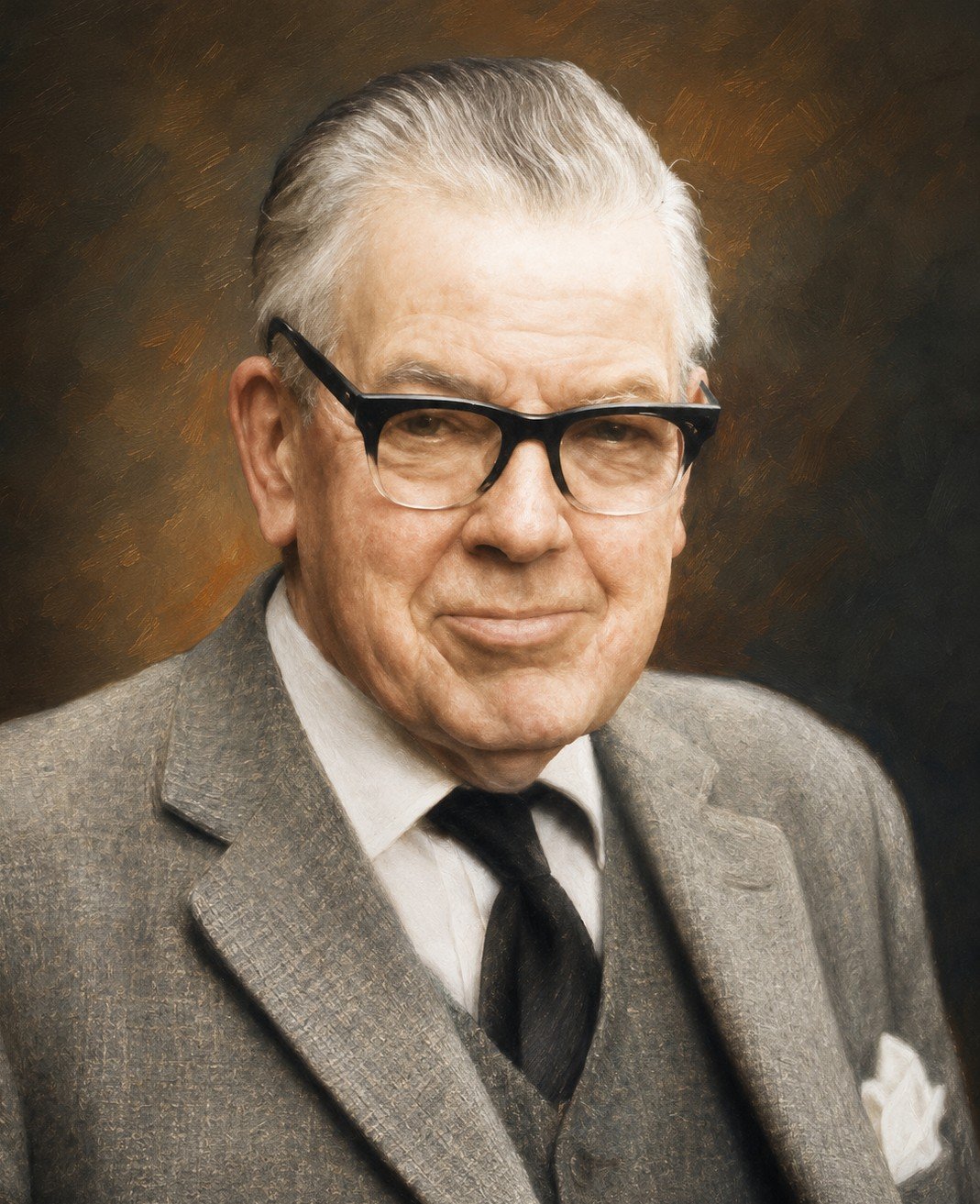
The highly respected Scottish New Testament scholar Frederick Fyvie Bruce (1910–1990) provided strong exegetical support for the corporate framework of salvation. Serving for many years as the Rylands Professor of Biblical Criticism and Exegesis at the University of Manchester, Bruce championed the idea that Paul’s theology of being “in Christ” was deeply rooted in the ancient Hebrew concept of corporate personality, where a king or federal head naturally contains the entire identity of the nation.
“When Paul asserts that ‘one died for all, therefore all died,’ he is operating within the Hebrew category of federal representation. In Paul’s view, Christ did not merely die instead of people as a detached substitute; because He was ‘in the domain of Christ’ as the new corporate head, His death was organically the death of the entire old creation. When the Representative died, the collective human race died in Him.” — F. F. Bruce, Paul: Apostle of the Heart Set Free, Chapter 19
“The ‘body of sin’ in Romans 6:6 is a near-synonym of ‘sinful flesh’ in Romans 8:3. Christ had to fully identify Himself with our human condition under the dominion of sin so that, in His own flesh, the legal power, control, and execution of that old nature could be carried out once and for all.” — F. F. Bruce, Flesh and Spirit: An Exegetical Study, p. 45
While Bruce generally avoided labels like Universal Legal Justification due to potential popular confusion with universalism, his literal exegesis of Romans chapter five strongly supported an objective global verdict.
In his commentary on the passage, he directly noted that “the effect of Christ’s ‘act of righteousness’ is ‘acquittal and life for all men‘” (F. F. Bruce, The Epistle of Paul to the Romans, p. 130).
He argued that this single act by Jesus Christ brought an objective judicial verdict of life to all men, directly mirroring and legally reversing the objective verdict of condemnation and death inherited by all men from the first Adam.
“To be ‘in Christ’ means that worldly standards and the old individualistic reckonings have ceased to count; the death of the One was legally and spiritually the death of the corporate whole.” — F. F. Bruce, Paul’s View of the Person of Christ, John Rylands Bulletin, p. 14
“By sending his own Son in the likeness of sinful flesh and for sin, he condemned sin in the flesh. God passed the death-sentence on sin by virtue of the humanity of Christ, who stood as our perfect representative with God. Our old self was crucified with him in order that the body of sin might be brought to nothing.” — F. F. Bruce, Paul: Apostle of the Heart Set Free, Chapter 19
Thomas F. Torrance
Thomas F. Torrance (1913 – 2007), a Scottish Protestant theologian and Presbyterian minister expressly believed in the ‘universality of Christ’s saving work’ but rejected the heresy of ‘universalism’ (final salvation of all sinners, including those who reject Christ) and any idea of ‘limited atonement’ (a heresy claiming that Jesus died only for the elected – for those who were predestined by God to salvation).
Torrance coined the phrase “the all-inclusive humanity of Christ” (representative or corporate incarnation) and believed that as our representative, Christ presents to God a perfect response on behalf of all humanity (The Mediation of Christ, 1992; p 144).
Torrance was condemned by other theologians for his idea of a universal ontological (existential) solidarity with all humanity. His critics claimed that such idea is a fiction, and that even if such a thing were possible, it could not be rendered intelligible, especially if such humanity is fallen (link).
“All men and women were represented by Christ in (His) life and death, in His advocacy and substitution in their place. That is a finished work and not a mere possibility. It is an accomplished reality, for in Christ, in His incarnation and in His death on the cross, God has once and for all poured himself out in love for all mankind, has taken the cause of all mankind therefore upon himself … It is the positive will of God in loving humanity that becomes humanity’s judgement when they refuse it.” (Thomas F. Torrance, Atonement, 188-89)
For Torrance, Christ does not just make atonement, rather atonement is made in Christ’s person not just His work. Hence, he says that atonement is something done…within the ontological depths of the Incarnation, for the assumption of the flesh by God in Jesus Christ is itself a redemptive act and of the very essence of God’s saving work. This takes place … in an intensely personal and intimate way within the incarnate Lord and his coexistence with us in our fallen suffering condition as sinners. Incarnation is thus intrinsically atoning, and atonement is intrinsically incarnational. (“Dramatic Proclamation of the Gospel: Homily on the Passion of Melito of Sardis,” in Greek Orthodox Theological Review 37, 1992, 155)
Charles Cranfield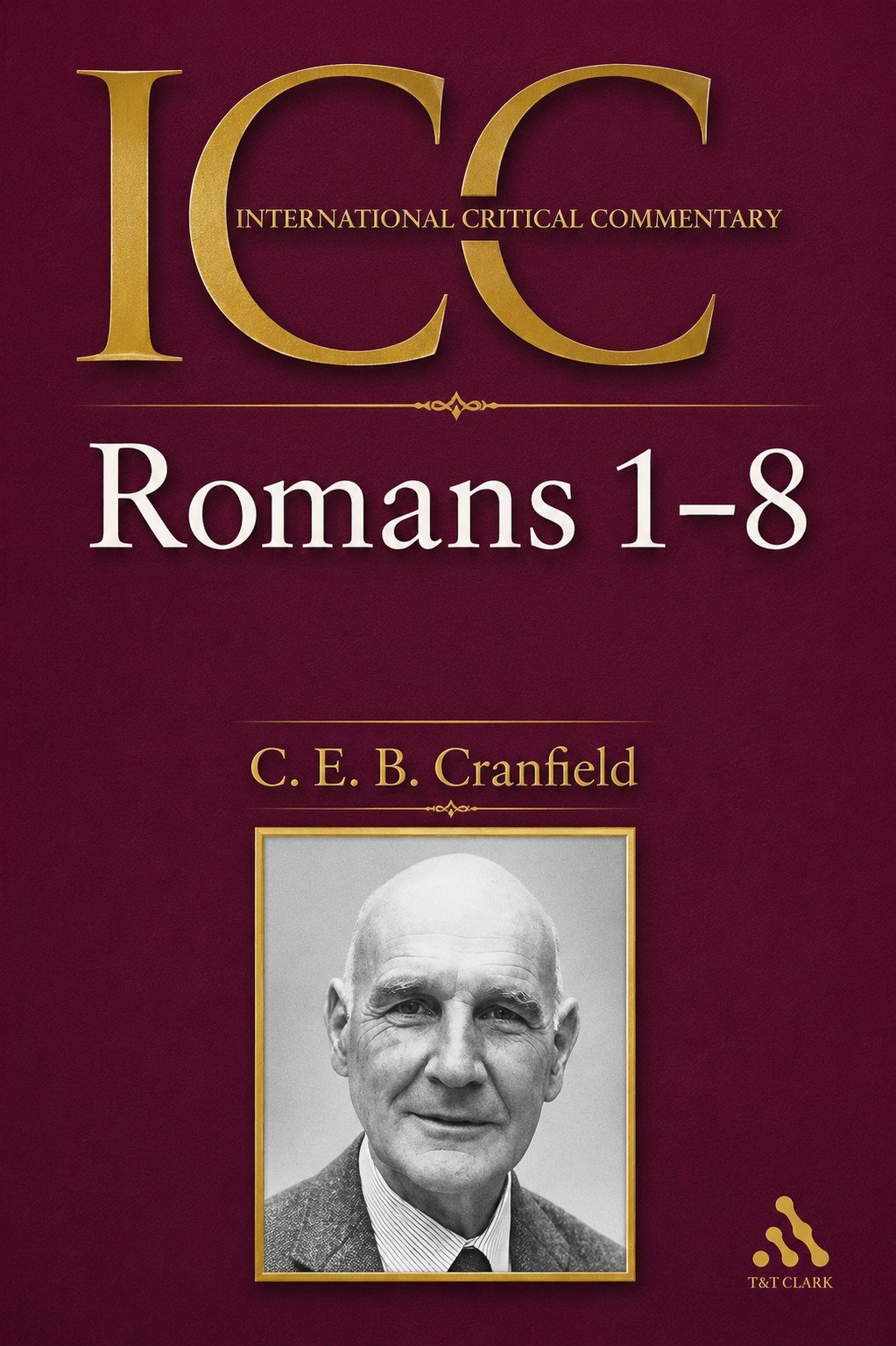
Charles E. B. Cranfield (1915 – 2015), a leading British New Testament scholar, in his Critical and Exegetical Commentary on the Epistle to the Romans (which is part of the International Critical Commentary), wrote the following words in his comment on Romans 5:18:
“The fact that this reconciliation is a reality in the case of believers does not stand by itself: it means that something has been accomplished by Christ which is as universal in its effectiveness as was the sin of the first man. Paul is no longer speaking just about the Church: his vision now includes the whole of humanity.”
“It has to be accepted as a gift ‘through faith in Jesus Christ’, and it is for all who will believe, without distinction. … What emerges here is that the centre, the heart, of the gospel is a particular deed of God accomplished once for all in Christ on behalf of humanity (and indeed of God’s whole creation), something objective, independent of us human beings who make up the church, and of our feelings, our comprehension, our aspirations, our deserts.” – On Romans and Other New Testament Essays, pp. 15–16 (Note on Romans 5.20-21”)
“Faith is not a contribution which man makes to his own justification… it is the humble, grateful acceptance of the gift which God has already provided.” — Commentary on Romans, Vol. 1 (ICC)
Anders Nygren
The renowned Swedish theologian Anders Nygren (1890-1978), author of the popular book “Eros and Agape”, in his excellent commentary to the book of Romans (5:12-21) expressed his understanding of Paul’s “in Christ motif” in the following way:
“If we would understand the benefaction which God, through Christ, has spread abroad to all mankind, we do well, according to Paul, to take note of the condemnation which has passed from Adam to all men. That comparison helps us to see the universal scope of the work of Christ. But we cannot grasp Paul’s thought unless we observe that his view of man is quite different from the present individualistic concept. Paul does not think of humanity as a gathering of individuals. He sees mankind as an organic unity, a single body under a single head (Christ).”
C.H. Dodd
C.H. Dodd (1884–1973), one of the most influential British (Welsh) NT scholars of the 20th century, was instrumental in explaining the “Corporate Personality” in Hebrew thought, which underpins the “In Christ” motif:
“Christ is the ‘Representative Man’ in whom the whole race is included. What happened to Him happened to all… His victory is the victory of the human race over the powers of evil.” — The Meaning of Paul for Today (1920)
Lesslie Newbigin
Lesslie Newbigin (1909–1998), a famous British theologian and missiologist, focused on the “Public Truth” of the Gospel, arguing that the Cross was a cosmic, objective event that changed the status of the world:
“The Gospel is not a piece of advice to be followed, but a report of a finished event… At the Cross, the world was reconciled to God. The task of the Church is to invite men to live in the reality of what is already done.” — The Gospel in a Pluralist Society (1989)
“The Cross means that we are all in the same situation regardless of our differences… when God personally met us as a human race, face to face [at the Cross], it was for practical purposes the unanimous decision of that representative company that he must be destroyed… Therefore, the redemption of the world is not a potentiality; it is a past fact of history.” Lesslie Newbigin, The Light Has Come: An Exposition of the Fourth Gospel
T. Austin-Sparks & Keswick Movement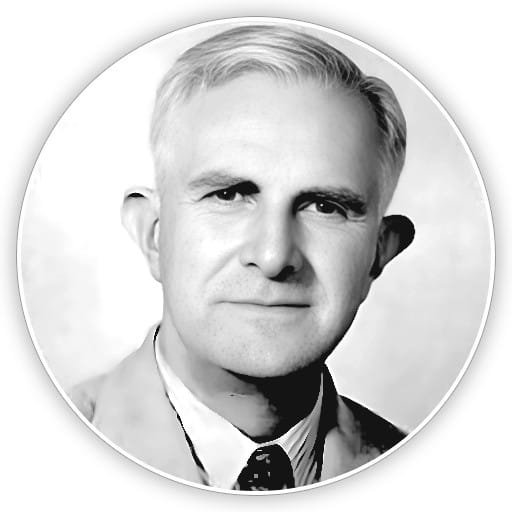
The corporate “in Christ” motif gained significant devotional momentum in the early to mid-twentieth century through the British Keswick movement, most notably in the extensive writings of Theodore Austin-Sparks (1888–1971).
As an influential British evangelist, author, and former Baptist pastor who later established an independent Christian fellowship center in London, Austin-Sparks pioneered a deeply Christocentric theology centered on the corporate solidarity of humanity. He argued that God never deals with human beings as isolated individuals when establishing their legal standing, but rather operates exclusively through two collective representatives: the First Adam and the Last Adam. In his theological framework, the entire fallen human race was legally executed, terminated, and buried in the historical person of Jesus Christ at the cross, while a completely new corporate humanity was legally resurrected in His triumph over death.
This corporate-mystic approach provided a rich vocabulary for later writers who sought to define how the entire world could be objectively impacted by the history of a single Representative.
The Keswick Movement (c. 1875–present) was an evangelical holiness movement that began with the first Keswick Convention in England in 1875. It emphasized:
- The “Higher Christian Life” or victorious Christian living.
- Entire surrender to Christ and complete dependence on the Holy Spirit.
- Sanctification by faith, rather than by human effort.
- The motto: “All One in Christ Jesus.”
- Strong emphasis on missions, Bible study, and personal holiness.
The Movement had a profound influence, although it was not a mass revival like the Welsh Revival (1904–1905) or the Great Awakenings. Rather, it was a deep spiritual renewal movement that transformed countless Christians, pastors, missionaries, and evangelical leaders. Many well-known Christian leaders were influenced by Keswick, including Hudson Taylor, F.B. Meyer, Andrew Murray, D.L. Moody, Amy Carmichael, Oswald Chambers, Watchman Nee, T. Austin-Sparks, and others.
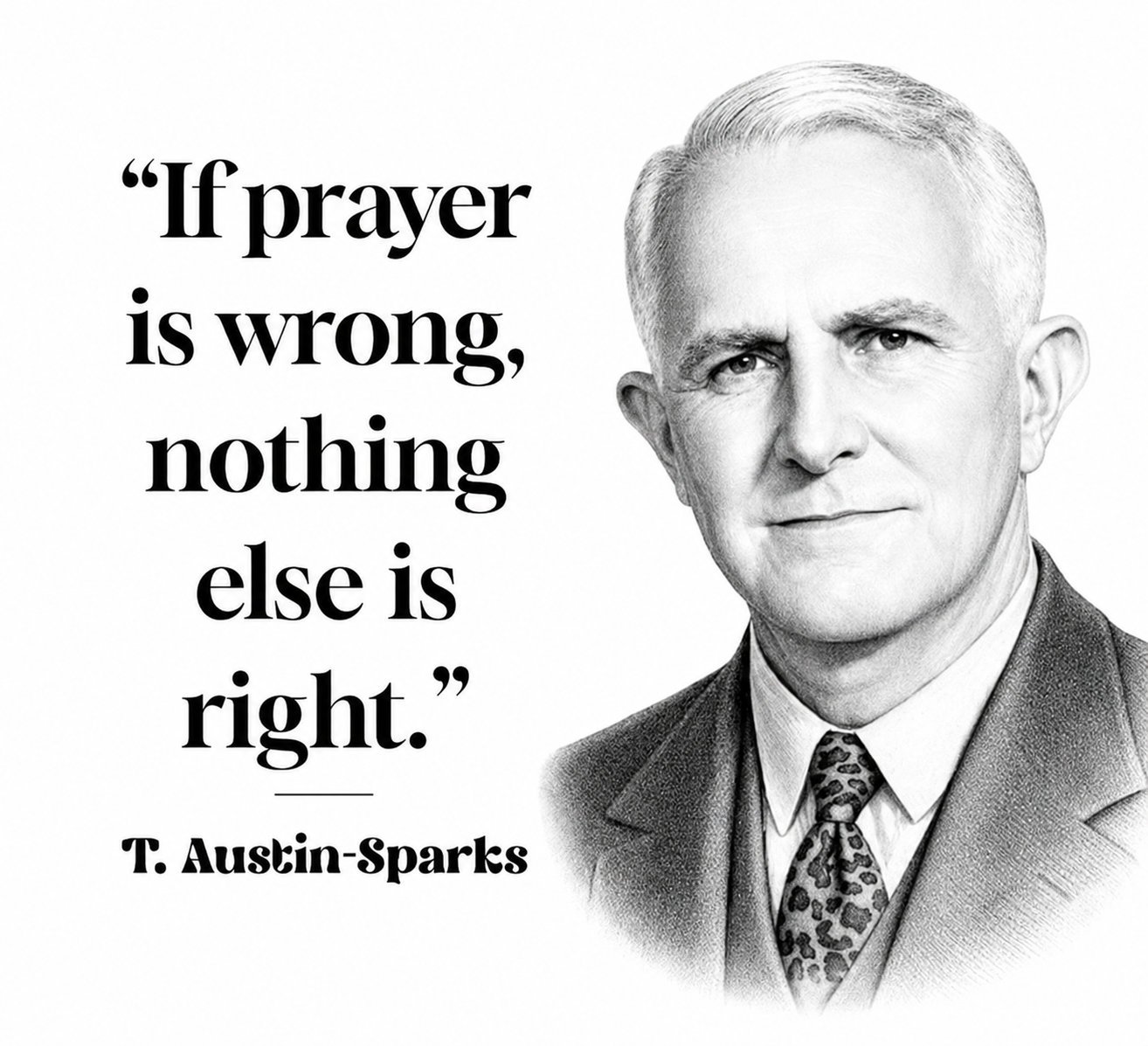
T. Austin-Sparks (1888–1971) was deeply influenced by the Keswick tradition but developed it further. He became known for emphasizing:
- Christ as the centre and fullness of all God’s purposes.
- The believer’s union with Christ.
- The Cross as the means of continual spiritual transformation.
- The corporate Body of Christ rather than merely individual Christianity.
- The need for spiritual maturity and the heavenly calling of the Church.
Unlike some Keswick teachers, Austin-Sparks placed much greater emphasis on the believer’s participation in Christ’s death and resurrection and on the corporate nature of the Church.
Its impact was so significant that many church historians regard the Keswick Movement as one of the most influential evangelical spiritual renewal movements of the late nineteenth and early twentieth centuries, shaping Protestant spirituality for nearly a century.
T. Austin-Sparks repeatedly described salvation as God’s objective work in one representative Man rather than as something originating in individual believers. He wrote: “The old man is a racial order represented by Adam… The new man is a corporate, collective Man… Christ.” Elsewhere he declared: “Before it was Adam who was all and in all; now it is Christ who is all and in all.”
These statements reveal his understanding that humanity is viewed by God corporately, first in Adam and then in Christ. Although he never used the term “Universal Legal Justification,” this corporate framework provides the theological foundation from which its legal implications naturally follow.
He continually taught that God no longer deals with humanity on the basis of individual merit but only in relation to Christ, the representative Head of the new humanity. This emphasis became one of the defining features of both his ministry and that of Watchman Nee.
The historical evidence that Watchman Nee was influenced by Austin-Sparks is unusually strong. In 1938, Nee travelled to England and spent about eight months with Austin-Sparks at Honor Oak. This meeting proved to be a major turning point in Nee’s ministry. During this period, Nee delivered the messages that later became The Normal Christian Life, which were first published chapter by chapter in Austin-Sparks’ magazine A Witness and A Testimony before appearing as a book.
Nee’s connection with Austin-Sparks extended far beyond one visit. He translated and published Austin-Sparks’ writings in China, read him extensively, maintained a long personal friendship with him, and even chose fellowship with Austin-Sparks over remaining in fellowship with the Exclusive Brethren, a decision that ultimately led to the Brethren breaking fellowship with Nee. These historical facts demonstrate that Austin-Sparks was not merely an acquaintance but one of the major theological influences on Nee’s ministry.
The similarity between their theology is unmistakable. Austin-Sparks repeatedly spoke of the old man as a racial order, Christ as the corporate Man, God’s answer being one Man, and the new humanity in Christ. These same themes became central to Watchman Nee’s writings, especially The Normal Christian Life and his teaching on identification with Christ. While Nee developed these ideas in his own distinctive way, the historical evidence strongly suggests that Austin-Sparks played a significant role in shaping his understanding of the corporate nature of salvation.
Watchman Nee
The same amazing truth about our corporate union with Christ and our death in Him is also found in the writings of famous Chinese preacher and martyr – Watchman Nee (1903-1972), who because of his faith in Jesus was kept by the communists in prison for 20 years, where he finally died in 1972. In the book Dying With the Lord, he wrote:


“In Romans 6:1-11 it is made clear that the death of the Lord Jesus is representative and inclusive. In His death we all died. None of us can progress spiritually without seeing this. Just as we can not have justification if we have not seen Him bearing our sins on the Cross, so we can not have sanctification if we have not seen Christ bearing us on the Cross. Not only have our sins been laid on Him but we ourselves have been put into Him… Christ died in my stead, but He bore me with Him to the Cross, so that when He died I died. Let me tell you, you have died! You are done with! You are ruled out! The self you loathe was on the Cross in Christ! And ‘he that is dead is freed from sin’ (Romans 6:7). This is the Gospel for Christians.”
Martyn Lloyd-Jones
Martyn Lloyd-Jones (1899 – 1981) – a Welsh Protestant minister, preacher and medical doctor who for almost 30 years was the minister of Westminster Chapel in London. He was famous for his expository preaching, and his Bible studies drew crowds of several thousand, attracting many students from universities and colleges in London. I have transcribed the following quote from his sermon on Romans 5:18, which is also included in audio form here.
“The way to get the assurance of salvation is not through feelings but through grasping this truth. See yourself in Adam; though you had done nothing you are declared a sinner. See yourself in Christ; though you had done nothing you are declared righteous. That is the parallel. So, we get rid of all our actions. There is no boasting. We do nothing at all. It is all the obedience of One… We must get hold of this idea that our salvation is entirely in Christ and what saves us is that we were put into Him. We must not think that God is dealing with us one by one in this matter, and that there is a separate act of salvation of each one. Not at all. It was all done there once and forever. And if I was put into Christ I was crucified with Him, I died with Him, I am raised with Him, and now I am in the heavenly places in Him! I am in Christ. And as we look at it in this way our assurance will never be shaken.”
Jamieson, Faussett And Brown Commentary
In 2 Corinthians 5:21 Apostle Paul wrote that God “made Him (Jesus) who knew no sin to be sin for us, that we might become the righteousness of God in Him.” And here is what the popular „Jamieson, Faussett and Brown Commentary” says what inspired Paul really meant in this famous and glories verse:
“Christ was made ‘sin‘, that is, the representative Sin-bearer of the aggregate sin of all men past, present, and future. The sin of the world is one, therefore the singular, not the plural, is used.”

William Barclay
William Barclay (1907 – 1978) – Scottish theologian, Professor of Divinity and Biblical Criticism at the University of Glasgow, author of the popular Bible Commentary. In his comment to Romans 5:12-21 (“The Daily Study Bible Series”), he wrote:
“No passage of the New Testament has had such an influence on theology as this (Romans 5:12-21); and no passage is more difficult for a modern mind to understand… If we were to put the thought of this passage into one sentence, it would be this: ‘By the sin of Adam all men became sinners and were alienated from God; by the righteousness of Jesus Christ all men became righteous and are restored to a right relationship with God.’ Paul, in fact, said this very much more clearly in 1 Corinthians 15:21: ‘As by a man came death, by a man has come also the resurrection of the dead. For as in Adam all die, so also in Christ shall all be made alive.’ The Jew never really thought of himself as an individual but always thought as part of a clan, a family, or a nation apart from which he had no real existence. To this day it is said that if an Australian aboriginal is asked his name, he gives the name of his tribe or clan. He does not think of himself as a person, but as a member of a society… In the Old Testament there is one vivid instance of this. It is the case of Achan as related in Joshua 7:1-26. Because Achan had sinned, and, as a result, the whole nation was branded as sinner and punished by God. Achan’s sin was not one man’s sin but the nation’s. That is how Paul sees Adam. Adam was not an individual. He was one of mankind, and because he was one of mankind, his sin was the sin of all men. Paul says that all men sinned in Adam. If we are ever to understand Paul’s thought here, we must be quite sure what he means. All through the history of Christian thinking, there have been efforts to interpret in different ways this conception of the connection between Adam’s sin and that of mankind… There is what has been called the legal interpretation. There is the interpretation that what we inherit from Adam is the tendency to sin. That is true enough, but that is not what Paul meant. It would not, in fact, suit his argument at all. The passage ought to be given what is called the realistic interpretation, namely that, because of the solidarity of the human race, all mankind actually sinned in Adam. This idea was not strange to a Jew; it was the actual belief of the Jewish thinkers… So, then, we have extracted the essence of Paul’s thought. Because of this idea of the complete solidarity of mankind, all men literally sinned in Adam; and because it is the consequence of sin, death reigned over all men. But this very same conception, which can be used to produce so desperate a view of the human situation, can be used in reverse to fill it with a blaze of glory. And, just as all men were involved in Adam’s sin, all men are involved in Jesus’ perfect goodness; and, just as Adam’s sin was the cause of death, so Jesus’ perfect goodness conquers death and gives men life eternal. Paul’s triumphant argument is that, as mankind was solid with Adam and was therefore condemned to death, so mankind is solid with Christ and is therefore acquitted to life. On the other hand, our connection with Christ is voluntary. Union with Christ is something a man can accept or reject.”
Harry Johnson
British scholar, Harry Johnson (PHD), author of an excellent study on Christ’s incarnation wrote in 1962: “In Christ we become linked with the second Adam and His victory and His benefits become ours… It could appear, therefore, that, for this Representative theory of the cross to be fully adequate to meet the sinful human situation, there needs to be incorporated within its structure a Christological position similar to the one that is the object of our present study (i.e., Christ assumed our fallen nature at the Incarnation).” Harry Johnson, The Humanity of the Saviour: A Biblical and Historical Study of the Human Nature of Christ in Relation to the Doctrine of Redemption, London: Epworth Press, 1962. p. 212.
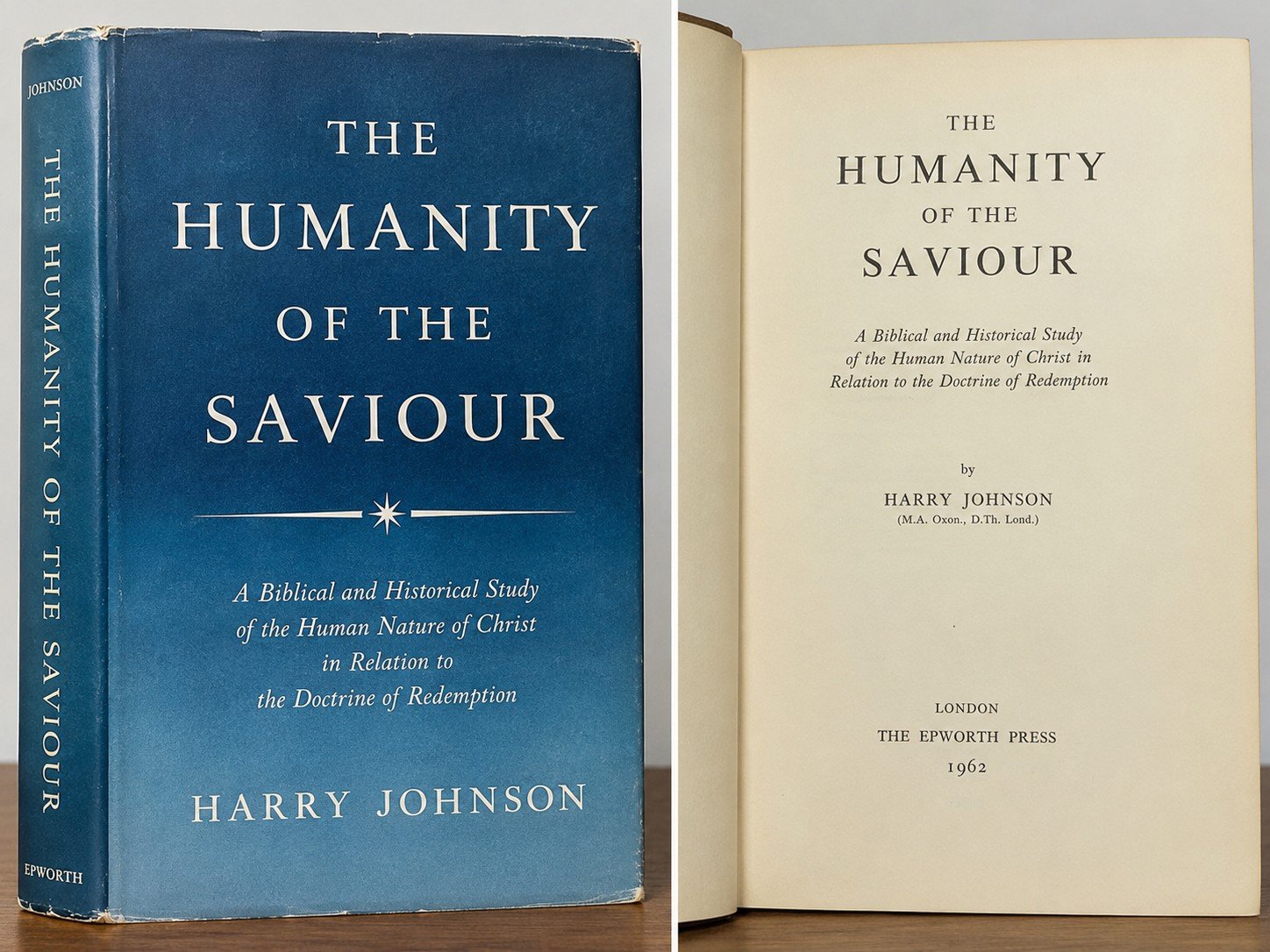
In the mid-twentieth century, Dr. Harry Johnson emerged as a pivotal figure in Christological research, earning his PhD from London University with a dissertation that challenged the prevailing “Pre-Fall” consensus within Protestantism. His work meticulously traced the biblical and historical foundations of Jesus’ nature, arguing that for the atonement to be truly transformative, the Son of God must have assumed the actual, weakened human nature common to all people after the Fall, rather than the unblemished nature of Adam before it. This research significantly influenced a shift in Protestant theology by demonstrating that Christ’s personal sinlessness did not require an exemption from human heredity, but was instead a triumph achieved through the Holy Spirit within the very arena of fallen humanity. By bridging the gap between historical orthodoxy and the existential reality of human struggle, Johnson provided a scholarly framework that moved the “Post-Fall” view from the theological fringe into a respected position of academic and redemptive importance.
In the 1950s, many conservative Protestants still regarded the Seventh-day Adventist Church as a sect or cult. One reason was the Adventist belief that Christ assumed our fallen human nature. During the 1955–1956 discussions with evangelical theologians Walter Martin and Donald Grey Barnhouse, Adventist representatives wanted to remove this “cult stigma,” and the influential book Questions on Doctrine (1957) consequently presented Christ’s humanity in a way much closer to the evangelical pre-Fall position.
Ironically, only a few years later, Protestant scholar Dr. Harry Johnson completed his doctoral research at the University of London, published in 1962 as The Humanity of the Saviour. After examining the Bible, Christian history, and theology, Johnson concluded that Christ assumed our fallen human nature while remaining completely sinless.
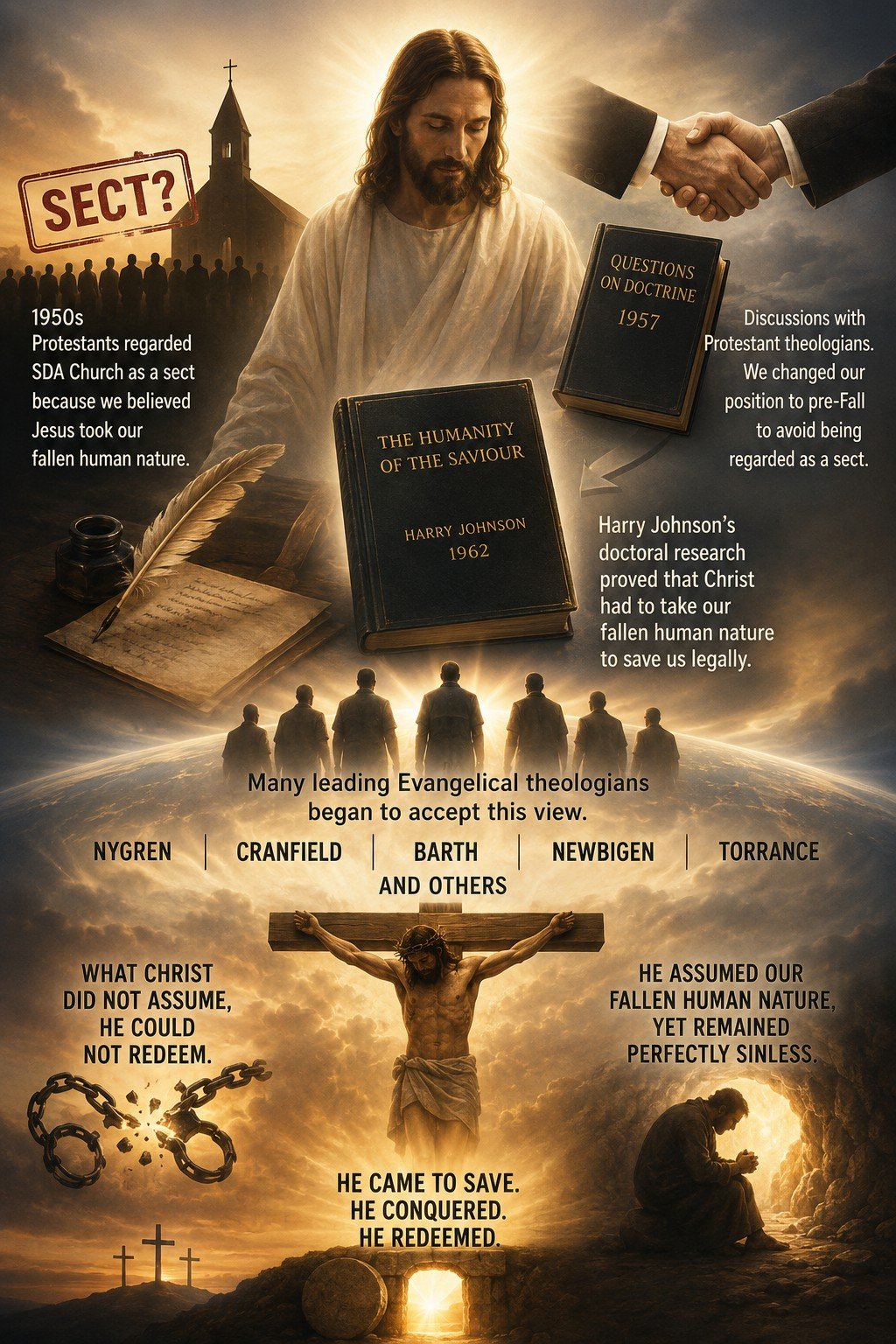
His strongest argument was simple and powerful: Christ had to assume the humanity He came to save. What He did not assume, He could not redeem. Scripture says that Christ “had to be made like His brethren” (Hebrews 2:17, NKJV) and that God sent His Son “in the likeness of sinful flesh” and “condemned sin in the flesh” (Romans 8:3, NKJV).
Significantly, the post-Fall understanding was not limited to Adventists. Important Protestant theologians and biblical scholars such as Karl Barth, T. F. Torrance, C. E. B. Cranfield, Anders Nygren, Lesslie Newbigin, C. K. Barrett, and others also supported this view or closely related interpretations.
What an irony! At the very time when some Adventist leaders were moving away from the post-Fall position partly to gain acceptance among evangelicals, respected Protestant scholars were recognising strong biblical reasons for believing that Christ truly assumed our fallen humanity.
This does not mean that Jesus was sinful. He assumed our fallen human nature, yet He Himself remained perfectly sinless—“tempted as we are, yet without sin” (Hebrews 4:15, NKJV).
Karl Barth
Great Swiss Reformed Protestant theologian, Karl Barth (1886-1968), is well-known in theology for his landmark commentary, The Epistle to the Romans, in which he expressed his understanding of corporate sinfulness in Adam and corporate salvation in Christ (Second Adam) presented by apostle Paul in Romans 5:12-21:
“Here, in Adam, are also the many, all men… There, in Christ, is, for the first time in the true sense, the One who stands, as such, for all the others. He also is the Inaugurator, Representative, and Revealer of what through Him and with Him the many, all men shall also be, do, and receive… As in the existence of the one, here in Adam, the result for the many, all men, is the lordship of sin, and, with it, the destiny of death; so again, in the existence of the One, there in Christ, the result for all men is the lordship of grace exercised in the divine righteous decision and promise of eternal life.”
For Barth, all humanity was elected in Christ for salvation, was saved in Him on the cross, and will be saved provided those save sinners do not reject the salvation history and their status in Christ. Such rejection is regarded by Barth as an ‘impossible possibility’, as something most foolish but still possible and in reality true for many sinners.
In his Dogmatics, Karl Barth, after affirming that Jesus Christ is “truly God,” skilfully articulated the extent to which Christ’s human nature is like ours, affected by the fall of Adam:
“He [Jesus] was not a sinful man. But inwardly and outwardly His situation was that of a sinful man. He did not commit the sin of Adam. But He lived the human life in the very condition to which it had been limited by the sin of Adam. Remaining guiltless, He took on the consequences of the guilt of Adam and the consequences of the guilt of us all. Freely He entered into solidarity and necessary association with our fallen and lost existence… One fact remains, that must be neither weakened nor obscured: that is that the [human] nature taken on by God in Christ is identical to our nature, that of men placed under the banner of the fall. If this were not the case, then how could Christ be like one of us? And in what way would He have been of interest to us? Therefore, the Son of God, not only took our nature, but He entered into the condition of our distress as men condemned, fallen and separated from God. The only way He differed from us all: is that He did not take part in the revolt against God; He was scarred by our guilt, but did not participate in the sin that caused it; and He was made sin, without having committed sin. All this, however, should in no way prevent us from recognising, without restriction or reservation of any kind, that He was completely made one with us, and nothing that is human was foreign to Him.”
Marcus Barth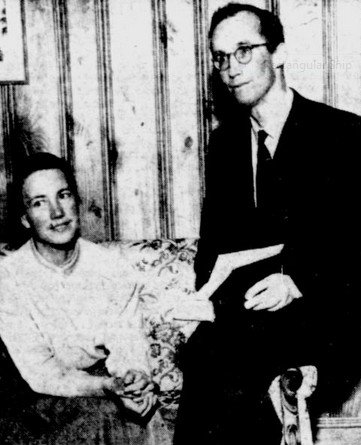
Marcus Barth (1915–1994), the son of Karl Barth and a world-class New Testament scholar, went even further than his father in emphasizing the “legal” and “corporate” nature of justification in the book of Ephesians:
“In Christ’s death, the death of all was a fact. It was not a possibility that had to be realized by the subsequent decision of individuals… The justification of the ungodly is an objective fact of world history.” — Justification: What’s It All About? (1968)
.
NON-ADVENTIST OPPONENTS OF ULJ
The concept of an objective, universal legal justification has faced fierce opposition across the broader theological landscape, most notably from the historic camps of Reformed Calvinism and Confessional Lutheranism.
Within traditional Calvinist theology, the idea of a universal legal acquittal is completely rejected as a logical and biblical impossibility. Because Calvinism is anchored in the doctrine of Limited Atonement—the belief that Christ died exclusively as a legal substitute for only the elect—Reformed theologians argue that a universal legal justification would inevitably lead to absolute Universalism.
They maintain that God’s judicial verdicts are infallible; if the entire human race was legally acquitted at the cross, then the entire human race would have to be saved, a conclusion they strongly deny. For the Calvinist, no individual possesses legal justification until the moment the Holy Spirit subjectively applies Christ’s righteousness through personal faith, as outlined in historical standards like the Westminster Confession.
Outside of the Reformed tradition, the direct structural debate over universal justification has historically been an intense internal controversy among Lutherans, specifically focusing on the division between objective and subjective justification.
Among its most prominent historic opponents was Aegidius Hunnius, a Lutheran theologian who wrote a fierce polemic against Samuel Huber’s teaching that all humanity had already been universally justified and forgiven prior to faith.
In modern times, this opposition has been heavily renewed by writers like Paul A. Rydecki, whose books and theological theses argue that Scripture recognizes justification solely through personal faith, thereby rejecting objective universal justification as an unscriptural invention.
Similarly, Pastor Gregory L. Jackson has published extensive critiques targeting these modern formulations, and this confessional stance is strictly maintained by the Evangelical Lutheran Diocese of North America, which has issued official theses explicitly rejecting the assertion that God passed a universal verdict of acquittal upon the ungodly world independent of individual faith.
Traditional Calvinist theologians explain Paul’s universal texts, such as Romans 5:18 by arguing that the phrase “all men” refers exclusively to all who belong to each respective covenant head, meaning that just as Adam brings condemnation to all his natural descendants, Christ brings justification only to all those who are spiritually reborn in Him.
Regarding 2 Corinthians 5:14, Reformed scholars maintain that the text explicitly ties Christ’s death to an effective spiritual death to sin, which restricts the scope of “all” to the church and the elect who actually live for Him.
Finally, when interpreting the word “world” in 2 Corinthians 5:19, Calvinists argue that Paul is not describing every individual without exception, but rather all nations without distinction, shattering Jewish exclusivity to show that Gentiles from every tribe are now being reconciled. They conclude that if God were truly not counting the trespasses of every single person on earth, hell would not exist; therefore, these texts emphasize the global, international scope of Christ’s elective salvation rather than an objective, universal legal acquittal for unrepentant individuals.
ADVENTISTS SUPPORTING ULJ
The historical development of Seventh-day Adventist theology has been profoundly shaped by a lineage of theologians, preachers and authors who recognized that the cross achieved an objective, legal victory for the entire human race. Rather than viewing justification merely as an individual transaction at conversion, they championed the biblical reality of corporate salvation of the sinful world in Christ.
The primary pioneer of this framework was W.W. Prescott, who synthesized and completed the themes of the 1888 message with incarnational theology to explicitly introduce global legal acquittal to the Adventist Church.
Decades later, this profound stream reached its peak clarity through Pastor Jack Sequeira, who perfected, systematized, and popularized the corporate “in Christ” message globally.
The following exploration traces how these prominent voices demonstrated that through the humanity of Jesus Christ, a verdict of life and justification has already been legally granted to every human being.
Ellet J. Waggoner & Alonzo T. Jones 
Presentations of Christ our righteousness by Ellet Joseph Waggoner (1855–1916) and Alonzo Trevier Jones (1850–1923) during and after the 1888 Minneapolis General Conference Session profoundly influenced Adventist theology and prepared the way for later clear expositions of the corporate salvation of the entire world in Christ presented by William Warren Prescott during his Armadale sermons in 1895.
Writing on March 10, 1890, Ellen White stated, “I am much pleased to learn that Professor Prescott is giving the same lessons in his class to the students that Brother Waggoner has been giving.” (Ellen G. White, Letter 32, March 10, 1890).
The statement demonstrates that in 1890 Prescott was already teaching the same Christ-centred theological lines that Waggoner had been presenting. Historian Gilbert M. Valentine likewise documents that following the Minneapolis Conference Prescott experienced a profound theological transformation. Reflecting on his earlier ministry, Prescott confessed that he had previously tried merely to “prove the doctrines,” but after encountering the message of Waggoner and Jones he came to see them as “simply the gospel of Christ rightly understood.” (Gilbert M. Valentine, The Shaping of Adventism, pp. 149–151). This helps explain why Prescott’s celebrated 1895 Armadale sermons present such a rich Christ-centred understanding of the believer’s union with Christ.
Waggoner mostly preached on justification by faith alone, and his transition toward the stronger language of “objective” or “corporate” salvation reality occurred as he dug deeper into the Greek text of Romans 5 during the early-to-mid 1890s. It was this rigorous study that led him to the specific conclusions found in his 1895–1896 Signs of the Times articles and his later Waggoner on Romans.
Commenting on Romans 5:18, he wrote, “By the righteousness of One the free gift came upon all men unto justification of life. There is no exception here. As the condemnation came upon all men, so the justification came upon all men. God leaves no room for anyone to introduce any restrictive clauses. The gift has come to all. The fact that it is a free gift is proof enough that it is not dependent upon any action on our part.” (E. J. Waggoner, Waggoner on Romans, p. 101).
This statement demonstrates that in 1895 Waggoner saw that Christ’s redemptive work embraced the entire human race objectively. Interestingly, at the same time, this theme was developed by Prescott in his famous 1895 Armadale sermons thus making the 1888 message complete and subsequently influencing many later Adventist writers who emphasized humanity’s corporate inclusion in Christ.
As far as Jones is concerned, the turning point for the corporate “Two Adams” language occurred in February 1895 at the General Conference Session, occurring just months before W.W. Prescott delivered his landmark Armadale sermons in the autumn of that same year. It was during this 1895 session that Alonzo T. Jones laid out the comparison between the two Adams that modern universal legal justification proponents frequently use, explicitly stating in the February 21, 1895, General Conference Bulletin transcript on page 269:
“Without our consent at all, without our having anything to do with it, we were all included in the first Adam… Now here is another Adam… What the second Adam did embraces all that were embraced in what the first Adam did.”
William Warren Prescott
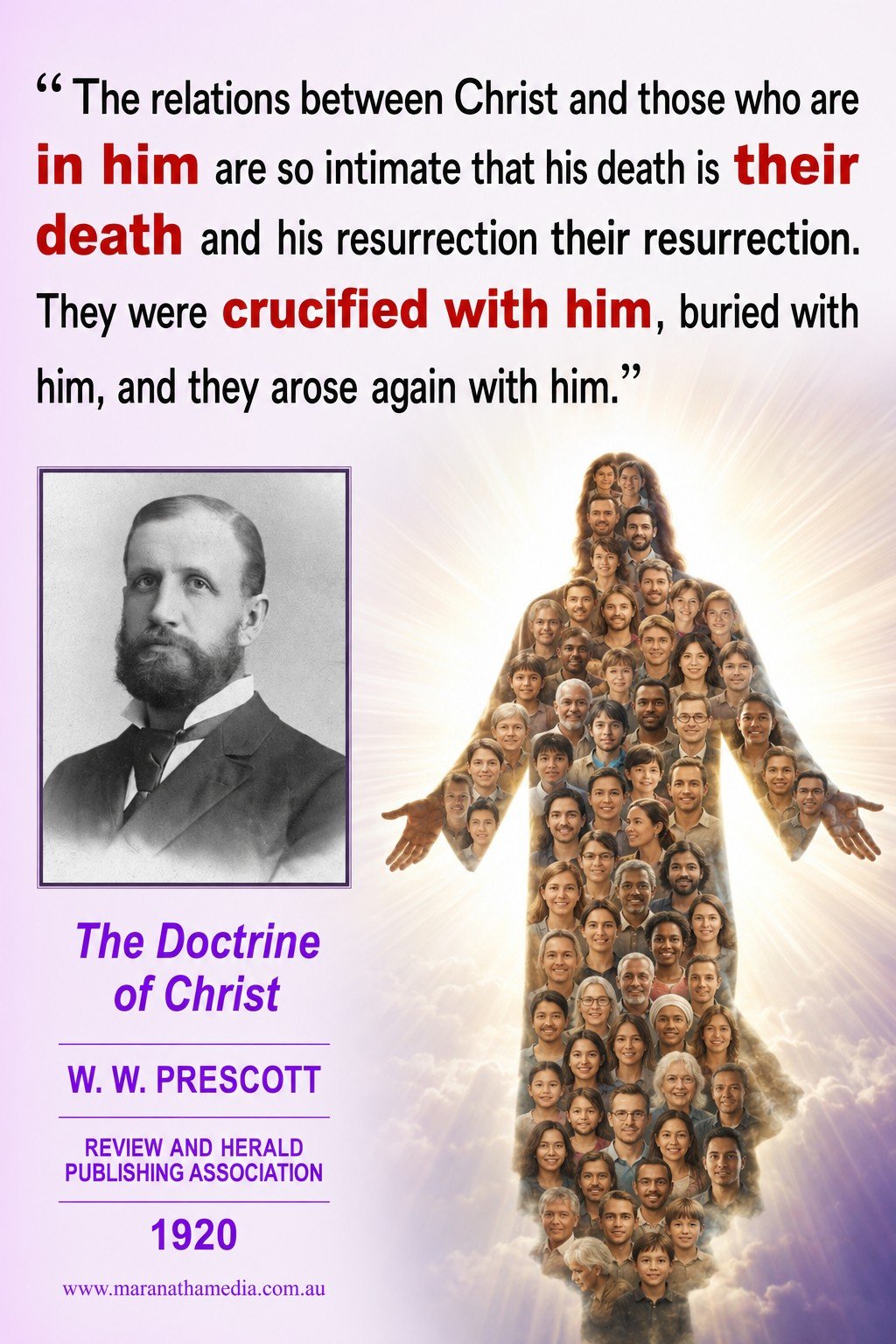
Professor William Warren Prescott (1855–1944), a highly influential educator, writer, scholar and administrator among Seventh-day Adventism’s second generation of leaders, served the church for a total of fifty-two years, holding numerous senior leadership roles in education and publishing and at the General Conference. He was a member of the General Conference Executive Committee for forty-two years.
Prescott was probably the first Adventist theologian through whom God restored to us the glorious truth about corporate salvation of the entire sinful human race in Christ (2Cor 5:14,19; Rom 5:18; 1Cor 15:22). The following quote comes from the most beautiful sermon delivered by Professor Prescott in 1895 in Armadale (Australia):
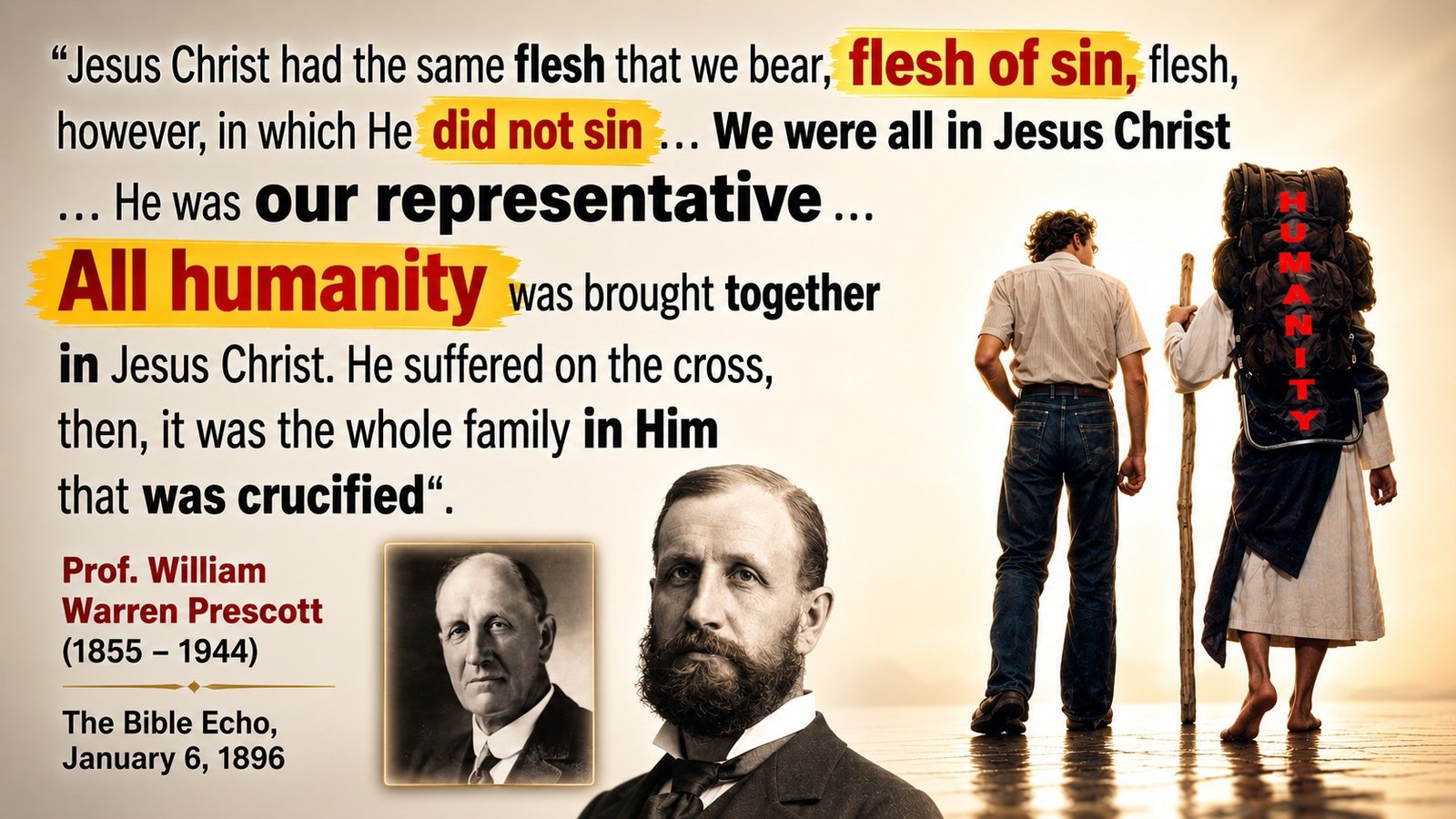
“Jesus Christ had exactly the same flesh that we bear, — flesh of sin, flesh in which we sin, flesh, however, in which He did not sin… We were all in Jesus Christ… He was our representative; He became flesh; He became we… All humanity was brought together in Jesus Christ. He suffered on the cross, then, it was the whole family in Jesus Christ that was crucified” – W. W. Prescott, “The Word Became Flesh,” sermon delivered October 31, 1895, published in The Bible Echo, January 6, 1896, Volume 11, Number 1, Page 15 (read full sermon)
“The life of God was manifested in the flesh—not in a few individuals only, but in humanity. The whole human race was represented in the person of Jesus Christ.” — W.W. Prescott, The Bible Echo, Dec. 30, 1895.
According to WW Prescott, the truth about salvation of sinful humanity in Christ constitutes the very heart of the Christian message: “Jesus Christ was the representative of humanity, and all humanity centered in him, and when he took flesh, he took humanity. He took humanity and he became the father of this divine-human family, and he became the father by joining himself in this way to humanity, and the flesh which he took and in which he dwelt was our flesh, and we were there in him, just as what Levi did in Abraham, so what Jesus Christ in the flesh did, we did in him. And this is the most glorious truth in Christianity. It is Christianity itself, it is the very core and life and heart of Christianity. He took our flesh, and our humanity was found in him, and what he did, humanity did in him.” (WW Prescott, “The Divine-Human Family,” 1895 General Conference Bulletin, pp. 8-9).
The theological transformation of William Warren Prescott during the mid-1890s represents one of the most critical turning points in the development of Seventh-day Adventist Christology. His encounter with the 1888 righteousness by faith message championed by Ellet J. Waggoner and Alonzo T. Jones shattered his cold methodology, initiating a profound spiritual and theological awakening.
However, while Waggoner and Jones provided the initial spark that softened his heart and realigned his ministry, they did not possess the precise, academic vocabulary required to construct a comprehensive, systematic framework of corporate humanity and universal legal justification.
To articulate the immense scope of what he now saw in the gospel, the highly educated, classically trained former college president turned to his extensive library of contemporary British and Scottish theology. Prescott became deeply immersed in the works of Brooke Foss Westcott, the renowned Anglican Bishop of Durham, along with the revolutionary incarnational theology of Scottish preachers like Edward Irving and Thomas Erskine. These scholars had spent decades countering strict, cold Calvinistic predestination by developing a sophisticated language centered on the Incarnation.
They argued that when Jesus Christ took human flesh, He did not merely become an isolated individual man, but rather gathered the entire corporate human race into Himself as the Second Adam. From these outside sources, Prescott absorbed the highly polished concepts of objective global justification—the idea that through the mystery of the Incarnation and the victory of the Cross, a legal verdict of acquittal, life, and inclusion had already been effectively passed upon the entire lump of humanity.
When Prescott traveled to Australia and delivered his celebrated Armadale camp meeting sermons (link) in the autumn of 1895, the messages he preached were far more than a simple echo of the frontier concepts taught by Waggoner and Jones. Instead, they represented a brilliant, unprecedented synthesis of the 1888 Adventist awakening and the highest caliber of British theology.
Prescott stood before his audiences and explicitly proclaimed that when Christ assumed our fallen, broken human nature, the whole world was corporately included in His life, death, and resurrection. He preached a clear, powerful vision of universal legal justification, declaring that in a judicial sense, the entire human race died in Christ and was legally justified in Him, leaving personal faith as the grateful awakening to an objective reality that God had already completed.
This beautiful, Christ-centered presentation was met with the highest validation, as Ellen G. White enthusiastically praised Prescott’s Armadale discourses, recognizing in them the true, elevated melody of the gospel that breathed vibrant spiritual life into the structural framework of the Adventist faith (link).
By infusing this profound concept of corporate salvation of humanity in Christ into the Adventist theological landscape, Prescott completed and perfected the 1888 Minneapolis message of justification by faith alone that had been proclaimed by Waggoner, Jones, and Ellen White. His refined framework went beyond merely reacting to historical legalism; it bridged the gap between the objective work of God and the subjective experience of the believer.
In doing so, Prescott did not invent a new theology, but rather achieved a full restoration and recreation of the exact, authentic gospel proclaimed by the Apostle Paul in his epistles to the Romans, Galatians, and Ephesians. He demonstrated how the entire human race was legally repositioned and redeemed “in Christ“ before making an individual choice.
The same, powerful message of the “in Christ” motif and universal legal justification did not fade away with the passing of the 1888 pioneers; rather, during the second half of the 20th century and into the beginning of the 21st century, it was tirelessly and powerfully proclaimed by Pastor Jack Sequeira. Echoing the exact theological structural framework synthesized by Prescott, Sequeira dedicated his global ministry to championing the matchless charms of the gospel, emphasizing that the entire human race was corporately linked to Christ in the Incarnation and legally redeemed at the Cross. Through his extensive preaching, books, and study guides, Sequeira kept this pure Pauline stream alive, ensuring that the revelation of God’s unconditional love and completed objective salvation continued to challenge legalism and bring vibrant reassurance to modern generations (link).
Jack Sequeira 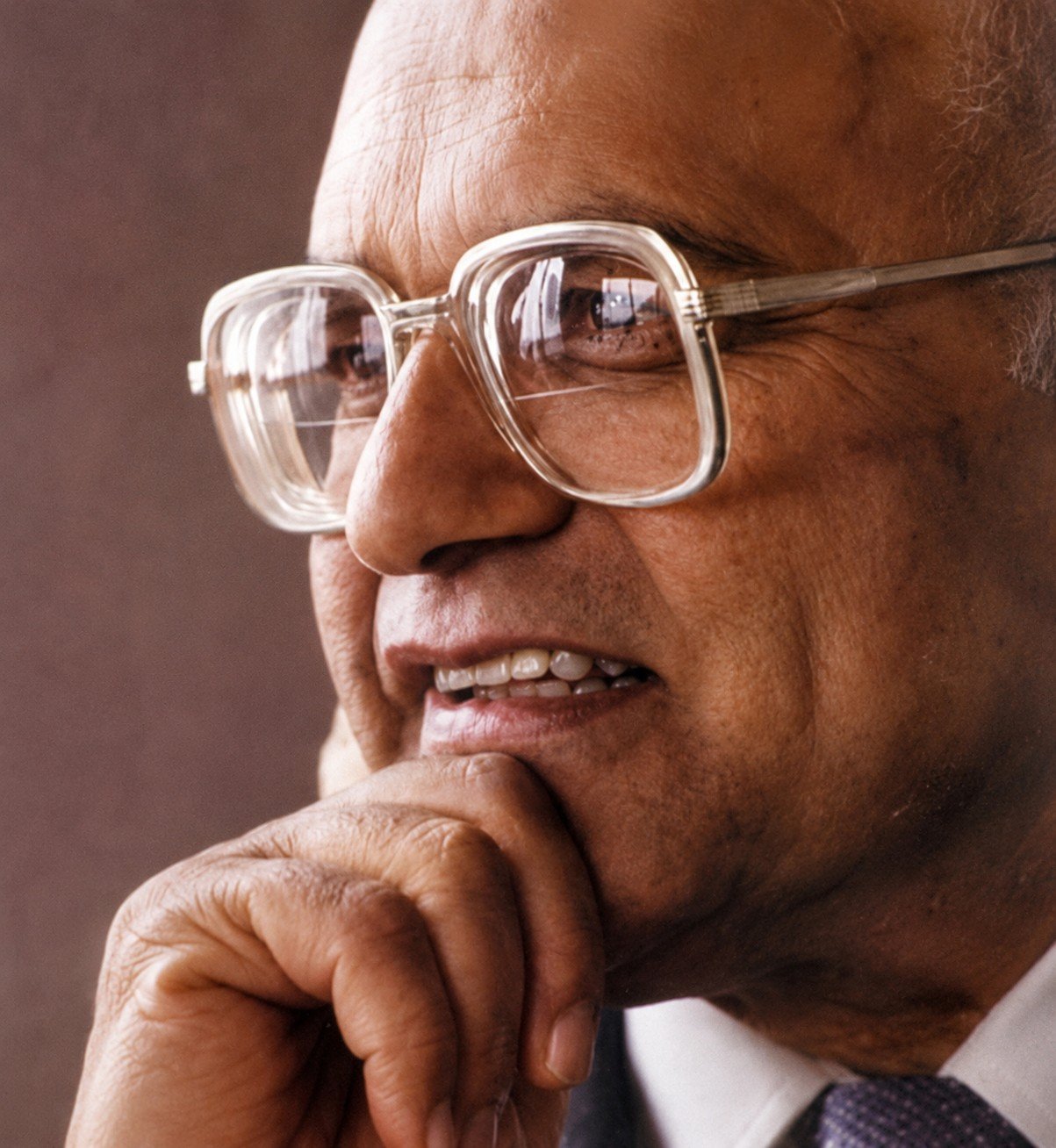
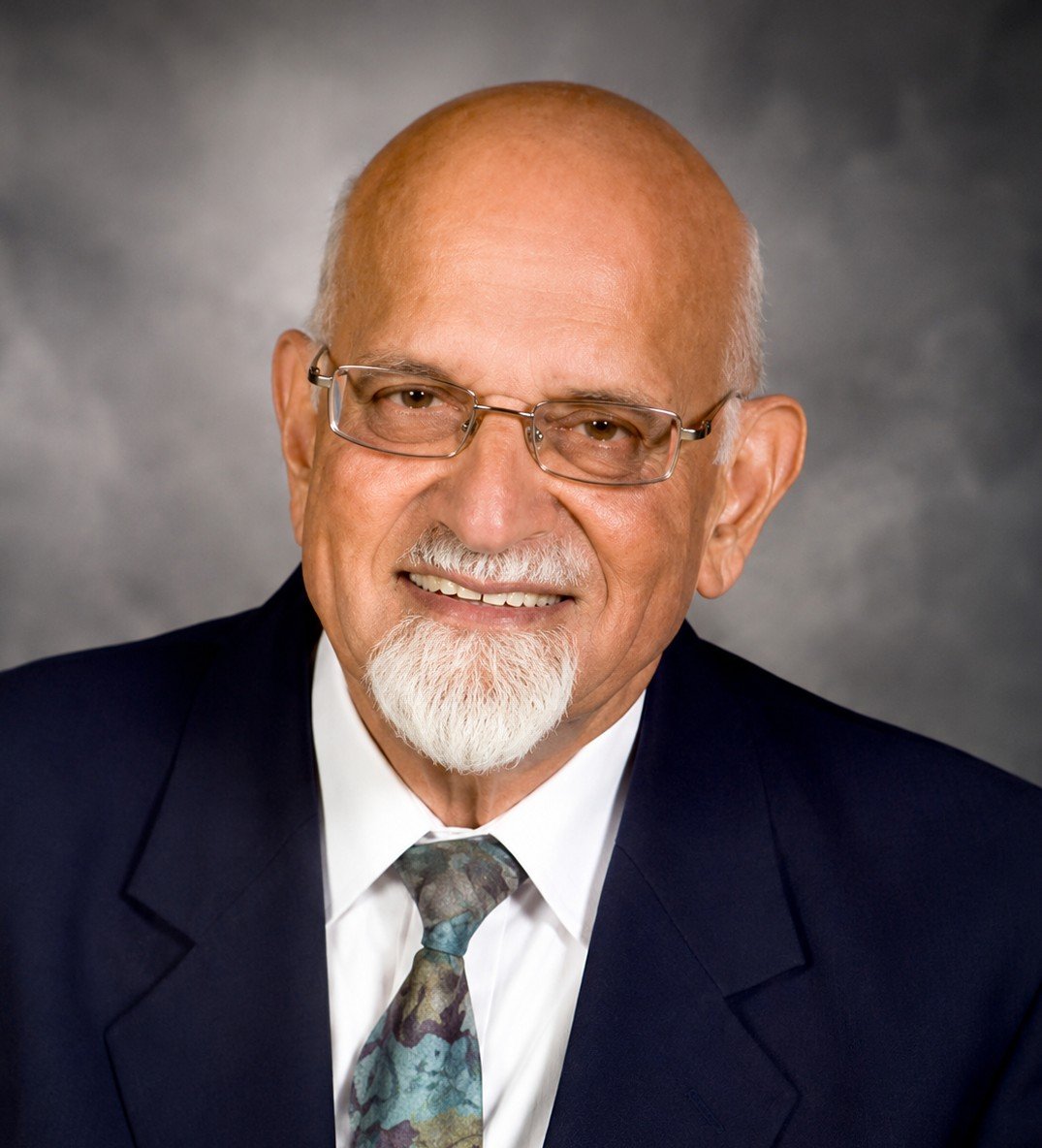
There are reasons to believe the most able and zealous advocate of the truth about the cross of Christ and our corporate salvation in Him in the SDA Church has been the pastor and popular preacher E. H. “Jack” Sequeira (1932 – 26 March 2022).
I believe that the main purpose God sent me from Poland to America in 1989 was to participate in a Bible seminar during which for 7 days I could enjoy listening to the heartfelt exposition of the Book of Romans presented twice a day by Pastor Sequeira. While listening I was impressed by Holy Spirit so much that I could understand what John Wesley meant when he wrote “my heart felt strangely warm” when he himself was listening to the commentary to the book of Romans written by Martin Luther.
In the book Beyond Belief (link) Jack Sequeira explains why God had to include all of us in the cross of Christ:
“We have to remember that although our sinful acts may be forgiven and blotted out through the blood of Christ, but sinfulness (sinful nature) cannot be forgiven, it must die. God, for example, is able to forgive us our selfish acts; but He cannot forgive selfishness. It must be crucified, and this is why God included you and me in the cross of Christ. And just as we cannot obtain forgiveness from our sins unless we see Christ bearing all our sins on the cross, so likewise we cannot know deliverance from the power of sin unless we see Christ bearing us on the cross” (E. H. “Jack” Sequeira, Beyond Belief).
In the same book, Sequeira states as follows:
“The biblical concept of corporate oneness leads us to the important doctrine of substitution. This doctrine was at the very heart of the theological controversy between the Reformers and the Roman Catholic scholars during the Reformation.
The central issue under dispute had to do with the ethical problem raised by the truth of justification by faith. The issue is real, and it still concerns us today: How can God justify believing sinners and at the same time maintain His integrity to the divine law that justly condemns them to eternal death? [see Romans 4:5, Galatians 3:10]. The Catholic scholars insisted that before God could declare the individual believer justified, He first had to make him righteous through an infused grace. Otherwise, God is testifying to a lie: declaring a sinner justified who is still a sinner.
The Reformers rejected this solution to the problem and came up with the biblical doctrine of substitution. ‘God declares a believer justified,’ they said, ‘on the basis of the life and death of Christ, which fully met the law’s requirements.’ In other words, the righteousness of Christ substitutes for the believer’s lack of righteousness.
The Catholic scholars would not accept this answer. They argued that such a substitution would be unethical and illegal. No law allows one person to assume the guilt or punishment of another. Righteousness cannot be passed from one person to another. Accordingly, they accused the Reformers of teaching ‘legal fiction‘.
Both parties were correct to a point, yet both taught error as well. The Catholic theologians were ethically right. God does need to make sinners righteous before He can legally declare them righteous. They were wrong, however, in their solution and rightly deserved the Reformers’ accusation of legalism. The Reformers, on the other hand, were correct in their solution; the Bible clearly teaches that believing sinners are justified on the basis of the life and death of Jesus substituting for their own sinful life [see Romans 10:4; Acts 13:39]. The Reformers, nevertheless, were ethically wrong in the definition of substitution: that the doing and dying of Christ was accepted instead of our doing and dying. As the Catholic theologians pointed out, it is a fundamental principle of all law, God’s or man’s, that guilt or punishment cannot be transferred from the guilty to the innocent, nor can the righteousness of one person be legally transferred to another [see Deuteronomy 24:16; 2 Kings 14:6; Ezekiel 18:1-20].
What, then, are we to make of the biblical teaching of substitution? How are we to define it? Biblically, the doctrine of substitution is based on the concept of solidarity or corporate oneness. All humanity stands legally condemned because all sinned in one man, Adam. Likewise, God can legally justify sinners because all humanity corporately obeyed the law in one Man, Jesus Christ — the second Adam. God made this possible by uniting His Son with the corporate life of the human race at the incarnation. This qualified Christ to be the second Adam and to be the legal Substitute for fallen humanity.
The Reformers failed to solve the ethical problem of the gospel for the simple reason that they, like the Roman Catholic Church, made a distinction between the humanity of Christ and the humanity He came to redeem. Only when we identify the humanity of Christ with the corporate fallen humanity that He came to redeem can we preach an ethical gospel that is unconditional good news. In other words, humanity that Christ did not assume, He could not save” (E. H. “Jack” Sequeira, Beyond Belief link).
Sequeira seems to agree that in a sense our salvation in Christ can be described as a provision or an offer that is made effective by faith alone (1 Cor. 3:11-13) but the word “provision” must not be confused with the word “provisional” as taught by Arminianism, that on the cross Christ did not actually secure salvation for anyone but only made it possible for all humankind to be saved. According to the true gospel, in Christ the entire humankind was already actually saved 2000 years ago. The only thing that is needed for this supreme gift of God to be effective is our wholehearted acceptance of this already accomplished historic fact through authentic faith which always bears fruit in the form of the new birth.
Sequeira’s understanding of justification can be illustrated using the analogy of money deposited into our bank account. The “money” (salvation) was already transferred to our account 2000 years ago but it does not benefit us if we refuse to accept it, just as money deposited into our bank account, though legally ours, does not benefit us unless we lay claim to it. On the other hand, according to the provisional gospel preached by most Adventists and Evangelical Christians, what happened 2000 years ago was not the actual salvation of humankind but only a provision that had been made to make salvation possible. Therefore, salvation requires a true faith in order to make it effective but in this case, our faith contributes to our salvation making such gospel a subtle form of legalism. We are not saved because of our faith but through faith.
According to this gospel, we must first sign a document (accept the provision) and only then the money can be transferred to our account. Bible, however, teaches that the salvation of all sinners has been already accomplished and secured (money already transferred) and the only thing we need to do to enjoy it is accepting it through genuine faith.
According to Sequeira, “Adventists traditionally belong to the Wesleyan Arminian school of theology. Unlike the Calvinists, who believe that Christ saved only the elect on the cross, hence “limited atonement,” the Armenians believe that Christ only “potentially” or “provisionally” saved all of mankind on the cross. For this provisional salvation to become a reality, one must repent and believe in Jesus Christ. Only then will God place that person into Christ and the provision will become a reality. Thus, traditionally, we Adventists have limited the in Christ motif only to believers.
The main argument that has often been used to prove that the in Christ motif applies only to believers is Romans 16:7. In this chapter of greetings, Paul makes this statement: “Greet Andronicus and Junias, my relatives who have been in prison on with me…. They were in Christ before I was”. Clearly, what Paul is implying is that these two men accepted the truth as it is in Christ and were converted before Paul himself. To build a whole theology on this one text while ignoring all the other in Christ texts Paul uses (some 64 times) is very poor exegesis, to say the least. Further, this conclusion is a subtle form of legalism, salvation by works, since repentance and faith contribute towards one’s salvation. Whereas, according to Paul, it is the goodness of God (the reality phase or objective facts of the gospel) that leads one to faith and repentance (Romans 2:4). Hence, faith is not allowing God or giving Him permission to put us into Christ but accepting with grateful hearts what God has already accomplished for mankind in Christ (1 Corinthians 1:30-31; 2 Corinthians 5:18-20; Ephesians 1:3-4).
It is here where I disagree with the teachings of the Biblical Research Institute (BRI) of the GC, as well as some of the Independent Ministries. I believe that the true everlasting gospel, which God raised the Advent Movement to proclaim to the world in its global mission, is neither the limited atonement of Calvinism nor the provisional salvation of Arminianism. Rather, it is the incredible good news that on the cross the entire human race was actually or objectively redeemed, justified, and reconciled to God by the death of His Son (John 3:17; 17:4; 19:30; Romans 5:5-10,18; Ephesians 2:5, 6, 8, 9; 2 Corinthians 5:19). This is God’s supreme gift to the entire human race, made effective by faith (John 3:16; Romans 3:21-28). I firmly believe when we Adventists fulfill this global mission we will have truly proclaimed the everlasting gospel of the three angels of Revelation 14 with the power of the fourth angel of Revelation 18. When this is realized, it will become inexcusable for anyone to be lost. The end will then come (Matthew 24:4). But when we limit the in Christ motif only to its third phase, the subjective experience of salvation, we make the experience of salvation the gospel itself, rather than its application or fruits. But since this experience is an ongoing process, until the Second Advent (Romans 5:19b, note future tense; Ephesians 2:7), it turns the gospel into good advice, rather than good news, thus robbing our people of the joy, peace, and assurance of salvation, as demonstrated by the Value-Genesis survey conducted some years ago.” (link)
Edward E. Heppenstall & Seventh-Day Adventist Bible Commentary
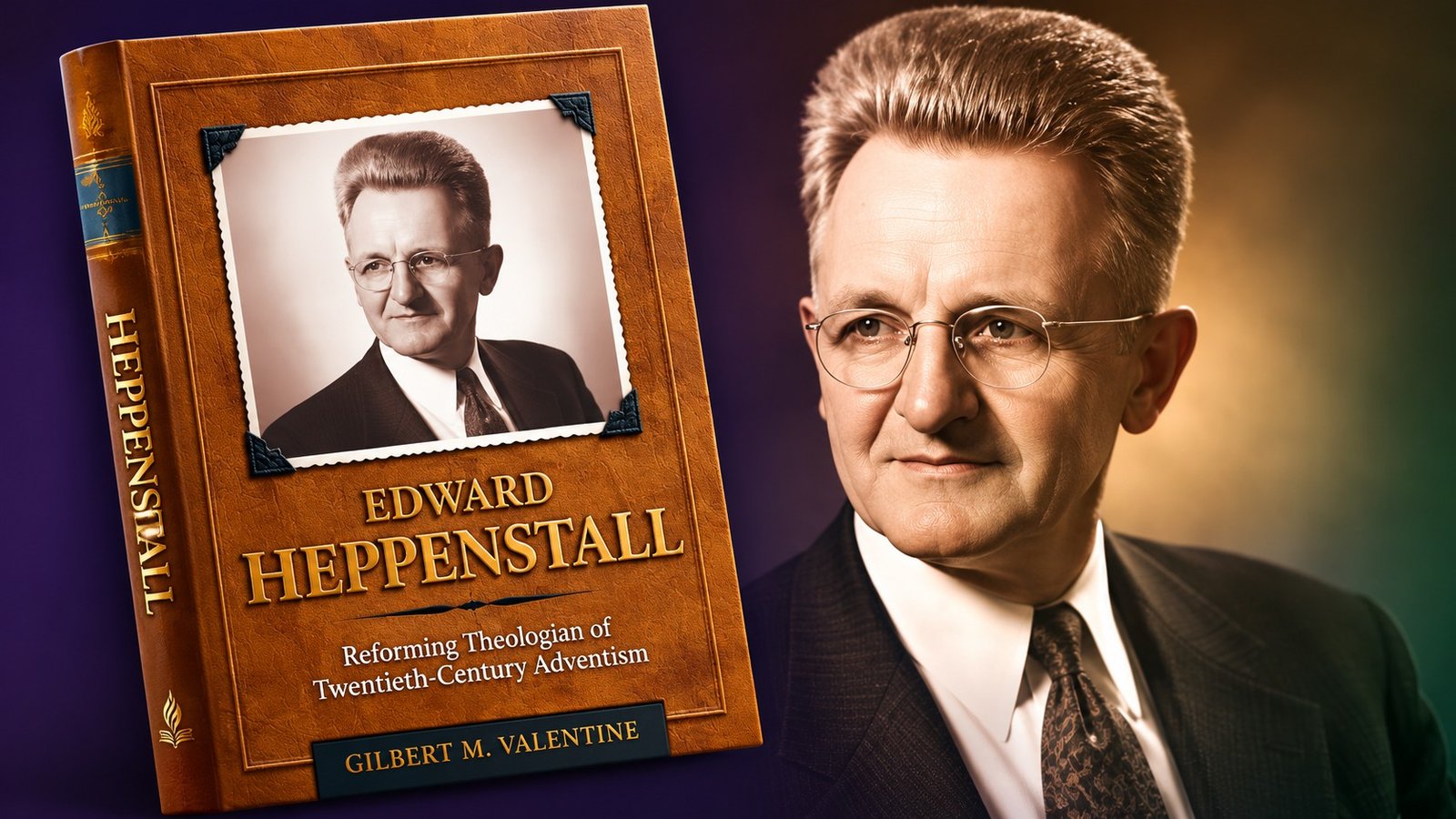
The Seventh-day Adventist Bible Commentary (edited by Francis D. Nichol) beautifully expresses the corporate redemption of humanity in Christ:
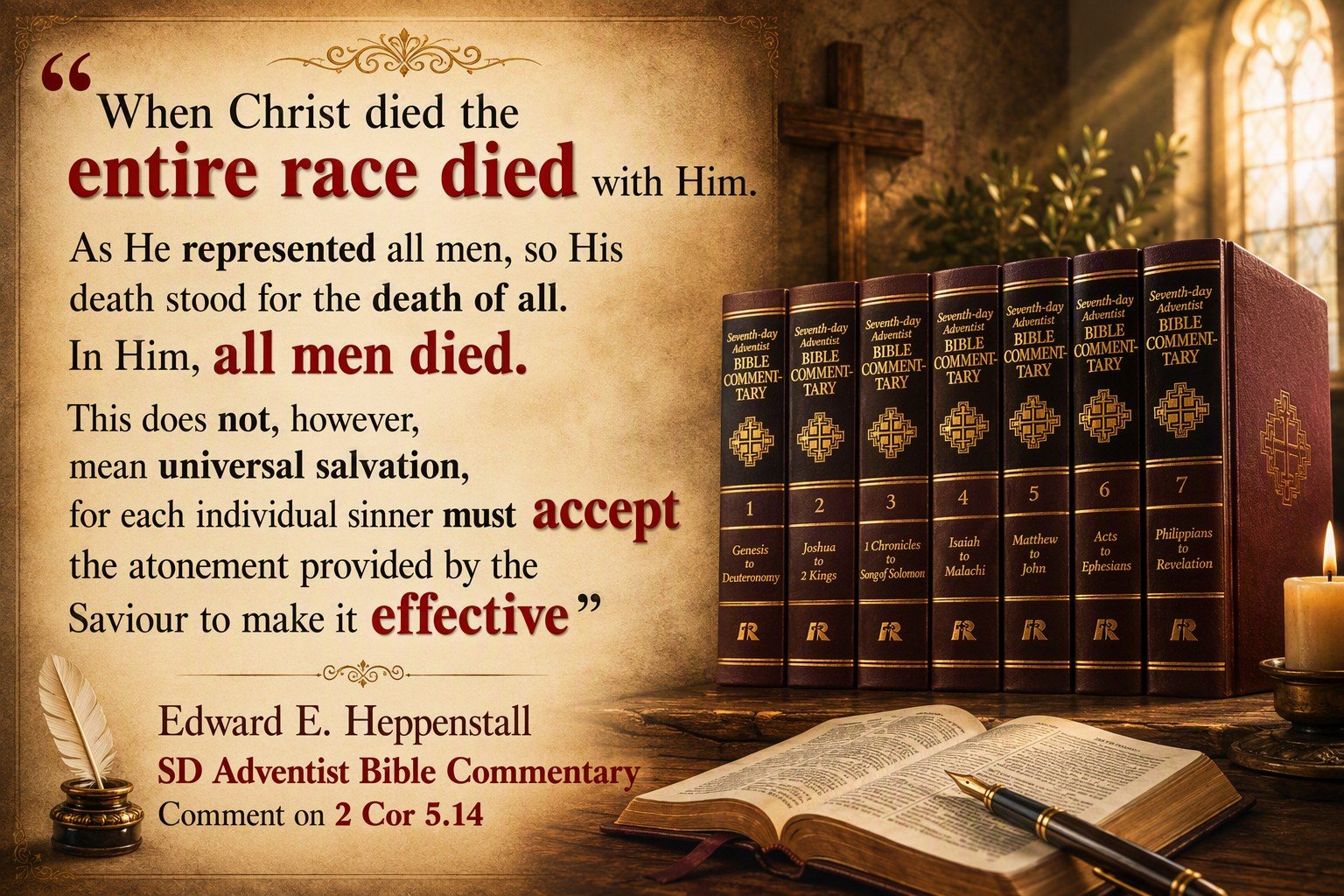
“In taking Adam’s place Christ became the head of the human race, and died on the cross as its representative. Thus, in a sense, when He died the entire race died with Him. As He represented all men, so His death stood for the death of all. In Him, all men died. This does not, however, mean universal salvation, for each individual sinner must accept the atonement provided by the Saviour in order to make it effective” (The Seventh-day Adventist Bible Commentary, vol. 6, comment on 2 Corinthians 5:14, edited by Francis D. Nichol (Review and Herald, 1956/1957).
Please notice that not only believers but “all men” (all sinners past, present and future) were included and saved in Christ 2000 years ago, and whe is needed to benefit from that historic fact is a genuine faith and acceptance of the free gift of God!
In this statement, we can sense the presence and inspiration of the Spirit of Truth which unfortunately can’t be found in the articles by BRI (Manuel Angel Rodriguez) or Hartland (Standish brothers) dealing with the same subject and condemning the biblical idea of corporatete salvation of all sinners in Christ.
Many Adventists assume that the Seventh-day Adventist Bible Commentary was written entirely by Francis D. Nichol. In reality, this is not the case. Although Nichol served as editor-in-chief, the Commentary was the work of thirty-seven Adventist Bible scholars, each assigned responsibility for specific books of the Bible. Their manuscripts were then carefully reviewed, revised and approved by the editorial team before publication. This means that the published Commentary represents both the work of the individual contributors and the official approval of the editors.
One of those contributors was Edward E. Heppenstall (1901–1994), one of the Church’s most respected theologians and Professor of Theology at Andrews University and later at Loma Linda University.
According to Raymond F. Cottrell, associate editor of the Seventh-day Adventist Bible Commentary and one of its principal contributors, Heppenstall was the scholar assigned to prepare the commentary on 2 Corinthians. This means that the famous comment on 2 Corinthians 5:14 was based on Heppenstall’s manuscript, although, like the rest of the Commentary, its final wording was reviewed and edited before publication (Raymond F. Cottrell, “The Untold Story of the Bible Commentary,” Spectrum, Vol. 16, No. 3, 1985).
Heppenstall’s own writings closely reflect this same corporate understanding of Christ’s saving work:
“God in Christ reconciled the world unto Himself… It is an objective act that changes the hopeless situation of mankind whether men believe and accept salvation or not.” (Edward Heppenstall, Salvation Unlimited, p. 43.)
“The atonement is complete, perfect, and sufficient. Nothing can be added to what Christ accomplished.” (Edward Heppenstall, Our High Priest, Review and Herald Publishing Association, 1972.)
“God has revealed and effected in Christ alone a righteousness that is eternally all-sufficient for all men.” (Edward Heppenstall, Salvation Unlimited, p. 44.)
These statements show that Heppenstall believed Christ accomplished an objective, representative work for the entire human race before any human response. This makes him the most likely source behind one of the clearest corporate statements found anywhere in Adventist literature—the famous commentary on 2 Corinthians 5:14.
A. Graham Maxwell’s Commentary on Romans
Unfortunately, although Edward Heppenstall’s commentary on 2 Corinthians 5:14 provides an excellent explanation of Paul’s representative theology and faithfully reflects the apostle’s inspired teaching that the whole human race died in Christ through His representative death nearly two thousand years ago, the same cannot be said of A. Graham Maxwell’s commentary on Romans 5:12–21 and Romans 6:6.
Instead of developing Paul’s central theme of humanity’s corporate history in Adam and in Christ, Maxwell interprets these passages primarily in terms of the believer’s personal conversion and spiritual experience. As a result, the objective, representative, and corporate foundation of Paul’s gospel is overlooked.
For this reason, the commentary on Romans in the Seventh-day Adventist Bible Commentary deserves careful revision so that it more faithfully reflects Paul’s inspired argument concerning humanity’s union with Christ, the second Adam.
Read: Need to Revise Commentary on Romans in SDA Bible Commentary
Contributors to the Seventh-day Adventist Bible Commentary: M. L. Andreasen (Leviticus; Hebrews), L. L. Caviness (Esther; Song of Solomon), O. H. Christensen (Joshua), Raymond F. Cottrell (Matthew, Mark, Luke, John 1–4; major introductory articles), Le Roy E. Froom (Daniel; Revelation – prophetic interpretation articles), R. Hammill (Judges), Louis Hardinge (Colossians), L. H. Hartin (Galatians), R. H. Hartwell (John and the Isle of Patmos), Edward E. Heppenstall (2 Corinthians), Earle Hilgert (Jeremiah 46–52; Lamentations; Daniel 10–12; John 5–6; Revelation 1–11; chronology and biblical criticism articles), Siegfried H. Horn (Genesis; Exodus 1–18; Ezra; Nehemiah; Daniel 1, 3–6; archaeology and chronology articles), W. T. Hyde (Proverbs; 1–3 John; Jude), T. H. Jemison (Philippians), Alger F. Johns (James), R. E. Loasby (Numbers; Deuteronomy; Ruth; Ecclesiastes; 1–2 Peter; Revelation 17–22), T. K. Ludgate (1 Corinthians), Frank Lewis Marsh (Science and Creation), Arthur G. Maxwell (Romans), E. J. McMurphy (Titus; Philemon), G. H. Minchin (Ephesians), W. G. C. Murdoch (Psalms 107–150; Daniel 2, 7–9), Don F. Neufeld (Ezekiel; John 7–21), Julia Neuffer (Biblical chronology articles), Norval F. Pease (Job), W. E. Read (Revelation 12–16), C. O. Smith (1–2 Thessalonians), W. F. Specht (Jeremiah 1–10), Edwin R. Thiele (2 Samuel; 1–2 Kings; 1–2 Chronicles; Isaiah), C. E. Weniger (Psalms 1–106; Poetry of the Bible), W. G. Wirth (Exodus 19–40; Jeremiah 11–45; Minor Prophets; 1–2 Timothy), Lynn H. Wood (1 Samuel; Between the Testaments; maps and illustrations), and Francis D. Yost (Acts; Jews of the First Christian Century; Early Christian Church; Medieval Church).

Francis D. Nichol (Editor)
Note: This list is based on the contributor assignments published by Raymond F. Cottrell in The Untold Story of the Bible Commentary (Spectrum, Vol. 16, No. 3, 1985). Although each scholar was assigned specific Bible books, Cottrell explains that all manuscripts were extensively reviewed and edited before publication, so the final published text represents the work of both the individual contributors and the editorial team led by Francis D. Nichol.
Ty Gibson, James Rafferty, David Asscherick (The Light Bearers)
Popular SD Adventist revivalists James Rafferty & Ty Gibson (The Light Bearers) seem to have the same understanding of our corporate salvation in Christ. To prove it let me quote the statement I found in their Epistle to the Hebrews, Study Outlines 08 – Once For All, Salvation In Christ:
Ty Gibson
Ty Gibson stands out as one of the strongest proponents of the “Universal Legal Justification” (ULJ) and “In Christ” motif pioneered by Jack Sequeira. Gibson frequently integrates these theological frameworks into his public sermons and Bible studies, sharing the concepts with a wider audience. Demonstrating his close connection to Sequeira and his legacy, Gibson was also present at the Jack Sequeira – Celebration of Life service (video link).
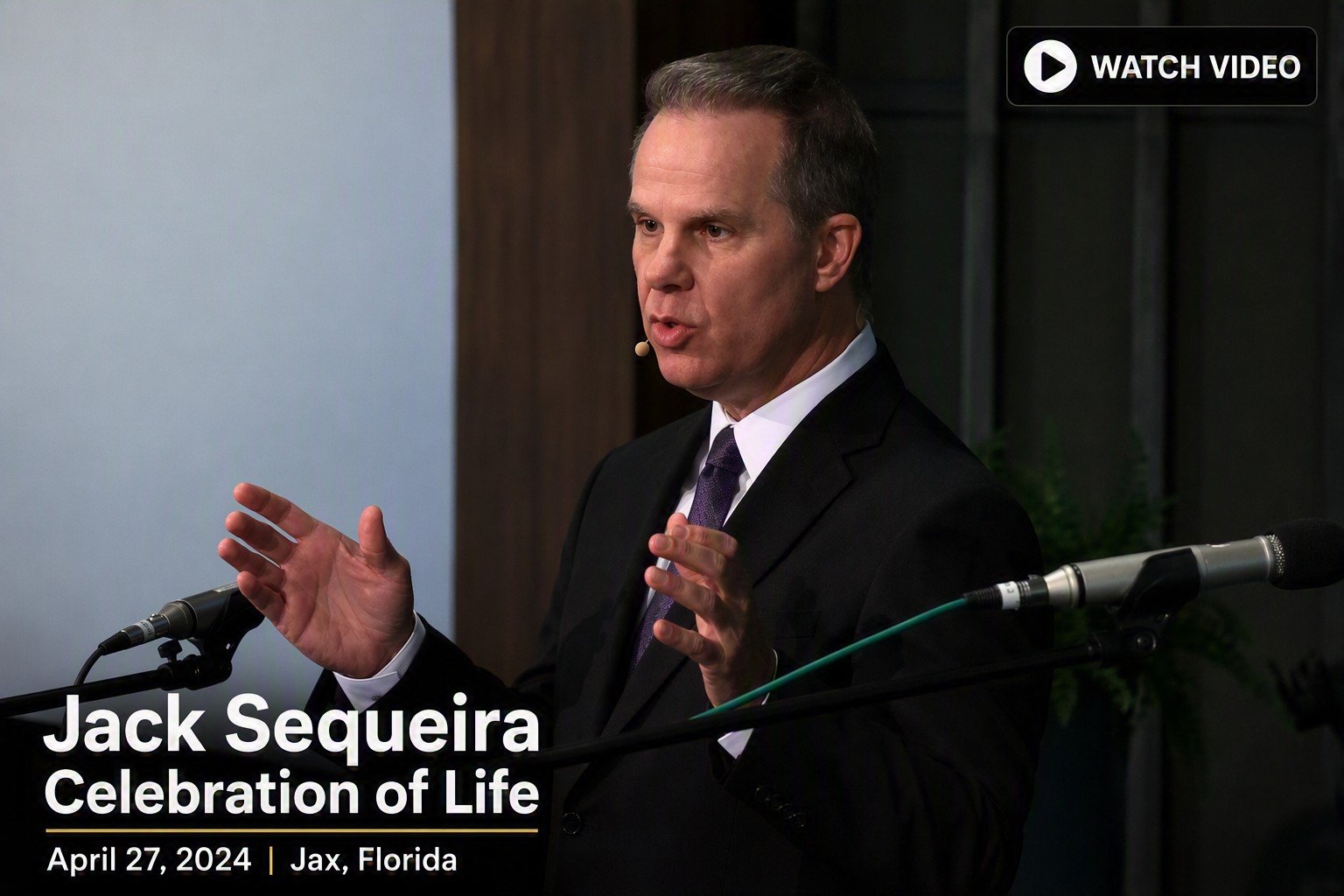
“The entire human race was literally gathered up in Christ and carried through His life, death, resurrection, and ascension.” — Ty Gibson, An Endless Falling in Love, Light Bearers Publishing, p. 63.
“Jesus became the second Adam, the new head of humanity, taking the whole race into Himself.” — Ty Gibson, sermon series on Romans 5, Light Bearers
“What happened to Christ happened to humanity in Him, because He bound Himself to the human race.” — Ty Gibson, teaching on 2 Corinthians 5, Light Bearers
“In Christ, humanity has been brought near to God. The cross is God’s act of embracing the world.” — Ty Gibson, A God Named Desire, Pacific Press, p. 118.
James Rafferty
“All humanity was represented in Christ, just as all humanity was represented in Adam.” — James Rafferty, sermon on Romans 5, Light Bearers
“God was in Christ reconciling the world unto Himself before the world ever responded.” — James Rafferty, message on reconciliation, Light Bearers
“When Christ died, humanity died in Him. When Christ rose, a new humanity emerged in Him.” — Ty Gibson, teaching on the gospel and corporate identity, Light Bearers
“Jesus Christ gathered humanity into Himself and rewrote the story of the human race.” — James Rafferty, sermon on Romans 5 and the Second Adam motif, Light Bearers
“Christ did not come merely to stand beside humanity, but to stand as humanity.” — James Rafferty, audio sermon on the incarnation and atonement, Light Bearers Sermons
“All humanity was comprehended in Christ just as all humanity was comprehended in Adam.” — James Rafferty, Romans seminar, Light Bearers
“The cross reveals that God included the entire race in Christ.” — James Rafferty, message on reconciliation and the everlasting gospel, Light Bearers
“What happened in Christ affects the entire human race because He became the new Head of humanity.” — James Rafferty, teaching on the ‘in Christ’ motif, Light Bearers
“The gospel is the announcement of what God has already accomplished in Christ for mankind.” — James Rafferty, evangelistic sermon series, Light Bearers
David Asscherick
“In Christ, the whole human race was rewritten with a new story.” — David Asscherick, sermon on Romans 5, ARISE / Light Bearers teachings
“Jesus became the new Head of humanity, the second Adam, reliving the human story in perfect fidelity to God.” — David Asscherick, gospel presentation on the Adam-Christ parallel, Light Bearers
“Jesus is the new Adam, the new representative man, reliving the human story the right way.” — David Asscherick, sermon on Romans 5 and 1 Corinthians 15, Light Bearers
“What Adam lost for the race, Christ regained for the race.” — David Asscherick, gospel seminar on the Second Adam motif, ARISE Online
Light Bearers
“What this means, in the context of the gospel, is that we have appropriated to us everything that Jesus did… And, just like Levi, all that Jesus has done is accounted to us as though we actually did it ourselves. The biblical truth that Levi paid tithes to Melchizedek in Abraham directs us to an even greater truth that humanity paid the wages of sin and lived the life of obedience in Christ (2 Corinthians 5:14; 1 Corinthians 1:29-30). There is no biblical truth that needs to be repeated more frequently, dwelt upon more earnestly, or established more firmly in our minds than this. Everything Christ accomplished in His life, death and resurrection is accounted to us in Him. It is only ‘in Him‘ that the entire world exists (Acts 17:28; Colossians 1:17; Hebrews 1:3). As we accept our position in Him, we are assured that His death and life of obedience are ours. Our obedience springs forth as the fruit of His life and reveals that we abide in Him. Our salvation is not in the fruit; our salvation is entirely in Jesus Christ. If there is no fruit, then there is no faith in Christ. However, we are not saved by the fruit, but rather by accepting our position in Christ. Since this one truth is so vital for our understanding, we will repeat the matter again from the beginning—What Christ did as head of this new family, we do in Him. He is our representative; He became flesh; He became us. He did not become simply a man, He became flesh, and everyone that should be born into His family was represented in Jesus Christ when He lived here in that flesh. Because of this, everything Christ did we are given credit for just as if we did it ourselves.” Epistle to the Hebrews, Study Outlines 08 – Once For All, Salvation In Christ.
A substantial portion of the quoted above article by Light Bearers contains passages taken or copied from quoted below sermon by WW Prescott. It is therefore very strange that Gibson and Rafferty were able to recognize and vindicate this adorned by Sister White truth of our corporate oneness with Jesus while A. M. Rodriguez (BRI), Colin and Russell Standish (Hartland) not only seem to be unable to see this great truth but even dare to oppose it!
Martin Weber 
Martin Weber (1951-) is a prominent Seventh-day Adventist theologian, author, and minister who spent decades analyzing the church’s competing views on salvation. As an editor for the Ministry magazine and the author of influential books like Who’s Got the Truth?, he became a key theological mediator in the 1990s.
In his public reviews and editorial columns during the mid-1990s, Weber regularly defended Sequeira’s ULJ and the “In Christ Motif” against critics who mischaracterized his views as dangerous or automatically universalist, praising his ability to make the clear and powerful: “Beyond Belief, by Jack Sequeira, reveals the gospel in such magnificent clarity that it could help detonate Pentecost II.” Martin Weber, quoted / referenced from his review of Sequeira’s theology in the Columbia Union Visitor (May 15, 1993)
He specialized in evaluating and synthesising the “In Christ” corporate motif and Universal Legal Justification, ultimately developing his own “Representational Model of Soteriology” to bridge the gap between objective corporate salvation and personal faith.
Martin Weber famously reviewed the distinct salvation frameworks of key Adventist thought leaders—specifically Morris Venden, George Knight, Jack Sequeira, Ralph Larson, and Graham Maxwell—in his landmark 1995 analysis of five different Adventist gospels, “Who’s Got the Truth?“.
Ultimately, Weber strongly supported only Jack Sequeira’s gospel and the corporate “In Christ” motif, viewing this emphasis on Universal Legal Justification as the key to the only fully restored gospel that returns absolute assurance to the believer.
Praising the Impact and Clarity of Sequeira’s Message in the book “Beyond Belief”, Weber wrote, “Seldom if ever has an Adventist book aroused more fierce denunciation from some in the church and at the same time more heartfelt thanks from others. Why is this book such a phenomenal catalyst? It has brought peace and assurance to thousands of troubled hearts who had been struggling under the burden of legalism.”
Commending the “In Christ” Motif and the Cross Weber heavily praised Sequeira’s corporate “In Christ” motif for shifting the theological focus away from human performance and entirely onto the objective victory of Jesus: “The core of the ‘In Christ’ motif is focused on the objective perfection of the gift provided… thank God we can agree on the central message of the New Testament that it is the birth, life, death, and resurrection of our Lord Jesus Christ that constitute the good news of the gospel, and that it is man’s only hope.” Martin Weber, Who’s Got the Truth?: Making Sense Out of Five Different Adventist Gospels (1995), p. 90
“By His corporate victory in the human nature He assumed, Christ legally redeemed the entire lost human race. His sacrifice reversed for all men the condemnation which came upon us all in Adam.” (Who’s Got the Truth?: Making Sense Out of Five Different Adventist Gospels, Chapter on Jack Sequeira)
“The core of the ‘In Christ’ motif rests on the truth that humanity is already legally and objectively justified at the cross independent of their initial belief, clearing the entire race of the legal penalty of sin.” (Who’s Got the Truth?: Making Sense Out of Five Different Adventist Gospels, Dialogue Section)
Arnold Wallenkampf
Dr. Arnold Wallenkampf who has served as a member of the Biblical Research Institute of the General Conference taught the truth about the corporate salvation of the world in Christ. Below quote is derived from his book, Justified (chapter 5):
“Because of Christ’s death on the cross, God temporarily treats all as if they were just and righteous. By virtue of the cross, all enjoy life through temporary universal (temporal and forensic) justification. All sins are covered temporarily by the blood of Jesus. ‘God shows his love for us in that while we were yet sinners Christ died for us’ (Rom. 5:8). This divine mercy is manifested to unworthy creatures because Jesus “is the expiation for our sins, and not for ours only but also for the sins of the whole world” (1 John 2:2)… In the ancient sanctuary service, the high priest carried the names of every tribe on his breastplate. Symbolically, he carried on his heart the name of every individual into the very presence of God. In the same way, Jesus carries on His heart every person born into this world, whether or not he has accepted Him as his Saviour… On the cross, He temporarily atoned for all sins—known as well as unknown, confessed as well as unconfessed. And “as our Mediator, Christ works incessantly. Whether men receive or reject Him, He works earnestly for them. In this way, temporary universal justification … only means that God temporarily deals with sinners as if they were just, or righteous, in spite of their rebellious attitude toward Him. In His temporary universal justification, God grants all a reprieve from death by not executing them immediately despite their sin. This reprieve is designed to break the sinner’s stubborn heart and draw him to His Saviour in repentance. To the woman taken in adultery, Jesus said: ‘Neither do I condemn thee: go, and sin no more’ (John 8:11). God deals in the same gracious way with all sinners. He condemns no one today. Today is still ‘the day of salvation’ (2Cor. 6:2). By virtue of temporary universal justification, God ordinarily chooses not to exact the wages for sin during a person’s life on earth. Rather, He treats him—and that embraces every person born into the world—as if he merited life… I have spent most of my life in the classroom, either studying or teaching. Some of my students were good, others not so good. But during the weeks or months of the course, there was no difference in my treatment of them. They were all equally accepted. The difference did not appear until the final examination. Some passed the exams, while some failed. The distinct difference between the righteous and the wicked, between the saved and the unsaved, between those who are only forensically justified and those who are justified by faith, will not become evident until the course of life has ended—at the final judgment.” (link)
Neal Wilson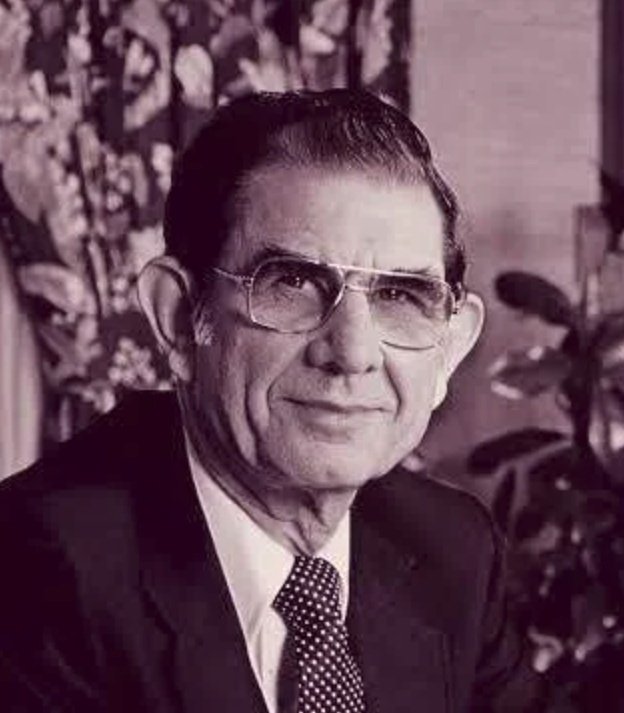
Elder Neal Wilson (1920 – 2010), while General Conference president, took the same position on universal legal justification of entire humanity in Christ in his Week of Prayer reading for 1988. He famously stated that through Christ’s one act, the human race was “corporately and legally justified” (Adventist Review, 1988):
“The cross of Christ is the focal point of all history. At the cross the entire human race was corporately and legally justified. Through the ‘one act of righteousness’ by the ‘second Adam,’ the condemnation that rested on all humanity because of the first Adam was reversed. In Christ, God has reconciled the whole world to Himself, not counting their trespasses against them. This is the objective reality of the Gospel—a finished work that provides every man and woman a new standing before God.” — Neal C. Wilson, “The Power of the Cross,” Adventist Review, Week of Prayer Special Issue, 1988.
For much of the mid-20th century, Adventist theology had leaned toward a more Arminian/Provisional view (that Christ only made a provision for salvation). Neal Wilson’s 1988 reading was a pivotal moment where the General Conference leadership officially utilized the Universal Legal Justification framework to provide members with a greater sense of Assurance of Salvation. He argued that we don’t “earn” a standing with God; rather, we “accept” a standing that was already legally granted to the human race in the Person of Jesus Christ.
Robert S. Folkenberg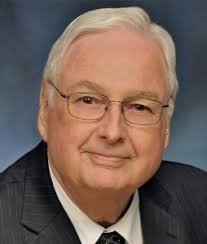
Robert S. Folkenberg (1941–2015), who succeeded Neal C. Wilson as General Conference President, continued to champion the “In Christ” motif as a central pillar of his presidency. He was particularly instrumental in framing the gospel around the Corporate Solidarity of the human race, ensuring that the “Objective Gospel” remained at the forefront of Adventist mission.
This passage comes from the introduction to the readings for the week of prayer (November 1993): “Being in Christ is a precious truth repeated many times in Holy Scripture. The Bible points to two persons who symbolize all people who have ever lived on earth—Adam and Christ (1 Cor. 15:22). We are all “in Adam” because of our birth in him—condemned to sin and death. However, the wonderful truth of the gospel is that Christ died for us all: we were in Him on the cross! In Christ we have righteousness and life.”
Folkenberg often utilized the “Two Adams” framework to provide church members with a solid foundation for the assurance of salvation. He emphasized that just as we did not “choose” to be in Adam for condemnation, God—by His own sovereign initiative—placed the human race in Christ for justification.
“The gospel is the good news that God has already provided a way out of the human dilemma. In the person of His Son, God has legally and corporately reconciled the world to Himself. When Jesus died on the cross, the entire human race died in Him. When He rose, we were raised to a new standing. This is not a theory; it is a historical reality that becomes ours the moment we stop resisting and accept His gift by faith.” — Robert S. Folkenberg, Adventist Review, “The Assurance of the Gospel,” 1992.
Folkenberg wrote a landmark article titled “Will the Real Evangelical Adventist Please Stand Up?” (1997). In this and other writings, he defended the idea that salvation is an accomplished fact in Christ. He maintained that Christ’s “one act of righteousness” (Romans 5:18) brought a “verdict of acquittal” to all men. He taught that the world is no longer condemned for Adam’s sin, but rather, individuals are lost only if they deliberately reject the life already granted to them in Christ.
While Folkenberg focused heavily on the legal aspects of salvation, his support for the “In Christ” motif naturally aligned with the belief that Christ had to be “one with us” in His humanity to legally represent us. He frequently cited 1 Corinthians 1:30 to show that God is the one who placed us “in Christ Jesus.”
Walter Veith
Walter Veith (born 1949) – professor of the zoology department at the University of Cape Town, Seventh-day Adventist author and speaker known for his work in nutrition, creationism and Biblical exegesis, in his sermon “Corporate Identity” expressed his belief in the legal justification and salvation of the entire humanity in Christ in the following way:
“What can the Bible teach us about our corporate identity in Christ? Typologically, as Levi and all Israel were corporately in Abraham, so all of humanity was corporately in Christ. To bring the fallen race into oneness with Divinity is the work of redemption. Having paid the price for every sin, Jesus could corporately give unfallen stature to the whole of humanity. That’s the plan of salvation. In Christ, our repentance, conversion and faith are perfect and immaculate. Corporately in Christ, humanity has paid the wages of sin as verily as Levi paid tithe in Abraham… Let no one tell you you’re not good enough, because in Christ you are perfect, absolutely immaculate.”
Watch sermon “Corporate Identity” by Prof. Walter Veith
Erika F. Puni
Dr. Erika F. Puni (Director of Stewardship Ministries of the General Conference), at the 2014 Camp Meeting hosted by North England Conference of Seventh-day Adventists said that “when Christ died the whole world was in Him and died in Him”:
“Stewardship is a response of the whole person to the Grace of God. Because we were in Christ when He died, our old self has been crucified with Him. When Christ died, the whole world was in Him and died in Him; therefore, we no longer belong to ourselves, but to the One who died for us and rose again.” — Dr. Erika Puni, Concept of Corporate Solidarity in Stewardship (cf. GC Stewardship Ministries archives).
Emmanuel Mwale
The below quote comes from the 2015 dissertation titled “Jesus Christ’s Substitutionary Death: An Attempt to Reconcile Two Divergent Seventh-Day Adventist Teachings” (link) written by Emmanuel Mwale (PhD). It is a remarkably interesting summary of the dissertation and his final conclusion based on the careful review of various non-Adventist and Adventist salvation theories:
“Having lived a life of perfect obedience in the fallen human flesh that Christ assumed at the incarnation, He voluntarily and willingly bore the sins of the entire human race and died the second death for, and in our place; thereby paying the penalty for sin. Jesus Christ bore our sins (acts or behaviors) vicariously (instead of us), while sin as nature or a law residing in the fallen human flesh that He assumed was condemned in that flesh (in the fallen representative human flesh Christ took) and received eternal destruction on the cross. Thus, on the cross, in Christ, God saved the entire humanity. On the cross, the condemnation that the entire humanity had received by being genetically linked to Adam was reversed in Christ. Thus, the entire human race stands legally justified. But this is a gift, which can either be received or rejected. Therefore, salvation is not automatic.” (link)
It basically means that according to the author’s understanding, Christ saved us vicariously (instead of us, or in our place) from our sins (transgressions of the law). At the same time, He saved us corporately, actually (as us) from our singular sin (sinful nature including the indwelling law of sin and selfishness). He took that representative “sin of the world” (fallen human nature) at the incarnation, perfectly overcame it in His life as Second Adam (second representative of entire sinful humankind), and carried it to the cross, where that representative sin was condemned by God (Rom 8:3) and punished with eternal death.
The above conclusion seems to correspond also with the understanding of the same subject by Jack Sequeira who wrote that “Christ, in His humanity, saved men and women in actuality-not vicariously… It may be possible for Christ to bear our many sins vicariously on His cross-although that would be illegal-but, it is impossible for Him vicariously to overcome and condemn the principle of sin that resides in our sinful flesh… Christ’s life and death actually changed humanity’s past; Christ’s life and death became our life and death. In Him we lived a perfect life; in Him we died the penalty for sin (2Corinthians 5:15)… As the Second Adam (humankind) Christ took our place and died our death in order that we might be identified with Him, both in death and resurrection… This is where vicarious substitution and actual substitution part company. The former teaches an exchanged experience; while the latter teaches a shared experience… Yes, we accept salvation as individuals, but humanity was condemned corporately in Adam and redeemed corporately in Christ.”
According to Mwale, Sequeira differs from other theologians because he dichotomizes Christ’s substitutionary death. On one hand, Christ died vicariously (instead of us). On the other hand, Christ died in actuality (He died as us and all humanity was obedient and punished with eternal death in Him). This is the way he solves the problem of how Christ dealt with our sins (what we do) and sin (our nature). He argues that since Christ himself never committed any sin (in thought, word, or deed), we can say that He vicariously took the sins of all of us and vicariously redeemed all sinners from their sins (sinful behavior). On the other hand, Christ dealt with sin as nature by identifying Himself personally with the sin problem by assuming our representative, corporate sinful human nature, was perfectly obedient as us and carried that “sin of the world” onto the cross where it was condemned by God in Christ’s flesh with eternal death (Rom 8:3)” (link).
Sequeira agrees that the term “vicarious” is also a form of substitution but it refers only to salvation from sins as acts and not from sin as nature (the core of the sin problem). He also believes that Ellen G. White used the term “vicarious” only to refer to how Christ redeemed humanity from sins as acts but she never used it with reference to sin as nature. She also never used the term to refer to the human nature that Christ assumed. (link)
Jean R. Zurcher 
The negative attitude of many Adventist pastors, writers, and theologians toward the Biblical “in Christ motif” and the universal legal justification, as taught by Jack Sequeira, has been inspired by the denial of Christ’s true humanity presented in the unfortunate book Questions on Doctrine. The new false teaching according to which Jesus took sinless human nature, made it impossible for Christ to identify Himself with sinful humankind and accomplish salvation as our representative. In his book, Touched With Our Feelings, Prof. Jean R. Zurcher (1918–2003), an Adventist scholar, revealed how the change took place and that it was associated with replacing the actual salvation of fallen humanity in Christ with vicarious substitution theory:
“It was not denied (in the book Questions on Doctrine) that Christ was the second Adam, coming in the ‘likeness’ of sinful human flesh. No one argues that ‘Jesus experienced the frailties to which our fallen human nature is heir. But could it not be that He bore this vicariously also, just as He bore the sins of the whole world? These weaknesses, frailties, infirmities, failings are things which we, with our sinful, fallen natures, have to bear. To us they are natural, inherent, but when He bore them, He took them not as something innately His, but He bore them as our substitute. He bore them in His perfect, sinless nature. Again we remark, Christ bore all this vicariously, just as vicariously He bore the iniquities of us all. In brief ‘whatever Jesus took was not His intrinsically or innately… All that Jesus took, all that He bore, whether the burden and penalty of our iniquities, or the diseases and frailties of our human nature—all was taken and borne vicariously‘. This expression is indeed the magic formula contained in ‘the new milestone of Adventism‘. According to the authors of Questions on Doctrine, ‘it is in this sense that all should understand the writings of Ellen G. White when she refers occasionally to sinful, fallen, and deteriorated human nature’.”
Robert J. Wieland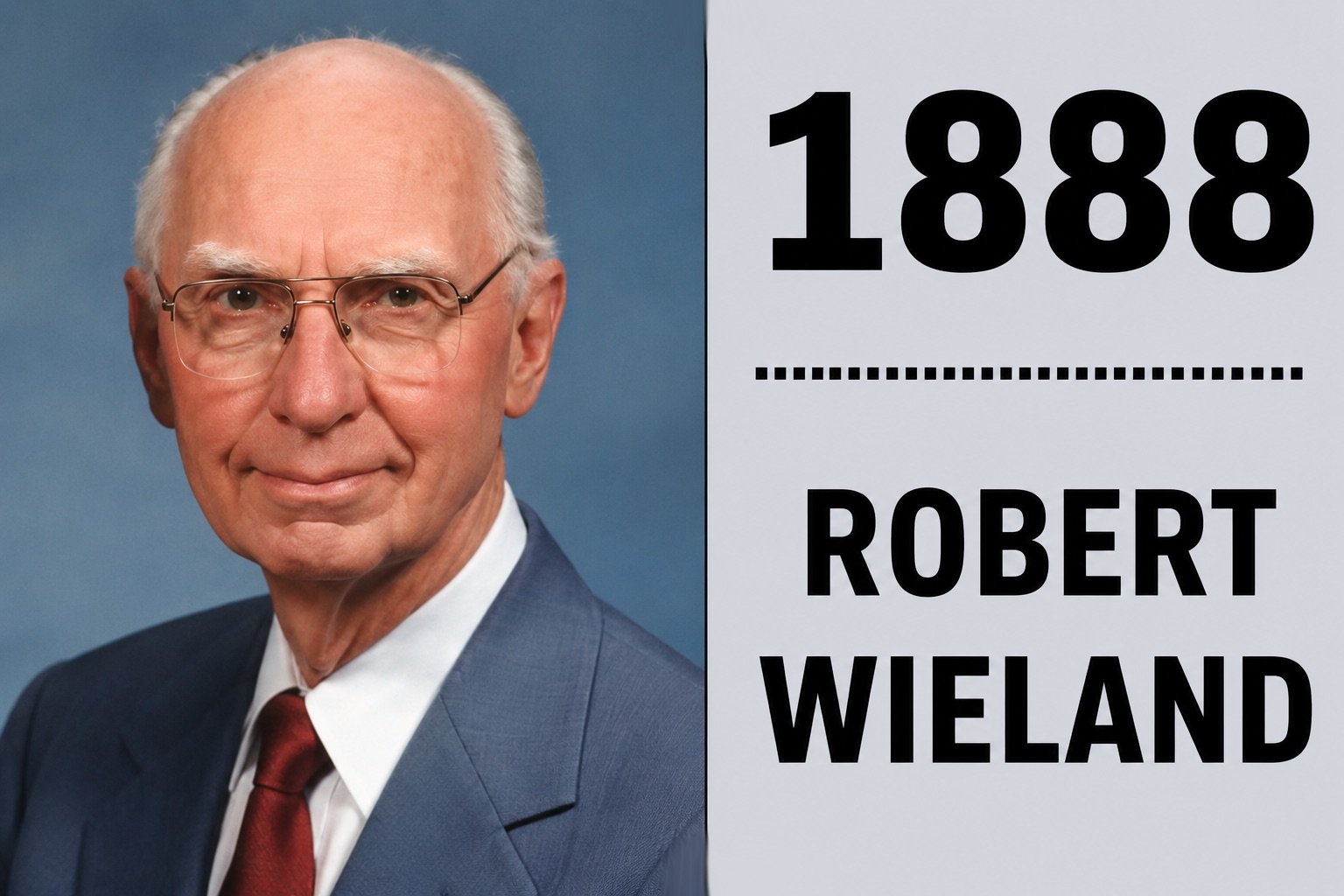
Robert J. Wieland (1916-2011) was a popular speaker, author, missionary in Africa, and ordained minister. At the Washington Missionary College, he discovered the beauty of the gospel by reading The Glad Tidings, by E. J. Waggoner. His love for these truths met with opposition, and he was told that there was no place “in the work” for him.
The General Conference publishing director helped him eventually find a position pastoring a small church. From there, he went on to become a missionary in Africa. In the 1950s, he, along with Donald K. Short, first started to raise the General Conference’s consciousness about the church’s rejection of the message of Righteousness by Faith, as proclaimed by E. J. Waggoner and A. T. Jones at the 1888 General Conference in Minneapolis. The following quote expresses Wieland’s belief in the corporate salvation of the entire humanity in Christ:
“All degrees of transgression have been cancelled in a legal, judicial sense for the whole world, and God can treat every man as though he has not sinned. This is a legal justification, for the judicial verdict of acquittal has been pronounced for the whole human race in Christ (See Romans 5:14-18, NEB). But this judicial verdict of acquittal is transformed by the faith of the believer into a change of heart which becomes the personal experience of justification by faith. Christ has opened a door to a new standing in relation to God, and the believer’s faith grasps this truth and appreciates it. Again, the proper name for this work is justification by faith wherein the believer repents of and confesses and forsakes all sin. And even though it can be said that the death of Jesus in one sense made a corporate reconciliation of all men to God, it is only in a “judicial” sense. It is only through personal faith and heart appreciation of the sacrifice of Christ that anyone can experience in his own soul a personal reconciliation with God—which again, is justification by faith.”
Find more on the same subject in the article “The 1888 Message and Legal Justification” by Robert Wieland
Jack Sequeira wrote the following words regarding Robert Wieland:
“Across from the home where I was living was a Seventh-day Adventist missionary, Robert Wieland and his family. He was the president of the Central Kenya Field. Since public transportation was not very reliable in those days, one of his burdens was to help the African pastors with reliable means of transportation. Many pastors were in charge of eight to ten churches. Elder Wieland would buy wrecked motorcycles from insurance companies and fix them for the workers. One of my hobbies at that time was racing motorcycles. It was this that led Elder Wieland to come to me for help in the above project. We became good friends, but not once did he bring up the subject of religion. In 1957, the Central Seventh-day Adventist Church in Nairobi planned an evangelistic effort. My landlady, a Presbyterian, wanted to attend these meetings, at the request of her SDA daughter who had moved to the UK for graduate studies. She went to Elder Wieland, requesting that he take her to the meetings. Being wise, Elder Wieland came to me with the request that I take her. He knew that, as a staunch Roman Catholic, I would not attend these meetings on my own. As a result, I sat at the back of the church and listened to Elder Dale Ringering, the evangelist, for some three weeks. It was the first time in my life I was exposed to the prophecies and truths of the Bible. As a Catholic, I had not even seen a Bible, let alone read one. The Holy Spirit convicted me, and, as a result, I decided to join the Adventist church. This required that I go through a series of baptismal classes before I could be baptized. The missionary who gave me these baptismal studies was the late Elder Joe Hunt. Twice a week I rode two miles to his home on my motorcycle. I could not understand, at that time, why Elder Wieland was unable to give me these studies, since he lived right across the road from where I lived. However, on the day Elder Wieland was baptizing his son Bob, Elder Joe Hunt requested him to baptize me at the same time, since my baptism studies were completed and Elder Wieland was already in the baptistry. Many years later I learned why Elder Wieland was unable to study with me. His manuscript on 1888 Re-examined, co-authored by Elder Don Short, was rejected by the GC [General Conference] Committee and, as a result, Wieland was black-listed by the missionaries of the East African Union. Consequently, Elder Wieland was not allowed to study with me, lest he influenced me with his ‘strange beliefs on 1888’. So the accusation often made that my theology was influenced by Wieland on the 1888 message is entirely false, even though we both came to the same conclusion regarding the 1888 message independently.” (link)
Ellen White 
Ellen White (1827-1915) herself believed in our corporate oneness with Jesus as she wrote about Christ that “by His obedience to all the commandments of God, Christ wrought out a redemption for man. This was not done by going out of Himself to another, but by taking humanity into Himself. Thus Christ gave to humanity an existence out of Himself. To bring humanity into Christ, to bring the fallen race into oneness with divinity, is the work of redemption. Christ took human nature that men might be one with Him as He is one with the Father, that God may love man as He loves His only-begotten Son, that men may be partakers of the divine nature, and be complete in Him” (The Review and Herald, April 5, 1906).
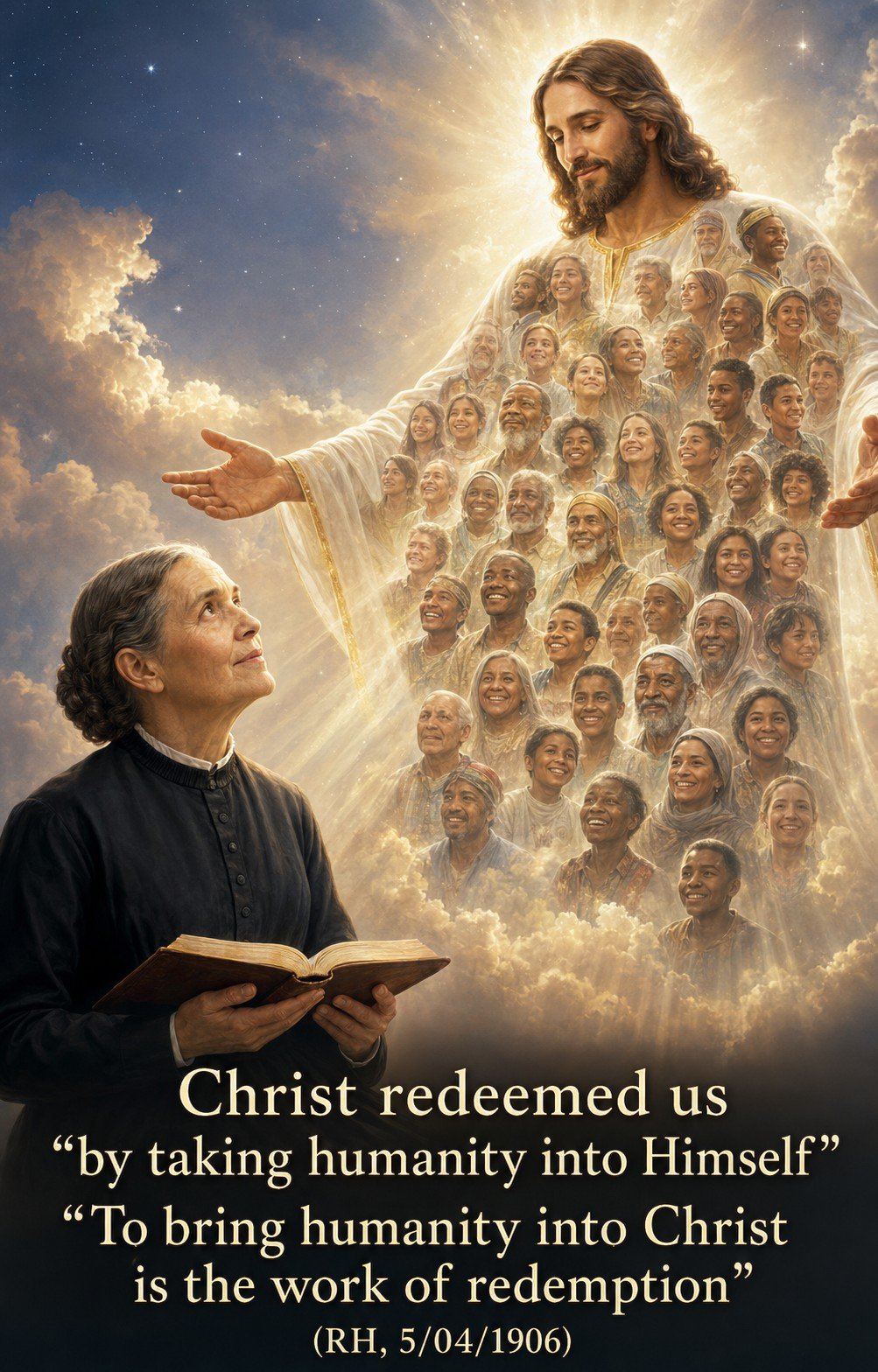
It is true that although Ellen White doesn’t say a lot about this subject yet when she heard Professor Prescott saying, “We were all in Jesus Christ… He was our representative; He became flesh; He became we… All humanity was brought together in Jesus Christ; He suffered on the cross, then, it was the whole family in Jesus Christ that was crucified“, she was very excited and repeatedly stated in her letters it was Jesus who was speaking through Professor Prescott.

But there is also strong evidence that before Ellen White heard Prescott preaching on this subject she already understood it in the very same way as she applied the “in Christ motif” to Lord’s baptism, about which she wrote the following words:
“How often we have read over the description of Christ’s baptism with no thought that there was any particular significance in it for us. But it means everything to us” (ST June 17, 1889, par. 11).
We know Christ’s incarnation and death are everything to us but why she wrote also His baptism is so important? The following statement from her book Desire of Ages proves that in her understanding Christ’s baptism is everything to us because we were actually baptized with and in Jesus, we were accepted by God and cleansed in Christ when we were baptized in Him. According to her, the words “This is my beloved Son” embraced the entire sinful world because all past, present and future sinful human beings were in Christ when He was baptized:
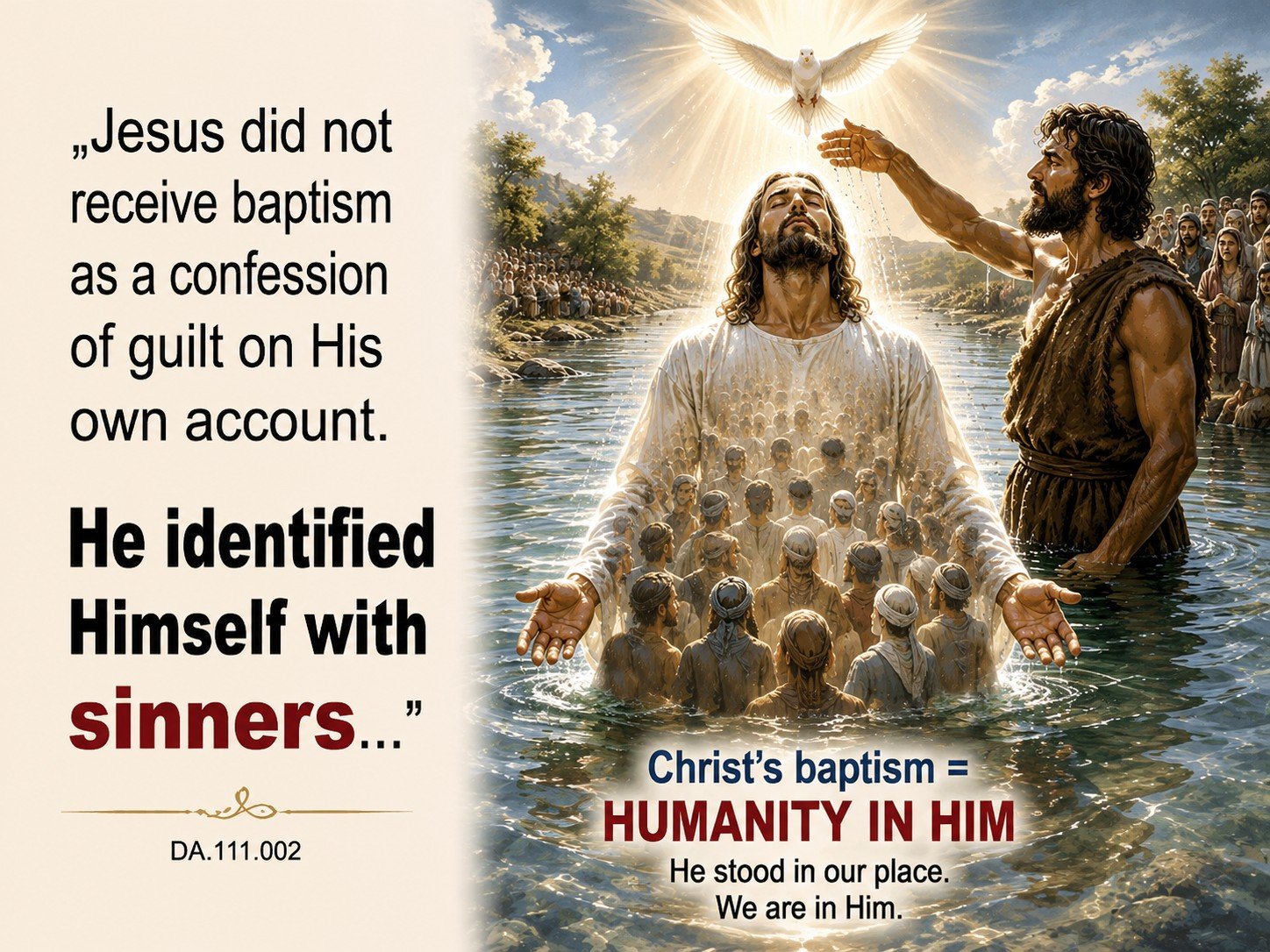
„John shrank from granting the request of Jesus. How could he, a sinner, baptize the Sinless One? And why should He who needed no repentance to submit to a rite that was a confession of guilt to be washed away? Jesus did not receive baptism as a confession of guilt on His own account. He identified Himself with sinners. He must bear the burden of our guilt and woe. The Sinless One must feel the shame of sin. Never before have the angels listened to such a prayer. They are eager to bear to their loved Commander a message of assurance and comfort. But no; the Father Himself will answer the petition of His Son. Direct from the throne issue the beams of His glory. The heavens are opened, and upon the Saviour’s head descends a dovelike form of purest light. From the open heavens a voice was heard saying, ‘This is My beloved Son, in whom I am well pleased‘. The word that was spoken to Jesus at the Jordan, This is My beloved Son, embraces humanity. God spoke to Jesus as our representative… The Saviour’s glance seems to penetrate heaven as He pours out His soul in prayer. He asks for the witness that God accepts humanity in the person of His Son. With all our sins and weaknesses, we are not cast aside as worthless. He hath made us accepted in the Beloved (Eph 1:6). Notwithstanding that the sins of a guilty world were laid upon Christ, notwithstanding the humiliation of taking upon Himself our fallen nature, the voice from heaven declared Him to be the Son of the Eternal” (DA. 110-113).
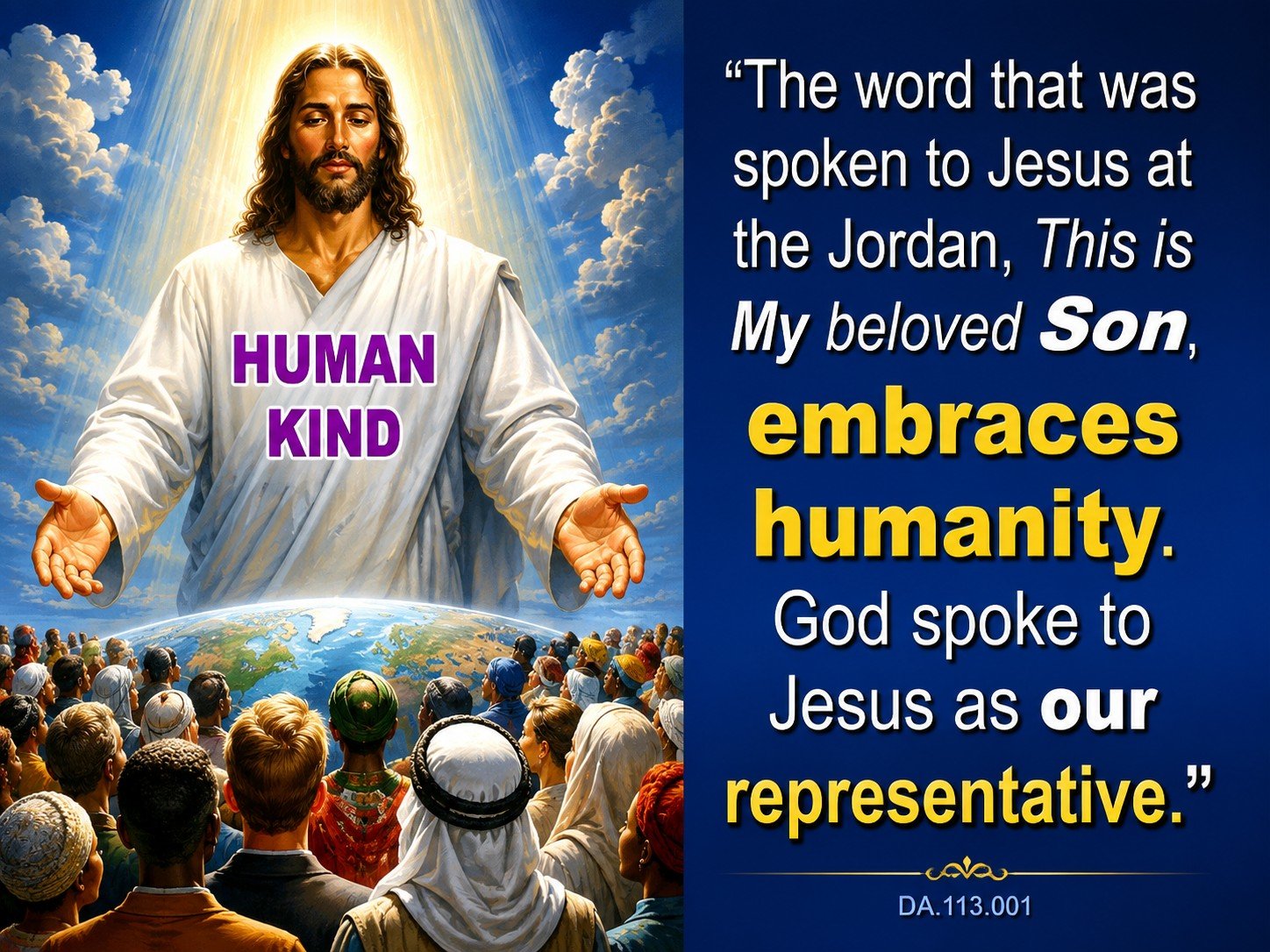
In this passage, she also gives evidence that Jesus could represent all of us – all sinners because He took not our sinless human nature but our representative sinful human nature.
But apart from the fact that Christ’s baptism points to the truth about our presence in Him the Bible makes it clear that also the meaning of our baptism is closely linked to the very same great idea. In many places Apostle Paul wrote that when Christ died we also died in and with Him (Rom 6:6,8; Rom 7:4; 2Cor 5:14; Gal 2:20) and theologians make it clear that he didn’t have in mind our daily dying to sin (sanctification) but he was dealing with the history of our salvation in Jesus: “Or do you not know that as many of us as were baptized into Christ Jesus were baptized into His death? Therefore we were buried with Him through baptism into death, that just as Christ was raised from the dead by the glory of the Father, even so, we also should walk in newness of life.” (Rom 6:3-4)
The conclusion, therefore, is obvious and can be only one: Through our baptism, we demonstrate that we accepted the historic truth according to which when Christ died (two thousand years ago) on the cross then we died with Him as well: “Knowing this, that our old man (self) was crucified with Him, that the body of sin might be done away with, that we should no longer be slaves of sin. For he who has died has been freed from sin. Now if we died with Christ, we believe that we shall also live with Him.” (Romans 6:6-8)
And if someone dies, the next step is always the funeral, and this is exactly what baptism represents. It is the funeral of our old sinful and condemned life that was crucified in Christ in the form of the representative corporate sinful human nature (including our law of sin and self we are born with) Christ assumed at His incarnation. And for this very reason, we are also no longer under the condemnation of the law (Rom 7:6).

Unfortunately, since we do not seem to understand and accept this great truth or some even dare to openly oppose it, our members are spiritually buried alive as they are baptized without the knowledge and acceptance of the truth according to which they already died in Jesus when He was dying on the cross. And since burying people who are still physically alive is a great crime likewise burying Christians who didn’t accept their death in Christ is also a (spiritual) crime!
ADVENTIST OPPONENTS OF ULJ
Unfortunately, almost all our members and pastors either do not understand this great truth of universal salvation in Christ or reject it and keep on believing and sharing the provisional salvation theory.
Taking into consideration all the above facts, the simple conclusion is that anyone who opposes this fundamental truth of the Gospel (like Standish brothers and BRI, still represented by Rodriguez, although retired) can’t be led by Holy Spirit but must be rather inspired by the enemy of Christ’s Gospel of which the biblical “in Christ motif” is the most vital part.
Unfortunately, and strangely, BRI, Manuel Rodriguez, Colin and Russell Standish (Hartland), Raoul Dederen, Norman Gulley, Ron Spear, Ralph Larson and some other Adventist writers pretend to not see biblical teaching about corporate salvation in Christ and they constantly kept on creating the false impression that Jack Sequeira and other proponents of this great biblical truth are promoting heresy of universalism! In order to confuse the minds of SD Adventists even more they sometimes call it federalism, although it is not the same as universalism.
Norman Gulley
Another enemy of the true Gospel and salvation in Christ was Norman Gulley who in the Adult Sabbath School Lessons (Jul Aug Sept 1996) in his comment to Rom. 5:17 wrote: “Just as we were not in Adam when he sinned, so we were not in Christ when He died. Christ died for us. His death was on our behalf. We did not die when Christ died; we die to sin when we accept His suffering and death as the punishment for our sins.” (Wednesday, September 18). Norman Gulley was also promoting the false teaching according to which Christ took our sinless nature.
Raoul Dederen
Raoul Dederen, professor of theology at Andrews University, during one of his lectures on Christ’s incarnation in Podkowa Leśna (Poland) said: „Some claim that we were in Adam when he sinned and therefore when he did it we also sinned in him… We do not believe that we sinned in Adam. We believe that we become sinners when we commit our own sins. We do not have to be punished for Adam’s sin but for our own sins.” During the same seminar, Dederen was brainwashing catholicising Polish pastors with the false idea according to which Christ took our sinless nature. Dederen was also known as a proponent of the ecumenical movement. He claimed that Christ inherited only the physical consequences of fallen humanity—such as tiredness, ageing, suffering and death—but not our inward sinful tendencies and predispositions. It means that Christ didn’t inherit the law of sin of humanity, the root of our sin problem. It clearly contradicts the teachings of apostle Paul who wrote that Christ was “made sin for us” (2 Cor. 5:21) and that God “condemned” that singular “sin” (“law of sin”) in Christ’s “flesh” (in fallen human nature) (Rom. 8:3) He took at the incarnation.
Dederen was not alone. The same or essentially the same understanding was promoted by influential SDA theologians including Edward Heppenstall, Roy Adams, Woodrow Whidden, Norman Gulley, Benjamin Rand and Ángel Manuel Rodríguez, George Knight, while LeRoy Edwin Froom, Roy Allan Anderson and W. E. Read promoted a closely related prelapsarian position in Questions on Doctrine.
This represents a clear catholicising tendency within modern Adventist theology, bringing the Adventist understanding of Christ’s humanity increasingly into line with Roman Catholic and mainstream Protestant Christology rather than the historic postlapsarian understanding defended by earlier Adventists.
According to Catholic theology, Christ’s human nature was sinless (before the Fall): He was free from the internal stain that all humans inherit from Adam. Christ assumed only the physical defects of post-Fall humanity. For this reason, He experienced ageing, hunger, thirst, fatigue and physical pain. Therefore the catholic teaching on Christ humanity is basically the same as promoted by the listed above Adventist theologians.
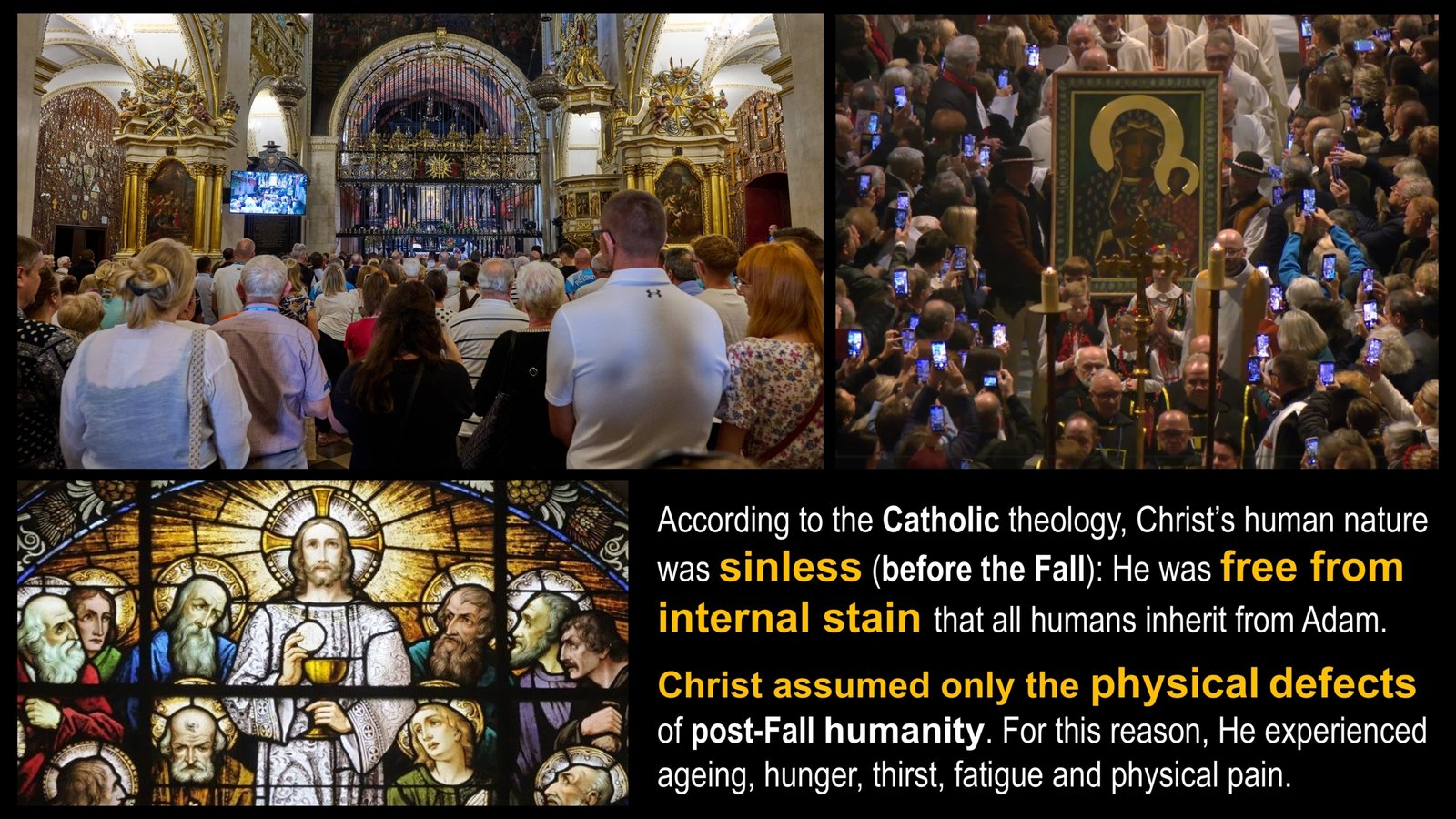
George R. Knight 
George R. Knight (1941–) is a Seventh-day Adventist historian, theologian, and professor emeritus of church history at Andrews University. Knight rejects Universal Legal Justification (ULJ)—the teaching that the entire human race was objectively and legally justified at the cross before personal faith. He argues instead that Christ provided salvation for all humanity, but that justification is received through faith: “Faith is the condition of salvation.” (George R. Knight, Sin and Salvation: God’s Work for and in Us, p. 85.)
Discussing Romans 5:18, one of the main texts used to support Universal Legal Justification, Knight states: “Without doubt Christ died for the sins of ‘everyone’ (see Heb. 2:9), but that does not imply universal justification. The ‘many,’ of course, are those who have complied with the faith condition that Paul has so aggressively argued for in Romans up to this point.” (George R. Knight, Sin and Salvation: God’s Work for and in Us, p. 86.)
There is no doubt that the above statement is not correct. According to Sequeira and many leading Protestant biblical theologians (quoted above), “the many” in Romans 5:15,19 refers to “all” sinners (Romans 5:18), and not to believers only. As all are condemned as a result of the first Adam’s sin, also all were saved as a result of the second Adam (Chris’s) perfect obedience in our representative flesh and His death.
Therefore, the salvation of all sinners was already accomplished by God on the cross (2 Cor. 5:14, 19; Rom. 5:10). Our role is to receive this historic fact we have in Christ with genuine faith. In this case, however, faith does not contribute to our salvation; it only acknowledges something which has been already accomplished.
In the popular evengelical gospel promoted by Knight and other Adventist theologians, God did not yet actually save anyone on the cross but provided a provision of salvation which first requires faith, making sinner’s faith a contributor to our salvation. Therefore, this substitutionary slavation theory can be regarded as a subtle form of legalism (Galatianism), salvation by faith plus human factor.
Above, I have included statements by many renowned theologians who clearly support Sequeira’s interpretation of Paul’s universal statements.
Discussing 2 Corinthians 5, another important passage often used to support of ULJ, Knight writes: “The real meaning concerning who is justified in 2 Corinthians 5 is that it is those who are ‘in Christ’ (verses 17–20).” (George R. Knight, Sin and Salvation: God’s Work for and in Us, p. 86.)
For Knight, however, those who are “in Christ” are believers only. Sequeira strongly disagrees with this interpretation. According to Sequeira and many leading biblical theologians, “in Christ” in this context embraces the entire human race: all sinners, past, present and future, were included in Christ in His representative saving work. This is why Paul can say that when “One died for all,” therefore “all died” (2 Cor. 5:14), and that “God was in Christ reconciling the world to Himself” (2 Cor. 5:19).
Here Knight makes another false interpretation, because there can be no doubt that in 2 Corinthians 5:14 and 2 Corinthians 5:19 Paul clearly states that it was not believers only, but “all” who died when “One” died, and that “God was in Christ reconciling” not believers only, but the entire “world” — all sinners — to Himself. Paul confirms this idea in Romans 5:9-10 where he states that God reconciled us to himslef (saved us), not when we were blievers, but when we were unbelievers and anemies!
To be honest, I find it difficult to understand how any theologian could carefully study 2 Corinthians 5 and conclude that Paul is referring only to believers in these statements. I am ashamed that well-known leading Adventist theologians including Knight, Rodriguez, Dederen could present such interpretation.
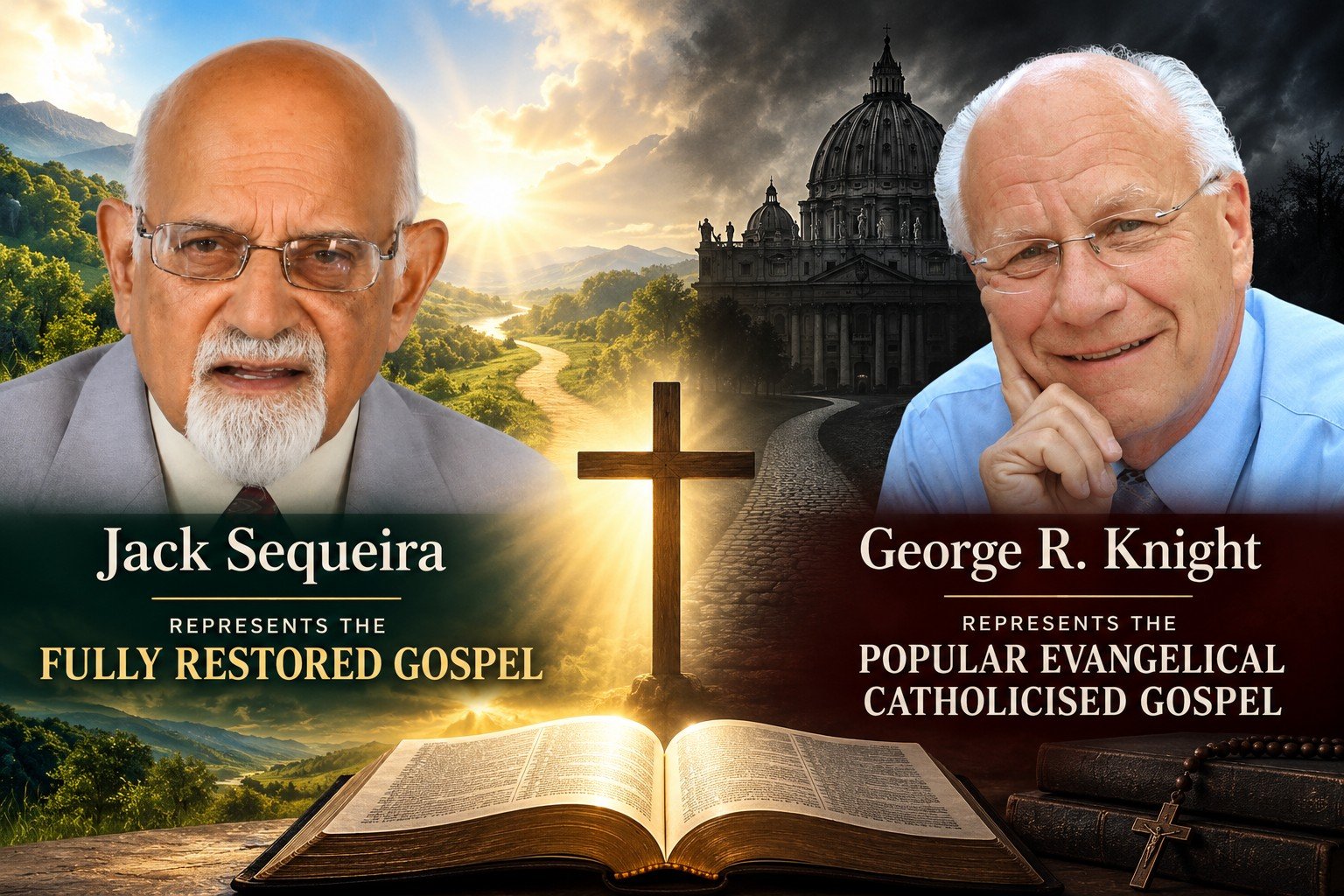
THE CATHOLIC PARALLEL: SEPARATING CHRIST FROM THE HUMANITY THAT NEEDED REDEMPTION
Knight also differs from Sequeira concerning the humanity Christ assumed. He accepts that Christ took humanity after the Fall and experienced its physical weaknesses, but he does not believe Christ inherited moral and spiritual dimension of fallen human nature, meaning that His human nature was deprived of the indwelling “law of sin” (from Romans 7 and Romans 8:2-3).
There is another serious consequence of the position represented by George Knight, Raoul Dederen, Ángel Manuel Rodríguez and a number of other modern Adventist theologians. Although these writers do not formally accept the Roman Catholic doctrine of the Immaculate Conception of Mary, their understanding of Christ’s humanity produces an important Christological parallel with the result achieved in Catholic theology: Christ becomes separated from an essential aspect of the fallen humanity He came to redeem.
The Roman Catholic doctrine of the Immaculate Conception teaches that Mary herself, from the first moment of her conception, was preserved from original sin. Pope Pius IX formally defined the doctrine in 1854, declaring that Mary was preserved “free from all stain of original sin.”
This Catholic doctrine provides a theological means of maintaining that Christ genuinely received His humanity from Mary while remaining free from the inherited sinful condition attributed to ordinary descendants of Adam. Mary herself is first made an exception to the ordinary fallen condition of humanity; Christ can consequently receive humanity through a mother preserved from original sin.
Adventists such as Knight, Dederen and Rodríguez do not need an immaculate Mary to reach a partly similar Christological result. They reject the Catholic doctrine, yet the crucial question remains: If Christ inherited our physical infirmities but was exempted from the deeper fallen condition and sinful propensities regarded as characteristic of ordinary fallen humanity, has His humanity not again been separated at a crucial point from the humanity that actually needed redemption?
The theological mechanism is different, but the resulting Christological separation deserves serious attention.
This does not by itself prove that Knight, Dederen or Rodríguez consciously intended to introduce Catholic theology into Adventism. Intention would require separate historical evidence. But theological ideas must be judged by their consequences regardless of intention. An Adventist Christology can reject the Immaculate Conception by name while nevertheless moving toward a comparable separation between Christ’s humanity and the fallen humanity He came to redeem.
Knight’s reinterpretations are considered by critics as a attempts of Catholicising and ecumenical trend within modern Adventism, associated in different theological areas with figures such as Raoul Dederen, Ángel Manuel Rodríguez, Jon Paulien and others. From this perspective, distinctive historic Adventist teachings that created a clear theological separation between Adventism and Roman Catholicism have progressively been weakened, reinterpreted or abandoned, making Adventism increasingly compatible with the wider ecumenical movement.
A particularly important example is the interpretation of 666 in Revelation 13:18. Historic Adventist interpreters famously connected the number with the papal designation Vicarius Filii Dei, whose Roman-numeral letters total 666. Rodríguez moved away from making this identification the primary meaning of the number and promoted a symbolic interpretation:
“It appears that the triple six stands for the satanic triumvirate in contrast to the triple seven of the Godhead in Revelation 1:4–6.” (Ángel Manuel Rodríguez, Adult Sabbath School Bible Study Guide: Great Apocalyptic Prophecies, April–June 2002, pp. 85–86.)
Jon Paulien also rejects the traditional Adventist interpretation that 666 refers to the papal title Vicarius Filii Dei. Instead, he interprets 666 mainly as a symbol of human imperfection and rebellion against God.
From this critical perspective, these developments are not insignificant academic adjustments. They Catholicise Adventism by removing or weakening doctrines and prophetic interpretations that historically distinguished the Seventh-day Adventist message from Roman Catholic theology. The resulting theology is considerably more Catholic-friendly and makes Adventist participation in the wider ecumenical movement easier. Critics see this movement as ultimately serving the ecumenical objective of bringing separated Christian bodies increasingly closer to Rome.
Clifford Goldstein 
I greatly appreciate Clifford Goldstein’s (1955 -) writings and sermons referring especially to the Biblical truth on the Heavenly Sanctuary. Unfortunately, to my surprise, some time ago I have discovered that he expressed his belief that Christ’s salvation didn’t embrace the entire world but only believers. In his article, “1888 and All that …” which appeared in the Adventist Review on 25th of April 2002, Clifford Goldstein wrote: “Nothing in Ellen G. White writings teaches universal legal justification … Why in all of Ellen White’s writings does no book, no chapter, no article, or even a simple full paragraph, spell out in unambiguous terms the idea of universal legal justification prior to personal faith?” (link)
Unfortunately, it appears that Goldstein wrote the last sentence without in-depth research into this subject. The ULJ does not claim that any sinner will be saved without accepting salvation through genuine faith. Rather, it opposes the idea that faith itself contributes to or merits our salvation. This truth was expressed by theologians long ago. An excellent example is the following statement by Edward Irving (1792–1834):
“The redemption of the world is a past fact. The work of the Cross was the re-creation of the human race in Christ. Faith does not make it so; it only acknowledges what is already true in the Second Adam.” — The Incarnation of the Word (1828), Sermon 1.
Goldstein’s claim is simply false because inspired apostle Paul clearly wrote that “God was in Christ reconciling the WORLD (all sinners) to Himself” (2Corinthians 5:19) and that Christ didn’t wait until we believe in order to save us but He saved us when “we were yet sinners” and “God’s enemies” (Romans 5:8-10).
It means that God saved us before we believed and accepted the gift. There are many universal Bible statements that give undeniable evidence that God already and actually saved in Christ the entire world (all past, present and future sinners) two thousand years ago without asking any of us for our approval or faith. He first unconditionally saved all sinners and the only thing He expects from us after saving us is to accept His supreme gift of love.
Unfortunately, Goldstein, like other antiuniversalists, believes that salvation was only provisional and sinners must first believe, and only then they can be saved.
Let me try to explain the subtle but important DIFFERENCE BETWEEN THE TWO VIEWS OF SALVATION.
UNIVERSAL LEGAL JUSTIFICATION: Imagine you are completely broke but someone transfers £1 million directly into your bank account as a free gift before you even know about it. The money is already there and already yours. You don’t need to apply for it you just need to use it. Likewise, believing the good news does not cause the transfer. Faith simply acknowledges the gift and enjoys what has already been given.
PROVISIONAL SALVATION: Now imagine someone promises you £1 million, but your account still shows £0. The money is prepared to be transferred, but it can’t be yours until you first apply for it. Here, you have to do something to make it happen. Likewise, in provisional salvation model, faith must come first then the gift becomes yours. Here faith of the believer contributes to salvation and the concept becomes a subtle form of legalism!

Goldstein was also wrong concerning Ellen White as she does teach universal legal justification and this truth even permeates her writings. In The Desire of Ages alone, in the chapter “Calvary,” she often uses phrases such as: “saved the sinful race”; “embraced the world”; “took in every sinner that had lived or should live, from the beginning of the world to the end of time”. “Salvation is like the sunshine. It belongs to the whole world” (DA 307). “The blessings of salvation are for every soul. Nothing but his own choice can prevent any man from becoming a partaker of the promise in Christ by the gospel” (DA 403). “He restored the whole race of men to favor with God. … All that man can possibly do toward his own salvation is to accept the invitation… No sin can be committed by man for which satisfaction has not been met on Calvary” (1SM 343). “All men have been bought with this infinite price… God has purchased the will, the affections, the mind, the soul, of every human being. Whether believers or unbelievers, all men are the Lord’s property” (COL 326). “With His own blood, He has signed the emancipation papers of the race” (MH 90). “He redeemed Adam’s disgraceful fall, and saved the world” (God’s Amazing Grace, 43). “Christ wrought out a redemption for men… Thus Christ gave to humanity an existence out of Himself. To bring humanity into Christ, to bring the fallen race into oneness with divinity, is the work of redemption” (1SM 250, 251). “The atonement for a lost world was to be full, abundant, and complete. Christ’s offering was exceedingly abundant, reaching every soul that God had created” (YI, July 19, 1900).
I have repeatedly emailed Adventist Review and requested from Clifford Goldstein a Biblical justification for his claim. Unfortunately, I have never received an answer neither from him nor other authors representing Adventist Review.
Larry J. Kane
Dr. Larry J. Kane, a Seventh-day Adventist lawyer and church elder in Indiana, published his Analysis of the Doctrine of Universal Legal Justification [link] in which he claims the following:
– It is not taught in Scripture.
– The “all men” of Romans 5:18 and the “all” of Romans 3:23,24 are only those who believe, not the entire human race.
– Paul’s parallels between the “all men” in condemnation “in Adam” and the “all men” acquitted by Christ are not to be taken literally.
– “Legal justification” comes only “at the point of conversion,” not at the cross.
The response to the above arguments is found in the article “The 1888 Message and Legal Justification” by Robert Wieland
Kwabena Donkor
Kwabena Donkor, in the Sabbath School Lesson ‘Growing in Christ’ (October 27-November 2012), expressed his disapproval of the so common in Paul’s epistles “in Christ” motif and the true substitutionary aspect of salvation in Christ in the following way:
“From the New Testament’s point of view, Christ’s redemptive death is substitutionary. He took our place… Though some reject this idea because they don’t like the notion of someone suffering in place of another (especially in the place of someone who is guilty), that’s the heart and soul of the gospel message“.
In response to this unfortunate statement I have repeatedly sent the following message to the GC of the SDA Church, BRI, Ministry Magazine, and obviously the Office of the Adult Bible Study Guide of the General Conferenc

The most direct historical and theological critique against modern formulations of Universal Legal Justification within Adventism has been articulated by church historian and theologian Woodrow Wilson Whidden the Second (1944–2025).
As a long-time Professor of Religion at Andrews University and a respected scholar who authored definitive biographical and historical assessments of the 1888 messengers, Whidden wrote extensively to counter the specific corporate legal definitions popularized in the late twentieth century.
He contends that the New Testament contains no evidence of an objective legal justification that occurs prior to or independent of individual faith. Whidden argues that the Greek term dikaiosis in the Pauline corpus is strictly conditional upon personal belief and trust in the merits of Christ.
He explicitly countered the universalist framework by stating that “justification is always conditional upon personal, individual faith in Jesus Christ” (Woodrow W. Whidden, The Judgment and Assurance, p. 112).
He asserts that the systematic structure of universal legal justification is an unnecessary theological invention that fundamentally confuses the absolute provision of the cross, which made salvation available to all, with the personal application of justification, which occurs only when an individual chooses to believe the gospel.
In his landmark theological biography, E. J. Waggoner: From the Physician of Good News to Agent of Division, Whidden actually takes a highly calculated position on whether Waggoner taught Universal Legal Justification.
Whidden carefully splits Waggoner’s theological career into distinct chronological phases. He argues that during the pivotal 1888 Minneapolis session and the immediate years following, Waggoner did not teach ULJ, but instead maintained an individual, faith-centered view of forensic justification.
According to Whidden’s analysis, it was only later, beginning around 1894 and expanding fully by 1897, that Waggoner transitioned into teaching a literal form of universal justification.
However, Whidden heavily critiques this later development, arguing that Waggoner’s eventual embrace of universal justification was not a sound extension of the 1888 message, but was instead the problematic byproduct of his slide into pantheistic and mystical concepts of the atonement, where Christ was viewed as literally dwelling and crucified inside every human being. By establishing this timeline, Whidden seeks to demythologize the claims of modern ULJ advocates by asserting that Waggoner’s universalist language belongs to his period of theological decline rather than his premier 1888 framework.
During the landmark 1895 Armadale camp meeting in Melbourne, Australia, William Warren Prescott preached a series of christological sermons that serve as an unassailable historical defense of the Universal Legal Justification model. Speaking directly in the presence of Ellen G. White, who sat on the platform and enthusiastically endorsed his presentations, Prescott articulated a sweeping, corporate “In Christ” motif that perfectly mirrors the theological framework later championed by Ellet J. Waggoner. Prescott proclaimed that when Jesus Christ took upon Himself our corporate human flesh, the entire human race was gathered into His divine person, meaning that when He died on the cross, the collective human family legally paid the penalty of the broken law in Him.
This objective, universal breakthrough at Calvary cleared the legal slate of the condemnation inherited from the first Adam, establishing a done thing on God’s part that granted a verdict of acquittal to all humanity. The strategic presence and overt approval of Ellen White during these Armadale sermons provides a powerful historical shield for Waggoner’s own expressions of universal legal justification. It demonstrates that the corporate, objective legal framework was not a late, aberrant slide into pantheism or a theological departure from the 1888 message, but was instead the very heart of the message preached by the church’s top leaders and validated by the prophetic gift as the true, unadulterated gospel of righteousness by faith.
Historians point to a sharp, visible shift in Waggoner’s theological vocabulary immediately following the Armadale camp meeting. Prior to 1895, Waggoner’s defense of righteousness by faith focused strictly on standard Pauline terms of justification and the law in Galatians.
However, after Prescott’s Armadale series—which revolutionized Adventist Christology by introducing the concept of Christ taking a corporate, fallen human nature—Waggoner’s articles in The Present Truth underwent a radical transformation. He began heavily using Prescott’s exact structural arguments regarding the corporate “Second Adam,” the concept that the entire human race was organically “In Christ” during the incarnation, and the declaration that a literal legal acquittal was passed upon all men at Calvary.
The ultimate evidence of Prescott’s influence on Waggoner appears in Waggoner’s masterwork, The Glad Tidings (published in 1900). In this commentary on Galatians, Waggoner synthesizes the universal legal concepts that Prescott pioneered at Armadale in the presence of Ellen White. Waggoner explicitly uses the corporate framework to argue that because Christ joined Himself to all human flesh, His death on the cross legally acquitted the entire race.
Far from working in isolation, Waggoner absorbed Prescott’s Australian presentations through the denomination’s international press network, using Armadale’s highly endorsed Christology to construct the robust, unconditional model of Universal Legal Justification that defined his late-career theology.
Jiri Moskala
Representing contemporary, mainstream academic leadership at the Seventh-day Adventist Theological Seminary, Jiri Moskala (1952–Present) provides a highly influential and systemic critique against the universal legal framework.
As a prominent Czech-born Professor of Old Testament Exegesis and Theology who served for many years as the Dean of the Seminary at Andrews University, Moskala argues that the systematic construct of an objective, universal legal justification at the cross creates a profound logical distortion of the biblical sanctuary doctrine and the pre-advent investigative judgment.
He maintains that if the entire world was objectively and forensically justified at Calvary, then the interactive process of the heavenly sanctuary and the subsequent judgment loses its organic, biblical meaning.
Moskala teaches that while salvation was fully provided and global reconciliation was completely accomplished as an objective reality at the cross, justification remains a deeply relational and forensic verdict that God pronounces exclusively over those who choose to enter into a covenant relationship with Him through personal faith.
He clearly summarized this position by writing that “the cross made salvation objectively available to all, but justification is only applied to those who respond in faith” (Jiri Moskala, The Gospel According to God’s Sanctuary, p. 78).
Herbert E. Douglass 
Alongside other traditional historic scholars, Douglass (1927–2014) heavily emphasized the postlapsarian human nature of Christ—meaning Christ took human nature affected by the fall—and argued that the final generation must replicate Christ’s flawless victory over sin before the second advent can occur.
He viewed the universal legal framework popularized by Jack Sequeira as a problematic concept that dangerously minimized the traditional Adventist understanding of the cleansing of the heavenly sanctuary, the investigative judgment, and the essential role of cooperative sanctification.
Theological critics of the Last Generation Theology framework frequently point out that the writings of Herbert Edgar Douglass elevate human performance and sanctification to a functional condition for the final completion of salvation. By dividing the mechanics of salvation into a divine part and a human part, his system subtly introduced a cooperative formula where human effort in overcoming sin completes the legal equation.
This emphasis on human maturity as a prerequisite for the close of earth’s history shifted the ultimate focus of redemption from the objective work of Christ on the cross to the subjective behavior of believers. Douglass explicitly argued that God is waiting for a whole generation of fallen men and women to follow the example of Christ, live as He lived in His humanity, and finally vindicate the character of God (Herbert E. Douglass, The Humanity of Jesus, p. 14).
Evangelical theologians within Adventism contend that this framework promotes a subtle form of legalism by transforming sanctification from a natural fruit of salvation into a co-condition for it. By maintaining that Christ’s return is entirely contingent upon a final generation achieving absolute, sinless character maturity, the system makes the ultimate culmination of the plan of salvation dependent upon the flawless performance of human flesh rather than the finished, all-sufficient sacrifice of Jesus Christ.
Colin & Russell Standish (Hartland)
The most crucial and magnificent component of the holy Gospel truth, the “in Christ motif”, is not only forgotten in our Churches but even attacked, especially by some independent ministries such as Hartland represented by Colin and Russell Standish. Below I included the link to their short and very poorly reasoned article opposing the biblical truth of the corporate salvation of all of us in Christ. They try to deny this message, originally presented by inspired Apostle Paul, and at the present time promoted in our Church especially by Pastor Jack Sequeira >, using a few primitive arguments which are based on taken out of context Bible verses: link
Here is, for example, what Colin and Russell Standish (Our Firm Foundation) wrote in the article “The Dilemma of the In Christ Motif”: “To imply that we were in Christ mystically when He died so that in that sense we paid the penalty for our own sins is surely an abomination and blasphemy.”

Colin D Standish
When I read that statement I couldn’t understand how someone who must had noticed the very frequently present in Paul’s epistles “in Christ universal motif” and who must be acquainted with the previously mentioned and adorned by Ellen White sermon by Professor Prescott, could write that the idea according to which we were in Christ and were saved in Him is a blasphemy!
This very hostile attitude toward this truth is an unexplainable mystery to me all the more since there is no reason to oppose it, unless this enmity is inspired by the most dogged enemy of Jesus and His Gospel. This opposition expressed by BRI and Hartland is unexplainable and unjustified because it is very clear in the inspired Paul’s writings that we all were in Christ, and that we were punished and died in Him (Rom 6:6,8; Rom 7:4; 2Cor 5:14; Gal 2:20).
Pastor Sequeira was once invited by Hartland leaders for a public discussion. As a result of that debate, ten young pastors changed their views and couldn’t identify themselves anymore with Hartland teachings as they realised that their leaders were opposing the truth of the gospel using Bible verses and Ellen White quotes out of context instead of proving their point in a systematic biblical way. The above video is the best example of how they manipulate the Bible and writings of Ellen White. Read or watch Sequeira’s seminars on Romans and you will see a huge difference.
Responding to one of the articles I have shared on FB, certain Brother wrote the following words: “My pastor, E.H. (Jack) Sequeira coined the phrase ‘in Christ motif’ years ago. And he has met resistance from every quarter, from the G.C. to Independents. Some have even blatantly sinned against the 9th Commandment, without repentance in several false accusations against his book, Beyond Belief (>). Others in leadership roles wanted to burn it. A cruel slanderous spirit rules these men. They will meet their Maker one day and regret their wicked hearts. By then it will be too late. I have met others who condemned his works. And when asked if they had read his writing, they said, ‘no;’ they heard it from someone else. Thus, we see the chain of sin.”
Dennis Priebe
Pastor Dennis Priebe was born in 1942. He is a prominent ordained minister, author, and theologian who has served the Seventh-day Adventist Church for more than 50 years. He spent over a decade teaching as an assistant professor in the religion department at Pacific Union College and later transitioned into a full-time revivalist role.
For the past three decades, he has traveled extensively under the Amazing Facts ministry umbrella, conducting over 1,000 seminars across the United States, Canada, and Australia. Priebe is widely recognized for his conservative theological focus, specifically his teachings on righteousness by faith, the human nature of Christ, and Last Generation Theology.
Dennis Priebe was firmly against the “universal legal justification” and the specific “In Christ” motif popularized by Jack Sequeira. As a leading proponent of Last Generation Theology (LGT), Priebe argued that Sequeira’s theology compromised the necessity of actual, experiential character perfection and the human role in the final generation.
In his analysis of Sequeira’s theological framework, Priebe explicitly identified what he viewed as the danger of isolating justification from character transformation: “It has become quite popular to say that sanctification is a fruit of the gospel. In other words, we have been saved by justification alone, and sanctification is the fruit or result of our being saved… One author believes salvation to be based on justification alone, declaring the ‘the righteousness God produces in us has no saving value.’ (Jack Sequeira, Beyond Belief, p. 170)” — Dennis Priebe, Do We Have An Adventist Gospel? / Current Issues In Sanctification by Faith
Priebe’s opposition is rooted in a fundamental clash over how salvation, the investigative judgment, and the end times function: Rejection of “Justification Alone”: Sequeira’s “In Christ” motif states that God legally justified the entire corporate human race at the cross, meaning a person’s qualification for heaven is entirely complete “up front” via imputed righteousness.
Priebe argued that this “evangelical form of the gospel” reduces sanctification (holy living) to a mere optional byproduct rather than a saving requirement. The Problem with Universal Legal Justification: From Priebe’s traditionalist perspective, teaching that future sins are covered under an “umbrella of grace” or a universal legal standing undercuts the necessity of overcoming sin.
Priebe maintained that for the investigative judgment to have meaning, believers must actually achieve total behavioral perfection. He argued that Sequeira’s framework “lessens the obligation of the divine law” by claiming that the inward righteousness produced by the Holy Spirit holds no saving value in qualifying a believer for heaven.
ARGUMENTS AGAINST PRIEBE’S TEACHINGS
Dennis Priebe (representing the “Last Generation Theology” position) argues against ULJ, claiming it reduces the necessity of character perfection, compromises the investigative judgment, and falsely teaches that sanctification plays no role in a believer’s ultimate salvation.
Where Priebe sees ULJ as a dangerous doctrine that promotes spiritual complacency and minimizes the high calling of the law, Sequeira counters that Priebe’s theology risks sliding into legalism, shifting the believer’s focus from the perfect, finished work of Christ to their own imperfect, subjective performance.
You can watch this video presentation on the Two Dimensions of Salvation where Jack Sequeira expands on how the objective work of Christ on the cross relates to the subjective experience of the believer.
Priebe argues that both justification and sanctification carry saving value and require a similar cooperative human effort of self-surrender. Sequeira directly rejects this, writing that mixing the two compromises the purity of grace: The objective gospel (the imputed righteousness of Christ) is what qualifies us for heaven—both now and in the judgment. The subjective gospel (the imparted righteousness of Christ) does not contribute to our qualification for heaven; it gives evidence of the reality of Christ’s imputed righteousness in the life (Beyond Belief, p. 11, 36).
The objective gospel, which is the imputed righteousness of Jesus Christ, is the sole and exclusive qualification for heaven. The subjective work of the Holy Spirit inside the believer, known as imparted righteousness or sanctification, does not contribute a single fraction to a person’s legal qualification for heaven; it merely functions as visible evidence of the reality of Christ’s imputed righteousness already active in the life. Turning sanctification into part of the saving ground of salvation shifts the focus from Christ’s flawless history to imperfect human performance.
God actually, objectively, and unconditionally altered the legal status of all humanity at the cross, justifying and reconciling the entire race by that singular historical act. Jesus Christ did not merely provide a potential, provisional rescue package that human beings must complete or secure through their own behavioral efforts. Because Christ is the corporate Second Adam, the entire human race was gathered into His divine person; when He died, the corporate race paid the penalty of the broken law, legally reversing the condemnation brought upon humanity by the first Adam.
Human beings are born into Adam’s condemned state without personal choice, but that corporate guilt was legally canceled by the corporate justification accomplished at Calvary. Consequently, the investigative judgment is not a terrifying process of measuring whether a believer has reached flawless character perfection to secure their salvation. The only reason any individual will face ultimate destruction is not because of inherited sin or human falling short, but because they deliberately choose to reject, push away, or opt out of the universal gift of justification that has already been legally granted to them.
Dennis Priebe explicitly denies legalism, framing his views as a defense of historic Adventism against cheap grace and antinomianism. However, Sequeira and other critics point directly to Priebe’s own written statements to demonstrate how his theology operates as functional legalism:
Priebe writes that sanctification “fits us for heaven, entitles us to heaven, and qualifies us for heaven. Without complete sanctification we are not entitled to heaven. … Sanctification is a necessary part of the saving process… Without holiness, we will not see God.” (Current Issues in Sanctification by Faith) Critics argue that defining human holiness as an “entitlement” or “qualification” for heaven explicitly undermines salvation by grace alone through Christ’s merit.
Priebe states that “the reality is that exactly the same kind of human effort is involved ‘in both justification and sanctification.’ … The greatest effort involves the perennial struggle to subdue self-will.” (Current Issues in Sanctification by Faith) Sequeira notes that if human effort is injected into justification, salvation becomes a cooperative human-divine effort rather than a resting in Christ alone.
Priebe asserts that “justification and sanctification are part of one process of salvation… If we separate them and make one part more important to salvation, we do violence to the gospel of Christ…” (Current Issues in Sanctification by Faith) Critics counter that this integrated process destroys the Pauline distinction and makes internal growth part of being saved.
Priebe explicitly declares that “there is a major attempt… to separate the transforming power of the Holy Spirit from justification… This unbiblical separation encourages Christians to tolerate sin… Obedience is clearly a condition of salvation.” (Current Issues in Justification) Making human obedience a causative condition—rather than a fruit—shifts the basis of salvation to a combination of Christ’s work plus human response.
For Sequeira, this creates a dangerous “as long as” loop: a believer feels they are right with God as long as they are performing victoriously. This conditional logic is the very essence of legalism, even when wrapped in the language of grace.
Stephen Bauer
Stephen Bauer serves as Professor of Theology and Ethics at the School of Religion at Southern Adventist University in Collegedale, Tennessee, where he has taught since 1999. His theological stance aligns strictly with the Biblical Research Institute (BRI) position.
- Bauer argues that the New Testament Greek uses the preposition hyper (“for” or “in place of”), which strictly supports a vicarious (one-for-one substitutionary) death. He rejects Sequeira’s idea that Christ died “as us” (hōs), insisting Christ died “instead of us”.
- Traditional Adventist sanctuary theology depends entirely on the concept of a literal transfer of sin from the repentant sinner to the innocent sacrifice, and eventually to the heavenly sanctuary. Because Universal Legal Justification (ULJ) rejects the transfer mechanism as “unethical,” Bauer argues it completely undermines the structural viability of the sanctuary doctrine.
- Bauer asserts that Sequeira’s anti-vicarious stance matches the late, problematic views of E.J. Waggoner around 1900, which introduced pantheistic overtones that Ellen White ultimately rejected. He notes that historical figures like Waggoner in late 1888, along with Ellen White in 1892, clearly affirmed the vicarious nature of the atonement.
- Bauer argues that ULJ reduces justification by faith to a mere psychological awareness of a past corporate reality, whereas scripture and Ellen White present justification as an individualized, forensic status granted in the present moment only when an individual actively repents and believes.
- Bauer argues that for vicarious substitution to be legally valid, the substitute must be completely detached from the corporate guilt and moral pollution of the race. If Jesus had a fallen human nature that was corporately or ontologically blended with sinful humanity, He would legally require a savior Himself. Therefore, Bauer maintains that Christ’s human nature was entirely sinless, qualifying Him to be the spotless Lamb upon whom sins could be legally transferred.
REFUTING BAUER’S ARGUMENTS
1. The Prepositional Unity (Hyper vs. Hōs)
Bauer attempts a grammatical trap, claiming that the Greek preposition hyper (“for/in place of”) strictly means an individualistic trade, completely ruling out the concept of hōs (“as us”). By doing so, Bauer forces an artificial, modern Western separation onto a first-century Hebrew concept of corporate representation. In biblical thought, hyper and hōs are two sides of the same coin. Bauer hides the fact that Sequeira fully agrees that in a very real sense, Jesus died instead of us, suffering the physical and mental agony of the second death so that we do not have to. However, this “instead of us” reality can only stand upon an “as us” legal foundation.
Consider a nation’s champion (like David fighting Goliath) or a King leading an army. The King fights instead of his people (hyper) so they don’t have to fight individual battles; but he can only do so because he stands as their representative head (hōs). If the King wins, the nation wins; if the King falls, the nation falls. Christ died instead of us in suffering, but He could only do so on behalf of us because He at the incarnation He was qualified to be our Brother in the flesh, or representative, and because He corporately included us in Himself as the Second Adam (second humankind).
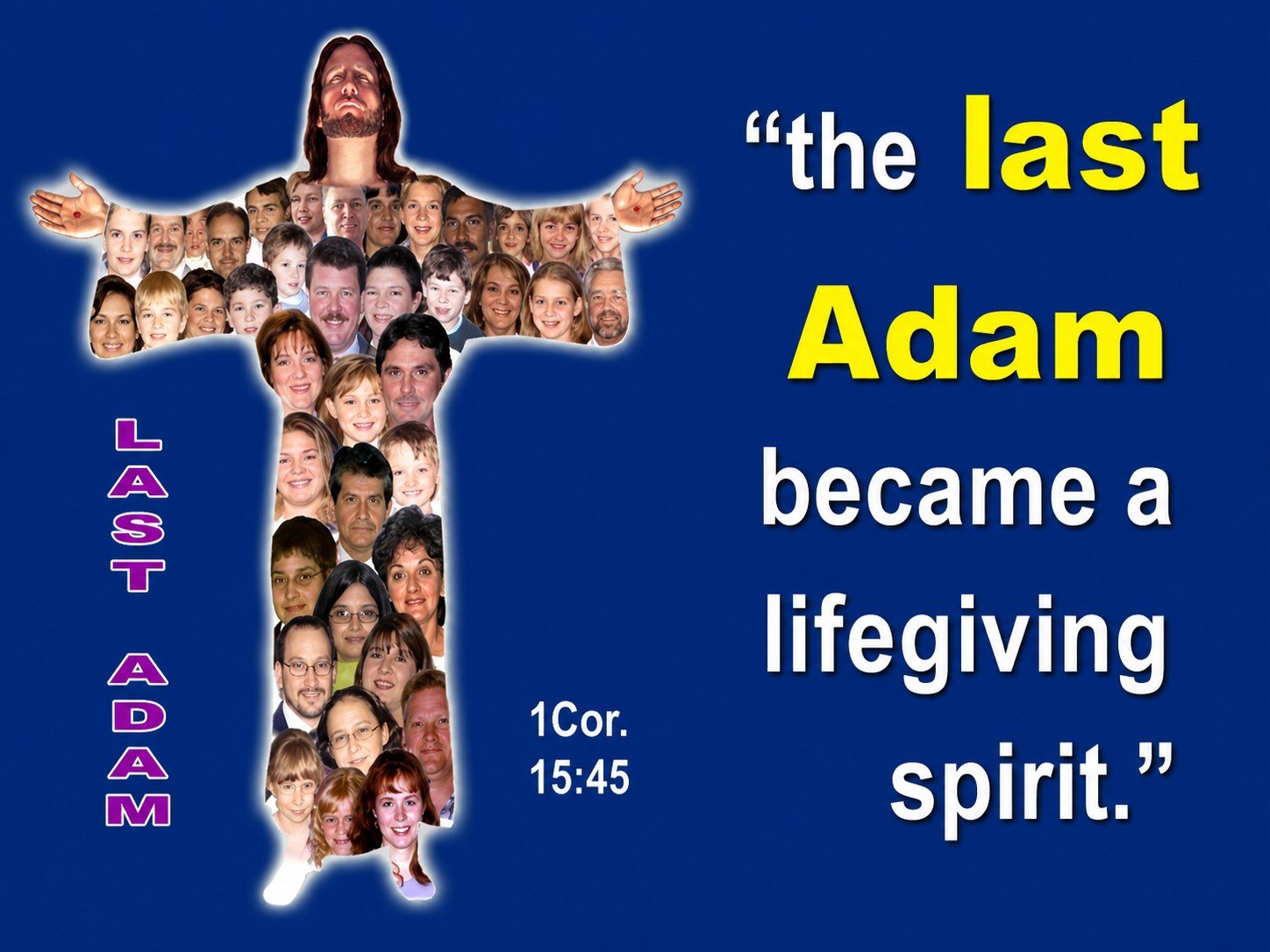
2. The Sanctuary Mechanism and Root vs. Fruit
Bauer’s critique focuses heavily on the Old Testament sanctuary service where an individual confessed dynamic, individual sins (plural acts) onto an animal. He uses this to argue that atonement is only about transferring individual bad deeds, which completely undermines the sanctuary if rejected. However, Bauer’s model only cures the symptoms of sin, not the source. If Christ only takes our plural sins (the fruits), the law of sin in our members (the root, or the carnal nature) remains legally unaddressed and unpunished by the cross.
Sequeira’s “tree and fruit” analogy is a devastating counter-argument. You cannot kill a tree by picking its apples; you must strike the root. At the Incarnation, Christ became the trunk of the human tree. When He died, He didn’t just pay for our bad actions instead of us; He executed the root—the carnal, inherited nature of Adam. When the tree is cut down, the fruits go down with it. The sanctuary framework is perfectly preserved because the legal cancellation of our plural sins is an automatic, structural consequence of the execution of our corporate nature.
Paul explains in Hebrews that the animal sacrifices were only “a shadow of the good things to come, and not the very image of the things” (Hebrews 10:1). They revealed Christ’s substitutionary death, but only in a limited and imperfect form, because an animal could never fully represent Christ as the second Adam or contain the corporate life of humanity. A lamb could die instead of the sinner, but it could not unite the sinner to itself so that the sinner died in it. Christ, however, became genuinely one with mankind; therefore, when He died, “all died” in Him (2 Corinthians 5:14). This is the deeper reality that the animal sacrifices could only foreshadow. Jack Sequeira, The Sanctuary
Other sanctuary symbols reveal this representative and corporate dimension more clearly. The high priest carried the names of the twelve tribes on the stones upon his shoulders and over his heart when he entered God’s presence (Exodus 28:9–12, 15–21, 29). He did not appear merely as a private individual but as the representative of all Israel—symbolically bearing the entire covenant people in himself. Likewise, Christ entered the heavenly sanctuary as humanity’s Representative and High Priest. Thus, the sanctuary does not contradict the corporate “in Christ” gospel; properly understood, its combined symbols point directly to it. The sacrificial animal reveals substitution, while the high priest bearing all Israel reveals corporate representation. Both find their complete fulfilment in Christ, in whom the sinful human tree was struck at its root and all its fruits were consequently dealt with.
3. Historical Continuity and the 1888 Armadale Heritage
Bauer tries to associate Sequeira’s teaching with E. J. Waggoner’s later movement towards pantheism. But the two ideas are fundamentally different. Waggoner’s later error blurred the distinction between Christ and creation by speaking of Christ as physically present within the substance of nature and every person. Sequeira does not teach this. He teaches that Christ became the second Adam and legally represented the human race. Humanity was incorporated into Christ representatively at the Incarnation, and its condemned corporate life was executed in Him at Calvary. This was a completed redemptive act in history—not an ongoing physical presence of Christ within all matter or every unbeliever. Corporate solidarity with Christ is therefore neither pantheism nor an extension of Waggoner’s later errors; it is a biblical representative relationship based upon the two Adams of Romans 5 and 1 Corinthians 15.
More importantly, Bauer’s historical argument is contradicted by W. W. Prescott’s Armadale sermons of 1895—before Waggoner’s later pantheistic teachings became evident. Prescott taught explicitly that Christ “gathered together in Himself all humanity,” that “what He did we did in Him,” and that “the whole family in Jesus Christ” was crucified. He then applied Romans 5:18 directly: “As condemnation came upon all men, so justification of life came upon all men. In Jesus Christ all men were justified.” Yet Prescott carefully distinguished this objective accomplishment from its personal enjoyment: justification had been provided for every human being, but it personally benefited only those who received Christ by faith. Thus, the Armadale message contained the essential structure of ULJ: an objective justification accomplished for all in Christ, followed by its subjective acceptance and experience through faith. W. W. Prescott, Corporate Solidarity in the 1895 Armadale Sermons
Ellen White strongly endorsed Prescott’s preaching at Armadale. She wrote that God had given him “a special message for the people,” that the truth was flowing from him “in rich currents,” and that it was being presented with “the demonstration of the Spirit and power of God.” She also described his teaching as “precious as gold” and said that he presented “the truth in such new lines,” separating truth from error and making it shine “like precious jewels.” These statements do not necessarily make every sentence Prescott uttered infallible, but they make it historically unreasonable to dismiss his corporate “in Christ” message as merely a product of Waggoner’s later pantheism. Ellen G. White, Manuscript 23, 1895
Critics such as Woodrow Whidden argue that Waggoner and Jones could not have taught ULJ because they frequently described justification as a personal, heart-changing experience received through faith. But this creates a false choice between objective and subjective justification. The 1888 framework included both. Objectively, God acted in Christ for the entire human race without waiting for anyone’s faith or consent. Subjectively, the individual must receive that accomplished gift by faith, resulting in peace with God, regeneration and obedience. Statements that justification makes the believer a doer of the law therefore do not disprove ULJ; they describe the personal experience and fruit of an objective gift already provided in Christ.
The strongest historical evidence is the unmistakable language used by both Waggoner and Prescott. Waggoner wrote concerning Romans 5:18: “As the condemnation came upon all men, so the justification came upon all men. God leaves no room for anyone to introduce any restrictive clauses. The gift has come to all. The fact that it is a free gift is proof enough that it is not dependent upon any action on our part.” Prescott expressed the same distinction at Armadale: God “has done all for justification to every human being,” while the individual apprehends and applies that justification by faith. Faith, therefore, does not persuade God to justify us or create a legal reality that did not previously exist. Faith receives, personalises and experiences what God has already accomplished and given to humanity in Christ.
This distinction also answers the accusation of universalism. ULJ does not teach that every person will be eternally saved irrespective of faith. It teaches that Christ is genuinely “the Saviour of all men,” while salvation is personally and eternally enjoyed by “those who believe” (1 Timothy 4:10). The gift truly came to all, but God does not force anyone to retain it. Unbelief does not mean that no gift was given; it means that the gift is resisted and rejected. Consequently, the lost are not condemned because Christ excluded them from His saving act, but because they rejected the justification and life already provided for them in Him. This preserves both the universality of God’s saving action and the necessity of personal faith without collapsing into either pantheism or universal salvation.
4. The Timing of Justification and Cosmic Double Jeopardy
Bauer claims that if the world was legally justified in AD 31, it leaves no room for Christ’s ongoing mediation in the heavenly sanctuary, reduces justification to a mere psychological awareness, and means humans are born saved.
This position completely confuses an objective legal provision with a subjective personal experience, and it exposes traditional substitution to a massive crisis of justice called double jeopardy. A just law cannot demand payment for a debt, execute a detached substitute, and then still demand that the original sinner die the second death if they fail to believe. If the debt was legally paid in full by a detached bystander, the law has no legal right to punish the sinner ever again—which logically forces either Universalism (everyone is saved) or a violation of divine justice.
Sequeira’s corporate model completely resolves this by distinguishing between the will of God and the choice of man. Because the human race was corporately bound to Christ as the Second Adam, humanity itself was legally executed on the cross.
“If one died for all, then all died” 2 Corinthians 5:14
This corporate identity is explicitly highlighted by Ellen White herself in her writings on Christ’s baptism: When Jesus was baptized, He represented the entire human race, meaning that in Him all sinners were corporately baptized, cleansed, and accepted by God in the person of His Son (Ellen White, Manuscript 14a, 1897).
Salvation is not a cosmic bookkeeping trick; it is a legal reality where the old, condemned human asset was completely written off, and a new, resurrected human race was created in Christ. At the cross, the legal corporate status of humanity was rewritten from “condemned in Adam” to “justified in Christ.” This is an objective cosmic fact. However, God does not force this new status on anyone. If an individual refuses to believe, they deliberately choose to remain in the “willful legacy” of Adam, staying under condemnation. Christ’s current heavenly mediation is not an ongoing legal trial to see if God can forgive us; it is the active, high-priestly application of the finished, complete victory of the cross to the hearts of those who accept it by faith.
5. Christology and the Legal Ethics of Substitution
Bauer argues that God’s law permits the transfer of guilt from a guilty person to a completely innocent, separate person who must be entirely detached from the corporate pollution of the race. This directly violates God’s own stated definition of legal justice in Scripture: “Fathers shall not be put to death for their children, nor shall children be put to death for their fathers; a person shall be put to death for his own sin.” Deuteronomy 24:16 (see also Ezekiel 18:20)
If Jesus is completely separate from our nature, God violated His own eternal moral law by executing Him. An innocent man cannot legally or ethically take the rap for a guilty man under divine jurisprudence. A detached transfer of guilt turns the atonement into an illegal and unjust transaction.
Sequeira’s model remains unrefuted here because Christ assumed our corporate, fallen human nature (Galatians 4:4, Romans 8:3). While He suffered instead of us as a spotless Lamb, He did so by taking the very flesh that contained the “law of sin” without ever committing personal sin or inheriting personal guilt. Therefore, Christ’s execution was entirely legal and ethical under Deuteronomy 24:16 because the corporate human flesh being executed on the cross was the very flesh that owed the death penalty.
MISSING PILLARS SUPPORTING UNIVERSAL LEGAL JUSTIFICATION
1. The SDA Bible Commentary on 2 Corinthians 5:14
When traditionalists try to argue that “one died for all, therefore all died” only means all were morally dead in trespasses and sins before Christ died, the Seventh-day Adventist Bible Commentary completely refutes them. It stands solidly on the side of corporate execution: The text reads “then all died,” not “then all were dead.” The Greek verb (apethanon) is in the aorist tense, indicating a specific, singular event in past history. The Commentary explicitly recognizes that when Christ died, the entire human race died in Him!
This is a massive blow to Bauer’s model because it proves that the death of “all” was not a description of their spiritual state, but a legal, corporate execution of humanity in the person of Christ at Calvary.
2. W.W. Prescott and the 1888 Armadale Heritage
As mentioned briefly before, W.W. Prescott’s 1885 Armadale sermons in Australia are the historical gold standard for ULJ within Adventism. Prescott openly preached that when Christ took sinful human nature, He took the corporate race into Himself. Therefore, what happened to Christ happened to humanity.
Ellen White did not just tolerate these sermons; she went into holy ecstasies over them, stating that Prescott was preaching the truth “with a clear, certain sound” and that the Lord was pouring out His Spirit. Bauer’s attempt to dismiss this theology as a late, pantheistic heresy is inspired by the enemy and is completely destroyed by Ellen White’s contemporary endorsement of Prescott’s corporate gospel.
3. Ellen G. White on Corporate Baptism
The quote from Ellen White regarding Christ’s baptism is the ultimate theological checkmate against the idea that Christ acted completely detached from us: “As the representative of the human race, He [Christ] was baptized… in Him all sinners were corporately baptized, cleansed, and accepted by God in the person of His Son.” Manuscript 14a, 1897
If “all sinners” were corporately baptized and accepted in Him at the Jordan, then the legal, objective inclusion of the race in Christ is an undeniable fact of her theology.
4. Leading Protestant Theologians
Sequeira did not invent this corporate “In Christ” framework; he recovered it from the New Testament with the help of the world’s greatest New Testament Greek scholars and theologians who recognized that Western individualism has blinded us to Paul’s corporate thought. Titans of biblical scholarship completely back this view:
-
C.H. Dodd & Anders Nygren: Demonstrated that Paul’s concepts of “In Adam” and “In Christ” are solid legal, corporate realities—not mere metaphors.
-
Thomas F. Torrance & Karl Barth: Championed the objective reality of the human race being legally reconciled and recreated in the Incarnation and Crucifixion of Christ before any individual says “yes” or “no.”
UNIVERSAL BIBLE TEXTS
Structural Parallel and Grammatical Symmetry of Romans 5:18
In this passage Paul states that through Adam’s sin condemnation and death came to all, likewise through Christ’s (last Adam) perfection in human flesh and His death justification and salvation came to all.
Stephen Bauer’s individualistic model suffers a fatal logical collapse when confronted with the strict parallel framework Paul constructs in this passage. The Apostle utilizes identical, uncompromised Greek phrasing, meaning “unto all men,” to measure both the reach of Adam’s ruin and the reach of Christ’s corporate rescue.
If Bauer insists that the first half of the verse establishes an objective, unconditional legal status where every single human being was legally bound, condemned, and ruined by Adam without their personal consent, then he is grammatically and logically forced to admit that the second half establishes an equally objective, unconditional corporate legal acquittal for the entire human race through Christ.
According to Jack Sequeira’s model of Universal Legal Justification, faith is absolutely required, but it does not contribute a single iota to the legal value or completion of our salvation, which was finished entirely two thousand years ago at Calvary. Instead, faith functions simply as the human hand that actively receives and experiences a pre-existing legal fact.
To understand this difference, consider a vast inheritance left in a fully funded bank account by a wealthy relative; the money belongs to you completely, and the legal transfer of ownership is a finished historical reality. Your signature on the bank document does not create the money, nor does it add a single penny to the inheritance—it simply activates the benefits of a fortune that was already legally yours.
By contrast, arguing that the second “all” in Romans 5:18 is conditional upon faith as a prior legal requirement turns Paul’s entire argument upside down, violating basic rules of grammar and reducing Christ’s finished cosmic achievement into an incomplete offer that is weaker and less universal than Adam’s destruction.
In Bauer’s (and all other oponennts of ULJ) model of atonement, faith contributes to our salvation. Therefore, salvation is not entirely the work of Christ but depends partly on the believer’s response, making it a subtle form of legalism.
Historical Aorist Execution of 2 Corinthians 5:14 (when One died for all, all died)
Bauer’s insistence that a sinner’s legal status is altered only at the subjective moment of personal repentance is completely dismantled by the historical, objective reality of the cross. Paul declares that if One died for all, then all died, using the specific aorist active verb apethanon, which denotes a single, finished event in past history.
As explicitly recognized in the Seventh-day Adventist Bible Commentary, this means that when the Substitute was punished with death at Calvary, the entire human race bound to Him was legally executed. Christ’s death was not a passive insurance policy waiting for a human signature, nor was Paul describing a state of spiritual deadness; it was a completed cosmic execution of the old human asset, an objective truth that Bauer cannot logically explain if he maintains that humanity remains under legal condemnation until the moment of individual belief.
Completed Judicial Settlement of 2 Corinthians 5:19
By ignoring this text, Bauer overlooks the explicit legal accounting terminology the New Testament uses to define the scope of the atonement. Paul states that God was in Christ reconciling the world to Himself, not imputing their trespasses to them, using the specific forensic auditing term mē logizomenos, which means omitting to charge to an account or writing off a debt.
The text explicitly declares that the recipient of this legal non-imputation of sin is the entire world, not merely the repentant church or the individual believer. At the cross, the global liability of the human race was objectively cleared, establishing a finished, historical reconciliation that exists completely outside of the sinner, proving that the cross changed the corporate legal standing of the world long before any individual responds to the gospel message.
Legal Status of Unrepentant Enemies in Romans 5:10
Bauer’s theological framework demands that a change in legal standing can only occur as a consequence of human faith and turning from sin, yet Paul directly obliterates this sequence in Romans 5:10. The text plainly declares that we were already reconciled to God through the death of His Son while we were still enemies, a status that by definition completely excludes repentance, faith, submission, or spiritual alignment.
This proves that universal legal justification is an objective, cosmic fact accomplished entirely independent of human awareness or cooperation, changing the legal status of the world from “condemned” to “acquitted” in AD 31, long before any individual believer responds to the drawing of the Holy Spirit.
Angel Manuel Rodriguez (BRI)
Much more deceptive, however, and complex arguments against the truth of corporate salvation of sinful humanity in Jesus are presented in articles written by, mentioned before, Angel Manuel Rodriguez (1945 – ) and available on the website of the Biblical Research Institute (BRI) of the General Conference of Seventh-day Adventist Church. link
Apart from his pro-ecumenical tendencies, an attempt to change the meaning of the number 666 from papacy to the alienation from God (link), and the fact that he seems to be one of the Vatican’s favourite Adventist theologians, there is another possible reason to assume Rodriguez has a potential to follow the example of Froom and Anderson. It is the fact that no other Adventist theologian opposes the most vital truth of the in Christ motif and fully restored gospel as strongly as he does.
I was astonished when years ago after reading these articles I discovered they are in open opposition to the most beautiful and holy truth according to which on the cross in Jesus God “reconciled the world to Himself” (2Cor 5:19) and that when Jesus died on the cross then “all died” (2Cor 5:14).
In the 2008 Adult Sabbath School Lessons (Atonement and the Cross of Christ) Manuel Rodriguez wrote: “No one is automatically in Christ apart from a personal faith commitment to Him. Our incorporation by faith into Christ expresses itself in baptism. The importance of this rite is vast. First, it is a public declaration that the death of Christ was our death and that through His resurrection we are part of a new creation, new humanity. Second, we did not die ‘in Christ,’ but we were ‘baptized into his death.’ Through baptism we joined Him in His sacrificial death, thus establishing a permanent relationship with Him. Third, the phrase “baptized into Christ” is interpreted by Paul to mean that we died “with Christ” (Rom. 6:3,8) and that we were made alive “with Christ” (Col. 2:13). This is participatory language, indicating that our death to sin and our new life take place only and exclusively in union with Christ and never apart from Him. In other words, the full benefits of Christ’s death are appropriated by us only when we by faith join Him in His death and resurrection. Dying with Him means recognizing Him as our Savior.”
Evaluating the in Christ concept as taught by the 1888 Message Study Committee, which is also taught by Jack Sequeira, Rodriguez (2011) argues that such understanding of the phrase in Christ is not biblical. He observes that not everybody was at the same time in Christ at the cross. In his opinion, if we were in Christ when He died for our sins, paying the penalty for our sins, then we died in Him; He did not die for me, I actually died for my own sins; I was not saved through Jesus; I saved myself through Him; since I was in Jesus, He was not my Substitute, my sin was not transferred to Him; I took my own sin to the cross in Jesus.
According to Sequeira, it can be asserted that just as individual human beings did not consciously sin when Adam sinned, but were implicated in his fall, in the same way, individual human beings did not consciously obey God when Christ obeyed, but were implicated in Christ’s obedience. Individual human beings did not consciously die on the cross when Christ died, but were implicated in Christ’s death.
Rodriguez claims that there is no text in the New Testament where we read about believers dying in Christ, that is to say, in union with Him. Christ died alone on the cross abandoned by all, including the Father. Our union with Christ designates the experience of the new creature and presupposes the death of the old self. The phrase in Adam does not refer to the presence of every human being in Adam-a type of corporate or mystical presence. in him-but to the spiritual condition in which human beings find themselves as a result of the first Adam’s fall.
Let me give you an example to prove articles by Rodriguez contain false and confusing arguments as he often accuses the biblical truth about corporate salvation of humankind in Christ of certain assumptions that actually don’t even exist in this concept!
For instance, in his article “Some Problems with Legal Universal Justification” Rodriguez claims that, “Legal universal justification separates God’s justifying act from the reception of the gift of the Spirit, or the new birth.”
This assertion is a complete nonsense and only someone who either doesn’t know this truth or is dishonest and intentionally wants to discredit it could write something like that.
According to the Word of God, it is true this legal universal justification, as some call it, means Jesus on the cross actually and legally saved the entire sinful humankind (2Cor 5:19; Rom 5:18; Rom 8:1-3; 2Cor 5:14). However, since God is love this historic fact of legal salvation of all sinners in Christ is not imposed on any sinner but it is offered by God in the form of a supreme free gift. And as it is with any gift, in order to enjoy this gift of already accomplished salvation it must be also accepted. It means that the salvation of a sinner, although already accomplished by our Lord two thousand years ago, is not a compulsory or an automatic process. In order to make this salvation, effective sinners must accept this gift of salvation in Christ with genuine faith. And if this reception of the gift of salvation in Christ is truly accepted through a sincere faith the immediate result is always the new birth!
Galatians 2:20: “I have been crucified with Christ. It is therefore not I who lives but Christ lives in me.” According to Paul, the entire sinful humankind was in Christ and we all were crucified with or in Him and if we only accept this wonderful good news by faith we always experience the new birth, which means now Holy Spirit and Lord Jesus start dwelling in us enabling us to live a truly sanctified life.
Therefore, the gospel message popularised by mentioned above theologians and in the SDA Church especially by Pastor Jack Sequeira (attacked by M Rodriguez) does not “separate God’s justifying act from the reception of the gift of the Spirit, or the new birth”!

Some time ago I wrote to Angel Manuel Rodriguez proving his arguments didn’t have biblical ground and demanding from him to remove his full of misleading errors articles from the BRI website, but unfortunately, and as expected, he refused using arguments that couldn’t be sustained by the Word of God. So finally I had to direct him to the most beautiful but unknown in our Churches sermon “The Word Became Flesh” which was presented in 1895, in the presence of Ellen White, by the leading Adventist theologian – Professor William Warren Prescott.
According to the concept of the gospel presented by him, Jesus didn’t take human sinless nature, He didn’t take the holy nature Adam had before he sinned, but He took the same sinful nature we all possess. And this act gave Him the right to become us, to be our representative. Then, in our flesh, as us and as our great representative Jesus perfectly obeyed God’s law, and finally, He took this our representative flesh of sin to the cross, where it was condemned by God and destroyed forever in Him (in the “flesh“ He took) (Romans 8:3).
According to the clear teaching presented by Professor Prescott, we were in Jesus when He perfectly obeyed the law as us, and we also were in Him when He died experiencing the second death. Thus we actually were obedient in Him and were punished (with the second death) in Him! And that, by the way, is the only way God was able to save us legally (according to the demands of His holy and changeless law). When we accept this true gospel message, then also Romans 3:26, according to which God remains righteous while justifying sinners, is not deprived of its meaning anymore because this way of salvation, unlike the vicarious one, vindicates the law (Romans 3:26). It uplifts the law because instead of changing it or bypassing its demands God saved us respecting all of them in spite of the fact that it involved unimaginable sufferings of His beloved Son.
This most beautiful sermon was delivered by Professor Prescott in 1895 in Armadale (Australia). According to Ellen White, who listened to the sermon, it was inspired by Holy Spirit. The following quote from that most beautiful message, which was later published in the Bible Echo, proves Professor Prescott accepted and preached the very same glories truth of the everlasting Gospel which has been now rejected and attacked by M Rodriguez and the BRI:

“Jesus Christ had exactly the same flesh that we bear, — flesh of sin, flesh in which we sin, flesh, however, in which He did not sin… We were all in Jesus Christ… He was our representative; He became flesh; He became we… All humanity was brought together in Jesus Christ. He suffered on the cross, then, it was the whole family in Jesus Christ that was crucified“.
Below I included the link which will give you the opportunity to read the entire most beautiful and inspired message presented by Professor Prescott including some extremely enthusiastic follow-up comments by Sister White: THE WORD BECAME FLESH
Unfortunately, Rodriguez didn’t get the message and responded that Professor Prescott in his sermon didn’t mean that the entire world was included in Jesus but only believers.
First of all, it was a very hypocritical answer because in his articles Rodriguez never promotes the truth according to which believers were in Jesus but gives the strong impression that nobody was in Him, neither unbelievers nor believers. If he agrees believers were in Christ why then he does not clearly vindicate this great truth in his articles in which he opposed the universal legal justification?
Secondly, the claim made by him that Professor Prescott in his sermon didn’t mean that the entire world was included in Jesus but only believers, is false, and the above quote from Prescott’s sermon proves it as he said, “All humanity was brought together in Jesus Christ. He suffered on the cross, then, it was the whole family in Jesus Christ that was crucified”. Also in another passage taken from the same sermon, Professor Prescott wrote that Jesus, “gathered all humanity unto Himself, embraced it in His own infinite mind, and stood as the representative of the whole human family.” “The life of God was manifested in the flesh—not in a few individuals only, but in humanity. The whole human race was represented in the person of Jesus Christ.” — W.W. Prescott, The Bible Echo, Dec. 30, 1895.
Like Apostle Paul, Prescott sometimes suggests in his sermon that the entire world was included in Christ and sometimes he states that only believers were present in Him simply because although it is true all sinners (including unbelievers) were in Christ when He lived a holy life and died on the cross yet in reality only those who accept this gift can enjoy it and will be actually saved.
Following Paul’s inspired example, Prescott interchangeably places all sinners or only believers in Christ because although all sinners were included in the holy life and death of Christ and were saved by Him yet in reality only believers can enjoy the gift because the historic fact of the salvation of the world in Christ requires acceptance through faith: “What we want in our experience” says Professor Prescott, “is to enter into the fact that we did die in Him. But while it is true that Jesus Christ paid the whole price, bore every grief, was humanity itself, yet it is also true that no man receives benefit from that except he receives Christ, except he is born again.”
Let me repeat it again, the Bible makes it clear that the salvation of the entire world (including all sinners past, present and future) was already accomplished once and for all on the cross over two thousand years ago! (2Cor 5:19) This salvation of the sinful world is complete, perfect and finished and nothing can be added to it! But it is also true that this already accomplished redemption also needs to be “activated” and it is made active and real in our lives only when we truly accept it through genuine faith.
Is it so difficult to understand this truth? No, it is not! But somehow our theologians from BRI still keep the articles opposing the great truth of universal legal salvation in Christ accusing those who try to share this great message of universalism or federalism, although to be honest, almost nobody seems to know what this federalism is all about. Elder Sequeira was accused of preaching this idea of federalism so often that he finally decided to write an article on it [link].
So, it is clear professor Prescott, following inspired Apostle Paul, meant all sinners were in Christ and were redeemed in Him but they also must accept it to receive the benefit of the fact. That is also why Apostle Paul says in 1 Timothy 4:10 that Jesus is the “Savior of all people”, and then he immediately adds, “especially of those who believe.” All sinful human beings were in Jesus when He lived a perfectly holy life and when he died on the cross which means He saved all but because it is a supreme gift of God it must be also accepted by faith in order for this salvation to become effective.
I think elder Sequeira was right suggesting that another proof that also unbelievers were redeemed in Christ is the fact that, like believers, they also will resurrect (in the second resurrection), but since they didn’t accept that gift by faith to make their salvation effective they will resurrect only to eternal death instead of eternal life. Without being included in Christ’s death they would never resurrect after their own death.
A SOLEMN APPEAL
The Restored Gospel vs. Institutional Obstruction
The Seventh-day Adventist Church was raised by God to be the “pillar and ground of truth.” However, for decades, the Biblical Research Institute (BRI) has promoted articles by Dr. Ángel M. Rodríguez and others that systematically oppose the “In Christ Motif” and the Universal Legal Justification of the human race. By mischaracterizing this glorious biblical truth as “Universalism” or “Federalism,” these publications have fostered a “provisional salvation” theory—one that subtly turns faith into a human work and a condition for God’s love.
If we are to be the people of the Loud Cry, we can no longer remain silent while the foundation of the 1888 Message—the corporate victory of Christ over our representative sinful nature—is marginalized or labeled as heresy on official church platforms.
Our Collective Responsibility
While we acknowledge the diversity of independent ministries, we have a solemn, Christ-appointed duty to hold the General Conference (GC) and the BRI accountable to the Word of God. It is time to demand a clear acknowledgment of the objective, finished work of Christ for the entire world, as presented by the Apostle Paul and championed by pioneers like W.W. Prescott.
We must insist on a formal review of the deceptive and confusing articles currently hosted on official sites. These materials act as a “theological veil,” preventing believers from resting in the finished work of Christ, thereby quenching the Spirit and delaying the Latter Rain and the return of our Lord.
A Call to Action: Four Steps for the Faithful
-
Study and Intercede: Re-examine the 1895 Armadale sermons and the “In Christ” evidence within The Desire of Ages. Pray specifically for the leaders of the BRI and GC, that their eyes may be opened to the beauty of the corporate Gospel.
-
Voice Your Protest: Send respectful but firm appeals to the General Conference, the Biblical Research Institute, the White Estate, and Ministry Magazine. Demand a formal reinvestigation of the “In Christ” motif and the removal of content that contradicts the light of 1888.
-
Mobilize the Laity: Share this evidence in your local churches, on social media, and within ministry groups. Do not allow these pillars of truth to be buried by institutional silence or academic complexity.
-
Demand Curriculum Reform: Petition your local Union and Conference leaders to advocate for a “Fully Restored Gospel” curriculum—one that emphasizes our corporate death, burial, and resurrection in the Person of Jesus Christ.
The Prophetic Mandate
The Spirit of Prophecy has left us with an unmistakable mandate for this hour: “My message to you is this: No longer consent to listen without protest to the perversion of truth.” Ellen G. White, Special Testimonies (Series B, No. 2, p. 15)
“Light will come to God’s people, and those who have sought to close the door will either repent or be removed out of the way.” Ellen G. White, The Signs of the Times (May 26, 1890)
Voice Your Protest
When sending your appeal, remain Christ-like, respectful, and firm. Reference specific scriptures (such as Romans 5:18 or 2 Corinthians 5:14) and historical Adventist sources (like the 1895 Armadale sermons) to ground your protest in the Word and the Spirit of Prophecy.
| Department / Entity | Primary Contact Channel | Focus of Appeal |
| Biblical Research Institute (BRI) | Email: bri@gc.adventist.org | Demand a review of articles by Dr. Ángel Rodríguez and a formal study of Corporate Solidarity. |
| General Conference (GC) | Web: adventist.org/contact | Appeal for leadership to prioritize the “Objective Gospel” and the 1888 Message in global policy. |
| Ministry Magazine | Email: editorial@ministrymagazine.org | Request the publication of articles supporting the “In Christ” motif and Universal Legal Justification. |
| Ellen G. White Estate | Email: mail@whiteestate.org | Seek clarification on the “Corporate” context of Ellen White’s writings regarding Christ’s humanity. |
| Adventist Review | Email: letters@adventistreview.org | Write a “Letter to the Editor” expressing your concern over the lack of emphasis on the finished work of Christ. |
“Copy-Paste” template at the bottom of your appeal:
Subject: Formal Appeal Regarding the “In Christ” Motif and the 1888 Message
To the Leadership of [Department Name],
I am writing as a member of the Seventh-day Adventist Church who deeply values our prophetic heritage. I am concerned by the ongoing institutional opposition to the biblical truth of Universal Legal Justification and the Corporate “In Christ” Motif as found in Romans 5:12-21 and championed by our pioneers in the 1895 Armadale sermons.
I respectfully request:
-
A formal reinvestigation of the “In Christ” motif as the foundation of the Loud Cry.
-
The removal or balanced review of official articles that mischaracterize the finished work of Christ as “Universalism.”
-
A return to the teaching that Christ’s victory was an objective, corporate victory over our representative sinful nature.
As the servant of the Lord stated, “No longer consent to listen without protest to the perversion of truth” (Special Testimonies, Series B, No. 2, p. 15). I look forward to seeing the “fully restored Gospel” at the heart of our mission.
Sincerely,
[Your Name]
[Your Conference/Union]
READ ALSO
Fully Restored Gospel Under Attack