Day of Atonement [David Asscherick]
THIS ARTICLE IS BASED ON THE VIDEO (LINK)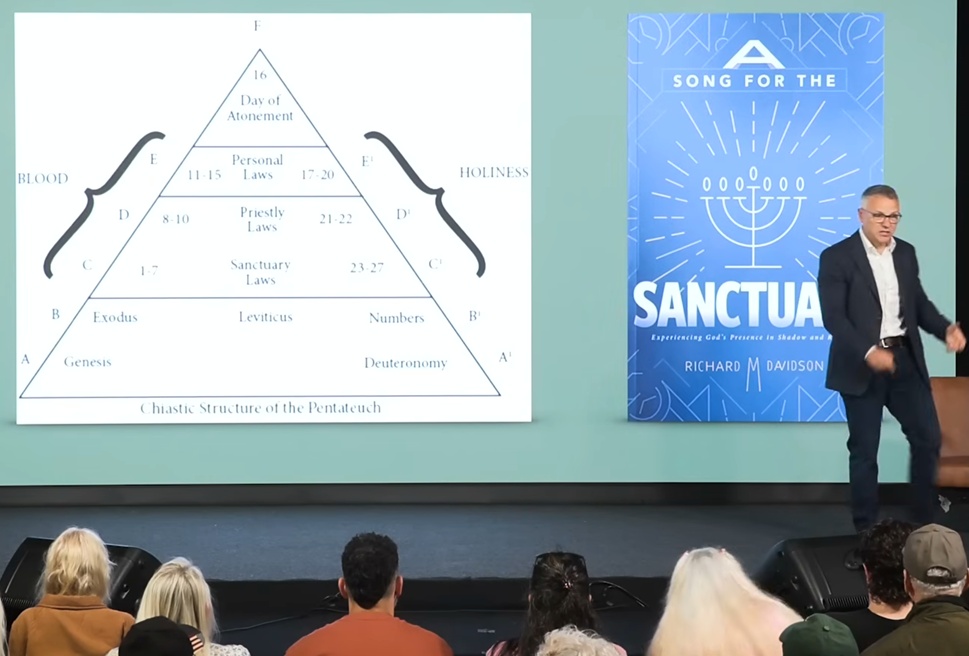
Introduction: Most Solemn Day
We’re going to start by noticing that Leviticus 16, which is where the Day of Atonement chapter occurs. Leviticus 16 is not some obscure Old Testament passage. It lies at the very heart of Torah. And this is true not only theologically, but also organizationally.
And I want to share that with you in this marvelous book that I’ll be talking a lot about this morning, Cult and Character by Roy Gane, Purification Offerings, Day of Atonement, and Theodicy. This is widely regarded as basically the definitive work on Leviticus 16. I’ll talk more about that in a bit, but Dr. Gane says:
The prescriptions for the day of atonement in Leviticus 16 are strategically placed at the heart of the central book of the Pentateuch. Its unique character sets it as the pinnacle of Israelite cultic observance.
Cultic here refers to the word culture, things that you do routinely. And with regards to the cultic observances of Israel, those were all of the ceremonies, sacrifices, and rituals in and around the sanctuary. That’s what the word means. So don’t get scared by the word cultic here. It just serves as the purpose to say the things that they did like culture or cultivate.
Now notice here he says that Leviticus 16 is placed strategically at the heart of the central book of the Pentateuch. The Pentateuch, the five books of Moses of course are Genesis, Exodus, Leviticus, Numbers, Deuteronomy. So that center book there is Leviticus and he’s making the point that at the center of the center book is Leviticus chapter 16. In his commentary on Leviticus and Numbers, which I highly recommend, Gane says the same thing:
Leviticus 16 can be described as the inner sanctum. That means the most holy place. Leviticus 16 can be described in terms of its placement in scripture as the most holy place of the Torah. Here at the heart of Leviticus, the central book of the Pentateuch are a few small steps for a man, the high priest, but a giant leap for humanity toward the heart of God. Commentary on Leviticus and Numbers by Roy Gane
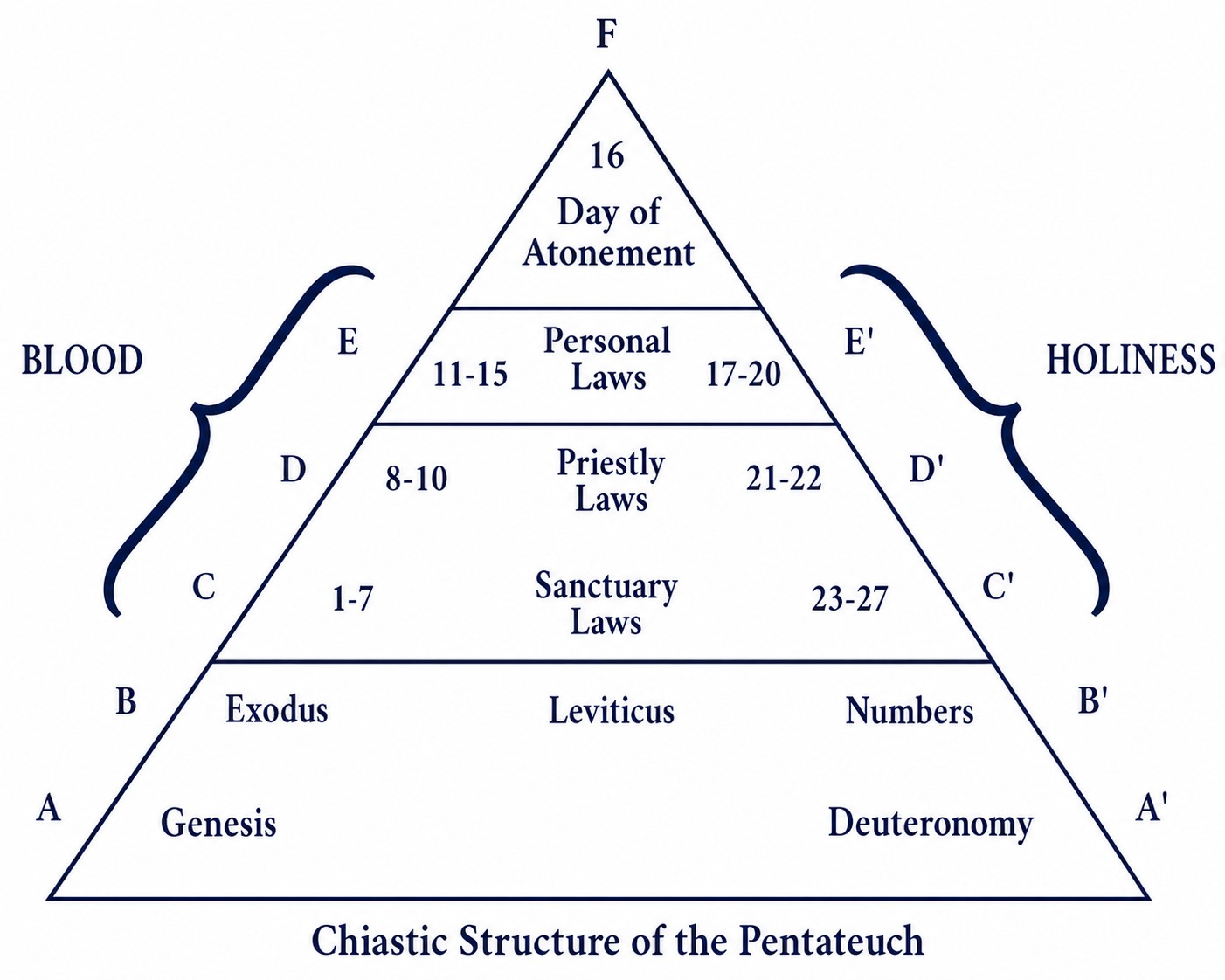
Theologically, in terms of the meaning of what was taking place on this day of atonement, or what the Jews called Yom Kippur, it was a monumental step toward the heart of God. But it gets even more amazing. In his wonderful book, A Song for the Sanctuary, Richard Davidson says, and I’ll take his word for it because he’s a scholar of the highest caliber in the Old Testament, that Leviticus 16 is actually placed, the day of atonement, at the top of a chiasm. This is a chart from the book. You want to take a picture of that (LINK TO VIDEO)
He basically says that the whole structure of the Torah or the Pentateuch is chiastic in nature, that it has this kind of stairstep structure, and at the top of that structure is Leviticus chapter 16. So the idea that it’s at the pinnacle, the heart or the apex is remarkable.
But it gets even more amazing than that. The Torah, the five books of Moses constitute the foundational revelation given by God to the people Israel. And at the very apex of that revelation is the chapter dealing with the day of atonement.
Meaning of “Atonement”
In thinking about why this chapter was given such privileged place in the Pentateuch, it becomes evident that the day of atonement or Yom Kippur, which literally just means day of purging, right? Day of purging or you could say day of atonement was the holiest day of the year in which the holiest person in all of Israel, the high priest, went into the holiest place on the earth, the most holy place, to perform the holiest work of all, the cleansing of the sanctuary and the work of final atonement.
You can begin to see why this has such a prominent place as it’s placed in Torah. Furthermore, it gets even more amazing. Davidson claims that Leviticus 16 itself is formed in a chiastic structure with Aaron’s work of final, ultimate, all-encompassing atonement for the tabernacle, for the altar, for the people, and for himself and the priestly families, which we’ll get to at the center of this chiasm and thus of the whole Pentateuch.
So he basically says not only is Leviticus 16 at the height of the structure of Torah, but Leviticus 16 itself is a chiasm. So you have, as it were, a peak on top of a peak.
So, now that we’ve established the importance of the Day of Atonement and of Leviticus 16, we’re going to basically address ourselves to four questions, four simple questions.
The first is what happened? And you’ll notice I put here in parenthesis, this is not really disputed across the kind of breadth of Christian scholars. There’s not a lot of dispute over what it is that took place. There’s a little bit of dispute. We’ll talk about some of those variations a bit, but generally not disputed. What happened? That’s number one.
Number two: Why did it happen? Now, as you might imagine, this is disputed. And we will talk a little bit about why it’s disputed and what we think is going on.
Thirdly, we’ll ask the question, well, what was unique on the Day of Atonement? What set it apart? What was it that placed it at the pinnacle of the pinnacle of Torah? What made it so special? This again is not really disputed in terms of the fundamental mechanics of what took place in the day of atonement.
And then finally, what does it mean for us? As you might imagine, there is some dispute there.
So, these are the four questions that we’re going to address ourselves to.
I’m going to invite you to open your Bibles if you have them to Leviticus 16. We’re going to do a little story time with Uncle David and we’re going to read most of the chapter. I’ve got both the NIV and the New King James here. I’m going to go with the New King James, though either would be great. Leviticus chapter 16, beginning in verse one:
Now the Lord spoke to Moses after the death of the two sons of Aaron when they offered profane fire before the Lord and died. And the Lord said to Moses, “Tell Aaron your brother not to come just at any time into the holy place inside the veil before the mercy seat which is on the ark, lest he die. For I will appear in the cloud above the mercy seat. Thus Aaron will come into the holy place with the blood of a young bull as a sin offering and a ram as a burnt offering. He shall put the holy linen tunic and the linen trousers on his body. He shall be girded with a linen sash and with a linen turban he shall be attired. These are holy garments. Therefore, he shall wash his body in water and put them on. And he shall take from the congregation of the children of Israel two kids of the goats as a sin offering and one ram as a burnt offering. Aaron shall offer the bull as a sin offering which is for himself and make atonement for himself and for his house.
He shall take the two goats and present them before the Lord at the door of the tabernacle of meeting. Then Aaron shall cast lots for the two goats, one for the Lord and the other for the scapegoat or Azazel, your translation might say. And Aaron shall bring the goat on which the Lord’s lot fell and offer it as a sin offering. But the goat on which the lot fell to be the scapegoat shall be presented alive before the Lord to make atonement upon it. And let it go as the scapegoat into the wilderness.” Leviticus 16:1-10
And that’s kind of an overview. The first 10 verses let you know broadly in broad strokes what’s going to happen. In the beginning in verse 11, we get into the particulars, okay, into the details of how much of this would happen. Verse 11:
And Aaron shall bring the bull of the sin offering, which is for himself, and make atonement for himself and for his house, and shall kill the bull as the sin offering, which is for himself. And he shall take a censer full of burning coals of fire from the altar before the Lord with his hands full of sweet incense beaten fine, and bring it inside the veil. That’s the most holy place. And he shall put the incense on the fire before the Lord, that the cloud of incense may cover the mercy seat, that is on the testimony, lest he die. He shall take some of the blood of the bull and sprinkle it with his finger on the mercy seat on the east side. Before the mercy seat, he shall sprinkle some of the blood with his finger how many times? Seven times. Then he shall kill the goat of the sin offering which is for the people. Bring its blood inside the veil, that’s also into the most holy place and do with that blood as he did with the blood of the bull and sprinkle it on the mercy seat and before the mercy seat. Verse 16. So he shall make atonement for the holy place because of the uncleanness of the children of Israel and because of their transgressions for all their sins. And so he shall do for the tabernacle of meeting which remains among them in the midst of their uncleanness. There shall be no man in the tabernacle of meeting when he goes in to make atonement in the holy place until he comes out that he may make atonement for himself, for his household, and for all the assembly of Israel. And he shall go to the outer altar that is before the Lord and make atonement for it. And he shall take some of the blood of the bull and some of the blood of the goat and put it on the horns of the altar all around. And he shall sprinkle some of the blood with it on his finger seven times, cleanse it, and consecrate it from the uncleanness of the children of Israel.
And when he has made an end of atoning for the holy place, the tabernacle of meeting, and the altar, he shall bring the live goat. Aaron shall lay both his hands on the head of the live goat, confess over it the iniquities of the children of Israel, and all their transgressions concerning all their sins, putting them on the head of the goat, and shall send it away into the wilderness by the hand of a suitable man. The goat shall bear on itself all their iniquities to an uninhabited land, and he shall release the goat into the wilderness.
Then Aaron shall come into the tabernacle of meeting, shall take off the linen garments which he put on when he went into the holy place, and shall leave them there. He shall wash his body with water in a holy place, put on his garments, come and offer his burnt offering, and the burnt offering of the people, and make atonement for himself and the people. And the fat of the sin offering he shall burn on the altar.
And he who released the goat as the scapegoat shall wash his clothes and bathe his body in water, and afterwards he may come into the camp.
The bull for the sin offering, and the goat for the sin offering, whose blood was brought in to make atonement in the holy place, shall be carried outside the camp, and they shall burn in the fire, their skins, their flesh, and their offal. Then he who burns them shall wash his clothes, bathe his body in water, and afterward he may come into the camp.
This shall be a statute forever for you. In the seventh month, on the 10th day of the month, you shall afflict your souls. You shall do no work at all, whether a native of your own country or a stranger who dwells among you. Leviticus 16:11-29
Okay, that’s virtually the whole chapter. Right now, we have to do that to give us a feel for the shape of what’s taking place in the chapter and how we can responsibly and biblically answer all of these questions. What happened? Why did it happen? What was unique about what happened? And what does it mean for us?
Last night we talked about this idea of holiness. Holiness of place, of process, and of personnel. Last night we dealt with holiness of place. We talked about the gradation or the transition from bronze into increasingly elaborate and more beautiful structures, and then we get into the most holy place and it’s gold. And here you have the mercy seat, the atonement cover with the very presence of Yahweh. Not a symbol, not a metaphor, not an analogy, but God himself dwelling in the most holy place, these gradations of sanctity or of holiness. That’s holiness of place. What we’ve just read here is holiness of process. How is it that the high priest would come on the 10th day of the seventh month into the most holy place? And you see it’s very specific. I mean exceedingly specific about how it was to be done. And the personnel who did it in this case was only the high priest. Very good. Okay. So here’s our top-down overview of the temple. And we’re going to just start by reconstructing what it is that we just read. We’re answering the question, what happened? You’ll want to take a picture of this slide. Okay, this is one of two slides. I’ve made it very simple. I’ve reduced it down to 26 easy steps.
26 easy steps, of which there are some we’re not quite sure about. Incidentally, probably a week ago when I was deep in study and preparation, I’ve been deep in study and preparation for many weeks, but when I was getting right down to the pointy end of the spear, so to speak, and I was going through Leviticus 16 and Leviticus 23 and really just trying to get my head around the exact order of events, I couldn’t make it make sense. I just kept, I was kind of pulling my hair out because when you read, as we just did a moment ago, some of the steps in there are implied. And the reason that those steps are implied is that Leviticus 16 of course is well into the book of Leviticus. And it’s assumed that the reader of Leviticus, the priests and others or the listeners to Leviticus already know Leviticus chapters 1-15. So they’re going to fill in the blanks about certain details. And so if you just read Leviticus 16 on its own, it’s very difficult to put it all together. And I was becoming so sort of frustrated with my inability to put it all together. I said, I’m going to call the world’s expert on this. I’m going to call Roy Gane. And I had a friend, I don’t know Roy personally, I do now, I reached out to a friend who had his number and I said, “I need you to give me Dr. Gane’s phone number.” She gave me the number. I reached out to him. He was very gracious, very kind. He set up an appointment. We ended up talking for almost two hours. And I said, “I have questions.” And he said, “Okay, great.” You know, this is a man who’s given his life to the study of the book of Leviticus and of Torah. And I said, “These are my questions.” And I was really happy that after I asked my initial questions, he said, “Well, nobody knows.” I was like, “Oh, great. Wonderful. So, I’m not mistaken, I’m not an idiot.” He said, “No, these are difficult questions that we don’t know the answer to because we don’t know every detail.” Okay.
Sanctuary Cleansed
So, what I’ve done here is I have as best as I can put together what likely happened, but there are a couple variations of what may have taken place, and I might point a couple of those out as we go through it. So let’s walk through it quickly here. Step number one, the bull was to be slain. This bull was to be slain, the Bible says repeatedly in Leviticus 16, for the priest himself and for his household. So the bull is what we might call a kind of preliminary offering. So the bull is slain. The bull’s blood is collected. This is one of the elements that is not expressly spelled out in Leviticus anywhere, but obviously it has to be collected because the blood is brought into the holy place and on the day of atonement into the most holy place. Can’t be hauling a giant carcass of a bull. No. So the blood is collected even though this point is never expressly made. Then the high priest would go and gather very special incense from the outer altar. Okay. And now the importance of this incense and a smoking agent would be added to this incense so that when he went into the most holy place, this smoke representing the righteousness of Christ would, as it were, protect him, shield him, or insulate him from the presence of Yahweh there in the most holy place. And so he would gather incense from the outer altar. He would then bring the bull’s blood and incense into the most holy place. And it’s one of the points where we’re not quite sure. There’s two options here. It’s possible that he went into the most holy place first only with incense to burn the incense, set the censer down and leave it there. Then he went back out and got the blood of the bull and then went back in. We don’t know. He only has two hands and there’s only one man. And so in order for him to do both at the same time, the container would have had to been, it would have had to been designed in such a way that it could be dexterously carried with a single hand along with the censer. Okay, so this is some of the details that we’re not quite sure about.
But be that as it may, he does at some point either by one trip or two trips, he brings the bull, the blood of the bull and the incense into the most holy place. Then crucially, he burns the incense in the most holy place by burning the censer, setting it down, very likely setting it down so that he can do his the blood manipulations there in the most holy place. And this incense again representing the righteousness of Christ and this insulative shield as it says there in the text. He has to do this unless he would die. Okay? So he burns the incense in the most holy place. He then sprinkles the bull’s blood on and before the ark in a seven and one pattern. This is quite important. He first sprinkles on the ark. So you can imagine I’m standing here before the ark. He sprinkles one time on the mercy seat. One time. How many times? One time. And the reason he sprinkles it is so that he doesn’t touch the ark. The ark cannot be touched. It’s why it has handles. We talked about this last night, the rings, so that the handles, wooden handles, poles could be put through. So he sprinkles it one time on the ark. He then steps eastward toward the door of the ark and sprinkles seven times. Okay, so one and seven. This is actually quite important. Then he exits with that blood to the courtyard. And this is another point we’re not quite sure about. Does he at that point also place the blood of the bull on the altar of incense? Perhaps, but probably not. He probably exits all the way to the courtyard and then we are quite sure that the goat is slain. Now, the lots have already been cast earlier as we saw. And so, the Lord’s goat is at this point slain. That blood is then collected. That’s number nine. And then number 10, the goat’s blood, which is the blood for the congregation. So you can think of that first, the offering of the bull and the atonement that’s made in the most holy place by the bull is for the priest himself. In other words, in order for him to be clean as it were to be able to go into the most holy place on behalf of the congregation, he himself is a sinner. He himself needs to have a sacrifice and his household. So that’s why you have the second sacrifice there. There’s actually other sacrifices that have already taken place before this, the Tamid, and there were non-calendar sacrifices which we’re not going to get into right now. We’re trying to make this simple. So then number 10, he brings the goat’s blood into the most holy place. Verse number 11, he sprinkles the goat’s blood on and before the ark in the exact same pattern. One time on the mercy seat, seven times eastward of the mercy seat. Okay, so the very same thing into the most holy place. 12, He exits with the blood to the courtyard, brings the bull’s blood into the holy place. Now, this is the point we’re not entirely sure, but he either makes two trips into the holy place or since the incense is remaining in the most holy place. Okay? So, that censer stayed in there. Very likely. Now, it’s possible that he brought the censer out to the holy place and left it there so that he didn’t have to go a third time back into the most holy place. We’re not exactly sure. The high priest went at least twice into the most holy place on the day of atonement and perhaps as many as four times. But let’s just imagine that he did not leave the censer in there, but he brought the censer out and he put it in the holy place where now it’s burning somewhere near the altar of incense. He now comes back in here into the holy place with the blood of the bull and the blood of the goat, probably in two separate containers because the bloods have not yet been mixed. He applies the bull’s blood to the incense altar and sprinkles it eastward before the veil. Very similar. By the way, here we have the 17 pattern, but he actually touches the altar of incense. The altar of incense on the four corners had horns and he would do the blood on his finger and put it one time on the horns of the altar. He would then, and this is crucially important, step away from the ark. The movement, as we will see on the day of atonement, is always away from the ark. Right? Imagine I’m back in the most holy place. One time on the mercy seat, a step away from the ark, seven times, right? And then when I get into the holy place, one do on each of the horns of the altar, step back seven times. Do you see the movement there? The movement is always away from the ark. Then he would exit with the bull’s blood to the courtyard. We’re not quite sure. If he brought both bloods in at the same time, then he would do both of the cleansings of the incense altar at that time. If not, he would go back out, retrieve the goat’s blood, and then come back into the holy place and do the same. Apply the goat’s blood to the incense altar. Sprinkle it eastward before the veil. And then return to the outer altar. We’re almost done. Right. Here’s the final few steps. Now that, yeah, you’ll want to take a picture of that as well. Now that the high priest has come outside and is back in the courtyard, the blood of the two animals is mixed. The blood of the bull and the blood of the goat is mixed. That’s step 19. Step 20, The blood, he applies the bloods. I’ve used this in the plural here so that you know it’s the mixed blood. Applies bloods to the outer altar on the horns of the outer altar. Again, touching the outer altar just as the altar of incense could be touched. But of course, the ark of the covenant could not. And then he’s instructed to pour out the remaining blood at the base of the altar. Now, then step 21 takes place, the removal of Azazel’s goat from the camp. And Tai’s going to talk all about that. I’m going to skip right over that. We have a whole presentation dedicated to that. Then 22, Then the suet, and we’re not actually, I should say we’re not exactly sure where the removal of Azazel’s goat goes in the order, but it seems most likely that it takes place here. At least that’s where it seems to occur in the chronology of Leviticus 16. Removal of the suet or the fat from the bull and the Lord’s goat. The suet was then burnt on the outer altar. Step 23. Step 24, the assistants to the priest removed the carcasses of the bull and the goat outside of camp and burn them. And then finally, step 25, the assistants and also the priest purify themselves from the disposal or burning of carcasses by washing clothes and body in water. And this is a simplified version of what took place. Again, maybe with a few slight variations, but for the most part, this is not disputed. This is what happened. Okay, not only have we read Leviticus 16, we’ve gone through step by step through what was it, 25 steps on a basic idea of what happened. Raise your hand if you feel like, “Yeah, I kind of got a sense of what happened.” Now again, there were other things that happened before this, but that’s outside of our scope here. We need to simplify at some level. Okay, so here we are. Not just in the courtyard, not just at the altar, not just at the laver, not just in the holy place, but the high priest goes at least twice and perhaps as many as four times into the most holy place and he brings in there the blood of the bull for himself and his family. He brings in there the blood of the goat. Okay, so that’s the answer to our first question. What happened? And this is not really disputed. Again, there is some variation about the precise order, but for the most part, broad agreement in this is what took place.
Judgment As Good News
Now, we get into, well, why did it happen? What’s going on here? And again, why do we have this marvelous placement of Leviticus 16 at the pinnacle of the pinnacle of Torah or of the books of Moses? Hey everybody, David Ashrick from Light Bearers here. I hope you are enjoying the Dwell series where we take an in-depth look at the biblical sanctuary. If you weren’t already aware, Light Bearers is a donor-supported ministry and it’s thanks to the generous donations of people just like you that we are able to do programs like this as well as Table Talk gospel conversations with DA and so much more. If you would like to make a donation of any amount to Light Bearers, please go to lightbearers.org to partner with us in making more gospel-centered content. All right, thank you so much and let’s get back to the program. Now we get into, well, why did it happen? What’s going on here? And again, why do we have this marvelous placement of Leviticus 16 at the pinnacle of the pinnacle of Torah or of the books of Moses? Well, this raises a major question and the question is, does atonement, at-one-ment, which is a relational term, we’ll talk more about that in a moment, take place in one phase or two? And this is the central question for not just Seventh-day Adventists but this is a question that Jews have wrestled with throughout their history and it is a question that evangelicals wrestle with like how, what’s going on here on the day of atonement. We know what happened. Why did it happen? And the vast majority of people have and interpreters, both Jewish and Christian, have said that the cleansing of the sanctuary, the purification of the sanctuary takes place in a single phase. But Seventh-day Adventists and others, but mainly Seventh-day Adventists, have maintained that what’s taking place on the day of atonement is a second phase of atonement. And we’re going to talk about that. The idea is basically that 359 days out of a year, a calendar year in the Jewish system which was 30 days to 12 months, 359 days sins and impurities, ritual impurities, were going into the sanctuary and thus effectively contaminating the sanctuary.
This then necessitated that on the day of Yom Kippur, literally the day of purgation, the day of purging, that the sins would be reversed. The direction would be reversed, which is what we see. That’s why we made the crucial point that at every stage, and this is a very important point that Gane brings out again and again in his marvelous volume Cult and Character, which is basically the summary of his life’s work. At every stage, the high priest moves away from the altar. And the illustration that is often used is the illustration of sweeping a house. If you have a room or a house with a single door and you’re going to sweep the room clean, you will start at the far end and sweep toward the door. Does this make sense? And so at every stage we see the direction of sin, the direction of these ritual impurities being moved out of the sanctuary. We’ll talk more about that. Okay. So Gane in kind of the summary of his book Cult and Character says, penetrating a long-standing puzzle, a long-standing puzzle, his teacher was the great Jacob Milgrom who was kind of widely regarded as the definitive mind on Leviticus and Dr. Gane studied under him for the better part of a decade and I actually got, I’d heard him tell the story on some of his presentations, but I asked him about this story. It’s absolutely marvelous how God opened the doors for him to study at the University of California Berkeley under Jacob Milgrom for the better part of a decade and it’s kind of a cute little thing. Milgrom had already published his opus, a magnum opus on Leviticus, a giant two-part series on a commentary on Leviticus from a Jewish perspective. And what Gane really wanted to study, of course, was the day of atonement. He wanted to know if what Adventists have historically held, a two-phase atonement, was true. But he couldn’t go in there and say, “Hey, I want to study the day of atonement.” Because Milgrom, who was the great mind and Gane was just a, you know, in his mid-20s at the time, just a young person, he couldn’t go in and say, “Hey, I want to study the Day of Atonement.” He’d say, “Well, why do you want to, I’ve already written the definitive work on the day of atonement, so there’s no need to study it further.” So, he kind of did this a little roundabout little trick. What he did was he suggested to Jacob Milgrom that he wanted to study the Israelite sanctuary in comparison to Hittite sacrifices and Babylonian sacrifices. And that allowed him to then do an analysis not only of the Hittite, the Babylonian, but also of the Jewish system. And that’s how he kind of roundabout could spend time analyzing Leviticus chapter 16. And he tells the story that when he made his preliminary sort of presentation of his working thesis to Milgrom, Milgrom was completely mystified. He was reading over Gane’s work on Leviticus and particularly Leviticus 16 saying, “It’s almost like you have your own system.” And he said, “Well, yeah, I do. I believe in a two-phased atonement.” And he said that resulted in an hours-long grilling back and forth and back and forth and what about this and what about this, arguing at the highest levels of the Hebrew language and the book of Leviticus and fortunately Gane had done so much study he was able to hold court with Jacob Milgrom and when this argument was done he said we both sat back in our seats and I was waiting because this is effectively academic suicide, right? He could just be told get out of my room, I don’t want you under my tutelage anymore, go find somebody else to study under, but they sat back in their chairs in kind of mutual exasperation and Milgrom said to him, “Okay, you can include it in your dissertation.” And that was permission for him to continue to explore. And then remarkably, I’ll just quickly point this out. On the back of Gane’s Cult and Character is an endorsement by none other than Jacob Milgrom. I want to read it to you. He says:
Gane’s book is a marvel of close reading and impeccable logic. It is the first major critique of my work and I am immensely happy and proud that it was done by my student and that my contribution is so comprehensively acknowledged. It is a major work and will be considered the standard for a long time. Cult and Character endorsement by Jacob Milgrom
Amen. Beautiful, right? It’s a beautiful story. So when Gane says here penetrating a long-standing puzzle, this was the puzzle of our, to put a really fine point on it: Are Adventists unusual when we say we affirm a two-phased atonement? Because, and I asked Dr. Gane this question, what would you have done if you would have found out that a two-phased atonement was unsubstantiable? You could not substantiate it from the text. He said, “I would have walked away because what we believe is either true or it’s not true.” And then I asked him the question, because Jacob Milgrom passed away I think in 2010, I said, “Did Dr. Milgrom ever come around, you know, did Rabbi Milgrom ever come around to your two-phased atonement?” He said, “No, he never came around to it, of course, but neither did he ever refute it.” So, that was really nice. So, this is what he means. By penetrating a long-standing puzzle, I have found a reason for this second phase of atonement. When Yahweh forgives guilty people, he incurs judicial responsibility. We talked about this last night, the cost of mercy, that God can be both just and the justifier, right? That he is fair, that there is some incurring of judicial responsibility by creating an imbalance between justice and what we might call kindness or mercy, that affects his reputation as a ruler. And we understand this intuitively. If a judge just starts letting people off just because of a whim or a whimsy, we don’t say, “Oh, that’s such a kind and merciful judge. What a great judge.” We say, “Hey, no, wait a minute. That’s wrong for you to do because it’s not fair by the standards of the law. It’s not fair by the standards of the statute. You can’t just willy-nilly forgive somebody. If you’re going to forgive somebody, there is some incursion of judicial responsibility, as Gane calls it, that affects his reputation as a ruler or in this case as a judge.” Gane continues:
Restoration of equilibrium is enacted through ritual purification of the sanctuary, which represents vindication of Yahweh’s administrative justice as he sheds judicial responsibility. Cult and Character by Roy Gane
So, what’s taking place on the day of atonement is remarkable. It’s this second phase of how it is that God can forgive the sinner 359 days out of the year and be fair in doing so. That’s what’s taking place on the day of atonement. He continues:
As a result, Israelites who show their continuing loyalty to him receive the secondary benefit of moral cleansing or clearing in the sense that the forgiveness that has already been granted them when they brought their individual offering on one of the days of the year is now confirmed when the forgiver is vindicated in the fairness of his forgiveness. Cult and Character by Roy Gane
And of course, this boils down to, as we discussed last night, the mercy seat. The mercy seat, that Christ himself is the mercy seat. He bore the weight of our judicial responsibility. I have found that the two-phased sacrificial remedies dramatically proclaim that the character of God is just and good. Okay. Now, this is very important. And you might be thinking, “Oh, but I have questions.” I know you have questions and we’re going to get to those questions in just a moment. Now, we have to make a very important point here that’s a little technical and I think you’ll be able to follow along here. Okay. So sometimes what we do when we talk about sacrifice and salvation and atonement and redemption is we just get so excited and because most of us are not theologians, we don’t think technically about the words we’re using. We just are rejoicing that God is good and we want to say things that we at least regard as true. But what we sometimes inadvertently do and sincerely do is we collapse ideas together that actually have distinct meanings. And I want to talk about one of those collapsings that sometimes takes place. We will sometimes say that atonement happened, you know, in the outer courtyard or that sacrifice took place in the outer courtyard. Well, that’s not entirely true. What took place in the courtyard was the slaughter or the slaying of the animal. Okay? So, we’re going to be very precise with our language here. So, just imagine a world in which, like Jeffrey was describing, he said, imagine a world in which you just brought the animal and you handed it over to the priest and you walked away. Well, atonement has not taken place. Sacrifice has not taken place. No, the animal was to be slain, but that wasn’t the end of the story. Now, it might have been experientially the end of the story for the offerer, but this was just the beginning of the process of the, what everyone, the process. And this whole process, including but not limited to the slaughter, is what we call the sacrifice. Okay? So we sometimes loosely use the word sacrifice for just the death. But the sacrifice is the death and everything that follows. Okay? And then the consequence of the slaying, the slaughter and the sacrifice is a relational word, and that word is atonement. Atonement is the at-one-ment that God experiences with his people as a consequence of the slaughter, of which an essential part is the sacrifice, of which an essential part is the slaughter. Does this make sense? So the slaughter or the slaying takes place in the courtyard. Then everything else that happens with the blood manipulation in the holy place and in the outer courtyard, that’s part of the sacrifice. And then the consequence is that God is now at one with his people.
Two Goats Of Leviticus 16
Okay. Now, this is a wonderful man who’s written a book I’m going to talk about in a moment. His name is David Moffitt. He’s written a marvelous book called Rethinking the Atonement, published in 2022. And in the conversation I had with Dr. Gane, he confirmed what I suspected because right at the crucial point, right at the crucial point of several times in Moffett’s book, Rethinking the Atonement, he quotes Roy Gane. And as I was reading through it, I was like, wow, he’s right at the crucial point of his argument, he quotes Roy Gane’s Cult and Character. And I thought, man, it looks to me like his basic understanding of the ministry of Jesus, the ascension of Jesus, and the high priestly ministry of Jesus has been radically informed by Dr. Gane. And so I asked Dr. Gane that in the conversation that we had just a few days ago. And he said, “Oh yes.” He said he had read my book, Cult and Character. He came to believe that it was accurate. And this then now radically informed his understanding of the high priestly ministry of Jesus. Dr. Moffitt is primarily a scholar of the book of Hebrews. Now I know that this might sound like all this is all just academic and it’s all happening out in the ivory towers. But the importance of this is this: An Adventist scholar wrote his life’s work into a book called Cult and Character, which is basically a study of the book of Leviticus. We talked about that. Years later, people have started to see the importance of the points made in that book, that something is going on in Leviticus. And if we get Leviticus wrong, it’s possible we could get the sacrifice of Jesus wrong, the high priestly ministry of Jesus wrong. And Moffett and others, but Moffett especially, has read this and said, “Wait a minute. I think Gane is right.”
Now, come with me on this journey. A sacrifice consists of an irreducible ritual process. The sacrifice is the whole thing, not just the slaughter. Roy Gane has compellingly argued that the rituals that constitute the process of sacrifices presented in Leviticus relate to each other hierarchically. In other words, that all of the things matter. Every part of the process matters. This means that some elements in the process hold more importance or weight than do others relative to achieving the goals of a given sacrifice. This also implies that a sequence of ritual elements is necessary, but no one of those elements alone is alone sufficient for the sacrifice. That is to say, a sacrifice involves several ritual events and cannot therefore be reduced to simply one element within the sequence. In other words, we can say Jesus paid it all and we can sing that with great enthusiasm. But that wasn’t the end of the sacrifice of Jesus. Jesus ascended into heaven as our high priest. So we could say the sacrificial, we could say the slaying of Jesus was finished on Calvary’s cross. But this was just the beginning of the larger ministry that Jesus had to perform as priest and king. That’s what he’s saying. Cannot be reduced to one element within the sequence. Contrary to the assumption of many today, in other words, basically everybody in evangelical theology. Therefore, neither the verb nor the noun sacrifice is in biblical terms self-evidently synonymous with the ritual act of slaughtering a victim. The word sacrifice does not mean to slaughter or to kill something. If one only slaughtered a victim, even at the temple, but did not bring the body and blood of the victim to the altars and offer them to God, no sacrifice would occur. Okay? So, it’s a little technical, but I hope you understand this is where the slaying takes place. That was an essential element for the sacrifice to take place, which takes place as a consequence of the death, and then the net result of the slaying and the sacrifice is what word am I going to say? Atonement. Very good. Okay. Well, what was unique on the day of atonement?
Scapegoat and Removal of Sin
Why did God give this secondary ritual? Well, clearly God was purposefully, unambiguously trying to set this day apart. Clearly something different was happening on the day of atonement. You’re going to want to take a picture of this. Okay. Now, this is just a, I think I put 13 of these up, but you could probably find not less than 20. Okay, so I’m just keeping this very simple. These were things that were unique, utterly unique to the day of atonement in the whole of Leviticus. These were things that happened only on that day. And the uniqueness of the Day of Atonement, this is the important point, the uniqueness of the Day of Atonement and all of these elements that were dissimilar to the other sacrifices show that God is purposefully, unambiguously trying to set the Day of Atonement aside as unique, as different. Okay? Which could then raise our theological curiosity and our expectation. It’s so different. Why is it so different? And let’s just run through some of these differences very quickly. Number one, the high priest washed his whole body, not just his hands and his feet. This was the only day the high priest washed his entire body. Number one. Number two, the high priest donned these holy linen garments that were reserved only for this occasion. So the entire body is washed and he puts on clothes that are not worn for any other occasion. Number two, this pre-slaughter or sacrifice for the high priest and his family is unique. The sacrifice of the bull for the high priest to begin to minister is something that doesn’t take place any other day. The casting of lots is unique to the day of atonement. The mention of Azazel is unique to the day of atonement. And Azazel, Ty will talk about this, is sometimes wrongly translated as scapegoat. This is a poor translation. The word is Azazel. And Ty will talk about what that word means. And he’s only mentioned in Leviticus 16. That’s it. Nowhere else in Torah. An unslaughtered sanctuary animal. This is unique. You have an animal that is presented at the sanctuary and not killed, not slaughtered. Number seven, the high priest entered the most holy place several times. Of course, we all know that’s unique. Number eight, the day of atonement involved the absolute poles of Israelite life and worship from the most holy place, the innermost compartment of the sanctuary, all the way to the wilderness, which is as far as you could go outside of the camp. Think of the kind of gradations here. Just imagine I’m in the most holy place. Now I’m in the holy place. Now I’m in the courtyard. Now I’m in the camp. Now I’m outside the camp. Now I’m in the wilderness. Okay. So you have these absolute poles in the whole of Israelite worship and life. From the wilderness to the most holy place, all taking place on the same day. Very important. Okay. A few more. You want to take a picture of this as well. I promise I’ll limit this to 13. It could have been 20.
The high priest applied blood to and in front of the ark of the covenant. So this is obviously a corollary of being in the most holy place. He applies blood to the ark and in front of it. Also uniquely, the high priest placed both hands on Azazel’s goat. This is the only place where both hands were placed on any ritual animal that was offered. Typically it was a single hand if there was the pronouncement over the animal. Both hands. So God is clearly going, the text is bending over backwards to say it’s different. It’s different. It’s different. It’s different. It’s different. It’s different. Okay. Number 11, the carcasses of the bull and the goat contaminated the assistants. But strangely and interestingly, when the carcasses were disposed of in Leviticus 4, the carcasses did not have a contaminating effect on those that disposed of the carcasses. But on the day of atonement, they did. Now, the point that Gane makes here is an amazing point. He says that’s because the bull and the goat sacrificed as we might say ritual sponges, and now they have sopped up, remember we’re sweeping, from now the sweeping analogy to the sponge analogy. So we’re wiping up all of the sin that’s been going into the sanctuary for 359 days out of a year and now we have that contaminated sponge with all of this contamination in it. So when those carcasses are carried outside of the sanctuary, this is contaminating. But on 359 days of the year when the other offerings that Jeffrey talked about were brought in, these were sacrifices that were bringing, they were holy sacrifices that were bringing sin into the temple, into the sanctuary, and therefore there was no contamination factor. Very interesting. Number 12, the man who led his goat into the wilderness was also contaminated even though Azazel’s goat was not killed, and he had to bathe his whole body before returning to camp. And then finally, overall, the day of atonement had an outward direction backing away from the ark, a reversal of the normal ceremonial direction. Okay, very important. Now, just a quick point here. This is very cool. In the sacrifices in Leviticus chapter 4, when the 71 pattern took place in the holy place, not the most holy place, of course, we’re talking about the daily offerings. When this would take place in Leviticus 4, the pattern was 71. Very interesting. You can take a picture of it and go back and look at it. What it says is when the priest comes into the sanctuary, he will come before the altar of incense. Listen carefully. He will sprinkle seven times to the east of the altar of incense. He will then do the horns of the altar. But on the day of atonement, we see the reversal of that. It’s 17 because he’s just come out of the holy place into the most, out of the most holy place into the holy place. And so you have the one, the dobbing of the horns, stepping away from the ark toward the entrance, and then the seven. So you see here again this reversal. It’s 71 359 days out of the year. On the day of atonement, it’s 17 because we’re moving away from the ark. Does this make sense everybody? Okay. So this is what we mean by this reversal of direction.
Christ our High Priest
Now, you’ve survived. We’re right here to the end. What happened? Check. We’ve got that. Number two, why did it happen? I’m suggesting here, as is Gane and others, that this is because of a two-phased atonement. Something was taking place on the day of atonement that was unique in character. What was unique? We went over that. Again, these are not really disputed. The fact that the day of atonement was set apart as unique. And now we get down to the punchline. What does all of this mean for us? Now, of course, Ty’s going to make application. Jeffrey’s going to make application. I will also make later application, but let’s just make some preliminary applications of what this means for us. First of all, I’m suggesting here that there is excellent biblical evidence to suggest that atonement takes place in two phases. What we might call the in-phase or the daily phase, and the out-phase or the day of atonement phase. Okay, so that’s data point number one.
The day of atonement was not about forgiveness. This is very important, very important for you. Sometimes people will be like, “Wait a minute, but why do we have to be forgiven twice?” You don’t have to be forgiven twice. When the offerer would bring his animal, or when the offerer would bring his animal to the courtyard and slay the animal, again, remember from his perspective, he walks away. It’s as though it’s all done. But that’s just the beginning of the process. Very good. Okay. Now, this is very important. In that moment, that offerer was forgiven. Was forgiven. And then curiously, when we get to the day of atonement, the word forgiven is never used. Never used even a single time. Surprisingly, says Gane:
The verb forgive does not appear even once in any of the biblical day of atonement prescriptions. Not in Leviticus 16, not in Leviticus 23, and not in Numbers 29. Cult and Character by Roy Gane
He continues:
This fact alone constitutes a major difference between the purification offerings of the day of atonement and those that remedy sins throughout the rest of the year. The purity accomplished for the people on this day is crucial beyond forgiveness. Cult and Character by Roy Gane
Something else is going on on this day. You’re already forgiven. And this is sometimes the critique that you’ll hear of Adventists like, “Oh, you have to be forgiven twice. You weren’t really forgiven.” No, you’re forgiven. You’re completely forgiven. What’s taking place on the day of atonement is not about forgiveness because forgiveness already took place during the daily ministration, one of the 359 days of the year. Make sense? So the day of atonement was not about forgiveness. It was about the loyalty, or we might say faith. It was about atonement, and it was about a confirmation that what had already taken place throughout the year is now being confirmed as those sins are being removed from the sanctuary. So it’s the confirmation for those that have professed loyalty, those that were, according to Leviticus 23, afflicting their souls and were, as it were, going with the high priest into the most holy place. This is a point I’m going to make in my last presentation, that all of this, I’ll make that present. It’s too good of a point to make now. So, I’m going to make it on the final presentation. Okay.
The day of atonement was about Israel as a whole. The individual offerings that were offered throughout the year, that was about you. That was about me. That was about the individual that brought their offering. The day of atonement is about Israel collectively or corporately. The corporate purgation of the sanctuary on the day of atonement results in the moral cleansing of the people. Excellent. The people do not need to be purified from physical ritual impurities on the day of atonement because they have already been purified from these in phase one. That’s already happened. He continues:
The blood of the inner sanctum, that is the most holy place sacrifices, reverses the direction of the transfer by purging the impurities and sins out of the sanctuary. Cult and Character by Roy Gane
Very important. It was also fundamentally about theodicy. Now, Ty is going to talk about this point. This is the central point of the book. In fact, if you look at the title here, Cult and Character: Purification Offerings, Day of Atonement, and Theodicy. Theodicy of course means the vindication, the affirmation of the goodness of God in the face of ubiquitous evil. God is good. God is fair. God is just. And that’s what’s going on here on the day of atonement. It’s about the collective cleansing and confirmation of God’s people Israel and about Yahweh himself shedding judicial responsibility. He has been just and the justifier. So Gane continues:
As a result, Israelites who show their continuing loyalty to him receive the secondary benefit of moral cleansing or clearing in the sense of the forgiveness already granted them is confirmed when the forgiver is vindicated. I have found that the two-phased sacrificial remedies dramatically proclaim that the character of God is just and good. Cult and Character by Roy Gane
That’s what’s going on here. And Dr. Davidson agrees:
As surprising as it may at first seem, there is no mention of forgiveness in the whole chapter of Leviticus 16. The word salach to forgive never appears in any of the biblical descriptions of the Day of Atonement rituals. The record of sins stored in the sanctuary even after the individual sinner was forgiven was ultimately for the purpose of theodicy, the vindication of the goodness of God, himself, his character and his dealing with sin. God takes the forgiven sins upon himself as it were bearing the judicial responsibility, the cost of mercy as we discussed for the purpose of demonstrating his justice in forgiving sinners. He is both just and the justifier of those that put their faith in Jesus Christ. A Song for the Sanctuary by Richard Davidson
What else makes it different? It illumines and magnifies the high priestly ministry of Jesus. And Jeffrey’s going to spend a lot of time on this, but I’m just going to say a few words. Back to Davidson:
And the lesson for those who live in the antitypical day of atonement, that is us, is that Christ did not transition to a totally new work in the antitypical day of atonement but continued the daily or tamid ministry and began an additional work of cleansing the sanctuary. A Song for the Sanctuary by Richard Davidson
So it’s not either-or on the day of atonement. It’s both. And because remember the daily sacrifice was also offered in the morning on the day of atonement before the day of atonement rituals took place. Very important.
Final Resolution of Evil
Furthermore:
The basis of acceptance before God during the antitypical day of atonement, that is the day that we’re living in, remains the same. The blood of Christ, our substitute, and his righteousness is imputed to us. A Song for the Sanctuary by Richard Davidson
Amen. All right, you’ve made it this far and I’ve just got one last kind of lengthy statement for you. And this is particularly remarkable because it’s from David Moffett who wrote the book Rethinking the Atonement. Again, that is largely on the book of Hebrews. There’s a little bit on Acts and 1 Corinthians. But again, this is because he’s come under the influence of Dr. Gane. Very important. So, this is worth its weight in gold. Here it is. He says the resurrected Jesus. Now, remember, he’s not writing as an Old Testament scholar. He’s writing as a New Testament scholar, largely a scholar of Hebrews, but he’s getting his understanding of Hebrews from what took place in Leviticus because of course Hebrews is built on the back of Exodus and Leviticus. So watch the application and remember this guy’s not a Seventh-day Adventist scholar. It’s very important, very important to recognize. And this is not some obscure book that nobody knows about. This is a hugely influential book. So much so that when you look at one of my favorite New Testament theologians, he wrote the forward to this book, a man by the name of NT Wright. And when you read the endorsements on the back, people are saying things like this book is going to transform not just soteriology, which is the study of salvation, this book is going to transform the way that people think about christology, which is the way that people think about Jesus. There’s even one writer on the back calls it field-changing, which means it’s going to change the whole field of theology with regard to christology and soteriology. It’s kind of, I would say, it’s thrilling to read this, but it’s also a little funny because for years, decades, decades, and decades, Adventists have been criticized for not affirming the full atonement taking place on the cross. “Oh, you guys don’t really believe this. You guys have added some additions.” And we’ve been criticized. We’ve been regarded as unusual, for example. And now you have people like David Moffett coming to the forefront and saying actually if we apply the shadow that took place in Leviticus, if we apply that to the substance, we have to see that something else is going on here. Now watch this quotation with all of that in mind:
The resurrected Jesus ascended through the heavens into the highest heaven where he entered the heavenly tabernacle. This is the location where he serves as high priest. Moses saw this heavenly structure while he was on Sinai and therefore patterned the earthly tabernacle on the heavenly exemplar that he saw. For the author of Hebrews, the priority of the heavenly tabernacle implies that the structure and worship within the earthly tabernacle brim with analogies. Rethinking the Atonement by David Moffett
In other words, identical. And in the Q&A and the conversations, I’ll talk about something a little technical. I’ll talk about something that is called the difference between what’s called a paramorphic and a homeomorphic analogy. Okay, that’s too technical to get into in the sermon, but it’s very interesting. Brim with analogies to their heavenly counterparts. Adventists have been saying this for 150 years:
Analogies of structure, courtyard, holy place, most holy place, activity, intercession, and function, mediation, atonement naturally hold between the earthly and heavenly realities. Rethinking the Atonement by David Moffett
Amen. This was the insight that Seventh-day Adventists began to have in the wake of the great disappointment. And it’s just thrilling for those of us that have been following this to see people coming to this realization now from an evangelical perspective. It’s absolutely thrilling because Moses obeyed God, obeyed God, and made everything according to the pattern that was shown him on the mountain. These analogies imply a hermeneutical corollary:
One can learn something of the heavenly structure and its cultic service, and so also about where Jesus is, what Jesus is presently doing by looking at its earthly model. Rethinking the Atonement by David Moffett
Amen and amen. In other words, this was an anticipation of what Jesus would do, what he would accomplish, and who he was. Here’s the last part of that quotation:
Jesus’ followers need ongoing atonement. Rethinking the Atonement by David Moffett
What? This is the very thing that Seventh-day Adventists have been saying for 150 years and have been criticized for by our evangelical friends as being somehow unusual. And it just thrills the soul to read this from an outside perspective because it’s true. Jesus’ followers need ongoing atonement. That is to say, we need the application of what Jesus accomplished on Calvary. Okay, let me say it this way: without distribution of the benefits of the atonement, the sacrifice of Jesus can’t get to us. But Jesus’ ongoing ministry in the heavenly sanctuary, he mediates what Moffett calls again and again the maintenance of the new covenant, the maintaining of the new covenant. Jesus’ followers need ongoing atonement. The very work that the high priest on earth could do only once a year is done by Jesus perpetually. And I’m going to make a really great point about that in my final presentation. The word perpetually, in contrast to the old covenant high priests who were prevented by death from remaining in their office. Jesus, because of his resurrection, is able not only to serve as the heavenly high priest but to do so without interruption. Come on now. Thus Jesus’ high priestly ministry brings a level of purity and forgiveness, oh, what does that sound like? Sounds like an Adventist. Purity and forgiveness that exceeds that of the old covenant. Jesus’ ministry ensures that the new covenant relationship is fully maintained because he is himself both the high priest and the sacrificial offering. His very presence in the father’s presence secures the covenant relationship and ensures the salvation of its members.
Amen and amen. So we have answered the questions: What happened? Why did it happen? What was unique? And what does it mean for us? And here’s the four-part summary in case you didn’t keep track of all those technical details: Jesus is high priest. Sinners are saved. God is vindicated. To summarize it all, everything will be okay. Amen. Amen. All right, let’s pray together. Our father in heaven, what a great message for us today to know that we have a great high priest who has entered into the very holy of holies in heaven above interceding for us. His bruised body, his nail-scarred hands, he is there. He is alive. He is perpetually alive. He ever lives to make intercession. And father, intercession is what we need. We need the ongoing imputation of the righteousness of Christ. We need the infilling of the spirit. We need to know that we have a high priest who is both God and fully human, and that stands before you and intercedes on our behalf. Our elder brother, our savior, our great high priest and our soon returning king Jesus Christ, in whose name we pray. Let everyone say amen.