Why We Don’t Follow the Lamb?
Slawomir Gromadzki
Revelation 14:1,4
Do We Follow the Lamb Wherever He Goes? If Not—Why?
Why is our Christianity not what it should be?
What are the reasons?
WE DO NOT STUDY GOD’S WORD
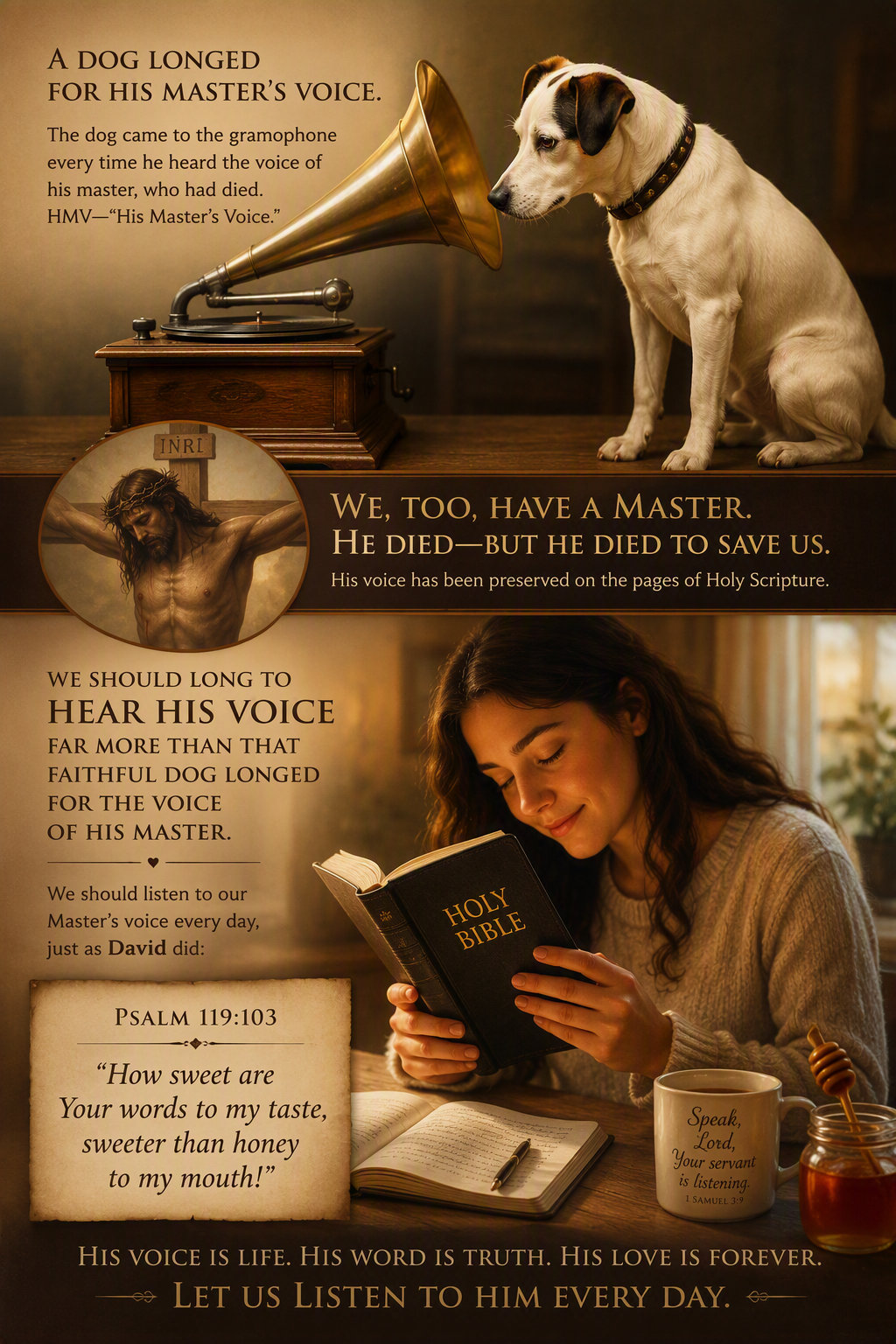
One of the most famous trademarks ever used by HMV Records is the image of a dog listening attentively to a gramophone. That dog really existed.
Its owner had recorded his voice on a gramophone record, but shortly afterwards he died. Every time the recording was played, the dog would come to the gramophone and listen sadly to the voice of his beloved master.
The initials HMV stand for “His Master’s Voice.”
We, too, have a Master. He also died—but He died to save us. His voice has been preserved on the pages of Holy Scripture.
We should long to hear His voice far more than that faithful dog longed for the voice of his master. We should listen to our Master’s voice every day, just as David did:
Psalm 119:103
“How sweet are Your words to my taste, sweeter than honey to my mouth!”
When we truly love our Master’s Word—when we treasure it more than the countless voices that reach us every day through television, radio, social media, magazines, and books—then God’s Word will prove true in our own lives. It will become “living and powerful, and sharper than any two-edged sword” (Hebrews 4:12), and we will truly follow the Lamb wherever He goes.
Do we follow the Lamb wherever He goes? If not—why?
WE NEGLECT EARNEST, PERSEVERING PRAYERS
One of the greatest reasons we fail to follow the Lamb wherever He goes is that we neglect earnest, persevering prayer. We often offer hurried, routine prayers instead of waiting before God with a humble, longing, and surrendered heart until He speaks to us and strengthens us.
EGW Quotes
„Satan knows that all whom he can lead to neglect prayer and the searching of the Word of God, will be overcome by his attacks. Therefore, he invents every possible device to engross the mind.”
“Prayer is the answer to every problem in life. So often we do not pray, because from our standpoint the outlook is hopeless. But nothing is impossible with God. Nothing is so entangled that it cannot be remedied.”
“Our heavenly Father has thousand ways to provide for us of which we know nothing.”
Scripture and history show that God has always worked through men and women of deep prayer.
George Mueller and His Orphanage
George Mueller lived in England. He was an alcoholic. And when one day he was in a church, the pastor said, “Jesus died for you so you could be forgiven, and He could use you to save others.”
And he says, “Jesus died for me? Was the pastor talking to me?” And the pastor says, “Yes, I am talking to you.” And this man says, “Jesus died for me? Who am I that God Himself would die for me?” So he said, “If He died for me and forgives me and saves me, what can I do for Him and for others?” Because when you understand the cross, you want to serve. When you don’t serve, it’s because you don’t understand the cross.
And he prayed, “Lord, use me to serve You and to save others.” And God impressed him to save the kids from the streets, the orphans. But he had no money. So he goes with the little money he has, and he goes in prayer. “Lord, I need money to give the orphans a shelter and to give them food. You told me—You impressed me to do it. You need to help me.”
And God said, “Go and buy the biggest building in the city.” In Bristol, the biggest building was called Ashley Down. It is gigantic. He says, “Lord, this is expensive.” The value of the building, even in our time, is extreme. For that time, that amount was something impossible.
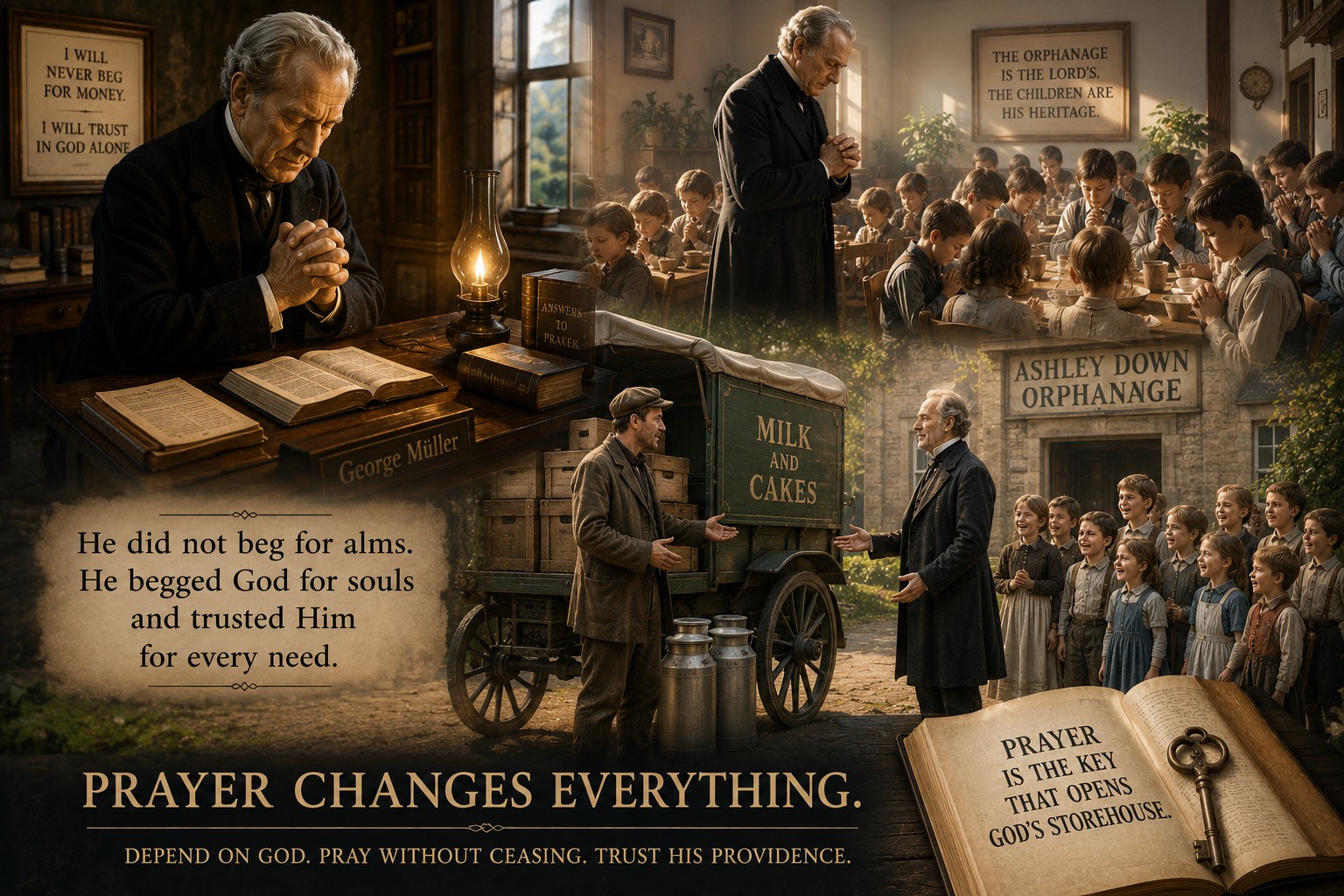
And he goes and he says, “I want to buy this building, but I have only a little pennies”—you know, a little, little, little money. The guy says, “You cannot do that. You need a lot of money to buy this building. What do you want the building for?”
And he says, “I want the building to take care of the orphans.”
And the guy says, “Okay, you can have the building for free.”
So, he started to collect children from the streets and pray with them. And then the time for the meal came. He says, “Lord, I have no food.” And they prayed. They got together, they put all the plates, all the silverware, and they prayed. And somebody knocks on the door—two trucks with food. And if you read his book, his story—every day he never had the food for them, God would bring trucks at the door.
In fact, Churchill, the Prime Minister of England from that time, said, “This man saved a whole generation.”
When the bombs from the German airplanes started to drop over the city, many people came to that building and they said, “Let us in.” He said, “Why? The bombs could drop on this building too.” And people said, “No, we know that God lives in this building. This is the only safe place in the city. We know that God lives in this building.”
Give Us Our Daily Bread
One day, an elderly Black Christian woman opened her window and prayed, “Lord, please provide us today with our daily bread.”
As she finished praying, two young men happened to be passing by. They heard her prayer and decided to make fun of her faith. They went to a nearby shop, bought a loaf of bread, and tossed it through her open window.
The woman immediately lifted her hands to heaven and joyfully exclaimed, “Praise the Lord! Thank You for providing our bread!”
The two young men burst out laughing and called through the window, “Old lady, it wasn’t God who gave you that bread—it was us!”
Smiling, she replied, “Young men, you may not realise it, but God has answered my prayer. He simply used you to deliver what I asked Him for. Even when the devil’s servants try to mock Him, God can still use them to accomplish His purposes.”
EGW Quotes:
“Those who decide to do nothing that will displease God, will know, after presenting their case before Him, what course to pursue.”
“Those who make the service of God supreme will find perplexities vanish and a plain path before their feet.” “We must be much in prayer if we would make progress in the divine life.”
“If we keep the Lord ever before us, allowing our hearts to go out in thanksgiving and praise to Him, we shall have a continual freshness in our religious life. Our prayers will take the form of a conversation with God as we would talk with a friend. He will speak His mysteries to us personally. Often there will come to us a sweet joyful sense of the presence of Jesus”.
Power of Persistent Prayer in Italy
In 2004, Pastor Pavel Goia preached in Spain but saw no visible results. But thirteen years later, he was told that a sister from Bergamo, Italy, had attended his meetings in Spain, recorded one of his sermons, and listened to it several times. Inspired, she gathered a few women from her small church of about 40 members to pray every morning at 6:30 for the Holy Spirit.
After one week, she called Pastor Goia, disappointed that nothing had happened. He replied, “Prayer is not an event—it is a lifestyle. Don’t pray for a week. Pray until God answers.”
The group continued praying faithfully every day. A few months later, a neighbour asked why cars were parked outside the church each morning. When they explained that they met to pray, he asked them to pray for his wife, who had terminal cancer. Two days after their prayer, doctors found no trace of the cancer. The couple gave their lives to Christ, and news of the miracle spread throughout the community.
Soon, people were lining up outside the church every morning, asking for prayer. The congregation grew from about 40 to over 240 members, and they eventually planted two new churches.
EGW Quotes:
“To every sincere prayer, an answer will come. It may not come just as you desire, or at the time you look for it; but it will come in the way and at the time that will best meet your need”.
“Prayer is the breath of the soul. It is the secret of spiritual power. No other means of grace can be substituted, and the health of the soul be preserved… Neglect the exercise of prayer, or engage in prayer sporadically, as seems convenient, and you lose your hold on God.”
“I saw that every prayer which is sent up in faith from an honest heart will be heard of God and answered, and the one that sent up the petition will have the blessing when he needs it most, and it will often exceed his expectations. Not a prayer of a true saint is lost if sent up in faith from an honest heart.”
WE FOCUS ON THE SINS OF OTHERS WHILE FORGETTING OUR OWN
Another reason may be that we take pleasure in concentrating on the sins of other people and condemning them, while forgetting that we ourselves are sinners and that our only righteousness is “The Lord Our Righteousness.”
When David committed the terrible sins of adultery and murder, he seemed strangely unconcerned about what he had done.
So God sent the prophet Nathan to tell him the story of another man who had committed a similar crime. David immediately became furious.
2 Samuel 12:5
“David burned with anger against the man and said to Nathan, ‘As surely as the Lord lives, the man who did this deserves to die!'”
Someone once wisely observed:
“We keep the sins of others before our eyes, but we carry our own behind our backs.”
There was once an elderly man who considered himself an expert in art. One day he was touring an art gallery with his wife and a group of friends.
Unfortunately, he had forgotten his glasses. Since he was very short-sighted, he could hardly see the paintings properly. Yet that did not stop him from loudly criticising almost every work of art.
Eventually he stood in front of a large framed image.
As soon as he approached it, he began pointing out what he believed were its flaws.
“The frame doesn’t suit the picture at all,” he sneered.
“The man is far too overweight and terribly dressed. How could any artist choose such an unattractive model?”
He would have continued indefinitely had his wife not leaned over and quietly whispered:
“What are you doing? You’re standing in front of a mirror!”
Whenever we constantly criticise and condemn others, it usually reveals our own spiritual short-sightedness and blindness.
When David judged another sinner guilty of the very sins he himself had committed, he unknowingly pronounced judgment upon himself.
Instead of constantly examining other people’s failures, let us look into the mirror of God’s Law. There we will continually be reminded of our own sinfulness and of the fact that our only hope of righteousness is “The Lord Our Righteousness.”
1 Corinthians 1:26–31
During a religious education class, a teacher asked her pupils:
“Why do you think my neighbours call me a Christian?”
The children were afraid to answer. They worried that if they said the wrong thing, the teacher might scold them.
Growing slightly impatient, she repeated:
“Come on, surely someone knows. Why do my neighbours think I’m a Christian?”
When no one volunteered, she pointed to one frightened little boy.
He stood up and nervously replied:
“Maybe… because… they don’t really know you?”
What do the people who know us best think about us?
If they consider us Christians, why do they think so?
I sincerely hope it isn’t simply because they do not know us well.
What would they think if they knew us as our husband or wife knows us… as our parents or children know us… and above all, if they knew us as God knows us—He who knows every thought and sees us even when no human eye is watching?
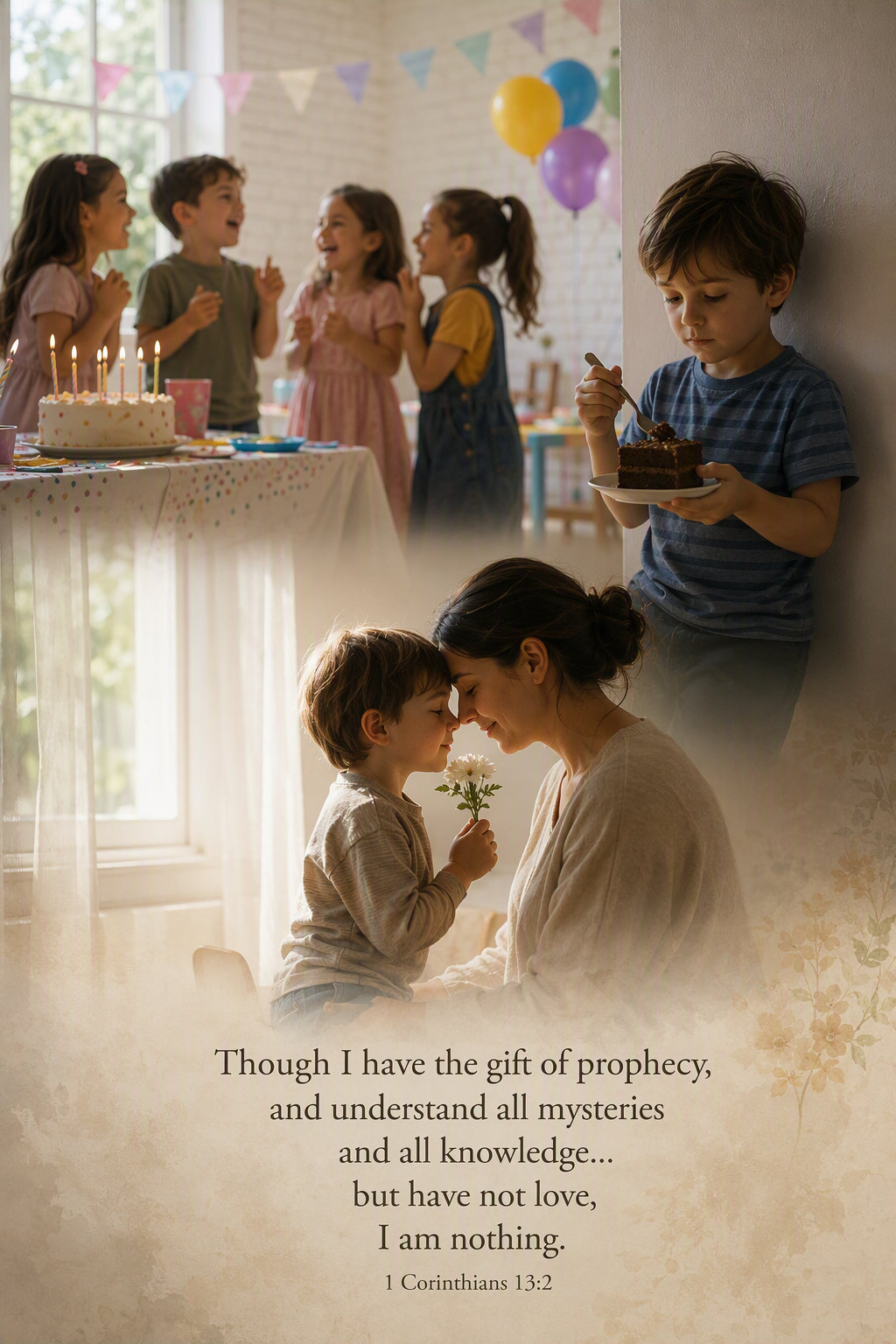
At a children’s birthday party, the children began boasting about their mothers. One said, “My mother is the best singer in the world!” Another quickly added, “My mum is the best cook in the world!”And so it continued. Every child had a mother who was “the best in the world” at something.
Only one little boy stood quietly by the wall, eating a piece of cake and saying nothing about his mother. Finally, the other children came over and asked him, “What about your mum? Can she do anything?”
The boy, still eating his cake, thought for a moment and replied: “I don’t know… but I love her very much.”
Sometimes we become too impressed by what people can do. But what matters most is not our talents, abilities, or achievements—it is what kind of people we are.
Do We Follow the Lamb Wherever He Goes? If Not—Why?
WE EASILY BECOME DISCOURAGED BY FAILURES AND TRIALS
Job 1:20–21
What would our faith look like if, in a single day, all our children were killed in an accident and we lost everything we had worked for throughout our lives?
There once lived a bird in the desert. The only thing it possessed was a single tree that provided both shade and food.
One day a violent storm uprooted the tree. It seemed that the bird had lost everything.
Yet the loss of that tree forced the bird to leave and search for another home. It flew many miles until it finally discovered a place filled with trees bending under the weight of delicious fruit.
Had the storm not taken away its only tree, the bird would never have found that far better place.
Many times God wants to give us something far better and more valuable, but He cannot because something else has taken too great a place in our hearts. Out of love for us, He sometimes leads us through painful experiences so that He can ultimately bless us with something much greater.
(Illustration: Zakopane—the poisoned flour—the wind.)
Isaiah 43 and Isaiah 40
As Christians we should always remember that God has never promised us a smooth flight—but He has promised us a safe landing.
The devil is like a relentless terrorist, always hiding in the shadows, impossible to predict, ready to attack at any moment.
Jesus never promised that we would not suffer because of Satan’s attacks. As long as we live, Satan will try to destroy our lives. He will create turbulence, engine failures, storms, and every possible danger. He will do everything he can to bring us down.
But the Lord has promised that if we keep our faith and trust Him to the very end, our landing is guaranteed to be safe.
That was the earthly journey of Christ… of Job… Moses… Joseph… Elijah… Jeremiah… the apostles… and Paul.
2 Timothy 4:6–8
“For I am already being poured out as a drink offering, and the time of my departure is at hand.
I have fought the good fight, I have finished the race, I have kept the faith.
Finally, there is laid up for me the crown of righteousness, which the Lord, the righteous Judge, will give to me on that Day, and not to me only but also to all who have loved His appearing.”
Paul’s Christian life was not a life of ease, for he wrote of a fight. It was a continual struggle against the “terrorist.” Likewise, the word race does not describe a pleasant jog through a forest on a beautiful day. It was an obstacle race. Yet Paul persevered in faith to the very end, and therefore he could be certain that his landing would be safe.
One Christian thinker once said:
“God’s will will never lead you where God’s grace cannot keep you.”
Do We Follow the Lamb Wherever He Goes? If Not—Why?
Another reason may be that:
OUR FAITH IS NOT “WORKING THROUGH LOVE”
We say that God knows everything about us and sees us even when no one else does. But do we actually live according to what we claim to believe?
Inside the womb of a woman who was far advanced in her pregnancy, one twin asked the other:
“Do you believe in life after birth?”
“Of course. There must be something beyond this. It seems to me that we are here to prepare ourselves for what comes later.”
“Nonsense! There is no life after birth. What could it possibly be like?”
“I don’t know… perhaps there will be more light. Maybe we’ll be able to run around and eat with our mouths.”
“Impossible! That makes no sense. You can’t run! And who ever heard of eating with your mouth? We’re fed by the umbilical cord!”
“That’s true now, but I believe that one day everything will change, and we’ll finally see our mother, and she will take care of us.”
“Mother? You actually believe in a mother? Who is she supposed to be?”
“Why, we live in her and because of her. Without her we wouldn’t exist.”
“I don’t believe it! I’ve never seen any mother, and that proves she doesn’t exist.”
“But when we’re quiet, you can hear her singing… and sometimes you can even feel her gently stroking our world.”
As Adventists—people who are waiting for Christ’s return—we constantly speak about the soon coming of Christ. But do we ourselves really believe it?
If we truly did, we would already today be following the Lamb wherever He goes.
During the Second World War, the Americans planned to bomb the area around Palermo in Sicily. Before the attack, American aircraft dropped thousands of leaflets warning the people that an air raid was imminent.
Only a few believed the warning and left the area.
Soon afterwards the bombers arrived and devastated Palermo and its surroundings. Many Sicilians were killed. Eyewitnesses later reported that some of those who died were still clutching in their hands the very leaflets that had warned them of the coming bombardment.
Revelation 18:2,4
God calls us to come out of Babylon because, at Christ’s second coming, spiritual Babylon will soon be struck by God’s plagues.
But if we do not stop worshipping our modern idols that have taken Christ’s place, if we do not accept the Three Angels’ Messages, and if we continue depending on our own righteousness for salvation, then perhaps it is evidence that we ourselves have not yet come out of Babylon.
And if we do not leave that place, the “bombs” will also fall upon us, and we may perish while still holding Bibles and literature in our hands that warned others about the coming plagues.
WE WASTE TIME
When the distinguished Colombian writer and Nobel Prize winner Gabriel García Márquez learned that he was terminally ill with cancer, he returned home and wrote a letter which was later published on the Internet and sent to all his family and friends.
“If God granted me a little more life, I would not say everything that came into my mind, but I would carefully think about everything I wanted to say.
I would judge things not by their appearance or material value, but by their true significance.
I would sleep less and dream more.
If God extended my life just a little longer, I would tell people that I love them instead of assuming they already know it.
I would convince people how mistaken they are when they claim that there is no point in loving in old age. They fail to realise that they grow old precisely because they stop loving.
I would tell them that death does not come with old age, but with forgetfulness.
I have learned so much from you, from people… I have learned that everyone wants to live on the top of the mountain, forgetting that true happiness is found in the way we climb it.
If God allowed me to live a little longer, I would teach others that a person has the right to look down on someone else only when helping them to stand up.
There is so much I would like to teach you… but… I no longer have enough time.“
Ecclesiastes 9:10
“Whatever your hand finds to do, do it with all your might, for in the grave, where you are going, there is neither working nor planning nor knowledge nor wisdom.”
EGW on Time Redeeming & Time Wasting
“Time squandered can never be recovered. We cannot call back even one moment. The only way in which we can redeem our time is by making the most of that which remains, by being co-workers with God in His great plan of redemption.” (Christ’s Object Lessons, p. 342)
“Life is too short to be trifled away. We have but a few days of probation in which to prepare for eternity. We have no time to waste, no time to devote to selfish pleasure, no time for the indulgence of sin.” (Christ’s Object Lessons, p. 342)
“The record of wasted moments and unimproved opportunities must be met when the judgment shall sit and the books shall be opened and everyone shall be judged according to the deeds done in the body.” (Testimonies for the Church, vol. 4, p. 453)
“Our time belongs to God. Every moment is His, and we are under the most solemn obligation to improve it to His glory. Of no talent He has given will He require a more strict account than of our time.” (Christ’s Object Lessons, p. 342)
“The bright morning hours are wasted by many in bed. Those precious hours are gone never to return; they are lost for time and for eternity. Only one hour lost each day, and what a waste of time in the course of a year!” (Testimonies for the Church, vol. 4, p. 411)
Do We Follow the Lamb Wherever He Goes?
If not, perhaps it is because
WE LACK GRATITUDE FOR WHAT GOD HAS DONE FOR US
Colossians 3:15
“And let the peace of Christ rule in your hearts, since as members of one body you were called to peace. And be thankful.”
Thankful to whom?
For what?
Why?
An eleven-year-old boy suggested to his mother that she should start paying him for doing the household chores she assigned him. She agreed.
A week later, while his mother was preparing a meal, the boy walked into the kitchen holding a piece of paper with a very serious expression. He handed it to her.
She wiped her hands and began to read:
- Pulling weeds in the garden – 5 pounds
- Cleaning my room – 2 pounds
- Shopping – 5 pounds
- Looking after my sister – 10 pounds
- Good grades at school – 10 pounds
- Taking out the rubbish – 5 pounds
Total: 37 pounds
His mother smiled, took another sheet of paper, wrote something on it, and handed it back to her son.
He began to read:
- Carrying you in my womb for nine months – 0 pounds
- Sleepless nights because of your illnesses and crying – 0 pounds
- Changing your nappies and bathing you – 0 pounds
- Washing and ironing your clothes – 0 pounds
- Every meal I prepared for you over the past eleven years – 0 pounds
- All the time and effort invested in raising and educating you – 0 pounds
Total: 0 pounds
When the boy finished reading, tears filled his eyes.
He took back his own list and underneath it wrote one word:
“PAID.”
Then he embraced his mother and asked her to forgive him.
We often do exactly the same thing with God.
Without even realising it, we make a list of everything we think deserves a reward. We expect God to answer our prayers and bless us because we keep the Sabbath, return our tithe, attend church, help others, prepare Bible studies and sermons, and preach the gospel.
Then our loving God could hand us His own list of everything we owe Him—everything He has done for us out of pure, selfless love:
- For creation – £0
- For continually supplying the life-giving power that keeps your brain and heart functioning – £0
- For the warmth and light of the sun – £0
- For air, water, and food – £0
- For daily protection from the attacks of fallen angels – £0
- For the humiliation, unimaginable suffering, and death of My beloved Son – £0
- For justification from your sins – £0
- For salvation from eternal death – £0
- For the endless happiness that awaits you – £0
Total: £0.
Remembering this, we should kneel before God every day with tears in our eyes and say:
“PAID.”
In other words, we no longer expect anything in return for obeying His will. We simply want to serve Him out of love—completely unselfishly.
Do we follow the Lamb wherever he goes?
If not, perhaps it is because
WE DO NOT YET HAVE THE SON (1 John 5:12)
And if we do not have the Son, we have no assurance of salvation, nor do we have the Holy Spirit, without whom no sinful human being is able to follow Christ.
There was once a very wealthy man who owned an extraordinary collection of priceless paintings and works of art.
His only son shared his father’s love for art, and the two of them could spend hours discussing the beauty of the masterpieces they owned.
Then the Vietnam War broke out.
The son was called to serve in the military, and he never returned home alive. He died a hero, sacrificing his own life while rescuing many other soldiers.
The father loved his son more than anything else. Losing him was a devastating blow, and for a long time he could not come to terms with his death.
One day, however, a young man came to visit him.
“You don’t know me,” he said, “but I am one of the soldiers your son saved. When I was wounded, he tried to carry me to safety, but at that very moment he was struck by an enemy bullet and was killed. He often spoke about you and about your love of art.”
“I know this is not much,” the young man continued, “and I am certainly not a great artist, but I believe your son would have wanted you to have this.”
With those words he handed the father a portrait that he himself had painted of his son.
With tears in his eyes, the father gazed at the picture. To him it immediately became the most precious work of art he possessed.
He hung it in the place of honour in his home, and whenever visitors came, before showing them any of the famous masterpieces in his collection, he first took them to see the portrait of his beloved son.
A few months later the father also died.
According to his final wishes, an auction was arranged to sell his paintings and works of art.
Many wealthy and influential collectors came, eager to purchase one of the famous masterpieces.
But the auction began with the portrait of the owner’s son.
The auctioneer struck his gavel and announced,
“We shall begin today’s auction with this painting. Who will open the bidding?”
Silence filled the room.
No one wanted the portrait.
The auctioneer asked again.
Still no one responded.
After calling for bids a third and final time, an elderly man at the back of the room slowly raised his hand.
He had been the family’s gardener and had known the son well.
He offered a small amount of money—the only amount he could afford.
Although the auctioneer called several more times for higher bids, no one else showed any interest in the portrait. In fact, many people became irritated that the auction had begun with a painting they considered worthless.
Finally, the auctioneer struck the gavel once more.
“Sold.”
Everyone expected the auction of the famous masterpieces to begin.
Instead, to everyone’s astonishment, the auctioneer announced:
“The auction is now concluded.”
“What about the other paintings?” the crowd demanded angrily.
“I’m sorry,” replied the auctioneer, “but before today’s auction I was entrusted with the owner’s last will and testament. According to his instructions, only one painting was to be auctioned—the portrait of his son. Whoever purchased the son would inherit everything else: every painting, every work of art, and the entire estate.”
Then he declared:
“Everything is now the property of the gardener.”
Because in his will the father had written these words:
“WHOEVER TAKES THE SON, TAKES EVERYTHING.”
WHOEVER TAKES THE SON, TAKES EVERYTHING!
1 John 5:12
“He who has the Son has life; he who does not have the Son of God does not have life.”
Do we have the Son?
If we have the Son, we have everything.
If we do not have the Son, we have nothing.
Exactly two thousand years ago, God the Father sent His beloved Son into this world, degraded by sin—a battlefield between good and evil.
On that battlefield His Son died.
But He died as a Hero, saving the lives of countless people.
And His Father also left us a testament—the Old and New Testaments—in which He revealed His will:
WHOEVER TAKES THE SON, TAKES EVERYTHING.
“He who has the Son has life.”
Do we follow the Lamb wherever He goes?
If we are not yet following Him, perhaps it is because we do not yet have the Son.
Therefore, let us receive the Son.
For if we receive the Son, we receive everything—not only the assurance of a glorious eternity, but also the Holy Spirit, through whom we will finally be able to follow the Lamb wherever He goes.
Amen.
Romans 8:31–39