
Legalism and the Gospel
Transcript from the Sermon by Slawomir Gromadzki at Amersham SDA Church, December 2011
In Bible times, the speaker sat down and the congregation stood. Unfortunately, we have changed this custom, so now the speaker has to stand while the congregation sits. But do not worry; I will not try to change it. So please rest in peace and listen to the Word of God with faith.
Jesus Christ and Him Crucified
By now, you have heard some of the messages I have tried to share with you here. On the basis of what you have heard from me, I am sure you have noticed that I love and always tend to speak about Christ, His death, and His righteousness. Is this a good or bad tendency?
Let me show you the main theme of the messages preached by the author of almost half of the New Testament.
“For I decided to know nothing among you except Jesus Christ and Him crucified” (1 Corinthians 2:2).
In 1890, just two years after the Minneapolis message was proclaimed, Ellen White wrote that before the second coming of Jesus:
“One interest will prevail, one subject will swallow up every other — Christ our righteousness” (Review and Herald Extra, 23 Dec.).
In Matthew 24:14, Jesus declared which message is to be preached throughout the world before His second coming:
“This gospel of the kingdom will be preached in all the world as a witness to all the nations, and then the end will come” (Matthew 24:14).
But what is this true gospel, which is going to be proclaimed all over the world, all about?
Unfortunately, the great majority of us today proclaim only the popular evangelical gospel, according to which Christ took our sinless nature, died instead of us sinners, and if we believe in Him, His righteousness is imputed to us; and this is the end of the gospel.
But according to the gospel given to us over one hundred years ago and proclaimed by Waggoner, Jones, and later especially by Professor Prescott, Christ took our sinful human nature and became the second Adam, or the second mankind—our representative—and in a sense, we were all in Him. So when He lived a holy life in the flesh and when He died on the cross with the equivalent of the second death, who was actually righteous and died in Him? We all were.
The Bible verse that best represents this gospel is, for example, Galatians 2:20 which says:
I have been crucified with Christ. It is no longer I who live, but Christ who lives in me.
This gospel, unlike the evangelical one, is not limited only to justification, but also involves sanctification by faith, or the truth about Christ in us. However, this sanctification by faith does not contribute to our salvation; rather, it is the sure result of our death in Christ, which leads to obedience to all God’s commandments.
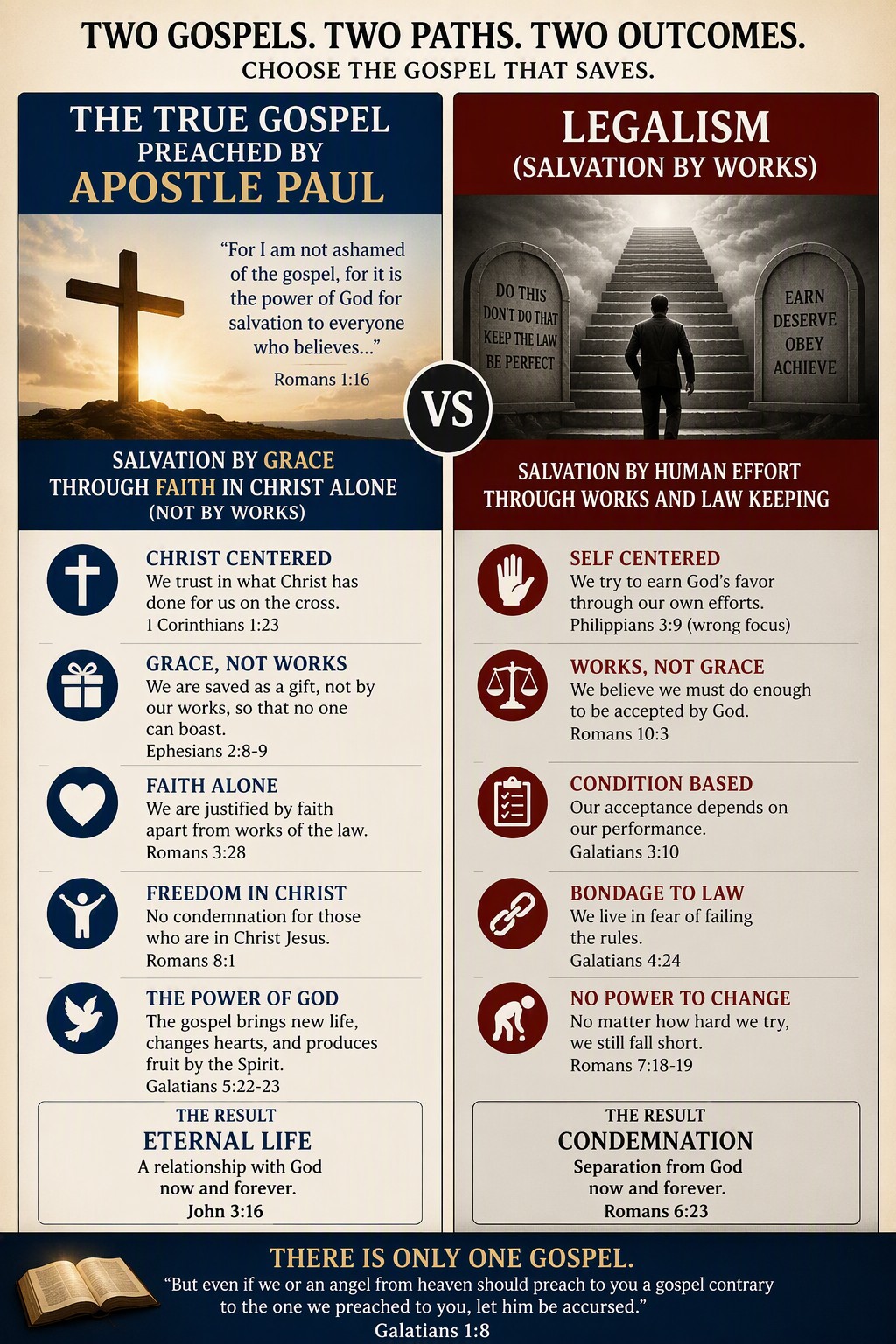
God Reconciled the World to Himself
Unfortunately, many of us believe that in order to be found in Christ and saved, we first have to believe in Him and confess our sins. But if this is true, then faith and repentance contribute to our salvation, which makes this idea a subtle form of legalism.
The Bible clearly states that in Christ all the world was already saved by God.
“God was in Christ reconciling the world to Himself, not imputing their trespasses to them” (2 Corinthians 5:19).
We do not need to repent first in order to be saved, because in Romans 2:4 we read that it is God’s goodness (His love revealed in saving all sinners) which leads us to repentance.
So, God already saved the whole world in Christ, but because it is a gift it also needs to be accepted through faith in order to make this salvation effective.
Made Alive and Raised With Christ
The most important truth concerning this full and complete message of the gospel is that whatever happened to Christ also happened with whom? With us. That is the reason why the Bible says that we are now even in Christ in the heavenly places:
“But God, who is rich in mercy, because of His great love with which He loved us, even when we were dead in trespasses, made us alive together with Christ (by grace you have been saved), and raised us up together, and made us sit together in the heavenly places in Christ Jesus, (this is our new reality!) that in the ages to come He might show the exceeding riches of His grace in His kindness toward us in Christ Jesus. For by grace you have been saved through faith, and that not of yourselves; it is the gift of God, not of works, lest anyone should boast. For we are His workmanship, created in Christ Jesus for good works, which God prepared beforehand that we should walk in them” (Ephesians 2:4–10).
The last sentence is another amazing truth, because it tells us that sanctification is not our efforts in cooperation with the Holy Spirit, but God’s work in us, or Christ in us, the hope of glory.
Our job from beginning to end, even with regard to sanctification, is what? Our job is faith.
So, it means that not only justification but also sanctification is by what? By faith.
When we surrender ourselves totally to God and believe God’s promises, then the Holy Spirit reproduces the character of Christ in us. But because it is an ongoing process, we should never base our assurance of salvation on this process of sanctification, but only on justification.
Dietrich Bonhoeffer wrote about the “in Christ motif” in the book “Life Together”:
“When God’s Son took on flesh, he truly and bodily took on, out of pure grace, our being, our nature, ourselves. This was the eternal counsel of the triune God. Now we are in him. Where he is, there we are too, in the incarnation, on the Cross, and in his resurrection. We belong to him because we are in him. That is why the Scriptures call us the Body of Christ. But if, before we could know and wish it, we have been chosen and accepted with the whole Church in Jesus Christ, then we also belong to him in eternity with one another. We who live here in fellowship with him will one day be with him in eternal fellowship. He who looks upon his brother should know that he will be eternally united with him in Jesus Christ…”.
This is the reason why another theologian wrote that “There is nothing we have as believers except we have it in Christ”.
Also in 1 Corinthians 1:30 the same Paul tells us how much we have in Christ.
The most important truth of the gospel is that we are in Christ.
But the problem is that many of us, throughout all our Christian lives, try to put ourselves in Christ because we believe that through our prayers, Bible reading, and other efforts we can be in Jesus. We beg God to put us in Christ, whereas the truth is that we already are there.
What would you think of me if, after our service today is finished, I came up to you and asked: “Guys, I need to be now in the Amersham Coleshill Church. Could you please tell me how I can get there?” What would you say? “Slawek? Are you OK? Where do you think you are right now? You already are in the Amersham Coleshill Church! So, you do not need to get there.”
“And because of Him you are in Christ Jesus, who became to us wisdom from God, righteousness and sanctification and redemption, so that, as it is written, ‘Let the one who boasts, boast in the Lord’” (1 Corinthians 1:30–31, ESV).
Do you know that in Christ we are holy and without blame, that we are sons and daughters of the eternal God? Are you aware that in Jesus we are liberated from under the condemnation of the law, and that the law cannot condemn us if we stay in Christ?
So, let us stop looking miserable, folks!
Unfortunately, one of the reports based on the so-called Valuegenesis survey of Adventist youth states that:
“The large majority of Adventist young people do not feel secure about their own salvation, and almost 60% believe that they can earn salvation directly through personal effort” (Adventism for a New Generation, 14–15).
No wonder so many young people decide to leave our church!
Where did they learn these legalistic ideas? In our churches, our homes, and often in our schools.
Unfortunately, the good news of the gospel is so good and wonderful that to many Christians it seems too good to be true. As a certain brother once said: “I have to work for anything I need. Why should salvation be different?”
How would you answer this question?
Salvation is different because the Bible says that “God’s ways are not our ways”. There are billions of light years between our ways and God’s ways. We should never judge God’s ways by our ways.
Recently I listened to a sermon by one of Adventist pastors who used to work in Africa as a missionary, and he was invited to have a Bible seminar in a very high-altitude area in Ethiopia. And on Friday night it was very cold and the people in the church were shivering. So the pastor said to the elder of the church: “Why do not we give people a hot drink before we start”. But the elder said: “Hot drink?! Pastor, we cannot break the Sabbath!” So, although the pastor had his own hot drink that he had brought from home, he did not drink it as he knew that they would not listen to him. So he was shivering with them while sharing with them the good news of the gospel. But after they understood it, the next Sabbath the elder himself came to the pastor and said: “Can we have a hot drink before we start?” And the young people were especially thankful and said that before, Sabbath was the worst day of the week. So they said: “Thank you for liberating us”. But the pastor said: “I am happy for you too, but please, use your freedom wisely and don’t turn it into cheap grace”.
Danger of Legalism
Please turn now to Matthew 23 where Christ warns us that we must never follow the example of the hypocritical Pharisees who were just a bunch of legalists, condemning and criticising others and comparing them with ourselves.
“But all their works they do to be seen by men. They make their phylacteries (fila’ktris) broad and enlarge the borders of their garments” (Matthew 23:5).
According to one of the dictionaries,
“Phylactery was a small leather case containing texts from the Scriptures worn on the forehead”.
Why did they wear these boxes with Bible verses on their foreheads? Because they loved God and His Word? No, they did it “to be seen by men”.
Sometimes you can see these guys even today. They put these boxes on their foreheads while reading the Torah, but at the same time they would not even talk to you because they are chosen and holy and you are an unclean gentile.
Woman Caught in Adultery
According to John 8 the same hypocrites one day brought to Jesus a woman caught by them in adultery. And they threw her at His feet. But that was the most foolish thing they could do. Why? Because when a frightened and contrite sinner is placed at the feet of the Son of God, the Savior of the world and the friend of sinners, this sinner is already as good as saved and nobody can touch him or her. Mary also understood this great truth and from that time on she was always at the feet of Jesus, because it was the safest and only safe place in this world.
So they brought Mary to Jesus demanding that He condemn her to death because she committed adultery. But, why didn’t they bring the man to Christ? Because that rascal was one of them.
According to John 8:4–5, they wanted to trap Jesus, so they said to Him, “Teacher, this woman has been caught in the act of adultery. Now Moses, in the law, commanded us that such should be stoned. But what do You say?” (John 8:4–5).
They were already proud of themselves because they knew that this time in answering them, Jesus would have to break either the law of Moses or the Roman law. So because they were convinced that Jesus kept silent because He was afraid to speak, they tried to force Him to speak, and they became angry and yelled at Him demanding an answer.
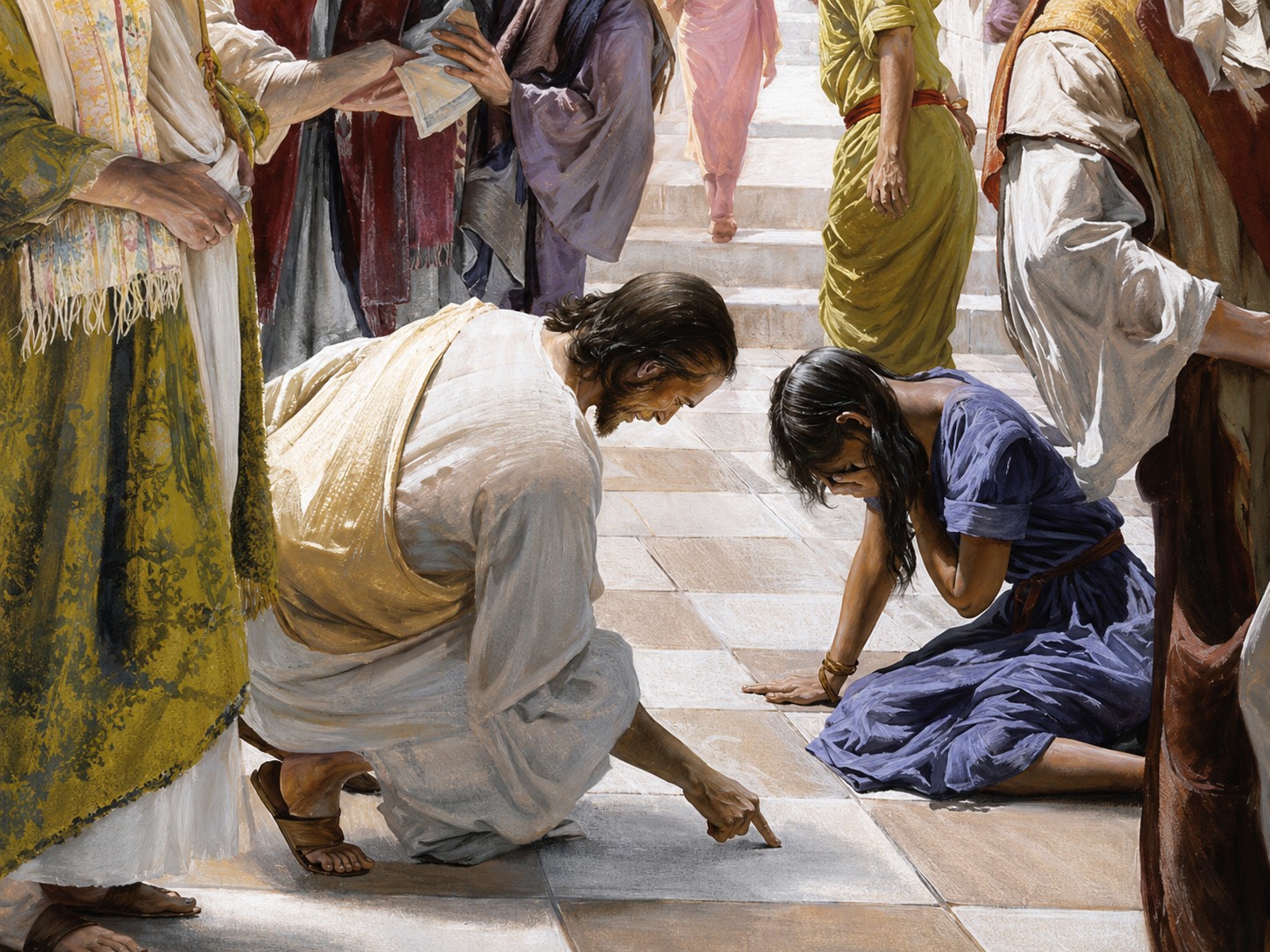
What was the answer Jesus finally gave them?
“And as they continued to ask Him, He stood up and said to them, ‘Let him who is without sin among you be the first to throw a stone at her.’ And once more He bent down and wrote on the ground” (John 8:7–8).
It is extremely interesting how Clarke’s Commentary on the Bible explains what Jesus actually meant when He said “He who is without sin”:
“He that is without sin – (anamarte’tos), means the same kind of sin, the sin of adultery. Kypke has largely proved that the verb (hamartanein) is used in this sense by the best Greek writers”.
It means that we can put the definite article before the word “sin”, which leads us to the conclusion that Jesus actually said to those Pharisees: “he among you who is without the sin”.
Because Jesus knew that they were all just a bunch of hypocritical adulterers and that they were guilty of the same sin of adultery as the woman, He said to them: “If among you there is at least one who had never committed the same sin of adultery, then you can stone her.”
In addition to that, what was Jesus writing on the ground to let them know that He could prove their sins of adultery? I believe He was writing the same sins.
Please listen to how William Barclay in his Daily Study Bible Commentary attempts to explain what Jesus was writing on the dust:
“By far the most interesting suggestion emerges from one of the later manuscripts which translates the passage this way: ‘Jesus was writing with his finger on the earth to declare their sins.’
The suggestion, therefore, is that Jesus was writing in the dust the sins of the very men who were accusing the woman. The normal Greek word for ‘to write’ is graphein; but here the word used is katagraphein, which can mean to write down a record against someone. Jesus was confronting those self-confident (sei’dists) sadists with the record of their own sins”.
So, when they heard that Jesus asked whether they had ever committed the sin of adultery, and when they saw their own adulterous acts associated with names written on the ground, they thought: “Man, this guy knows everything about me”. And because of that they said: “OK, guys, let’s go! And don’t look what he wrote, I am sure it is another heresy!”
One Died for All
There was only one person there who met that requirement—one who had never committed adultery, even in His thoughts, and therefore had the right to pronounce the woman and that whole group of adulterers guilty and put them to death. It was Jesus.
Did He put them to death?
If you say “no,” that is not the correct answer. If Jesus had not punished them with death, He Himself would have sinned!
Yes, He put them to death, but He did it later, when He put the woman and even those self-righteous hypocrites to death in Himself on the cross. If Jesus had not done so, He would have broken the law by leaving their sins unpunished.
“For the love of Christ compels us, because we judge thus: that if One died for all, then all died” (2 Corinthians 5:14).
How many people died in Christ? All—including Mary, those hypocrites, you, and me. Does this mean that legalists and hypocrites will be saved?
Do you know that in the temple built by Solomon there were little locked rooms around the temple where the priests kept their garments? And later in some of these rooms hidden idols were found that those priests were worshipping. Right there in the temple the priests who were supposed to represent the Son of God worshipped pagan idols.
In the Bible we are also called the Royal Priesthood and we are sitting with Christ in the heavenly places or in the most holy place of the heavenly sanctuary. Is it possible also for us today to have our own idol? Yes, it is. So it is time now to get rid of them all and surrender all to Jesus before it is too late.
When God gave the law to the Jews, did He do it to save them? According to what Paul wrote in Galatians God gave them the law to prove their sinfulness and to lead them to the Saviour. But instead of acknowledging their weakness and asking God to save them they said what? “We will do everything you said in the law!” What was the result? A very short time after that they were worshiping the Egyptian idol. But later, when they realized that it was impossible for them to keep God’s law, they modified it and reduced it to their own rules and traditions they were able to keep, and they believed it would save them.
Unfortunately, the sad truth is that today we also repeat the same mistake.
Transforming Power of the Gospel
A certain Adventist pastor was asked to visit a brother who was in the hospital because of leukemia and was told that he was going to die in 3 months. He was the head elder of his church for 20 solid years and now he was afraid to die. And because of this the pastor was asked to go and comfort him. So the pastor asked him, “What is the problem, and why are you afraid to die?” “You see, Pastor, I have committed the unpardonable sin,” the brother answered. “But how could you commit the unpardonable sin while being an elder of your church? After all, the unpardonable sin in the Bible is the sin of unbelief, the deliberate, persistent and ultimate rejection of Christ.” That elder explained that when his daughter was in high school she got pregnant and because it was a disgrace to him he took her to a witch doctor to have an abortion and it killed her. So now he felt God was punishing him with cancer. “When did it happen?” the pastor asked. “Ten years ago.” “So, for ten years you have had no peace?” “No.” So you were preaching in your church? He said: “I do not know”. Then he said, “Pastor, maybe God will listen to you and forgive me.” “You do not need my prayers, you need the good news of the gospel”. And he spent with him two hours explaining the truth. And he also said: “If God could forgive David who not only committed adultery but was a murderer, if God could forgive king Manasseh who killed so many people including his own children, why would He not forgive you?” And as the pastor was explaining the good news of the gospel suddenly he saw a smile on the face of that brother. And two months later when the pastor came to the hospital to visit that brother again, guess what he was doing? He was sharing the truth of the gospel with all the other patients who were also terminally ill, and he said, “Pastor, I am no longer afraid to die, but everyone here is dying because of the terminal disease, so before I die I want to share with them this wonderful good news, so that they might also die in peace.” There were 50 beds in that ward and he shared the gospel with every person, because this is what the power of the gospel does.
When we accept this wonderful good news of salvation by God’s grace, the truth of the gospel transforms us and we want to share this wonderful good news with others.
It is so because according to Romans 1:16, the Gospel is the power of God for salvation to everyone who believes.
Amen.