Is Catholic Church Teaching Salvation By Faith Today?
Slawomir Gromadzki
“This union (between fallen protestantism and catholicism) will not, however, be effected by a change in Catholicism; for Rome never changes. She claims infallibility. It is Protestantism that will change. The adoption of liberal ideas on its part will bring it where it can clasp the hand of Catholicism.” — Ellen G. White, The Review and Herald, 1 June 1886; reproduced in Last Day Events, p. 130.
Catholic Gospel Versus Biblical Gospel
Catholic scholars have failed to provide an acceptable gospel because they teach that God saves believing sinners by infusing them with His grace (power), thus enabling them to live righteous lives and qualifying them to be saved. But if God fails to make them righteous, He sends them to purgatory, where they are cleansed from their remaining sins.
In addition, in the Catholic Church, believing sinners do not have direct access to Christ in heaven but have to reach Him through human intercessors: first, Catholic priests; then, those who used to be believing sinners but were regarded as saints after death; and then holy angels, and finally Mary, who, due to the unbiblical idea of Immaculate Conception, was free from the stain of original sin. Finally, through Mary, they have access to Christ, who took a sinless human nature and died for them; and through Christ, they have access to God. This obscures the biblical truth that Christ alone is our heavenly Mediator: “There is one God and one mediator between God and mankind, the man Christ Jesus” (1 Timothy 2:5). Through Christ, every believer has direct access to God (Ephesians 2:18; Hebrews 4:14–16).
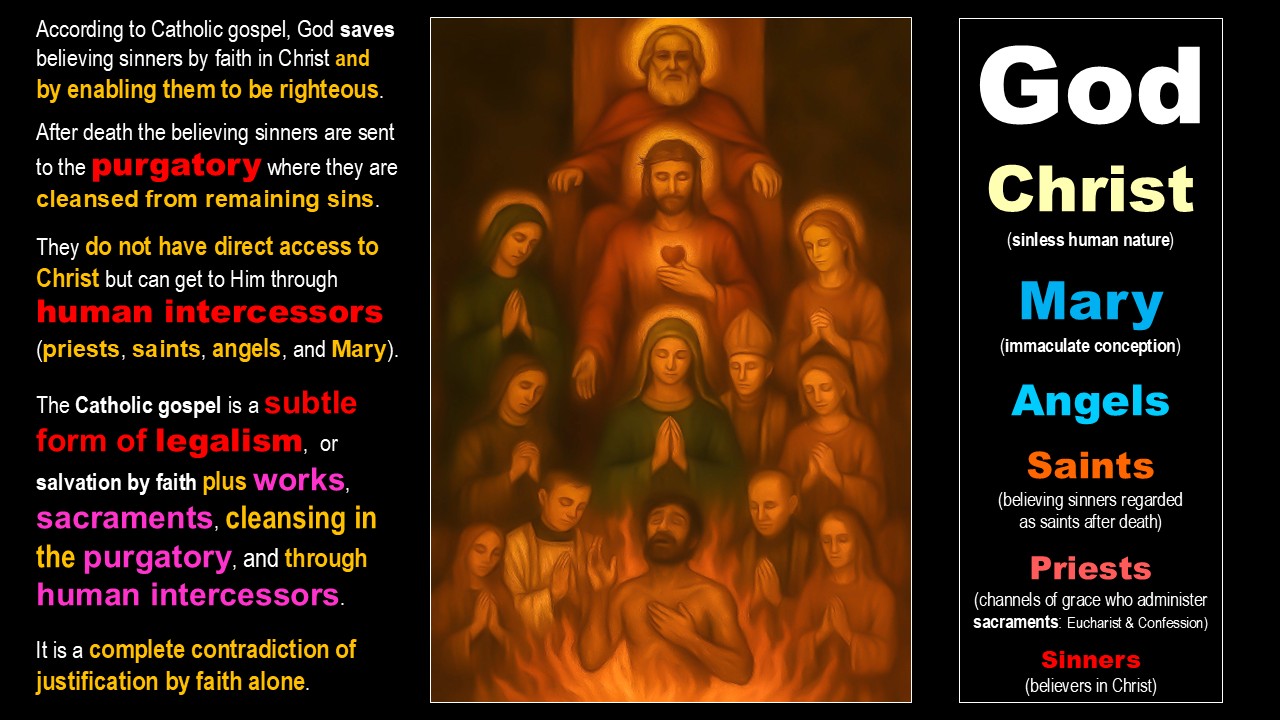
Therefore, the Catholic gospel is salvation by faith plus works, plus sacraments, plus purgatory, plus through human intercessors. It completely contradicts Paul’s message of justification by faith.
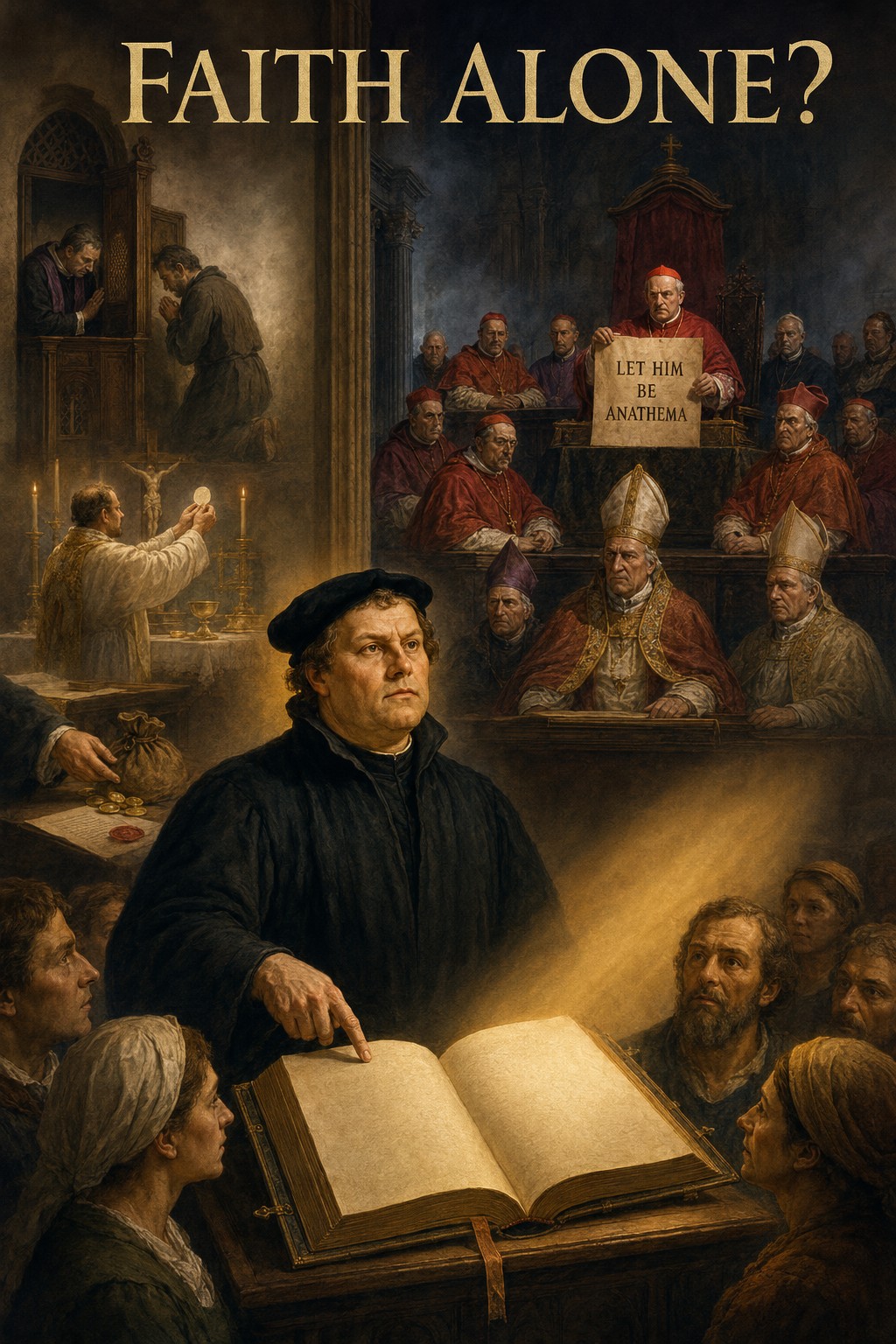
The Council of Trent officially condemned justification by faith alone: “If anyone says that the sinner is justified by faith alone…let him be anathema [cursed]” (Council of Trent, Session VI, Canon 9). Canon 11 also condemns justification by “the sole imputation of the righteousness of Christ.”
These canons have never been revoked. Yet according to the inspired apostle Paul, those who formulated them—and anyone who continues to promote this false gospel—place themselves under God’s curse: “Even if we, or an angel from heaven, should preach a gospel other than the one we preached to you, let them be under God’s curse! As we have already said, so now I say again: If anybody is preaching to you a gospel other than what you accepted, let them be under God’s curse!” (Galatians 1:8–9).
The Council of Trent pronounced a curse upon those who teach justification by faith alone; but Scripture places the curse upon those who preach any gospel contrary to salvation by grace through faith in Jesus Christ. We must therefore follow the inspired Word of God rather than the decrees of men.
by the Catholic Church and directly contradicts Paul: “For we maintain that a person is justified by faith apart from the works of the law” (Romans 3:28). “To the one who does not work but trusts God who justifies the ungodly, their faith is credited as righteousness” (Romans 4:5). “For it is by grace you have been saved, through faith…not by works” (Ephesians 2:8–9).
The biblical gospel declares that sinners are justified entirely by grace, through faith alone, solely because of Christ’s perfect life, sacrificial death and resurrection. Good works are the fruit of salvation, never the cause or basis of it.
Short History
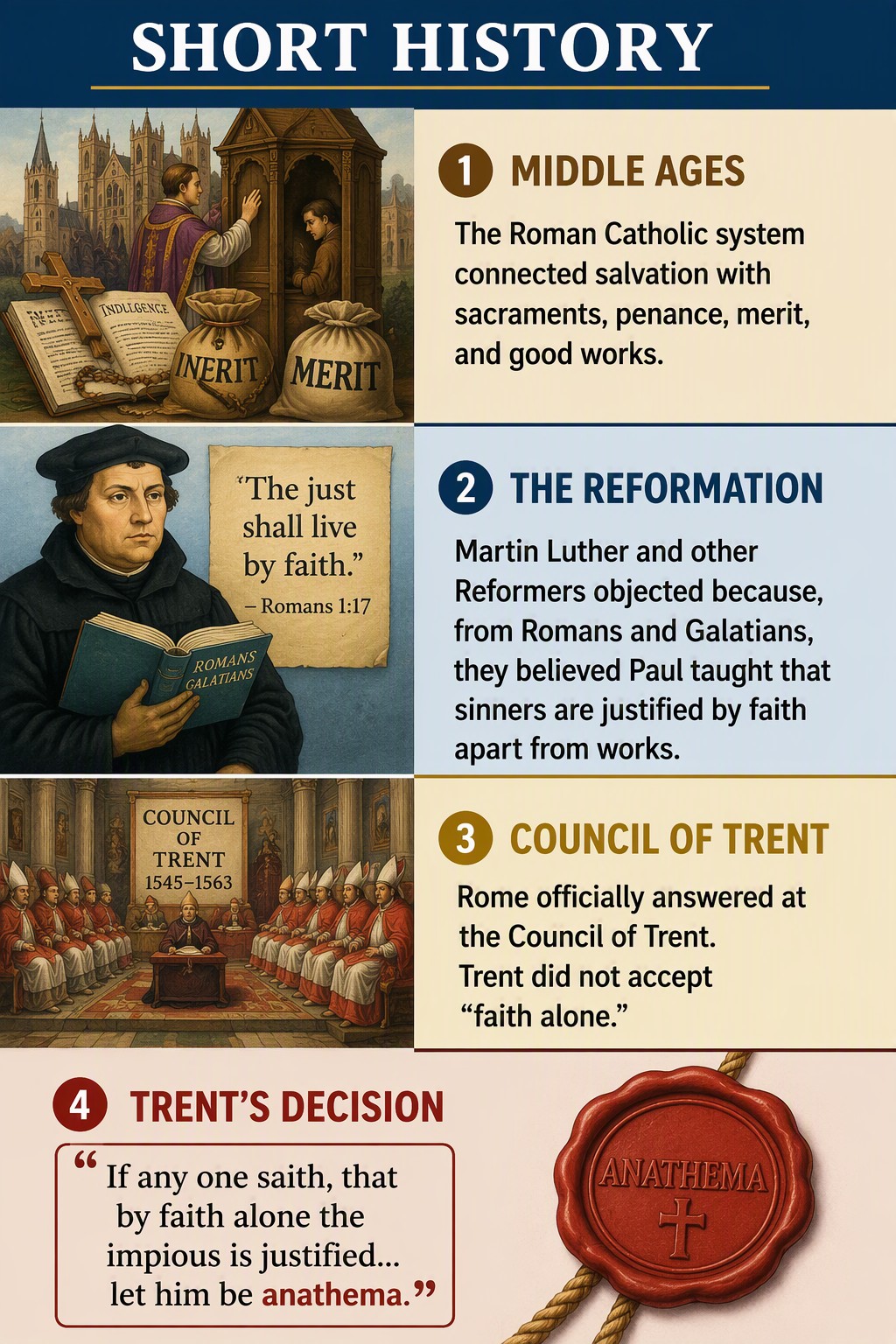
In the Middle Ages, the Roman Catholic system connected salvation with sacraments, penance, merit, and good works. Martin Luther and other Reformers objected because, from Romans and Galatians, they believed Paul taught that sinners are justified by faith apart from works. Rome officially answered at the Council of Trent, and Trent did not accept “faith alone.” It said: “If any one saith, that by faith alone the impious is justified… let him be anathema.” [The Counci…on, Canons]
What “Grace” Means Here
In Catholic teaching, “grace” means God’s undeserved help and spiritual life given to a person. Rome does not say people can save themselves without God. The Catechism says: “The grace of the Holy Spirit has the power to justify us, that is, to cleanse us from our sins.” So when Catholics say “works,” they usually mean works done after God’s grace has begun working in the person, not works done by human strength alone. [vatican.va]
Key Catholic Quote
The important point is this: Rome says the beginning of justification cannot be earned, but after that, the believer can merit more grace and eternal life. The Catechism says: “No one can merit the initial grace of forgiveness and justification, at the beginning of conversion.” But the same paragraph continues: “Moved by the Holy Spirit and by charity, we can then merit… the graces needed… for the attainment of eternal life.” [vatican.va]
Why Protestants Say This Is Still “Faith Plus Works”
Protestants object because Rome does not treat good works only as fruit or evidence of salvation. Trent says justification is “preserved and also increased before God through good works,” and not merely shown by them. Trent also says the justified person can “truly merit increase of grace, eternal life, and the attainment of that eternal life.” [The Counci…on, Canons]
So the difference is simple. Protestants say: God saves the sinner through faith in Christ, and good works come afterward as the fruit of salvation. Rome says: God’s grace starts salvation, but the believer must cooperate with grace, and good works done in grace help preserve, increase, and finally attain eternal life. That is why critics say modern Roman Catholic teaching is still faith plus works, even though Rome describes those works as being produced by grace.
Conclusion
The Roman Catholic Church does not teach that sinners can save themselves by works without grace. It says that initial justification is a free gift of grace. However, it still teaches that afterwards justification is preserved and increased through sacraments, obedience and grace-enabled works.
The present Catholic Catechism says:
“No one can merit the initial grace of forgiveness and justification.”
But immediately adds:
“We can then merit… the increase of grace… and the attainment of eternal life.”
—Catechism §2010
The Council of Trent, whose teaching Rome has never withdrawn, states:
“If anyone says that by faith alone the sinner is justified… let him be anathema.” —Canon 9
It also condemns anyone who says good works are “merely the fruits and signs of justification” rather than a cause of its increase, and teaches that grace-enabled works “truly merit… eternal life” (Canons 24, 32). Council of Trent
The difference is therefore clear:
- Paul: We are fully justified through faith in Christ; good works follow as the fruit of salvation (Romans 3:28; 4:5; Ephesians 2:8–10).
- Rome: Justification begins by grace, but must be maintained and increased through cooperation, sacraments and good works.
Therefore, although Catholic language sounds more biblical today, its official system still makes works—not works without grace, but grace-enabled works—part of the conditions for final salvation. Paul, however, presents works as the result of justification, never as part of its basis.
- Protestant/Pauline View: God credits Christ’s perfect righteousness to believers legally as a free gift the moment they place faith in Him.
- Catholic View: God pours grace into a person through sacraments (like baptism), gradually making them holy. Critics point out that under this system, final salvation relies on how well a person cooperates with that grace through their actions.
- The Catechism of the Catholic Church states that Christians can merit (deserve or earn reward for) growth in grace and eternal life through God-given good works.
- Critics argue that the moment human actions become something that “merits” eternal life, salvation ceases to be purely by grace through faith.
- In Catholic doctrine, serious (“mortal”) sin destroys justification, requiring sacramental confession and penance to regain it.
- Critics argue that keeping salvation dependent on ongoing rituals and avoiding moral failure turns salvation into a conditional, works-based system.
Quotes from Critics
The decisive point of infusion versus imputation remains an unbridgeable issue. We are either justified by a righteousness that is in us, or by a righteousness that is outside of us. R. C. Sproul
Any claim to merit obscures divine grace, devalues the cross of Christ, and inevitably promotes human pride. Gregg R. Allison and Chris Castaldo