Resurrection of Christ and Resurrection of All the Dead (1 Corinthians 15)
Slawomir Gromadzki
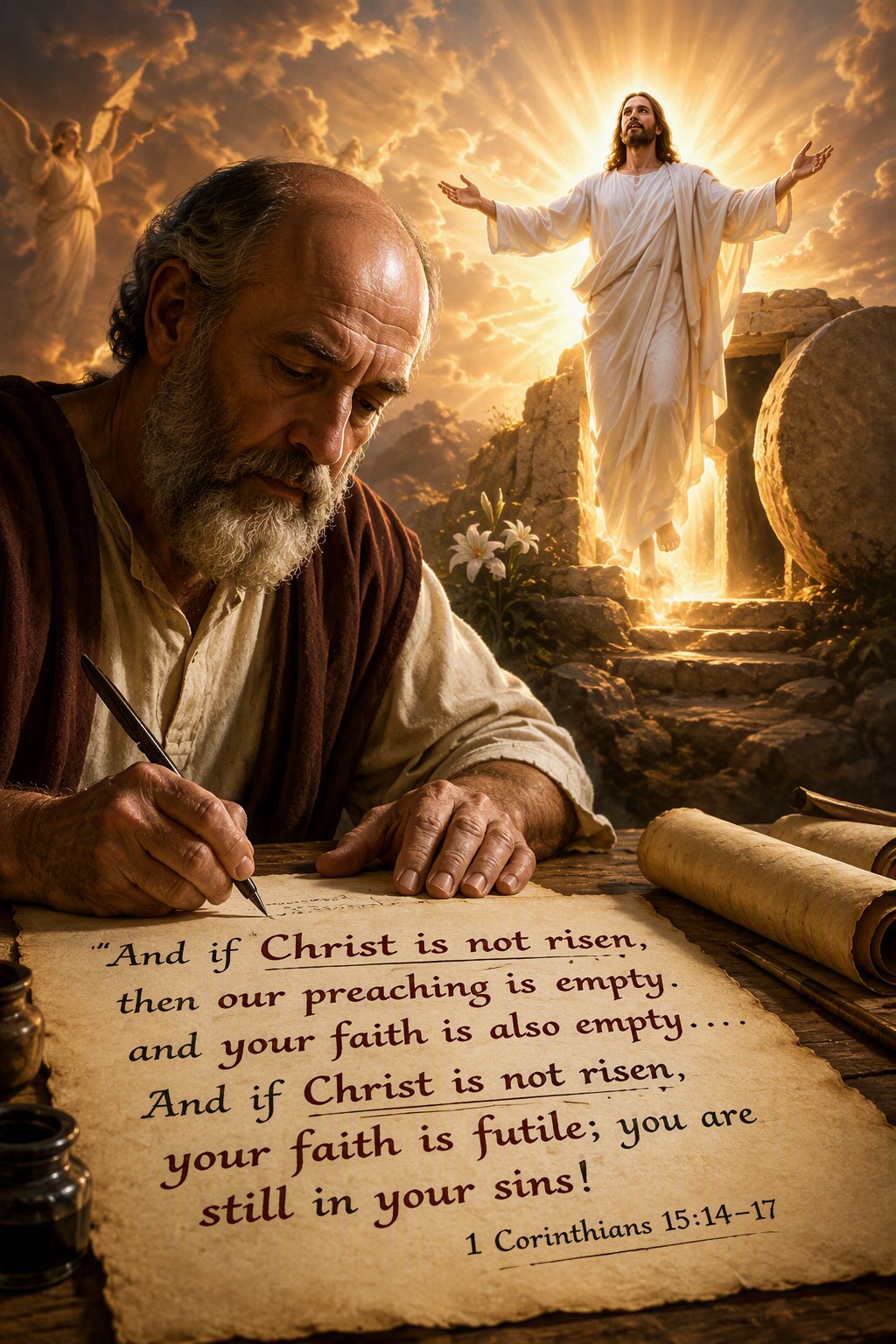
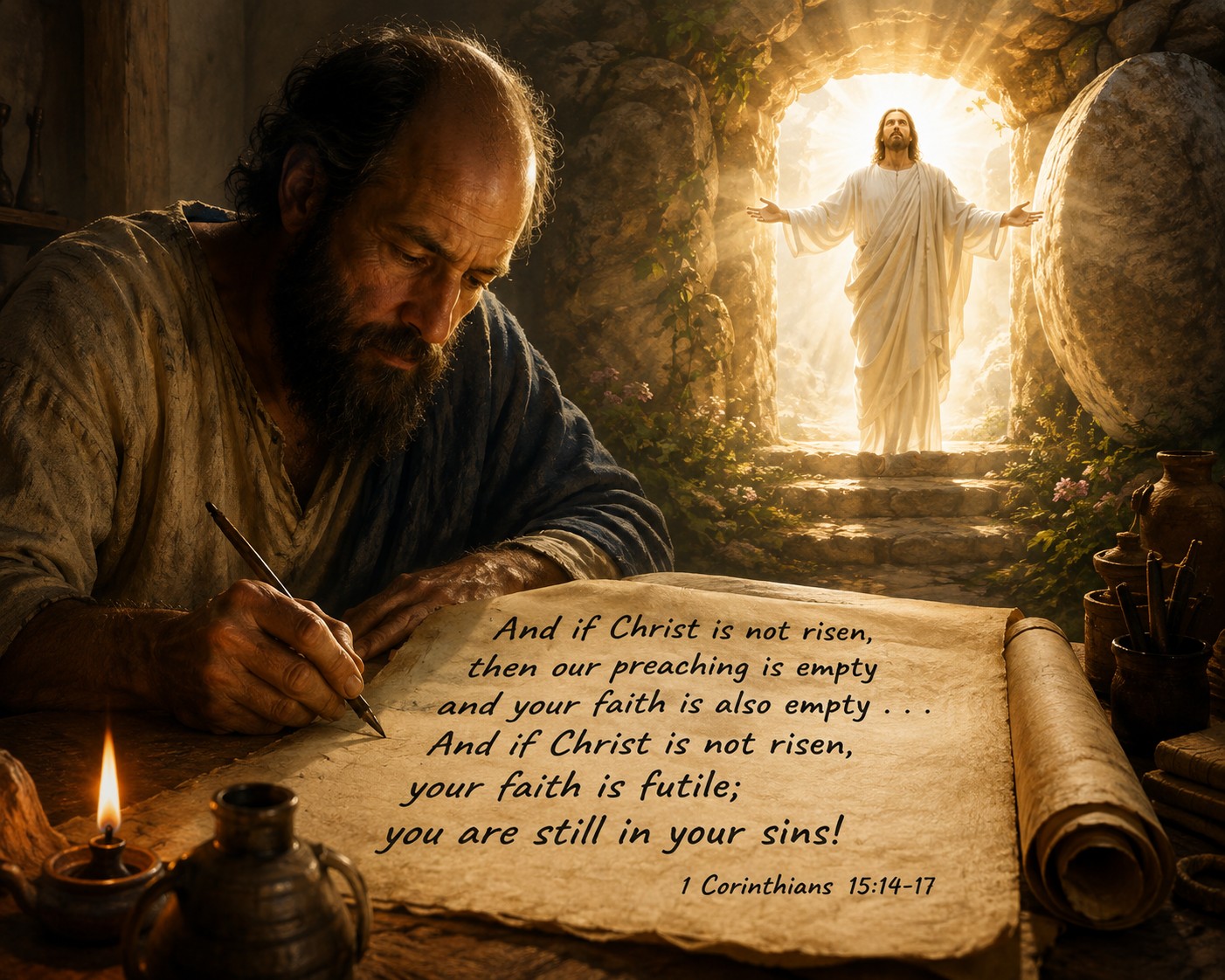
“And if Christ is not risen, then our preaching is empty and your faith is also empty. . . . And if Christ is not risen, your faith is futile; you are still in your sins!” (1 Corinthians 15:14–17, NKJV).
Some Christians in Corinth Didn’t Believe in the Resurrection!
1 Corinthians 15:12: “Now if Christ is preached that He has been raised from the dead, how do some among you say that there is no resurrection of the dead?”
Theologians are not sure exactly what those Corinthian Christians believed concerning life after death, but in Greek culture and philosophy there were three major schools:
Platonism: The body dies and the immortal soul continues life after death, but without the resurrection of the body.
Epicureanism: Nothing after death.
Stoicism: The soul may survive death temporarily, but not necessarily forever.
However, Paul does not tell us exactly which philosophy influenced them, or whether some among the Corinthian Christians refused to believe in Christ’s resurrection or in their own future resurrection.
Anyway, how fascinating that, even in his time, with so many witnesses of Christ’s resurrection, Paul had to deal with those who denied the resurrection of the dead.
Why Did Satan Attack the Resurrection?
To prevent Christians from preaching the gospel in spite of persecution! Because if there is no resurrection, then preaching the gospel and suffering for it is futile and foolish!
Christianity Stands or Falls With the Resurrection
And it was crucial, too. If Jesus is not risen, He is not who He said He was, the Cross had no effect, and our sins have not been paid for.
Paul does not treat the resurrection as a secondary doctrine. He says that if Christ did not rise, Christianity collapses: “If Christ is not risen, then our preaching is empty and your faith is also empty… you are still in your sins!” (1 Corinthians 15:14–17, NKJV). But then Paul declares: “But now Christ is risen from the dead, and has become the firstfruits of those who have fallen asleep.” (1 Corinthians 15:20, NKJV).
What Reasons Do I Have for Believing in Christ’s Resurrection?
To me, the greatest evidence of the resurrection of the dead is my own conversion, which is also a form of a miracle and a resurrection from the dead!
I also believe in the resurrection because God provided evidence that His Word is true through amazing fulfilled prophecies and through the gospel, which has transformed millions, including my life. I know the Bible is God’s Word and that what it tells us is 100% true. So, since it tells us that believers will resurrect to new life, I have no doubt about it.
Hundreds of Witnesses Could Be Questioned
Paul lists eyewitnesses of the risen Christ: Peter, the apostles, James, Paul himself, and more than 500 people at one time. Most importantly, he says that most of those 500 were still alive (1 Corinthians 15:3–8). Paul was not describing a secret vision that nobody could investigate. He was effectively saying: many witnesses are still alive—ask them!
The risen Jesus also spoke, walked, ate food, showed His wounds and allowed people to touch Him: “Handle Me and see, for a spirit does not have flesh and bones as you see I have.” (Luke 24:39, NKJV).
Christianity Began Where Jesus Had Been Buried
The apostles began preaching the resurrection in Jerusalem—the very city where Jesus had been crucified and buried. If His body was still in the tomb, the enemies of Christianity had a simple way to destroy the new movement: produce the body! Instead, Peter publicly declared in Jerusalem: “This Jesus God has raised up, of which we are all witnesses.” (Acts 2:32, NKJV).
Something Changed Terrified Disciples Into Fearless Witnesses
Before the resurrection, the disciples fled, Peter denied Jesus, and they hid behind locked doors “for fear of the Jews” (John 20:19). Soon afterwards, the same men publicly preached Christ despite threats, imprisonment and beatings. Their explanation was simple: “We cannot but speak the things which we have seen and heard.” (Acts 4:20, NKJV). The fact that out of His everlasting love Christ suffered and became a curse for their salvation and seing Him resurrected, transformed frightened disciples into men willing to suffer rather than deny what they had seen.
Paul Himself Is Powerful Evidence
Paul was not looking for reasons to believe in Jesus—he was persecuting Christians! Then the persecutor suddenly became Christianity’s greatest missionary because, as he said: “Last of all He was seen by me also.” (1 Corinthians 15:8, NKJV).
What did Paul gain? Beatings, imprisonment, persecution, shipwreck and eventually death. His entire life became evidence that he genuinely believed he had encountered the risen Christ.
One of Jesus’ Most Brilliant Arguments for the Resurrection
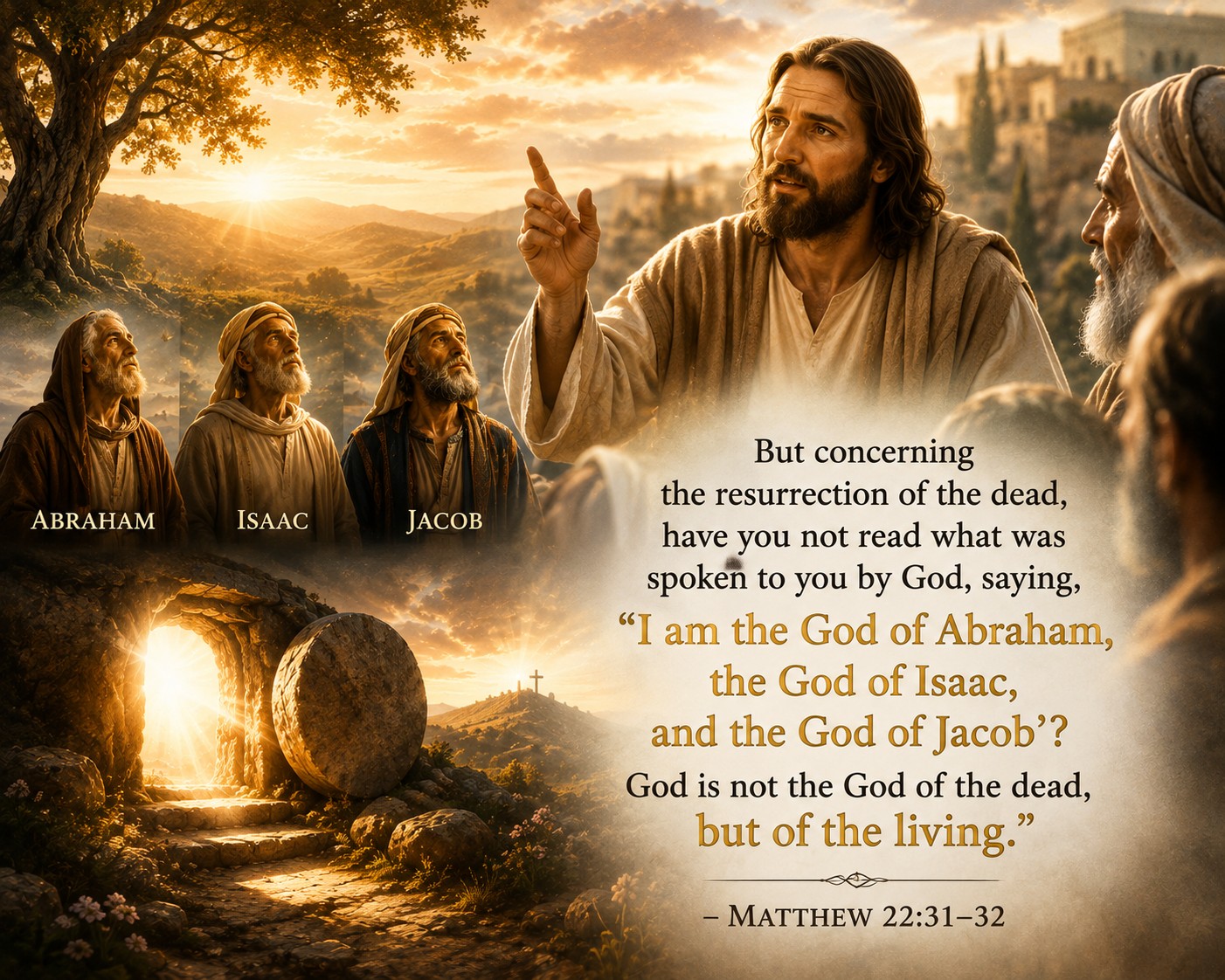
“But concerning the resurrection of the dead, have you not read what was spoken to you by God, saying, ‘I am the God of Abraham, the God of Isaac, and the God of Jacob’? God is not the God of the dead, but of the living.” — Matthew 22:31–32
The Sadducees denied the resurrection, and Jesus answered them brilliantly from Exodus—the writings of Moses on which they particularly based their beliefs. Abraham, Isaac and Jacob had been dead for centuries when God appeared to Moses, yet God still declared: “I am the God of Abraham, the God of Isaac, and the God of Jacob.” God had made an everlasting covenant with these men. Death could not cancel that covenant or prevent God from fulfilling His promises to them. Therefore, if Abraham, Isaac and Jacob are dead, GOD MUST RAISE THEM!
This is the real force of Jesus’ argument: God’s faithfulness guarantees resurrection. The grave cannot cancel His promises. Death cannot break His covenant. If God has promised eternal life to His children, even death cannot prevent Him from giving it to them!
And Jesus was not teaching the immortality of the soul. The question He was answering was specifically “concerning the resurrection of the dead.” His conclusion was not that Abraham did not really die, but that death cannot be his final condition. From God’s perspective, the resurrection is so certain that His covenant people cannot ultimately remain dead.
What a powerful thought! If God is our God, the grave cannot keep us! The same God who remained the God of Abraham, Isaac and Jacob will call His children from their graves. That is why Jesus could say: “I am the resurrection and the life. He who believes in Me, though he may die, he shall live.” John 11:25
Jesus as the Firstfruits — The Harvest Must Follow
Read 1 Corinthians 15:20–23. What does it mean to say that Jesus is the “firstfruits”?
The firstfruits were not merely the first grain harvested; they were the beginning and guarantee of the harvest that followed. Therefore, when Paul calls Christ “the firstfruits of those who have fallen asleep” (1 Corinthians 15:20), he is saying that Christ’s resurrection guarantees the resurrection of His people.
Ellen White expresses it powerfully: “His resurrection is the type and pledge of the resurrection of all the righteous dead.” The Desire of Ages, p. 785. (Ellen G. White Writings)
If the Firstfruits has risen, the harvest must follow!
In Adam All Must Die — In Christ (Second Adam) All Must Resurrect
In 1 Corinthians 15:20–23, we have great evidence that all people will resurrect. Paul gives here one of his strongest arguments: “For since by man (Adam) came death, by Man (Chris) also came the resurrection of the dead. For as in Adam all die, even so in Christ all shall be made alive.” (1 Corinthians 15:21–22).
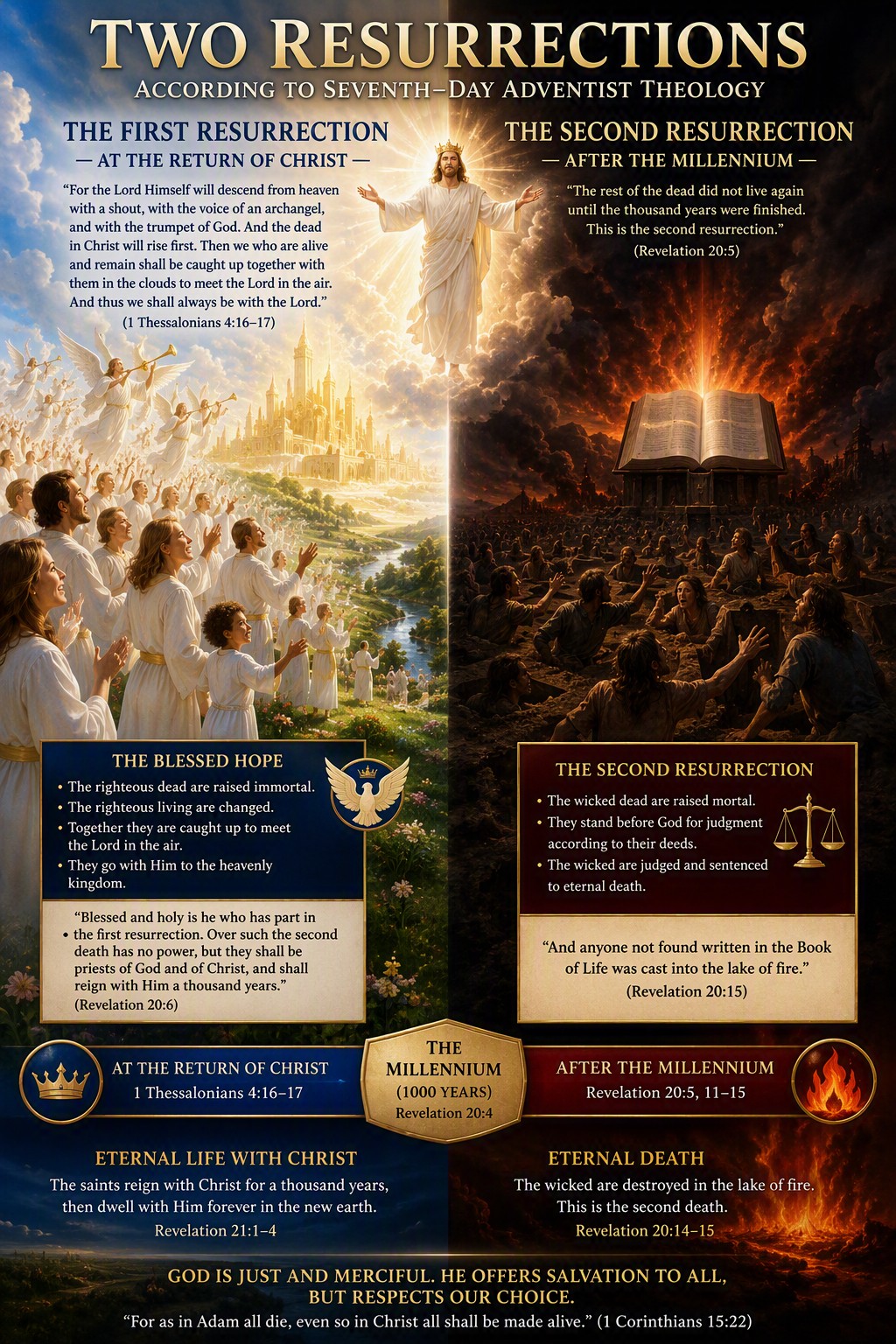
He states that since Adam represented humankind, through his sin and death he brought death to all. Likewise, since Christ was made the Second Adam (second humankind, 1 Cor 15:45), and because He was perfectly righteous in our representative flesh and resurrected, then how many must resurrect? All!
One group will resurrect at the Second Advent to life, and others will resurrect after the millennium to die again, this time forever, but all will resurrect! Why? Because Christ became us, the Second Adam, and therefore what happened in His life (including resurrection) is ours. Therefore, all will resurrect, just as all must die because the first Adam was us! The fact that also the weacked people will resurrect is an evidence that Christ died and suffered for them too, but since thet rejected the gift they will die forever. If Christ didn’t include them in His cross they would never resurrect.
The first Adam was the firstfruits of death, and therefore all die. Likewise, Christ, the Second Adam, became the firstfruits of the resurrection, and therefore all must resurrect!
The first Adam brought death to humanity; Christ, the Second Adam, brought resurrection to entire humanity. Jesus confirms it: “All who are in the graves will hear His voice and come forth.” (John 5:28–29, NKJV).
Raised With Christ (Colossians 3:1-3)
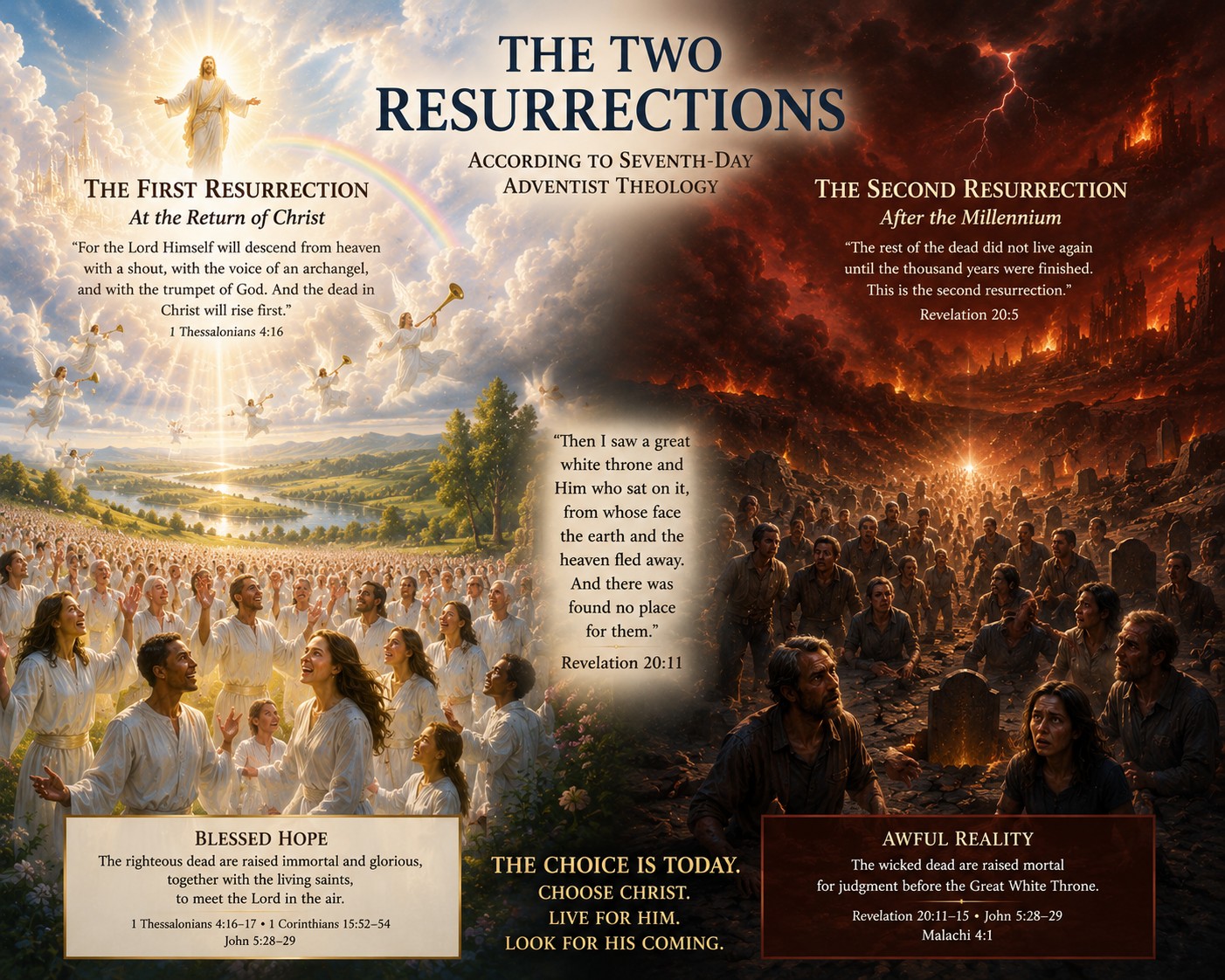
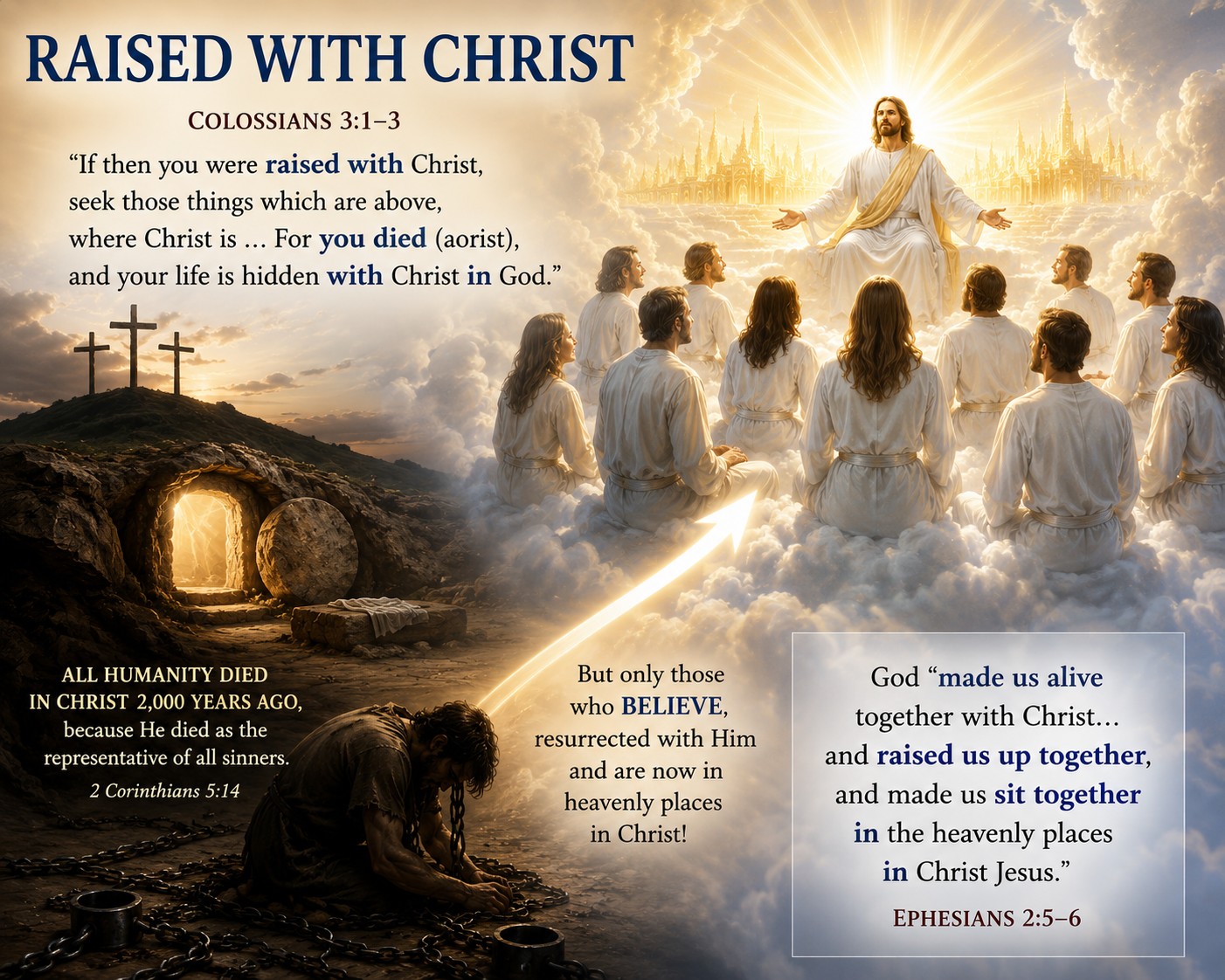
Colossians 3:1–3: “If then you were raised with Christ, seek those things which are above, where Christ is … For you died (aorist), and your life is hidden with Christ in God.”
All humanity died in Christ 2,000 years ago, because He died as the representative of all sinners (2 Corinthians 5:14). But only those who believe resurrected with Him and are now in heavenly places in Christ! God “made us alive together with Christ… and raised us up together, and made us sit together in the heavenly places in Christ Jesus” (Ephesians 2:5–6, NKJV).
We could resurrect only when we first died! There is no resurrection without death. We can resurrect to eternal life only when we accept the historic fact of our death in and with Christ, which took place 2,000 years ago!
Therefore, if we true believers have already died with Christ, been raised with Christ, and are with Him in heavenly places, what are we to do now here?
According to Colossians 3:1–3, we are to love Him, think about Him, have communion with Him, talk to Him, read about Him, look at Him, and talk about Him!
Without Death, Resurrection Loses Its Meaning
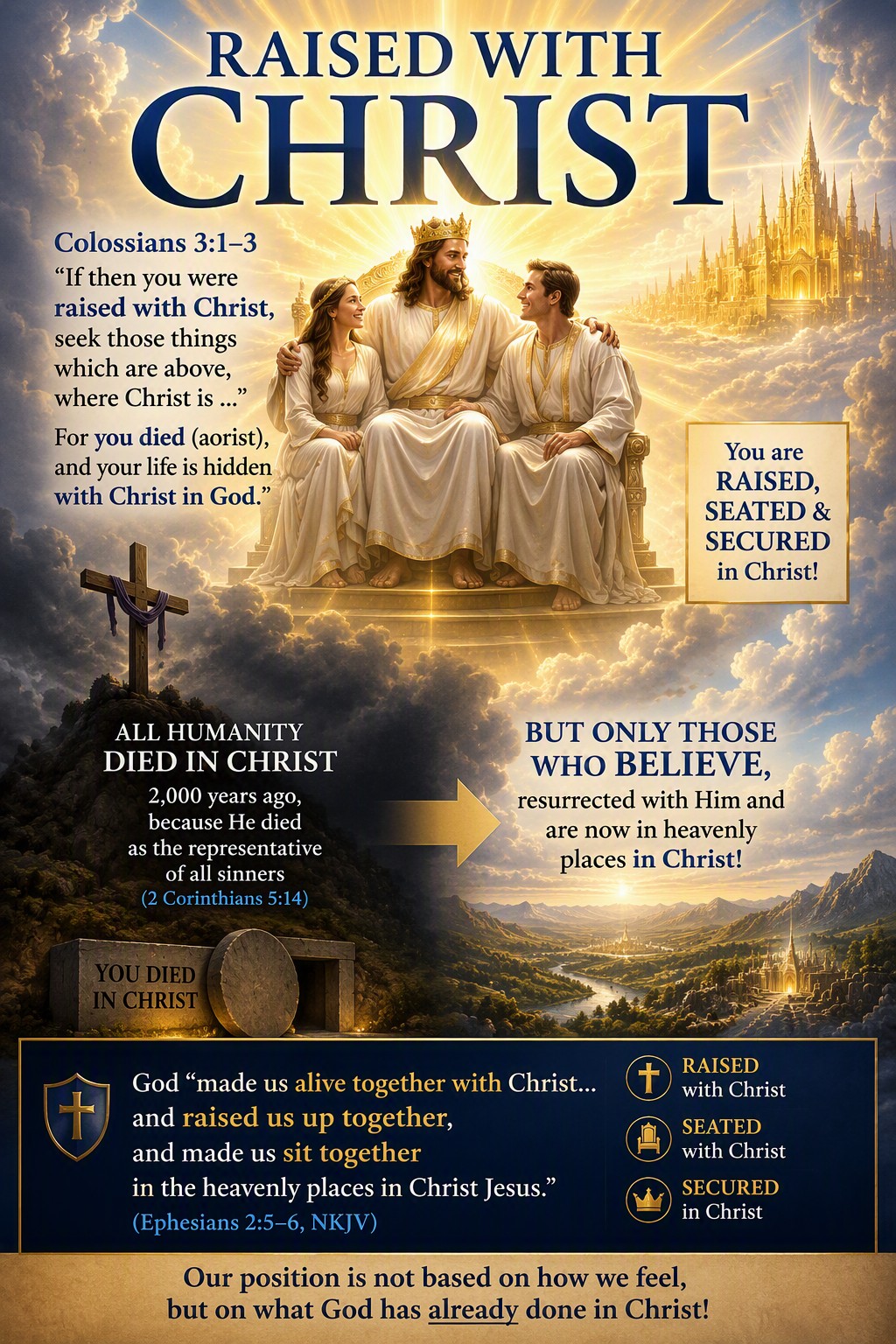
If believers already possess immortal souls consciously enjoying heaven after death, why is resurrection so central to Christian hope? Scripture says: “The dead in Christ will rise first.” (1 Thessalonians 4:16, NKJV). Paul also says immortality is something mortal human beings must receive: “This mortal must put on immortality.” (1 Corinthians 15:53, NKJV).
Biblical hope is therefore not that an immortal soul escapes death, but that Christ conquers death by raising the dead!
The Miracle of the Seed
Paul uses the germination of a seed as an illustration of the miracle of the resurrection in 1 Corinthians 15:
“How foolish! What you sow does not come to life unless it dies. When you sow, you do not plant the body that will be, but just a seed, perhaps of wheat or of something else. But God gives it a body as he has determined, and to each kind of seed he gives its own body.” 1 Corinthians 15:36–38 (NIV)
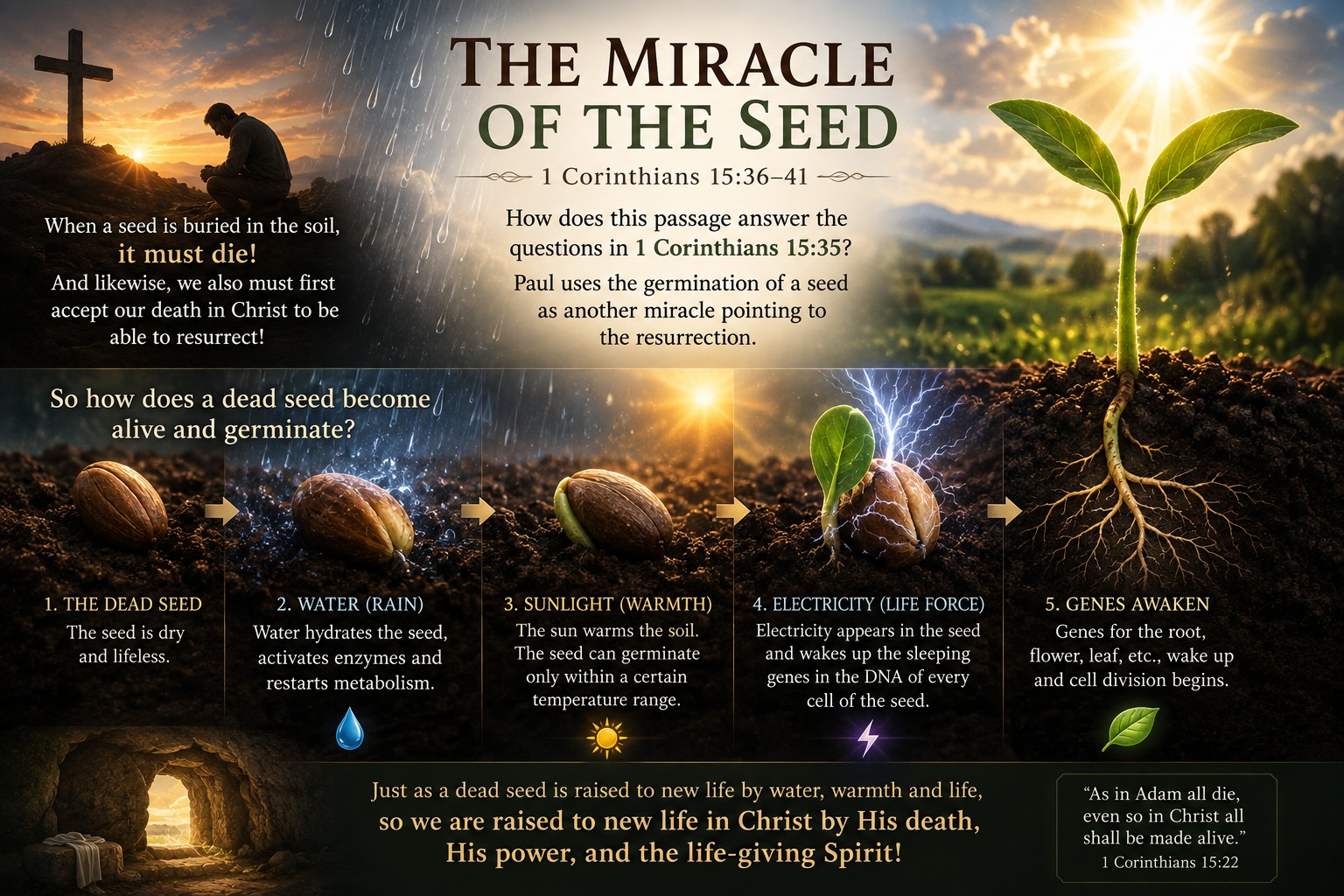
Paul uses the germination of a seed as another miracle pointing to the resurrection. First, he states that when a seed is buried in the soil, it must die!
And likewise, we also must first accept our death in Christ to be able to resurrect!
So how does a dead seed become alive and germinate?
First of all, in order to germinate, the seed requires water from rain to hydrate the dry seed and activate enzymes, allowing metabolism to restart, and the sun must warm up the cold soil because the seed can germinate only within a certain temperature range.
Then, at the same time, electricity must appear in the seed and wake up the sleeping genes in the DNA of every cell of the seed. Then the genes for the root, flower, leaf, etc., wake up and the process of cell division starts.
Ellen White and Electricity in the Seed
It is interesting that Ellen White, in the 1890s, wrote about electricity in the seed. The first scientist who mentioned it was Dr Burr of Yale University, who did so 50 years later.
The germination of the dead seed reflects the new birth and resurrection of a sinful and saved human being.
Like that dead seed in the soil, we also are spiritually dead and in darkness, deprived of the Holy Spirit and God’s agape love.
But when we drink the water of life from Jesus and when we are warmed by the sun of Christ’s righteousness, accepted by faith, then the Holy Spirit starts dwelling in us with His electric current and power, making us spiritually alive and able to produce the fruit of the Spirit.
Paul Would Be Greatest Fool Suffering So Much Without Assurance of Resurrection
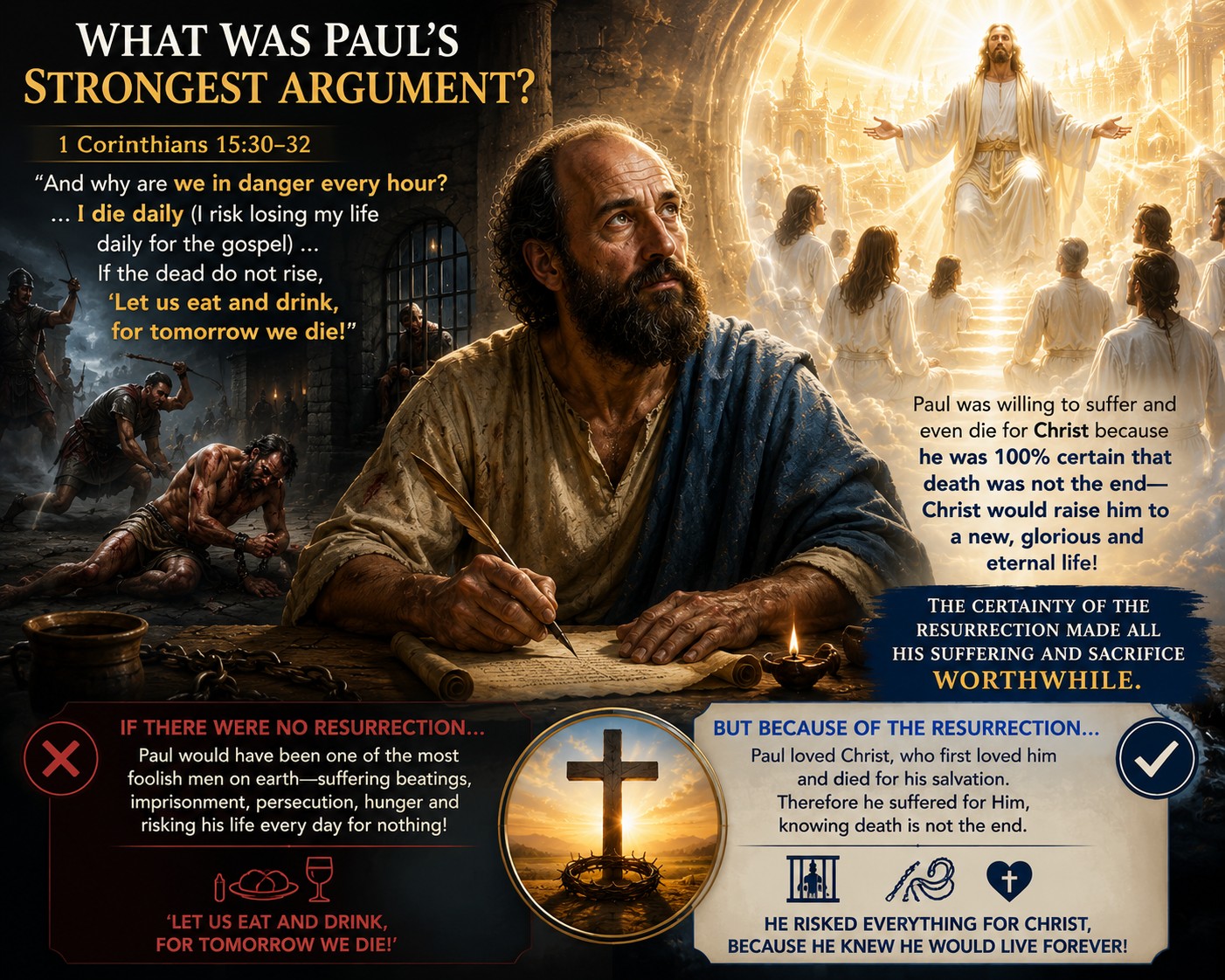
1 Corinthians 15:30–32: “And why are we in danger every hour? … I die daily (I risk losing my life daily for the gospel) … If the dead do not rise, ‘Let us eat and drink, for tomorrow we die!’”
Paul used his tremendous daily sufferings for Christ as a powerful argument! If there were no resurrection, Paul would have been one of the most foolish men on earth—suffering beatings, imprisonment, persecution, hunger and risking his life every day for nothing! Instead, he should have enjoyed the passing pleasures of this short life: “Let us eat and drink, for tomorrow we die!”
But Paul was willing to suffer so much because he was in love with Christ, who had first loved him and suffered and died for his salvation. And Paul was willing to suffer and even die for Christ because he was 100% certain that death was not the end—Christ would raise him to a new, glorious and eternal life! The certainty of the resurrection made all his suffering and sacrifice worthwhile.
This is why Paul himself is such powerful evidence. Paul was not looking for reasons to believe in Jesus—he was persecuting Christians! Then the persecutor suddenly became Christianity’s greatest missionary because, as he said: “Last of all He was seen by me also.” (1 Corinthians 15:8, NKJV).
What did Paul gain? Beatings, imprisonment, persecution, shipwreck and eventually death. That is why his argument is so powerful: “If the dead do not rise, ‘Let us eat and drink, for tomorrow we die!’” (1 Corinthians 15:32, NKJV). Paul’s entire life became evidence that he genuinely believed he had encountered the risen Christ.
Why Did Moses “Choose Suffering With the People of God Rather Than the Passing Pleasures of Sin”?
Because he looked to the reward (Hebr. 11:24-25)! And what was the reward? It was resurrection to eternal life with Jesus!
If Moses wasn’t sure about resurrection, then he was the most foolish man on earth, refusing to be the king of Egypt, the most powerful empire on earth at that time, and instead choosing suffering!
One Voice Will Open the Graves
Jesus once stood before one grave and cried: “Lazarus, come forth!” (John 11:43, NKJV). One dead man came out. But at the Second Coming, that same voice will be heard throughout the earth!
Ellen White writes: “The voice of the Son of God calls forth the sleeping saints… ‘Awake, awake, awake, ye that sleep in the dust, and arise!’” The Great Controversy, p. 644. (Ellen G. White Writings)
Then Paul’s prophecy will finally be fulfilled: “Death is swallowed up in victory. O Death, where is your sting? O Hades, where is your victory?” (1 Corinthians 15:54–55, NKJV).
The Christian hope is not that death does not really happen. It is much greater: We die. Christ returns. Christ speaks. The dead rise. Death is defeated!
Summary of the Key Evidence and Arguments for the Resurrection
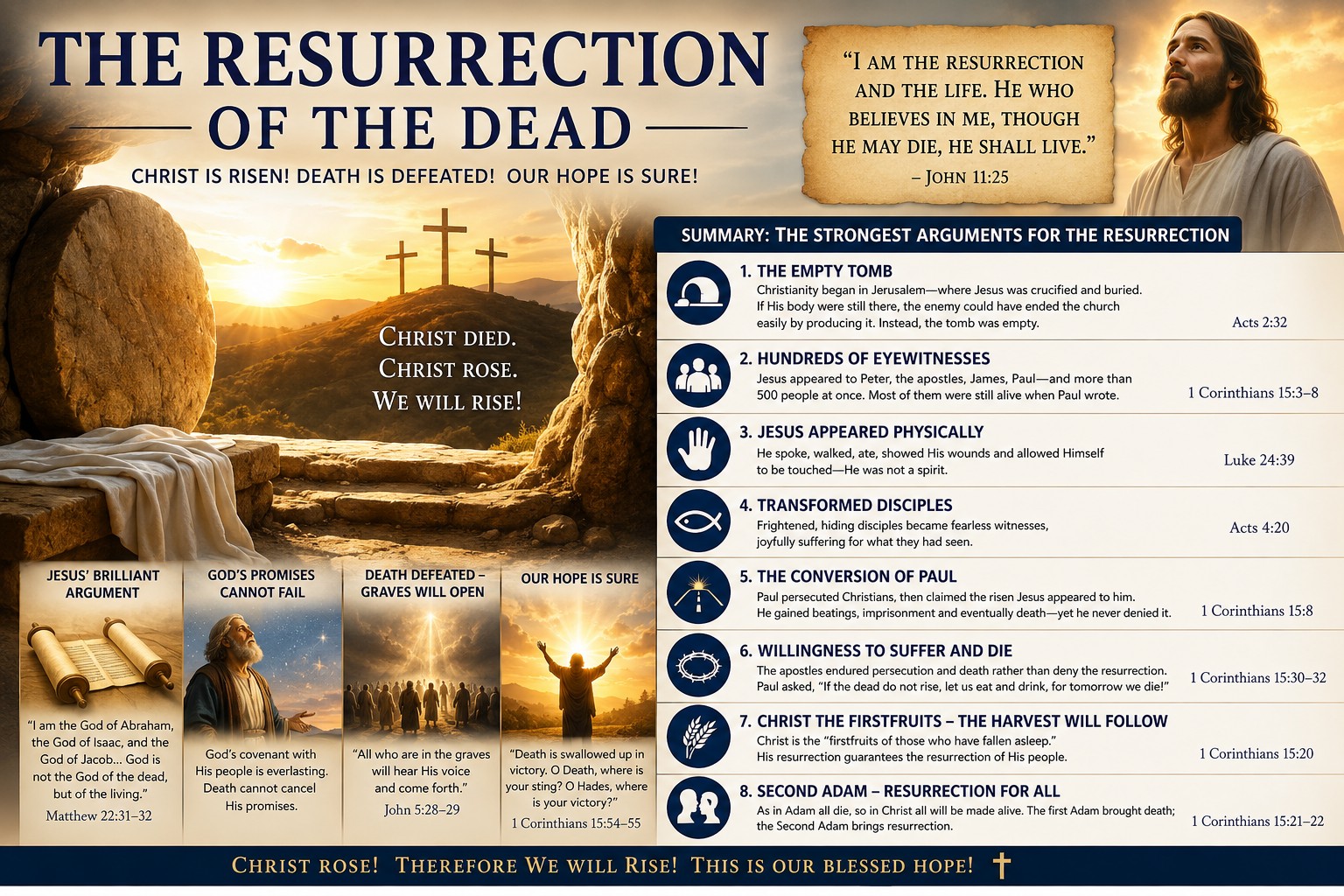
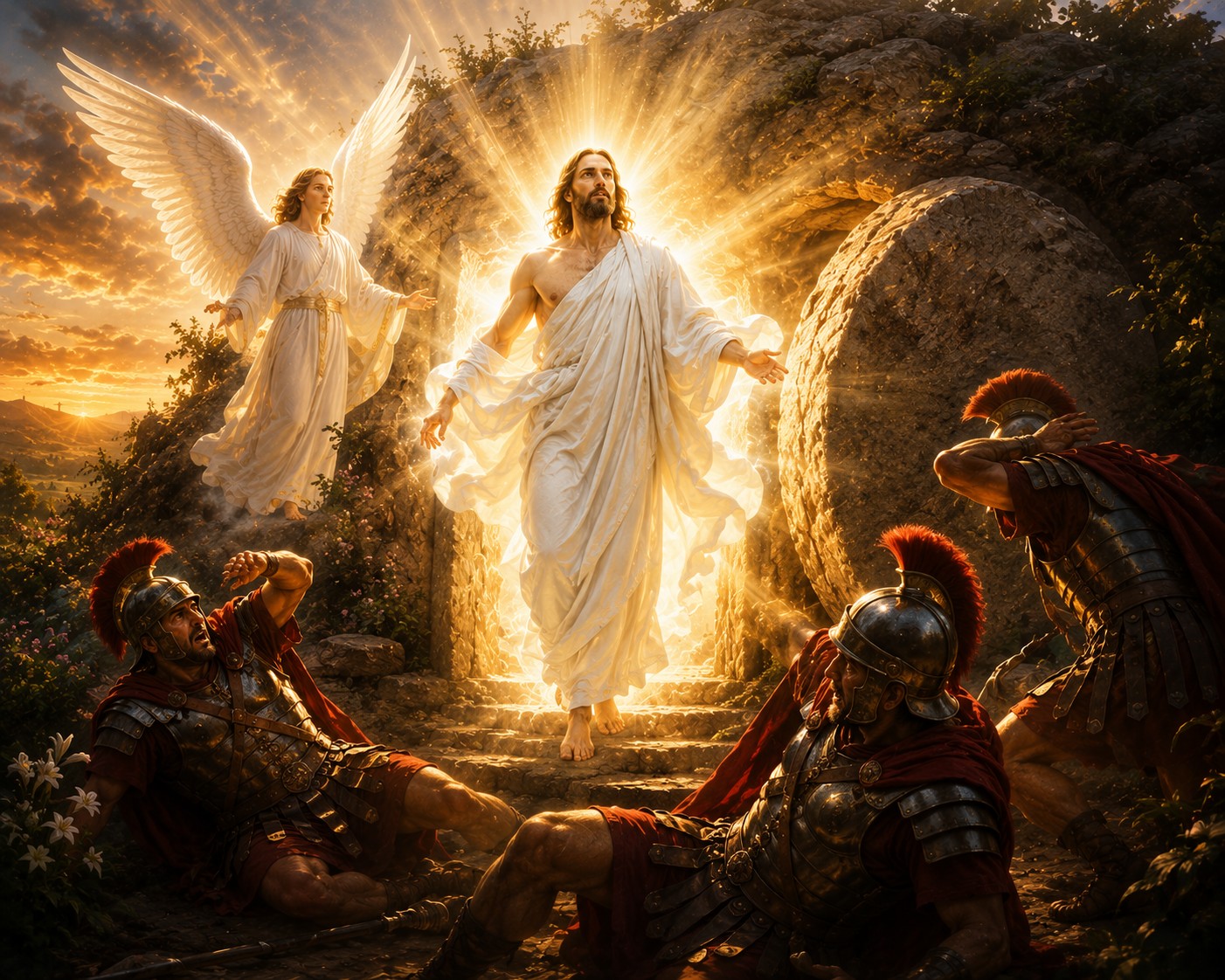
The resurrection is not a minor Christian teaching—it is the foundation of the gospel. Paul says that if Christ did not rise, Christian preaching is empty, faith is useless, the apostles are false witnesses, believers remain in their sins, and those who died in Christ have perished (1 Corinthians 15:14–19). But Paul immediately declares: “But now Christ is risen from the dead.” (1 Corinthians 15:20, NKJV).
1. The empty tomb. Christianity began in Jerusalem—the very place where Jesus had been crucified and buried. If His body remained in the grave, the authorities could have destroyed Christianity at its beginning simply by producing the body. Instead, the apostles publicly proclaimed in Jerusalem: “This Jesus God has raised up, of which we are all witnesses.” (Acts 2:32, NKJV).
2. Hundreds of eyewitnesses. Paul names Peter, the apostles, James and himself, and states that Jesus appeared to more than 500 people at once. Most of them, Paul says, were still alive when he wrote (1 Corinthians 15:3–8). His claim could therefore be investigated and challenged by people living at the time.
3. Jesus appeared physically, not merely in visions. The resurrected Christ spoke, walked, ate food, showed His wounds and allowed Himself to be touched: “Handle Me and see, for a spirit does not have flesh and bones as you see I have.” (Luke 24:39, NKJV).
4. The extraordinary transformation of the disciples. Before the resurrection, the disciples fled, Peter denied Christ, and they hid behind locked doors in fear. Soon afterwards, these same men openly proclaimed the resurrection despite threats, imprisonment and beatings. They explained why: “We cannot but speak the things which we have seen and heard.” (Acts 4:20, NKJV).
5. The amazing conversion of Paul. Paul was not a follower of Jesus looking for reasons to believe. He was Christianity’s persecutor! Yet suddenly he became its greatest missionary because he claimed that the risen Jesus had appeared to him: “Last of all He was seen by me also.” (1 Corinthians 15:8, NKJV). Instead of gaining wealth or comfort, Paul received beatings, imprisonment, persecution and eventually death. His transformed life is powerful evidence that he genuinely believed he had encountered the risen Christ.
6. The apostles were willing to suffer for their testimony. Paul asks why he would continually risk his life if there were no resurrection: “Why are we in danger every hour?… I die daily… If the dead do not rise, ‘Let us eat and drink, for tomorrow we die!’” (1 Corinthians 15:30–32, NKJV). If there were no resurrection, Paul would have been foolish to suffer so much instead of enjoying the passing pleasures of life. He willingly suffered because he loved Christ, who had suffered for his salvation, and because he was absolutely convinced that Christ would raise him to eternal life.
7. The resurrection explains the birth of Christianity. Something extraordinary must explain how a crucified Messiah whose frightened followers had scattered became the centre of a rapidly expanding movement publicly proclaiming that He was alive. The explanation consistently given by the earliest Christians was not merely that Jesus’ teachings continued—it was that they had seen Him alive after His death.
8. Christ is the “firstfruits,” guaranteeing the coming harvest. Paul calls Christ “the firstfruits of those who have fallen asleep.” (1 Corinthians 15:20, NKJV). The firstfruits were the beginning and guarantee of the harvest to follow. Ellen White therefore wrote: “His resurrection is the type and pledge of the resurrection of all the righteous dead.” The Desire of Ages, p. 785. Christ has risen; therefore His people will rise!
9. The First Adam brought death; the Second Adam brings resurrection. Paul presents Christ’s resurrection as the reversal of Adam’s catastrophe: “For since by man came death, by Man also came the resurrection of the dead. For as in Adam all die, even so in Christ all shall be made alive.” (1 Corinthians 15:21–22, NKJV). Adam brought humanity under death; Christ guarantees that death will not have the final word.
10. God’s own faithfulness guarantees resurrection. Jesus’ argument against the Sadducees is profound: “I am the God of Abraham, the God of Isaac, and the God of Jacob… God is not the God of the dead, but of the living.” (Matthew 22:31–32, NKJV). God made everlasting promises to Abraham, Isaac and Jacob. Death cannot cancel His covenant. Therefore, if they are dead, God must raise them! The grave cannot prevent God from fulfilling His promises.
11. Fulfilled prophecy and the transforming power of the gospel support confidence in the biblical testimony. The resurrection does not stand isolated from the rest of Scripture. Fulfilled prophecies and the extraordinary transforming power of the gospel provide further reasons to trust the Bible’s testimony concerning Christ and the resurrection.
12. The final proof will come when Christ speaks and the graves open. Jesus demonstrated His power over death when He stood before Lazarus’ grave and commanded: “Lazarus, come forth!” (John 11:43, NKJV). At His return, that same authority will be exercised universally: “All who are in the graves will hear His voice and come forth.” (John 5:28–29, NKJV).
The evidence forms one powerful picture: the tomb was empty; hundreds claimed to have seen Jesus alive; the risen Christ was seen and touched physically; terrified disciples became fearless witnesses; Christianity arose in the very city where Jesus had been buried; Christianity’s greatest persecutor became its greatest missionary; and these witnesses accepted tremendous suffering rather than deny what they claimed to have seen.
And Christ’s resurrection is only the beginning: “Death is swallowed up in victory. O Death, where is your sting? O Hades, where is your victory?” (1 Corinthians 15:54–55, NKJV).
Christ rose. Therefore death has been defeated. Christ is the Firstfruits. Therefore the harvest will follow. Christ lives. Therefore those who belong to Him will live also!