Scarlet Worm: Remarkable Picture of Christ and the Cross
Psalm of the Crucifixion
Psalm 22 is often called the psalm of the crucifixion. It was written nearly 1,000 years before Jesus Christ cried out from the cross, “My God, My God, why have You forsaken Me?”
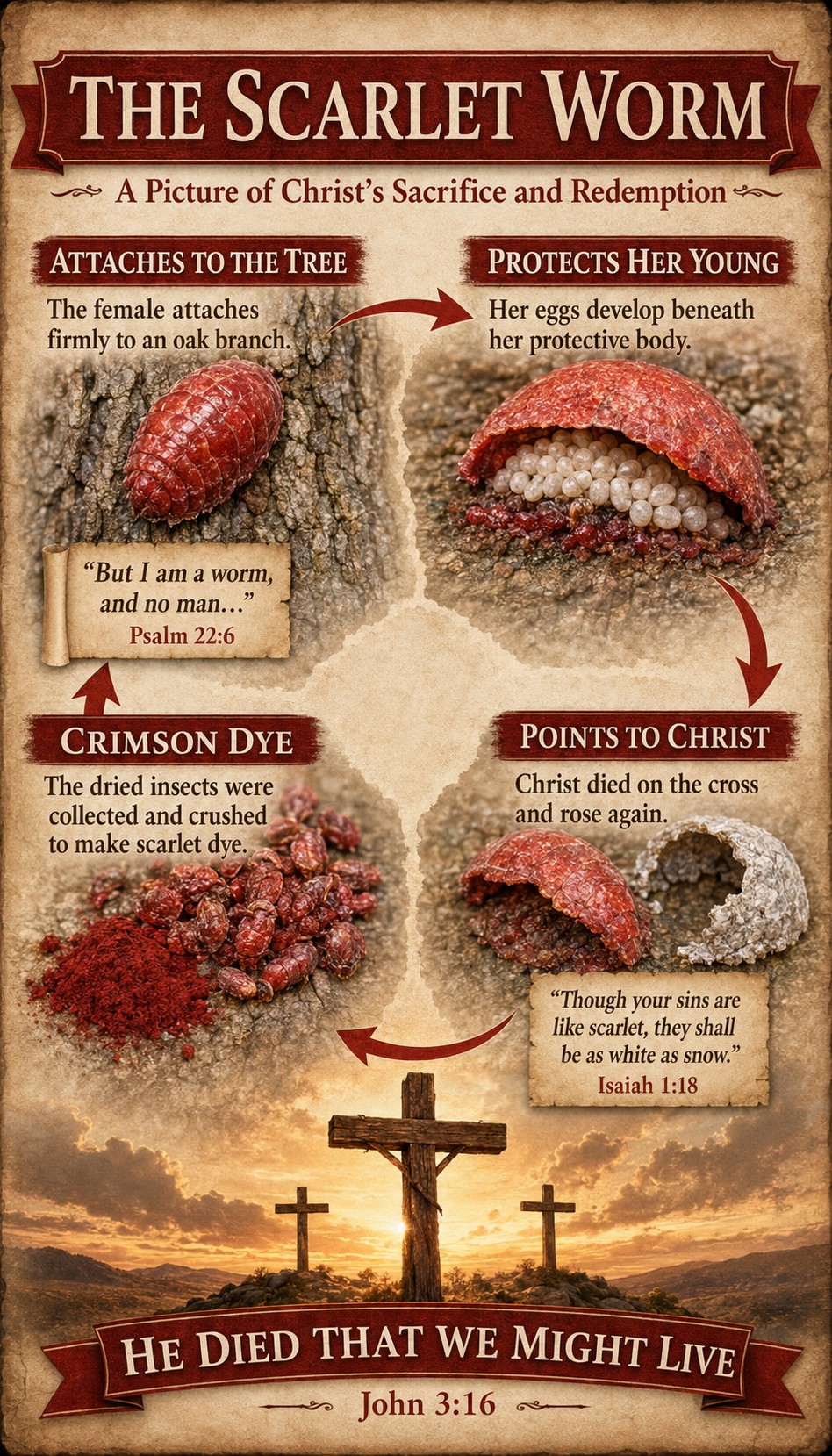
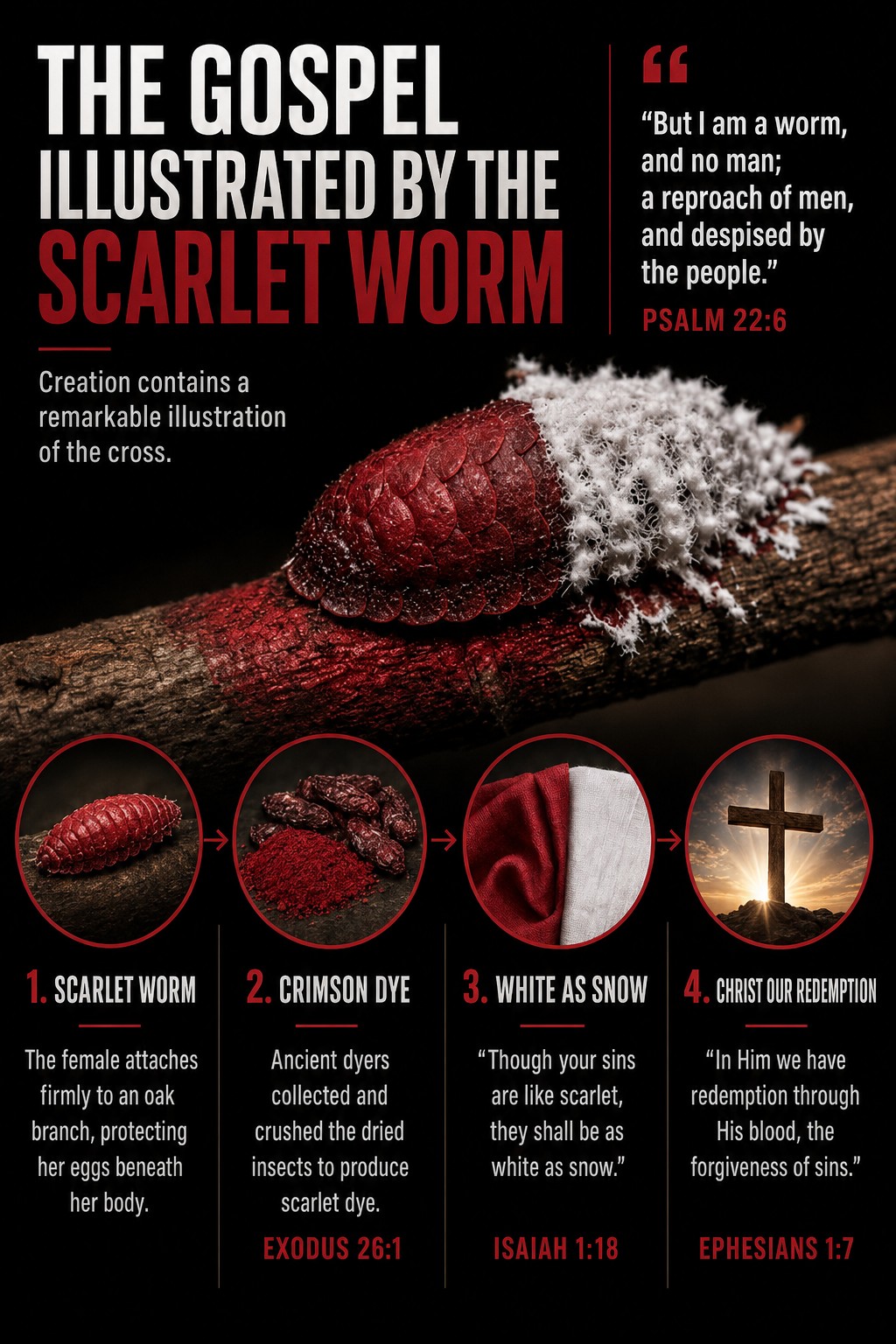
But in verse 6, David records words carrying a remarkable prophetic meaning: “But I am a worm, and no man; a reproach of men, and despised by the people.” Psalm 22:6.
At first glance, this statement seems strange. Why would the Messiah compare Himself to a worm?
Meaning of Tolaʿath
The Hebrew word used here is tolaʿath. Although it can mean a worm, it is also associated with the scale insect from which deep crimson or scarlet dye was produced.
This creature has traditionally been identified as the scarlet worm, sometimes called Coccus ilicis. These insects were collected, dried and crushed to produce a valuable crimson dye. The dye was used to colour royal robes and the sacred fabrics of the Tabernacle.
Strong’s Concordance connects the word with both the insect and its crimson colour. The Brown–Driver–Briggs Hebrew Lexicon similarly associates it with the scale insect whose dried body was used to produce scarlet dye.
The Hebrew expression tolaʿath shani is frequently translated as “scarlet.” This connection existed because the colour came from the processed bodies of these tiny creatures.
Scarlet in Tabernacle
The book of Exodus repeatedly mentions scarlet material in connection with the Tabernacle. Scarlet was woven into the fine linen of its entrance screen. It was also present in the veil separating the Holy Place from the Most Holy Place.
Every scarlet thread in God’s sanctuary pointed towards something greater. It foreshadowed Jesus Christ, His sacrifice and His blood shed for sinners.
Scarlet Worm and Tree
The creationist Henry Morris used the scarlet worm as an illustration of Christ’s sacrifice. When the female scale insect was ready to produce her young, she attached her body firmly to the branch or trunk of a tree. Her eggs remained protected beneath her body until they hatched.
As the mother died, her body provided protection for her young. Ancient people collected and processed the dried bodies of these insects to obtain their valuable scarlet dye.
Some sources also claim that a crimson substance stained the insect’s young and the surrounding wood and that, after three days, the remains turned white. It provides a powerful illustration of Christ’s resurrection and making our scarlet sins white as snow.
White as Snow
Jesus Christ, the Messiah, willingly allowed Himself to be fastened to the tree of the cross. He poured out His crimson blood and gave His life for humanity. He was crushed, despised, rejected and pierced for our sins.
On the third day, He rose again. Through His sacrifice, the scarlet stain of sin can be made white as snow.
This is what the prophet Isaiah declared: “Though your sins are like scarlet, they shall be as white as snow; though they are red like crimson, they shall be as wool.” Isaiah 1:18.
The scarlet insect was crushed so that kings could wear robes of crimson. Jesus, mocked by men, was clothed in a scarlet robe of shame before His crucifixion. Yet He was truly the King of kings, laying down His life so that believers could be clothed in His perfect righteousness.
Scarlet Robe and Cross
The scarlet worm stained the wood, while Christ stained the cross with His blood. The insect was crushed to produce dye, while Christ was crushed for our iniquities.
The scarlet worm points us towards the One who said, “I am the way, the truth, and the life. No one comes to the Father except through Me.” John 14:6.
When Christ died upon the cross, the scarlet veil of the Temple, which represented Christ who took our scarlet sins that separated us from God, was torn in two from top to bottom. The scarlet thread woven into that veil could no longer prevent access to the Most Holy Place.
Christ’s sacrificed body opened a new and living way into God’s presence. The sacrifices of bulls and goats were no longer needed because the true Sacrifice had been offered. The work was finished. The blood of Christ cleanses believers from sin and makes them white as snow.
Pierced for Our Transgressions
Isaiah 53 says: “He was wounded for our transgressions, He was bruised for our iniquities; the chastisement for our peace was upon Him, and by His stripes we are healed.” Isaiah 53:5.
At the cross, the scarlet thread of redemption reached its fulfilment. The tolaʿath—the scarlet worm—provides a remarkable picture pointing towards Christ.
He was crushed. He was pierced. He was mocked. He was despised. But He rose again. Because of His blood, believers whose sins were as scarlet are made white as snow.