Slawomir Gromadzki
INTRODUCTION
PHYSICAL SUFFERING
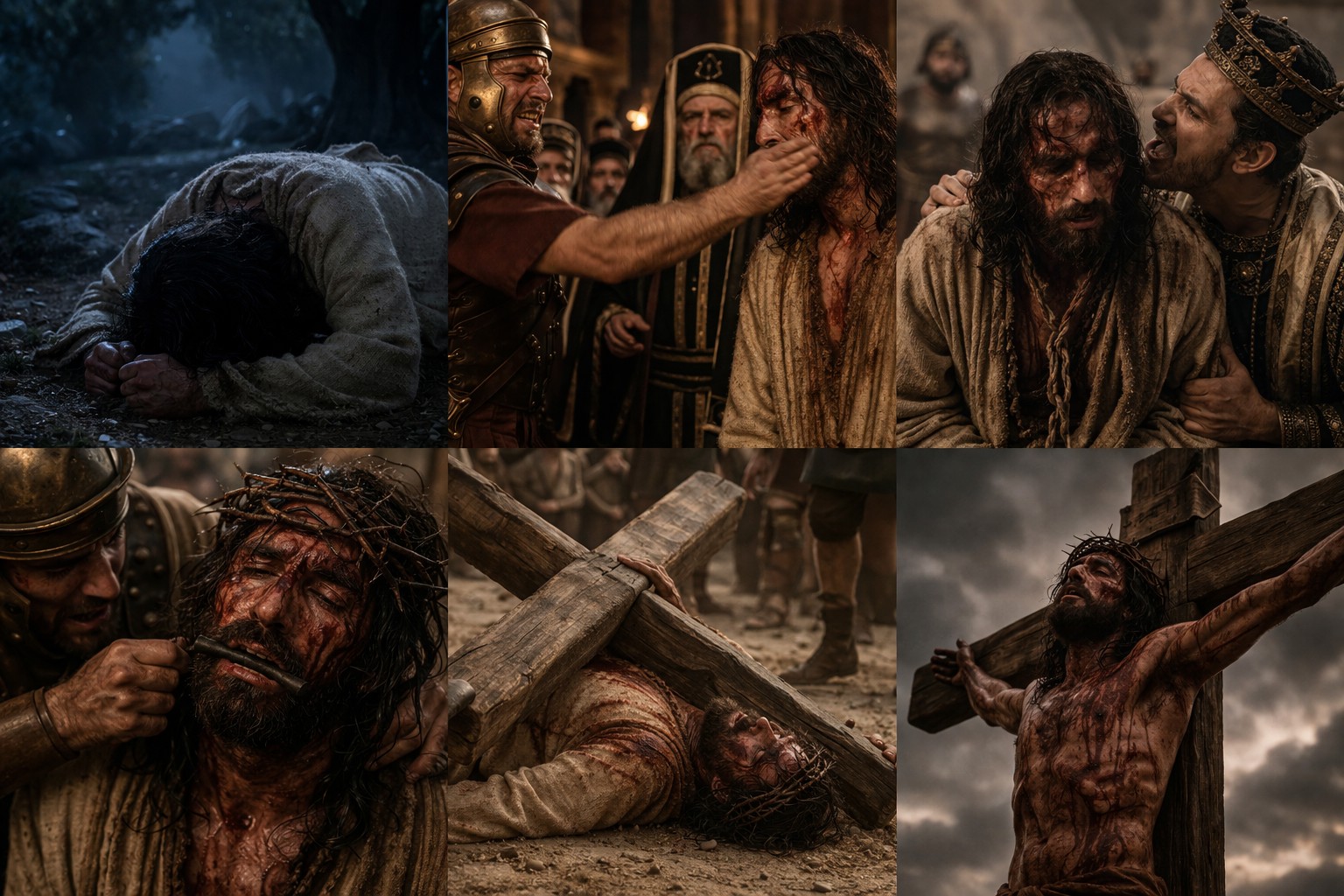
From the very beginning of the closing scenes of His life, the sufferings of Christ for our salvation were intensely physical—beyond anything the human mind can fully grasp. In Gethsemane, His agony was so severe that His sweat became like great drops of blood falling to the ground.
Betrayed, bound, and dragged from one tribunal to another through the night, He was struck, mocked, blindfolded, beaten, and denied with cursing and swearing by one of His beloved disciples and forsaken by all.
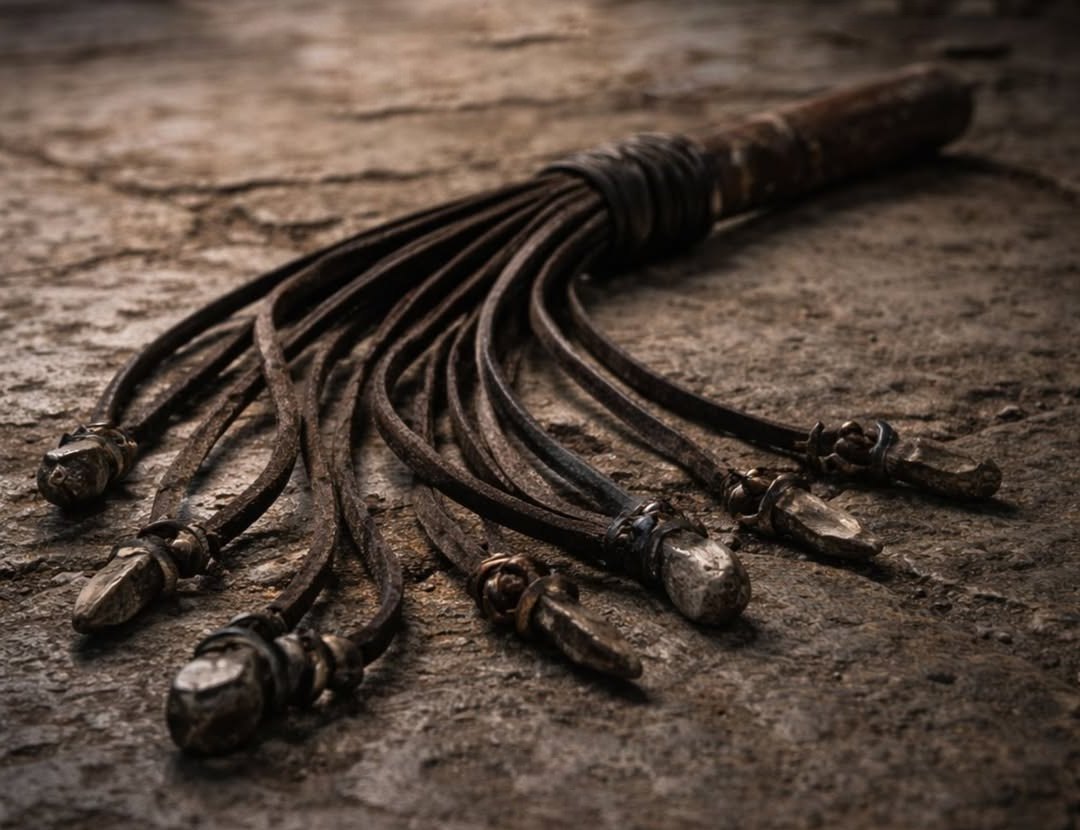
His sacred face was bruised and spat upon. A crown of thorns was pressed into His brow, sending blood down His face. His body was torn by the cruel Roman scourging, until His flesh was lacerated and His strength nearly gone.
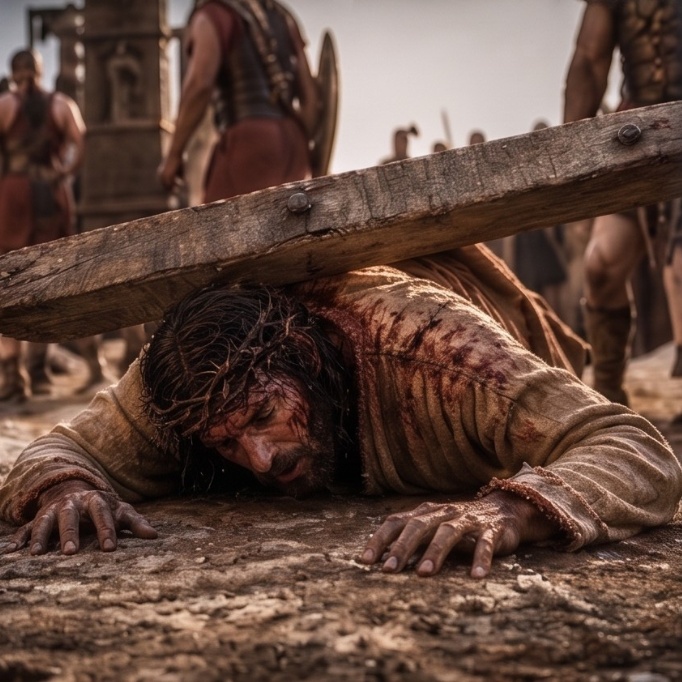
Exhausted, sleepless, and weakened by massive loss of blood, He was forced to carry the heavy crossbeam, stumbling and collapsing under its weight. At Golgotha, His hands and feet were pierced with nails, fastening Him to the cross – symbol of eternal curse Christ was made for us (Gal 3:13).
As His body hung suspended, every breath became a struggle. Crucifixion was a very slow death. To inhale, He had to push His torn body upward against the nails, enduring unbearable pain; to exhale, He sank back down, only to repeat the torment again and again. Every breath was purchased by excruciating agony. For hours, He endured this relentless cycle—fighting for air, in unthinkable suffering.
MENTAL AND SPIRITUAL SUFFERING
Yet as dreadful as these physical tortures were, they were not the deepest aspect of His suffering. Far more terrible was the emotional, mental, and spiritual anguish—an agony no human mind can fully comprehend.
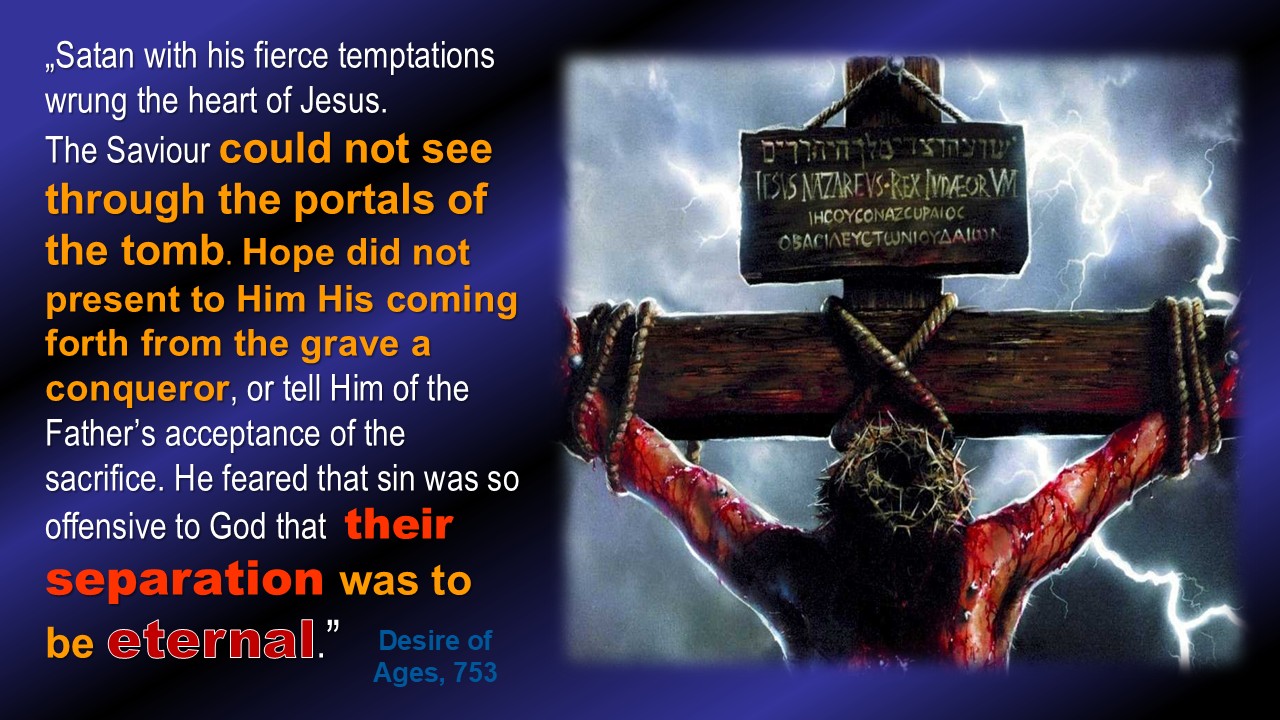
Upon Christ was laid the sin of the whole world; the guilt of every transgression pressed with crushing weight upon His soul. He who had lived in perfect, eternal union of love with the Father now entered into the horror of separation. Because He was made “sin” for us (2 Corinthians 5:21) and “a curse” for us (Galatians 3:13), there came a moment in that dreadful darkness when, in His consciousness, He was overwhelmed with the conviction that this separation was to be eternal. The sense of His Father’s presence—His highest joy from all eternity—was withdrawn, and He felt the full desolation of the lost.
In that state of deep, crushing despair, Satan pressed his fiercest temptations upon Him—again and again urging Him to save Himself, to come down from the cross, to abandon the sacrifice. At that moment, Christ faced the most terrible decision ever confronted by any being: whether to save Himself and return to the eternal love of His Father, or to remain and bear the eternal consequences of sin to the end. And out of infinite self-sacrificing love, He chose the second death for Himself and eternal life for us at the cost of all things to Himself.
This reveals the greatest truth in the universe: the love of God. No language can fully express it, no mind can comprehend it. That the Son of God was willing to endure such physical torment, and infinitely greater spiritual anguish—the apparent loss of His Father’s love and even the agony of eternal separation—so that we might live, is the most magnificent revelation ever given to sinful humanity.
This is why the cross stands at the center of all truth: “For I determined not to know anything among you except Jesus Christ and Him crucified” (1 Corinthians 2:2).
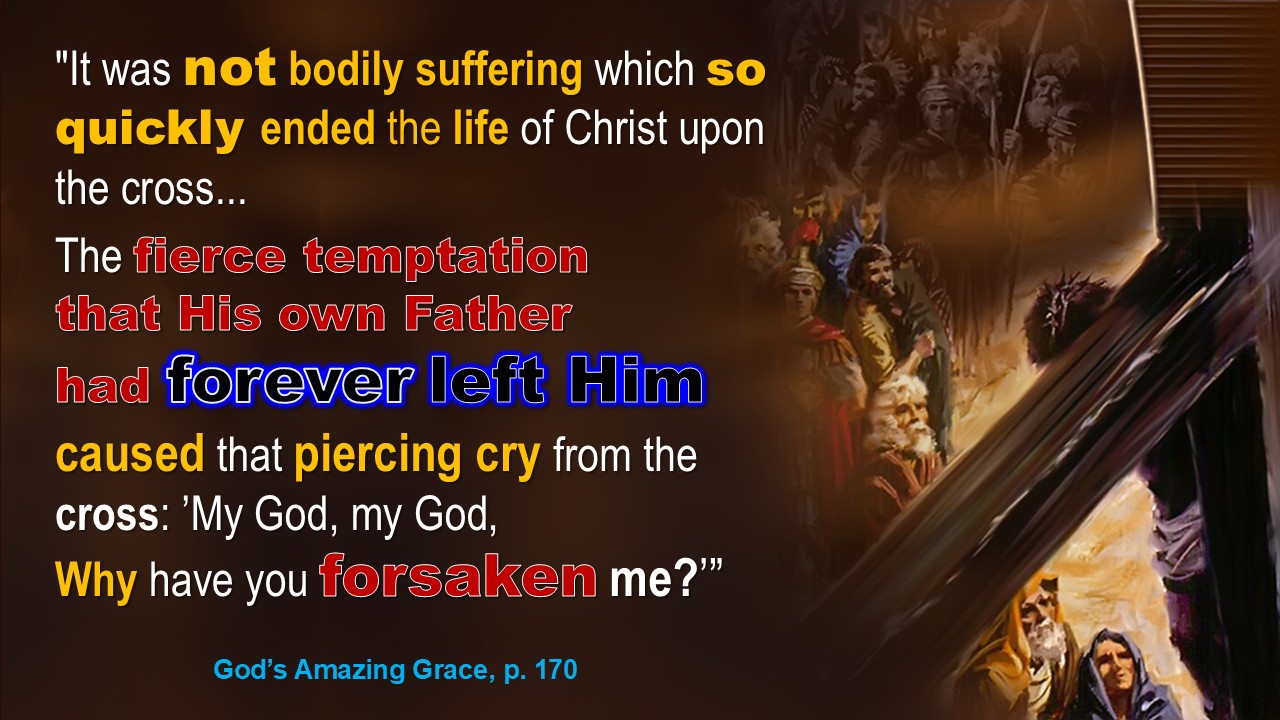
GOD THE FATHER SUFFERED WITH HIS SON
And yet, in this deepest mystery of the cross, the Father was not absent. It is true that the sense of His presence was withdrawn from Christ, so that the Son might truly stand in our place—as sin, as a curse, as our Representative and the Second Adam—tasting the second death and the separation that sin brings. But this withdrawal was not the withdrawal of love. It was the very expression of it.
For the Scripture declares: “God was in Christ, reconciling the world unto Himself” (2 Corinthians 5:19). In a mystery too deep for human thought, the suffering of the Son was the suffering of the Father:
“The angels suffered with Christ. God Himself was crucified with Him, because Christ was one with the Father.” (The Bible Echo, August 6, 1894).
“God did not change His law, but He sacrificed Himself, in Christ, for man’s redemption. ‘God was in Christ, reconciling the world unto Himself’ (2Cor 5:19).” The Desire of Ages (Vol. 3, p. 762)
The heart of the Father entered into that agony. The same infinite love that had bound Father and Son together from all eternity was now being torn in the experience of separation. Every blow that fell upon Christ, every drop of blood, every moment of despair, was felt in the heart of the Father. He did not spare His Son—not because He loved Him less, but because He loved us more than we can comprehend. The giving of Christ was the giving of Himself.
In that dark hour, when Christ felt forsaken, the Father suffered in silence hidden in the darkness that engulfed the dying Son. It was His love for us that held back the full manifestation of His presence, so that the sacrifice might be complete and redemption secured. The pain of that separation—felt by the Son as loss, and borne by the Father as immeasurable grief—reveals a depth of divine love that no created being can fully grasp—the love that will be the study of the redeemed throughout all eternity.
TRANSFORMED BY BEHOLDING CHRIST’S SUFFERINGS
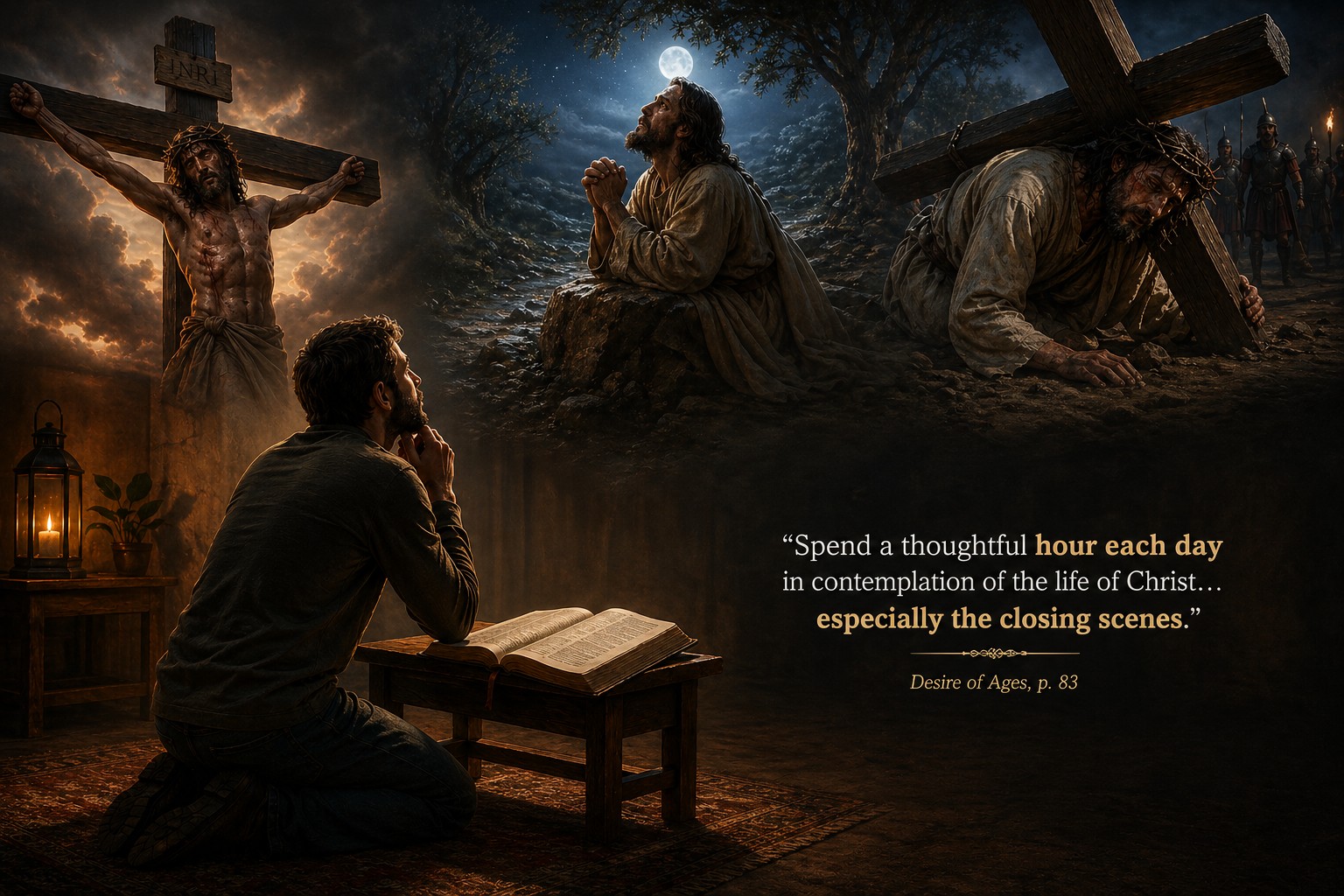
BY BEHOLDING HIS SUFFERINGS WE ARE CHANGED
To behold these sufferings is to behold the love of God. And those who truly see it are never the same again.
“For the message of the cross is foolishness to those who are perishing, but to us who are being saved it is the (life-transforming) power of God.” 1 Corinthians 1:18
“And we all, who with unveiled faces behold (contemplate) the Lord’s glory (His great love revealed especially in His sufferings for us), are being transformed into his image with ever-increasing glory, just as by the Spirit of the Lord.”
“Behold Him in the garden, sweating great drops of blood. A little longer, and see Him on the cruel cross. See the sun vailing its face in darkness, because it could not behold the sufferings of the Son of God. These things were done for you.” Review and Herald, April 1, 1890
“Spend a thoughtful hour each day in contemplation of the life of Christ. We should take it point by point, and let the imagination grasp each scene, especially the closing ones. As we thus dwell upon His great sacrifice for us, our confidence in Him will be more constant, our love will be quickened, and we shall be more deeply imbued with His spirit… We must learn the lesson of penitence and humiliation at the foot of the cross.” Desire of Ages, on page 83
ROGER MORNEAU’S RECOMMENDATION
“As I began to spend time every day—about 45 minutes to an hour—contemplating the closing scenes of the life of my Saviour, especially as recorded in the twenty-seventh chapter of Matthew, a transformation of the mind took place. I began to see the love of God in a way I had never seen it before. The power that was in those verses to change my life, and the lives of those I prayed for, was absolutely beyond human comprehension.” Roger Morneau, The Incredible Power of Prayer (Adapted from video testimony)
Roger Morneau often spoke about how a consistent, daily focus on the closing scenes of Christ’s life served as a catalyst for profound personal and spiritual change: “The daily reading and meditating on the sufferings of Christ produced a transformation in my life and in the lives of many others who followed this practice. As we behold the Savior’s love, our hearts are softened and the power of the enemy is broken.” Roger Morneau, Incredible Answers to Prayer.
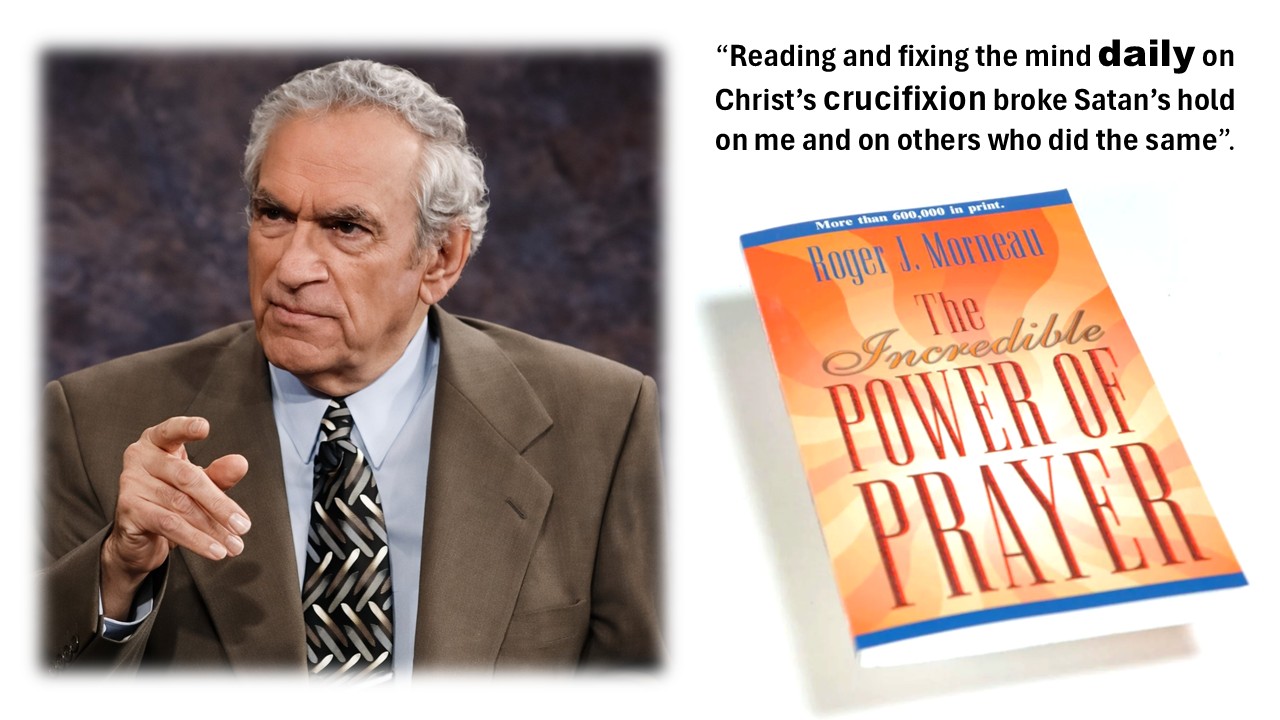
Morneau emphasized that this wasn’t just a reading exercise, but a method of spiritual redirection. By spending what he called a “thoughtful hour” each day on the sacrifice of Jesus, he noted several specific shifts: Focusing on divine love made worldly temptations lose their “magnetic” pull. The practice was described as a way to “re-tune” the mind away from fear and toward peace. He frequently shared that his prayer life became significantly more effective once he prioritized this daily meditation.
Morneau documented numerous accounts where individuals struggling with deep-seated depression, addictions, or spiritual oppression found relief through this specific habit. He maintained that the “science of salvation” is best understood through the lens of the Cross, and that such a transformation is available to anyone willing to dedicate the time to behold it.
Roger Morneau frequently testified that a specific passage from the Gospel of Matthew was the foundation of his spiritual life and the secret to his renowned prayer ministry. In his videos and books, specifically The Incredible Power of Prayer, he refers to Matthew 27:24–54 as his “Power Passage.” He committed to reading or reciting these 30 verses daily for over 40 years:
“As I began to spend time every day—about 45 minutes to an hour—contemplating the closing scenes of the life of my Saviour, especially as recorded in the twenty-seventh chapter of Matthew, a transformation of the mind took place. I began to see the love of God in a way I had never seen it before. The power that was in those verses to change my life, and the lives of those I prayed for, was absolutely beyond human comprehension.” Roger Morneau, The Incredible Power of Prayer (Adapted from video testimony)
“Pride and self-esteem cannot flourish in the hearts that keep fresh in memory the scenes of Calvary. This world will appear of but little value to those who appreciate the great price of man’s redemption, the precious blood of God’s dear Son.” — Lift Him Up, p. 43.
MATTHEW 27:24-54 FOR DAILY READING
DEATH SENTENCE
24 When Pilate saw that he could not prevail at all, but rather that a tumult was rising, he took water and washed his hands before the multitude, saying, “I am innocent of the blood of this just Person. You see to it.”
25 And all the people answered and said, “His blood be on us and on our children.”
26 Then he released Barabbas to them; and when he had scourged Jesus, he delivered Him to be crucified.
MOCKING
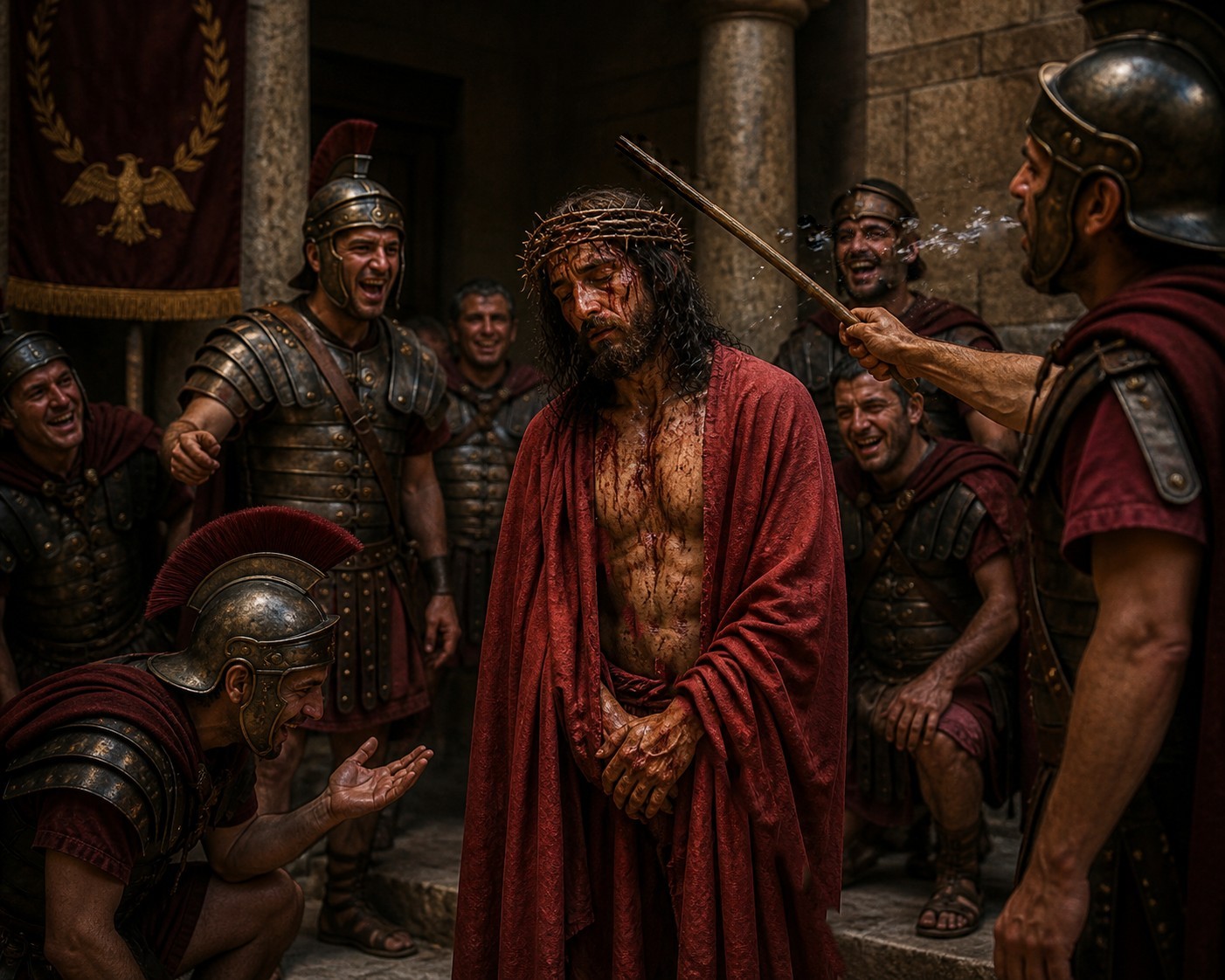
27 Then the soldiers of the governor took Jesus into the Praetorium and gathered the whole garrison around Him. 28 And they stripped Him and put a scarlet robe on Him. 29 When they had twisted a crown of thorns, they put it on His head, and a reed in His right hand. And they bowed the knee before Him and mocked Him, saying, “Hail, King of the Jews!”
30 Then they spat on Him, and took the reed and struck Him on the head.
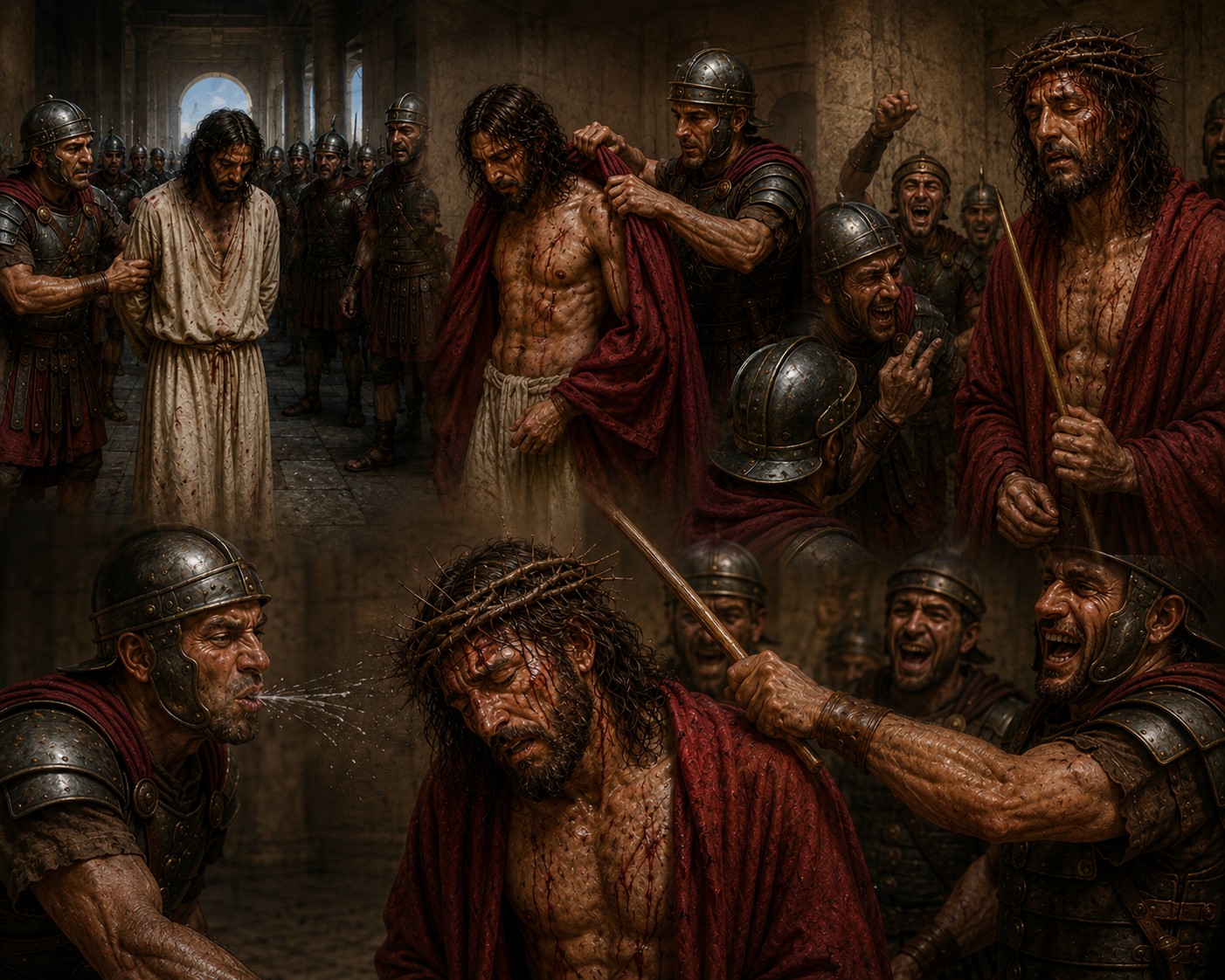
31 And when they had mocked Him, they took the robe off Him, put His own clothes on Him, and led Him away to be crucified.
CRUCIFIXION
32 Now as they came out, they found a man of Cyrene, Simon by name. Him they compelled to bear His cross.
33 And when they had come to a place called Golgotha, that is to say, Place of a Skull, 34 they gave Him sour wine mingled with gall to drink. But when He had tasted it, He would not drink.
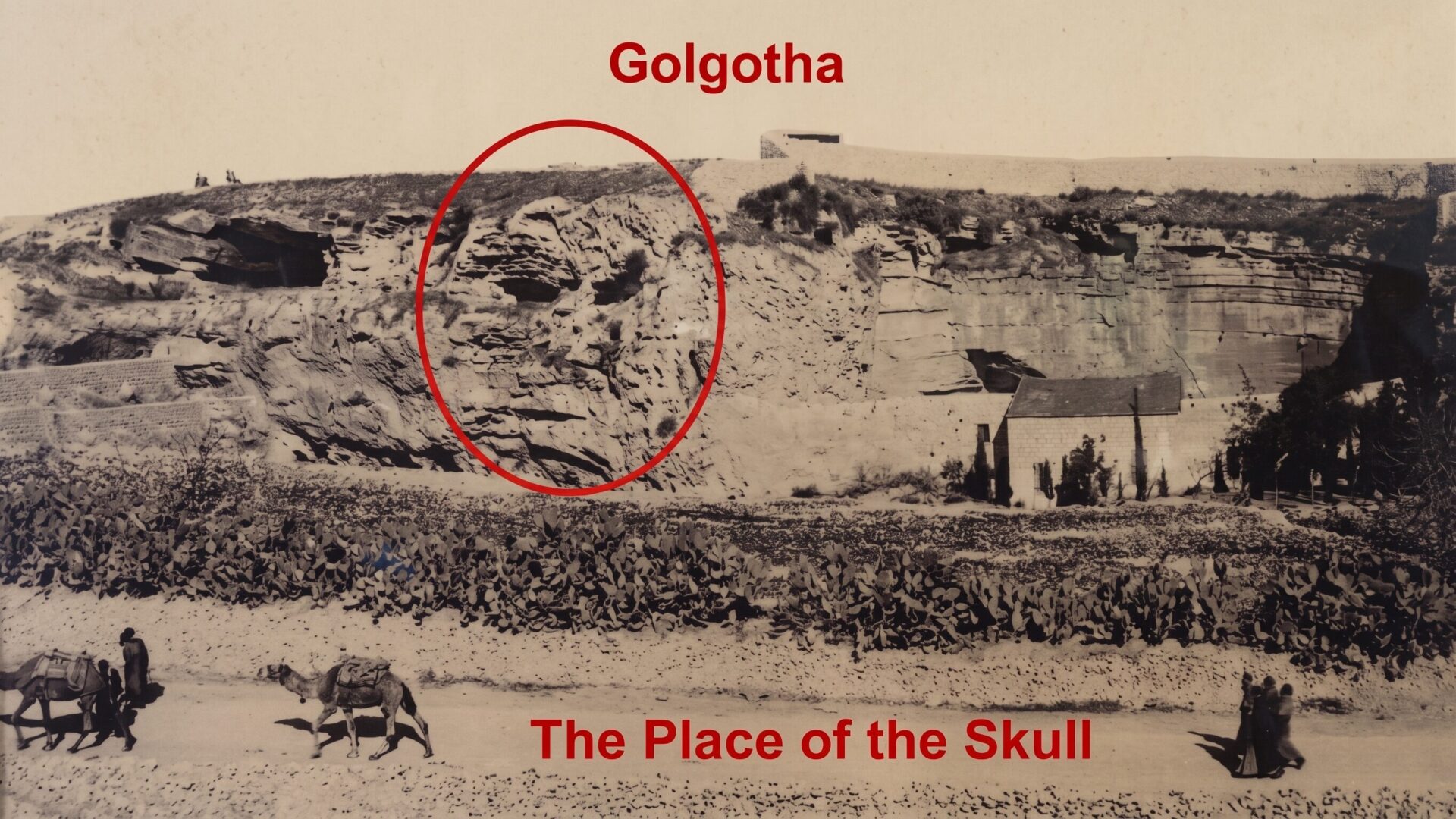
35 Then they crucified Him, and divided His garments, casting lots, that it might be fulfilled which was spoken by the prophet: “They divided My garments among them, And for My clothing they cast lots.” …
38 Then two robbers were crucified with Him, one on the right and another on the left.
TEMPTED THREE TIMES TO SAVE HIMSELF
39 And those who passed by blasphemed Him, wagging their heads 40 and saying, “You who destroy the temple and build it in three days, save Yourself! If You are the Son of God, come down from the cross.”
41 Likewise the chief priests also, mocking with the scribes and elders, said, 42 “He saved others; Himself He cannot save. If He is the King of Israel, let Him now come down from the cross, and we will believe Him. 43 He trusted in God; let Him deliver Him now if He will have Him; for He said, ‘I am the Son of God.’ ”
44 Even the robbers who were crucified with Him reviled Him with the same thing.
DEATH
45 Now from the sixth hour until the ninth hour there was darkness over all the land.
46 And about the ninth hour Jesus cried out with a loud voice, saying, “Eli, Eli, lama sabachthani?” that is, “My God, My God, why have You forsaken Me?” …
50 And Jesus cried out again with a loud voice, and yielded up His spirit.
51 Then, behold, the veil of the temple was torn in two from top to bottom; and the earth quaked, and the rocks were split,
52 and the graves were opened; and many bodies of the saints who had fallen asleep were raised; 53 and coming out of the graves after His resurrection, they went into the holy city and appeared to many.
54 So when the centurion and those with him, who were guarding Jesus, saw the earthquake and the things that had happened, they feared greatly, saying, “Truly this was the Son of God!”
KEY QUOTES BY ELLEN WHITE
“The sacrifice of Christ as an atonement for sin is the great truth around which all other truths cluster. In order to be rightly understood and appreciated, every truth in the Word of God must be studied in the light that streams from the cross of Calvary.” — Gospel Workers, p. 315.
“The death of Christ on the cross of Calvary is our only hope in this world, and it will be our theme in the world to come…It is the greatest subject that can engage the human mind.” Testimonies for the Church (Vol. 3, p. 172).
“To Paul the cross was the one object of supreme interest. Ever since he had been arrested in his career of persecution against the followers of the crucified Nazarene he had never ceased to glory in the cross.” — Lift Him Up, p. 246.
“Satan with his fierce temptations wrung the heart of Jesus. The Saviour could not see through the portals of the tomb. Hope did not present to Him His coming forth from the grave a conqueror, or tell Him of the Father’s acceptance of the sacrifice. He feared that sin was so offensive to God that their separation was to be eternal. Christ felt the anguish which the sinner will feel when mercy shall no longer plead for the guilty race.” Desire of Ages, Golgotha
“It was not bodily suffering which so quickly ended the life of Christ upon the cross… The fierce temptation that His own Father had forever left Him caused that piercing cry from the cross: ‘My God, my God, why hast thou forsaken me?’” — God’s Amazing Grace, p. 170.
“It was not the spear thrust, it was not the pain of the cross, that caused the death of Jesus. That cry, uttered ‘with a loud voice’ (Matthew 27:50; Luke 23:46), at the moment of death, the stream of blood and water that flowed from His side, declared that He died of a broken heart. His heart was broken by mental anguish. He was slain by the sin of the world.” Desire of Ages, Golgotha
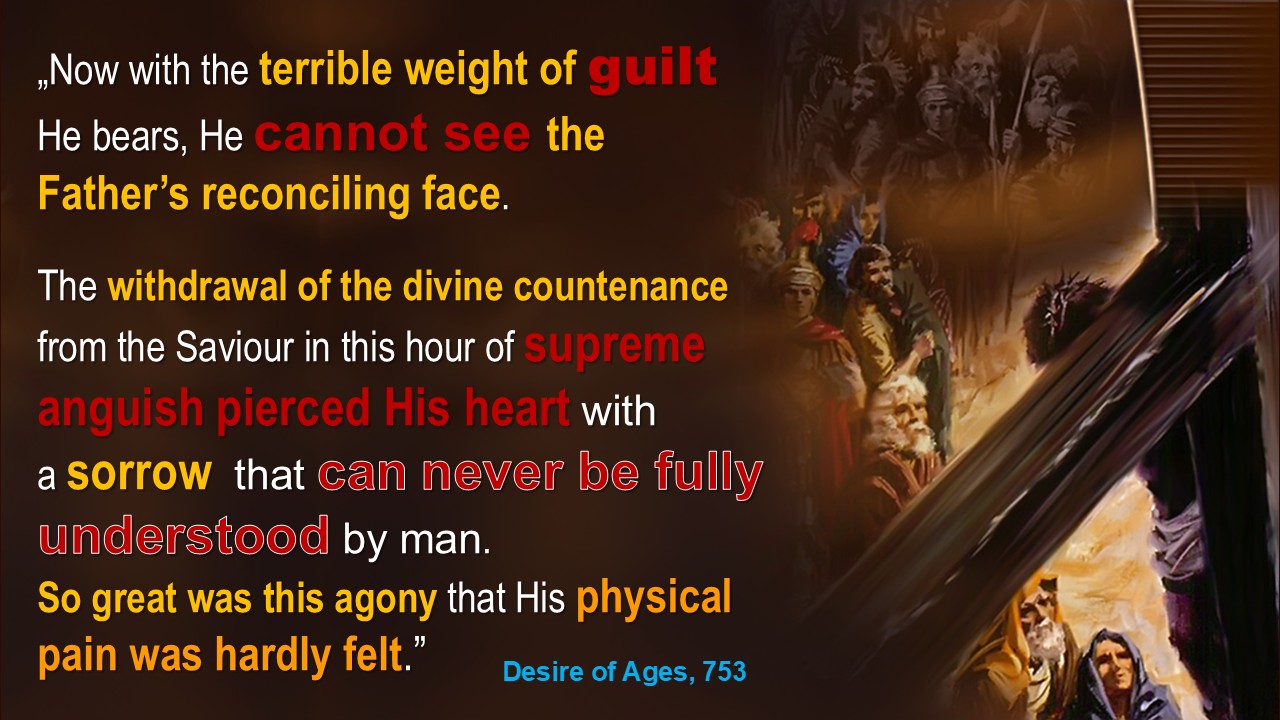
“The withdrawal of the divine countenance from the Saviour in this hour of supreme anguish pierced His heart with a sorrow that can never be fully understood by man.” Desire of Ages, Golgotha
“Never was criminal treated in so inhuman a manner as was the Son of God.” Desire of Ages, Golgotha
“His whole form was convulsed with pain.” Desire of Ages, 734
“The multitude were clamorous for the blood of Jesus. They cruelly scourged Him, and put upon Him an old purple kingly robe, and bound His sacred head with a crown of thorns. They put a reed into His hand, and bowed to Him, and mockingly saluted Him, “Hail, king of the Jews!” They then took the reed from His hand and smote Him with it upon the head, causing the thorns to penetrate His temples, sending the blood trickling down His face and beard. Jesus stood meek and humble before the infuriated multitude, while they offered Him the vilest abuse. They spit in His face—that face from which they will one day desire to hide, which will give light to the city of God and shine brighter than the sun. Christ did not cast upon the offenders an angry look. They covered His head with an old garment, blindfolding Him, and then struck Him in the face and cried out, ‘Prophesy, who is it that smote Thee’?” Early Writings, Trial of Christ
“The angels suffered with Christ. God Himself was crucified with Him, because Christ was one with the Father.” (The Bible Echo, August 6, 1894).
“God did not change His law, but He sacrificed Himself, in Christ, for man’s redemption. ‘God was in Christ, reconciling the world unto Himself’ (2Cor 5:19).” The Desire of Ages (Vol. 3, p. 762)
“Pride and self-esteem cannot flourish in the hearts that keep fresh in memory the scenes of Calvary. This world will appear of but little value to those who appreciate the great price of man’s redemption, the precious blood of God’s dear Son.” — Lift Him Up, p. 43.
“All the riches of the world are not of sufficient value to redeem one perishing soul. Who can measure the love Christ felt for a lost world as he hung upon the cross, suffering for the sins of guilty men? This love was immeasurable, infinite.” — Lift Him Up, p. 43.
“So dreadful does sin appear to Him, so great is the weight of guilt which He must bear, that He is tempted to fear it will shut Him out forever from His Father’s love. Feeling how terrible is the wrath of God against transgression, He exclaims, ‘My soul is exceeding sorrowful, even unto death‘… Every step that He now took was with labored effort. He groaned aloud, as if suffering under the pressure of a terrible burden. Twice His companions supported Him, or He would have fallen to the earth.” – DA, Gethsemane.
“The revelation of God’s love to man centers in the cross. Its full significance tongue cannot utter; pen cannot portray; the mind of man cannot comprehend. . .” God’s Amazing Grace, p. 178.
“We do not expect rest here. No, no. The way to heaven is a cross-bearing way … We will not complain… We will rejoice in tribulation and keep in mind the recompense of reward, the ‘far more exceeding and eternal weight of glory’. I crave the suffering part. I would not go to heaven without suffering if I could, and see Jesus who suffered so much for us to purchase for us so rich an inheritance; and to see the martyrs who laid down their lives for the truth, and the sake of Jesus. No, no. Let me be perfected through sufferings. I long to be a partaker with Christ of His sufferings, for if I am, I know I shall be a partaker with Him of His glory. Oh, for to be wholly consecrated to Him! Oh, how hard it is for dear self to die… I long to see the King in His beauty, Him whom my soul loveth.” — Reflecting Christ, p. 350.
CHRONOLOGICAL GOSPEL RECORD
I. Gethsemane: The Agony and Prayer (Thursday, 10:00 PM – Midnight)
-
And He took with Him Peter and the two sons of Zebedee, James and John, and He began to be sorrowful, and deeply distressed. Then He said to them, “My soul is exceedingly sorrowful, even to death. Stay here and watch with Me.” Matthew 26:37-38; Mark 14:33-34
-
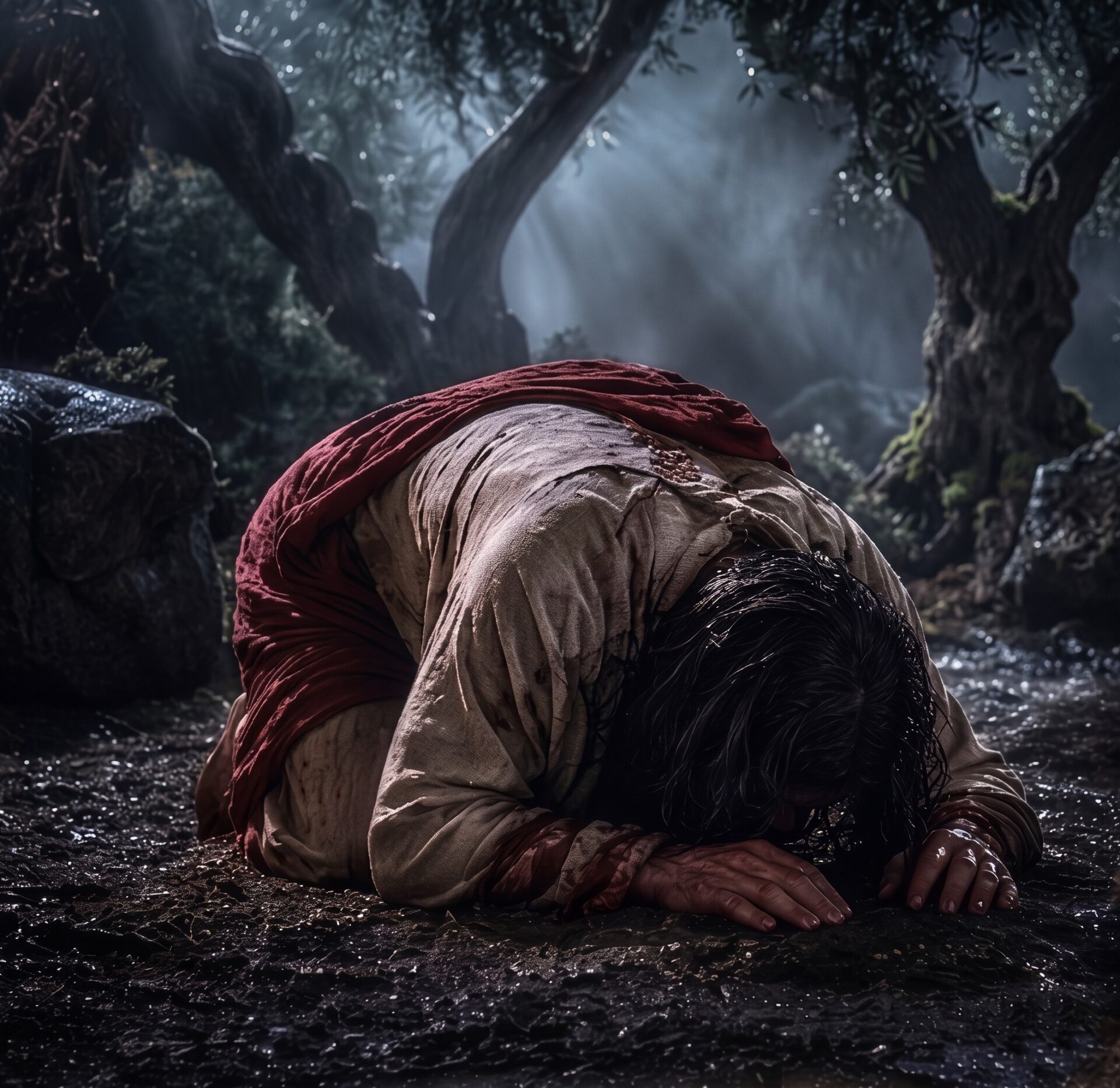
He went a little farther and was withdrawn from them about a stone’s throw, and He knelt down and fell on His face on the ground, and prayed that if it were possible, the hour might pass from Him. And He said, “Abba, Father, If You are willing, remove this cup from Me; nevertheless not My will, but Yours, be done.” Matthew 26:39; Mark 14:35-36; Luke 22:41-42
-
And being in agony, He prayed more earnestly. Then His sweat became like great drops of blood falling down to the ground. Luke 22:43-44
II. The Betrayal and Arrest (Thursday/Friday, Midnight)
-
Then Judas, having received a detachment of troops, and officers from the chief priests and Pharisees, came there with lanterns, torches, and weapons. John 18:2-3
-
Now His betrayer had given them a sign, saying, “Whomever I kiss, He is the One; seize Him and lead Him away safely.” Immediately he went up to Jesus and said, “Greetings, Rabbi!” and kissed Him. But Jesus said to him, “Friend, why have you come? Judas, are you betraying the Son of Man with a kiss?” Then they came and laid hands on Jesus and took Him. Matthew 26:48-50; Mark 14:44-46; Luke 22:47-48
-
Then all the disciples forsook Him and fled. Matthew 26:56; Mark 14:50-52
III. Preliminary Interrogation before Annas (Friday, After Midnight)
-
Then the detachment of troops and the captain and the officers of the Jews arrested Jesus and bound Him. And they led Him away to Annas first, for he was the father-in-law of Caiaphas who was high priest that year. John 18:12-14
-
The high priest then asked Jesus about His disciples and His doctrine. Jesus answered him, “I spoke openly to the world. I always taught in synagogues and in the temple, where the Jews always meet, and in secret I have said nothing. Why do you ask Me? Ask those who have heard Me what I said to them.”
-
And when He had said these things, one of the officers who stood by struck Jesus with the palm of his hand, saying, “Do You answer the high priest so?” Jesus answered him, “If I have spoken evil, bear witness of the evil; but if well, why do you strike Me?” John 18:19-23
-
Then Annas sent Him bound to Caiaphas the high priest. John 18:24
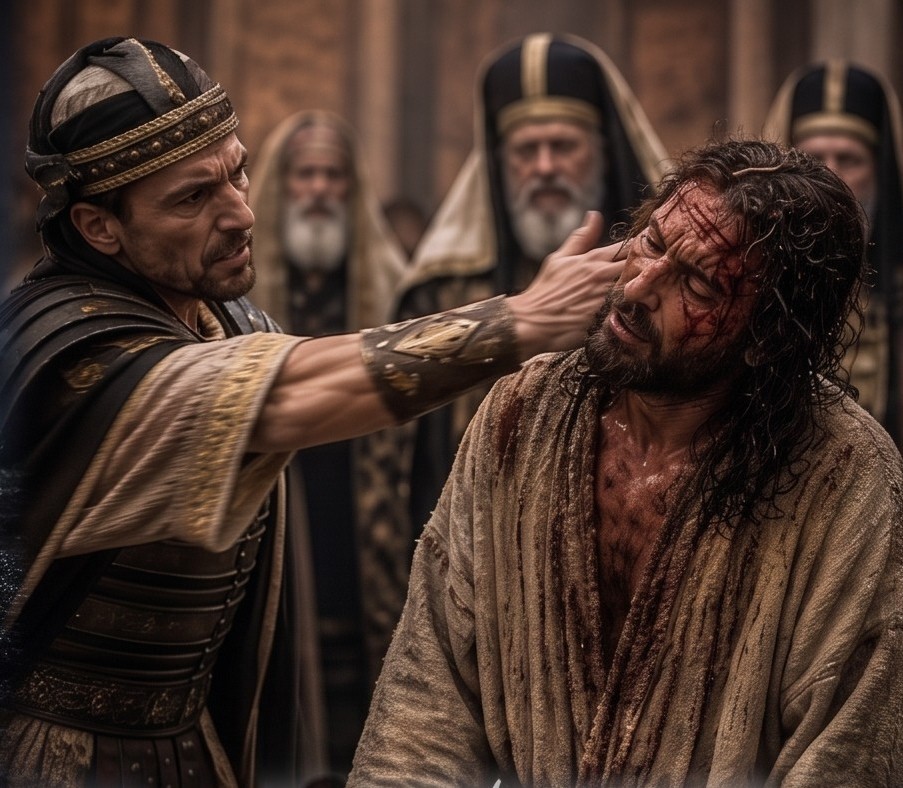
IV. Trial Before Caiaphas: and First Trial Before Sanhedrin – Night Session (Friday, 1:00 AM – 2:00 AM)
-
And those who had laid hold of Jesus led Him away to Caiaphas the high priest, where the scribes and the elders were assembled. But Peter followed Him at a distance to the high priest’s courtyard. Matthew 26:57-58; Mark 14:53-54; Luke 22:54
-
Again the high priest said to Him, “I adjure You by the living God that You tell us if You are the Christ, the Son of God!” Jesus said to him, “It is as you said. I am. Then the high priest tore his clothes, saying, “He has spoken blasphemy! What further need do we have of witnesses? They all answered and said, “He is deserving of death.” Matthew 26:62-64; Mark 14:60-64
V. Peter’s Denials During the Nighttime Trials (Approx. 1:00 AM – 3:00 AM)
-
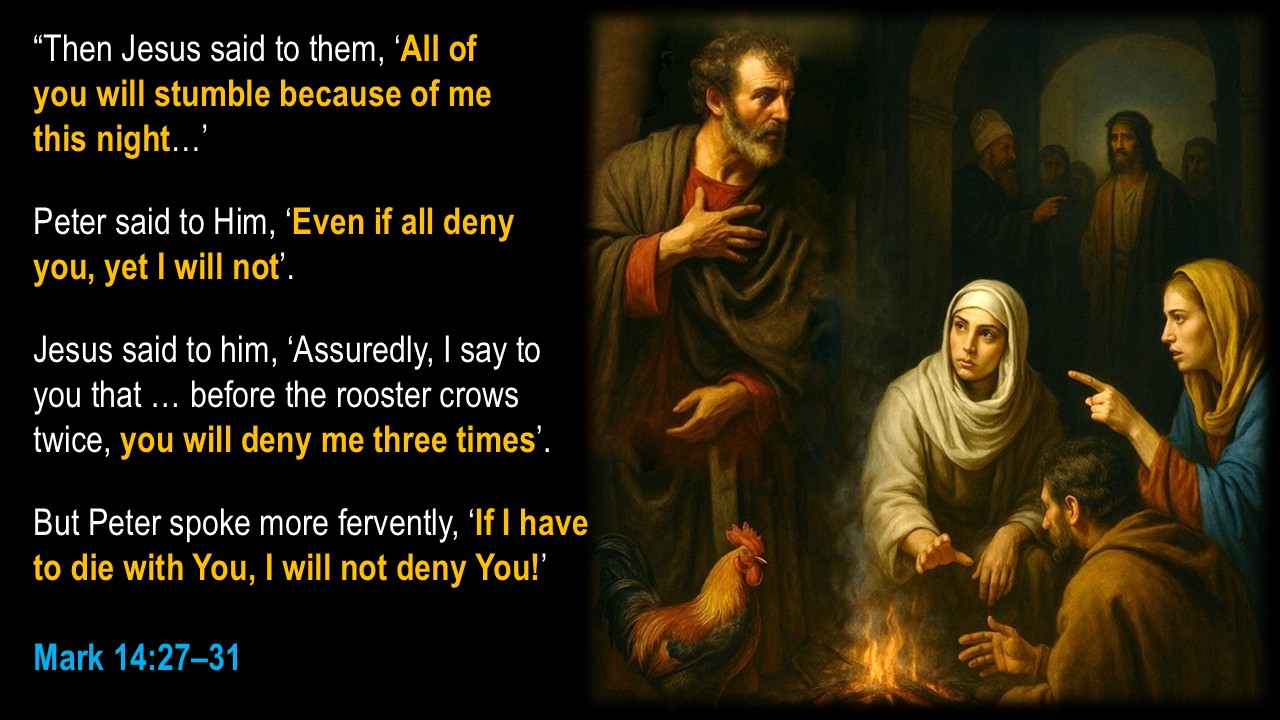
Now as Peter was below in the courtyard, a servant girl came by. And when she saw Peter warming himself by the fire, she said, “You also were with Jesus of Galilee.” But he denied it before them all, saying, “Woman, I do not know Him.” Matthew 26:69-70; Mark 14:66-68; Luke 22:55-57; John 18:15-18
-
And when he had gone out onto the porch, another saw him and said, “This fellow also was with Jesus of Nazareth.” They said to him, “Are you not also one of His disciples?” He denied it again with an oath and said, “I do not know the Man!” Matthew 26:71-72; Mark 14:69-70; Luke 22:58; John 18:25
-
After about an hour had passed, another confidently affirmed, “Surely this fellow also was with Him, for he is a Galilean.” A relative of him whose ear Peter cut off said, “Did I not see you in the garden with Him?” Then Peter began to curse and swear, “I do not know this Man of whom you speak!” Immediately, while he was still speaking, the rooster crowed. Matthew 26:73-74; Mark 14:70-71; Luke 22:59-60; John 18:26-27
-
And the Lord turned and looked at Peter. Then Peter remembered the word of the Lord, how He had said to him, “Before the rooster crows, you will deny Me three times.” So Peter went out and wept bitterly. Luke 22:61-62
VI. The Guardroom Torture (Approx. 3:00 AM – 5:00 AM)
- Now the men who held Jesus mocked Him and beat Him. And having blindfolded Him, they struck Him on the face and asked Him, saying, “Prophesy! Who is the one who struck You?” And many other things they blasphemously spoke against Him. Luke 22:63-65
-
Then they spat in His face and beat Him; and others struck Him with the palms of their hands, saying, “Prophesy to us, Christ! Who is the one who struck You? Matthew 26:67-68; Mark 14:65
VII. Second Trial Before Sanhedrin: Morning Ratification (Friday, around 5:00-6:00 AM)
-
As soon as it was day, the elders of the people, both chief priests and scribes, came together and led Him into their council. Matthew 27:1; Mark 15:1; Luke 22:66
-
They said, “If You are the Christ, tell us.” But He said to them, “If I tell you, you will by no means believe.” They all said, “Are You then the Son of God?” So He said to them, “You rightly say that I am.” And they said, “What further testimony do we need? For we have heard it ourselves from His own mouth.” Luke 22:67-71
VIII. First Trial Before Pilate (Friday, 6:00-7:00 AM)
-
When they had bound Him, they led Him away from Caiaphas to the Praetorium and delivered Him to Pontius Pilate the governor; and it was early morning. Matthew 27:2; Mark 15:1; Luke 23:1; John 18:28
-
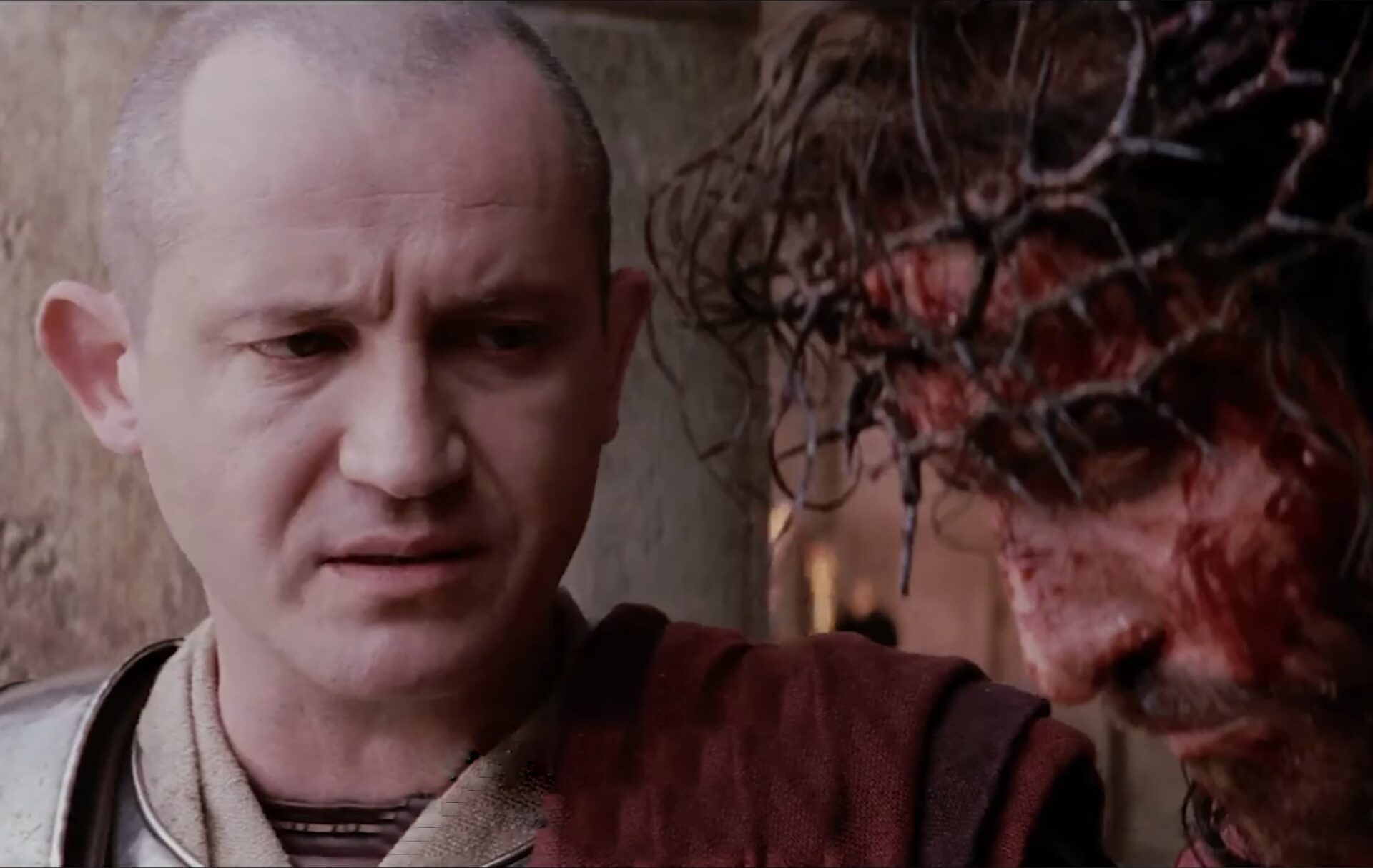
And they began to accuse Him, saying, “We found this fellow perverting the nation, and forbidding to pay taxes to Caesar.” Then Pilate entered the Praetorium again, called Jesus, and said to Him, “Are You the King of the Jews?” Jesus answered, “Are you speaking for yourself about this, or did others tell you this concerning Me?” Luke 23:2-3; John 18:33-35
-
Jesus answered, “My kingdom is not of this world. If My kingdom were of this world, My servants would fight.” Pilate said, “Are You a king then?” Jesus answered, “You say rightly that I am a king. For this cause I was born.” Pilate said to him, “What is truth?” and went out again and said, “I find no fault in Him at all.” John 18:36-38
-
And while He was being accused by the chief priests and elders, He answered nothing. Then Pilate said to Him, “Do You not hear how many things they testify against You?” But He answered him not one word, so that the governor marveled greatly. Matthew 27:12-14; Mark 15:3-5
IX. Before Herod Antipas (Friday, Early Morning)
-
When Pilate heard of Galilee, he asked if the Man were a Galilean. And as soon as he knew that He belonged to Herod’s jurisdiction, he sent Him to Herod, who was also in Jerusalem at that time. Luke 23:5-7
-
Now when Herod saw Jesus, he was exceedingly glad; for he had desired for a long time to see Him and hoped to see some miracle done by Him. Then he questioned Him with many words, but He answered him nothing. And the chief priests and scribes stood and vehemently accused Him. Luke 23:8-10
-
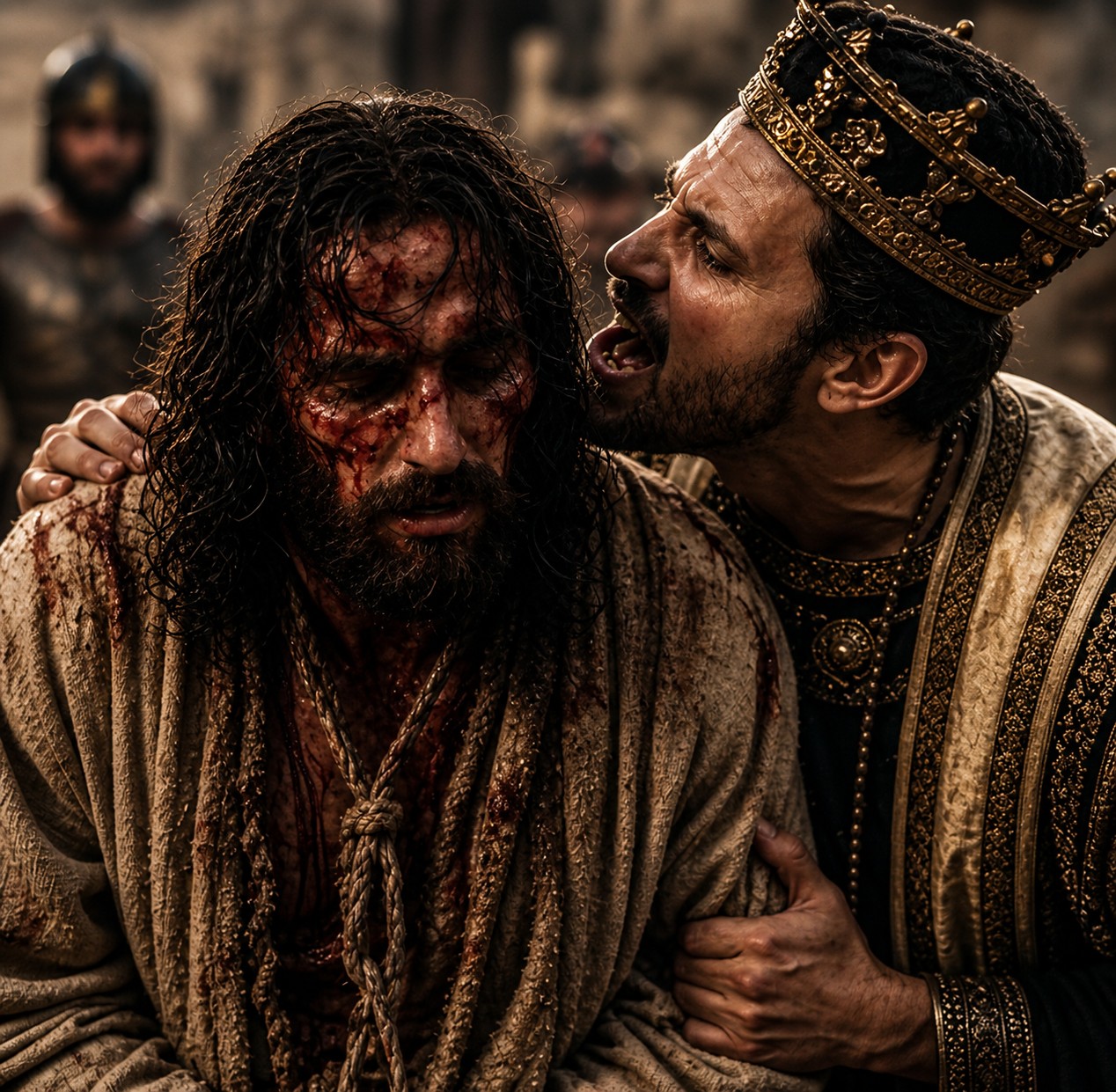
Then Herod, with his men of war, treated Him with contempt and mocked Him, arrayed Him in a gorgeous robe, and sent Him back to Pilate. That very day Pilate and Herod became friends with each other. Luke 23:11-12
X. Return to Pilate and the First Scourging (Friday, 7:00 AM – 8:00 AM)
-
Then Pilate, when he had called together the chief priests and the rulers, said, “I have found no fault in this Man; neither has Herod. I will therefore chastise Him and release Him.” Luke 23:13-16
-
But the chief priests stirred up the crowd to ask for Barabbas—who was a robber and had been thrown into prison for murder. Pilate said, “What then shall I do with Jesus?” They all shouted, “Crucify Him!” Matthew 27:20-23; Mark 15:11-14; Luke 23:18-23; John 18:40
-
So then Pilate took Jesus and scourged Him. John 19:1
-
Then the soldiers led Him into the Praetorium. They stripped Him and put a scarlet robe on Him. When they had twisted a crown of thorns, they put it on His head, and a reed in His right hand. And they bowed the knee before Him and mocked Him, saying, “Hail, King of the Jews!” Then they spat on Him, and took the reed and struck Him on the head. Matthew 27:27-30; Mark 15:16-19; John 19:2-3
-
Pilate then went out again, and said, “Behold, I am bringing Him out to you, that you may know that I find no fault in Him.” Then Jesus came out, wearing the crown of thorns and the purple robe. And Pilate said to them, “Behold the Man!” John 19:4-5
XI. The Sentence and Second Scourging (Friday, 8:00 AM)
-
When Pilate saw that he could not prevail, he took water and washed his hands, saying, “I am innocent of the blood of this just Person.” And all the people answered, “His blood be on us and on our children.” Matthew 27:24-25
-
So Pilate, wanting to gratify the crowd, gave sentence that it should be as they requested. He released Barabbas, and delivered Jesus to be crucified. Matthew 27:26; Mark 15:15; Luke 23:24-25; John 19:16
XII. The Way to Golgotha (Friday, 8:00 AM – 9:00 AM)
-
And when they had mocked Him, they took the robe off Him, put His own clothes on Him, and led Him out to crucify Him. Matthew 27:31; Mark 15:20
-
And He, bearing His cross, went out to a place called the Place of a Skull, which is called in Hebrew, Golgotha. John 19:17
-
Now as they led Him away, they laid hold of a certain man, Simon a Cyrenian, and on him they laid the cross that he might bear it after Jesus. Matthew 27:32; Mark 15:21; Luke 23:26
-
And a great multitude followed Him, and women who lamented Him. Luke 23:27-31
XIII. The Crucifixion: The Third Hour (Friday, 9:00 AM)
-
And when they had come to Golgotha, they gave Him sour wine mingled with gall; and wine mingled with myrrh; but He would not drink. Matthew 27:33-34; Mark 15:22-23
-
Now it was the third hour, and they crucified Him, and the robbers with Him, one on the right hand and the other on the left, and Jesus in the middle. Mark 15:25; Luke 23:33; John 19:18
-
Then Jesus said, “Father, forgive them, for they do not know what they do.” Luke 23:34
-
And those who passed by blasphemed Him, wagging their heads and saying, “If You are the Son of God, come down from the cross!” The chief priests mocked Him, saying, “He saved others; Himself He cannot save.” Matthew 27:39-44; Mark 15:29-32; Luke 23:35-37:
-
One of the criminals blasphemed Him, but the other rebuked him, saying, “Lord, remember me when You come into Your kingdom.” And Jesus said to him, “Assuredly, I say to you, today, you will be with Me in Paradise.” Luke 23:39-43
-
Now there stood by the cross His mother. He said to her, “Woman, behold your son!” Then He said to the disciple, “Behold your mother!” John 19:25-27
XIV. Supernatural Darkness: The Sixth Hour (Friday, Noon)
-
Now from the sixth hour until the ninth hour there was darkness over all the land. Then the sun was darkened. Matthew 27:45; Mark 15:33; Luke 23:44-45
XV. The Death of Christ: The Ninth Hour (Friday, 3:00 PM)
-
And about the ninth hour, Jesus cried out with a loud voice, saying, “Eli, Eli, lama sabachthani?” that is, “My God, My God, why have You forsaken Me?” Matthew 27:46-47; Mark 15:34-35
-
After this, Jesus, knowing that all things were now accomplished, said, “I thirst!” John 19:28
-
Immediately one of them ran and took a sponge, filled it with sour wine and put it on hyssop, and offered it to Him to drink. Matthew 27:48-49; Mark 15:36; John 19:29
-
So when Jesus had received the sour wine, He said, “It is finished!” John 19:30
-
And when Jesus had cried out with a loud voice, He said, “Father, ‘into Your hands I commit My spirit.’” Luke 23:46
-
And having said this, He bowed His head and yielded up His spirit. Matthew 27:50; Mark 15:37; John 19:30
-
Then, behold, the veil of the temple was torn in two from top to bottom; and the earth quaked, and the rocks were split. When the centurion saw what had happened, he glorified God, saying, “Truly this was the Son of God!” Matthew 27:51-54; Mark 15:38-39; Luke 23:45, 47-48
XVI. The Burial [Friday, 3:00 PM – 5:00 PM (Sunset)]
-
Because it was the Preparation Day, the Jews asked Pilate that their legs might be broken. The soldiers broke the legs of the first and the other, but when they came to Jesus and saw He was already dead, they did not break His legs. But one of the soldiers pierced His side with a spear, and immediately blood and water came out. John 19:31-34
-
When evening had come, Joseph of Arimathea, a prominent council member, went to Pilate and asked for the body of Jesus. Nicodemus also came, bringing a mixture of myrrh and aloes. They took the body of Jesus and bound it in strips of linen with the spices. They laid Him in a new tomb which had been hewn out of the rock, and rolled a large stone against the door of the tomb before the Sabbath began. Matthew 27:57-60; Mark 15:42-46; Luke 23:50-54; John 19:38-42
CHRONOLOGICAL EVENTS (HOUR BY HOUR)
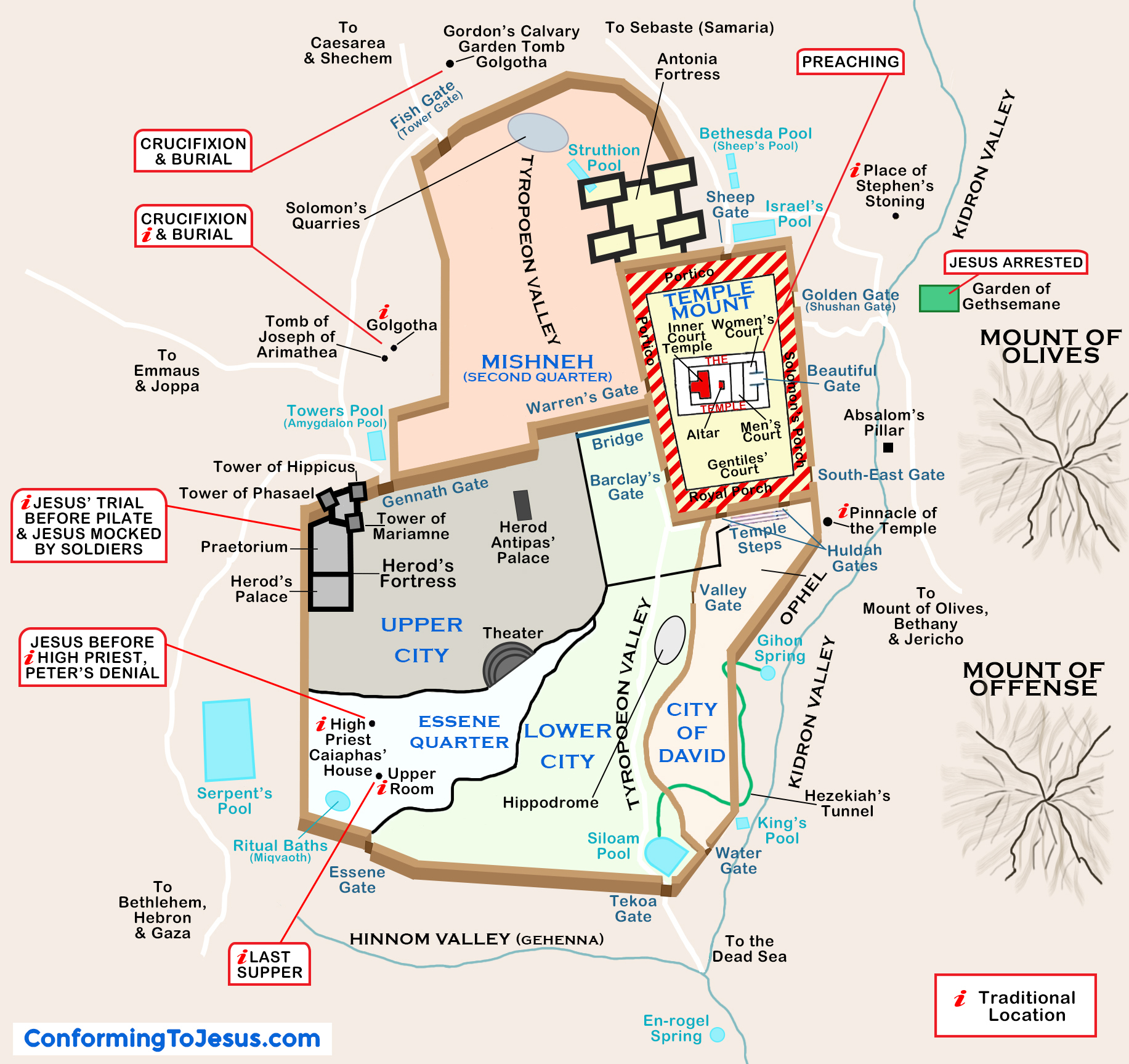
Jesus entered the Garden of Gethsemane with his disciples after the Last Supper, likely arriving on Thursday around 10 PM-11:00 PM, where he prayed for over 1 hour (till midnight) in agony, sweating drops of blood, while his disciples slept.
Judas Iscariot arrived with soldiers (around midnight) to arrest Jesus shortly after He finished praying and accepted the cup of curse to save sinful humanity.
Jesus was first taken to Annas, the father-in-law of the High Priest Caiaphas, for a preliminary, unofficial interrogation (Friday, after midnight).
Following Annas, Christ was taken to Caiaphas for a trial by the Jewish council (Friday, around 1 AM).
First interrogation before the Sanhedrin (the unofficial, preliminary, Night Session): Matthew 26:59 and Mark 14:55. A gathered council of Jewish leaders seeking false witnesses to secure a death sentence (Friday, around 2:00 AM or 3 AM?).
Jesus was kept in the guardroom and tortured probably for about 2 to 3 hours by possessed mob waiting for the trial before Sanhedrin and Pilate (Friday, 3 AM to 5:00 AM).
Second interrogation before the Sanhedrin (the Morning Ratification): Luke 22:66. A formal meeting at daybreak to give a legal appearance to the illegal nighttime verdict. Probably around 5am.
First interrogation before Pilate (Friday, Early Morning, probably around 6:00 AM – because day began at sunrise at 6:00 AM).
To avoid responsibility, Pilate sent Jesus to Herod Antipas (ruler of Galilee), who was in Jerusalem. Herod mocked Him and returned him to Pilate.
Christ was brought back to Pilate, who ordered to flog Jesus the first time in attempt to save Him from crucifixion. Since the Jews didn’t change their minds, facing pressure, Pilate ordered Christ’s crucifixion at around 8 AM. After that, Jesus was flogged the second time.
Heavy crossbar (patibulum) was placed on Christ and carried to Golgotha (8 AM- 9 AM). Christs repeatedly collapsed under the heavy load.
Jesus was nailed to the cross at 9 AM (the third hour) on Friday. In the 1st century, the “day” was divided into twelve equal parts (hours) of daylight. Sunrise (around 6 AM at that time of the year) marked the beginning of the first hour of the day. Thus, approximately 6 AM was the first hour, 9 AM the third hour, 12 PM (noon) the sixth hour, and 3 PM the ninth hour.
Jesus died on the day of the Passover (14th of Nisan), becoming the true Paschal Lamb. The supernatural darkness fell over the land, around 12:00 PM (noon time). In the Gospels (Matthew, Mark, and Luke), it is recorded that Jesus died at the “ninth hour” (3:00 PM), at the same time when the Passover lamb was offered.
Jesus’s body was washed, embalmed and buried before sunset (before 5 PM). On that specific day in Jerusalem, the estimated Sunset was at 5:24 PM.
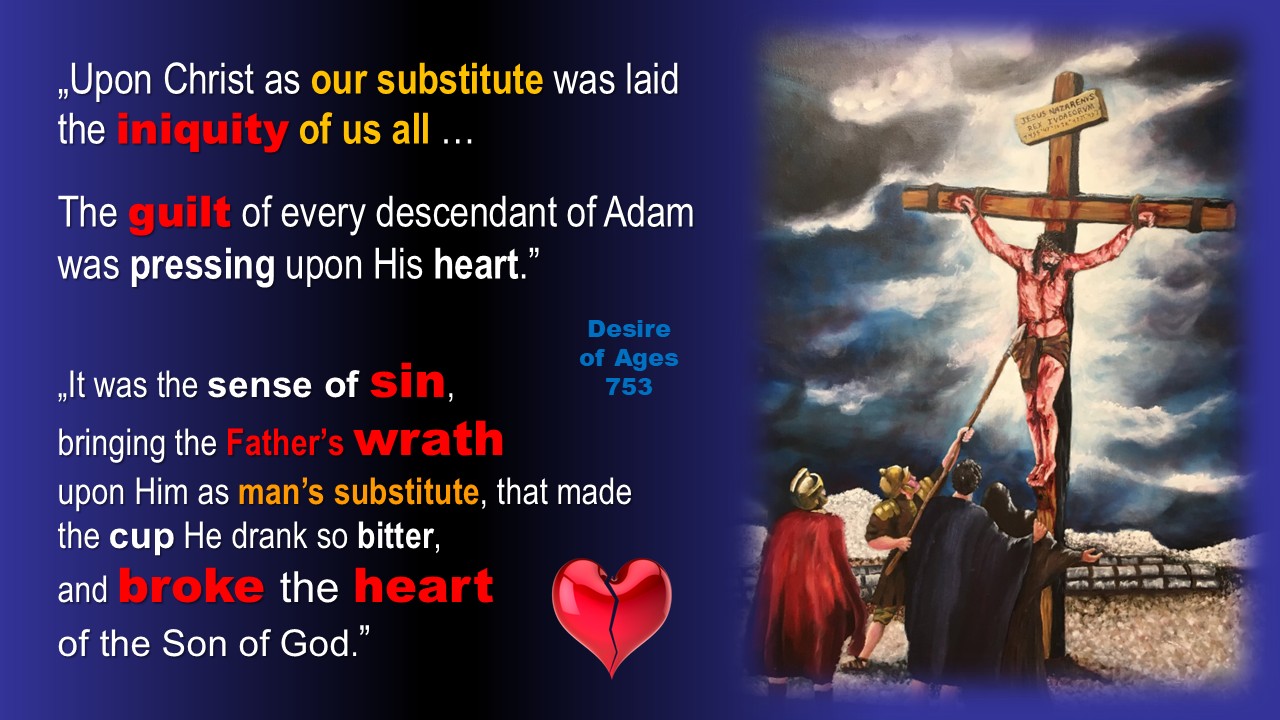
INTERROGATED SEVEN TIMES
“He was interrogated by the priests and the Sanhedrin, by Pilate and by Herod. Seven times He was brought before the authorities, and each time He was treated with the most shameful cruelty.” Ellen G. White, Manuscript 111, 1897
“Oh, fearful scene! the Saviour seized at midnight in Gethsemane, dragged to and from from palace to judgment hall, arraigned twice before the priests, twice before the Sanhedrin, twice before Pilate, and once before Herod.” (DA, Chapter 79, 1890s-1898).
BIBLICAL EVIDENCE THAT CHRIST WAS INTERROGATED 7 TIMES
1. Before Annas (The Preliminary Priest): John 18:13, 19-23. An informal, illegal nighttime questioning by the former High Priest to trap Jesus in His doctrine. “treated with the most shameful cruelty.”
2. Before Caiaphas (The High Priest): John 18:24 and Matthew 26:57. A private interrogation before the current High Priest prior to the full council’s arrival. “treated with the most shameful cruelty.”
3. Before the Sanhedrin (The Night Session): Matthew 26:59 and Mark 14:55. A gathered council of Jewish leaders seeking false witnesses to secure a death sentence. “treated with the most shameful cruelty.”
4. Before the Sanhedrin (The Morning Ratification): Luke 22:66. A formal meeting at daybreak to give a legal appearance to the illegal nighttime verdict. “treated with the most shameful cruelty.”
5. Before Pilate (The First Roman Trial): John 18:28-38. The transfer to civil authority where the Roman Governor initially declared, “I find no fault in Him.” “treated with the most shameful cruelty.” Flogged the first time (Roman flogging often exposed muscles and bones).
6. Before Herod: Luke 23:7-11. A mockery of justice where the King of Galilee sought a miracle and received only the silence of God. “treated with the most shameful cruelty.”
7. Before Pilate (The Final Sentencing): Luke 23:13-25. The second and final appearance before Rome where the Savior was scourged and surrendered to the will of the mob. “treated with the most shameful cruelty.” Flogged the second time (Roman flogging often exposed muscles and bones).
Other Authors on Christ Interrogated 7 Times
“There were seven distinct stages in that awful trial… Seven times was He brought before His judges, and seven times was He treated with the most shameful cruelty. In each of these seven stages, the innocence of the Lamb of God was made manifest.” William Edward Biederwolf, The Trial of Jesus, 1907
“The Lord of Glory was seven times arraigned before His creatures. By Annas, by Caiaphas, by the Sanhedrin at night, by the Sanhedrin in the morning, by Pilate, by Herod, and again by Pilate. This sevenfold trial shows the perfect patience of the Son of Man.” Arthur T. Pierson, The Gospel of the Kingdom, 1892
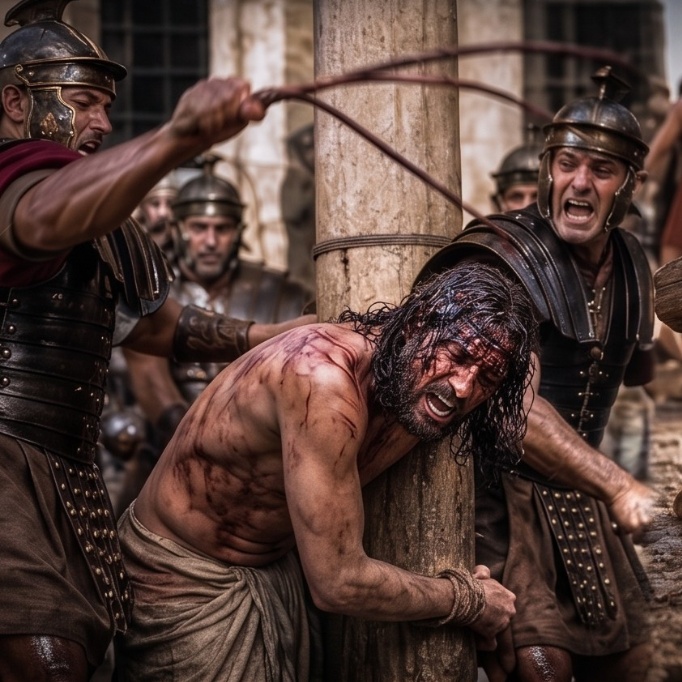
WAS CHRIST FLOGGED ONCE OR TWICE?
Taking both the Gospels and Ellen White together, it is very possible Jesus was flogged twice:
Here is the quote from the book Desire of Ages: “He had been taken to Annas, then to Caiaphas, and then to Pilate. From Pilate He had been sent to Herod, then sent again to Pilate. From insult to renewed insult, from mockery to mockery, twice tortured by the scourge,—all that night there had been scene after scene of a character to try the soul of man to the uttermost… But when after the second scourging the cross was laid upon Him, human nature could bear no more. He fell fainting beneath the burden.”
1. The first scourging occurred as a calculated compromise. Pilate, having declared Jesus innocent, hoped that a “lesser” punishment would satisfy the bloodlust of the mob and allow him to release Jesus. After Pilate first tried to release Jesus through the Passover custom he failed. He believed that if the people saw Jesus bruised and bleeding, they would feel His punishment was sufficient.
“Pilate was filled with amazement at the uncomplaining patience of the Saviour. He did not doubt that the sight of this Man, in contrast with Barabbas, would move the Jews to sympathy. But he did not understand the fanatical hatred of the priests… Pilate then in the presence of the multitude he scourged Jesus. … This was a most cruel and shameful punishment, but Pilate hoped by this means to save the life of the Prisoner.” (The Desire of Ages, p. 733)
2. The second scourging was the official Roman “verberatio“—the brutal flogging that legally and traditionally preceded crucifixion. After the “Ecce Homo” (“Behold the Man”) scene failed, Pilate finally yielded to the threat of being accused of disloyalty to Caesar. It was standard Roman legal procedure. Once a criminal was sentenced to the cross, they were scourged as part of the execution process.
“Pilate longed to deliver Him. But he saw that he could not do this, and yet retain his own position and honor… He yielded to the demands of the mob. Rather than risk losing his position, he delivered Jesus up to be crucified. … It was the custom to scourge those who were sentenced to death by crucifixion. This also Jesus endured.” (The Desire of Ages, p. 738)
Does the Bible Support Two Scourgings?
The Bible does not explicitly say “He was scourged a second time,” but many biblical scholars find strong evidence for it by comparing the Gospel accounts:
John 19:1–5: Records Jesus being scourged before the final sentence. Pilate then brings Him out and says, “Behold the man!” (v. 5), clearly using the beating as an argument for His release.
Matthew 27:26 & Mark 15:15: Record that Pilate released Barabbas and, “having scourged Jesus,” delivered Him to be crucified.
The Theological Harmony: The Greek verbs used in these passages can refer to different types of Roman beatings:
Fustigatio (John 19:1): A “corrective” beating for minor offenses or to satisfy a crowd (Luke 23:16: “I will therefore chastise him, and release him”).
Verberatio (Matthew/Mark): The horrific, bone-exposing scourging that was the mandatory preliminary to the cross.
By combining the accounts, it appears Pilate used a “lighter” (though still brutal) flogging to try to save Him, but when that failed, Jesus was subjected to the full, official executioner’s scourge before being led to Calvary.
Under Roman law, punishment was categorized by intensity and intent. While the Bible uses general terms like “scourged,” historians recognize these three distinct levels:
Latin Term Fustigatio refers to the Lightest Corrective Warning For “minor” crimes; often done with sticks or rods (fustis).
Flagellatio – Brutal Punitive For serious crimes; used the flagrum (whip with lead/bone).
Verberatio Most Severe Preliminary to Death The “death-blow” scourging; mandatory for those about to be crucified.
1. The First Scourging of Jesus was either Fustigatio or Flagellatio. Pilate officially declared, “I find no fault in him” (John 18:38). However, to appease the crowd, he used a “chastisement” to satisfy their anger without killing the prisoner. In Roman law, if a prisoner was scourged as a punishment, they were usually then released. Pilate said, “I will therefore chastise (paideuo – to discipline) him, and release him” (Luke 23:16). Pilate was attempting to use the “lesser” punishment to settle the matter. This is why he presented the bloodied Jesus to the crowd saying, “Behold the man!”—he was essentially saying, “Isn’t this enough?”
Since Pilate wanted the crowd to be impressed by the severity of the punishment, it is very likely that the most cruel type of scourging was used.
2. The Second Scourging was Verberatio. Once Pilate “delivered him to be crucified” (Matthew 27:26). Under Roman law, crucifixion was not a standalone event; it was a package deal that required a final, horrific scourging (verberatio) to weaken the victim so they would die faster on the cross. This was the official executioner’s scourging. It was no longer a “chastisement” to evoke pity; it was the beginning of the execution itself.
While the Bible doesn’t explicitly count “one” and “two,” the order of events in the different Gospels points to two separate instances:
John 19:1–5: This first scourging happens during the trial (before the death sentence was pronounced). After the beating, Pilate continues to argue for Jesus’ release. This matches Ellen White’s description of the “first” scourging.
Matthew 27:26 / Mark 15:15: These verses state that Pilate released Barabbas and, “having scourged Jesus,” delivered Him to be crucified. This happens at the end of the trial as the final act before heading to Golgotha.
Ellen White clarifies that the first beating was an act of mercy (in Pilate’s twisted view) meant to spare Jesus’ life, while the second was an act of law (Roman custom) because the death sentence had finally been passed.
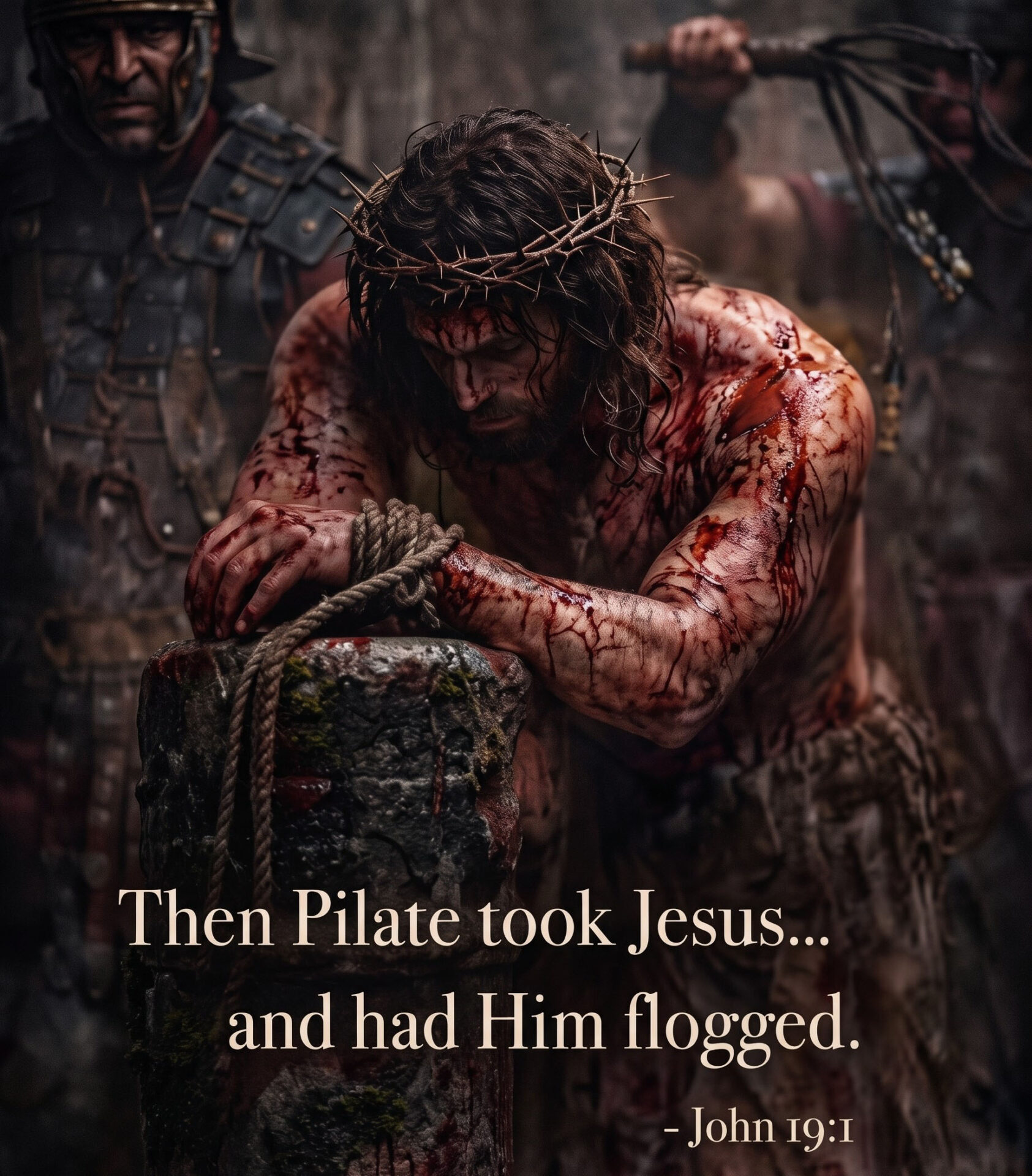
DID THE ROMANS FLOG ONLY THE BACK OF CHRIST’S BODY?
Roman scourging was designed to be a “halfway death.” The goal of the flagrum (the whip with metal or bone weights) was to strip away skin and muscle to the point of exposing the victim’s internal organs.
Historical accounts and forensic analysis (including studies on the Shroud of Turin, which many scholars use as a reference for Roman techniques) show scourge marks distributed across the back, chest, stomach, and legs. Even if a soldier stood behind the victim, the weighted tips of the whip would “wrap around” the body, causing the metal pieces to dig into the chest, abdomen, and thighs with every strike. Victims were typically stripped completely naked and tied to a low pillar in a stooped position. This stretched the skin of the back tight, making it easier to tear, but it also left the front of the body vulnerable to the “wrap-around” effect of the lashes.
Ellen White emphasises the total physical devastation of Christ’s body. She does not limit the injuries to His back; rather, she describes a scene where His entire form was so mangled that He was almost unrecognisable.
In The Desire of Ages, she writes: “His whole form was convulsed with pain.” (p. 734). She notes that the scourging was so severe across His body that He fainted multiple times from the sheer volume of blood lost. When she describes Him carrying the cross, she refers to His “weariness, pain, and loss of blood” from the “scourging and blows” (Early Writings, p. 175). Mangled Flesh: She describes the soldiers‘ cruelty as “unrelenting,” suggesting they were not careful or surgical, but struck Him everywhere in their mockery of His “royalty.”
The idea that only the back was struck comes from two places: Modesty in Art: For centuries, artists depicted Jesus with a loincloth and focused on the back to maintain a level of “decorum” in church paintings. Jewish Law vs. Roman Law: Under Jewish law (Deuteronomy 25:3), lashes were limited to 40 and were usually applied specifically to the back and shoulders. However, Jesus was scourged by Romans, who had no limit on the number of stripes and no rules about where they could strike. They were professional torturers who aimed for maximum surface area to induce hypovolemic shock.
The Roman scourging was not a “whipping” in the modern sense; it was a shredding of the body. By the time the second scourging was over, the skin of Jesus’ chest, abdomen, and back would have been hanging in ribbons of flesh. This is why the prophet Isaiah (often cited by Ellen White) says of the Messiah: “His visage was so marred more than any man, and his form more than the sons of men” (Isaiah 52:14).
WHY DID CHRIST DIE AFTER ONLY 6 HOURS WHEN OTHERS DIED AFTER 3-6 DAYS?
It is a historical fact that crucifixion was designed to be a slow, agonising death that could last several days. The “short” duration of Jesus’ suffering (roughly 9:00 AM to 3:00 PM) was so unusual that when Joseph of Arimathea asked for the body, Pilate was shocked that He was already dead (Mark 15:44).
Based on Ellen White’s writings and medical-historical analysis, there are three primary reasons why Jesus died so quickly compared to others.
As we discussed, Jesus endured two separate scourgings. Most victims only received one.
Hypovolemic Shock: The massive loss of blood from the two scourgings put Jesus in a state of a shock before He even reached the cross.
Physical Exhaustion: He had been awake for over 24 hours, subjected to seven trials, constantly mocked, beaten, and forced to carry a heavy crossbeam (patibulum) under which He collapsed three times. Most prisoners arrived at the cross with more physical “reserve” than Jesus had left.
However, Ellen White emphasises that physical torture was not what ultimately killed Jesus. She argues that the mental and spiritual agony of bearing the sins of the world caused a physical rupture of His heart:
“But it was not the spear thrust, it was not the pain of the cross, that caused the death of Jesus. That cry, uttered ‘with a loud voice‘ (Matthew 27:46, 50), at the moment of death, the stream of blood and water that flowed from His side, declared that He died of a broken heart. His heart was broken by mental anguish. He was slain by the sin of the world.” (The Desire of Ages, p. 772)
When the Roman soldier pierced Jesus’ side, “blood and water” flowed out (John 19:34).
Pericardial Effusion: When the heart wall ruptures due to extreme stress, blood fills the pericardium (the sac around the heart). The blood then separates into red clots (blood) and clear serum (water). If Jesus had died purely from the slow suffocation of crucifixion (as most did), there would not have been that volume of “water” and blood. This confirms He died from a sudden, internal cardiac event triggered by extreme grief and pressure.
CHRIST’S SUFFERINGS FROM GETHSEMANE TO DEATH IN “DESIRE OF AGES”
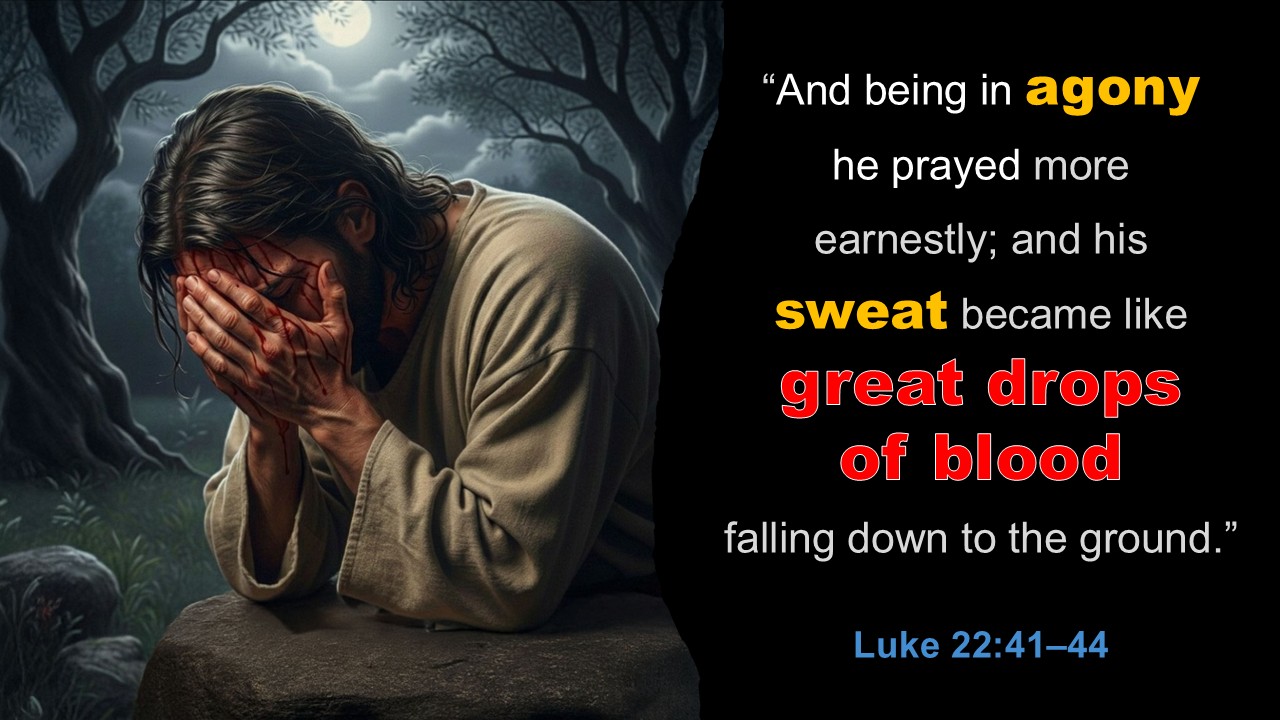
GETHSEMANE (Chapter 74)
Based on Matthew 26:36–56; Mark 14:32–50; Luke 22:39–53; John 18:1–12.
Jesus entered the Garden of Gethsemane with his disciples after the Last Supper, likely arriving on Thursday around 10 PM-11:00 PM to midnight, where he prayed for over 1 hour in agony, sweating drops of blood, while his disciples slept.
Jesus had been earnestly conversing with His disciples and instructing them; but as He neared Gethsemane, He became strangely silent. He had often visited this spot for meditation and prayer; but never with a heart so full of sorrow.
Now He seemed to be shut out from the light of God’s sustaining presence. Now He was numbered with the transgressors. The guilt of fallen humanity He must bear. Upon Him who knew no sin must be laid the iniquity of us all.
So dreadful does sin appear to Him, so great is the weight of guilt which He must bear, that He is tempted to fear it will shut Him out forever from His Father’s love.
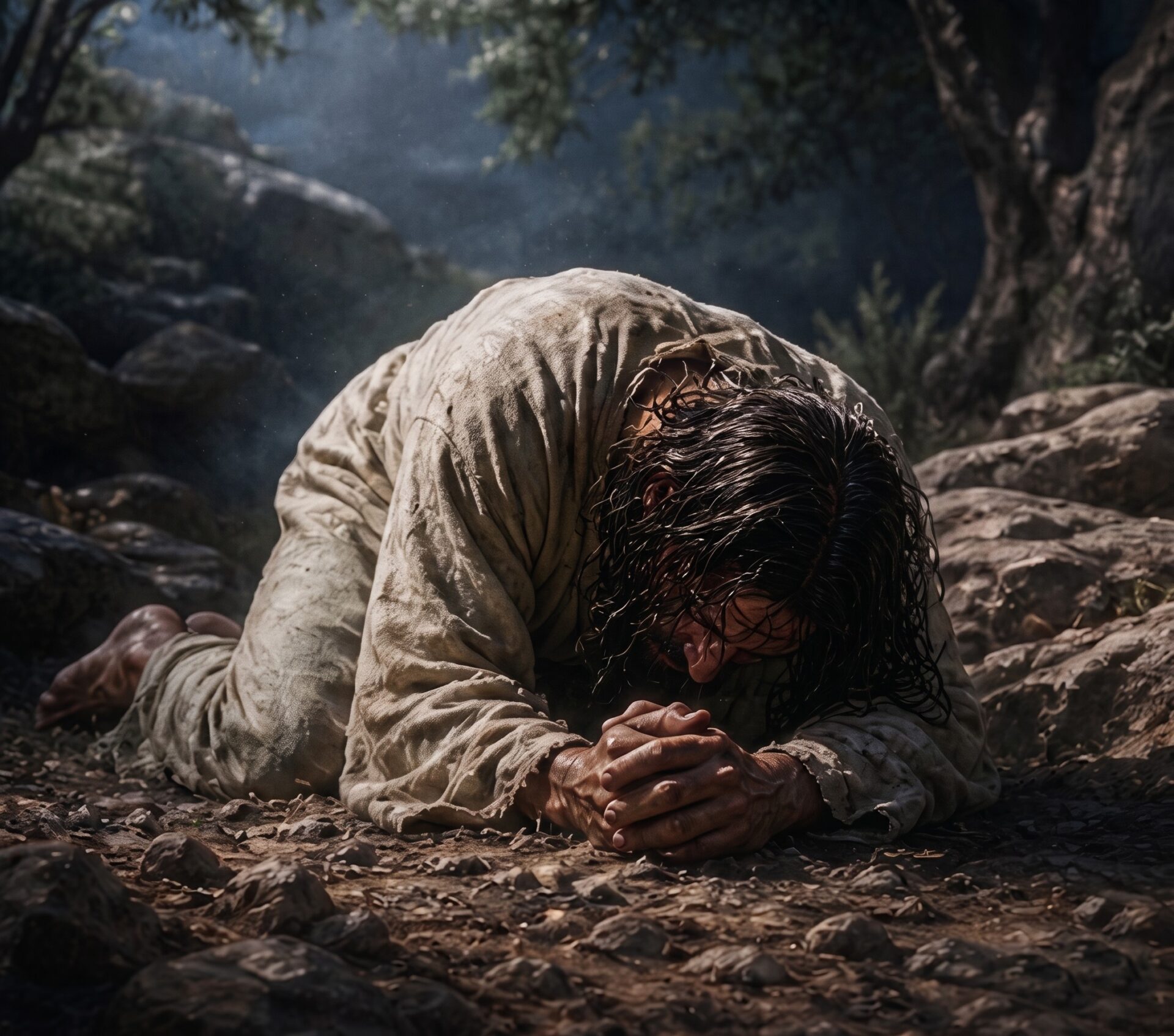
Feeling how terrible is the wrath of God against transgression, He exclaims, “My soul is exceeding sorrowful, even unto death.”
Never before had they seen Him so utterly sad and silent. As He proceeded, this strange sadness deepened; yet they dared not question Him as to the cause. His form swayed as if He were about to fall. Every step that He now took was with labored effort. He groaned aloud, as if suffering under the pressure of a terrible burden. Twice His companions supported Him, or He would have fallen to the earth.
As Christ felt His unity with the Father broken up, He feared that in His human nature He would be unable to endure the coming conflict with the powers of darkness.
Satan told Him that if He became the surety for a sinful world, the separation would be eternal. He would be identified with Satan’s kingdom, and would nevermore be one with God.
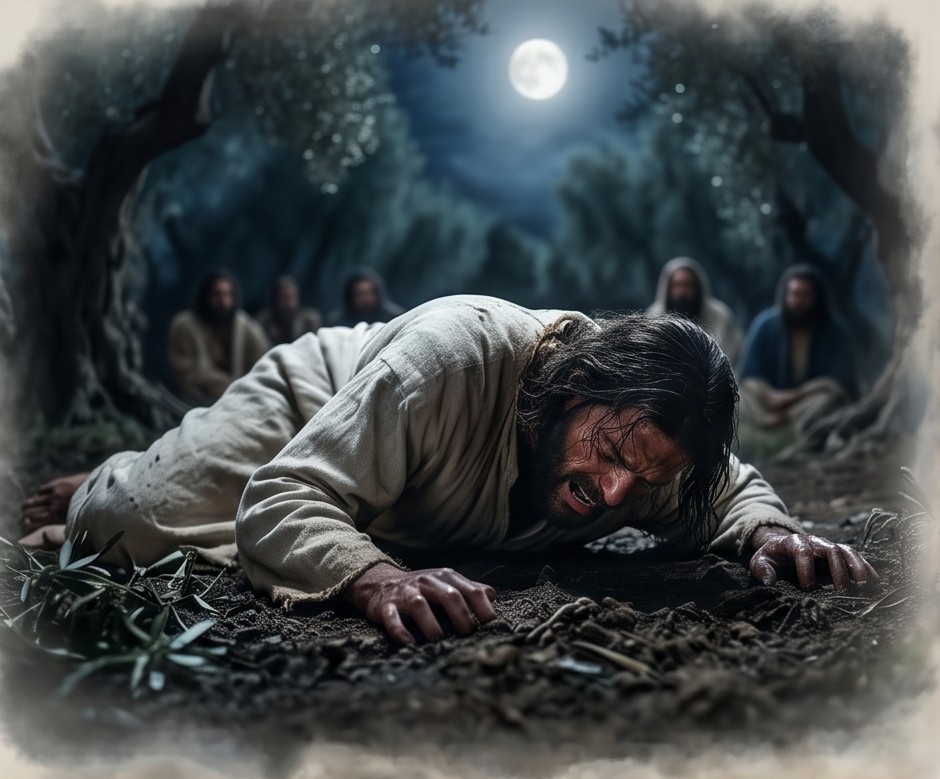
Satan pressed the situation upon the Redeemer: The people who claim to be above all others in temporal and spiritual advantages have rejected You. One of Your own disciples, will betray You. One of Your most zealous followers will deny You. All will forsake You. Christ’s whole being abhorred the thought.
The sins of men weighed heavily upon Christ, and the sense of God’s wrath against sin was crushing out His life.
In His agony He clings to the cold ground, as if to prevent Himself from being drawn farther from God. The chilling dew of night falls upon His prostrate form. From His pale lips comes the bitter cry, “O My Father, if it be possible, let this cup pass from Me.
The human heart longs for sympathy in suffering. This longing Christ felt to the very depths of His being.
In the supreme agony of His soul He came to His disciples with a yearning desire to hear some words of comfort from those whom He had so often blessed and comforted, and shielded in sorrow and distress. The One who had always had words of sympathy for them was now suffering superhuman agony, and He longed to know that they were praying for Him and for themselves.
How dark seemed the malignity of sin! Terrible was the temptation to let the human race bear the consequences of its own guilt, while He stood innocent before God. If He could only know that His disciples understood and appreciated this, He would be strengthened.
The disciples awakened at the voice of Jesus, but they hardly knew Him, His face was so changed by anguish.
He did not reprove them, but said, “Watch ye and pray, lest ye enter into temptation.” Even in His great agony, He was seeking to excuse their weakness. “The spirit truly is ready,” He said, “but the flesh is weak.”
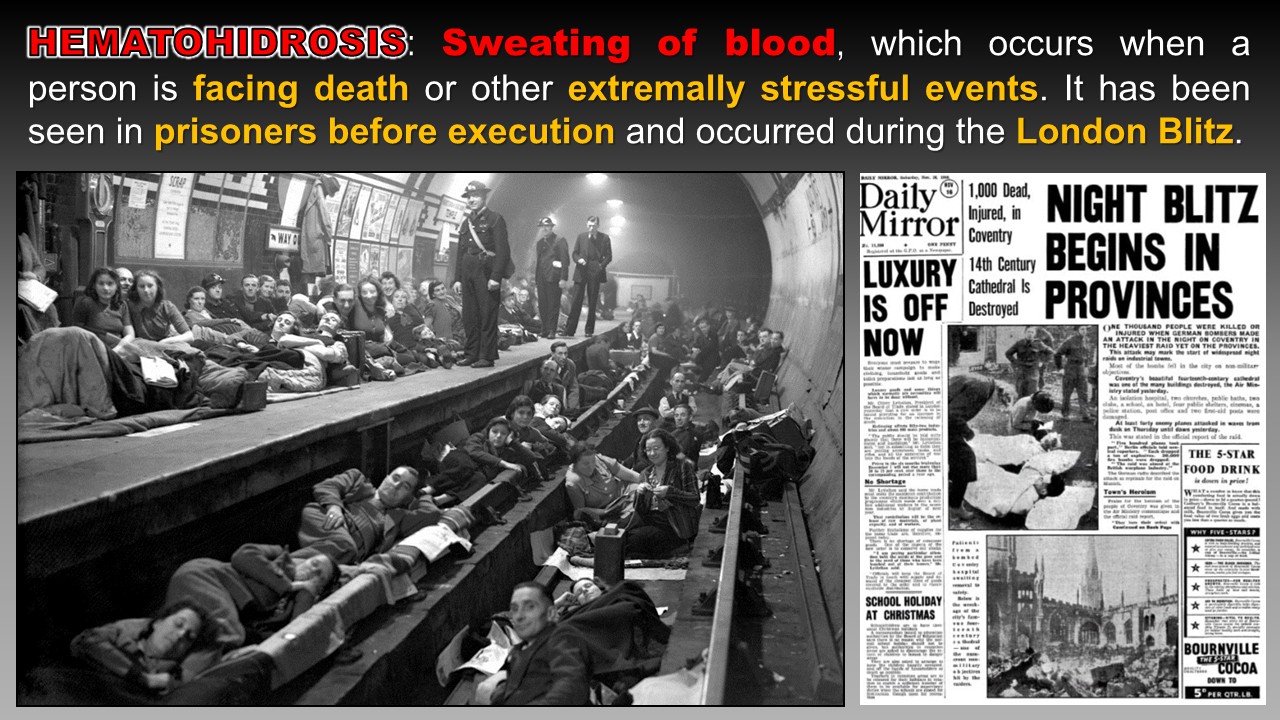
Again the Son of God was seized with superhuman agony, fainting and exhausted, He staggered back to the place of His former struggle. His suffering was even greater than before.
As the agony of soul came upon Him, “His sweat was as it were great drops of blood falling to the ground.”
Again He had felt a longing for companionship, for some words from His disciples which would bring relief, and break the spell of darkness that overpowered Him.
They saw His face marked with the bloody sweat of agony, and they were filled with fear.
Turning away, Jesus sought again His retreat, and fell prostrate, overcome by the horror of a great darkness.
He beholds its impending fate, and His decision is made. He will save man at any cost to Himself.
Having made the decision, He fell dying to the ground from which He had partially risen.
Where now were His disciples, to place their hands tenderly beneath the head of their fainting Master, and bathe that brow, marred indeed more than the sons of men? The Saviour trod the wine press alone, and of the people there was none with Him.
But God suffered with His Son. Could mortals have viewed the amazement of the angelic host as in silent grief they watched the Father separating His beams of light, love, and glory from His beloved Son, they would better understand how offensive in His sight is sin.
Christ’s agony did not cease (after an angel strengthened him), but His depression and discouragement left Him.
He had borne that which no human being could ever bear; for He had tasted the sufferings of death for every man.
Judas Iscariot arrived with soldiers (around midnight) to arrest Jesus shortly after He finished praying and accepted the cup of curse to save sinful humanity.
They now laid hold of Jesus, and proceeded to bind those precious hands that had ever been employed in doing good.
BEFORE ANNAS (Chapter 75)
Jesus was first taken to Annas, the father-in-law of the High Priest Caiaphas, for a preliminary, unofficial interrogation (Friday, possibly between midnight to 1:00 AM).
Over the brook Kedron, past gardens and olive groves, and through the hushed streets of the sleeping city, they hurried Jesus. It was past midnight, and the cries of the hooting mob that followed Him broke sharply upon the still air.
The Saviour was bound and closely guarded, and He moved painfully… to the palace of Annas, the ex-high priest.
Christ was to be tried formally before the Sanhedrin; but before Annas He was subjected to a preliminary trial…
One of his officers, filled with wrath as he saw Annas silenced, struck Jesus on the face, saying, “Answerest Thou the high priest so?”
His calm answer came from a heart sinless, patient, and gentle, that would not be provoked.
Christ suffered keenly under abuse and insult. At the hands of the beings whom He had created, and for whom He was making an infinite sacrifice, He received every indignity.
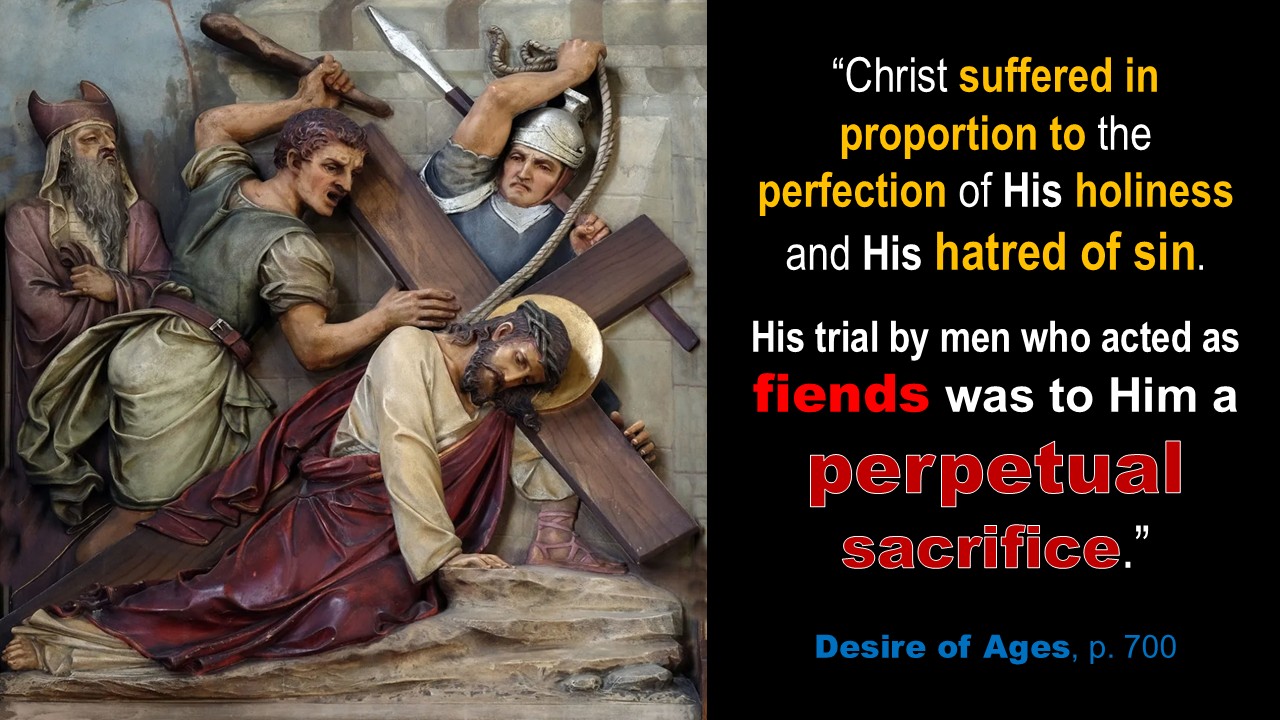
And He suffered in proportion to the perfection of His holiness and His hatred of sin. His trial by men who acted as fiends was to Him a perpetual sacrifice.
To be surrounded by human beings under the control of Satan was revolting to Him. And He knew that in a moment, by the flashing forth of His divine power, He could lay His cruel tormentors in the dust. This made the trial the harder to bear.
When Christ was treated with contempt, there came to Him a strong temptation to manifest His divine character… But it was His difficult task to keep to the position He had chosen as one with humanity.
He who could have doomed His enemies to death bore with their cruelty. His love for His Father, and His pledge, made from the foundation of the world, to become the Sin Bearer, led Him to endure uncomplainingly the coarse treatment of those He came to save.
BEFORE CAIAPHAS (Chapter 75)
“Following Annas, Christ was taken to Caiaphas for a formal trial by the Jewish council (Friday, 1 AM-2:00 AM?). Caiaphas … was fully as severe, heartless, and unscrupulous as was Annas. He would leave no means untried to destroy Jesus.
It was now early morning, and very dark; by the light of torches and lanterns the armed band with their prisoner proceeded to the high priest’s palace. Here, while the members of the Sanhedrin were coming together, Annas and Caiaphas again questioned Jesus, but without success.”
SUFFERING CAUSED BY THE DENIAL OF PETER (Chapter 75)
Peter’s denial took place when Jesus was interrogated by Caiaphas (Friday, 1 AM-2:00 AM?).
“But a keener anguish rent the heart of Jesus; the blow that inflicted the deepest pain no enemy’s hand could have dealt. While He was undergoing the mockery of an examination before Caiaphas, Christ had been denied by one of His own disciples.
Peter tried to show no interest in the trial of his Master, but as he heard the cruel taunts, and saw the abuse He was suffering…
In order to conceal his true feelings, he endeavored to join with the persecutors of Jesus in their untimely jests. But his appearance was unnatural. He was acting a lie, and while seeking to talk unconcernedly he could not restrain expressions of indignation at the abuse heaped upon his Master. ‘Surely thou art one of them: for thou art a Galilean, and thy speech agreeth thereto’. At this Peter flew into a rage. The disciples of Jesus were noted for the purity of their language, and in order fully to deceive his questioners, and justify his assumed character, Peter now denied his Master with cursing and swearing.
While the degrading oaths were fresh upon Peter’s lips, and the shrill crowing of the cock was still ringing in his ears, the Saviour turned from the frowning judges, and looked full upon His poor disciple. At the same time Peter’s eyes were drawn to his Master. In that gentle countenance he read deep pity and sorrow, but there was no anger there.
The sight of that pale, suffering face, those quivering lips, that look of compassion and forgiveness, pierced his heart like an arrow.
Once more he looked at his Master, and saw a sacrilegious hand raised to smite Him in the face. Unable longer to endure the scene, he rushed, heartbroken, from the hall. It was in sleeping when Jesus bade him watch and pray that Peter had prepared the way for his great sin. All the disciples, by sleeping in that critical hour, sustained a great loss.”
FIRST TRIAL BEFORE SANHEDRIN (AT NIGHT) – DA, Chapter 75
First interrogation before the Sanhedrin (the Night Session): Matthew 26:59 and Mark 14:55. A gathered council of Jewish leaders seeking false witnesses to secure a death sentence (Friday, 1 AM-2:00 AM?).
“When the council had assembled in the judgment hall, Caiaphas took his seat as presiding officer.
Upon Him (Christ) the gaze of the whole multitude was fixed. The excitement was intense. Of all the throng He alone was calm and serene.
Caiaphas now looked upon the prisoner, he was struck with admiration for His noble and dignified bearing. A conviction came over him that this Man was akin to God. The next instant he scornfully banished the thought.
False witnesses had been bribed to accuse Jesus.
The Sanhedrin had pronounced Jesus worthy of death; but it was contrary to the Jewish law to try a prisoner by night… Notwithstanding this, the Saviour was now treated as a condemned criminal, and given up to be abused by the lowest and vilest of humankind.
JESUS TORTURED IN THE GUARDROOM (Chapter 75)
Jesus was kept by guards and tortured by possessed mob waiting for the trial before Sanhedrin and Pilate (Friday, 2 AM-5:00 AM).
“The palace of the high priest surrounded an open court in which the soldiers and the multitude had gathered. Through this court, Jesus was taken to the guardroom, on every side meeting with mockery of His claim to be the Son of God. His own words, “sitting on the right hand of power,” and, “coming in the clouds of heaven,” were jeeringly repeated.
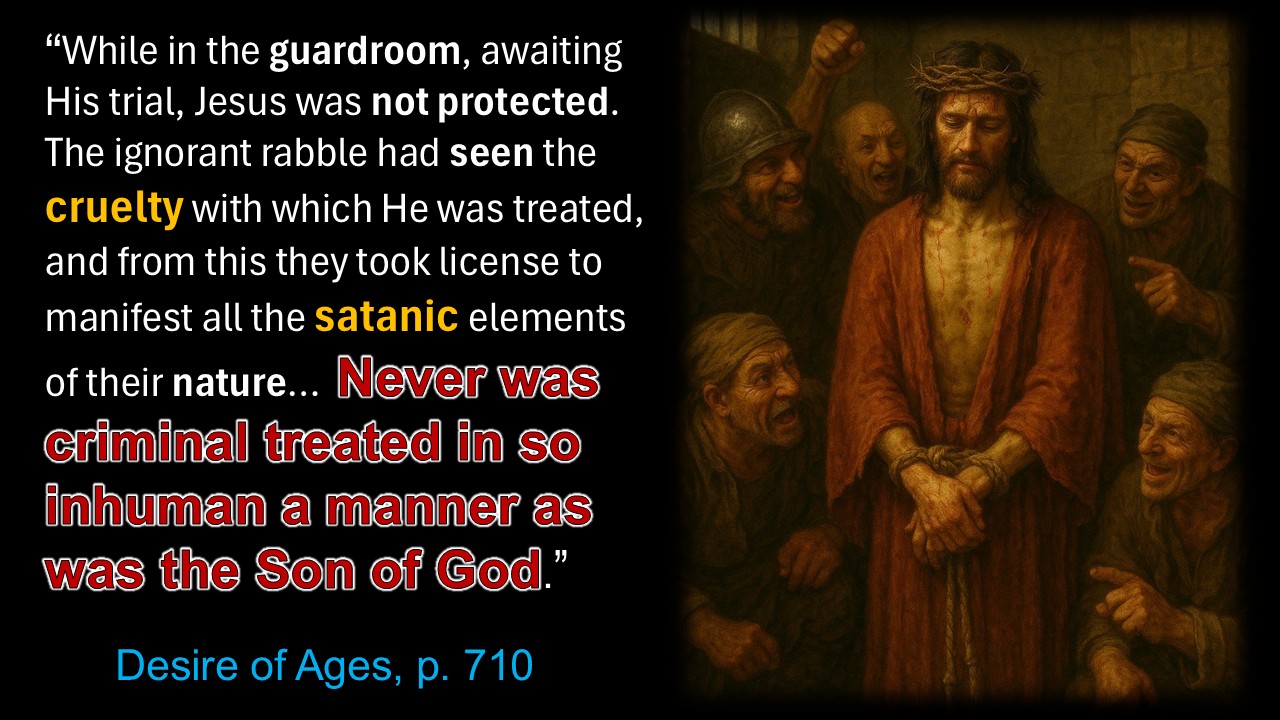
While in the guardroom, awaiting His legal trial, He was not protected. The ignorant rabble had seen the cruelty with which He was treated before the council, and from this they took license to manifest all the satanic elements of their nature. Christ’s very nobility and godlike bearing goaded them to madness. His meekness, His innocence, His majestic patience, filled them with hatred born of Satan.
Mercy and justice were trampled upon. Never was criminal treated in so inhuman a manner as was the Son of God…
“The Son of God was not alone in that guardroom; the angels of God were there, and as they beheld the treatment of their loved Commander, they would have put forth their power to rescue Him; but they were restrained. The heavens were filled with mourning. The angels with grief and indignation saw the Son of the infinite God, the Majesty of heaven, insulted, mocked, and tortured.” Spirit of Prophecy, Vol. 3, p. 108
BEFORE SANHEDRIN – THE SECOND (MORNING) TRIAL (Chapter 75)
Second interrogation before the Sanhedrin (The Morning Ratification): Luke 22:66. A formal meeting at daybreak to give a legal appearance to the illegal nighttime verdict. Probably around 5-6 AM.
“As soon as it was day, the Sanhedrin again assembled, and again Jesus was brought into the council room. “Art Thou the Christ?” they said, “tell us.” But Christ remained silent…
“Hereafter shall the Son of man sit on the right hand of the power of God.”…
“Art Thou then the Son of God?” they asked with one voice. He said unto them, “You say that I am.” They cried out, “What need we any further witness? For we ourselves have heard of His own mouth.”
Then came the third scene of abuse and mockery, worse even than that received from the ignorant rabble. In the very presence of the priests and rulers, and with their sanction, this took place. Every feeling of sympathy or humanity had gone out of their hearts.
When the condemnation of Jesus was pronounced by the judges, a satanic fury took possession of the people. The roar of voices was like that of wild beasts. The crowd made a rush toward Jesus, crying, He is guilty, put Him to death!
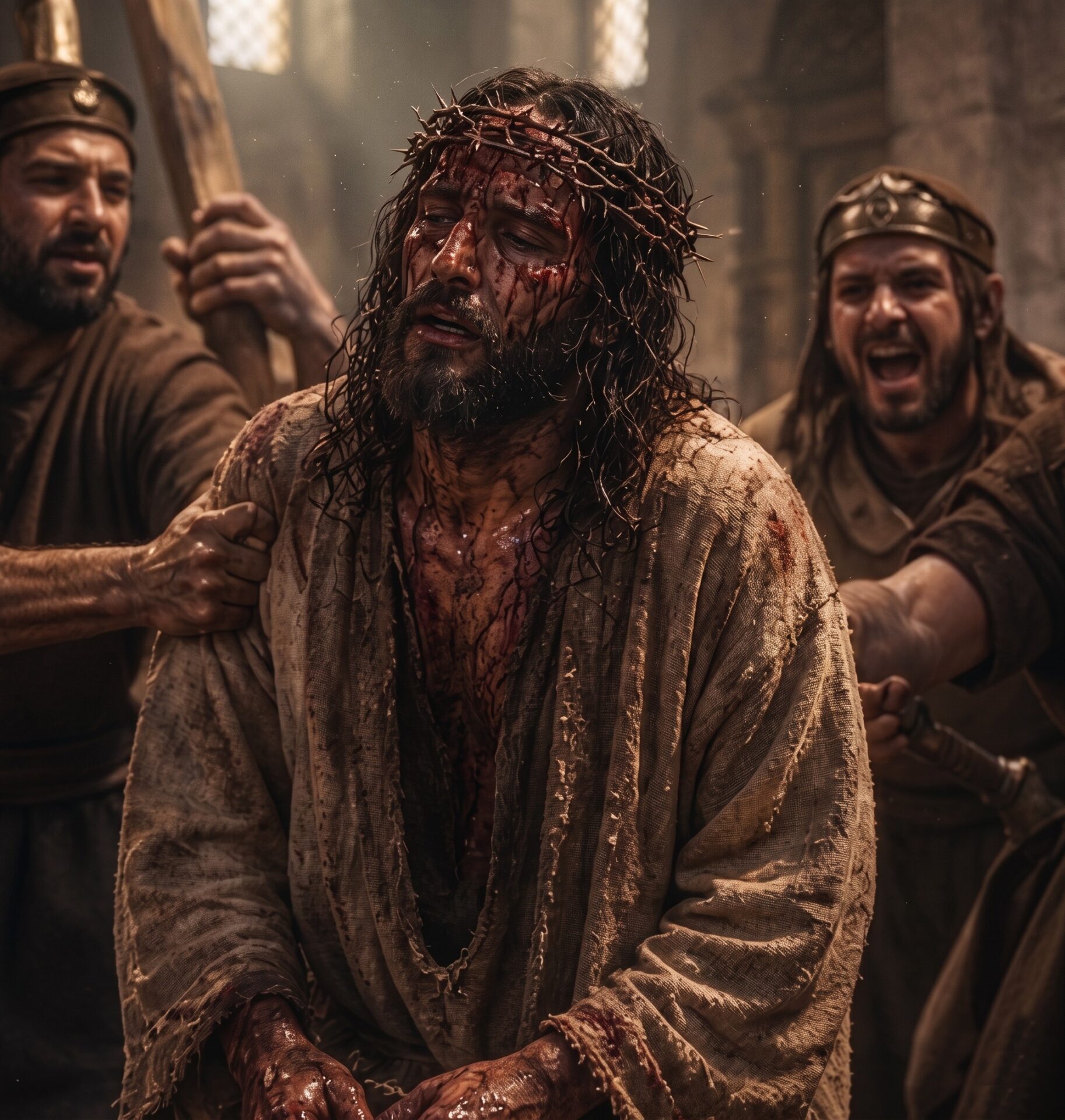
Had it not been for the Roman soldiers, Jesus would not have lived to be nailed to the cross of Calvary. He would have been torn in pieces before His judges, had not Roman authority interfered, and by force of arms restrained the violence of the mob.
Priests and rulers forgot the dignity of their office, and abused the Son of God with foul epithets. They taunted Him with His parentage.
The most dissolute [rozpustny] men engaged in infamous abuse of the Saviour.
An old garment was thrown over His head, and His persecutors struck Him in the face, saying, “Prophesy unto us, Thou Christ, Who is he that smote Thee?” When the garment was removed, one poor wretch spat in His face.
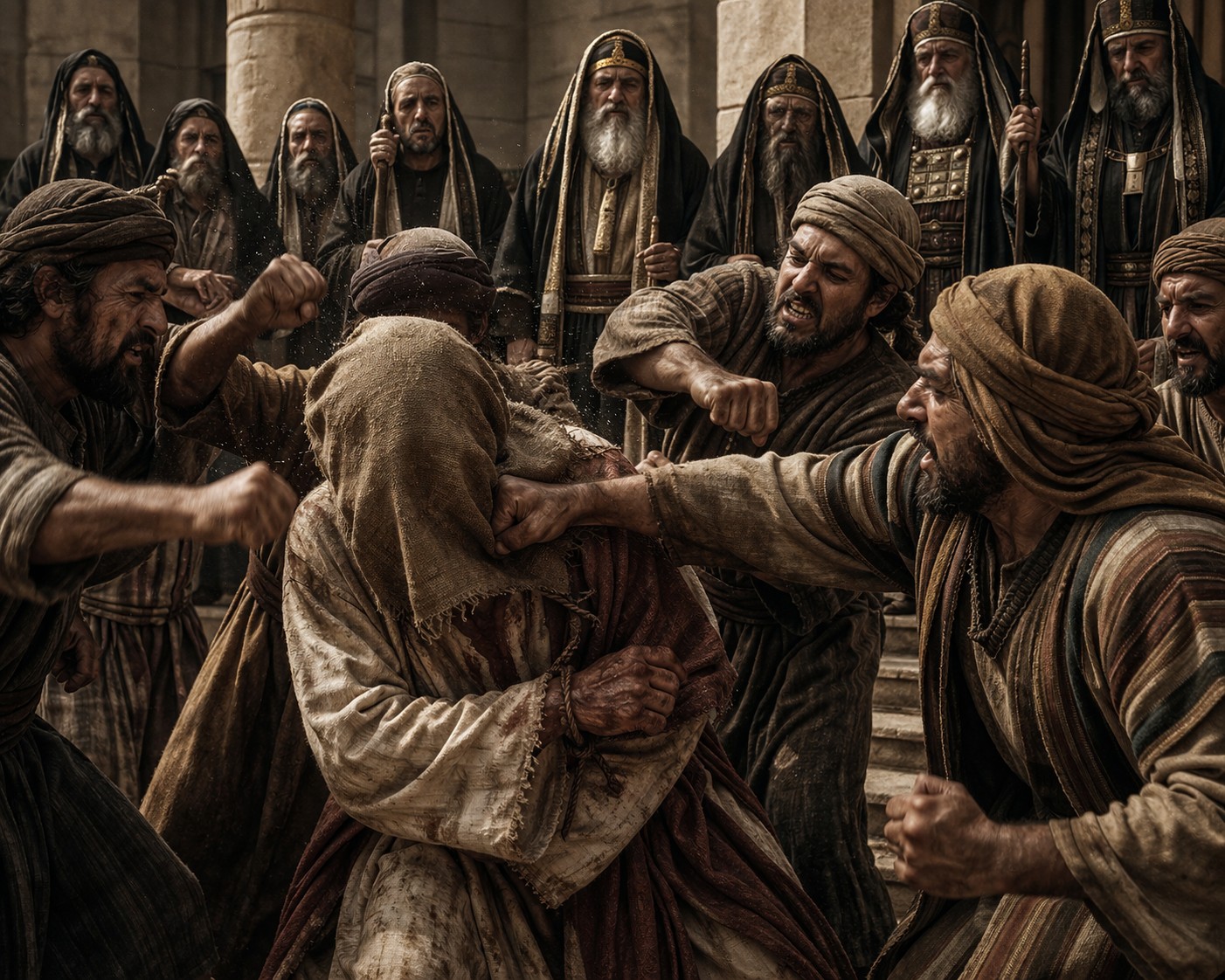
The angels of God faithfully recorded every insulting look, word, and act against their beloved Commander. One day the base men who scorned and spat upon the calm, pale face of Christ will look upon it in its glory, shining brighter than the sun.
FIRST TRIAL BEFORE PILATE (Chapter 77)
Based on Matthew 27:2, 11–31; Mark 15:1–20; Luke 23:1–25; John 18:28–40; John 19:1–16
First interrogation before Pilate (Friday, Early Morning, probably around 6:00 AM – because day began at sunrise at 6:00 AM). At the first trial before Pilate Christ was not yet Flogged but sent to Herod.
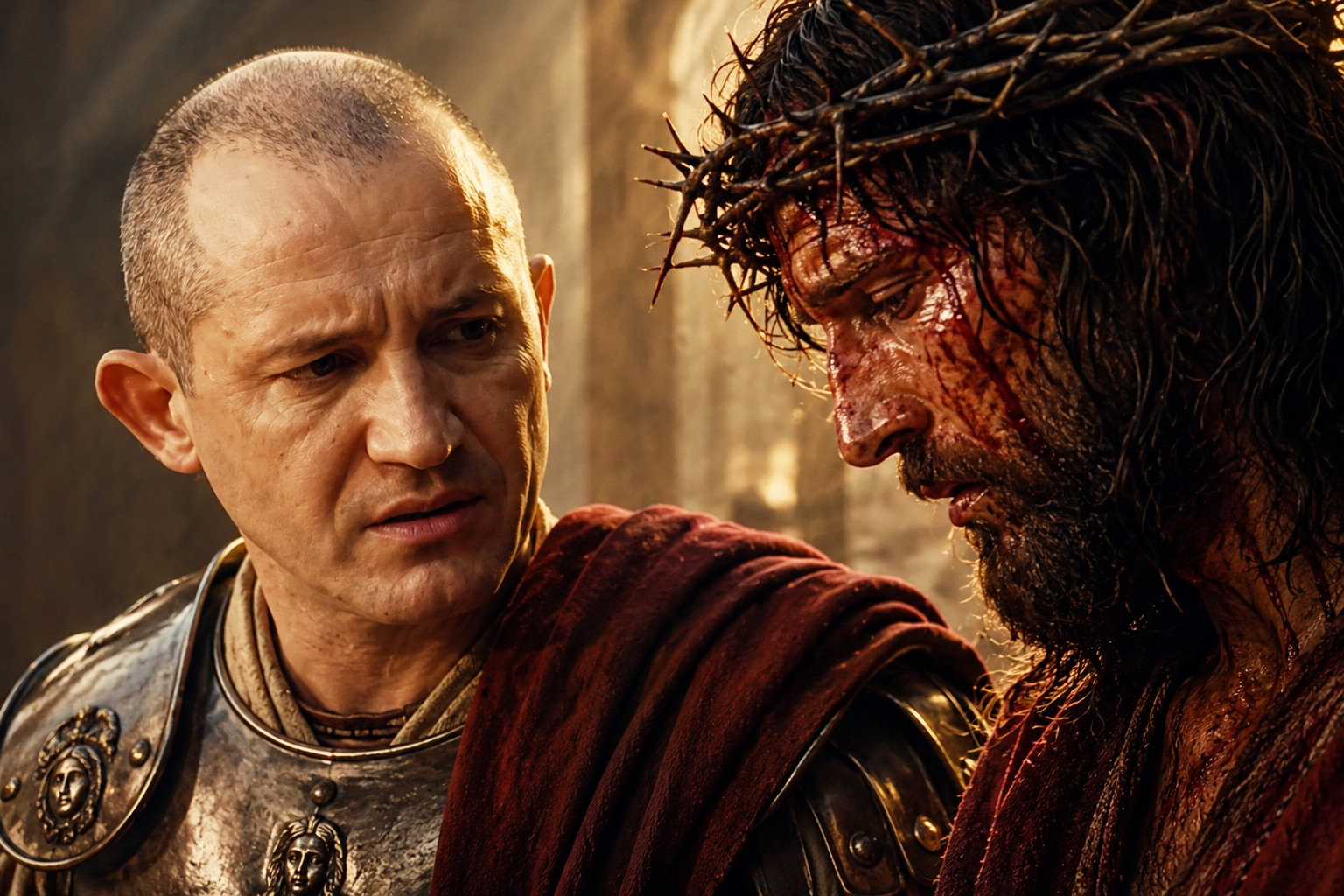
“Assuming his severest expression, he (Pilate) turned to see what kind of man he had to examine, that he had been called from his repose at so early an hour.
Never before had a man bearing marks of such goodness and nobility been brought before him. On His face he saw no sign of guilt, no expression of fear, no boldness or defiance. He saw a man of calm and dignified bearing, whose countenance bore not the marks of a criminal, but the signature of heaven.
Christ affirmed that His word was in itself a key which would unlock the mystery to those who were prepared to receive it. It had a self-commending power, and this was the secret of the spread of His kingdom of truth. He desired Pilate to understand that only by receiving and appropriating truth could his ruined nature be reconstructed.
Pilate had a desire to know the truth. His mind was confused. He eagerly grasped the words of the Saviour, and his heart was stirred with a great longing to know what it really was, and how he could obtain it. “What is truth?” he inquired. But he did not wait for an answer…
They had long plotted and waited for this opportunity. As they saw the prospect of the release of Jesus, they seemed ready to tear Him in pieces. They loudly denounced Pilate, and threatened him with the censure of the Roman government. They accused him of refusing to condemn Jesus, who, they affirmed, had set Himself up against Caesar…
Pilate delivered Jesus again to the soldiers, and amid the jeers and insults of the mob He was hurried to the judgment hall of Herod.
BEFORE HEROD (Chapter 77)
To avoid responsibility, Pilate sent Jesus to Herod Antipas (ruler of Galilee), who was in Jerusalem. Herod mocked him and returned him to Pilate. Looking with compassion into the serene face of the world’s Redeemer, he read in it only wisdom and purity. Christ’s silence was the severest rebuke that He could have given. Herod had rejected the truth spoken to him by the greatest of the prophets, and no other message was he to receive.
Herod’s face grew dark with passion. Turning to the multitude, he angrily denounced Jesus as an impostor. Then to Christ he said, If You will give no evidence of Your claim, I will deliver You up to the soldiers and the people.
Like wild beasts, the crowd darted upon their prey. Jesus was dragged this way and that, Herod joining the mob in seeking to humiliate the Son of God. Had not the Roman soldiers interposed, and forced back the maddened throng, the Saviour would have been torn in pieces.
“Herod with his men of war set Him at nought, and mocked Him, and arrayed Him in a gorgeous robe.” The Roman soldiers joined in this abuse.
There were some who trembled in Christ’s presence. While the rude throng were bowing in mockery before Him, some who came forward for that purpose turned back, afraid and silenced. Herod was convicted. The last rays of merciful light were shining upon his sin-hardened heart. He felt that this was no common man; for divinity had flashed through humanity. At the very time when Christ was encompassed by mockers, adulterers, and murderers, Herod felt that he was beholding a God upon His throne.
Hardened as he was, Herod dared not ratify the condemnation of Christ. He wished to relieve himself of the terrible responsibility, and he sent Jesus back to the Roman judgment hall.
SECOND TRIAL BEFORE PILATE (Chapter 77)
Christ was brought back to Pilate, who, facing pressure, ordered His crucifixion at around 8 AM. Christ flogged the first and the second time (Roman flogging often exposed muscles and bones).
Thinking that the people had not understood his question, Pilate asked, “Will ye that I release unto you the King of the Jews?” But they cried out again, “Away with this Man, and release unto us Barabbas”! “What shall I do then with Jesus which is called Christ?” Pilate asked. Again the surging multitude roared like demons. Demons themselves, in human form, were in the crowd, and what could be expected but the answer, “Let Him be crucified”? …
Jesus was taken, faint with weariness and covered with wounds, and scourged [first flogging] in the sight of the multitude.
‘And the soldiers led Him away into the hall, called Praetorium, and they call together the whole band. And they clothed Him with purple, and platted a crown of thorns, and put it about His head, and began to salute Him, Hail, King of the Jews! And they … did spit upon Him, and bowing their knees worshiped Him.’
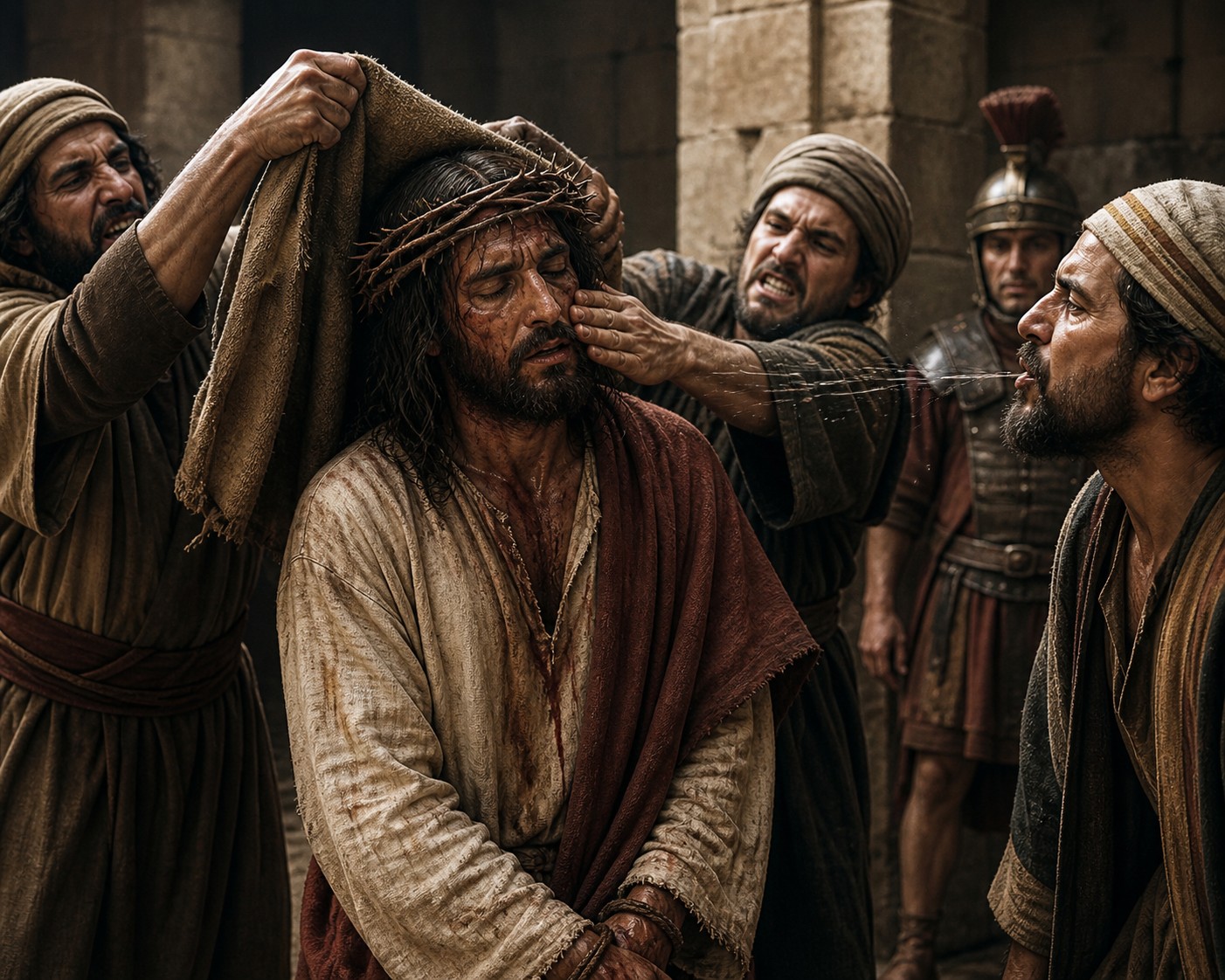
Occasionally some wicked hand snatched the reed that had been placed in His hand, and struck the crown upon His brow, forcing the thorns into His temples, and sending the blood trickling down His face and beard.
“A tattered silk robe of purple was placed upon the Saviour’s shoulders, a reed was put into His hand, and a crown of thorns was braided and forced upon His brow. His face was defiled with spit, and His enemies bowed before Him in mock-adoration, and struck Him in the face, saying, ‘Prophesy unto us, thou Christ, Who is he that smote thee?'” Manuscript 101, 1897
Wonder, O heavens! and be astonished, o earth! Behold the oppressor and the oppressed. A maddened throng enclose the Saviour of the world. Mocking and jeering are mingled with the coarse oaths of blasphemy.
His lowly birth and humble life are commented upon by the unfeeling mob. His claim to be the Son of God is ridiculed, and the vulgar jest and insulting sneer are passed from lip to lip.
Satan led the cruel mob in its abuse of the Saviour. It was his purpose to provoke Him to retaliation if possible, or to drive Him to perform a miracle to release Himself, and thus break up the plan of salvation. One stain upon His human life, one failure of His humanity to endure the terrible test, and the Lamb of God would have been an imperfect offering, and the redemption of man a failure.
But He who by a command could bring the heavenly host to His aid—He who could have driven that mob in terror from His sight by the flashing forth of His divine majesty—submitted with perfect calmness to the coarsest insult and outrage.
The blood drops of agony that from His wounded temples flowed down His face and beard were the pledge of His anointing with “the oil of gladness” (Hebrews 1:9.) as our great high priest.
There stood the Son of God, wearing the robe of mockery and the crown of thorns. Stripped to the waist, His back showed the long, cruel stripes, from which the blood flowed freely.
His face was stained with blood, and bore the marks of exhaustion and pain; but never had it appeared more beautiful than now. The Saviour’s visage was not marred before His enemies. Every feature expressed gentleness and resignation and the tenderest pity for His cruel foes. In His manner there was no cowardly weakness, but the strength and dignity of long-suffering…
The silent submission of Christ stamped upon their minds the scene, never to be effaced until they either acknowledged Him as the Christ, or by rejecting Him decided their own destiny.
Pilate was filled with amazement at the uncomplaining patience of the Saviour … with bleeding brow and lacerated back, He still had the bearing of a king upon his throne…
Then to Jesus he said, Forgive me for this act; I cannot save You. And when he had again scourged Jesus, [“again” means it was the second flogging] he delivered Him to be crucified…
WAY TO CALVARY (Chapter 78)
Heavy crossbar (patibulum) placed Christ and carried to Golgotha (8 AM- 9 AM). Simon was forced to carry the cross because Christs repeatedly collapsed under the heavy load. From a strictly historical and archaeological standpoint, it was nearly impossible and highly unusual for a victim to carry a full, assembled cross as it could weigh over 300 lbs (136 kg). The horizontal crossbar alone weighed between 75 to 125 lbs (34–57 kg). Historical records (such as those by Plautus and Dionysius of Halicarnassus) indicate that the upright posts (stipes) were often permanently fixed at execution sites like Golgotha. The condemned person would carry only the crossbar to the site, where they were then hoisted onto the waiting post. Having endured the Roman flagrum (which often exposed muscle and bone), a human being would be physically incapable of dragging 300 lbs (136 kg) for hundreds of yards. Most Adventist scholars suggest Ellen White uses the term “cross” in a sense of the instrument of death and the curse Jesus accepted for our salvation.
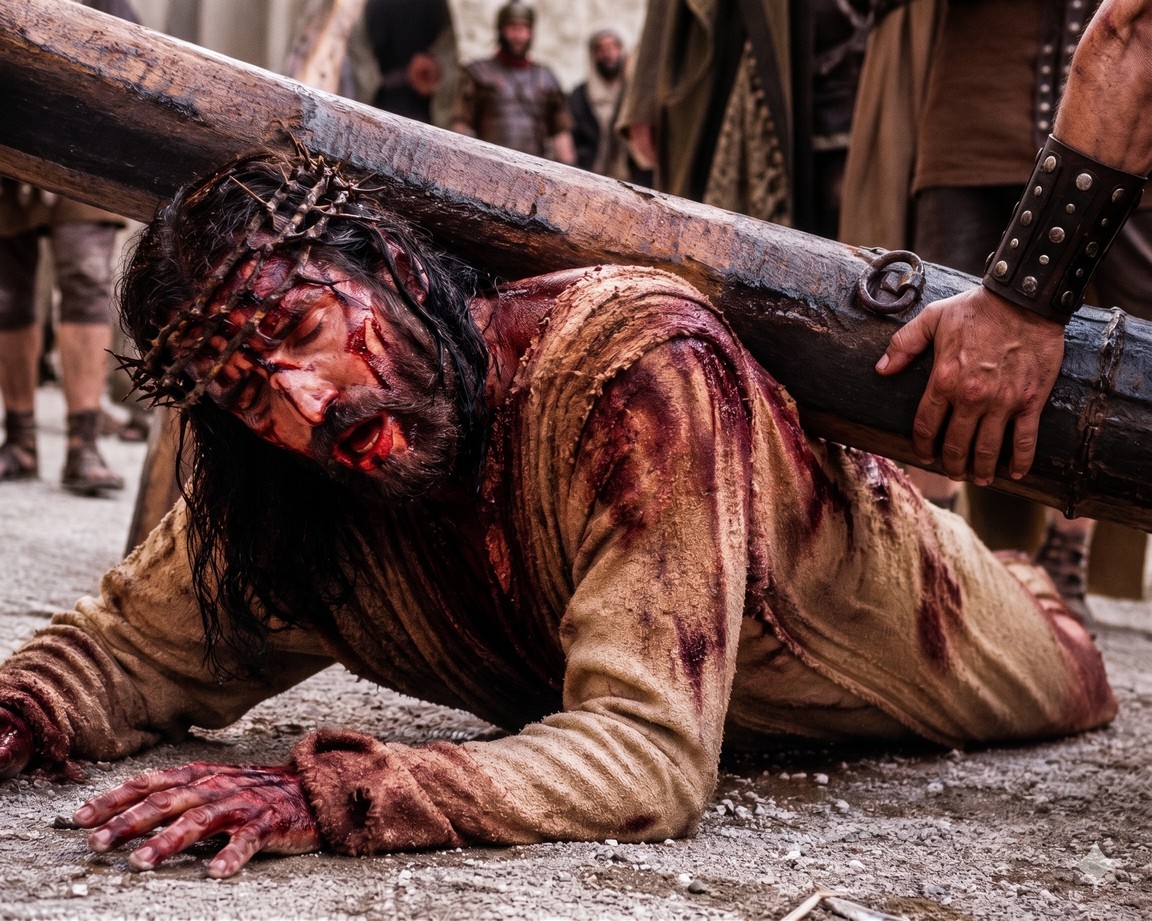
“He died outside the gate, where felons and murderers were executed. Full of significance are the words, “Christ hath redeemed us from the curse of the law, being made a curse for us.” Galatians 3:13.
A vast multitude followed Jesus from the judgment hall to Calvary. The news of His condemnation had spread throughout Jerusalem, and people of all classes and all ranks flocked toward the place of crucifixion.
As Jesus passed the gate of Pilate’s court, the cross which had been prepared for Barabbas was laid upon His bruised and bleeding shoulders.
Two companions of Barabbas were to suffer death at the same time with Jesus, and upon them also crosses were placed.
The Saviour’s burden was too heavy for Him in His weak and suffering condition. Since the Passover supper with His disciples, He had taken neither food nor drink. He had agonized in the garden of Gethsemane in conflict with satanic agencies. He had endured the anguish of the betrayal, and had seen His disciples forsake Him and flee.
He had been taken to Annas, then to Caiaphas, and then to Pilate. From Pilate He had been sent to Herod, then sent again to Pilate. From insult to renewed insult, from mockery to mockery, twice tortured by the scourge,—all that night there had been scene after scene of a character to try the soul of man to the uttermost.
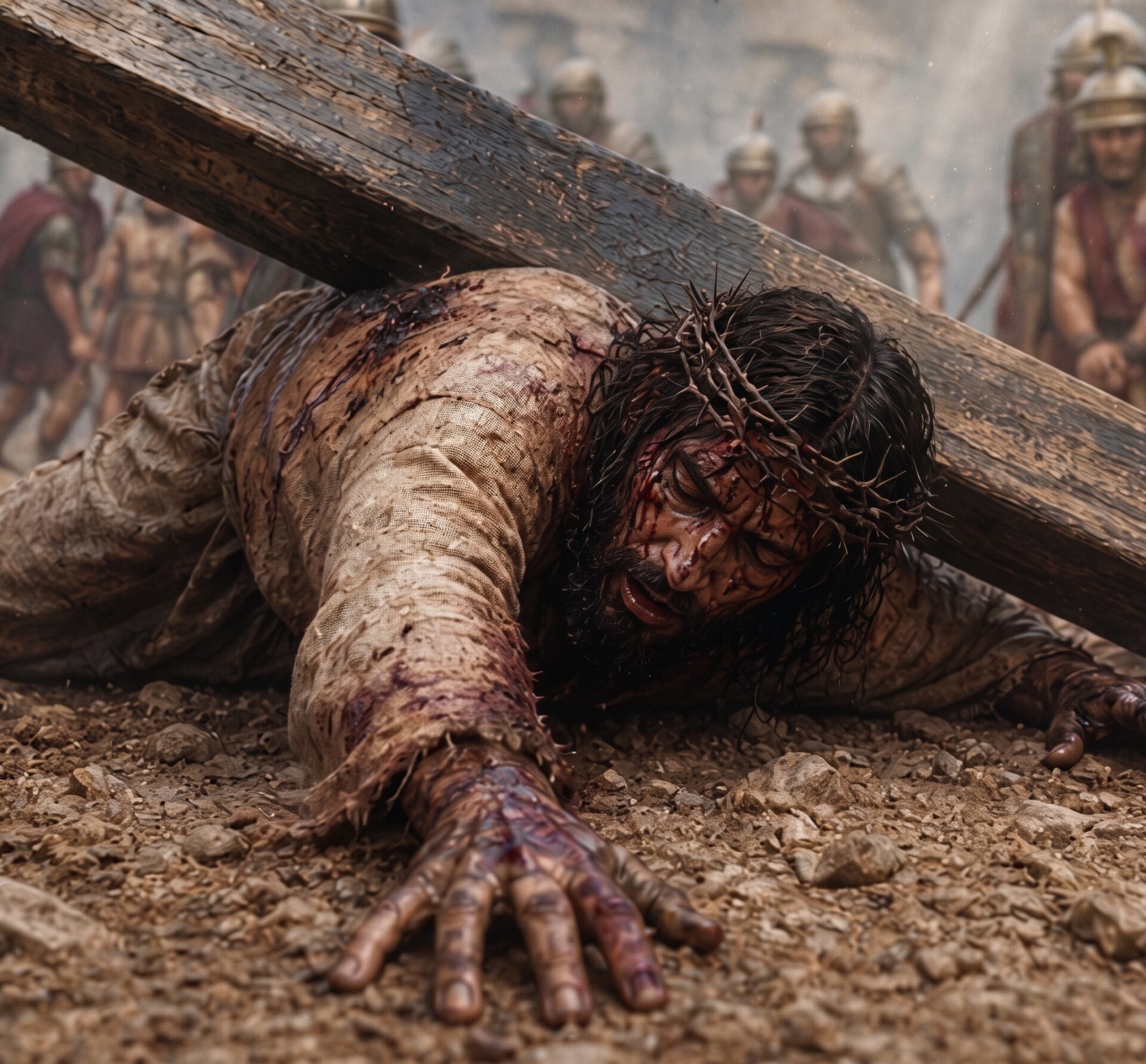
But when after the second scourging the cross was laid upon Him, human nature could bear no more. He fell fainting beneath the burden.
The crowd that followed the Saviour saw His weak and staggering steps, but they manifested no compassion. They taunted and reviled Him because He could not carry the heavy cross. Again the burden was laid upon Him, and again He fell fainting to the ground.
None even of the mob that followed Him would stoop to bear the cross.
CRUCIFIXION (Chapter 78)
Jesus was nailed to the cross at 9 AM (the third hour) on Friday (in the 1st century, the “day” was divided into twelve equal parts (hours) of light. Sunrise (around 6 AM) at that time of the year was the beginning hour of the day. 6 AM was the first hour, 9 AM was the third hour, 12 AM was the sixth hour, 3 PM was the ninth hour and 6 PM the twelfth hour).
“Arriving at the place of execution, the prisoners were bound to the instruments of torture. The two thieves wrestled in the hands of those who placed them on the cross; but Jesus made no resistance.
The mother of Jesus, supported by John the beloved disciple, had followed the steps of her Son to Calvary. She had seen Him fainting under the burden of the cross, and had longed to place a supporting hand beneath His wounded head, and to bathe that brow which had once been pillowed upon her bosom. But she was not permitted this mournful privilege. She saw His hands stretched upon the cross; the hammer and the nails were brought, and as the spikes were driven through the tender flesh, the heart-stricken disciples bore away from the cruel scene the fainting form of the mother of Jesus.
The Saviour made no murmur of complaint. His face remained calm and serene, but great drops of sweat stood upon His brow. There was no pitying hand to wipe the death dew from His face, nor words of sympathy and unchanging fidelity to stay His human heart.
While the soldiers were doing their fearful work, Jesus prayed for His enemies, “Father, forgive them; for they know not what they do.” That prayer of Christ for His enemies embraced the world. It took in every sinner that had lived or should live, from the beginning of the world to the end of time. Upon all rests the guilt of crucifying the Son of God. To all, forgiveness is freely offered. “Whosoever will” may have peace with God, and inherit eternal life.
As soon as Jesus was nailed to the cross, it was lifted by strong men, and with great violence thrust into the place prepared for it. This caused the most intense agony to the Son of God.
Centuries before the crucifixion, the Saviour had foretold the treatment He was to receive. “Dogs have compassed Me: the assembly of the wicked have enclosed Me: they pierced My hands and My feet. I may tell all My bones: they look and stare upon Me. They part My garments among them, and cast lots upon My vesture.” Psalm 22:16–18.
In another prophecy the Saviour declared, “Reproach hath broken My heart; and I am full of heaviness: and I looked for some to take pity, but there was none; and for comforters, but I found none. They gave Me also gall for My meat; and in My thirst they gave Me vinegar to drink.” Psalm 69:20-21.
To those who suffered death by the cross, it was permitted to give a stupefying potion, to deaden the sense of pain. This was offered to Jesus; but when He had tasted it, He refused it. He would receive nothing that could becloud His mind. His faith must keep fast hold upon God. This was His only strength. To becloud His senses would give Satan an advantage.
The enemies of Jesus vented their rage upon Him as He hung upon the cross. Priests, rulers, and scribes joined with the mob in mocking the dying Saviour. Jesus, suffering and dying, heard every word as the priests declared, “He saved others; Himself He cannot save. Let Christ the King of Israel descend now from the cross, that we may see and believe.”
Christ could have come down from the cross. But it is because He would not save Himself that the sinner has hope of pardon and favor with God.
With amazement the angels beheld the infinite love of Jesus, who, suffering the most intense agony of mind and body, thought only of others, and encouraged the penitent soul to believe.
O pitiful, loving Saviour; amid all His physical pain and mental anguish, He had a thoughtful care for His mother! He had no money with which to provide for her comfort; but He was enshrined in the heart of John, and He gave His mother to him as a precious legacy. Thus He provided for her that which she most needed,—the tender sympathy of one who loved her because she loved Jesus. And in receiving her as a sacred trust, John was receiving a great blessing. She was a constant reminder of his beloved Master.
It was not the dread of death that weighed upon Him. It was not the pain and ignominy of the cross that caused His inexpressible agony. Christ was the prince of sufferers; but His suffering was from a sense of the malignity of sin.
The guilt of every descendant of Adam was pressing upon His heart. The wrath of God against sin, the terrible manifestation of His displeasure because of iniquity, filled the soul of His Son with consternation. All His life Christ had been publishing to a fallen world the good news of the Father’s mercy and pardoning love… But now with the terrible weight of guilt He bears, He cannot see the Father’s reconciling face. The withdrawal of the divine countenance from the Saviour in this hour of supreme anguish pierced His heart with a sorrow that can never be fully understood by man. So great was this agony that His physical pain was hardly felt.
Satan with his fierce temptations wrung the heart of Jesus. The Saviour could not see through the portals of the tomb. Hope did not present to Him His coming forth from the grave a conqueror, or tell Him of the Father’s acceptance of the sacrifice. He feared that sin was so offensive to God that Their separation was to be eternal. Christ felt the anguish which the sinner will feel when mercy shall no longer plead for the guilty race. It was the sense of sin, bringing the Father’s wrath upon Him as man’s substitute, that made the cup He drank so bitter, and broke the heart of the Son of God.
With amazement angels witnessed the Saviour’s despairing agony. The hosts of heaven veiled their faces from the fearful sight. In that thick darkness God’s presence was hidden… God and His holy angels were beside the cross. The Father was with His Son. In that dreadful hour Christ was not to be comforted with the Father’s presence. He trod the wine press alone, and of the people there was none with Him.
All who had seen Christ in His suffering had been convicted of His divinity. That face, once beheld by humanity, was never forgotten. As the face of Cain expressed his guilt as a murderer, so the face of Christ revealed innocence, serenity, benevolence,—the image of God.
Vivid lightnings occasionally flashed forth from the cloud, and revealed the cross and the crucified Redeemer. At the ninth hour the darkness lifted from the people, but still enveloped the Saviour. It was a symbol of the agony and horror that weighed upon His heart. No eye could pierce the gloom that surrounded the cross, and none could penetrate the deeper gloom that enshrouded the suffering soul of Christ.
The angry lightnings seemed to be hurled at Him as He hung upon the cross. Then “Jesus cried with a loud voice, saying, Eloi, Eloi, lama sabachthani?” “My God, My God, why hast Thou forsaken Me?”
When the darkness lifted from the oppressed spirit of Christ, He revived to a sense of physical suffering, and said, “I thirst.”
The spotless Son of God hung upon the cross, His flesh lacerated with stripes; those hands so often reached out in blessing, nailed to the wooden bars; those feet so tireless on ministries of love, spiked to the tree; that royal head pierced by the crown of thorns; those quivering lips shaped to the cry of woe. And all that He endured—the blood drops that flowed from His head, His hands, His feet, the agony that racked His frame, and the unutterable anguish that filled His soul at the hiding of His Father’s face—speaks to each child of humanity, declaring, It is for thee that the Son of God consents to bear this burden of guilt; for thee He spoils the domain of death, and opens the gates of Paradise.
He, the Sin Bearer, endures the wrath of divine justice, and for thy sake becomes sin itself. The sun shone forth; but the cross was still enveloped in darkness. Suddenly the gloom lifted from the cross, and in clear, trumpetlike tones, that seemed to resound throughout creation, Jesus cried, “It is finished.” “Father, into Thy hands I commend My spirit.”
A light encircled the cross, and the face of the Saviour shone with a glory like the sun. He then bowed His head upon His breast, and died. Amid the awful darkness, apparently forsaken of God, Christ had drained the last dregs in the cup of human woe. In those dreadful hours He had relied upon the evidence of His Father’s acceptance heretofore given Him. He was acquainted with the character of His Father; He understood His justice, His mercy, and His great love. By faith He rested in Him whom it had ever been His joy to obey. And as in submission He committed Himself to God, the sense of the loss of His Father’s favor was withdrawn. By faith, Christ was victor.
“IT IS FINISHED”(Chapter 79)
Heaven beheld the Victim betrayed into the hands of the murderous mob, and with mockery and violence hurried from one tribunal to another. It heard the sneers of His persecutors because of His lowly birth. It heard the denial with cursing and swearing by one of His best-loved disciples.
Oh, fearful scene! the Saviour seized at midnight in Gethsemane, dragged to and fro from palace to judgment hall, arraigned twice before the priests, twice before the Sanhedrin, twice before Pilate, and once before Herod, mocked, scourged, condemned, and led out to be crucified, bearing the heavy burden of the cross, amid the wailing of the daughters of Jerusalem and the jeering of the rabble.
Heaven viewed with grief and amazement Christ hanging upon the cross, blood flowing from His wounded temples, and sweat tinged with blood standing upon His brow. From His hands and feet the blood fell, drop by drop, upon the rock drilled for the foot of the cross. The wounds made by the nails gaped as the weight of His body dragged upon His hands. His labored breath grew quick and deep, as His soul panted under the burden of the sins of the world.
All heaven was filled with wonder when the prayer of Christ was offered in the midst of His terrible suffering,—“Father, forgive them; for they know not what they do.” Luke 23:34.
God did not change His law, but He sacrificed Himself, in Christ, for man’s redemption. “God was in Christ, reconciling the world unto Himself.” 2 Corinthians 5:19.
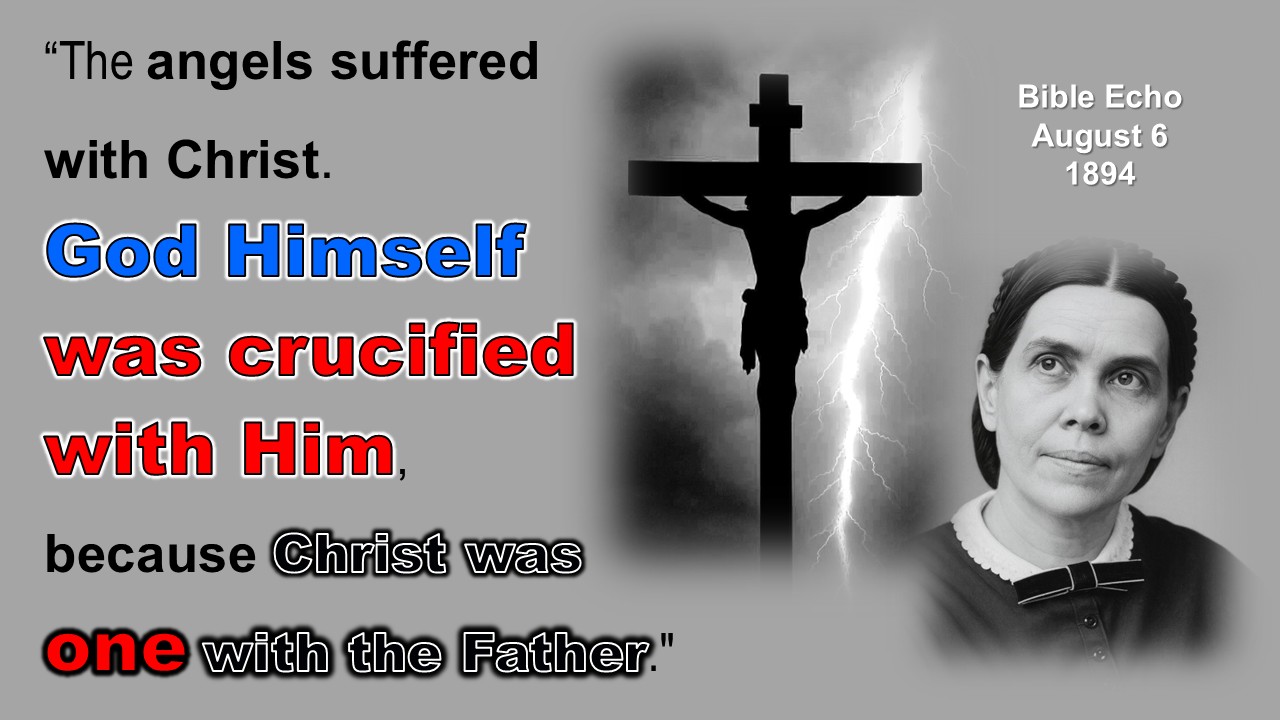
IN JOSEPH’S TOMB (Chapter 80)
At last Jesus was at rest. The long day of shame and torture was ended. As the last rays of the setting sun ushered in the Sabbath, the Son of God lay in quietude in Joseph’s tomb. His work completed, His hands folded in peace, He rested through the sacred hours of the Sabbath day.
The priests and rulers were amazed to find that Christ was dead. Death by the cross was a lingering process. It was an unheard-of thing for one to die within six hours of crucifixion. The priests wished to make sure of the death of Jesus, and at their suggestion a soldier thrust a spear into the Saviour’s side. From the wound thus made, there flowed two copious and distinct streams, one of blood, the other of water.
But it was not the spear thrust, it was not the pain of the cross, that caused the death of Jesus. That cry, uttered “with a loud voice” (Matthew 27:50; Luke 23:46), at the moment of death, the stream of blood and water that flowed from His side, declared that He died of a broken heart. His heart was broken by mental anguish. He was slain by the sin of the world.
Gently and reverently they (Joseph and Nicodemus) removed with their own hands the body of Jesus from the cross. Their tears of sympathy fell fast as they looked upon His bruised and lacerated form.
Joseph owned a new tomb, hewn in a rock. This he was reserving for himself; but it was near Calvary, and he now prepared it for Jesus. The body, together with the spices brought by Nicodemus, was carefully wrapped in a linen sheet, and the Redeemer was borne to the tomb. There the three disciples straightened the mangled limbs, and folded the bruised hands upon the pulseless breast.
The Galilean women came to see that all had been done that could be done for the lifeless form of their beloved Teacher. Then they saw the heavy stone rolled against the entrance of the tomb, and the Saviour was left at rest.
The women were last at the cross, and last at the tomb of Christ. While the evening shades were gathering, Mary Magdalene and the other Marys lingered about the resting place of their Lord, shedding tears of sorrow over the fate of Him whom they loved. “And they returned, … and rested the Sabbath day according to the commandment.” Luke 23:56.
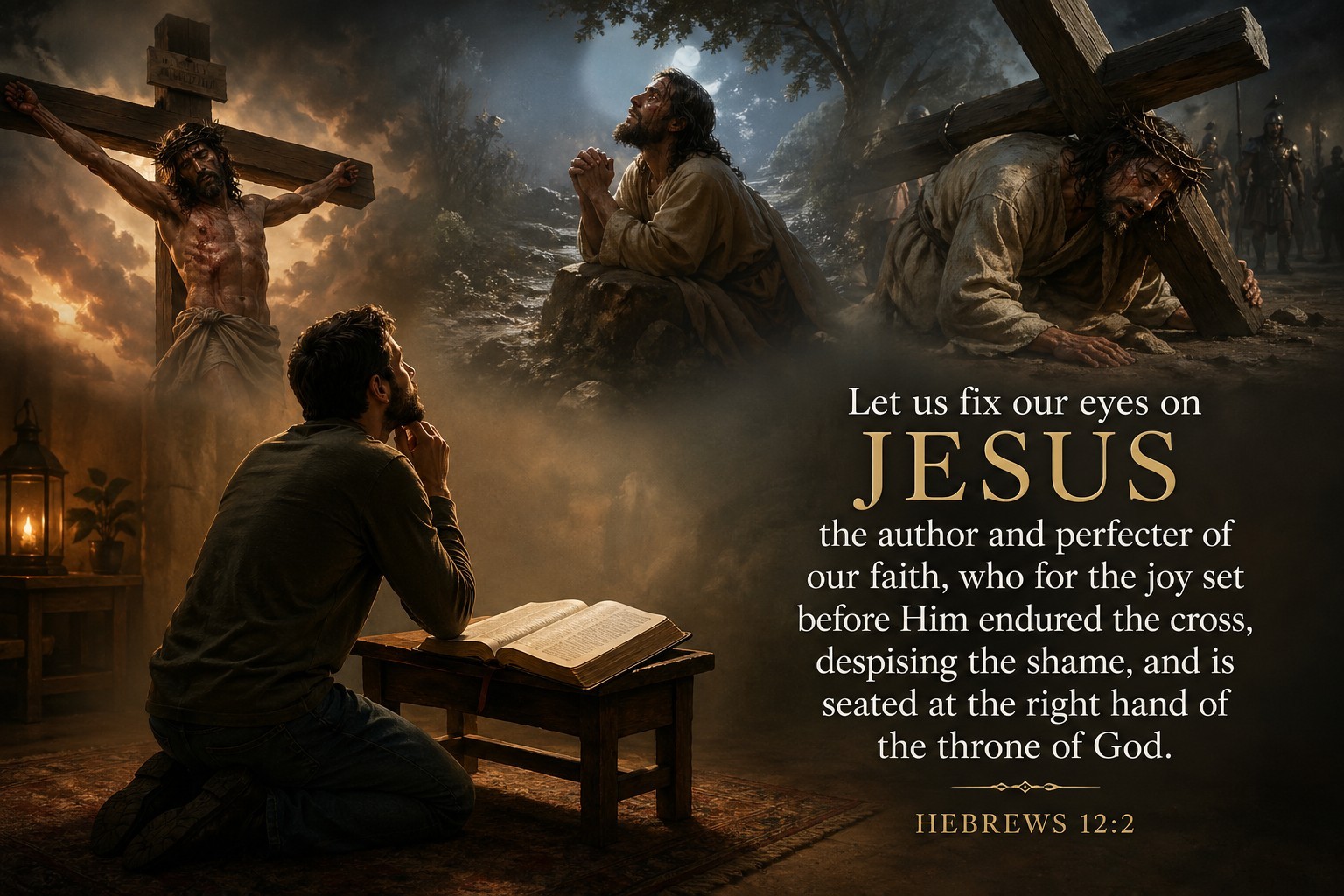
QUOTES FROM OTHER BOOKS
“It was not bodily suffering which so quickly ended the life of Christ upon the cross… The fierce temptation that His own Father had forever left Him caused that piercing cry from the cross: ’My God, my God, Why have you forsaken me?’”
“The power of God was manifest in the suffering of His Son. The skin was torn from His back, and the blood flowed down.” Manuscript 101, 1897
“The Savior was not only mocked and insulted, but he was most cruelly scourged. His body was one mass of wounds and bruises.” The Youth’s Instructor, June 1, 1899
“He felt that by sin He was being separated from His Father. The gulf was so broad, so black, so deep, that His spirit shuddered before it. . . It was not the spear-thrust, it was not the pain of the cross, that caused the death of Jesus.” Youth’s Instructor, August 24, 1899
“It was not bodily suffering which so quickly ended the life of Christ upon the cross… The fierce temptation that His own Father had forever left Him caused that piercing cry from the cross: ‘My God, my God, why hast thou forsaken me?’” — God’s Amazing Grace, p. 170.
“The sacrifice of Christ as an atonement for sin is the great truth around which all other truths cluster. In order to be rightly understood and appreciated, every truth in the Word of God must be studied in the light that streams from the cross of Calvary.” — Gospel Workers, p. 315.
“To Paul the cross was the one object of supreme interest. Ever since he had been arrested in his career of persecution against the followers of the crucified Nazarene he had never ceased to glory in the cross.” — Lift Him Up, p. 246.
The multitude were clamorous for the blood of Jesus. They cruelly scourged Him, and put upon Him an old purple kingly robe, and bound His sacred head with a crown of thorns. They put a reed into His hand, and bowed to Him, and mockingly saluted Him, “Hail, king of the Jews!” They then took the reed from His hand and smote Him with it upon the head, causing the thorns to penetrate His temples, sending the blood trickling down His face and beard. Jesus stood meek and humble before the infuriated multitude, while they offered Him the vilest abuse. They spit in His face—that face from which they will one day desire to hide, which will give light to the city of God and shine brighter than the sun. Christ did not cast upon the offenders an angry look. They covered His head with an old garment, blindfolding Him, and then struck Him in the face and cried out, ‘Prophesy, who is it that smote Thee’?” Early Writings, Trial of Christ
“The angels suffered with Christ. God Himself was crucified with Him, because Christ was one with the Father.” (The Bible Echo, August 6, 1894).
“Pride and self-esteem cannot flourish in the hearts that keep fresh in memory the scenes of Calvary. This world will appear of but little value to those who appreciate the great price of man’s redemption, the precious blood of God’s dear Son.” — Lift Him Up, p. 43.
“All the riches of the world are not of sufficient value to redeem one perishing soul. Who can measure the love Christ felt for a lost world as he hung upon the cross, suffering for the sins of guilty men? This love was immeasurable, infinite.” — Lift Him Up, p. 43.
“The revelation of God’s love to man centers in the cross. Its full significance tongue cannot utter; pen cannot portray; the mind of man cannot comprehend. . .” God’s Amazing Grace, p. 178.
“We do not expect rest here. No, no. The way to heaven is a cross-bearing way … We will not complain… We will rejoice in tribulation and keep in mind the recompense of reward, the ‘far more exceeding and eternal weight of glory’. I crave the suffering part. I would not go to heaven without suffering if I could, and see Jesus who suffered so much for us to purchase for us so rich an inheritance; and to see the martyrs who laid down their lives for the truth, and the sake of Jesus. No, no. Let me be perfected through sufferings. I long to be a partaker with Christ of His sufferings, for if I am, I know I shall be a partaker with Him of His glory. Oh, for to be wholly consecrated to Him! Oh, how hard it is for dear self to die… I long to see the King in His beauty, Him whom my soul loveth.” — Reflecting Christ, p. 350.
ADDITIONAL DETAILS ABOUT CHRIST’S SUFFERINGS & DEATH
YEAR OF CHRIST’S DEATH – 31 AD
According to Seventh-day Adventist (SDA) theology, historians, and specifically Ellen G. White, Jesus died in the spring of 31 AD. This date is considered the “central keystone” of the Adventist prophetic interpretation of Daniel 9.
Adventist theology is built on the interpretation that the “70 weeks” prophecy of Daniel 9:24-27 began in 457 B.C. and concluded in 34 A.D. In this framework, the “midst of the week” (3.5 years into the final 7-year period) represents the crucifixion.
In her writings, particularly in the Desire of Ages and Looking Unto Jesus, Ellen White confirms that Jesus’ ministry lasted 3.5 years, starting in 27 AD and ending in 31 AD. She specifically states that this date aligns with the prophecies that the Messiah would be “cut off” in the middle of the final week, ending the sacrificial system.
Adventist theology maintains that if this 31 AD date (“the central keystone”) falls, the entire 2300-day prophecy of Daniel 8:14, which leads to 1844 and the investigative judgment, collapses.
While Adventist scholars defend 31 AD, the broader academic consensus tends to favor 33 AD, due to different interpretations of the exact date of Herod’s death and the timing of Passover during the governorship of Pontius Pilate.
31 AD is the only year that perfectly satisfies the mathematical requirements of the 2,300-day and 70-week prophecies.
Alfred Palla uses historical markers, such as the 15th year of Tiberius Caesar (27 AD) for Christ’s baptism, to anchor the timeline that leads to a 31 AD crucifixion rather than the 33 AD date favoured by many non-Adventist scholars.
“The seventy weeks, or 490 years, were to be cut off from the 2300 days. . . These two periods were to begin together, and A.D. 31 is the central point of that calculation.” The Great Controversy, p. 326
DAY & MONTH OF CHRIST’S DEATH – 27 APRIL (FRIDAY)
Most scholars and astronomers point to Friday, April 3, 33 AD, as the most probable date because it aligns with a Friday Passover and a recorded lunar eclipse. Adventists argue that 3rd March would be way too early for Passover, which always occurs in the Jewish month of Nisan (usually late March or April).
Below are examples of Passover Dates for 2026–2030
2026: Sunset, April 1 – Nightfall, April 9
2027: Sunset, April 21 – Nightfall, April 29
2028: Sunset, April 10 – Nightfall, April 18
2029: Sunset, March 30 – Nightfall, April 7
2030: Sunset, April 17 – Nightfall, April 25
Most traditional Adventist sources, following the calculations of pioneer Samuel Snow, pinpoint 27th April 31 AD as the Julian date for the crucifixion.
This date is chosen because it fits the “midst of the week” requirement in Daniel 9:27. Adventists believe Jesus’ 3.5-year ministry began in the autumn of 27 AD and ended in the spring of 31 AD.
HOUR OF CHRIST’S DEATH – 3 PM (FRIDAY)
Jesus died on the day of the Passover (14th of Nisan), becoming the true Paschal Lamb. He ate the Passover supper with His disciples on Thursday evening, and then was crucified and died on Friday afternoon — the day of Preparation— which was the same time the Passover lambs were being sacrificed in the Temple.
The Passover lambs were sacrificed on Friday afternoon at around 3 PM before sunset (sunset took place at around 5.20 PM), before the Sabbath began.
Jesus was nailed to the cross at around 9 AM on Friday (the third hour). When darkness fell over the land, this was roughly 12:00 PM (noon). The darkness that lasted from noon to 3 PM was not a normal solar eclipse (Passover occurs during a full moon, when solar eclipse couldn’t happen). The Gospels present it as a supernatural event.
In the Gospels (Matthew, Mark, and Luke), it is recorded that Jesus died at the “ninth hour” (approximately 3:00 PM), at the same time the Passover lamb was offered.
“When the loud cry, ‘It is finished,’ came from the lips of Christ, … it was the hour of the evening sacrifice. The lamb representing Christ had been brought to be slain.” Desire of Ages, end of chapter 78.
Christ was on the cross for only about six hours because due to unimaginable suffering caused especially by the horrible feeling of being separated from the love of His Father as a result of being made sin and curse for us (2 Cor 5:21; Gal 3:13), He died out of the broken heart.
The Jews wanted to make sure all three crucified men died and were buried before the Sabbath began (before sunset). On that specific day in Jerusalem, the estimated Sunset was at 5:24 PM. This explains the urgency of the burials described in the text, as all work had to be completed before the sun went down.
2000TH ANNIVERSARY OF CHRIST’S DEATH – 27TH APRIL 2031, AT 3 PM
Jesus died at 3 PM on the 27th of April, 31 AD. Therefore, at 3 PM on the 27th of April 2031, it will be 2000 years since His death.
END OF 6000 YEARS OF WORLD’S HISTORY UNDER SIN
Christ started His 3.5 year ministry in autumn 27 AD immediately after His baptism. Since He died on 27th April 31 AD, then 3.5 years earlier would be 27th October 27 AD (or the end of October 27 AD) was the approximate time He was baptised, started His ministry, and announced the end of the final jubilee of the OT 4000 years era (Luke 4:18).
Therefore, the end of October 2027 is the date of the end of 6000 years of World’s history under sin!

CHRIST CARRIED THE CROSSBAR, NOT THE FULL CROSS
From a strictly historical and archaeological standpoint, it was nearly impossible and highly unusual for a victim to carry a full, assembled cross as it could weigh over 300 lbs (136 kg). The horizontal crossbar alone weighed between 75 and 125 lbs (34–57 kg). Historical records (such as those by Plautus and Dionysius of Halicarnassus) indicate that the upright posts (stipes) were often permanently fixed at execution sites like Golgotha. The condemned person would carry only the crossbar to the site, where they were then hoisted onto the waiting post.
Having endured the Roman flagrum (which often exposed muscle and bone), a human being would be physically incapable of dragging 300 lbs (136 kg) for hundreds of yards.
DID CHRIST FALL THREE TIMES CARRYING THE CROSS?
The evidence for Christ fainting three times on the way to the cross is found in the writings of Ellen G. White, rather than the canonical Gospels.
“He was weak and faint from weariness, pain, and loss of blood by the scourging and blows which He had received; yet the heavy cross upon which He was soon to be nailed was laid upon Him. Jesus fainted beneath the burden. Three times the cross was placed upon His shoulders, and three times He fainted.” Early Writings, p. 176
The canonical Gospels (Matthew, Mark, Luke, and John) do not record Christ collapsing or fainting on the way to the cross. They focus on the physical exhaustion and the immediate impressment of Simon of Cyrene to carry the cross.
Matthew 27:32: “And as they came out, they found a man of Cyrene, Simon by name: him they compelled to bear his cross.”
Mark 15:21: “And they compel one Simon a Cyrenian, who passed by, coming out of the country, the father of Alexander and Rufus, to bear his cross.”
Luke 23:26: “And as they led him away, they laid hold upon one Simon, a Cyrenian, coming out of the country, and on him they laid the cross, that he might bear it after Jesus.”
John 19:17: “And he bearing his cross went forth into a place called the place of a skull, which is called in the Hebrew Golgotha.”
WAS JESUS IN THE GRAVE 3 DAYS AND NIGHTS?
Matthew 12:40 “For as Jonah was three days and three nights in the belly of the great fish, so will the Son of Man be three days and three nights in the heart of the earth.”
Three days and three nights in Jewish reckoning is inclusive, meaning no more than three days or the combination of any part of three separate days.
Jesus was raised “in three days” although he was buried Friday afternoon and resurrected Sunday morning (i.e., part of Friday is day one, all of Saturday is day two, and part of Sunday is day three).
Jews counted parts of days as full days:
Jesus died on Friday before the sunset (1 day)
He was dead on Friday night (1st night)
Dead on Saturday (2nd day)
Dead on Saturday night (2nd night)
Resurrected on Sunday morning (so he was still dead for the part of Sunday morning – 3rd day)
What we lack is the 3rd night but in Jewish culture they treated parts of days as full days (days and nights)
In addition, on Friday there was total darkness when Jesus felt like in a grave and therefore it could be counted as night in the grave too (and regarded as the 3rd night)!
Also “three days and nights” was known as an idiomatic expression and therefore it cannot be taken literally. We find a similar usage in the Old Testament. In first-century Jewish thought, any part of a day, no matter how small, was counted as a full day and a full night. This idiom is used throughout the Old Testament and in rabbinic literature. This way of speaking wasn’t unique to Jesus; it was a common cultural expression. This is the same principle as before, but applied to the entire phrase “days and nights.” In Jewish thought, the phrase “three days and three nights” was an idiom that simply meant “a period of three days” (which, by definition, includes nights). It wasn’t meant to be a literal, hour-by-hour count.
“The heart of the earth” in Matthew 12:40 is not just a reference to the physical tomb, but to the realm of the second death. Jesus’ experienced the curse and darkness (night) of the second death, and three nights refer to the fact that the Three Persons of the Godhead experienced the same spiritual night.
WEDNESDAY CRUCIFIXION THEORY
If Jesus was crucified on Wednesday afternoon and buried just before sunset, a literal “three days and three nights” would place His resurrection on Saturday evening, just after the Sabbath ended.
This timeline creates significant problems with the Gospel narratives. Most notably, the bible states that Jesus was crucified and died on Passover day (Friday and not Wednesday), and Mark 15:42 and Luke 23:54 explicitly state the burial took place on the “Preparation Day,” which is the day before the Sabbath.
RELATED ARTICLE: God’s Love in the Cross of Christ