Slawomir Gromadzki
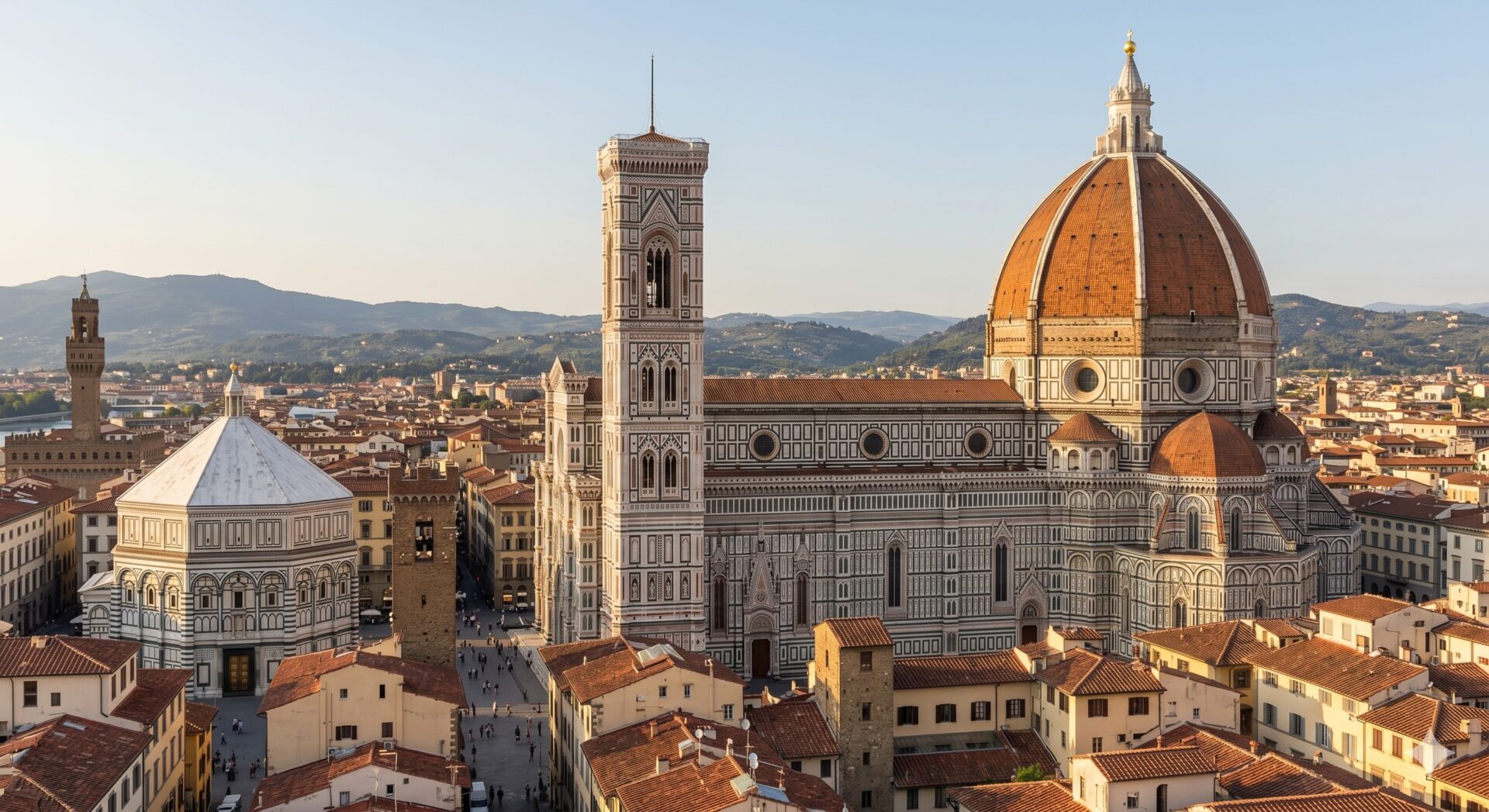
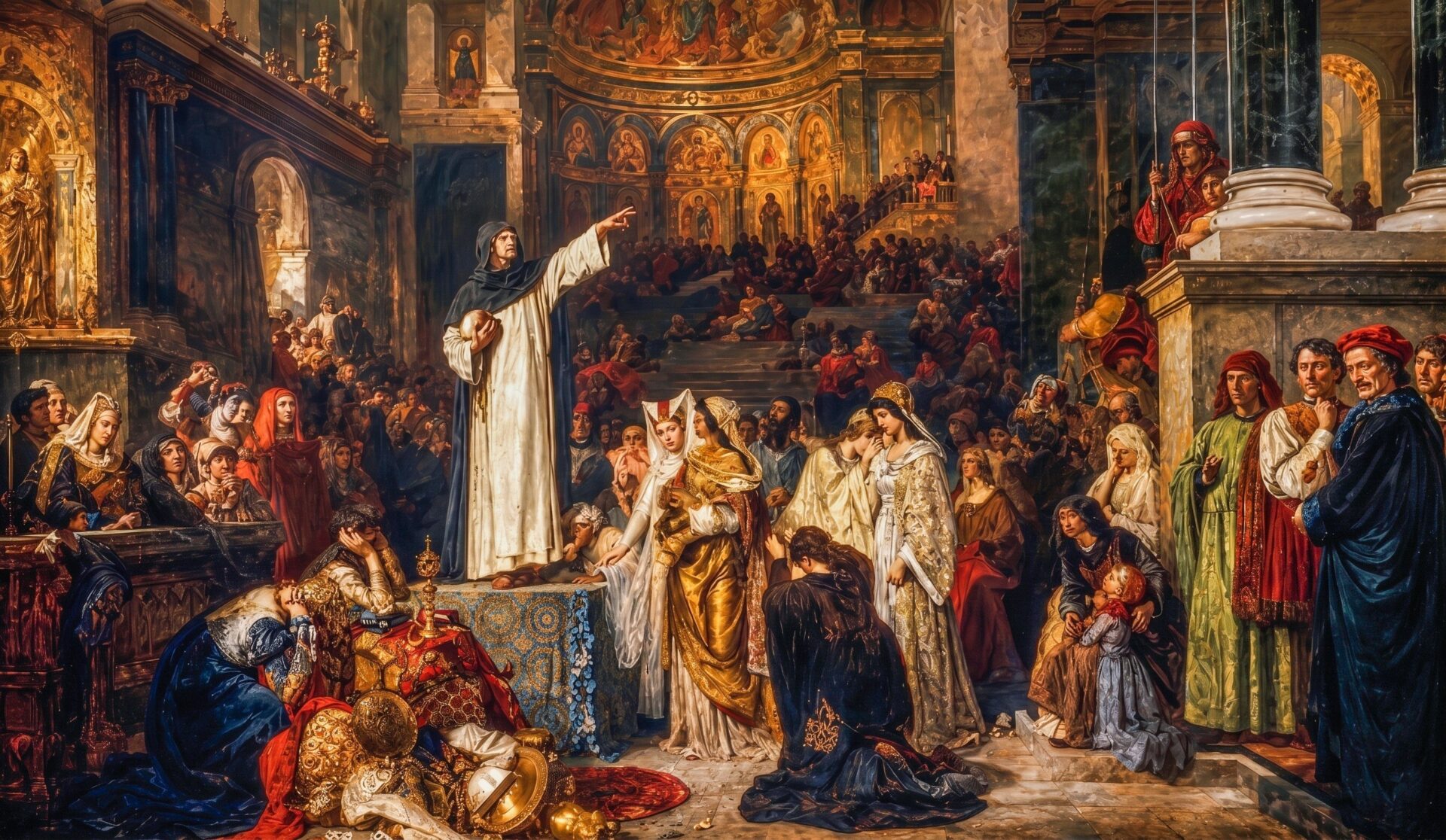
Step back into the winter of 1495. Imagine standing within the cavernous, cold stone walls of the Cathedral of Santa Maria del Fiore in Florence. The air is heavy, thick with the breath of fifteen thousand human beings packed shoulder-to-shoulder. Nobles in velvet tunics press hard against beggars in rags. The wealthy, the intellectuals, the very artists who painted the masterpieces of the High Renaissance—all are crammed into the dim light of the nave, waiting in a strained, absolute silence.
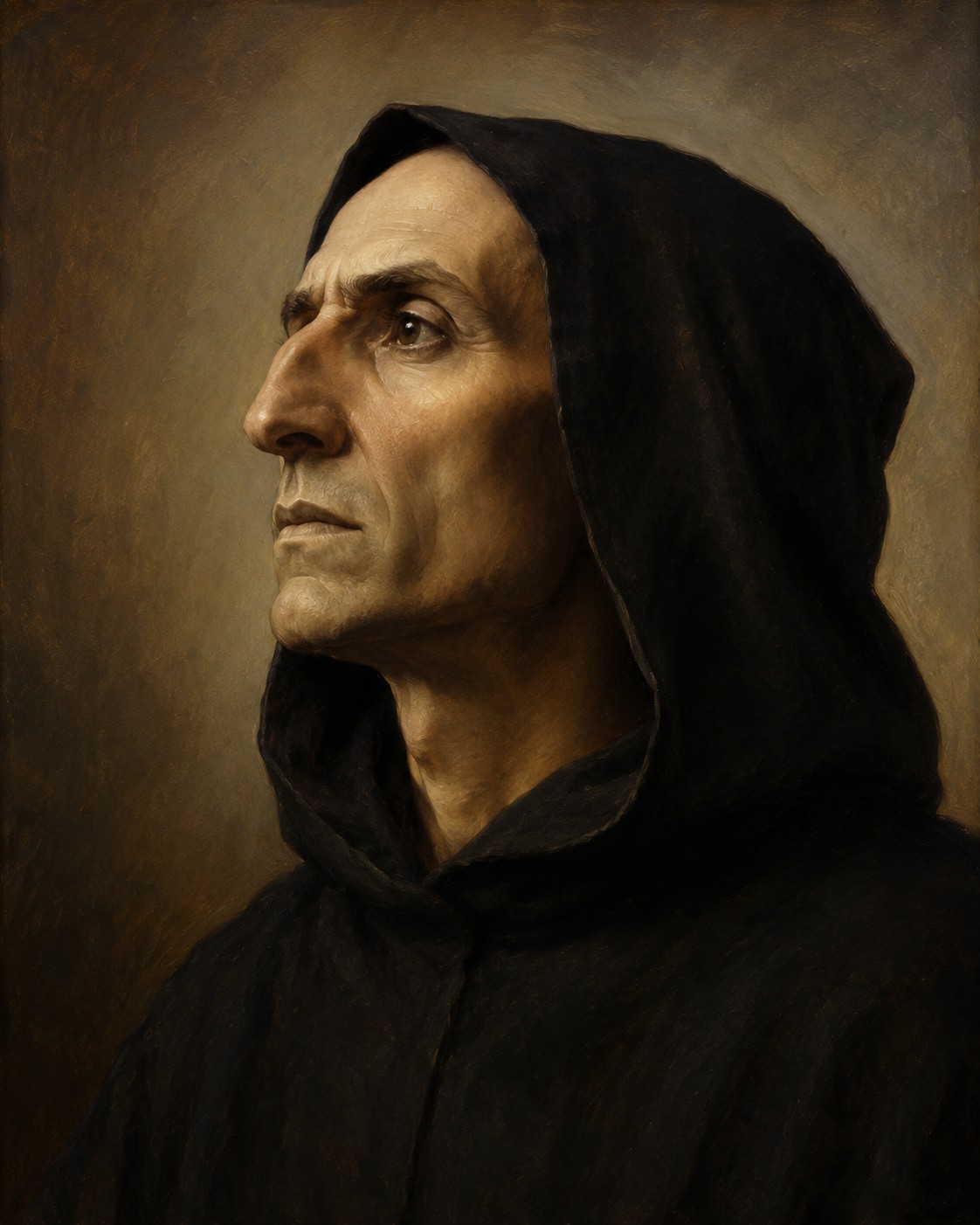
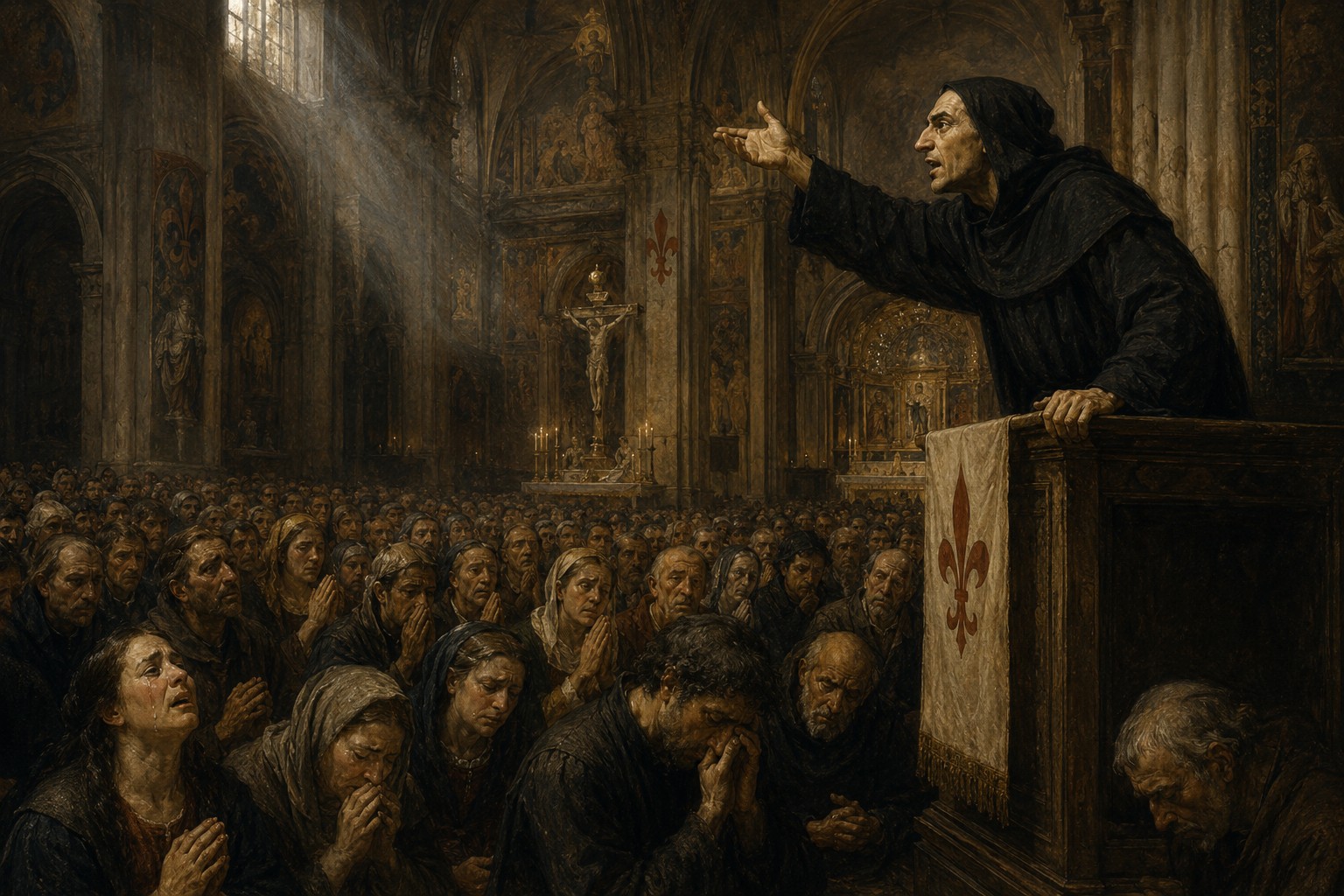
Suddenly, a figure ascends the pulpit. He is a small, frail Dominican friar with deep-set, piercing eyes and a hawk-like nose. His black-and-white habit looks stark against the cathedral stone. This is Fra Girolamo Savonarola.
Born in Ferrara on September 21, 1452, Savonarola had abandoned his medical studies as a young man. He was utterly sickened by the moral decay, greed, and spiritual emptiness of Italian society. Choosing the life of a poor monk, he carried nothing but his Bible.
The Cry of the Prophet
Savonarola does not preach to entertain. He preaches to shatter. In a world drunk on luxury, political corruption, and spiritual indifference, his words pierce straight through to the bone. He looks out over the sea of faces and delivers a devastating warning:
“Weep, I say, for your failings and your sins. I tell you that the time to weep is coming rather than the time to sing and feast, because God will punish you if you do not change your life and habits.”
He turns his gaze toward the corruption eroding the heart of the Church, directly confronting leaders who traded holiness for gold:
“In the primitive church the chalices were of wood and the prelates were of gold; in these days the church has chalices of gold and prelates of wood!” In the old days, the church tools were cheap, but the leaders were holy. Today, the church tools are expensive, but the leaders are worthless.
The crowd listens, transfixed. The atmosphere grows heavy with conviction. Savonarola spares no one—not the politicians, not the priests, and certainly not the citizens who let vanity rule their homes. He begs mothers to cast away their extravagant ornaments, demanding that the city look squarely at its own hidden rot.
“Cry My Heart, Cry My Eyes”
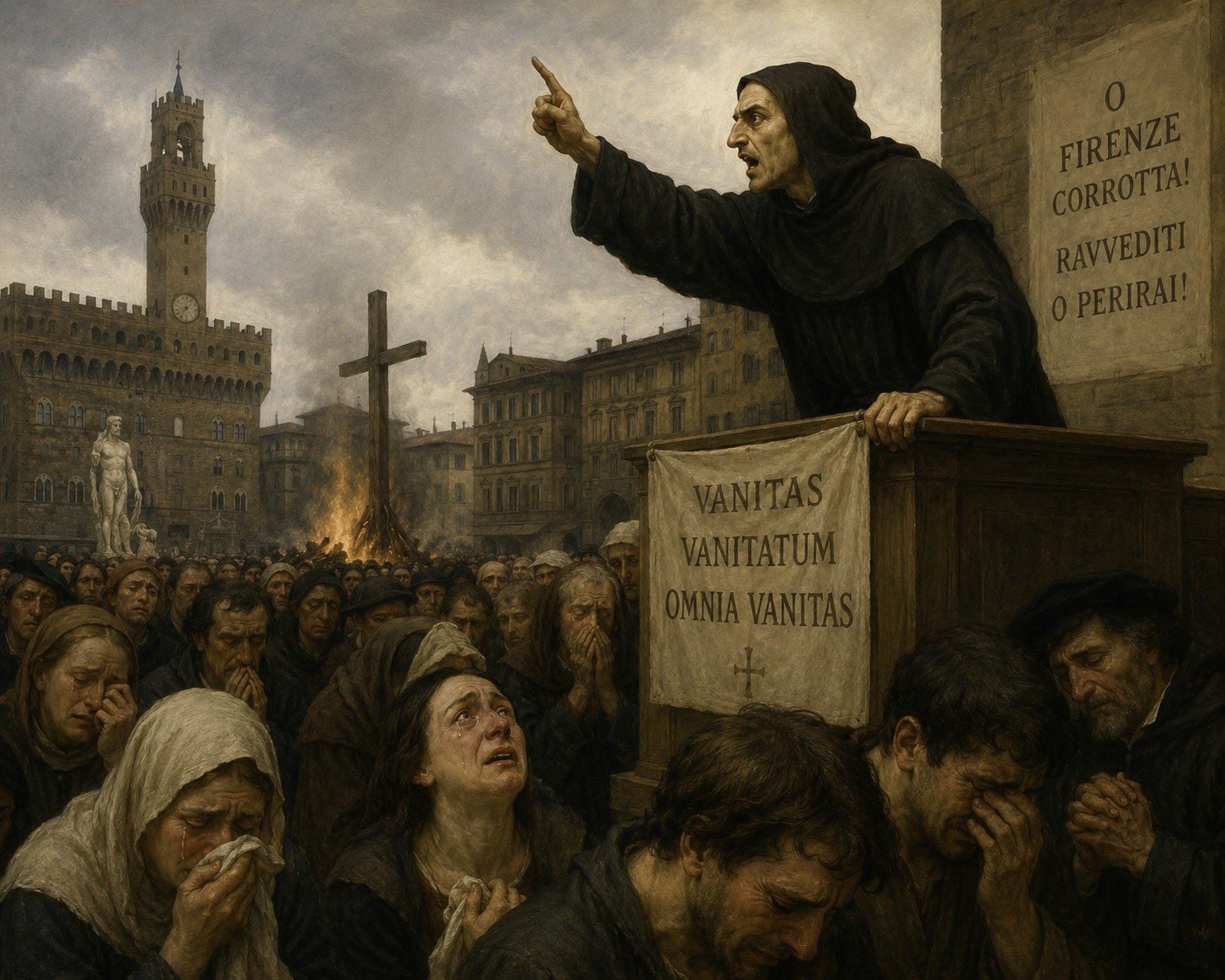
As the sermon reaches its peak, the physical frailty of the monk vanishes. Consumed by a holy fire, he pleads with his listeners to realize the sheer weight of their rebellion against God, pointing them to the boundless mercy waiting if they will only turn back. He addresses the very anatomy of the human spirit, begging the heart to break, the eyes to overflow, and the entire congregation to mourn.
“O human heart,” his voice echoes through the rafters, “why do you not dissolve and melt? Your sins, then, O Italy, O Rome, O Florence, your impieties, your fornications, your cruelties, your sins, I say, beget these tribulations. Here is the cause!”
The rhetoric becomes a cascading lament: Cry my heart, cry my eyes, let all the people cry. He begs the audience to stop bargaining with their salvation: “O sinners, stubborn, lukewarm, all who defer repentance to the last… do penance; do it now; do not delay any longer, for the Lord now awaits you and thus He calls you. Come, sinner, come, for God calls you. I feel great grief and great compassion for you…”
The Rushing Wave of Repentance
What followed on those Florentine mornings was unlike anything seen before or since. Under the weight of Savonarola’s words, the sophisticated pride of Florence completely dissolved.
The silence of the cathedral broke into a wave of audible groans and weeping. Eyewitnesses recorded that the entire congregation would regularly erupt into tears. Hardened men sobbed openly into their hands. Wealthy women tore the pearls from their hair. The collective weeping of thousands of people echoed out of the church doors and filled the streets outside.
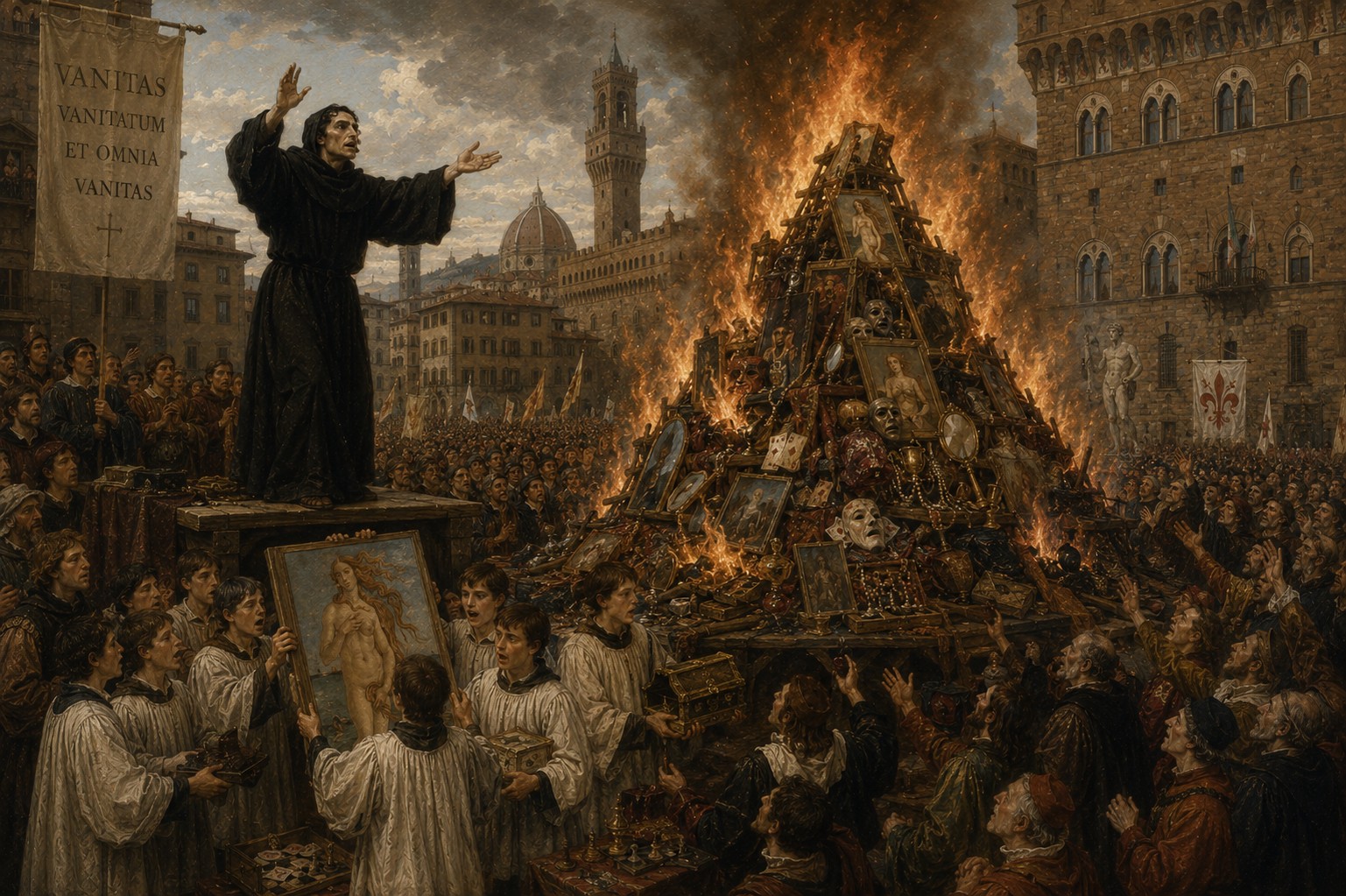
This was not a passing emotional high; it changed the fabric of the city. People walked out of those sermons and immediately mended their lives. They paid back stolen debts. They flooded the streets to feed the hungry instead of joining the carnivals. In the center of the Piazza della Signoria, they erected the famous “Bonfires of the Vanities,” voluntarily tossing masks, lewd books, expensive cosmetics, and gambling dice into the flames, choosing Christ over fleeting pleasures.
The Fury of Rome and the Ultimate Sacrifice
But speaking raw truth to power always triggers a fierce backlash from those who profit off the dark. Savonarola’s fiercest battle was not with the common people, but with the compromised religious elite of his day.
His open exposures of systemic sin reached the ears of the notorious Borgia Pope, Alexander VI. The papal court, deeply stained by political assassinations, greed, and scandalous private lives, wanted the troublesome monk silenced at all costs. Local priests and powerful prelates who hated Savonarola for exposing their hypocrisy joined the attack. When the Pope tried to muzzle him with a bribe—offering him the red hat of a cardinal—Savonarola fiercely refused from the pulpit, declaring he would accept no hat but a crown of martyrdom crimsoned with his own blood.
Losing control, an enraged Rome turned to excommunication, political threats, and manipulation. Papal commissioners were dispatched directly from Rome with a pre-determined verdict already in hand.
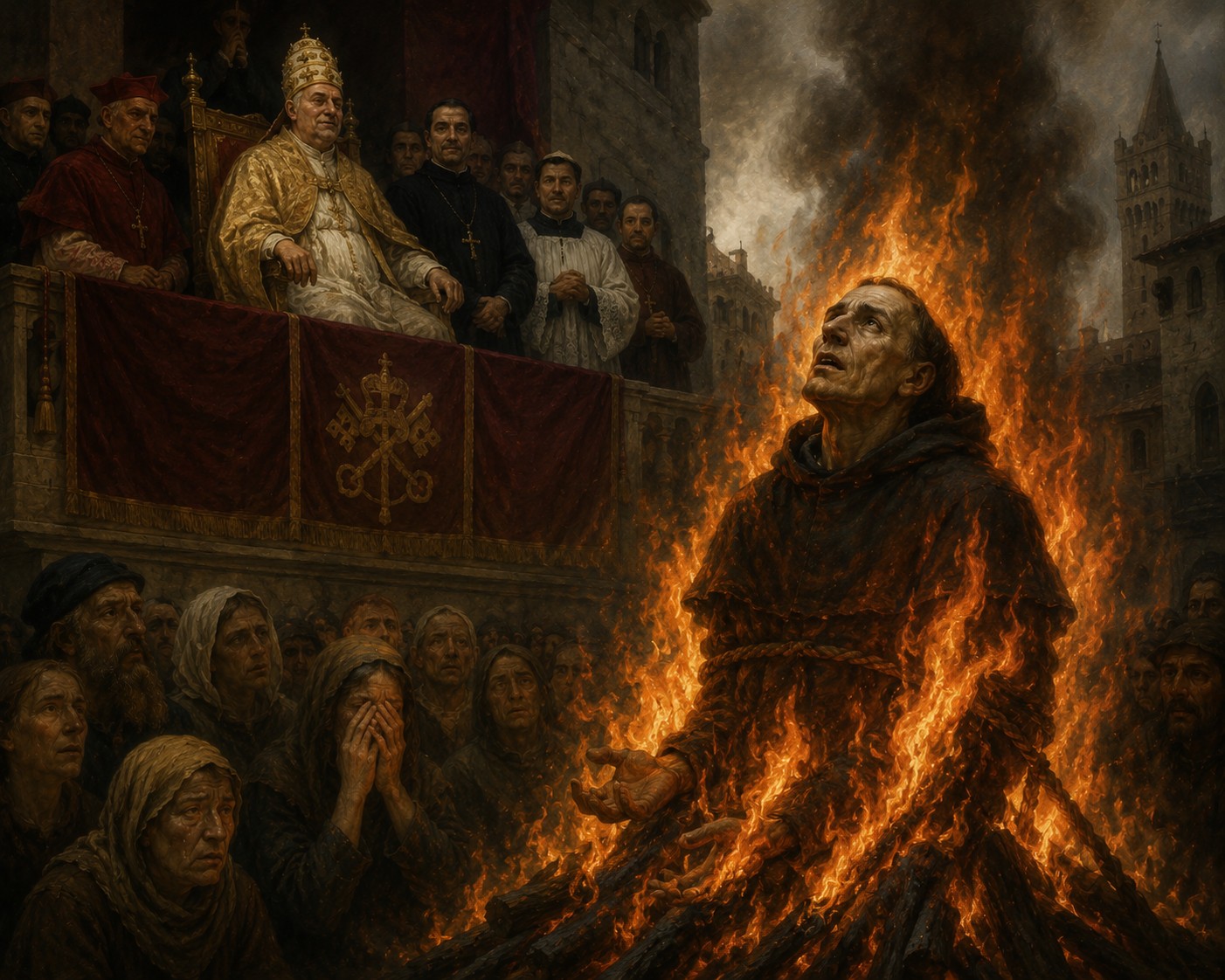
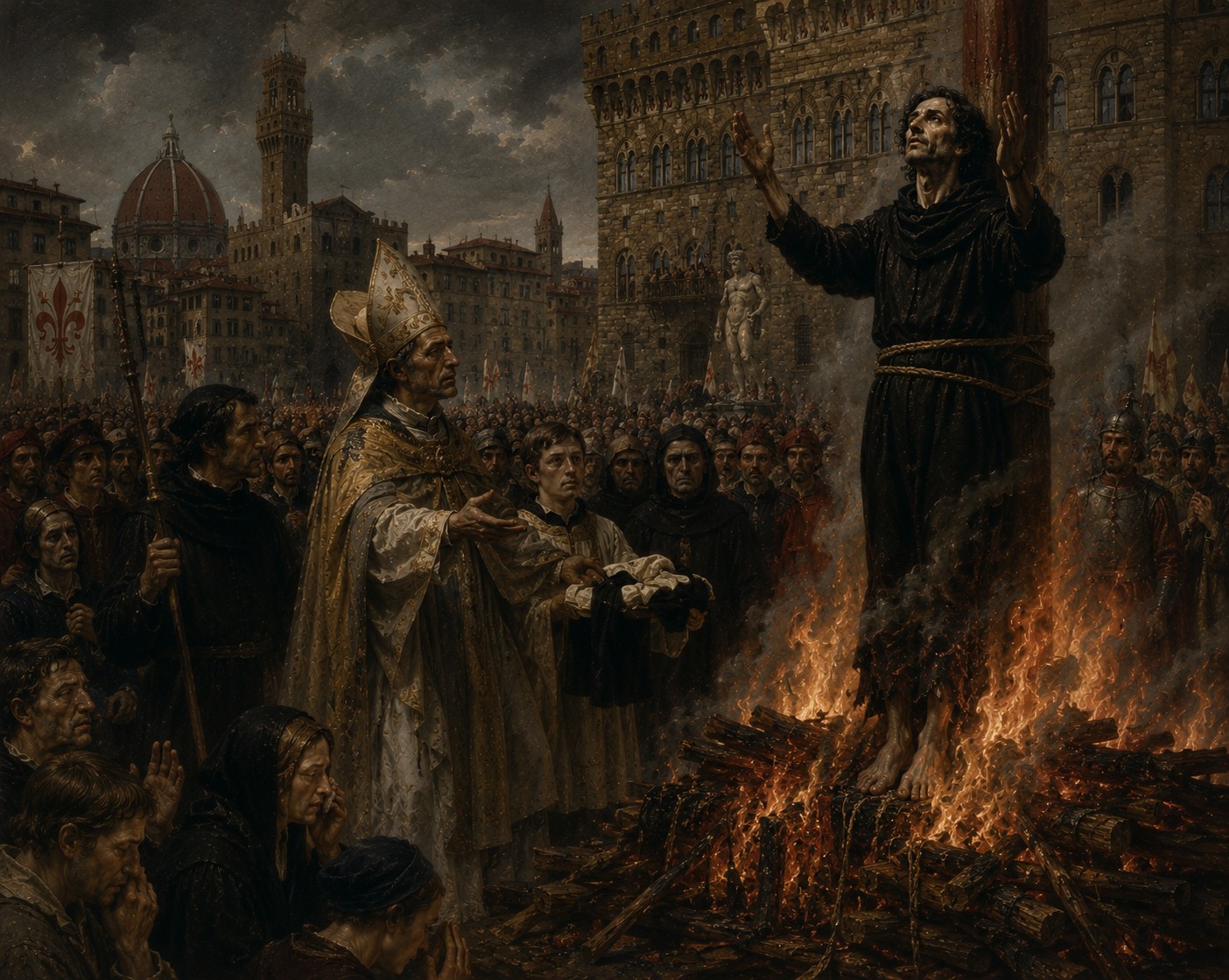
On May 23, 1498, after weeks of brutal interrogation and torture, Savonarola and two of his closest companion friars were led out into the very same square where the bonfires of repentance had once burned. Before a mocking crowd of political enemies, local priests, and corrupted officials, the forty-five-year-old preacher was defrocked, tied to a beam, and hanged. Beneath his body, a raging pyre was lit to consume what remained.
Yet, as the fierce flames engulfed him, a final wonder occurred. The intense heat caused the muscles in his right arm to contract and raise up, leaving his two fingers extended—appearing, even in death, to bless the very people who took his life. His ashes were immediately gathered and cast into the River Arno to prevent anyone from preserving his memory.
The Question for Us Today
They burned the prophet, but they could never burn the truth. The thunder of Savonarola’s message echoes across five centuries straight into our modern lives.
We live in a world flooded with distractions, chasing after luxury and pleasures, and constantly numbing our hearts to spiritual realities. We look for peace in everything except the one source that can actually grant it. Savonarola’s ancient plea breaks through our modern noise today:
“O foolish men, who by sinning are willing to lose so much peace and rest… return to God and you will find complete rest; repent your errors; confess; make strong your intention never to sin again.”
If Savonarola stood before us today, he would look past our screens, our busy schedules, and our proud accomplishments, and he would ask us the same burning question: When will your heart dissolve? When will your eyes weep for the things that grieve the heart of God?
Do not wait for tomorrow. Do not let your heart remain hardened or lukewarm. Let the tears of repentance clear your vision today, run to the arms of a merciful Father, and find in Jesus the true, unshakable rest that your soul has been crying out for!

Life Experiences
Girolamo Savonarola’s life was a tempestuous drama of fiery passion, immense political power, and tragic betrayal. Beyond his reputation as a stern, uncompromising preacher, his biography is filled with deeply human, touching, and dramatic moments.
1. The Broken Hearted Flight (His Forlorn Youth)
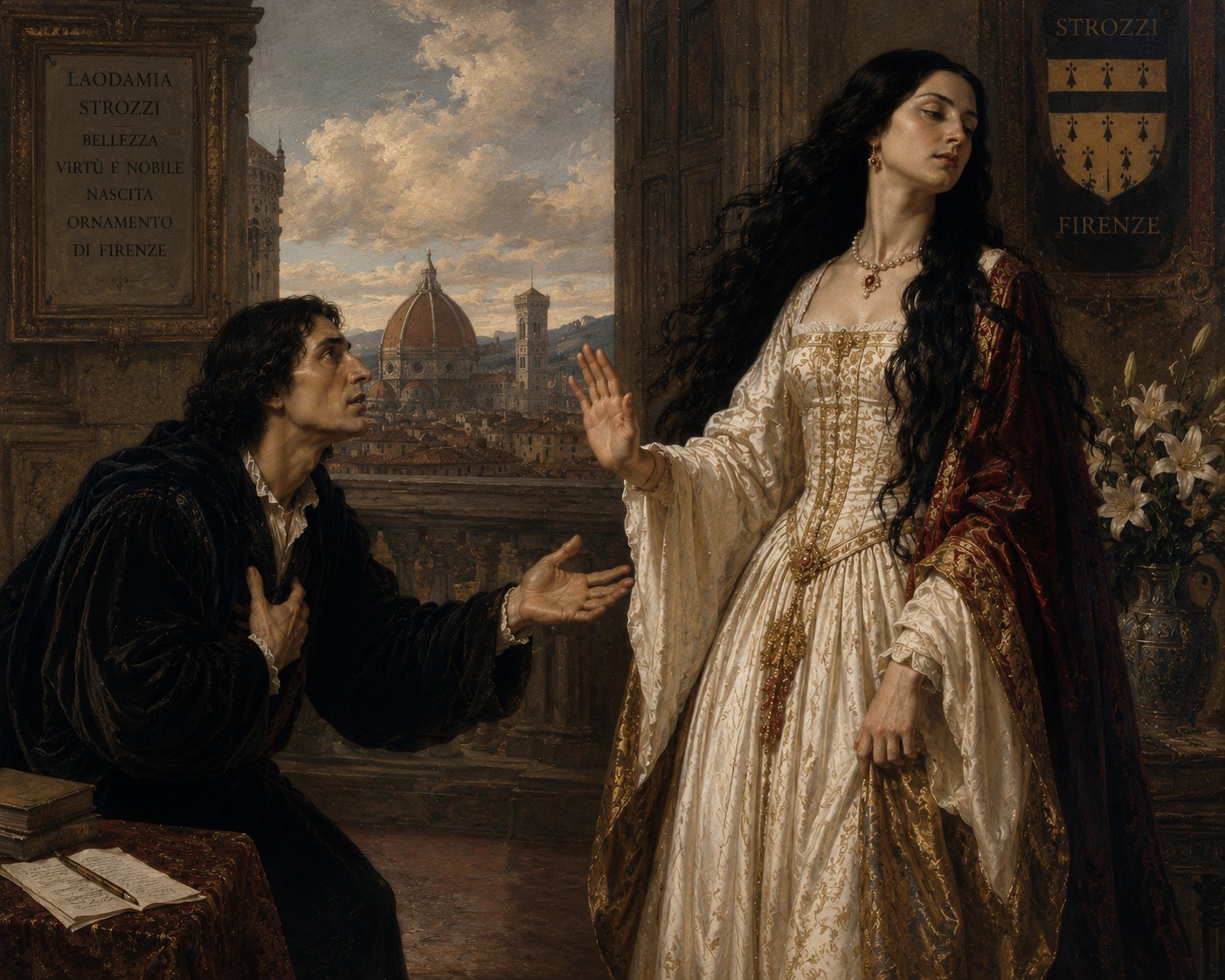
Before he was a monk, Savonarola was a brilliant youth studying medicine, deeply moved by poetry and music. At age 20, he fell passionately in love with Laodamia Strozzi, the daughter of an exiled Florentine noble living near his family in Ferrara. When he finally gathered the courage to hint at his feelings, she rejected him with aristocratic scorn, stating that a Strozzi could never ally with a family of lesser rank.
Crushed and disillusioned by the pride and vanity of the world, he abandoned his secular career. A year later, while his family was away celebrating a festival, he secretly fled his home to join the Dominican Order. He left behind a touching letter to his father, explaining that the misery of the world and the corruption of humanity had become too painful for him to bear, and that he could no longer endure seeing virtue trampled.
2. The Conversion of Florence (The Miracle of Tears)
When Savonarola first preached in Florence in 1482, his delivery was so awkward, his voice so harsh, and his style so dry that his audiences dwindled to barely 25 people. Humiliated, he left the city to preach in rural mountain villages, where he completely transformed his style into one of raw, apocalyptic passion.
When he returned to Florence years later, the change was miraculous. His preaching at the Duomo (the Cathedral of Florence) became so profoundly moving that the entire city was seized by an overwhelming wave of repentance. Hardened criminals wept openly, wealthy merchants voluntarily returned ill-gotten gains to those they had cheated, and enemies embraced in the streets. Because the cathedral could not hold the crowds, people would camp out from midnight onward, shivering in the cold just to secure a spot to hear his voice.
3. The Rejection of Lorenzo the Magnificent
As Savonarola’s influence grew, the ruler of Florence, the immensely wealthy and powerful Lorenzo de’ Medici, grew uneasy. Lorenzo tried to win the monk over with massive donations to his convent, San Marco. Savonarola took the money, put it straight into the poor box, and remarked from the pulpit that a faithful dog does not stop barking in defense of his master just because a bone is thrown to him.
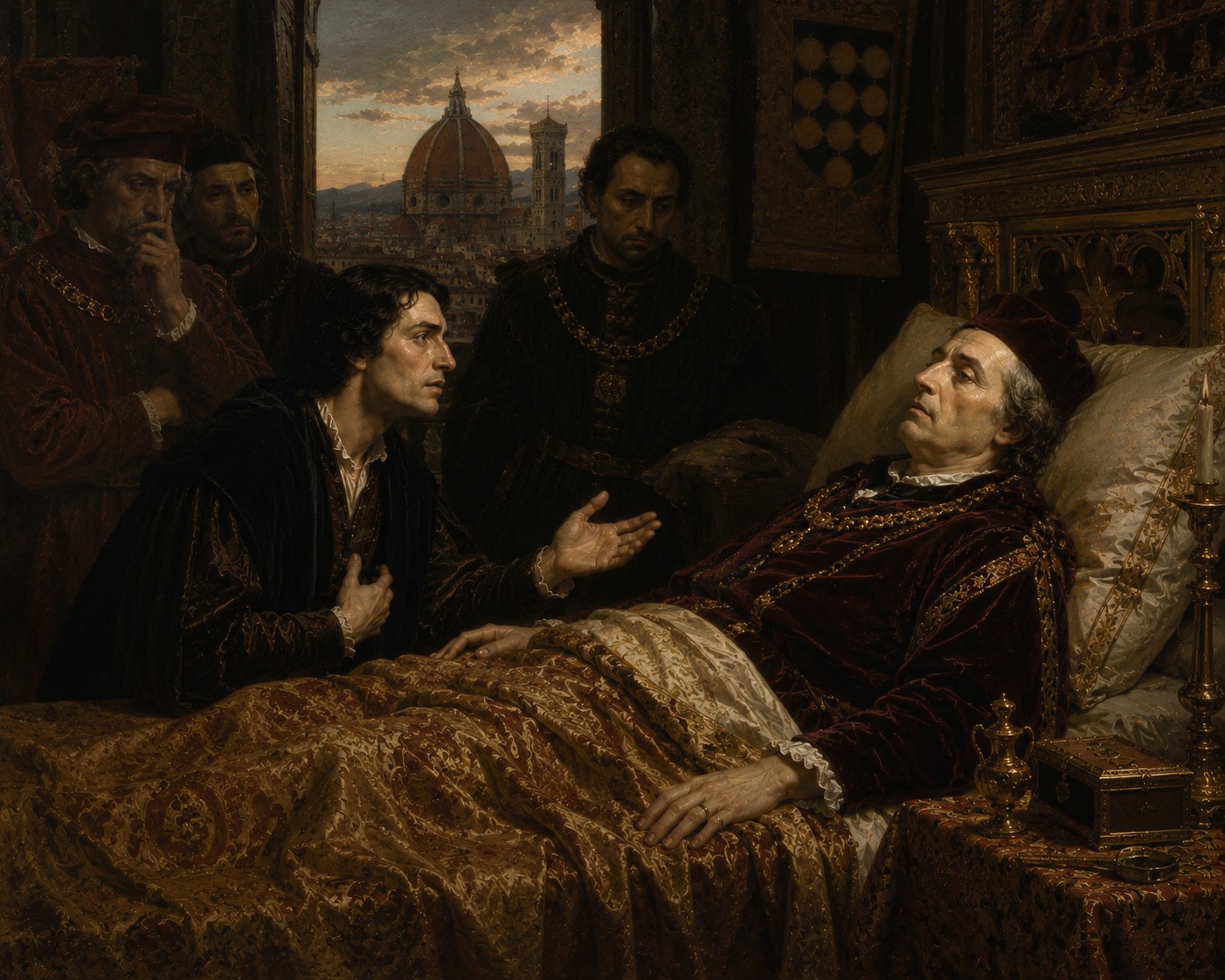
The most dramatic moment between them occurred in 1492 when Lorenzo lay dying at his luxurious villa. Desperate for absolution, Lorenzo sent for Savonarola, the only priest he believed was genuinely uncorrupt. Savonarola stood by the dying ruler’s bedside and offered absolution on three strict conditions:
-
Lorenzo must have a deep and lively faith in God’s mercy. (Lorenzo agreed).
-
Lorenzo must restore his ill-gotten wealth to those he had wronged. (Lorenzo, after a pause, agreed).
-
Lorenzo must restore liberty and republican freedom to the citizens of Florence.
Hearing this final demand, the dying Medici turned his face to the wall in silent refusal. Savonarola walked out without granting absolution, leaving the most powerful man in Renaissance Italy to die alone with his conscience.
4. The “Bonfire of the Vanities” (A City Transformed)
During the Carnival season of 1497, instead of the traditional rowdy, drunken, and often violent celebrations, Savonarola organized a massive, symbolic event. He sent bands of young boys—whom he had organized into a sort of moral police force—door-to-door to collect “vanities.”
On Shrove Tuesday, a massive, pyramid-shaped wooden scaffold was built in the Piazza della Signoria. It was piled high with luxurious carnival masks, expensive cosmetics, mirrors, gambling tables, indecent books, and secular paintings. Great Renaissance artists, deeply moved by Savonarola’s message, voluntarily brought their own masterpieces to throw into the flames. Notably, the famous painter Sandro Botticelli was so touched by Savonarola’s preaching that he allegedly cast several of his own mythological paintings into the fire and entirely changed his artistic focus to sacred subjects for the rest of his life. As the flames erupted, thousands of citizens circled the bonfire, singing hymns of praise.
5. The Tragic Betrayal and the Broken Hand
Savonarola’s downfall was as swift as his rise. Excommunicated by the corrupt Pope Alexander VI and facing a severe famine, the fickle Florentine public turned against him. A hostile mob attacked the Convent of San Marco. Savonarola’s loyal friars fought back desperately with clubs and stones, but Savonarola begged them to stop, saying, “Do not dismantle my work with weapons.”
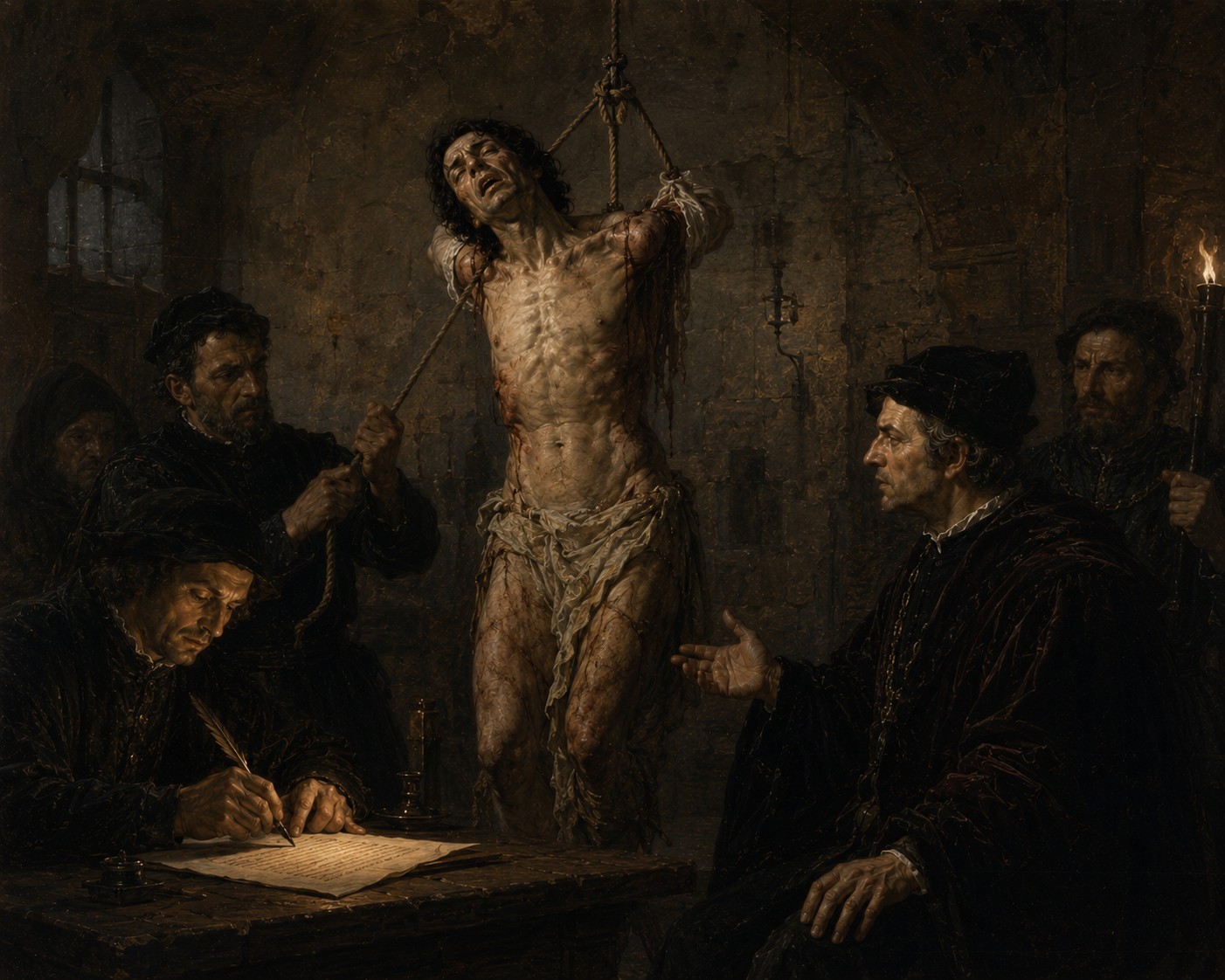
He surrendered to the authorities to prevent further bloodshed. For over a month, he was subjected to horrific torture on the strappado (a rope mechanism that violently dislocated the shoulders). His frail body was broken, but his torturers kept his right arm intact so that he could sign a forced confession.
In the dark, damp cell between torture sessions, using that agonizingly painful right hand, he wrote his final, deeply moving spiritual meditations on Psalms 31 and 51. These writings were so profoundly beautiful and Christ-centered that Martin Luther later discovered them, reprinted them, and praised Savonarola as a martyr for the true gospel.
6. The Final Walk to the Scaffold
On May 23, 1498, Savonarola and two of his closest companion friars were led out to the Piazza della Signoria to be hanged and burned—in the very same spot where the Bonfire of the Vanities had taken place a year earlier.
Before the execution, a bishop officially stripped him of his priestly robes. Shaken by emotion, the bishop misspoke the formula of degradation, declaring: “I separate thee from the Church Militant and from the Church Triumphant.”
Savonarola, standing barefoot, bruised, and bound, looked the bishop calmly in the eye and gently corrected him with his final famous words: “From the Church Militant, yes. But from the Church Triumphant, no. That is not in your power.”
Witnesses recorded that as the flames finally consumed him, his hands, charred by the fire, appeared to be raised above the weeping crowd in a final, silent gesture of blessing over the city that had destroyed him.
Meditations on Psalm 51 & Psalm 31
During his final days in the dark cell of the Palazzo della Signoria, with his body broken by the strappado, Savonarola poured his remaining strength into writing two deeply moving spiritual commentaries: Infelix Ego (“Unhappy am I,” on Psalm 51) and Tristitia Obsedit Me (“Sorrow has beset me,” on Psalm 31).
Here are the most powerful and touching quotes from those final meditations:
From His Meditation on Psalm 51 (Infelix Ego)
“Unhappy am I, destitute of all help, who have offended heaven and earth! Whither shall I go? Whither shall I turn myself? To whom shall I fly? Who will have pity on me? To heaven I dare not lift up my eyes, for I have offended it; on earth I find no refuge, for I have been a scandal to it. What therefore shall I do? Shall I despair? God forbid. God is merciful, my Saviour is compassionate.”
“Fear has cast up an army against me, and has surrounded my heart, and has besieged it with engines of war, and day and night ceases not to fight against me… But I will not despair; I will return to the Lord, and I will say to Him: Have mercy upon me, O God, according to Thy great mercy.”
“Cleanse me, O Lord, with the hyssop of Thy blood; wash me with the tears of Thy compassion, and I shall be whiter than snow.”
From His Meditation on Psalm 31 (Tristitia Obsedit Me)
“Sorrow has pitched its camp around me; it has besieged me closely, and has filled my heart with sadness. My friends have become my enemies, and those who loved me have lifted up their heel against me. But Thou, O Lord, art my helper; Thou art my refuge and my deliverer.”
“Let the worldly-wise trust in their own strength, let them glory in their riches and power; but as for me, I will glory only in the Lord. In Thee, O Lord, have I trusted; let me never be confounded.”
“O Hope, which canst not be shaken! Thou enterest into the very heavens, and bringest back comfort to the sorrowing soul. Thou art the anchor of my ship in this terrible storm.”
Note: Because Savonarola wrote these works in Latin, slight variations may exist depending on the historical English translation used (such as those later popularized by Martin Luther or English Reformers).
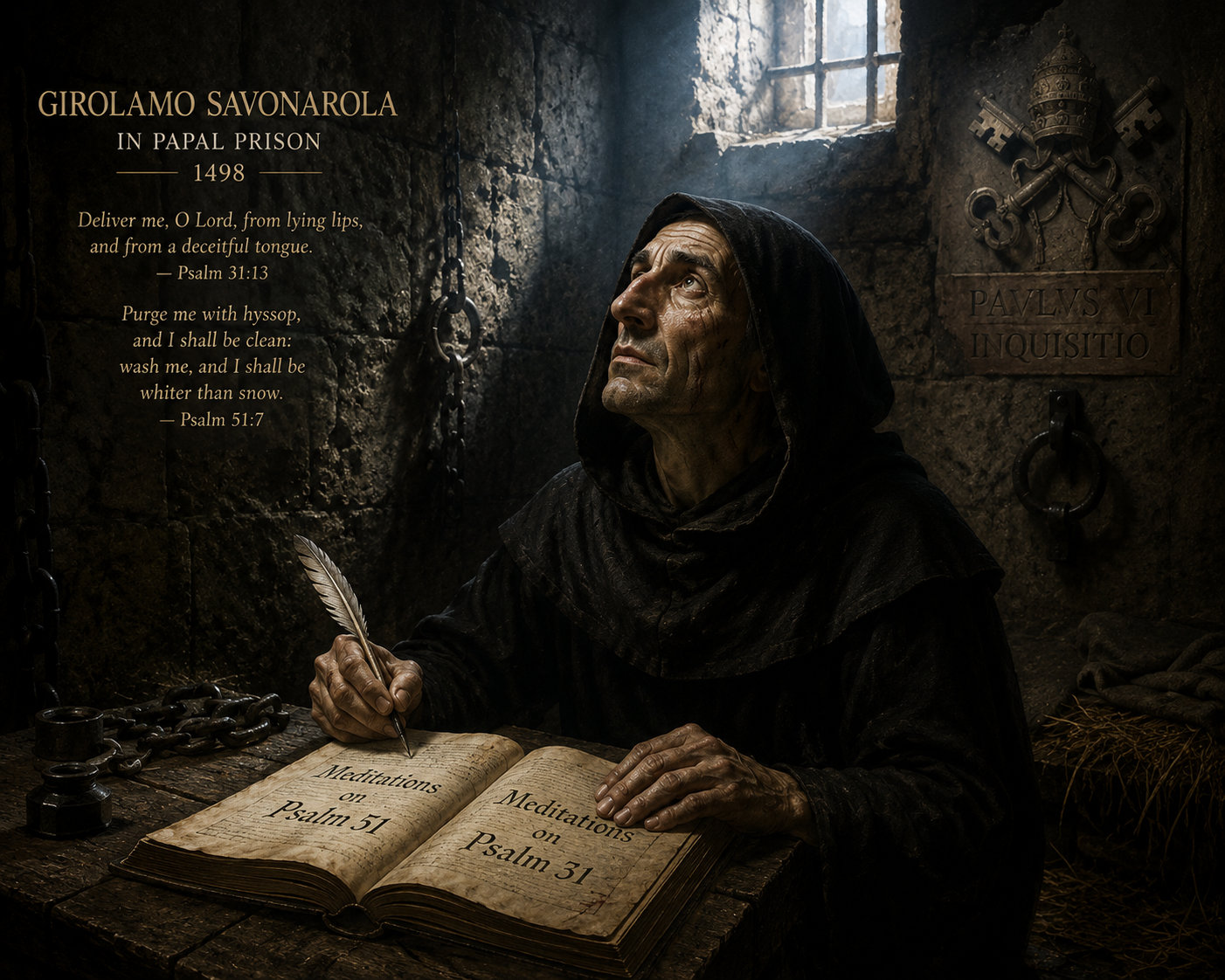
Unhappy Am I
(Based on the meditation on Psalm 51)
Unhappy am I, of all help bereft, No comfort on the earth or heaven left. For I have sinned against the stars above, And walked a scandal to the world I love. Whither shall I fly? Where shall I turn? While in this breast the flames of sorrow burn? Who will have pity on a soul so torn, In darkness cast, forsaken and forlorn?
To heaven’s light I dare not lift my eyes, Where all my faults are written in the skies; Upon the earth no refuge can be found, Where grief and heavy shadows hedge me round. What shall I do? Shall absolute despair Consume the remnant of my final prayer? God forbid! For mercy still is nigh, And Christ the Savior hears the lonely cry.
Fear has advanced an army in the night, Besieging this frail heart with all its might; With engines of despair it strikes the wall, And day and night awaits to see me fall. Yet in the storm, I will not yield to dread; I turn to where the stream of grace is shed. To Him I cry, while bound in iron chains: Have mercy, Lord, according to Thy great mercy.
Cleanse me, O Lord, with hyssop of Thy blood, And wash my spirit in compassion’s flood. Let fall the tears of pity from above, To drown my failures in redeeming love; Oh, touch this soul, and wash away the stain, That through the agony, the loss, the pain, My broken heart may emerge from the night, And shine far whiter than the winter’s snow.
Sorrow Has Pitched Its Camp
(Based on the meditation on Psalm 31)
Sorrow has pitched its camp around my soul, And heavy clouds across my spirit roll; It holds me close, a captive in the dark, Quenching the final, faint and fading spark. My closest friends are turned to enemies, Their voices carried on the bitter breeze; And those who loved me in the days of pride Now lift their heel and turn their face aside. But Thou, O Lord, art still my faithful stay, My shield, my refuge, and my guiding ray.
Let worldly minds put all their fragile trust In human strength that crumbles into dust; Let others glory in their fleeting gold, And all the transient power that they hold. But as for me, when everything is gone, I glory in the Lord, and Him alone. In Thee, O Lord, my anchor has been cast; Let me never be confounded at the last.
O sacred Hope, that cannot shaken be! Thou overcomest all the skies for me, Descending down into the deepest cell, Where grief and bitter isolation dwell. Thou bringest comfort to the sorrowing breast, And to the weary, Thine eternal rest. Amidst the howling gale and crashing sea, Thou art the anchor that delivers me.
Girolamo Savonarola and Seventh-day Adventism: Key Prophetic and Moral Parallels
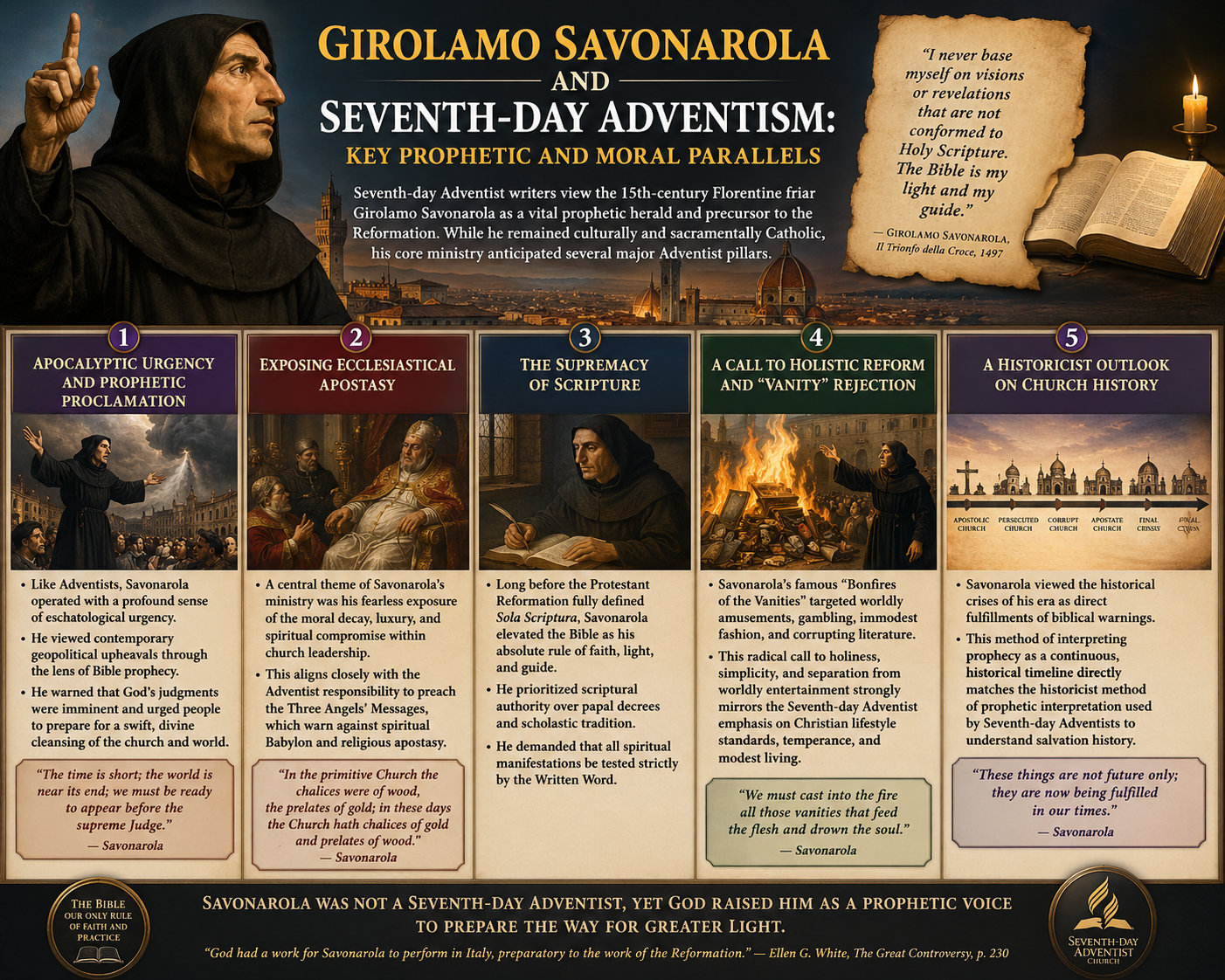
Seventh-day Adventist writers view the 15th-century Florentine friar Girolamo Savonarola as a vital prophetic herald and precursor to the Reformation. While he remained culturally and sacramentally Catholic, his core ministry anticipated several major Adventist pillars.
Here are the key points of similarity between Savonarola’s teachings and Seventh-day Adventist faith:
-
Apocalyptic Urgency and Prophetic Proclamation
Like Adventists, Savonarola operated with a profound sense of eschatological urgency. He viewed contemporary geopolitical upheavals through the lens of Bible prophecy, warning that God’s judgments were imminent and urging people to prepare for a swift, divine cleansing of the church and world.
-
Exposing Ecclesiastical Apostasy
A central theme of Savonarola’s ministry was his fearless exposure of the moral decay, luxury, and spiritual compromise within church leadership. This aligns closely with the Adventist responsibility to preach the Three Angels’ Messages, which warn against spiritual Babylon and religious apostasy.
-
The Supremacy of Scripture
Long before the Protestant Reformation fully defined Sola Scriptura, Savonarola elevated the Bible as his absolute rule of faith, light, and guide. He prioritized scriptural authority over papal decrees and scholastic tradition, demanding that all spiritual manifestations be tested strictly by the Written Word:
“I never base myself on visions or revelations that are not conformed to Holy Scripture. The Bible is my light and my guide.” — Girolamo Savonarola, Il Trionfo della Croce, 1497
-
A Call to Holistic Reform and “Vanity” Rejection
Savonarola’s famous “Bonfires of the Vanities” targeted worldly amusements, gambling, immodest fashion, and corrupting literature. This radical call to holiness, simplicity, and separation from worldly entertainment strongly mirrors the Seventh-day Adventist emphasis on Christian lifestyle standards, temperance, and modest living.
-
A Historicist Outlook on Church History
Savonarola viewed the historical crises of his era as direct fulfillments of biblical warnings. This method of interpreting prophecy as a continuous, historical timeline directly matches the historicist method of prophetic interpretation used by Seventh-day Adventists to understand salvation history.
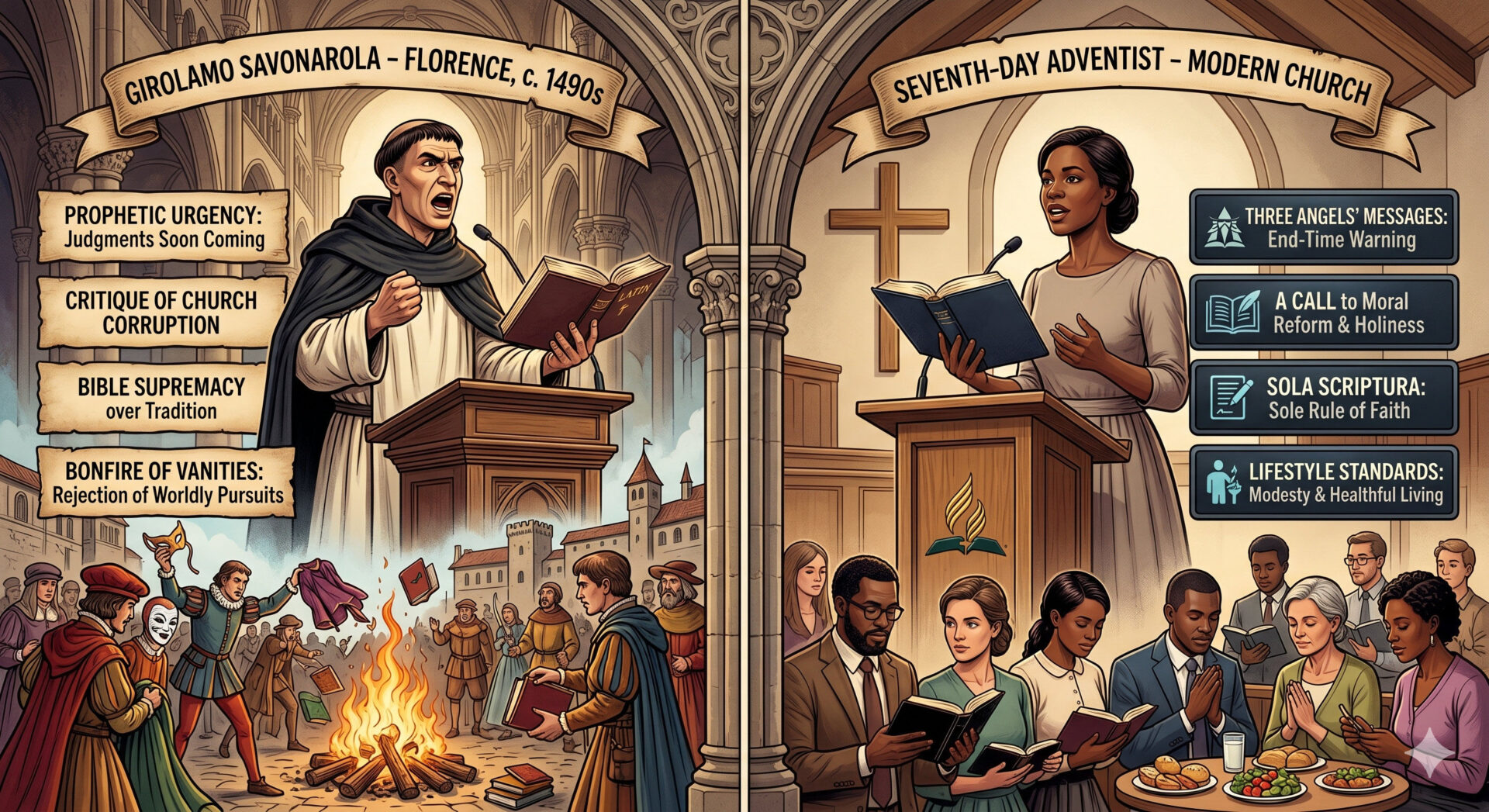
READ BOOK: LIFE AND TIMES OF SAVONOROLA
Copyright © 2026 Sławomir Gromadzki. All rights reserved.