
Slawomir Gromadzki

Minneapolis, 1888
When in 1990 I attended lectures in the United States, at the health center directed by Dr. Agatha Thrash, given by Pastor Jack Sequeira, I was deeply impressed by what I heard. Although at that time I did not yet understand everything well, I sensed a special influence of the Holy Spirit, impressing me that what I had heard was the message that the Lord had given to His people, and that its acceptance would bear fruit in revival and in the outpouring of the Holy Spirit.
Fascinated by the truth I had heard, I bought several dozen audio cassettes with Pastor Sequeira’s lectures, as well as several commentaries on the book of Romans. After carefully studying them, I decided to prepare, on their basis, a series of lectures entitled: “THE TRUTH AS IT IS IN CHRIST.”
I decided to give these lectures, and the whole message, that title because I am convinced that if we had the opportunity to ask the apostle Paul himself to describe in one sentence the gospel he preached, he would say that it was “the truth as it is in Jesus,” or “the truth as it is in Christ.”
I believe that anyone who carefully and prayerfully reads the content of Paul’s letters, especially Romans and Galatians, could come to the same conclusion.
The same “TRUTH AS IT IS IN CHRIST” was also the central theme of the message preached in Minneapolis in 1888. Therefore this first lecture will be devoted to the history connected with that message.
Although I believe that the most important thing is not the history of Minneapolis, but the message itself, because it opens the way for the outpouring of the Holy Spirit, I also believe that we should pay attention to the historical aspect of this event. This will help us understand that this truth ought to be absolutely central for us, because it focuses on the righteousness and love of Christ.
We may reach such a conclusion by reading Ellen White’s statement published in the Review and Herald of April 5, 1892, and quoted by A. G. Daniells in Christ Our Righteousness:
“Do not allow your minds to be diverted from the all-important theme of the righteousness of Christ by the study of theories. Do not imagine that the performance of ceremonies, the observance of outward forms, will make you an heir of heaven. We want to keep the mind steadfastly to the point for which we are working; for it is now the day of the Lord’s preparation, and we should yield our hearts to God, that they may be softened and subdued by the Holy Spirit.” — Ellen G. White, “The Righteousness of Christ,” Review and Herald, April 5, 1892, par. 12; quoted in A. G. Daniells, Christ Our Righteousness, p. 56.
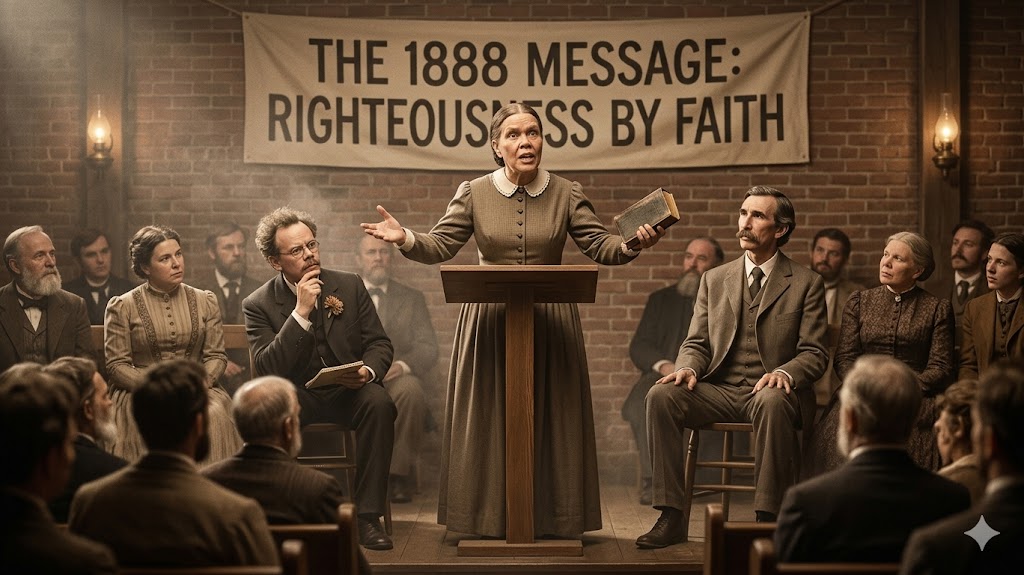
The most important theme is “the righteousness of Christ,” a righteousness that can become ours by faith. This was the central subject of the message with which the Lord blessed His people in 1888.
The General Conference session held then in Minneapolis has been regarded by many of our historians and theologians as one of the most important events so far in the history of our church. Professor LeRoy Edwin Froom, the well-known Adventist historian and theologian who died in 1974, wrote in his popular book Movement of Destiny:
“Standing out like a mountain peak, the Minneapolis Conference of 1888 marks a distinct turning point in our denominational history. It introduced a new epoch.” — LeRoy Edwin Froom, Movement of Destiny, p. 187.
Why was this event to have such great significance for our church?
Certainly it was because, at that time, Adventists had neglected the doctrine of justification by faith—that which should have been of greatest importance to them—and had focused too much on the law. For this reason God desired, during that conference, to direct the attention of His people again to the gospel, without diminishing the importance of the law, especially the fourth commandment.
The fact that Adventists had largely lost sight of Christ and His righteousness, while placing an excessive emphasis on the commandments of God, especially the fourth, was connected with the appearance in the mid-nineteenth century of a new doctrine in the Christian world, whose author was John Nelson Darby.
This doctrine divided human history into two periods:
The first period, called the OLD COVENANT, was the period from Moses to Christ, in which, according to this theory, a person could be saved on the basis of his relation to the law.
The second period, called the NEW COVENANT, was the period from Christ to the time of the end, in which, according to that theory, the law was abolished and the believer is no longer under law but under grace.
Unfortunately, the great majority of Protestant churches accepted this false doctrine regarding the abolition of God’s law in the new covenant, and this remains the case even today.
Supporters of this untrue extreme view preached grace without law. Some Adventists, understandably, very zealously defended God’s law, but in doing so they lost sight of the gospel and fell into the opposite extreme. The result was that they began to preach law, but without grace.
Ellen White made a very interesting statement on this subject in the first chapter of Faith and Works:
“While one class pervert the doctrine of justification by faith and neglect to comply with the conditions laid down in the Word of God—‘If ye love Me, keep My commandments’—there is fully as great an error on the part of those who claim to believe and obey the commandments of God but who place themselves in opposition to the precious rays of light—new to them—reflected from the cross of Calvary. The first class do not see the wondrous things in the law of God for all who are doers of His Word. The others cavil over trivialities and neglect the weightier matters, mercy and the love of God.
“Many have lost much because they have not opened the eyes of their understanding to discern the wondrous things in the law of God. On one hand, religionists generally have divorced the law and the gospel, while we have, on the other hand, almost done the same from another standpoint. We have not lifted up before the people the righteousness of Christ and the full significance of His great plan of redemption.” — Ellen G. White, Faith and Works, pp. 15-16.
It was because we, as a church, had neglected this most important message—preaching all doctrines without the most important one—that God decided to aid Ellen White’s efforts and called two young ministers who began to preach justification by faith, not separated from the law, but in the light of the law.
The first of them was Ellet J. Waggoner. At that time he was only thirty-three years old. Compared with many other delegates, he was almost a “child.” Waggoner was short in stature, gentle in disposition, and well educated theologically. He was also trained as a physician, but because of his calling he left that profession and devoted himself completely to the preaching ministry. From 1885 onward, together with A. T. Jones, he was co-editor of Signs of the Times.
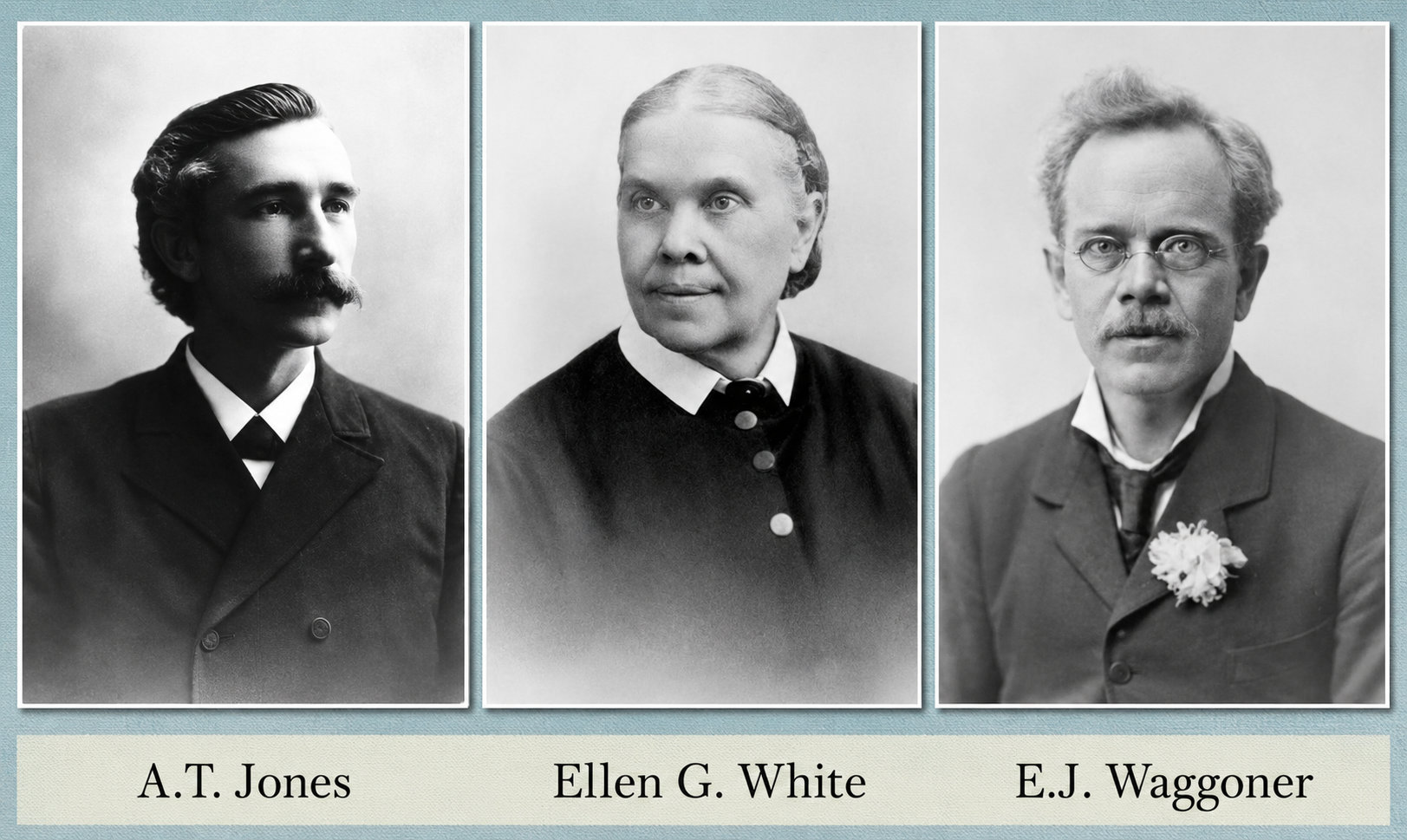
Alonzo T. Jones was also a relatively young minister at that time, being thirty-eight years old. In contrast to Waggoner, he was tall and well built. At times he gave the impression of being proud and rough in manner. Some did not like him, while others, such as S. N. Haskell, admired him and regarded him as an exceptional and brilliant man.
Sister White sometimes rebuked Jones’s manner of speaking and presenting the message, but it should be remembered that she did so only in private correspondence. Publicly she consistently supported the message he preached.
As an interesting detail, it has been said that Jones’s sermons often lasted around two and a half hours.
In reality, the 1888 Minneapolis Conference was the climax of a theological dispute that had begun two years earlier, in 1886. It was then that Waggoner wrote a series of articles in Signs of the Times on the law in Galatians. In those articles he argued that the law in that epistle was primarily the moral law, and not merely the ceremonial law.
This claim, however, did not receive a friendly reception. The chief opponent of this view was the then General Conference president, George I. Butler, who, in response to Waggoner’s teaching, published in 1887 a nearly one-hundred-page pamphlet entitled The Law in the Book of Galatians.
When Ellen White read that pamphlet, she wrote to him from Switzerland that since he had used his position to demonstrate the superiority of his own views, he must now give Waggoner the opportunity to defend his position publicly. Thus the question of the law in Galatians became one of the main subjects of discussion at the General Conference session in Minneapolis in 1888, and Waggoner was able to present the message in eleven studies.
Butler could not attend the meetings personally because he was ill, but by letter he appealed to the delegates to “stand by the old landmarks.” Ellen White replied to him that he did not even know what the “old landmarks” were.
Nevertheless, Butler exerted considerable influence on the attitude of the delegates toward what Waggoner was saying in Minneapolis. This is shown, for example, by the testimony of one of the participants in the conference, Elder McReynolds:
“I went to that meeting prejudiced in favor of Elder Butler and against E. J. Waggoner. With notebook and pencil in hand I listened for heresy and was ready to oppose anything that might be said. But as I listened, I became increasingly impressed that Waggoner’s message was very different from what I had expected. By the close of his second study I was ready to admit that what he was saying was the truth, and that he was not showing hostility or opposition. By the close of the fourth or fifth study I felt like a repentant sinner surrendered to God.” — Statement attributed to Elder C. McReynolds, quoted in later 1888 histories; exact original archival source not fully verified in this translation.
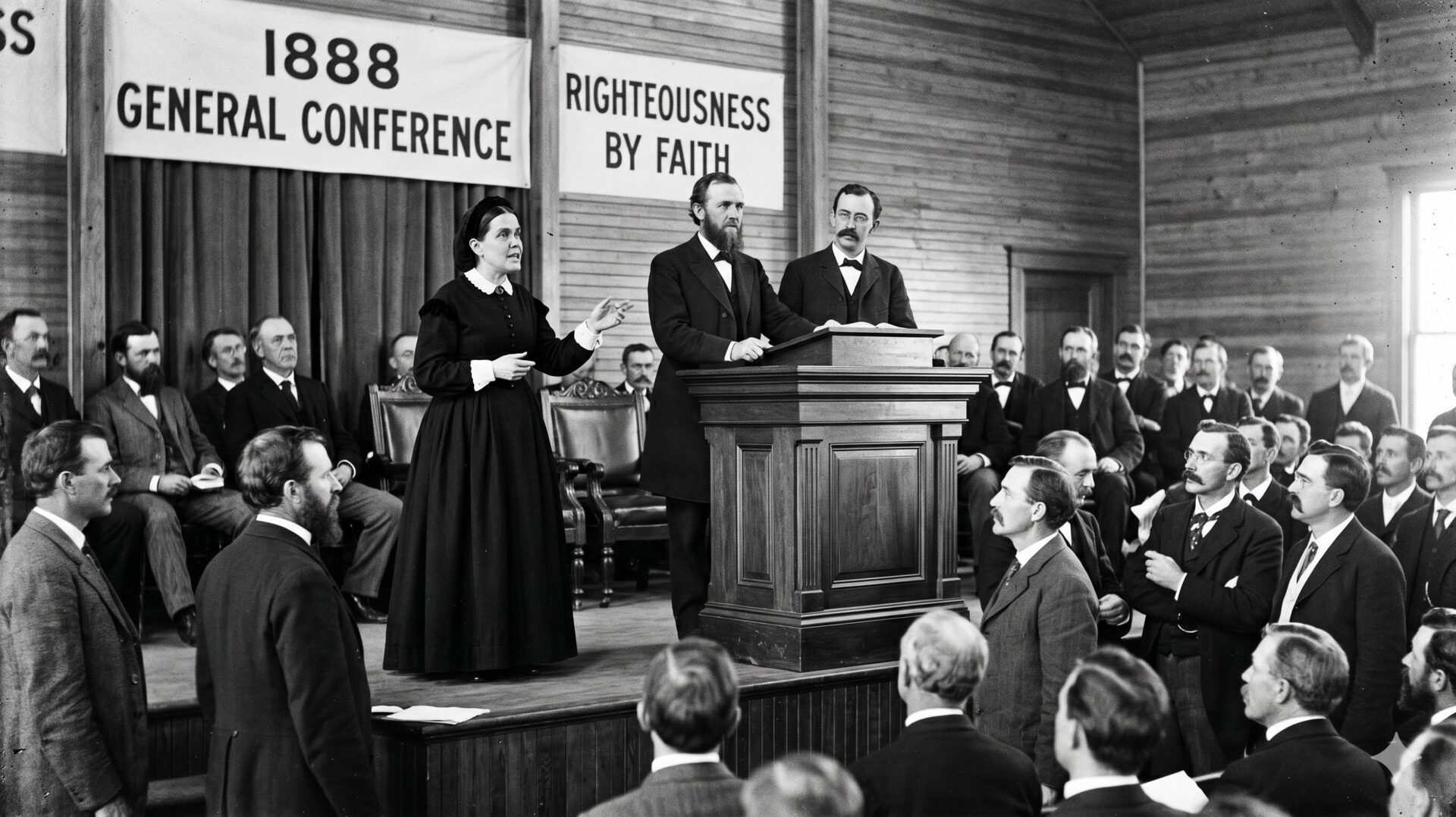
As this testimony indicates, the main reason most delegates rejected the message was prejudice and the mistaken idea that the message would undermine the authority of the Decalogue and the fourth commandment.
The truth as it is in Christ, presented in Minneapolis, whose acceptance was intended to bring an enormous blessing to the church, was unfortunately not properly received, even though it had firm and unmistakable support from Ellen White.
Let us now consider several of her remarkable statements on this subject.
“In rejecting the message given at Minneapolis, men committed sin. They have committed far greater sin by retaining for years the same hatred against God’s messengers, by rejecting the truth that the Holy Spirit has been urging home. By treating the message and the messengers with indifference, they dishonored God. All the universe of heaven witnessed the disgraceful treatment of Jesus Christ, represented by the Holy Spirit. Had Christ been before them, they would have treated Him in a manner similar to that in which the Jews treated Christ.” — Ellen G. White, Special Testimonies to Ministers and Workers, Series A, No. 6, pp. 20-21; also in Testimonies to Ministers and Gospel Workers, p. 97.
“The Lord is working through Brethren Jones and Waggoner. These men have a message from God to the people. If you accept the message, you accept Christ.” — Ellen G. White, Letter 51, 1895; published in The Ellen G. White 1888 Materials, pp. 1353-1354. [Wording checked against later published excerpts; punctuation may vary by edition.]
An eyewitness to those events, J. S. Washburn, later recalled Ellen White’s attitude while Waggoner was speaking. He remembered that Ellen White, sitting near the front, listened to Waggoner with great interest and repeatedly said, “Amen! Brethren, there is great light here!” — J. S. Washburn reminiscence, quoted in 1888 Message study literature; exact archival wording not fully verified in this translation.
Later, regarding the message presented, Ellen White said:
“I have had the question asked, What do you think of this light that these men are presenting? Why, I have been presenting it to you for the last forty-five years—the matchless charms of Christ. This is what I have been trying to present before your minds. When Brother Waggoner brought out these ideas in Minneapolis, it was the first clear teaching on this subject from any human lips I had heard, excepting the conversations between myself and my husband. I have said to myself, It is because God has presented it to me in vision that I see it so clearly, and they cannot see it because they have never had it presented to them as I have. And when another presented it, every fiber of my heart said, Amen.” — Ellen G. White, Manuscript 5, 1889; sermon at Rome, New York, June 19, 1889; published in Manuscript Releases, vol. 5, p. 219; also The Ellen G. White 1888 Materials, pp. 348-349.
On November 22, 1892, four years after Minneapolis, an extraordinary statement by Ellen White appeared in the Review and Herald:
“The time of test is just upon us, for the loud cry of the third angel has already begun in the revelation of the righteousness of Christ, the sin-pardoning Redeemer. This is the beginning of the light of the angel whose glory shall fill the whole earth.” — Ellen G. White, Review and Herald, November 22, 1892, par. 7; also Selected Messages, book 1, p. 363.
Equally impressive to Adventists is the message that Sister White sent from Australia five years after the Minneapolis Conference. It was read at the General Conference session in 1893. A. T. Jones stated:
“Now that message of the latter rain—the righteousness of Christ—is the message of God; it is the message of the third angel; it is the loud cry of the third angel.” — A. T. Jones, General Conference Bulletin, 1893, p. 377. [This is Jones’s report/application of Ellen White’s 1892 statement, not a direct Ellen White sentence.]
In the same 1893 General Conference Bulletin, on page 419, we find this verified Ellen White statement:
“Had every soldier of Christ done his duty, had every watchman on the walls of Zion given the trumpet a certain sound, the world might ere this have heard the message of warning. But the work is years behind.” — Ellen G. White, General Conference Bulletin, 1893, p. 419; also The Ellen G. White 1888 Materials, pp. 1129-1130.
Note: A stronger sentence is often circulated: “If the people of God had gone to work as they should have gone to work right after the Minneapolis meeting in 1888, the world could have been warned in two years, and the Lord would have come.” However, Loma Linda University lists this as an “Unverified quotation.” Therefore it should not be presented as a verified Ellen White statement unless an authenticated source is found.
The verified statements still show that if this truth had been properly received, the work could have advanced rapidly toward the full outpouring of the Holy Spirit and the final proclamation of the message.
It is also noteworthy that the United States government had never been so close to passing a national Sunday law as it was at that time. Senator Henry W. Blair was the politician who was then pressing strongly for legislation requiring Sunday observance in the United States.
It appears that, at that time, the end was nearer than many realize.
Unfortunately, there is no doubt that both during the Minneapolis Conference itself and afterward, the message was not accepted to a sufficient degree. As a result, God was compelled to withhold the great blessing that was to have been the outpouring of the Holy Spirit.
Why did this happen? What was the reason?
Why was this wonderful truth as it is in Christ not properly appreciated by many Adventists of that time?
One of the most important reasons is given in Testimonies to Ministers and Gospel Workers, pages 91-93:
“The Lord in His great mercy sent a most precious message to His people through Elders Waggoner and Jones. This message was to bring more prominently before the world the uplifted Saviour, the sacrifice for the sins of the whole world. It presented justification through faith in the Surety; it invited the people to receive the righteousness of Christ, which is made manifest in obedience to all the commandments of God. Many had lost sight of Jesus.” — Ellen G. White, Testimonies to Ministers and Gospel Workers, pp. 91-92.
“Many had lost sight of Jesus. They needed to have their eyes directed to His divine person, His merits, and His changeless love for the human family.” — Ellen G. White, Testimonies to Ministers and Gospel Workers, p. 92.
Waggoner’s sermons centered on Christ. Sister White referred to this as the “matchless charms of Christ.” Yet many delegates felt that Waggoner spoke too much about Christ. “It is important to speak about Christ,” they said, “but the present truth is the fourth commandment, and if we do not emphasize that, people will think they can get to heaven without the Sabbath.”
After the General Conference session in Minneapolis ended, Ellen White, together with Waggoner and Jones, preached this message throughout the United States.

Unfortunately, three years after Minneapolis, church leaders decided to send Ellen White to Australia, and not long afterward Waggoner was sent to England.
In 1896 Ellen White wrote from Australia to the then General Conference president, O. A. Olsen, that her departure from the United States, and Waggoner’s removal from the center of the work, were not in harmony with God’s plan:
“The Lord was not in our leaving America. He did not reveal that it was His will that I should leave Battle Creek. The Lord did not plan this, but He let you all move after your own imaginings. The Lord would have had W. C. White, his mother, and her workers remain in America. We were needed at the heart of the work.” — Ellen G. White, Letter 127, 1896; published in The Ellen G. White 1888 Materials, p. 1622; also Manuscript Releases, vol. 10, p. 393.
Sadly, it is also true that the two ministers through whom the Lord desired to give His people this wonderful message—Waggoner and Jones—later became separated from the church. It is commonly believed that their later spiritual decline was also connected with the “alpha” of deadly heresies and the pantheistic influence associated with Dr. J. H. Kellogg.
This fact is used even today by many people who suggest that, because of this, it is better not to be too interested in the message.
But even if it is true that these two ministers were later deceived, does that mean we should reject the Minneapolis message?
Does that mean the message did not come from God?
Here is Ellen White’s own answer from Letter S-24, written in 1892:
“It is quite possible that Elders Jones or Waggoner may be overthrown by the temptations of the enemy; but if they should be, this would not prove that they had had no message from God, or that the work that they had done was all a mistake.” — Ellen G. White, Letter 24, 1892; published in The Ellen G. White 1888 Materials, p. 1044.
Therefore, this message remains relevant today, and our task is to become acquainted with it and to receive it with grateful hearts.
Unfortunately, not a few among us, when becoming acquainted with the history of Minneapolis, tend to fall into extremes. Some say that we should not concern ourselves with it at all, and even condemn those who show interest in it. Others fall into the opposite extreme and focus on criticism. Often, because of their zeal without balance, they come into conflict with the pastor and the church. When the devil then succeeds in discouraging them, he tries to link them with representatives of various offshoot movements who use the history of Minneapolis to claim that the Seventh-day Adventist Church is Babylon.
However, the Spirit of Prophecy clearly indicates that anyone who indulges in such criticism and charges God’s remnant church with being Babylon gives evidence that he himself has fallen into a satanic snare and has been deceived:
“When anyone is drawing apart from the organized body of God’s commandment-keeping people, when he begins to weigh the church in his human scales and begins to pronounce judgment against them, then you may know that God is not leading him.” — Ellen G. White, Selected Messages, book 3, p. 18; Manuscript 21, 1893.
The devil wants us to concentrate on anything except the true gospel, because he knows that only by receiving it can we gain the victory over him, for the gospel is the power of God.
Therefore the enemy of the gospel seeks to occupy our minds with different, often attractive subjects—for example, the question of whether God kills—because he knows that by doing this he can divert our attention from the truth whose acceptance leads to the outpouring of the Holy Spirit. Sister White also warns us against this subtle satanic deception:
“Do not allow your minds to be diverted from the all-important theme of the righteousness of Christ by the study of theories.” — Ellen G. White, Review and Herald, April 5, 1892, par. 12.
The most important theme is “the righteousness of Christ,” not the question of whether God kills. Let us not allow the devil to turn us away from the most important subject—the righteousness of Christ—and let us not permit some theory to occupy our minds continually, especially when it cannot be established by the clear statements of Scripture. It is enough that the Bible says “God is love,” and that He has done everything to save every person and has no pleasure in the death of anyone:
“As I live, saith the Lord GOD, I have no pleasure in the death of the wicked; but that the wicked turn from his way and live: turn ye, turn ye from your evil ways; for why will ye die?” — Ezekiel 33:11, KJV.
Whether we believe that God Himself will destroy the unrepentant sinners, or that He will do so by commanding His angels, or by withdrawing the breath of life, or by revealing His glory, or by withdrawing the power that holds together the quarks and atoms in our bodies so that these particles explode and kill those who stubbornly reject His grace, it will still happen by His permission.
The Word of God encourages us to concentrate rather on the truth that “God is love,” and to rest in the fact that unrepentant sinners will perish forever not because God has ceased to love them, for agape never fails, but because His love and justice cannot allow them to live in sin forever. This is so both for their own good and for the good of the whole universe.
Therefore let us avoid unnecessary discussions on a subject that is not treated in this way either by Scripture or by the Spirit of Prophecy. Those who become involved in needless debates on such controversial subjects always meet opposition from fellow believers, and it then takes little for them to begin concluding that those who disagree with them are “Babylon.”
In 1913, only two years before her death, Ellen White wrote:
“I am encouraged and blessed as I realize that the God of Israel is still guiding His people, and that He will continue to be with them, even to the end.” — Ellen G. White, Life Sketches of Ellen G. White, pp. 437-438; remarks at the 1913 General Conference session.
How long will the Lord remain with this church?
“Even to the end.”
Ellen White’s son, W. C. White, not long before his mother’s death, asked her about the future of our church. This is the answer he later reported:
“I tell you now, that when I am laid to rest, great changes will take place. I do not know when I shall be taken; and I desire to warn all against the devices of the devil. I want the people to know that I warned them fully before my death.” — Ellen G. White, cited by W. C. White in later correspondence. [The exact sentence often circulated as “God will not permit this denomination to apostatize so far that there will be the coming out of another church” is not verified in this form in this translation.]
Another statement shows that, despite the mistakes made in the past, the Lord has not forsaken and will not forsake His people, but will heal their wounds:
“I want every one of you to remember that God has said that He would heal the wounds of His people.” — Ellen G. White, General Conference Bulletin, April 25, 1901, pp. 463-464.
Therefore the testimony of Ellen White in this matter is clear: despite delay in receiving the Minneapolis message and despite any other failures, God will not abandon His people. Those who criticize the church, identify it as Babylon, and leave it, give evidence that they themselves have been deceived and that they never truly loved the church, for if they had, as the apostle John wrote, “they would no doubt have continued with us”:
“They went out from us, but they were not of us; for if they had been of us, they would no doubt have continued with us.” — 1 John 2:19, KJV.





THE HOUSE WITH GOLDEN WINDOWS
A certain boy grew up in a poor home, and his parents were farmers. Every morning the boy woke while it was still dark and helped his father milk the cows. Then he would go outside, and as the sun rose he would look toward the west, where, in the distance on a hill, he saw a beautiful house with golden windows. The longer he looked at that house, the more he longed one day to live there, or at least to see it up close.
The boy dreamed about it for a long time until one day, when he was twelve years old, his father said to him, “Son, your mother and I appreciate the way you try to help us with the work, and we have decided that you deserve a day of rest. So rest tomorrow, and we will manage somehow by ourselves.”
The next morning the boy got up later than usual. When he went outside, the sun was just rising, and when he looked toward the west, he again saw in the distance the beautiful house with golden windows. After a moment, he knew what he would do.
He took some food with him and set out toward the house with golden windows. But when, after a long walk, he climbed the hill on which the house stood, he was surprised to see that the windows of that house were not golden at all.
He knocked on the door, and when the owner appeared, the boy asked, “Excuse me, ma’am, is this the house with golden windows?”
“I’m sorry, my boy,” the woman replied, “but this is not the house with golden windows. However, if you would like to wait a little, I will show you where such a house is.”
When the sun began to set, the woman led the boy outside and, pointing eastward, said, “Do you see that house down there? That is the house with golden windows.”
When the boy looked eastward, he again saw that house—the house with golden windows. After a moment, however, he realized with astonishment that the house with golden windows was his own family home.
The house with golden windows, the house of God’s truth, the house of God’s blessings, is not found in another fellowship, another family, another church, and it will never be found in another place. The house with golden windows was, is, and will be to the end here, in this church, in this fellowship, because here, in this “house,” are those “which keep the commandments of God, and have the testimony of Jesus Christ,” which is “the spirit of prophecy.” — Revelation 12:17; 19:10.
Since, then, we have found this house, God’s house of truth, let us not look for another, no matter how attractive it may appear.
Perhaps our house is not yet, in a certain sense, a perfect house, because those who live in it make mistakes. Perhaps this house needs renovation, spiritual and even physical renewal. Perhaps its windows are not yet gold, and love is lacking in it. But this is the house—God’s house with golden windows—because in it are reflected the golden rays of the righteousness and love of Christ connected with truth.
“I am encouraged and blessed as I realize that the God of Israel is still guiding His people, and that He will continue to be with them, even to the end.” — Ellen G. White, Life Sketches of Ellen G. White, pp. 437-438; remarks at the 1913 General Conference session.
“I want every one of you to remember that God has said that He would heal the wounds of His people.” — Ellen G. White, General Conference Bulletin, April 25, 1901, pp. 463-464.
We may therefore be certain that in the end the Minneapolis message will triumph.
Some time ago I was invited to Chełm Lubelski to conduct a series of health lectures. Unfortunately, in Warsaw I got stuck in traffic. At one point, however, I noticed a car that had been slowly driving in front of me for some time, and especially its unusual registration number: WIN 1888. In English, those three letters, “WIN,” literally mean “to win” or “to overcome.” I received this as a sign from the Lord and as a promise that the 1888 message—that is, THE TRUTH AS IT IS IN CHRIST—will soon win.
However, for this to happen, we must properly appreciate this truth, focus our attention on it, and cease all criticism. We should act in harmony with the official statement issued by our church council in 1976. This statement was entitled “The 1888 Era”:
“After a careful review of the 1888 era, we have come to the conclusion that it was a time unlike any other period in the history of our church. The Lord did indeed give His people the beginning of the latter rain and the loud cry in the revelation of the righteousness of Christ, the sin-pardoning Redeemer… The attitude and spirit manifested by too many at that time forced God to withdraw this special blessing… It will do us no good to argue over how many rejected or accepted the message then. We must recognize that the great blessing God intended to bestow upon the church at that time was not received…. In the light of these historical facts, our special concern should be to remove every obstacle standing in the way of God’s promises and power, and through repentance, faith, revival, and reformation, clear the way so that the Lord may do His work for us and through us.” — Statement on “The 1888 Era” Adventist Church council statement, 1976.
Unfortunately, what Waggoner said during the General Conference session in Minneapolis was not officially transcribed. Only his wife took notes of his presentations, and on the basis of those notes he later wrote Christ and His Righteousness, published in 1890, only two years after Minneapolis.
A second book, written by him somewhat later, was The Glad Tidings, a commentary on Galatians.
Unfortunately, this second book was written by Waggoner around 1900, twelve years after Minneapolis, when he was already under the influence of Kellogg and pantheism. I even know ministers who had the opportunity to read the original edition of that book and who actually found in it one passage affected by pantheism and removed it.
Personally, I have had the privilege of reading both books, and without doubt they contain a wonderful gospel message based on Galatians and Romans. However, there is no doubt that in our time God has called ministers whom He has given no less light and wisdom on this subject. One such pastor is undoubtedly Jack Sequeira, whom I had the pleasure of hearing several times during my stay in the United States, including at Andrews University.
Pastor Sequeira has always been a loyal member of our church. He studied at Newbold College and Andrews University. For seventeen years he served as a missionary in Uganda, Kenya, and Ethiopia. Later he served the church as senior pastor of Capital Memorial Church in Washington, D.C., and is now retired. This has not prevented him from spreading the gospel not only in the United States but also in many countries of the world, to which he is continually invited.
The next five lectures, entitled “THE TRUTH AS IT IS IN CHRIST,” which by God’s help I have the privilege of presenting, have been prepared primarily on the basis of the book of Romans, taking into account the content of the 1888 message and numerous statements from the Spirit of Prophecy. Most of the comments used in this lecture series, however, come chiefly from the lectures and written materials of Pastor Jack Sequeira. Let us now listen to a portion of one of his lectures, which I had the pleasure of attending personally and which was recorded on audio cassettes:
“Toward the end of my stay at Andrews University, one of my friends directed my attention to the message of justification by faith which the Lord gave to His people in 1888. That truth made an enormous impression on me, so much so that from that time on I devoted most of my time to everything that could help me understand it better, praying that the Lord would also help me proclaim this wonderful truth. In 1973, shortly after completing my studies at Andrews University, I went to Ethiopia. Only a few days after my arrival, the president of the church in that country telephoned me and told me that Adventists owned a college in Ethiopia, but because of financial difficulties they had been forced to admit students who were not Adventists. This led to the point where non-Adventists made up as much as 75 percent of all the students at that college. The parents of these students were very wealthy. Unfortunately, the young people were especially unruly and rebellious, and at times even dangerous to those around them. For this reason they had previously been expelled from government schools. So their parents sent them to our school in the hope that perhaps Adventists would be able to change them. But these young people had no intention of changing and showed hostility toward everything connected with religion. Because of this, during a Week of Prayer, they even openly rebelled. They overturned two cars belonging to the school and three motorcycles and set them on fire. They did not want anyone to force them to attend worship services or Bible lectures. After this incident, the administration decided to close the school for a time. Shortly afterward, however, the government forced the school leadership to reopen it and even to readmit those rebellious students—the same ones who had burned the cars and motorcycles. The principal and the teachers then wondered whether it might be better to cancel the Week of Prayer. Finally, however, they said, ‘This is an Adventist school, and we cannot give up the Week of Prayer. This time, however, we will ask one of the national ministers to lead the meetings, not a foreigner, since previously the main speaker had been a pastor from Canada. When our own man speaks,’ they said, ‘they certainly will not harm him.’ So a speaker was chosen, but two days before the Week of Prayer began, that man changed his mind because he feared that this time his car would be burned. In this situation the church president desperately looked for someone who would replace him. The rebellious youth were so dangerous that no one wanted to take such a risk. Finally he contacted me, asking me to conduct the meetings. Before I gave him an answer, I prayed: ‘Lord, You said in Romans that the gospel is Your power. Please show now that this is true. You have allowed me to know this wonderful truth; now let me test its power on these rebellious young people.’ Immediately after that telephone conversation I boarded a plane, and shortly afterward I arrived in Addis Ababa. Several missionaries were waiting for me at the airport, and they told me I had acted unwisely by agreeing to do this. I replied, ‘Yes, you are right. It does indeed look like an unwise decision. So I have one request: if you have to bury me, remember that I like gladiolas.’ Finally I reached the college. I did not yet know that five leaders of those unruly young people had prepared a pile of stones in front of the church in order to stone me if they did not like what I said. When the service began, all five sat in the front row directly in front of the pulpit, looking me straight in the eyes. And so I began a series of sermons on the gospel from the book of Romans. But thanks be to God, I was able to speak without interruption. On the third day something extraordinary happened. One of those five leaders came up to me and said, ‘This is the most wonderful news I have ever heard!’ Some time later all five were baptized and joined our church, and the chief leader of those rebellious youth even graduated from Andrews University and now works in the church as a minister.”
— Jack Sequeira, lecture testimony, translated from the Polish transcript supplied by the author; exact audio source not independently verified in this translation.
This encouraging experience confirms even more strongly that what the apostle Paul wrote in Romans 1:16 is true: “For I am not ashamed of the gospel of Christ: for it is the power of God unto salvation to every one that believeth.” — Romans 1:16, KJV.
Some believe that in order to restore order and raise the level of morality—whether in the family, the state, or even the church—it is necessary to introduce more prohibitions, commands, and stricter laws. But such a method has more in common with communism and dictatorship than with Christianity. This goal cannot be achieved by any compulsion, external improvement of behavior, or superficial growth in morality forced by fear of punishment. Only the gospel can accomplish it—the gospel that is the power of God, the gospel whose acceptance leads to being born of the Spirit.
This extremely important principle is beautifully presented in Steps to Christ: “Many have an idea that they must do some part of the work alone. They have trusted in Christ for the forgiveness of sin, but now they seek by their own efforts to live aright. But every such effort must fail. Jesus says, ‘Without Me ye can do nothing.’ Our growth in grace, our joy, our usefulness,—all depend upon our union with Christ. It is by communion with Him, daily, hourly,—by abiding in Him,—that we are to grow in grace.” — Ellen G. White, Steps to Christ, p. 69.
“Consecrate yourself to God in the morning; make this your very first work. Let your prayer be, ‘Take me, O Lord, as wholly Thine. I lay all my plans at Thy feet. Use me today in Thy service. Abide with me, and let all my work be wrought in Thee.’ This is a daily matter.” — Ellen G. White, Steps to Christ, p. 70.
Why has Jesus Christ not yet come? Why are there so many atheists? The main reason is that the church, in its daily life, does not reveal the power of the gospel.
Nietzsche, the great philosopher who was an atheist, addressed Christians with a statement to this effect: “If you want me to believe in your Redeemer, you will have to look more redeemed.” — Commonly attributed to Friedrich Nietzsche; exact source and wording not verified.
The only answer to the challenge Nietzsche laid before Christianity is the new birth by the Spirit, which can take place only as a result of accepting the truth of salvation by faith in Christ.
In one of his sermons, Charles Spurgeon told of a drunken man who once accosted him, crying out, “You converted me! You converted me!” Spurgeon tried to avoid engaging him in discussion, but the man continued to cry, “You converted me! You converted me!” Finally, impatient, Spurgeon said, “Yes, you are right. I must have converted you, for if the Holy Spirit had done it, you would not now be drunk.” — Anecdote commonly attributed to Charles H. Spurgeon; exact sermon source not verified in this translation.
Only by the Holy Spirit can true new birth take place. But before that happens, we must know, understand, and accept all that God has accomplished for us in His Son. Whether the good Lord can finally bestow upon His people the great blessing for which we have waited so long—the outpouring of the Holy Spirit—also depends on our proper understanding and acceptance of the truth as it is in Christ.
We must also be aware that the author of evil knows very well that if God’s people begin to concentrate on the truth as it is in Christ, this will lead to the rapid return of the Son of God. Therefore the enemy of the gospel will do everything possible to influence the remnant church so that its members remain indifferent toward this truth, or—as happened over one hundred years ago—even regard it as heresy and oppose its spread.
It is precisely against such a tragic attitude toward the Minneapolis message, that is, toward the truth as it is in Christ, that Sister White warns us. This statement and appeal comes from Review and Herald articles of March 11 and May 27, 1890, and July 26, 1892, as quoted in A. G. Daniells’s Christ Our Righteousness:
“For nearly two years we have been urging the people to come up and accept the light and the truth concerning the righteousness of Christ, and they do not know whether to come and take hold of this precious truth or not. They are bound about with their own ideas.” — Ellen G. White, Review and Herald, March 11, 1890; quoted in A. G. Daniells, Christ Our Righteousness, p. 30.
“Some have turned from the message of the righteousness of Christ to criticize the men.” — Ellen G. White, Review and Herald, May 27, 1890; quoted in A. G. Daniells, Christ Our Righteousness, p. 30.
“They have not understood the message of the third angel. The light which is to lighten the whole earth with its glory will be called a false light by those who refuse to walk in its advancing glory.” — Ellen G. White, Review and Herald, May 27, 1890; quoted in A. G. Daniells, Christ Our Righteousness, pp. 30-31.
“We entreat of you who oppose the light of truth, to stand out of the way of God’s people. Let Heaven-sent light shine forth upon them in clear and steady rays.” — Ellen G. White, Review and Herald, May 27, 1890; quoted in A. G. Daniells, Christ Our Righteousness, p. 31.
“Heaven is indignant at the spiritual blindness of many of our brethren. Our younger ministers, who fill less important positions, should make decided efforts to come to the light, to sink the shaft deeper and still deeper into the mine of truth.” — Ellen G. White, Review and Herald, May 27, 1890; quoted in A. G. Daniells, Christ Our Righteousness, p. 31.
“Let no one run the risk of interposing himself between the people and the message of Heaven. The message of God will come to the people; and if there were no voice among men to give it, the very stones would cry out.” — Ellen G. White, Review and Herald, July 26, 1892; quoted in A. G. Daniells, Christ Our Righteousness, p. 31.
The following story took place in eighteenth-century England, at a time when the country was afflicted by plague and many people were dying.
A little boy had already lost his father and older sister because of the epidemic, and now his mother was near death. Knowing that his mother was dying, the boy, deeply anxious about his future, said with tears in his eyes:
“Mother, don’t die! Father is dead, and my sister has died too. What will I do? Where will I go if you die too?”
“It is true, my son,” said the mother. “Your father and sister are dead, and I too will soon have to leave. But you must be brave, and even if you are left alone, remember that soon the Lord Jesus will come for you.”
Sadly, not long afterward the woman died and was buried near the house.
The boy was left alone and grieved deeply after his mother’s death. The day after the funeral, very depressed and with eyes full of tears, he went to the meadow, lay down beside his mother’s grave, and fell asleep.
Soon afterward a man passed by that place. When he saw the boy lying by the grave, he woke him and asked what he was doing there.
The boy replied:
“My father and older sister recently died, and yesterday my mother was buried here. I am alone now. But before Mother died, she told me not to worry, because soon the Lord Jesus would come for me.”
When the boy said this, he thought for a moment, then added with a smile:
“Thank you for coming so soon.”
Then the man took the boy home with him and cared for him.
The second coming of Jesus Christ is certainly very near. But on the basis of the history connected with the 1888 message, we may say that how soon our Lord returns depends, in a real sense, on us.
It depends on whether we sufficiently focus our attention on this holy and most important truth: “THE LORD OUR RIGHTEOUSNESS.” — Jeremiah 33:16.
If this happens, then surely the outpouring of the Holy Spirit will soon take place, and then we too, like that boy, will be able to say, “Thank You, Lord, that You came so soon.”
As Adventists, as those who await the return of the Saviour, we should show far greater interest in everything that can hasten His second coming. The testimony of the Word of God and of the Spirit of Prophecy is so clear and obvious that there can be no doubt regarding what can open the way for the outpouring of the Holy Spirit that precedes the return of the Lord Jesus. We can say with certainty that it is the Minneapolis message—the teaching of righteousness by faith alone in Jesus Christ, whose fruit is a sanctified life. It is the truth as it is in Christ.
Therefore it is not enough merely to pray for the outpouring of the Holy Spirit. If we continue to neglect, or worse, oppose this truth, then the Lord cannot answer our prayers. It is like pulling at the handle of a door locked with a key while forgetting that the key is in our pocket. Therefore we can no longer neglect this message, much less oppose it. We must know it, understand it, and receive it with grateful hearts; then the Lord will hear our prayers and the door will be opened.
There is, however, something else we should do before focusing on this truth. Our slowness in receiving the message that the Lord entrusted to us in 1888 should bring us to repentance, reflection, and humbling ourselves before the Lord in prayer and even fasting:
“Sanctify ye a fast, call a solemn assembly, gather the elders and all the inhabitants of the land into the house of the LORD your God, and cry unto the LORD. Alas for the day! for the day of the LORD is at hand, and as a destruction from the Almighty shall it come.” — Joel 1:14-15, KJV.
If we truly desire the outpouring of the Holy Spirit and revival, if we want to proclaim the last message with power, then first we should all humble ourselves before the Lord and apologize—not only for our personal sins, but also for the sin connected with our slowness in knowing and accepting this wonderful truth as it is in Christ.
If anyone thinks he does not need to do this, let him remember the attitude of the prophet Daniel. Although Daniel received from the angel the assurance that he was greatly beloved of God, and although he could have thought that other Israelites, not he, should humble themselves before God and confess sins, Daniel identified himself with the guilt of the whole nation and pleaded with the Lord as though he too were guilty:
“And I set my face unto the Lord God, to seek by prayer and supplications, with fasting, and sackcloth, and ashes:
“And I prayed unto the LORD my God, and made my confession, and said, O Lord, the great and dreadful God, keeping the covenant and mercy to them that love him, and to them that keep his commandments;
“We have sinned, and have committed iniquity, and have done wickedly, and have rebelled, even by departing from thy precepts and from thy judgments.” — Daniel 9:3-5, KJV.
We should all humble ourselves before the Lord and cry to Him in prayer, just as Jerome Savonarola, condemned to death by hanging for preaching the truth, called from the pulpit to the people:
“Weep, my heart; weep, my soul; weep, my eyes!
“Weep with me, all of you, great and small, women and men, sinners and righteous.” — Saying attributed to Girolamo Savonarola; exact source not verified in this translation.
As Savonarola spoke, the organ played a sorrowful hymn softly, and the whole congregation wept and beat their breasts.
If we act in this way, and not only sincerely confess our guilt but also turn away from it, removing every obstacle that stands in the way of truth, then we may be certain that the Lord will finally “be jealous for His land, and pity His people,” and what we have waited for so long will at last take place—the outpouring of the Holy Spirit and the second coming of our Saviour.
Let us therefore listen once more to the inspired counsel and earnest appeal that the Lord directs to us through Sister White, and let us finally stand together, united on the side of this “precious truth”:
“For nearly two years we have been urging the people to come up and accept the light and the truth concerning the righteousness of Christ, and they do not know whether to come and take hold of this precious truth or not. They are bound about with their own ideas.” — Ellen G. White, Review and Herald, March 11, 1890; quoted in A. G. Daniells, Christ Our Righteousness, p. 30.
“Some have turned from the message of the righteousness of Christ to criticize the men.” — Ellen G. White, Review and Herald, May 27, 1890; quoted in A. G. Daniells, Christ Our Righteousness, p. 30.
“They have not understood the message of the third angel. The light which is to lighten the whole earth with its glory will be called a false light by those who refuse to walk in its advancing glory.” — Ellen G. White, Review and Herald, May 27, 1890; quoted in A. G. Daniells, Christ Our Righteousness, pp. 30-31.
“We entreat of you who oppose the light of truth, to stand out of the way of God’s people. Let Heaven-sent light shine forth upon them in clear and steady rays.” — Ellen G. White, Review and Herald, May 27, 1890; quoted in A. G. Daniells, Christ Our Righteousness, p. 31.
“Let no one run the risk of interposing himself between the people and the message of Heaven. The message of God will come to the people; and if there were no voice among men to give it, the very stones would cry out.” — Ellen G. White, Review and Herald, July 26, 1892; quoted in A. G. Daniells, Christ Our Righteousness, p. 31.
May none of us be counted among those who “stand in the way of God’s people” and call false the light that is to lighten the earth. Let us heed this call and not risk placing ourselves between God’s people and the message from heaven. Let us take such a position toward the truth that the saying will not again be fulfilled in our lives: “History teaches us that people learn nothing from history”—in this case, from the history of the Minneapolis message.
AMEN!