
Sławomir Gromadzki
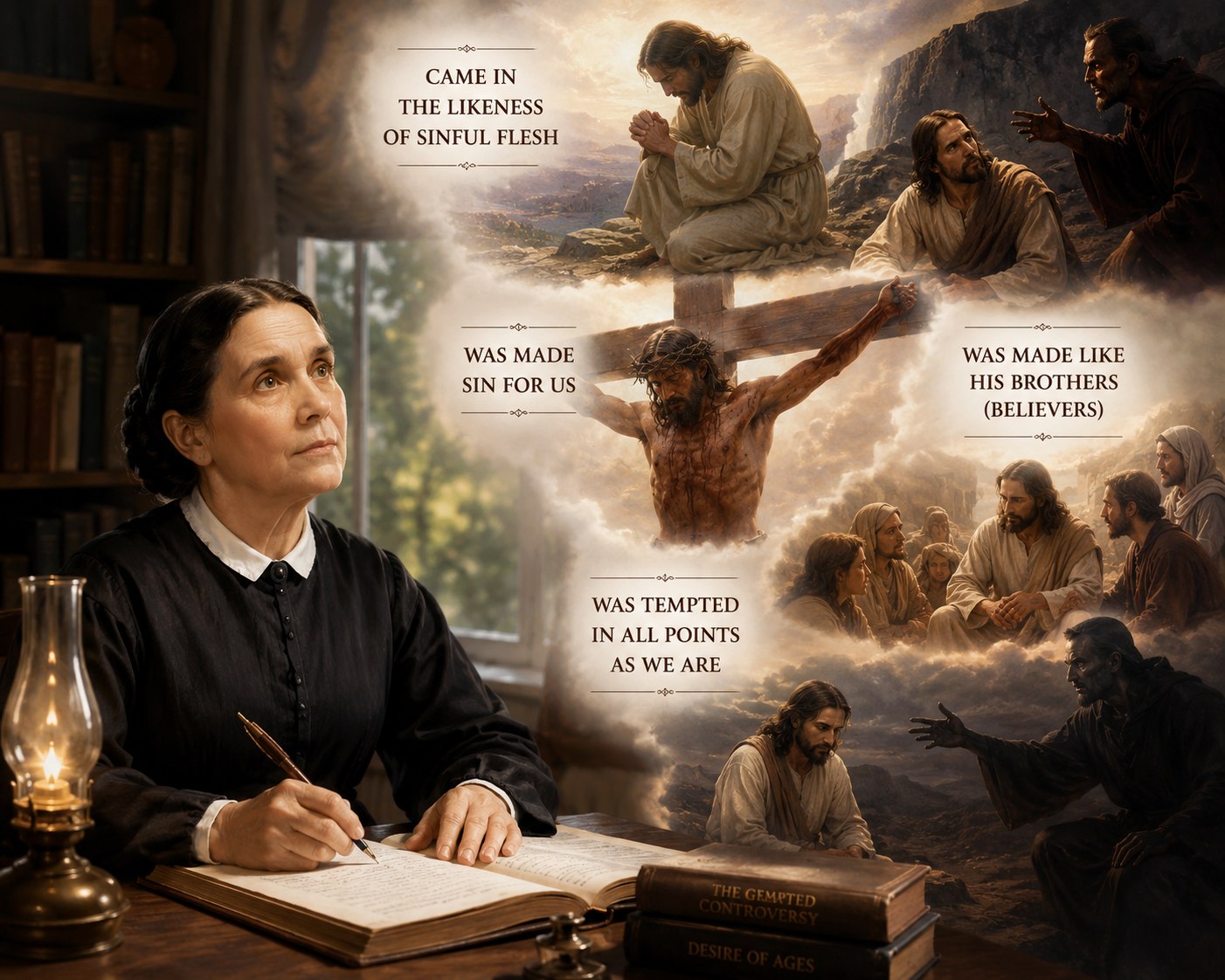
This study examines one of the most important and sensitive questions in Adventist Christology: What kind of human nature did Jesus Christ assume at the incarnation?
The purpose of this manuscript is not to diminish Christ’s sinlessness, holiness, or divinity, but rather to examine whether Ellen G. White taught that Christ truly entered the full reality of fallen human existence in order to redeem humanity from within its condition.
The central argument presented throughout this study is that Christ assumed the same fallen human nature inherited by humanity after the Fall — including the weaknesses, infirmities, hereditary degeneration, and inward pressures characteristic of fallen humanity — yet without ever becoming personally sinful, morally corrupt, or spiritually defiled.
This distinction is critically important.
According to the position defended in this manuscript, Christ never possessed cultivated sin, cherished evil, inward rebellion against God, or corrupt moral consent to evil. Although He truly entered humanity’s fallen condition, He never once yielded to temptation, even in thought.
At the same time, this study rejects the idea that Christ overcame temptation through the independent exercise of divine power unavailable to humanity.
Although fully divine, Christ voluntarily laid aside the independent use of divine prerogatives and met temptation in the same way humanity itself must overcome — through faith, surrender, prayer, Scripture, dependence upon the Father, and the continual power of the Holy Spirit.
Ellen White repeatedly emphasised this truth:
“The Saviour overcame in the same way that every sinner may overcome.” (Review and Herald, Feb. 18, 1890)
“He exercised in His own behalf no power that is not freely offered to us.” (The Desire of Ages, p. 24)
Thus His victory over sin was not artificial or inaccessible to humanity, but genuinely representative.
The law of sin dwelling within fallen humanity was condemned, resisted, and perfectly overcome in Christ’s humanity. In Him, fallen humanity rendered perfect obedience to God. At the cross, humanity’s condemned condition was judged in Christ, who bore the consequences of sin and tasted the second death on behalf of the human race.
This study therefore seeks to demonstrate — primarily from Scripture, the writings of Ellen White, early Adventist sources, and historical Adventist theology — that Christ’s humanity was truly one with the fallen race He came to redeem, while He Himself remained entirely sinless.
For readability, some older quotations have occasionally been clarified with brief explanatory words in brackets where necessary. The intention throughout has been to preserve the original theological meaning while making the material easier for contemporary readers to follow.
INTRODUCTION
When Ellen White’s statements concerning the incarnation of the Son of God are read only superficially, one may easily conclude that they contain contradictions. In some places she wrote that Christ assumed fallen human nature, while in a few other statements she appears to suggest that He may have possessed the unfallen nature of Adam before the Fall.
A good example of such an apparent contradiction may be found in an article published in Signs of the Times on June 9, 1898, where Ellen White wrote:
“We should have no misgivings in regard to the perfect sinlessness of the human nature of Christ.”
If this statement is removed from its context, one could indeed conclude that Christ assumed an unfallen human nature. However, when the entire passage is read carefully, a different picture emerges:
“In taking upon Himself man’s nature in its fallen condition, Christ did not in the least participate in its sin… He was subject to the infirmities and weaknesses by which man is encompassed… He was tempted in all points like as we are, yet without sin… We should have no misgivings in regard to the perfect sinlessness of the human nature of Christ.” (ST, June 9, 1898)
In this statement, Ellen White appears to make a very important distinction. Although Christ assumed human nature “in its fallen condition,” He “did not in the least participate in its sin.” Therefore, we should have “no misgivings” concerning the perfect sinlessness of Christ’s humanity, because although He took fallen humanity, He never sinned in that humanity.
The difference between Christ’s humanity and ours lies partly in this: our fallen humanity has sinned, while His fallen humanity never once yielded to sin. For this reason His humanity may rightly be described as perfectly sinless, even though it was truly fallen.
In another statement Ellen White wrote that Christ:
“Conquered in the same nature over which Satan obtained the victory in Eden.” (Youth’s Instructor, April 25, 1901)
Because Adam in Eden possessed an unfallen nature, one could conclude from this statement that Christ also assumed Adam’s pre-Fall nature. But if Ellen White truly believed Christ’s humanity was unfallen, how can this statement be reconciled with the many other passages in which she explicitly teaches the opposite?
Consider only a few examples:
“He took upon His sinless nature our sinful nature.” (Review and Herald, Dec. 15, 1896)
“He took upon His sinless nature our sinful nature, that He might know how to succor those that are tempted.”
“He took upon Himself fallen, suffering human nature, degraded and defiled by sin.” (Youth’s Instructor, Dec. 20, 1900)
“Christ did in reality unite the offending nature of man with His own sinless nature.” (Manuscript Releases, vol. 17)
“Coming as He did, as a man, to meet and be subjected with all the evil tendencies to which man is heir, working in every conceivable manner to destroy His faith, He made it possible for Himself to be buffeted by human agencies inspired by Satan.” Letter K-303, 1903
If Ellen White so clearly taught that Christ assumed fallen humanity, why would she also say that He “conquered in the same nature over which Satan obtained the victory in Eden”?
The answer again appears in the context of her statements. She continued:
“The enemy was overcome by Christ in His human nature. The power of the Saviour’s divinity was hidden. He overcame in human nature, relying upon God for power.” (Youth’s Instructor, April 25, 1901)
And elsewhere she wrote:
“Christ is called the second Adam… Voluntarily He passed over the ground where Adam fell, and redeemed Adam’s failure.” (Youth’s Instructor, June 2, 1898)
When Ellen White wrote that Christ “conquered in the same nature over which Satan obtained the victory in Eden,” she does not necessarily appear to mean that Christ possessed Adam’s pre-Fall condition. Rather, she seems to emphasise that both Adam and Christ stood as representatives of humanity in their conflict with Satan.
Adam represented the race in Eden; Christ, the “Second Adam,” represented the fallen race in redemption.
Nowhere does Ellen White clearly teach that Christ came in Adam’s unfallen nature before the Fall. Such an interpretation would directly contradict her many explicit statements affirming that Christ assumed humanity after four thousand years of degeneration.
This becomes even clearer in another statement written in the same year:
“The nature of God, whose law had been transgressed, and the nature of Adam, the transgressor, met in Jesus — the Son of God, and the Son of man.” (Manuscript 141, 1901)
Notice that she does not say Christ united Himself with Adam’s unfallen nature before sin, but with the nature of Adam the transgressor.
Another important statement helps clarify Ellen White’s meaning:
“Christ gained the victory where Adam fell. Our first parents were placed in Eden and surrounded with everything favorable for obedience to God. But Christ came to the world and took our fallen nature, and was tempted in all points like as man is tempted.”
This statement plainly teaches that Christ gained victory where Adam fell, yet did so in our fallen humanity, not Adam’s unfallen condition.
Ellen White similarly wrote:
“Christ took the place where Adam stood… He took man’s fallen nature, and engaged to cope with the strong foe who had triumphed over Adam.” (Redemption; or the Temptation of Christ, p. 15)
When Ellen White says Christ gained victory where Adam fell, she may also refer to the fact that both Adam and Christ were first tempted on the point of appetite:
“Christ began the work of redemption just where the ruin began. The fall of Adam was brought about by the indulgence of appetite.”
Thus, regardless of precisely what Ellen White intended by the phrase “the same nature,” the broader context of her writings strongly indicates that she did not believe Christ assumed Adam’s pre-Fall unfallen humanity.
Instead, she consistently presents Christ as entering the actual condition of fallen humanity in order to redeem humanity from within its fallen state.
SINFUL TENDENCIES
Perhaps the most frequently quoted statement used to support the claim that Christ assumed an unfallen human nature free from sinful tendencies is Ellen White’s private letter to Baker, written around 1895. She sent this letter from Australia to a young minister working in Tasmania. In this letter she wrote:
“Be careful, exceedingly careful as to how you dwell upon the human nature of Christ. Do not set Him before the people as a man with the propensities of sin… He took upon His sinless nature our sinful nature. He was tempted in all points like as man is tempted, yet He is called that holy thing… Never, in any way, leave the slightest impression upon human minds that a taint of, or inclination to corruption rested upon Christ… Never leave the impression that Christ was altogether such an one as ourselves, for this cannot be.” (Letter to Baker, SDA Bible Commentary, vol. 5, pp. 1128–1129)
From this passage it is clear that Ellen White did not believe Christ possessed sinful or corrupt inclinations in the sense of cherished evil or inward moral corruption. On this point every Christian must agree. Christ could never possess cultivated sinfulness or inward rebellion against God.
At first glance, however, this statement appears difficult to reconcile with a number of other passages in which Ellen White describes Christ as entering fully into humanity’s fallen condition.
One particularly striking example comes from a previously unpublished letter discovered in the early 1990s. Written by Ellen White to Dr. J. H. Kellogg on August 29, 1903, the letter contains one of the strongest statements in support of Christ assuming fallen humanity:
“He came to this world and stood as a man among men. He was subject to all the evil propensities to which man is heir, working in every conceivable manner to destroy His faith.” (Letter 303, 1903)
These are remarkably strong words. Left unexplained, they could easily be misunderstood. Yet they plainly indicate that Ellen White believed Christ truly entered humanity’s battle against inherited tendencies and inward pressures associated with fallen human nature.
At that time, this understanding was not limited to Ellen White alone. Other influential Adventist leaders — including Waggoner, Jones, Prescott, and many early Adventist writers — openly taught that Christ assumed humanity weakened by the Fall.
For example, M. C. Wilcox, editor of Signs of the Times, wrote in 1900:
“In the womb of His mother Christ received sinful flesh, the same flesh possessed by all the children of Adam… Yet although possessing this flesh with its tendencies to sin, He never sinned. Living faith kept the power of God ruling over these tendencies.”
Similarly, the 1909 Bible Readings for the Home Circle declared:
“Divinity dwelt in sinful flesh, not in a sinless body, but in one like that possessed by the children of earth… In this sinful flesh the Son of God manifested the glory of God by maintaining perfect victory over its tendencies.”
An even more explicit statement appeared in the 1915 edition of Bible Readings for the Home:
“On His human side, Christ inherited just what every child of Adam inherits — a sinful nature.”
Ellen White herself repeatedly wrote in ways suggesting that Christ struggled against the inward pressures characteristic of fallen humanity:
“Though He had all the strength of passion of humanity, never did He yield to temptation.” (HP 155)
“When Christ came to meet the temptations of Satan, He bore ‘the likeness of sinful flesh.’” (Signs of the Times, Oct. 17, 1900)
“Christ knows the sinner’s temptations, for He took upon Himself our nature. The strongest temptations come from within.”
“Coming as He did, as a man, to meet and be subjected with all the evil tendencies to which man is heir, working in every conceivable manner to destroy His faith, He made it possible for Himself to be buffeted by human agencies inspired by Satan.” Letter K-303, 1903
Such statements strongly suggest that Christ’s temptations were not merely external.
This raises an important question:
How can Ellen White say in one place that Christ had no evil propensities, while elsewhere saying that He was subject to inherited tendencies associated with fallen humanity?
The answer seems to lie in the distinction between:
- inherited tendencies which tempt,
- and cultivated sinful propensities which already involve moral consent to evil.
James appears to make a similar distinction:
“Then when lust hath conceived, it bringeth forth sin.” (James 1:15)
Desire itself is not yet identical with conscious sin. Temptation becomes sin only when the will consents to it.
In this sense, Christ could fully experience the inward pressure of temptation without ever yielding to it.
Ellen White therefore appears to distinguish between:
- natural inherited tendencies of fallen humanity,
- and corrupt cultivated propensities resulting from personal sin.
Christ never possessed the latter.
Herbert Douglass explained this distinction in the following way:
“Jesus fought the battle against inherited tendencies, but never for one moment did He allow temptation to conceive and become sin. Therefore it may rightly be said that He never possessed evil propensities, because He never sinned.”
Similarly, J. H. Durland wrote in 1895:
“Christ took sinful flesh that He might conquer the corruption of our old nature… Yet had He yielded once, that flesh would quickly have become the seat of all sinful passions.”
Joe Crews later made a similar distinction between cultivated sinful propensities and inherited human tendencies:
“Natural tendencies are inherited. Evil propensities are cultivated through indulgence in sin.”
This distinction appears highly consistent with Ellen White’s own language.
She wrote:
“Christ took our nature, fallen but not corrupted.” (Manuscript 57, 1890)
This statement is profoundly important.
First, it indicates that Christ truly assumed fallen humanity.
Second, it explains that His humanity was not morally corrupted through personal participation in sin.
Third, it suggests that Christ experienced temptation as a genuine inward struggle, yet without inward moral defilement.
Jack Sequeira later expressed this concept in a very insightful way:
“Temptation reached Christ through the desires of fallen flesh just as it reaches us. But because His mind remained fully surrendered to the Spirit of God, temptation never conceived and produced sin.”
Ellen White also wrote:
“Temptation is resisted when man is powerfully influenced to do a wrong action, and, knowing that he can do it, resists by faith with a firm hold upon divine power. This was the ordeal through which Christ passed.” (Youth’s Instructor, July 20, 1899)
Adam before the Fall could not experience temptation in exactly the same inward way, because there was in him no inherited law of sin pulling against obedience.
Christ, however, entered the battlefield of fallen humanity itself.
Yet throughout His entire earthly life He never once yielded.
Thus, Ellen White appears to teach that Christ:
- possessed fallen human nature,
- experienced real inward temptation,
- struggled against inherited tendencies of fallen humanity,
- yet never cultivated sin,
- never inwardly consented to evil,
- and never became morally corrupt.
In this way, Christ truly became humanity’s representative while remaining entirely sinless.

THE DISCOVERY OF LETTER K-303 (1903) AND ITS INFLUENCE ON THE ADVENTIST UNDERSTANDING OF CHRIST’S HUMANITY
One of the most discussed Ellen G. White statements on the humanity of Christ was largely unknown to the wider Adventist world until the early 1990s. The statement comes from Letter K-303, written in 1903, and addressed to Dr. John Harvey Kellogg. It contains the remarkable words:
“Coming as He did, as a man, to meet and be subjected with all the evil tendencies to which man is heir, working in every conceivable manner to destroy His faith, He made it possible for Himself to be buffeted by human agencies inspired by Satan.”
For decades, this statement was not commonly available in published Ellen White compilations, books, or theological discussions. Although the letter existed in archival files, it remained virtually unknown to most Adventists.
According to historical reports from the Ellen G. White Estate, the document came to public attention around late 1993, when Tim Poirier, assistant director and archivist of the White Estate, discovered the letter while examining old document files connected with Battle Creek materials and historical correspondence. The statement was then discussed publicly in 1994 and quickly became one of the most debated Ellen White quotations concerning the humanity of Christ.
The discovery had a profound impact on Adventist theological discussions because many readers viewed the expression:
“with all the evil tendencies to which man is heir”
as one of the strongest Ellen White statements supporting the view that Christ truly entered the full reality of fallen human existence.
At the time, the Adventist Church had already experienced decades of debate regarding Christ’s human nature. Broadly speaking, two major perspectives existed within Adventism:
- One emphasized that Christ took the nature of Adam before the Fall (the “unfallen” view).
- The other emphasized that Christ took the weakened, fallen humanity of mankind after four thousand years of sin’s degenerating effects (the “fallen” or post-Fall view).
The publication of Letter K-303 strongly energized advocates of the latter position. Many theologians, ministers, and independent ministries saw the statement as powerful confirmation that Christ fully identified Himself with fallen humanity while remaining completely sinless.
The quotation became especially influential among writers associated with the theology of:
- M. L. Andreasen
- Jack Sequeira
- Robert Wieland
- Dennis Priebe
These writers emphasized Christ’s complete identification with humanity, His victory over temptation through dependence upon the Father, and His role as both Substitute and Example for believers.
However, the statement also intensified theological controversy within Adventism. Some Adventist theologians feared that careless interpretation of the phrase “evil tendencies” could imply that Christ possessed inward sinful propensities or moral corruption. In response, they pointed to other Ellen White statements such as:
“Not for one moment was there in Him an evil propensity.”
As a result, the debate increasingly centered on how all of Ellen White’s statements should be harmonized together.
Another important issue involved the actual manuscript structure of the letter. Researchers noted that the original document contained handwritten insertions and editorial marks. Some argued that punctuation and sentence structure significantly affected interpretation. In other words, the question arose whether Ellen White meant that Christ Himself possessed “evil tendencies,” or whether He entered humanity’s sphere of temptation where Satan worked upon the inherited weaknesses and vulnerabilities of fallen mankind in “every conceivable manner” to destroy His faith.
Because of these issues, Letter K-303 became one of the central quotations in modern Adventist discussions on Christology. It appeared repeatedly in sermons, theological papers, books, camp meetings, internet discussions, and studies on righteousness by faith and Last Generation Theology.
Yet despite its influence, the discovery of the statement did not officially change the doctrinal position of the Seventh-day Adventist Church. The Church’s official Fundamental Beliefs continue to affirm that Christ became “truly human” while avoiding an overly narrow dogmatic definition concerning every aspect of the fallen/unfallen humanity debate.
Nevertheless, historically speaking, the rediscovery of Letter K-303 undeniably changed the conversation. It strengthened interest in the post-Fall understanding of Christ’s humanity, intensified theological discussion throughout Adventism, and became one of the most widely cited Ellen White statements on the subject in modern times.
THE FOUNDATION OF THE MINNEAPOLIS MESSAGE (WAGGONER’S VIEW)
Because the incarnation of the Son of God truly lies at the very heart of the gospel, the humanity of Christ became one of the central themes connected with the 1888 Minneapolis message.
It is therefore important to examine how E. J. Waggoner understood this subject.
Only a few months after the Minneapolis Conference, Waggoner published a series of articles in Signs of the Times dealing with the humanity of Christ. These articles later appeared in his well-known book Christ and His Righteousness. Consider several representative statements:
“It must have been sinful man that Christ was made like unto, for He came to redeem sinful man. Christ took upon Himself, not the nature of unfallen beings, but the nature of sinful man, with all the weaknesses and tendencies to sin to which fallen human nature is subject.” (E. J. Waggoner, Christ and His Righteousness)
Waggoner repeatedly emphasised that Christ entered the actual condition of fallen humanity in order to redeem humanity from within its fallen state.
Particularly interesting is Waggoner’s commentary on 1 Peter 2:24, which says that Christ “bare our sins in His own body on the tree.”
Waggoner wrote:
“Our sins were not merely figuratively laid upon Him, but were actually in Him. He was made a curse for us; He was made sin for us, and consequently suffered death for us… Yet He Himself committed no sin.”
Waggoner’s point was not that Christ personally became sinful in character, but that He truly identified Himself with humanity’s fallen condition and bore the full reality and consequences of sin in humanity’s place.
It is also important to remember that Waggoner’s Christology did not initially stand outside mainstream Adventist thought.
The opposition surrounding the Minneapolis Conference originally centred primarily upon his interpretation of the law in Galatians, not upon his understanding of Christ’s humanity.
In fact, following Minneapolis, Waggoner was repeatedly invited to participate prominently in General Conference sessions.
At the 1891 General Conference — three years after Minneapolis — he presented sixteen sermons on the book of Romans, again teaching that Christ assumed fallen humanity.
In 1897 he was invited once more to present a series of sermons on Hebrews, particularly concerning the incarnation and priesthood of Christ.
Again in 1901, Waggoner participated in discussions opposing the so-called “Holy Flesh” movement, which denied that Christ assumed fallen human nature.
On April 16, 1901, in the presence of Ellen White and the General Conference delegates, Waggoner delivered an extended study arguing that Christ did not possess Adam’s unfallen nature before the Fall.
Thus, according to Waggoner and many early Adventist writers, Christ truly assumed the fallen humanity of the race He came to redeem.
Even more importantly, Ellen White repeatedly endorsed the broader Minneapolis message as heaven-sent light connected with the loud cry and the latter rain.
This does not automatically mean every statement made by every individual connected with Minneapolis was infallible. However, it does strongly suggest that the central emphasis upon Christ’s nearness to fallen humanity was not foreign to the theological direction God was leading the Advent movement.
The incarnation was not presented merely as a theological abstraction.
It was presented as the very foundation of righteousness by faith.
According to this understanding:
- Christ entered humanity’s fallen condition,
- fought the battle where humanity had fallen,
- condemned sin in the flesh,
- and achieved perfect victory as the representative Head of the human race.
This understanding also explains why the humanity of Christ occupied such a central role in the preaching of Jones and Waggoner.
If Christ overcame only through advantages unavailable to humanity, His victory could not function as a genuine representative victory.
But if Christ entered the full reality of fallen human existence while depending entirely upon the Father through the Holy Spirit, then His victory becomes both substitutionary and representative.
This appears to be precisely what many early Adventist writers sought to emphasise.
For them, Christ’s humanity was not a secondary issue.
It was inseparably connected with:
- righteousness by faith,
- victory over sin,
- the practical Christian life,
- the believer’s union with Christ,
- and the vindication of God’s character in the great controversy.
WOULD CHRIST BECOME SINFUL BY ASSUMING OUR FALLEN NATURE?
One of the most common arguments used by those who believe Christ assumed sinless humanity is this: if the Son of God had taken our fallen nature, He would have become a sinful being and would Himself have needed a Saviour.
However, we must remember that although in our case the possession of fallen nature does make us sinful, this was not so in the case of Christ. In Him, fallen human nature was assumed without the least participation in its sin.
Ellen White illustrates this truth by referring to Christ touching the leper:
“His disciples sought to prevent their Master from touching the leper; for he who touched a leper became himself unclean. But in laying His hand upon the leper, Jesus received no defilement… Thus it is with the leprosy of sin… Jesus, coming to dwell in humanity, receives no pollution.” (The Ministry of Healing, p. 70)
For the same reason Ellen White could also write:
“Taking upon Himself man’s nature in its fallen condition, Christ did not in the least participate in its sin.” (SDA Bible Commentary, Ellen G. White Comments, on Hebrews 4:15)
To illustrate this point more simply, imagine that the Son of God came into this world as a symbolic number seven, representing His perfect holiness, righteousness, and divinity. Fallen human nature — weakened, condemned, and affected by four thousand years of sin — may be represented by zero.
Now, when zero is placed beside seven, it does not reduce the value of seven in the slightest. The seven remains exactly what it was before. The zero does not change the value of seven.
In the same way, the “body of sin” which Christ assumed did not diminish His holiness. The fallen humanity He took upon Himself did not make Him personally sinful.
C. E. B. Cranfield, the well-known Protestant scholar and professor of theology at the University of Durham, explains Paul’s phrase “in the likeness of sinful flesh” in Romans 8:3 in a very helpful way:
“Paul’s intention is not to call in question the reality of Christ’s sinful flesh, but to draw attention to the fact that, while the Son of God truly assumed sinful flesh, He never became sinful flesh… By using the words ‘in the likeness of’, Paul meant that although Christ assumed the same fallen nature which is ours, unlike us, it was not all that He was. He never ceased to be also the eternal Son of God.” (C. E. B. Cranfield, The Epistle to the Romans, International Critical Commentary, vol. 1, p. 379)
A helpful example of how Christ could assume our fallen nature without becoming a sinful being is found in Scripture itself. In John’s Gospel, Jesus is called “the Word”:
“In the beginning was the Word, and the Word was with God, and the Word was God… And the Word was made flesh, and dwelt among us.” (John 1:1, 14)
The written Word of God, which symbolises Christ, was written by believing yet sinful men who possessed fallen human natures. But does this mean that the Bible is a sinful and imperfect book?
Of course not.
Why? Because although the Bible was written through sinful human instruments, those men were inspired by the Holy Spirit. Therefore we call it Holy Scripture, not sinful scripture.
In the same way, although the Word of God was written through fallen human beings, it was sanctified and made alive by the Spirit of God. In Scripture, as in Christ, the human and the divine meet together.
Therefore Christ, although He assumed our fallen nature, must never be described as a sinful man. In Him, fallen humanity was united with a life of perfect faith, surrender, and uninterrupted dependence upon God through the Holy Spirit.
Let us use another illustration.
Imagine placing a sheet of paper inside a Bible. The Bible represents Christ, and the paper represents us — sinful human beings. Now imagine that this Bible, with the paper inside it, is sent to China. Since China is still a communist country, a postal official sees that it is a Bible and orders it to be burned. When the Bible is burned, the paper inside it is burned as well.
In a similar representative sense, God accomplished our salvation in Christ. Because Christ identified Himself with our united humanity, God placed us in Him. In Him, humanity rendered perfect obedience to the law. In Him, humanity also bore the penalty of sin — death.
Another important consideration showing that participation in a nature does not automatically transfer all characteristics of that nature is found in 2 Peter 1:4.
According to this passage, the believer becomes “partaker of the divine nature” (2 Peter 1:4). Ellen White also wrote, “Man must become a partaker of the divine nature.” (Selected Messages, book 1, p. 408)
Yet no one would say that because the believer becomes a partaker of the divine nature, he automatically becomes sinless or divine in himself.
Likewise, no one should say that because Christ became a partaker of our fallen human nature, He automatically became a sinful man.
The distinction is crucial.
Christ truly assumed fallen humanity, but He never participated in its sin. He met temptation in that humanity, not through the independent exercise of divine power, but through faith, prayer, surrender, and continual dependence upon His Father through the Holy Spirit — the very way humanity must overcome.
Therefore His victory was real, representative, and legally effective on behalf of the human race.
FALLEN NATURE YET SPIRITUALLY ALIVE
One of the greatest misunderstandings surrounding the humanity of Christ comes from failing to distinguish between different aspects of human nature.
Humanity after the Fall became:
- physically weakened,
- mentally darkened,
- morally damaged,
- and spiritually separated from God.
Yet these realities are not entirely identical.
Many Adventist writers have pointed out that fallen humanity possesses both inherited weakness and the inward law of sin, yet the deepest problem of humanity is separation from the life of God.
Christ truly assumed humanity weakened by four thousand years of sin. Ellen White repeatedly emphasised this:
“Like every child of Adam He accepted the results of the working of the great law of heredity.” (The Desire of Ages, p. 49)
“For four thousand years the race had been decreasing in physical strength, in mental power, and in moral worth; and Christ took upon Him the infirmities of degenerate humanity.” (The Desire of Ages, p. 49)
Yet although Christ accepted humanity weakened by heredity, temptation, suffering, mortality, and inward pressure, He was never spiritually separated from His Father in the same way fallen humanity is naturally separated.
This distinction is critically important.
Christ possessed fallen humanity, but from the very beginning His life was completely surrendered to God and governed by the Holy Spirit.
Thus, while He experienced the pull, pressure, and weakness associated with fallen humanity, His mind remained continually submitted to His Father.
Jack Sequeira explains this distinction by arguing that Christ’s fallen humanity was spiritually enlive from the moment of conception through the presence of the Holy Spirit, and that His mind remained continually surrendered to God. This helps explain why Christ could experience genuine temptation without ever becoming inwardly corrupt. (Jack Sequeira, Saviour of Every Man, p. 39)
Ellen White similarly wrote:
“Not even by a thought did He yield to temptation.” (The Desire of Ages, p. 123)
And again:
“He kept His Father’s commandments, and there was no sin in Him.” (Signs of the Times, June 9, 1898)
This continual dependence upon God is central to understanding Christ’s earthly life.
Christ did not live independently.
He repeatedly declared:
“The Son can do nothing of Himself.” (John 5:19)
“I can of Mine own self do nothing.” (John 5:30)
“The Father that dwelleth in Me, He doeth the works.” (John 14:10)
Ellen White strongly emphasised this same truth:
“As one with us, He must bear the burden of our guilt and woe. The Sinless One must feel the shame of sin… He must tread the path of temptation.” (The Desire of Ages, p. 111)
Yet throughout this conflict Christ remained fully dependent upon the Father.
He overcame:
- by faith,
- by prayer,
- by surrender,
- by Scripture,
- and through the continual power of the Holy Spirit.
This is precisely why His victory becomes both representative and meaningful for believers.
Had Christ relied upon independent divine prerogatives unavailable to humanity, His earthly life could not truly function as an example for fallen human beings.
But because He overcame in dependence upon God, His victory reveals what humanity united with God may become.
This does not mean believers become divine or cease possessing fallen humanity.
Rather, it means the same “law of the Spirit of life” that operated perfectly in Christ may also dwell within believers.
Paul wrote:
“For the law of the Spirit of life in Christ Jesus hath made me free from the law of sin and death.” (Romans 8:2)
Thus two principles are seen operating within fallen humanity:
- the law of sin in the flesh,
- and the law of the Spirit of life.
In ordinary fallen humanity, the law of sin reigns.
In Christ, however, the Spirit of God exercised complete control over His surrendered humanity.
Therefore, although Christ truly assumed fallen humanity, sin never gained dominion over Him.
This understanding also preserves the biblical balance between:
- Christ’s complete identification with humanity,
- and His absolute sinlessness.
He was not a sinner.
Yet neither was He merely pretending to enter humanity’s battle.
He entered humanity’s fallen condition fully and genuinely, met temptation where humanity had fallen, and overcame perfectly through dependence upon His Father.
In this way Christ became:
- the second Adam,
- the representative Head of humanity,
- the condemnation of sin in the flesh,
- and the perfect revelation of victorious surrendered humanity depending wholly upon God.
JACK SEQUEIRA QUOTES ON THE HUMANITY OF CHRIST
Jack Sequeira’s treatment of Christ’s humanity strongly supports the main burden of this article, provided his teaching is understood in the light of the gospel and not in a legalistic or perfectionistic way.
Sequeira does not present Christ’s fallen humanity primarily in order to teach that believers must reproduce Christ’s sinless life as a condition of salvation. Rather, he places the humanity of Christ first in the context of Christ as Saviour, Redeemer, Representative, and High Priest. Only after this does he speak of Christ as the believer’s Example.
“An integral part of this message was that Christ, in order to save humanity from sin’s guilt and punishment, as well as from its power and slavery, assumed the self-same, sinful nature of the human race He came to redeem.” (Jack Sequeira, Saviour of the World, Prologue)
This statement corresponds very closely with the position defended in this article: Christ assumed the same fallen humanity He came to redeem, not merely an external likeness to humanity.
Sequeira also explains why this issue is inseparable from the gospel:
“Through the incarnation, we who were spiritually dead were made spiritually alive in Christ.” (Jack Sequeira, Saviour of the World, “Salvation Defined”)
He then connects Christ’s assumption of fallen humanity with the full scope of salvation:
“By His birth, life, death, and resurrection, Christ redeemed fallen humanity from every aspect of our sin problem.” (Jack Sequeira, Saviour of the World, “Salvation Defined”)
This is important because it shows that, in Sequeira’s view, Christ did not merely save us from guilt and punishment. He also redeemed humanity from sin’s power and slavery.
Sequeira states this even more clearly when he writes:
“When we understand what the objective gospel actually is and what it has accomplished, it becomes clear that unless Christ totally assumed our sinful human nature that needed redeeming, none of this could be realized.” (Jack Sequeira, Saviour of the World, “Salvation Defined”)
Sequeira also strongly rejects the idea that Christ’s humanity was unlike ours in relation to the indwelling law of sin:
“The context of Romans 8:3 clearly indicates that Christ condemned sin in the very same human nature that you and I possess—a nature in which the ‘law of sin’ resides.” (Jack Sequeira, Saviour of the World, “Redeemed From the Law of Sin”)
This is one of the strongest statements for the position that Christ assumed fallen humanity with the indwelling law of sin, yet never yielded to it.
Sequeira explains how Christ overcame:
“All through His earthly life, two forces struggled within Christ’s humanity, each trying to dominate Him—the law of the Spirit of life versus the law of sin and death. The good news is that in Christ’s humanity, the law of the Spirit of life defeated and overcame the law of sin and death—and finally condemned it on the cross (Romans 8.2-3).” (Jack Sequeira, Saviour of the World, “Redeemed From the Law of Sin”)
This corresponds exactly with the central burden of this article: Christ overcame the law of sin not by using independent divine power, but through the law of the Spirit of life.
Sequeira also writes:
“God sent Christ ‘in the likeness of sinful flesh’ (Romans 8:3) in order that He might first overcome sin by His life, and then condemn that law of sin on the cross by His death.” (Jack Sequeira, Saviour of the World, “Redeemed From the Law of Sin”)
This statement is especially valuable because it brings together Christ’s life and His death: He overcame sin in the flesh throughout His life, and then condemned that law of sin on the cross (Romans 8.2-3).
In his chapter on Christ as the believer’s Example, Sequeira summarises the point in very strong language:
“Having assumed our sinful humanity with all the force of sin dwelling in its nature, Christ conquered and condemned ‘the law of sin’ through ‘the law of the Spirit of life’ (Romans 8:2), and thus became forever not only the Redeemer of the world, but also the perfect Example for believers.” (Jack Sequeira, Saviour of the World, “Christ, the Believers’ Example”)
This quote should be understood carefully. Sequeira does not mean that Christ was personally sinful, inwardly rebellious, or morally corrupt. Rather, he means that Christ assumed the fallen humanity in which the law of sin operates, yet He conquered and condemned that law through the Spirit.
At the same time, Sequeira warns against confusing this truth with perfectionism:
“Sinless living must not be confused with sinlessness or perfectionism. Sinlessness of nature will not be a reality until the second coming, when ‘this corruptible has put on incorruption’ (1 Corinthians 15:54).” (Jack Sequeira, Saviour of the World, “Christ, the Believers’ Example”)
This is a vital clarification. Even if believers may experience victory through the Spirit, their fallen nature is not eradicated before glorification.
Sequeira therefore adds:
“There will never be a time, this side of eternity, when we can live without a Saviour.” (Jack Sequeira, Saviour of the World, “Christ, the Believers’ Example”)
This protects the doctrine from legalism and from the idea that believers can reach a state of independent perfection.
Finally, Sequeira connects Christ’s humanity with His present work as High Priest:
“Because Christ partook of and overcame our sinful human nature, He is able today, as our High Priest, to both understand ‘the feeling of our infirmities’ (Hebrews 4:15, KJV), as well as ‘aid those who are tempted’ (Hebrews 2:18, KJV).” (Jack Sequeira, Saviour of the World, “Objections Considered—1”)
In summary, Sequeira’s position strongly supports the main thesis of this article:
Christ assumed fallen, sinful humanity — including the indwelling law of sin — yet He never yielded to sin, never became personally sinful, and never possessed cultivated corruption. Through the law of the Spirit of life, He conquered and condemned the law of sin in that very humanity. At the cross, He condemned sin in the flesh and bore the penalty of humanity’s condemned condition. This makes Him not only our perfect Substitute and Representative, but also our merciful and sympathetic High Priest.
The writings of Ellen White consistently present Christ as truly entering the fallen condition of humanity while remaining completely sinless.
Although He assumed weakened, degenerate, fallen human nature after four thousand years of sin, He never once yielded to evil in thought, desire, or action.
The evidence presented throughout this study strongly suggests that Ellen White distinguished between:
- fallen human nature itself,
- inherited tendencies and weaknesses,
- and cultivated moral corruption resulting from personal sin.
Christ assumed the first, experienced the second, but never participated in the third.
He did not overcome temptation through the independent use of divine power unavailable to humanity. Rather, He lived by faith, prayer, surrender, Scripture, and continual dependence upon His Father through the Holy Spirit.
Thus His earthly victory was genuinely representative.
In Christ, humanity rendered perfect obedience to God.
In Christ, the law of sin dwelling in fallen flesh was resisted, condemned, and overcome.
And at the cross, humanity’s condemned condition was judged in the person of its divine Representative.
For this reason the incarnation must never be understood merely as a theological theory.
It stands at the very centre of the gospel itself.
Only a Saviour who truly entered humanity’s fallen battle could truly redeem humanity from within that battle.
And only One who remained perfectly sinless while bearing humanity’s fallen condition could become the spotless Lamb of God.
Therefore Christ is both:
- completely one with humanity,
- and completely victorious over sin.
In Him, fallen humanity met perfect obedience, perfect surrender, and perfect dependence upon God through the Holy Spirit.
Thus the incarnation reveals not only who Christ is, but also what God intends to accomplish in humanity through the power of His Spirit.
END