144 Thousand and the New Song of Moses and the Lamb
Written by Slawomir Gromadzki
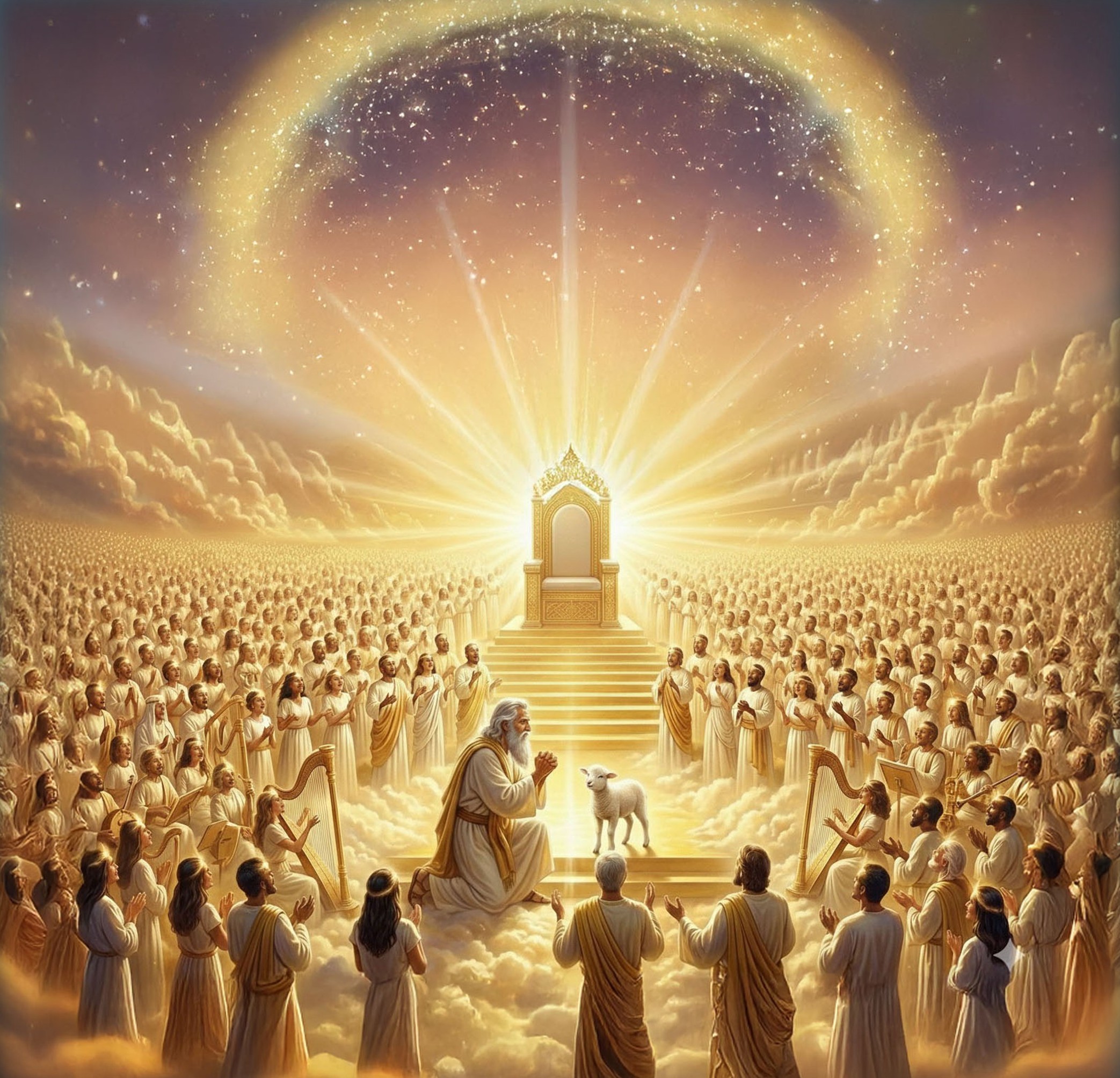
The New Song in Psalm 96:1-3
“Oh, sing to the LORD a new song! Sing to the LORD, all the earth. (not only chosen) Sing to the LORD, bless His name; Proclaim the good news of His salvation from day to day. 3 Declare His glory among the nations, His wonders among all peoples.” Psalm 96:1-3
The new song is entirely about the Good news of salvation! It is crucial to understand that this is Not good advice but actual good news!
How many people should sing this song of salvation?
The scripture commands All the earth to sing it! This explicitly means that salvation is for all, as supported by 2Cor 5.21.
What is the second subject this new song includes?
The second vital subject included in this new song is God’s glory!
What is it?
To truly comprehend what God’s glory is, we must look at Exodus 33:18. When Moses asked God to show him His glory, what did God do? In Exodus 33:18, Moses made a direct request: “And he said, ‘Please, show me Your glory.'”
Exodus 34: 5-8
The answer came in Exodus 34:6, which records the profound revelation: “6 And the LORD passed before him and proclaimed, ‘The LORD, the LORD God, merciful and gracious, longsuffering, and abounding in goodness and truth…'”
What is God’s glory?
It is His character and love.
Revelation 14
Here we can discover two important details concerning the new song. The first one is that the new song is to be sung by 144,000.
Revelation 14:1-4 states: “Then I looked, and there before me was the Lamb, standing on Mount Zion, and with him 144,000 who had his name and his Father’s name written on their foreheads. (they walk in Spirit). And they sang a new song before the throne and before the four living creatures and the elders. No one could learn the song except the 144,000 who had been redeemed from the earth. These are those who did not defile themselves with women, for they remained virgins. They follow the Lamb wherever he goes.”
Conversation With Jehovah’s Witness
One day a Jehovah’s Witness visited a SDA Pastor who invited her and asked if she belonged to 144 thousand. He asked the question because they divide their members into two camps, 144,000 who are allowed to participate in Lord’s Supper and go to heaven, and the rest who will not go to heaven but will enjoy heaven on earth and are not allowed to participate in the communion service. So, when she answered she didn’t belong to the 144 thousand he said, “If you don’t belong to the 144 thousand then according to your theology you do not have the Spirit. Is that right?” Yes, she answered, it is true as only 144,000 have the Spirit, all the rest don’t have the Spirit. After she said that, the pastor opened the Bible and read her Rom 8:9: “However, you are not in the flesh but in the Spirit, if indeed the Spirit of God dwells in you. But if anyone does not have the Spirit of Christ, he does not belong to Him.” And she was shocked that those who do not have the Spirit do not belong to Christ, which means they can’t be saved. So the pastor said: “Please, take this text to your brethren and have a Bible study with them.”
Meaning of 144,000 (Rev 14:1-4; Rev 15:3) – Paul Volk
Some time ago I was watching a health seminar by Paul Volk during which he shared the following interesting concept with regards to 144,000. The book of Revelation describes a particular group of people living before the second coming of Jesus. According to John’s description they are special because they maintain a very close relation with Christ “following Him whenever He goes”. They are described as 144,000, and 144 is an exceptional number.
If we calculate the tenth part out of 24 hours, it is very interesting because 10% of 24 hours gives us 144 minutes. In the 4th Commandment God says: “6 days you will work and do all your work”. And again it is very interesting because 6 days gives us 144 hours. God also gave us one whole day of every week – the seventh day Sabbath to rest and have special communion with Him. And one day gives 1,440 minutes.
It’s amazing how God uses numbers. He simply says to us: Every week I give you 144 hours to do your work. Just give me 144 minutes (2 hours and 40 minutes) each of these days as a time tithe (Bible study, prayers, sharing the gospel). And give me the full seventh day (1,440 minutes) so that I could enable you to follow my Son whenever He goes.
The 144,000 are so extraordinary because every day they have a custom of giving God a tithe from their time. Also on every Sabbath, they have a special communion with God for the whole day. In this way they allow the Holy Spirit to empower them and enable them to reflect Christ’s agape love and to “follow the Lamb whenever He goes”.
The book of Revelation (14:1-4) tells us that the 144,000 can “sing a new song”. And, whatever this new song is, it will be sung only by those who are redeemed (saved by God’s grace), follow the lamb wherever He goes (fallen in love with Him), have Christ’s and God’s name written on their foreheads (minds totally submitted to Holy Spirit), sing a new song no one can learn, and according to Rev 15:2 are completely victorious.
Revelation 15:3 says: “3. They sing the song of Moses, the servant of God, and the song of the Lamb…” This “new song” is not so new because it was already sung by Christ and Moses. In what sense then it is a new song to us?
Christ once said to His disciples: “A new commandment I give unto you, That ye love one another; as I have loved you” John 13:34. But, was this commandment really new? No, it was already given in the Old Testament. So, in what sense it was new? It was new for the disciples because at that time they didn’t love one another. Likewise, the new song is new only for those who haven’t yet learned it!
Learning the New Song Through Suffering
How did Jesus learn this song? Hebrews 5:7-9 tells us: “7. During the days of Jesus’ life on earth, he offered up prayers and petitions with fervent cries and tears to the one who could save him from death, and he was heard because of his reverent submission. 8. Son though he was, he learned obedience from what he suffered 9. and, once made perfect, he became the source of eternal salvation for all who obey him.”
We also can learn the new song through painful experiences and sufferings and submission.
In Help in Daily Living, page 472, it says:
“In the full light of day, and in hearing of the music of other voices, the caged bird will not sing the song that his master seeks to teach him… But the master covers the cage, and places it where the bird will listen to the one song he is to sing. In the dark, he tries and tries again to sing that song until it is learned. Then the bird is brought forth, and ever after he can sing that song in the light. Thus God deals with His children. He has a song to teach us, and when we have learned it amid the shadows of affliction we can sing it ever afterward”. God loves us and He wants us also to learn the new song and He can teach us this song only through reverent submission and sufferings.
We read that Christ and Moses already sang that song. Therefore, in order to find out what is this new song all about we need to compare the life of Moses and Christ trying to discover two most important similarities.
What Was the Greatest Achievement of Moses and Christ?
In the Old Testament God used Moses to set Israel free from slavery, and in the New Testament God also offers all of us freedom from the slavery to sin, condemnation and second death through His Son, as promised in Romans 6:8 (“… no longer slaves of sin”), Romans 8:1, and Romans 7:4,6. So the gospel of freedom is the first stanza of the new song.
What is the second vital similarity when we compare the life of Moses and Christ? Exodus 32:31-32 states: “31. So Moses went back to the LORD and said, “Oh, what a great sin these people have committed! They have made themselves gods of gold. 32. But now, please forgive their sin—but if not, then blot me out of the book you have written.””
What was Moses willing to sacrifice here for his people? He was willing to say goodbye to eternal life for them. Did he want to die forever for good people or bad, for friends or enemies? Think about how many times they accused him, criticized him, and even tried to kill him.
And what about Christ? Was He willing to do the same for us? Revelation 20:6 says: “Blessed and holy are those who have part in the first resurrection. The second death has no power over them, but they will be priests of God and of Christ and will reign with him for a thousand years.” Galatians 3:13 shows the depths He went to for us.
Paul’s Love in Romans 9:3
Another example of someone who learned from Jesus how to sing the new song is found in Romans 9:1-3: “1. I speak the truth in Christ—I am not lying, my conscience confirms it in the Holy Spirit— 2. I have great sorrow and unceasing anguish in my heart. 3. For I could wish that I myself were cursed and cut off from Christ for the sake of my brothers, those of my own race, the people of Israel.”
What is Paul offering here for the salvation of his countrymen? His eternity. Were they his friends, were they good to him? No, many times they tried to kill him. Paul like Christ and Moses was also willing to say goodbye to eternal life so that his enemies may live forever.
The Most Important Meaning of the Song of Moses and the Lamb
It is the song of God’s unselfish agape love willing to sacrifice even eternity not for friends or good people but enemies!
How Can We Learn the New Song?
We learn it through the process outlined in 2 Corinthians 3:17-18: “17 Now the Lord is the Spirit; and where the Spirit of the Lord is, there is liberty. 18 But we all, with unveiled face, beholding as in a mirror the glory of the Lord, are being transformed into the same image from glory to glory, just as by the Spirit of the Lord.”
What was Christ’s greatest dream and song and desire? To save the world in spite of sufferings and the flesh.
What should be our greatest dream? The same. To learn the new song and save the world through Christ. The question is, are we fulfilling this dream or is it always only an unfulfilled dream?
Graveyard – the Richest Plot of Land
As a conclusion let me read for you a beautiful sentence from the book “Dream Releasers” written by Wayne Cordeiro: “The richest spot on the face of the earth cannot be found in the diamond mines. No, the richest plot of land on this planet is the graveyard. Beneath those rectangular pieces of grass lie countless unsung melodies and unwritten poems. The grassy plots overflow with brilliant ideas that could have transformed entire communities, saved the lost and brought hope to the weary. Our burial grounds reek with unattained successes and unrealized dreams.”
The burial grounds on this earth are filled with the bad smell of unsung songs, and unfulfilled dreams. What will be the smell of my burial ground after I die? The grave of Jesus, however, was the poorest place on earth, because He sang all the songs He came to sing for us, He wrote all the poems he came to write for us, and he fulfilled all the dreams he had about our salvation. The graves of true Christ’s followers like Paul, Moses, Daniel, John, and Mary Magdalene are also the poorest places on earth.
We close with the ultimate vision of this triumphant group in Revelation 14:1-4: “1. Then I looked, and there before me was the Lamb, standing on Mount Zion, and with him 144,000 who had his name and his Father’s name written on their foreheads. (they walk in Spirit) 3. And they sang a new song before the throne and before the four living creatures and the elders. No one could learn the song except the 144,000 who had been redeemed from the earth. 4. These are those who did not defile themselves with women, for they remained virgins. They follow the Lamb wherever he goes.”
EGW Quotes
“And they sing ‘a new song’ before the throne, a song which no man can learn save the hundred and forty and four thousand. It is the song of Moses and the Lamb—a song of deliverance. None but the hundred and forty-four thousand can learn that song; for it is the song of their experience—an experience such as no other company have ever had.” – The Great Controversy, p. 648
“Why were they [the 144,000] so specially singled out? Because they had to stand amid the perils of the last days in the assembly of the wicked, and resist the power of the enemy… They have passed through the time of trouble such as never was since there was a nation; they have endured the anguish of the time of Jacob’s trouble; they have stood without an intercessor through the final outpouring of God’s judgments.” – Review and Herald, March 9, 1905
“Christ says that there will be those in the church who will present fables and suppositions, when God has given grand, elevating, ennobling truths which should ever be kept in the treasure house of the mind. It is not His will that they shall get into controversy over questions which will not help spiritually, such as, Who is to compose the hundred and forty-four thousand? This those who are the elect of God will in a short time know without question.” — Selected Messages, Book 1, p. 174
“Let us strive with all the power that God has given us to be among the hundred and forty-four thousand. And let us do all that we can to help others to gain heaven.” — Review and Herald, March 9, 1905
1. Moses’ Willingness to Sacrifice His Eternal Life
“In the face of this terrible revelation, Moses forgot himself; he forgot his own future, which promised so much. He forgot that God had proposed to destroy disobedient Israel, and to make of him a greater nation. He saw only their danger, their terrible doom. He stepped into the breach, and wrestled with God for their lives. His prayer came from a heart that was full of love for the people for whom he had done and suffered so much. He was willing to sacrifice his own soul, to have his name blotted out of the book of life, if God would but save his people.” — Patriarchs and Prophets, p. 326.2
“As Moses interceded for Israel, his self-forgetfulness was a type of the love of Christ for the fallen race. But the Lord did not permit Moses to bear the load of the people’s guilt. He declared to his servant, ‘Whosoever hath sinned against Me, him will I blot out of My book.'” — Patriarchs and Prophets, p. 327.1
“The crisis had arrived. The people were murmuring against Moses, and were threatening to stone him. The Lord proposed to destroy this rebellious people, and to make of Moses a greater nation. But Moses was a true shepherd. He was willing to sacrifice his own life, his own honor, his own future, for the sake of the flock of God.” — The Review and Herald, September 10, 1901
2. Christ’s Willingness to Sacrifice His Eternal Life for His Enemies
“Satan with his fierce temptations wrung the heart of Jesus. The Saviour could not see through the portals of the tomb. Hope did not present to Him His coming forth from the grave a conqueror, or tell Him of the Father’s acceptance of the sacrifice. He feared that sin was so offensive to God that Their separation was to be eternal. Christ felt the anguish which the sinner will feel when mercy shall no longer plead for the guilty race. It was the sense of sin, bringing the Father’s wrath upon Him as man’s substitute, that made the cup He drank so bitter, and broke the heart of the Son of God.” — The Desire of Ages, p. 753.1
“Wonderful, wonderful love! Christ, the Son of God, the second person of the Trinity, was willing to step down from His high estate and take upon Himself human nature, that He might stand at the head of the human race… He was willing to be treated as a rebel and an enemy, that we might be treated as loyal subjects. He was willing to give His life, His eternal life, if need be, to save a ruined world.” — Manuscript 14, 1893 (also found in The Seventh-day Adventist Bible Commentary, Vol. 5, p. 1126.6)
“While we were yet enemies, Christ died for us. He came to bring us back to God, to restore in us the divine image. He came to give us eternal life at the cost of His own life.” — The Review and Herald, September 10, 1908