Slawomir Gromadzki
NATURAL SELF-LOVE – HUMANITY’S GREATEST PROBLEM
What is humanity’s greatest problem? Why is there so much evil, so many divorces, and wars? Why do children die of hunger in one part of the world, while in many other places adults—seemingly sensitive people—instead of saving these children, spend vast amounts of money on things like armaments? What is the reason for this? What is humanity’s greatest problem?
It is our natural selfishness and lack of true love!
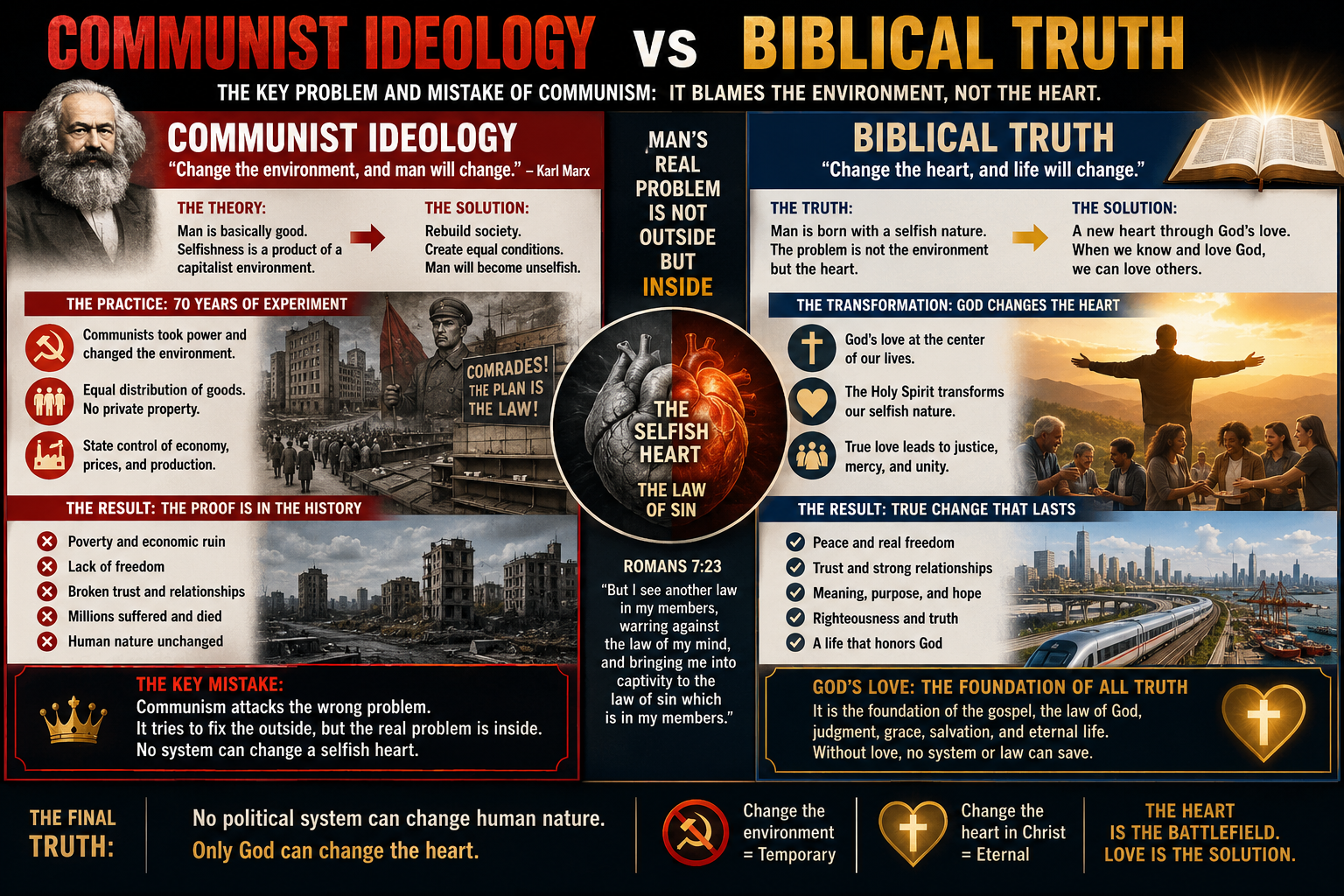
COMMUNIST IDEOLOGY VS BIBLICAL TRUTH
The co-founder of communism, Karl Marx, claimed, however, that although man is indeed a little selfish by nature, the reason for this is not so much man himself and his nature, but the environment in which he lives. When speaking of the environment, he obviously meant capitalism. Thus, Marx’s “gospel” was: “Change the environment, and man will change!”
So, the socialist revolution in Russia was to change the capitalist environment into a socialist one. All people were to receive an equal amount of material goods so that they would have something to share with others. Thanks to this, over time, they were to learn to share and slowly rid themselves of their selfish habits, which, according to Marx, were a product of capitalism.
And because this proposed way of solving humanity’s problems seemed sensible, in many countries communists took power and began to change the environment. In the Soviet Union, communists tried to change the environment for 70 years. And we all know what the effects are. A lack of trust in what the Word of God, which teaches that our problem is not environment but the selfish nature we are born with, led this great country to poverty and economic ruin. Much like my own country, Poland, and all other communist countries.
However, someone may say that China is still a communist country yet it experiences a great economic development. Yes it is true, but China’s ideology has changed and it is communist only politically, but economically capitalist. China’s economy didn’t grow by using communist ideas—it grew because China abandoned them in 1978 and switched to capitalism. Pure communism bans private companies. China changed the rules. Today, private businesses create 80% of China’s jobs and drive most of its growth. While countries like Cuba isolated themselves, China invited foreign companies to build factories, becoming the “Factory of the World” and trading with everyone. The Chinese Communist Party keeps total political control, but instead of micromanaging prices and shops, they let the free market run the economy while the state builds massive infrastructure (high-speed rails, highways, and ports). So, China is a hybrid. It is state-run capitalism.
Anyway, the history of communisem provides another evidence that the Word of God is right because our problem is not the external environment in which we live, but what is inside us: our selfishness (the “law of sin”), the tendency to love ourselves excessively, and a lack of true, unselfish love. It is from this that all the evil taking place on earth arises.
In Romans 7:23, the Apostle Paul wrote: “But I see another law in my members, warring against the law of my mind, and bringing me into captivity to the law of sin which is in my members.”
What, then, is our greatest problem?
Not the external environment, any political system, or the conditions in which we live, but the fact that there is something evil within ourselves, a certain law, a “principle”, which ensures that we possess natural tendencies to love ourselves more than anyone else!
God’s love should be at the centre of all our interests, because if we get to know it, understand its meaning and value, and realise how to obtain it, then it will subdue our own selfishness, which is the main cause of all problems, whether in our personal, family, or church life.
In addition to this, the Love of God is a matter of the utmost importance, because it forms the foundation of every biblical truth coming from God, regardless of whether it concerns the gospel, the genesis and nature of sin, the law of God, the judgement, the wrath of God, the death of unrepentant sinners, or many other truths.
DO YOU LOVE ME TO DEATH?
A little boy, who had a sincere affection for a little girl, decided to find out whether she felt the same way. So one day he asked her:
“Do you love me to death?”
“No,” she replied. “I do not love you to death.”
“Why don’t you love me to death?” the boy asked indignantly. “You know I would do anything for you! I would even give my life for you. So you don’t love me…”
“I do not love you to death,” the girl replied, “because my love is immortal.”
It is with just such a never-failing, immortal love that God has loved us. Through the mouth of the prophet Jeremiah, He says to every human being:
“I have loved thee with an everlasting love: therefore with lovingkindness have I drawn thee.” Jeremiah 31:3
There is, however, someone who is very keen for us to think of God as a harsh Being, who constantly points out our faults and wants to punish us for them.
Yet the Bible gives a completely different picture of who God actually is:
“He that loveth not knoweth not God; for God is love (AGAPE)… And we have known and believed the love that God hath to us. God is love” (1 John 4:8,16).
This is undoubtedly the most accurate definition of God found in Holy Scripture, especially if we consider the characteristics of this love given by the Apostle Paul in the 13th chapter of the First Epistle to the Corinthians, where he wrote that this love (AGAPE), unlike human love, “never faileth”.
Since, therefore, God is never-ending love and everything He does stems from this love, every biblical doctrine we consider relating to truths such as the gospel, the wrath of God, the final judgement, the eternal death of unrepentant sinners, or God’s law must be viewed in the context of the sentence, “God is Love.”
If this condition is not met, we will never properly understand these extremely important matters and distort them.

GOD’S LOVE IN ELLEN WHITE’S WRITINGS
God’s love, revealed in the plan of human salvation, has always been the theme most frequently taken up by Christian writers.
For example, the well-known and popular five-volume series by Ellen White, which wonderfully presents the entire plan of salvation, begins and ends with the sentence “God is love”.
The first of these five volumes, entitled “Patriarchs and Prophets”, begins with the words: “God is love. His nature, His law, is love. It ever has been; it ever will be. Every manifestation of creative power is an expression of infinite love…”
Likewise, the last book in this series, “The Great Controversy”, ends with the same statement: “The great controversy is ended. Sin and sinners are no more… From the minutest atom to the greatest world, all things, animate and inanimate, in their unshadowed beauty and perfect joy, declare that God is love.”
This entire five-volume series begins and ends with the sentences: “God is love”, and between these two statements lies the plan of salvation, depicting the Son of God waging a great controversy with Satan in defence of God’s love.
When the same author wrote the book “Steps to Christ”, its first chapter originally spoke of man’s need for salvation. However, God directed her to begin this book with a description of His love. So she took her pen and wrote the following words:
“God did not give Jesus merely to bear the sins of the world and die as their sacrifice on the cross. He gave Him to the fallen race! He who was one with the Father linked Himself with the children of men by a tie that is never to be broken. For this cause He is not ashamed to call them brethren (Heb. 2:11). He is our Sacrifice, our Advocate, our Brother, bearing our human form before the Father’s throne, and through eternal ages to be one with the race He has redeemed—the Son of man… By taking human nature, Christ elevates humanity. Fallen men may indeed become worthy of the name of children of God… Such love is without a parallel. We may become children of the heavenly King. What a precious promise! Theme for the deepest meditation! The matchless love of God for a world that did not love Him! The thought has a subduing power upon the soul and brings the mind into captivity to the will of God.”
TYPES OF LOVE
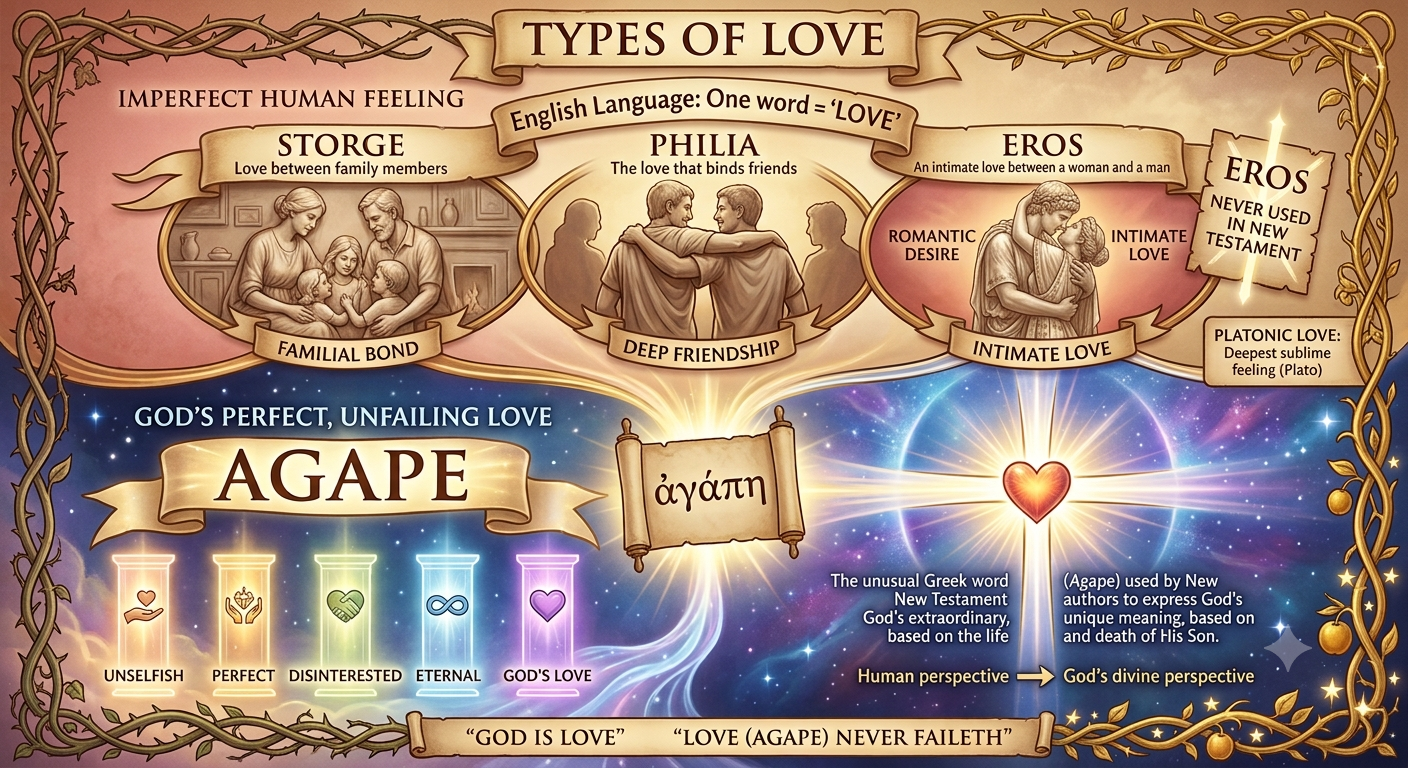
God cares deeply that we should know how great love He has for us, and how very different His love is from ours.
The greatest obstacle to perceiving this difference is that we view God’s love from the standpoint of human love, thereby bringing this greatest of divine virtues down to the level of an imperfect human feeling.
This is partly because our language, unlike the language in which the New Testament was written, uses only one word to define love. Thus, when we read in the English translation of the Bible that God is love, we often subconsciously think about human love.
But, when the books of the New Testament were being written, there were at least four words in the Greek language to define love:
STORGE: Love between family members.
PHILIA: The love that binds friends.
EROS: An intimate love between a woman and a man.
AGAPE: The unselfish, perfect, disinterested, and eternal love of God.
So, when the early Christians read the passage in the Greek text of the 13th chapter of the Apostle Paul’s First Epistle to the Corinthians, which states that love (AGAPE) never faileth, they all knew perfectly well that Paul meant exclusively God’s love.
Before the New Testament was written, however, the noun eros held the greatest significance among Greek words. With it, the Greeks expressed the deepest and most sublime feelings, which could influence a person to such an extent that they would be ready to give even their life, but only for a loved one.
Plato gave it a very deep meaning, defining it as “heavenly eros”, and later it was also called “platonic love”.
Despite this, however, in the entire New Testament, the word “eros” is not used even once. And this was no accident; it happened because the Holy Spirit, under whose inspiration these books were written, did not want a word representing imperfect human love, marred by sin, to be used to express divine and Christian love.
To express God’s love, the authors of the New Testament used a Greek word that was very little known at the time, agape, and based on the sacred history of the life and death of the Son of God, they gave it an extraordinary, unique meaning.
DIFFERENCES BETWEEN DIVINE AND HUMAN LOVE
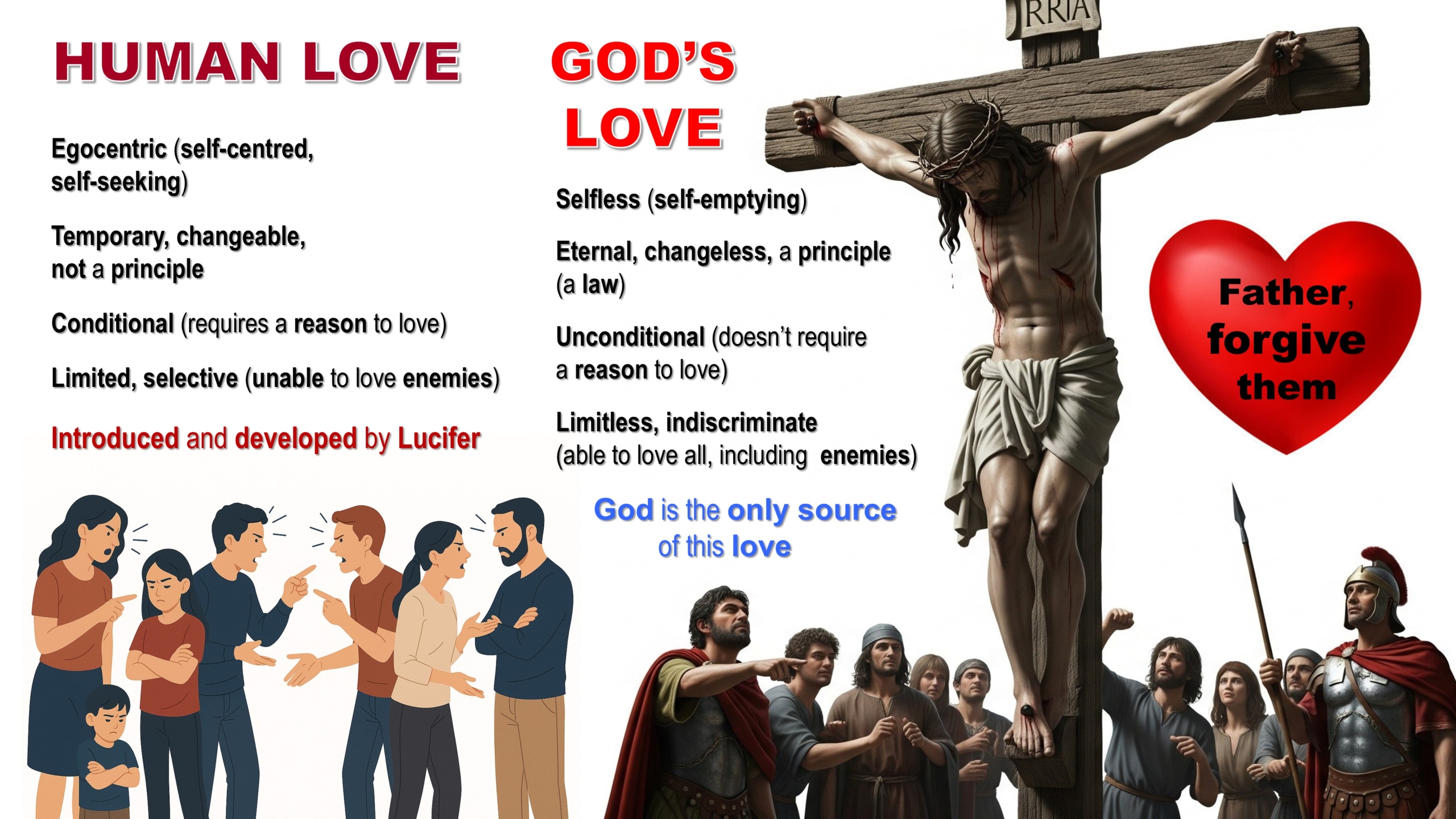
Between divine and human love there is a fundamental difference, arising from the fact that God is perfect and holy, whereas man is by nature sinful and selfish.
COMMAND TO LOVE ENEMIES
An unconverted person can only love those who reciprocate their feeling or are at least friendly towards them, whereas God is able to love everyone, both those who love Him and those who are hostile towards Him:
“But God commendeth his love toward us, in that, while we were yet sinners, Christ died for us… For if, when we were enemies, we were reconciled to God by the death of his Son…” Romans 5:8,10.
To be able to love, human nature requires certain conditions to be met, whereas agape “seeketh not her own” (1 Cor. 13:5), which means it is an unselfish and unconditional love. God loves spontaneously, because in Himself He simply is love.
Therefore, Jesus Christ commands all His followers to love even their enemies. We are to love all people unconditionally, including those who unjustly condemn us, slander and persecute us. We are to love all sinners and those who have been disfellowshipped.
This does not mean, however, that we are to love without telling the truth about them. We are to speak the truth, but with God’s love, not with anger!
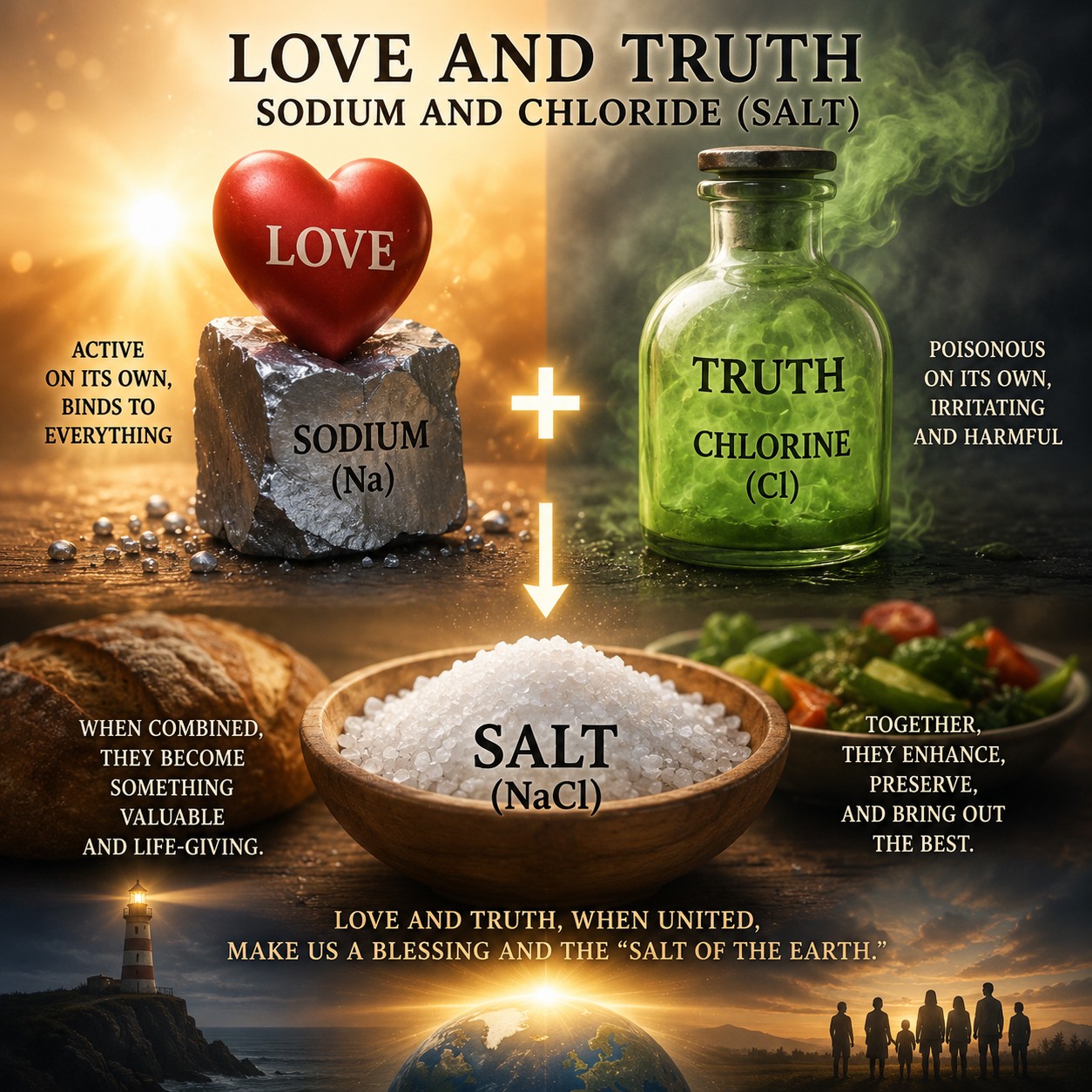
LOVE AND TRUTH – SODIUM AND CHLORIDE (SALT)
The truth must always be proclaimed with love and, conversely, true love should always be combined with truth because truth without love can kill while love without truth can be deceptive.
Very helpful in understanding this principle is the comparison of two elements, sodium and chlorine.
Sodium is an extremely active element, occurring in nature only as a compound and is always bound to other elements. Chlorine, on the other hand, is a poisonous gas with a characteristic sharp, irritating, and unpleasant smell. But when they combine, chlorine is transformed into chloride, and together they become sodium chloride (common salt), a stable compound that preserves food, enhances its flavour, and is essential for life.
It is similar with love and truth. Love and truth are like sodium and chlorine. Love without truth, just like sodium without chlorine, tends to bind itself to everything it encounters on its path. Without truth, love is careless, blind, and naive, and always tends to cling the first available theory or doctrine, even if it is false.
Truth without love, on the other hand, resembles chlorine without sodium, for truth alone proclaimed without love can irritate, destroy, and even kill. Truth alone proclaimed without love can cause people to turn away from God and the gospel, thus condemning themselves to death.
If, however, in our personal or church life, truth and love always constitute two inseparable components of our Christian life, then we will be the “light of the world”, a blessing, and what Christ called the “salt of the earth”.
JOHN STOTT ON GRACE AND LAW
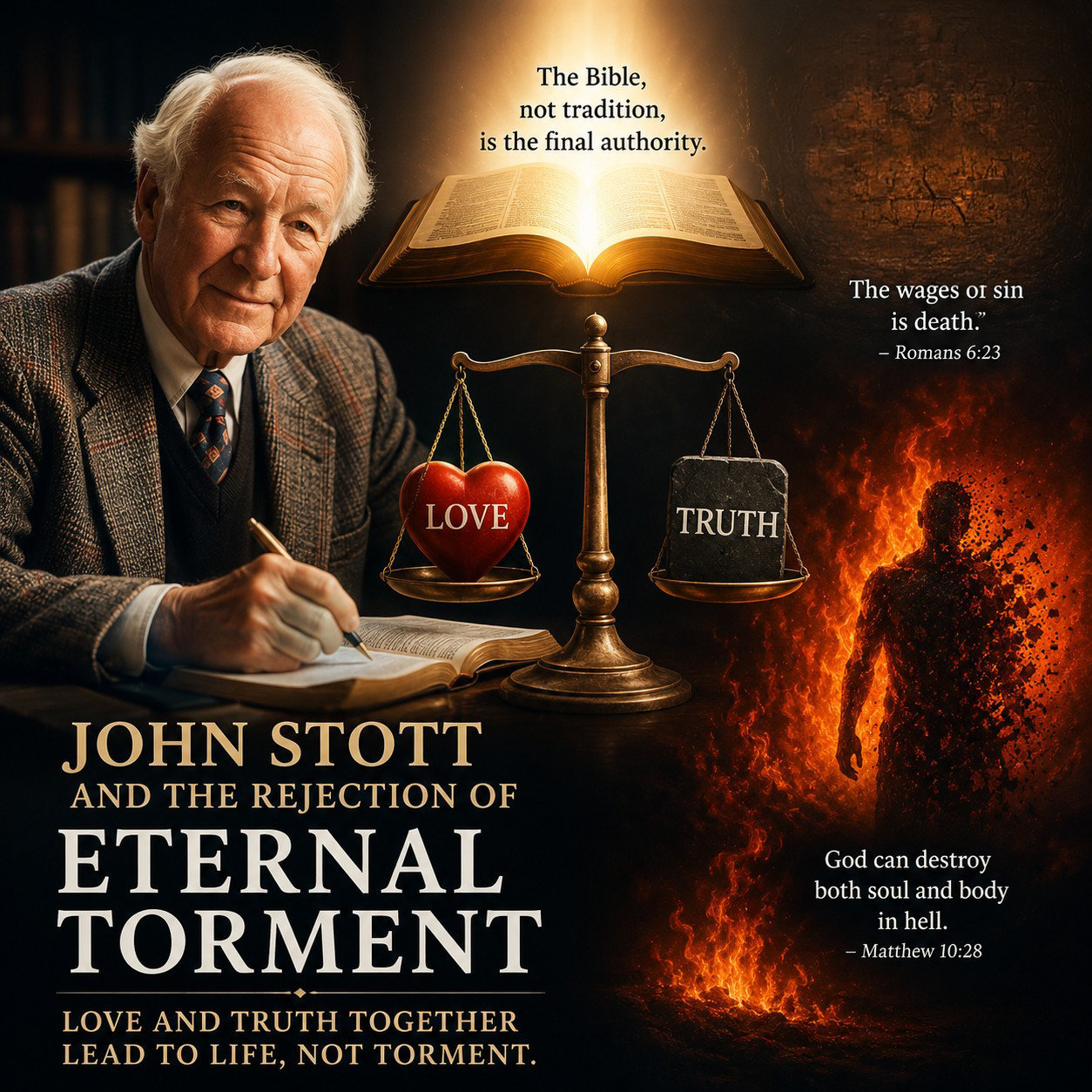
Unfortunately, the sad truth is that the extremely important principle of combining love with truth has been forgotten by the vast majority of contemporary evangelical Christians. They claim that under the New Covenant only love matters, and the truth associated with the Decalogue (including the Sabbath commandment) is no longer binding upon us.
They commit a cardinal error by focusing exclusively on love and grace alone, whilst disregarding the whole truth. And this is not merely my opinion, but such a view on the subject is currently expressed, among others, by one of the greatest authorities in the Protestant church, who is undoubtedly John Stott.
“For justification we look to the cross, not the law, and for sanctification we look to the Spirit, not the law. Legalists fear the law and are in bondage to it. Antinomianists hate the law and repudiate it. But the law-abiding free people love the law and fulfil it.” – Stott, J. R. W. (1994). The Message of Romans: God’s Good News for the World. The Bible Speaks Today, Chapter 7.
In the article “Grace and Law” he wrote the following statemen:
“In these days, God’s call to moral obedience (that is, to keeping God’s Commandments) needs to be particularly emphasised, because at least two groups of people oppose it. The first are the defenders of the so-called ‘New Morality’ developed in the 1960s. They claim that the only and absolute commandment of God is the commandment of love, and all other laws have been abolished, and that love alone is a sufficient guide for a Christian’s conduct. They forget, however, that love needs directions, and it is precisely such directions that God’s commandments provide. Love does not abolish the law, it fulfils it (Rom 13: 8-10). Secondly, there are evangelical Christians who believe that Paul’s statements ‘Christ is the end of the law‘ (Rom. 10:4) and ‘you are not under the law‘ (Rom. 6:14) mean that Christians are no longer obligated to obey the moral law of God. Attempts to keep it, they claim, are ‘legalism‘ which denies the freedom that Christ gave us. However, they misunderstand Paul. The ‘legalism’ that Paul rejected is not the law of God itself, but the attempt to gain God’s favour and forgiveness through obedience. He himself wrote that this is not possible, because ‘by the deeds of the law there shall no flesh be justified in his sight’ (Rom 3:20). Justified, however, solely by the grace of God, we are obligated to keep this law and we desire to do so. Therefore, our Christian freedom is a freedom to show obedience, not disobedience.”
This statement, whose author is not an Adventist but one of the world’s most prominent Protestant theologians, proves that the Protestant churches committed a cardinal error by separating love from truth. The Catholic Church, in turn, neglected both. We (SD Adventists), on the other hand, face yet another danger, which is that we may have a tendency to focus exclusively on the truth, whilst neglecting love and grace!
“AGAPE NEVER FAILETH” (1 COR. 13:8)
Another extremely important characteristic that distinguishes AGAPE from human love is also found in 1 Cor. 13. This chapter is a wonderful description of God’s love and should be the subject of our contemplation as often as possible: “The Lord desires me to call the attention of His people to the thirteenth chapter of First Corinthians. Read this chapter every day.” – RH July 21, 1904.
One of the most important attributes of God’s love is that, unlike human love, “agape never faileth” (1 Cor. 13:8). Unfortunately, the same cannot be said of human love. The best proof of this is the numbers of divorces increasing at an alarming rate. Someone once said that often two people before marriage cannot live without each other, and after marriage, with each other.
God, however, never stops loving, because agape is an immortal, eternal love, and embraces all, including sinful bad people. God cannot stop loving a sinful person because His love “never faileth”. This obviously does not mean that those who deliberately rejected the gift of salvation will be saved anyway, as the Word of God clearly explains what fate awaits them:
“Who shall be punished with everlasting destruction from the presence of the Lord, and from the glory of his power” 2 Thes. 1:9.
Undoubtedly, many people will perish with the second, eternal death, but this will happen not because God stopped loving them, for that is impossible, but because they did not want to place their sin upon the shoulders of the Saviour.
In the beginning, when God created Adam and Eve, their hearts were filled with God’s unselfish love. But as soon as they sinned (rebelled against God), that self-emptying love disapearred and they became contaminated with the egocentric love introduced by Lucifer.
When Adam decided to eat the forbidden fruit and share Eve’s fate, he did so, among other reasons, because he still held that imperishable love for Eve at that time, and loved her more than himself. Despite knowing perfectly well that the consequence of this act would be death, he decided to share the fate of the person he loved more than himself.
But once he had done so and committed sin, at that very moment he lost agape love, and its place was taken by selfish love: “As a result of committing sin… the love that Adam and Eve had previously shared vanished forever” (PP, p. 37).
When Adam still possessed agape, he was able to sacrifice even his own life for Eve, but when he sinned and lost this unselfish love, then, while justifying his sin before God, he shifted the blame onto Eve, saying: “The woman whom thou gavest to be with me, she gave me of the tree, and I did eat” (Genesis 3:12).
When God later asked Eve the same question, she also did not want to admit her guilt but shifted it onto the serpent. In this way, both Adam and Eve, as a result of sin, lost the right to possess agape, and all their descendants, including you and me, come into the world deprived of this greatest vertue – God’s spontanus, self-emptying, unconditional love. We appear in this world with natural sefishness.
PETER’S LOVE
It was precisely this lack of AGAPE love that was the main reason Peter denied Christ.
During the Last Supper, the Saviour told His disciples that they would all deny Him that night. Peter, however, suggested that although other disciples might indeed turn away from Jesus during the trial, his love for the Master was so strong and enduring that he would certainly not deny Him, even if he had to die for it.
Unfortunately, Peter did not know himself and did not understand that he didn’t yet possess this never-ending agape love at that time.
Therefore, shortly afterwards, in accordance with the prediction, Peter denied the Son of God three times with cursing and swearing. And since in the Jewish culture denying God in such way was equivalent to an unforgivable sin, Peter was convinced that this his great would not be forgiven him.
And, for this very reason, Christ, wishing to lift Peter’s spirits, instructed the angel to tell the women who came to the empty tomb, “go, and tell the disciples and Peter…” Mark 16:7.
With these words, the Saviour wanted to say to Peter: “If you think that because you denied me, I have stopped loving you, do not want to know you, and you can no longer be my disciple, you are mistaken, because my love for you is eternal. I will never stop loving you, and if you only desire it, you can still be my disciple.”
And although Lord Jesus forgave Peter his sin, yet before His ascension He had to have a serious conversation with Peter to make sure he understood what was his greatest need.
The Saviour, after His resurrection, appeared to the disciples by the Sea of Galilee and asked Peter three extremely important questions, which He also puts today to everyone who claims to be a Christian: “So when they had dined, Jesus saith to Simon Peter, Simon, son of Jonas, lovest (agapas) thou me more than these?” (John 21:15).
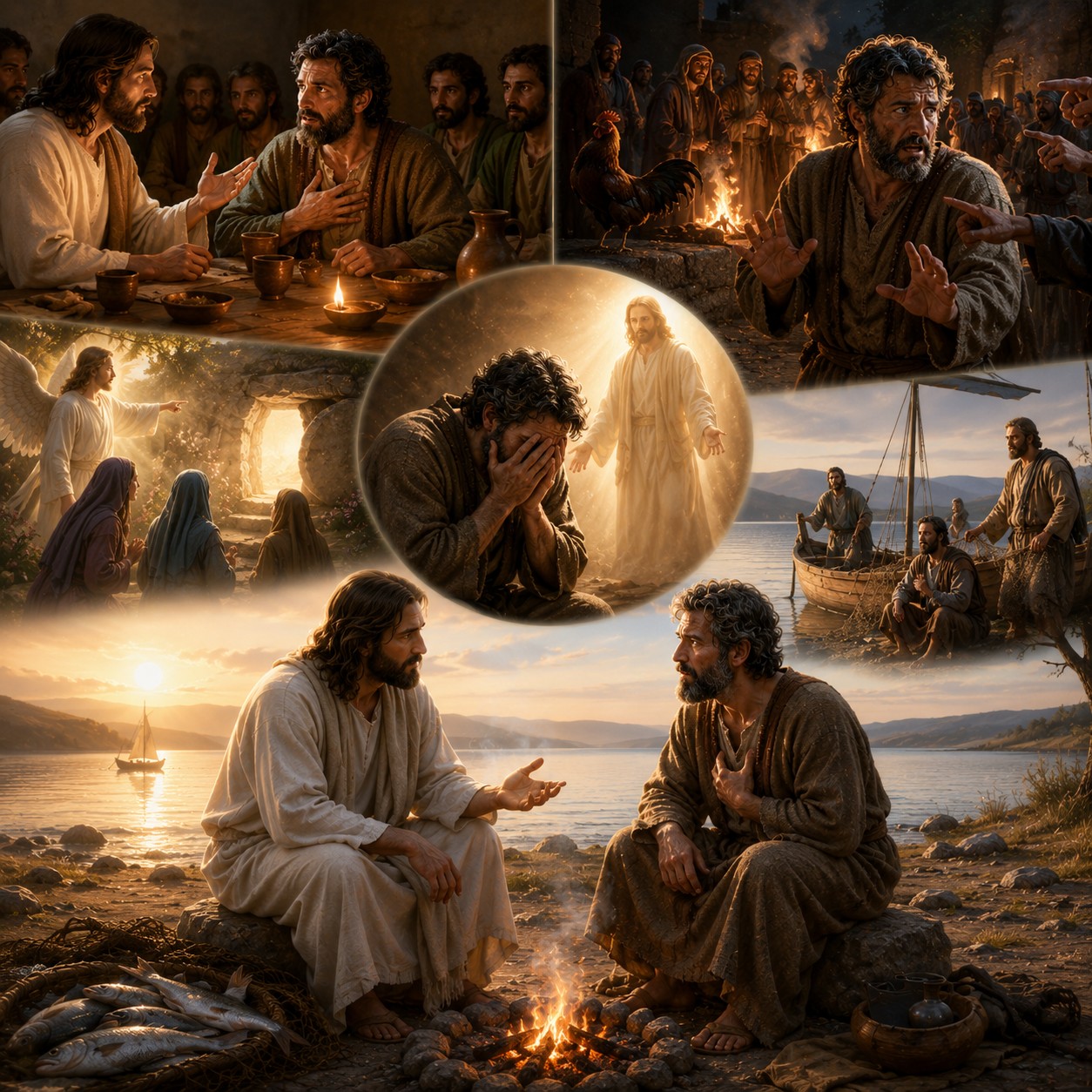
In asking this question, Christ used the Greek verb “agapao” so that Peter would have no doubt as to what kind of love was meant. Thus, the Lord Jesus asked him whether he still believed he possessed the agape love that never fails, and whether he still thought his feeling for his Master was more enduring and stronger than that which the other disciples possessed.
Here is the answer Peter gave to this question: “He saith unto him, yes, Lord; thou know that I love (philo) thee” (John 21:15).
When we read this in English, it looks as though Peter still stubbornly maintained that he possessed such an unwavering love, but when we carefully read this same passage in the Greek language, it turns out that in saying “I love you”, Peter did not use the verb “agapao”, which Christ had used, but “phileo”, which was not used to express God’s love, but an imperfect human feeling relating to the bond existing between friends.
Peter, therefore, answering Jesus’ question, humbly confessed – “Yea, Lord! You are right and You know that I do not yet possess agape, but I hold for You only such human love (filia), and that is why I denied You.”
When with these words Peter showed that he now knew what constituted his greatest need, the Saviour said to him: “Feed my lambs.” – Since you already know that God’s AGAPE love is not yet your portion, you can now ask for it, and when you receive it, you will be ready to take care of those who believe in Me.
Then, for the second time, Christ asked Peter the same question and received exactly the same answer, but when He repeated this question for the third time, He made a certain change: “He saith unto him the third time, Simon, son of Jonas, lovest (phileis) thou me?” (John 21:17).
This time, for some reason, Christ did not use the verb “agapao”, but “phileo”, which means that now He asked Peter whether he loved Him with such an imperfect human love relating to friendship. Then the sorrowful Peter sincerely replied that he certainly held such love for Christ:
“Peter was grieved because he said unto him the third time, Lovest (phileis) thou me? And he said unto him, Lord, thou knowest all things; thou knowest that I love (philo) thee. Jesus saith unto him, Feed my sheep” (John 21:17 ).
Peter was grieved, not because Christ asked this question for the third time, but because this time He asked Peter whether he definitely had at least that kind of love for Him. Peter, undoubtedly, already held such affection for Christ at that time and would sincerely want to suffer for Him, and even give his life, but love for himself was still stronger at that time than the feeling he held for the Saviour.
The Lord Jesus, however, in His mercy comforted Peter, assuring him that a time would come when he would be able to correct his mistake, and this time he would not deny his Saviour, because his portion then would be not merely filia, but agape.
SECOND DEATH – THE WAGES OF SIN
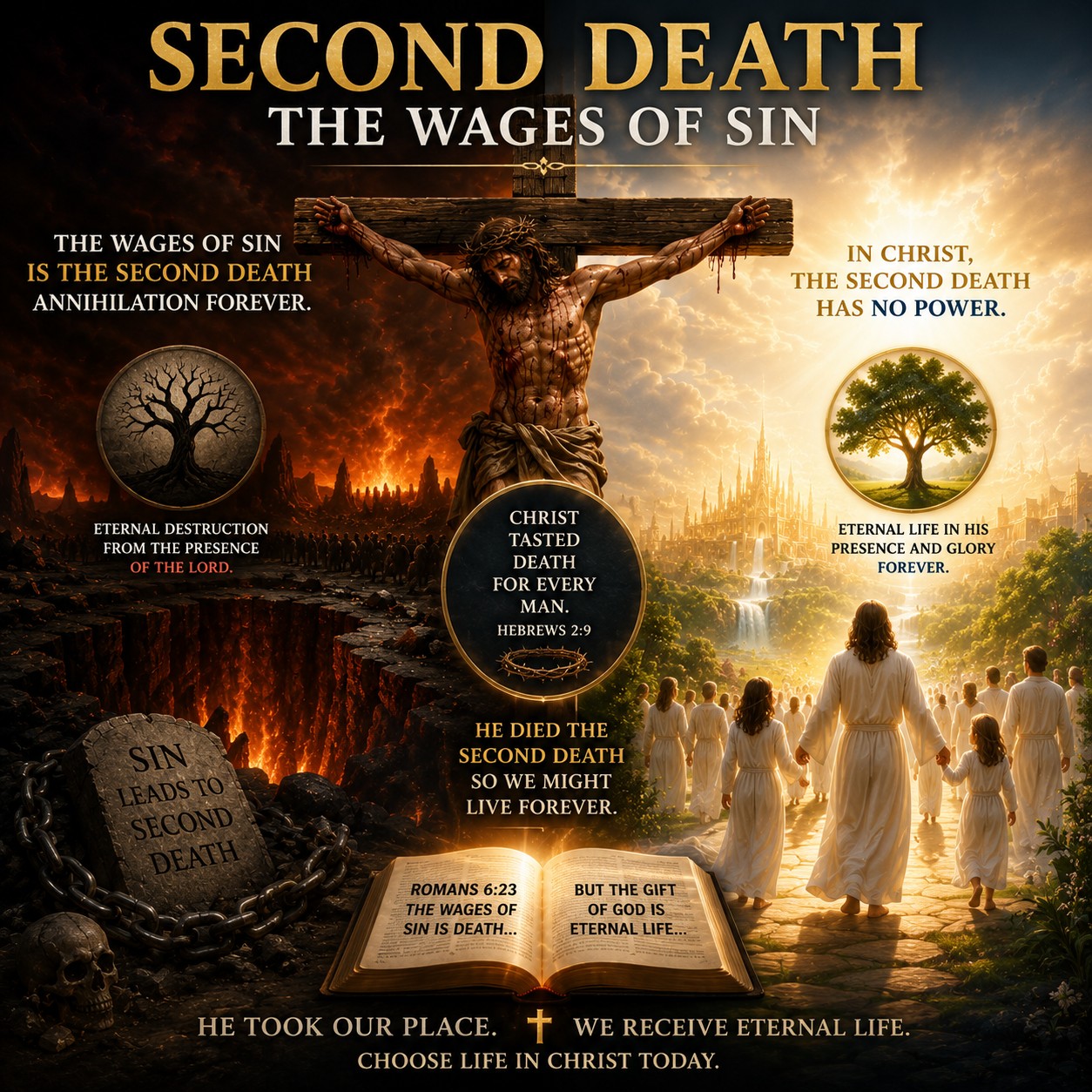
The death our Saviour died was no ordinary martyr’s death. To obtain the right to save man, who was condemned to eternal death, the Son of God had to taste that same death Himself, for the Word of God explicitly states that the wages of sin is the second death, which is annihilation forever:
2 Thess. 1:7-9 “…when the Lord Jesus shall be revealed from heaven with his mighty angels, In flaming fire taking vengeance on them that know not God, and that obey not the gospel of our Lord Jesus Christ: Who shall be punished with everlasting destruction from the presence of the Lord, and from the glory of his power”
Since the punishment for sin is eternal death, by what right could the Son of God save us from this death if He had not tasted it Himself?
In Romans 3:26 we read that God sent His Son “To declare, I say, at this time his righteousness: that he might be just, and the justifier of him which believeth in Jesus.”
This means that in justifying sinful man, God had to act justly, that is, in accordance with the requirements of His unchangeable Law.
And since this Law demands eternal death from everyone who has transgressed it, Christ, representing fallen humanity, also had to experience that same death.
In the Epistle to the Hebrews 2:9, the Apostle Paul wrote that Christ “should taste death for every man.”
But which death did the apostle mean here?
There is no doubt that Christ could not have tasted the first death to save us from it, because over the centuries many people believing in Him have lived who, despite this, had to die this first death.
If this kind of death were the wages of sin, and if the Lord Jesus had saved them from it, then they would not have to die this death. This means that the Apostle Paul, writing that “Christ tasted death for every man”, could only have meant the second, eternal death, because it is this which constitutes the final punishment for sin.
This is also confirmed by the Apostle John, who writes in the book of Revelation that not the first, but exclusively the second death (eternal), has no power over believers:
Rev. 20:6 “Blessed and holy is he that hath part in the first resurrection: on such the second death hath no power…”
Why did John, inspired by the Holy Spirit, write that those who believed in Christ would not die the second death?
There can be only one answer to this question; no sincere Christian will have to die forever, because Someone was found who already died such a death on his behalf.
The first death cannot be the punishment for sin at all, as this death is only a certain period of unconsciousness preceding the resurrection of all people, both the righteous and the wicked.
If only this death constituted the punishment for sin, then it would mean that sin actually entails no punishment, because every unrepentant sinner, after experiencing the first death, would be resurrected and live forever, continuing to lead their wicked and selfish life, increasingly poisoning the universe with the poison of sin and selfishness.
GETHSEMANE
To be able to save us, the Son of God had to pass through the experience of the second death.
There are many biblical arguments confirming the truth of this claim. One of them can be the experience that was Christ’s portion during the night preceding His martyr’s death.
The Saviour’s behavior in the Garden of Gethsemane proves that He feared something intensely:
Matt. 26:37-39: “And he took with him Peter and the two sons of Zebedee, and began to be sorrowful and very heavy. Then saith he unto them, My soul is exceeding sorrowful, even unto death: tarry ye here, and watch with me. And he went a little further, and fell on his face, and prayed, saying, O my Father, if it be possible, let this cup pass from me…”
Luke 22:44 “And being in an agony he prayed more earnestly: and his sweat was as it were great drops of blood falling down to the ground.”
Considering the physiology of the human body, only exceptionally severe stress could have caused such a symptom.
He, before whom demons trembled, was now mortally terrified because of the “cup” which He Himself was to drink as the representative of the fallen human race.
The bravest Son of God in the entire universe was now so very afraid of something that bloody sweat fell from His brow.

To understand what was the cause of this terrible agony that the Lord Jesus suffered in Gethsemane, we must explain on the basis of the Bible what the “cup” is a symbol of, the drinking of which the Saviour so greatly feared:
Rev. 14:9-10 “…If any man worship the beast and his image, and receive his mark in his forehead, or in his hand, The same shall drink of the wine of the wrath of God, which is poured out without mixture into the cup of his indignation; and he shall be tormented with fire and brimstone”
Ezek. 23:32-33 “Thus saith the Lord God; Thou shalt drink of thy sister’s cup deep and large: thou shalt be laughed to scorn and had in derision; it containeth much. Thou shalt be filled with drunkenness and sorrow, with the cup of astonishment and desolation”
Hab. 2:16 “…the cup of the Lord’s right hand shall be turned unto thee, and shameful spewing shall be on thy glory.”
On the basis of these passages, one can draw the conclusion that the “cup” in Holy Scripture symbolises the wrath of God that is to fall upon unrepentant sinners. This wrath, as is evident from the above texts, is synonymous with destruction, horror, separation from God, and eternal death in fire.
Now we know why Christ was so very afraid of drinking this “cup”. We begin to understand why bloody sweat fell from His brow.
It was so because He knew that the wages of sin—not His sin, but ours—is death, and that the second death, parting with life forever.
Since the word cup carries such a meaning, it is no wonder that the human nature of the Son of God shrank from drinking it.
When we compare the impression that the vision of approaching death made on Christ with the attitude toward death displayed by Paul, we might conclude that he was more courageous than the Son of God:
Acts 21:10-14 “And as we tarried there many days, there came down from Judaea a certain prophet, named Agabus. And when he was come unto us, he took Paul’s girdle, and bound his own hands and feet, and said, Thus saith the Holy Ghost, So shall the Jews at Jerusalem bind the man that oweth this girdle, and shall deliver him into the hands of the Gentiles. And when we heard these things, both we, and they of that place, besought him not to go up to Jerusalem. Then Paul answered, What mean ye to weep and to break mine heart? for I am ready not to be bound only, but also to die at Jerusalem for the name of the Lord Jesus. And when he would not be persuaded, we ceased, saying, The will of the Lord be done.”
Unlike Christ, the Apostle Paul was not afraid, because he was not going to meet the death that is the wages of sin. He knew that Someone else had already paid this penalty on his behalf.
Paul knew that the death awaiting him was only an unconscious, short-lived sleep, ending in an awakening to a new, wonderful life.
For this reason, in the Epistle to the Philippians, showing no fear of death, he confessed:
“For to me to live is Christ, and to die is gain.” Philippians 1:21
The death, however, which the Lord Jesus was going to meet was not a sleep, but separation from God and the experience of His wrath, the curse of the Law (Gal. 3:13), and the wages for the sin of fallen humanity.
CROWN OF THORNS
Have we wondered why a crown of thorns was placed on the Saviour’s head? Certainly, among other things, to mock Him, but perhaps it had some deeper meaning?
What do thorns symbolise in the Bible?
Genesis 3:17-18: “And unto Adam he said, … cursed is the ground for thy sake; … Thorns also and thistles shall it bring forth to thee; and thou shalt eat the herb of the field”
Hebrews 6:7-8: “For the earth which drinketh in the rain that cometh oft upon it, and bringeth forth herbs meet for them by whom it is dressed, receiveth blessing from God: But that which beareth thorns and briers is rejected, and is nigh unto cursing; whose end is to be burned.”
Thus, the crown of thorns, like the cup, can symbolise a curse in the Bible.
THE CROSS
Many Christians do not perceive that the Saviour tasted eternal death for us, because they look at the cross only through the eyes of the Roman soldiers, who saw there only a physically suffering man.
However, when we look at Jesus dying on the cross from the standpoint of the Jews, we can perceive something there, after understanding which Jesus’ disciples were never the same disciples again.
What was death on a cross to the Israelites?
This method of executing punishment constituted the most shameful kind of death for them, and they despised this method of killing.
The method of executing the death penalty on a sinner commonly used by them was stoning.
Why, then, during Christ’s trial, did the Jews insist so strongly to Pilate that He be crucified, since they themselves did not recognise this cruel method of killing?
The Jews forced Pilate to agree to sentence Christ to death on a cross because they actually desired something much worse than death for Him.
In crying out to Pilate to crucify Christ, they had in mind what Moses wrote regarding the execution of punishment on sinners deserving death:
Deut. 21:22-23 “And if a man have committed a sin worthy of death, and he be to be put to death, and thou hang him on a tree: His body shall not remain all night upon the tree, but thou shalt in any wise bury him that day; (for he that is hanged is accursed of God;) that thy land be not defiled, which the Lord thy God giveth thee for an inheritance.”
Every criminal tried and sentenced to death by the Mosaic law was usually stoned and then hanged on a post or tree, which was meant to signify that he was irrevocably rejected by God.
This man was accursed not because he hung, but the fact that he was suspended on a tree stood as symbolic testimony that he deserved to be accursed and rejected by both God and men.
It is no wonder, then, that when Christ was crucified, His disciples had doubts as to whether He was actually the Son of God, since He hung on a tree, which for them as Jews was synonymous with God’s curse and rejection.
A well-known commentary on Holy Scripture—”Matthew Henry’s Commentary”—discussing this passage suggests that:
“Those who in those days saw a man hanging between heaven and earth knew that he was accursed and unworthy not only of heaven, but even of earth.”
Christ’s enemies hated Him so much that they desired death on a cross for Him, because they thought that if He hung on a tree (the cross) between heaven and earth, then according to the words that God Himself spoke through Moses, He would become accursed by God. The Jews, therefore, wanted Jesus to perish forever.
What is extraordinary, and for many even shocking, is that Holy Scripture states that the Son of God did indeed become such a curse, but He became it for us:
Gal. 3:13 “Christ hath redeemed us from the curse of the law, being made a curse for us: for it is written, Cursed is every one that hangeth on a tree”
This is how Ellen White comments on this passage:
The Desire of Ages, p. 743 “Christ, representatively standing at the head of humanity, was to suffer outside the boundaries of Jerusalem. He died outside the city gate, where criminals and murderers were executed. Full of significance are the words: ‘Christ hath redeemed us from the curse of the law, being made a curse for us’ (Gal. 3:13).”
What did the Apostle Paul wish to make understood in Gal. 3:13 by writing that in order to redeem us from the curse of the law, Christ Himself had to become such a curse?
The correct answer to this question can be found only when we understand what the author meant by the phrase “the curse of the law”.
The explanation of what this “curse of the law” is can be found a few verses earlier:
Gal. 3:10 “For as many as are of the works of the law are under the curse: for it is written, Cursed is every one that continueth not in all things which are written in the book of the law to do them.”
From the above statement it follows that accursed are all those who believe that through their good works they deserve eternity. However, for any human being to be able to obtain immortality through the works of the law, they would have to, as is evident from the text, “continue” in fulfilling the dictates of this law, that is, fulfil it perfectly even in the mind and never transgress it.
Since, however, no sinful man is able to meet this condition, everyone who, in the matter of salvation, relies not on Christ but on the law is accursed, or in other words, deserves eternal death.
Remembering, therefore, that according to Gal. 3:10 the curse of the law is the second death, let us read once again what Paul wrote three verses later in Gal. 3:13: “Christ hath redeemed us from the curse of the law, being made a curse for us: for it is written, Cursed is every one that hangeth on a tree”
Paraphrasing this passage, we can read it in the following way: “Christ hath redeemed us from the curse of the law (that is, from the second death), being made a curse for us (partaking in the second death for us): for it is written, Cursed is every one that hangeth on a tree”
Thus, the fact that Christ “hung on a tree”, becoming a curse for us, must mean that as the representative of all sinful humanity, He Himself passed through the experience of this second, eternal death, which is the curse of the law.
Consequently, the “tree”, that is, the cross, also signifies a “curse”.
This is why Paul wrote in Gal. 6:14: “But God forbid that I should glory, save in the cross of our Lord Jesus Christ, by whom the world is crucified unto me, and I unto the world.”
THREE TREES
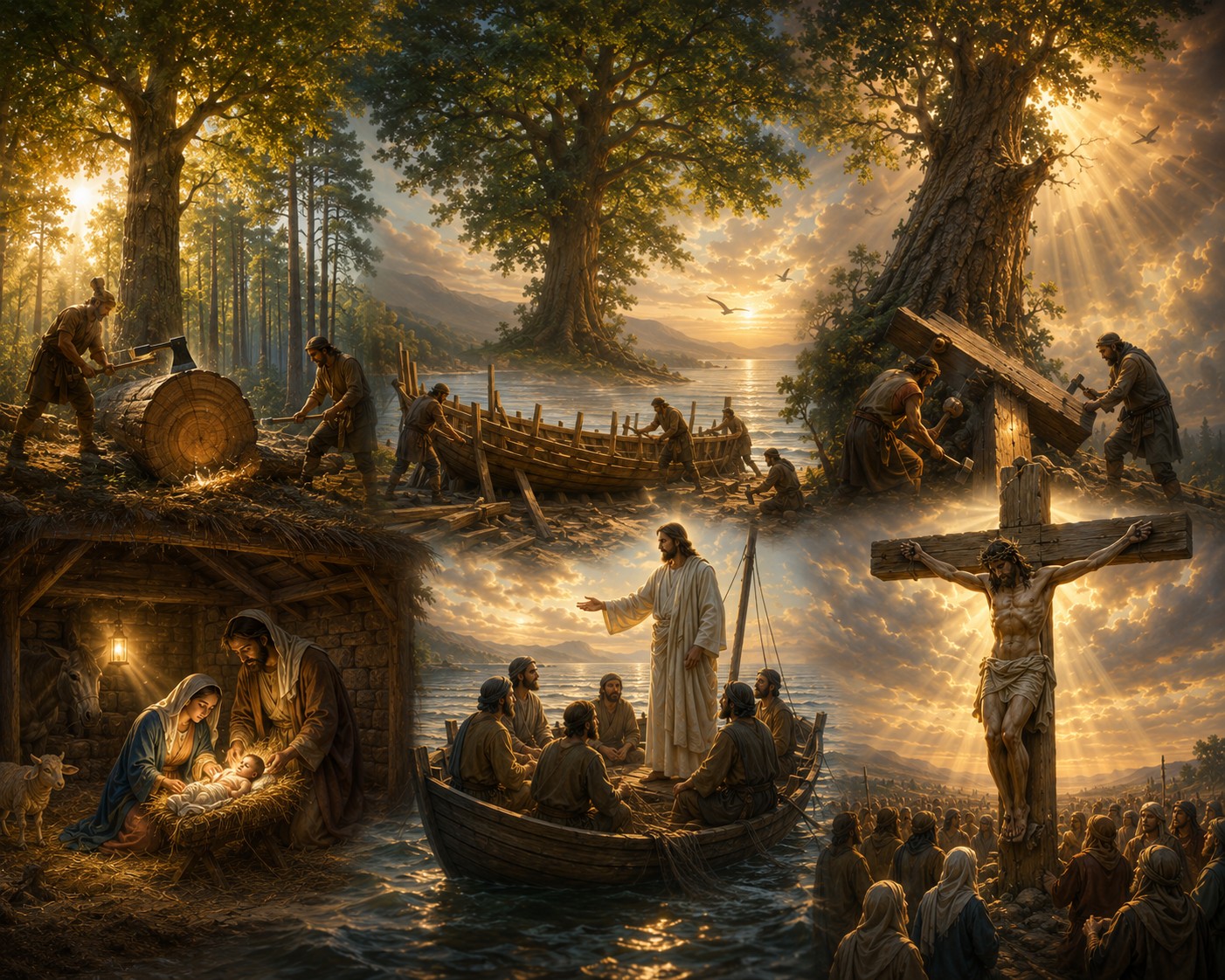
There is a beautiful story about three tall, lofty, and beautiful trees that grew in a forest a long time ago. The first tree prayed that after being cut down, the most magnificent structure would be built from it, in which the greatest kings and rulers of the world could live.
However, instead of this, the planks of this tree were used to build an ordinary stable in which animals lived, and the tree considered this an insult to its noble origin.
Yet one day, in this stable, a little Boy came into the world, who was the Son of God and the Saviour of the world.
The second tree prayed that after being cut down, the most beautiful ship would be built from it, on which the greatest rulers of the world could sail. But this tree was used to build an ordinary fishing boat.
Yet one day, into this ordinary fishing boat entered the Son of God Himself – the Saviour of the world, and from this boat, on the shore of the Sea of Galilee, He delivered the most beautiful sermons that people could ever listen to.
The third tree earnestly asked God in prayers that it would never be cut down by a cruel axe, and that it might forever point to heaven with its tall, beautiful canopy.
Unfortunately, this time too, that sad day arrived when woodcutters came and applied a sharp axe to the trunk of this tree. Then, in despair, it cried out to God: “Why?! Why?!”.
Yet one day, two beams were fashioned from the trunk of this tree and made into a cross, a cross which forever was to direct the attention of the entire universe to heaven – the source of incomprehensible love.
The fact that Christ died hanging on a cross was initially the greatest obstacle for the Jews to recognise Him as the Messiah.
Their attitude toward Jesus changed only when they realised that this curse which fell upon Him was meant to be their portion, and that He died not because of His own sins, for He had none, but “was made a curse for us”.
The fact that the Son of God became a curse for us means that at a certain moment hanging on the cross (the tree), He felt like a sinner dying forever and rejected by God.
It was for this very reason, passing through unimaginable sufferings, that in despair He cried out to the Father (Matt. 27:46):
“Eli, Eli, lama sabachthani? that is to say, My God, my God, why hast thou forsaken me?”.
The answer to this question is found in the well-known passage from the Gospel of John (3:16):
“For God so loved the world, that he gave his only begotten Son”.
Although God was actually very close to His Son then and suffered no less than He Himself, He could not let Him feel His presence, because the Lord Jesus had to drink the cup of God’s wrath to the dregs and feel like a sinner dying forever.
God has a countless number of children in the universe whom He loves, but the Son, who was with Him always from eternity, He had only one. And though He loved Him as no one else in the entire universe, He allowed Him to experience unimaginable sufferings for our sake. This is perhaps the best proof of what an extraordinary love He bestowed upon us.
Holy Scripture says nothing about how God the Father Himself felt at the moment when His Beloved Son asked Him why the One whose love had accompanied Him from eternity had now forsaken Him. We can only guess that for God it was just as terrible and painful an experience as it was for His Son. God the Father undoubtedly suffered along with Christ out of love for us and to save us from eternal ruin. It was so because they constitute a perfect unity. Sister White understood this matter in the same way, as evidenced by what she wrote in a comment on Matt. 27:45-46:
“Angels suffered with Christ. God Himself was crucified with Him, for Christ was one with the Father.”
UNABLE TO SEE RESURRECTION
A certain pastor working in Africa as a missionary once asked an interesting question to a group of converted locals:
-
How many people do you think have died in the world so far?
-
Oh, pastor – replied the Black men – millions and millions, so many that no one can count them!
-
You are mistaken – said the missionary – so far, only one man has truly died – Jesus Christ, and everyone else has only fallen asleep.
So far, among all people, only the Son of God has tasted eternal death.
Someone, however, might ask: – How is it possible that Christ thought He was dying the second death, since He had previously predicted His resurrection?
The answer to this question is found in Psalm 40, which expresses the sufferings and thoughts of Christ dying on the cross:
Psalm 40:7-8
“Then said I, Lo, I come: in the volume of the book it is written of me, I delight to do thy will, O my God…”
Psalm 40:12,14
“For innumerable evils have compassed me about: mine iniquities have taken hold upon me, so that I am not able to look up;… Let them be ashamed and confounded together that seek after my soul to destroy it”
Expressing the thoughts of the dying Saviour, the psalmist, inspired by the Holy Spirit, wrote:
“Mine iniquities have taken hold upon me, so that I am not able to see.” Psalm 40:12
The crushing weight of our sins meant that the Lord Jesus at one point could not “see”, that is, He was unable to see His resurrection.
A similar statement is found in the book “The Desire of Ages” (p. 753):
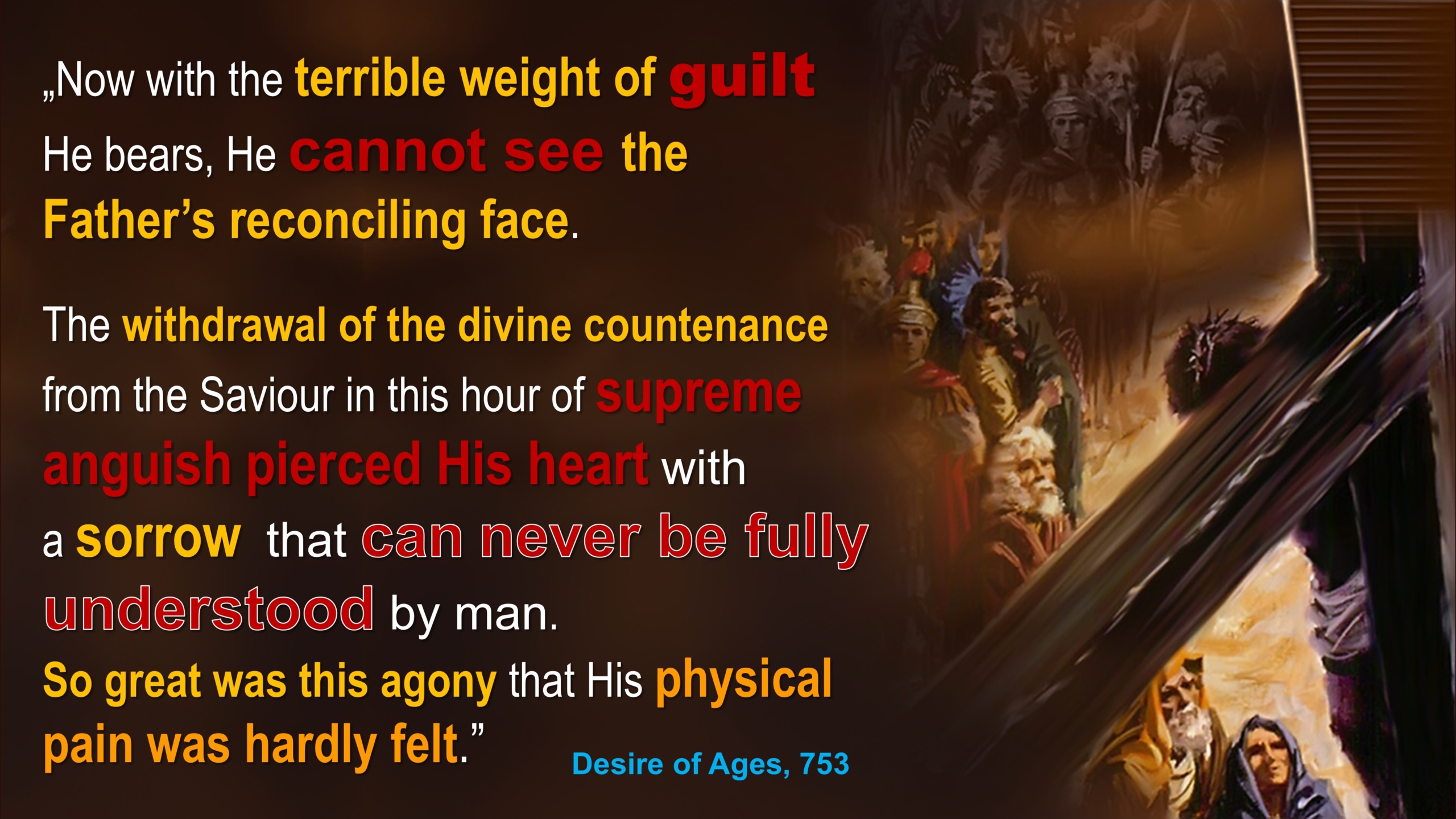
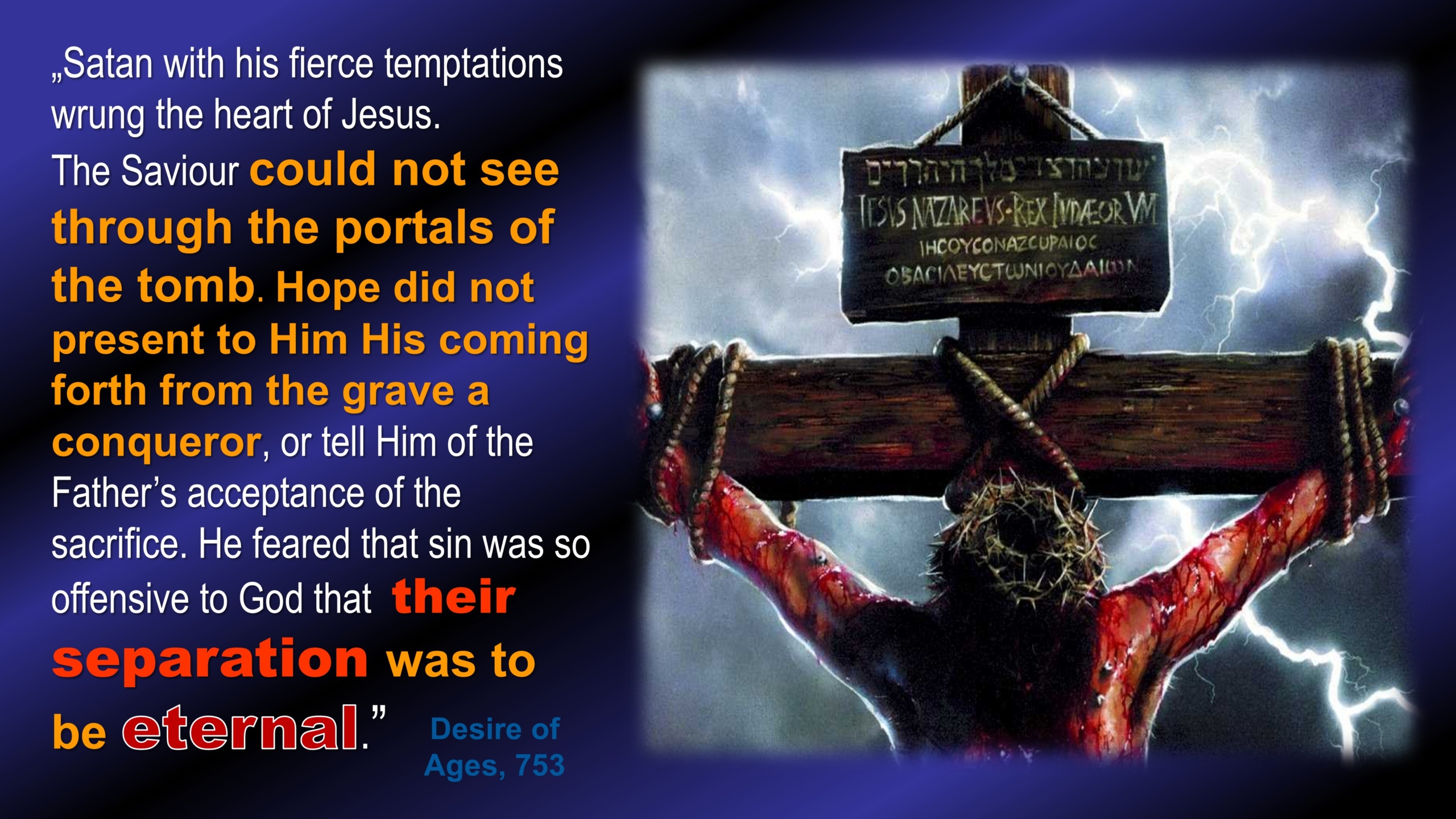
“Satan with his fierce temptations wrung the heart of Jesus. The Saviour could not see through the portals of the tomb. Hope did not present to Him His coming forth from the grave a conqueror… He feared that sin was so offensive to God that Their separation was to be eternal. Christ felt the anguish which the sinner will feel when mercy shall no longer plead for the guilty race. It was the sense of sin, bringing the Father’s wrath upon Him as man’s substitute, that made the cup He drank so bitter, and broke the heart of the Son of God.”
These extraordinary words prove that although the Saviour had previously predicted His resurrection, now the despondency was so severe that “He could not see through the portals of the tomb”, “had no hope” that He would rise again, and thought that because He had become sin and a curse for us, the consequences of this sacrifice would last eternally!
However, when Jesus made the decision to dedicate His life as an eternal sacrifice for sinful humanity, then the sense of hope for the resurrection returned, and the Saviour could say:
Luke 23:46
“Father, into thy hands I commend my spirit…”
“The Desire of Ages”, p. 756:
“Amid the awful darkness, apparently forsaken of God, Christ had drained the last dregs in the cup of human woe… And as in submission He committed Himself to God, the sense of the loss of His Father’s favour was withdrawn. By faith Christ was victor.”
PSALM 22
Psalm 22 is one of the most amazing chapters in the entire Bible. Written a thousand years before Jesus was even born. It is an amazing prediction of His crucifixion, fulfilling future events with astonishing precision.
But more than just an incredible prophecy, the true heart of this psalm is the story of Christ’s everlasting love for each of us. It reveals the unimaginable suffering He willingly endured on the cross, where He experienced the ultimate agony of being completely separated from His Father, His greatest eternal love. Jesus chose to bear that crushing weight of curse (Gal 3:13) and separation because of our sins, proving that there is absolutely nothing that could prevent Him from saving us.
Psalm 22 begins in deepest darkness, but ends in triumph: the Forsaken One becomes the victorious Saviour whose righteousness is proclaimed to all nations:
My God, my God, why have You abandoned me?
Why so far from my call, my help to see?
Why art Thou distant from my heavy sigh,
And from my bitter, anguished, groaning cry?
My God, I call by day, but You do not reply;
By night I cry aloud, yet no relief have I.
Yet You are enthroned as the Holy One above,
The glory of Israel, worthy of our love.
In You our fathers trusted in their day;
They trusted, and You rescued them alway.
To You they cried out, and they soon escaped;
In You they trusted, never put to shame.
But I am a worm, and not a man at all,
Scorned by men, despised by great and small.
All who see me mock me as I bleed,
They curl their lips and jeer at my deep need.
They shake their heads at me and scornfully say:
“He trusted in the Lord—let Him save today!
If He delights in him, let Him rescue him now,
And lift the heavy burden from his brow!”
For You drew me forth from the mother’s womb,
Made me safe at her breasts from early gloom.
Upon You I was thrust from my very birth;
Since my mother bore me, You are my God on earth.
Do not stay far from me, for trouble is near,
And there is no one to help or wipe my tear.
Many bulls surround me, closing in to slay;
Fierce bulls of Bashan encircle my way.
They open wide their mouths against my face,
Like roaring lions tearing at their prey.
Like water poured out, my life drains away;
All my bones are disjointed, undone in the fray.
My heart has become like wax in the flame,
Melting with sorrow no language can name.
As dry as a potsherd is my burning throat,
While merciless enemies look on and gloat.
My tongue cleaves tightly, no strength can it find;
Laid in the dust where death is assigned.
For packs of dogs surround me, fierce and grim;
A band of evildoers closes in.
They have pierced my hands and my feet;
This bitter work of rejection is made complete.
I can count all my bones as I hang on high;
They stare at me and jeer as I die.
They divide my garments among them in their might,
And for my clothing they cast lots in my sight.
But You, Lord, do not stay far off from me;
My strength, come quickly, help my misery!
Deliver my soul from the strike of the sword,
My life from the grip of the dog, o Lord!
Save me from the lion’s open, roaring mouth,
My poor life from the horns of wild bulls from the south!
Then I will proclaim Your Name to my own;
In the midst of the assembly Your praise shall be known:
“You who fear the Lord, give praise and adore!
All descendants of Jacob, give honor evermore!
Show reverence to Him, all Israel’s seed,
For He has responded to my deepest need!”
For He has not spurned, nor disdained with pride,
The misery of a poor wretch cast aside;
He did not turn away His face from my cry,
But heard and delivered when danger was nigh.
I will offer praise within the congregation;
My vows I will fulfill before His holy nation.
The meek will be sustained and praise Him altogether;
Those who seek the Lord shall have hearts that live forever!
All who sleep in the earth will bow low before God;
All who go down to the dust where they trod
Will kneel down in homage to His holy Name,
Even he whose failing breath has no strength to remain.
And I will live for the Lord all my days;
My descendants will serve You and give You the praise.
The generation to come will be told of the Lord,
That they may proclaim His true, faithful word
To a people yet unborn, that all may perceive
The deliverance and justice You brought to relieve!
DEATH OR LIFE
Laden with our humanity and our sins, the righteous and sinless Son of God, representing fallen humanity, became a “curse” (Gal. 3:13) and “sin” (2 Cor. 5:21) for us.
The fulfilment of this condition was demanded of us by the unchangeable Law of God, which condemns us to death for its transgression.
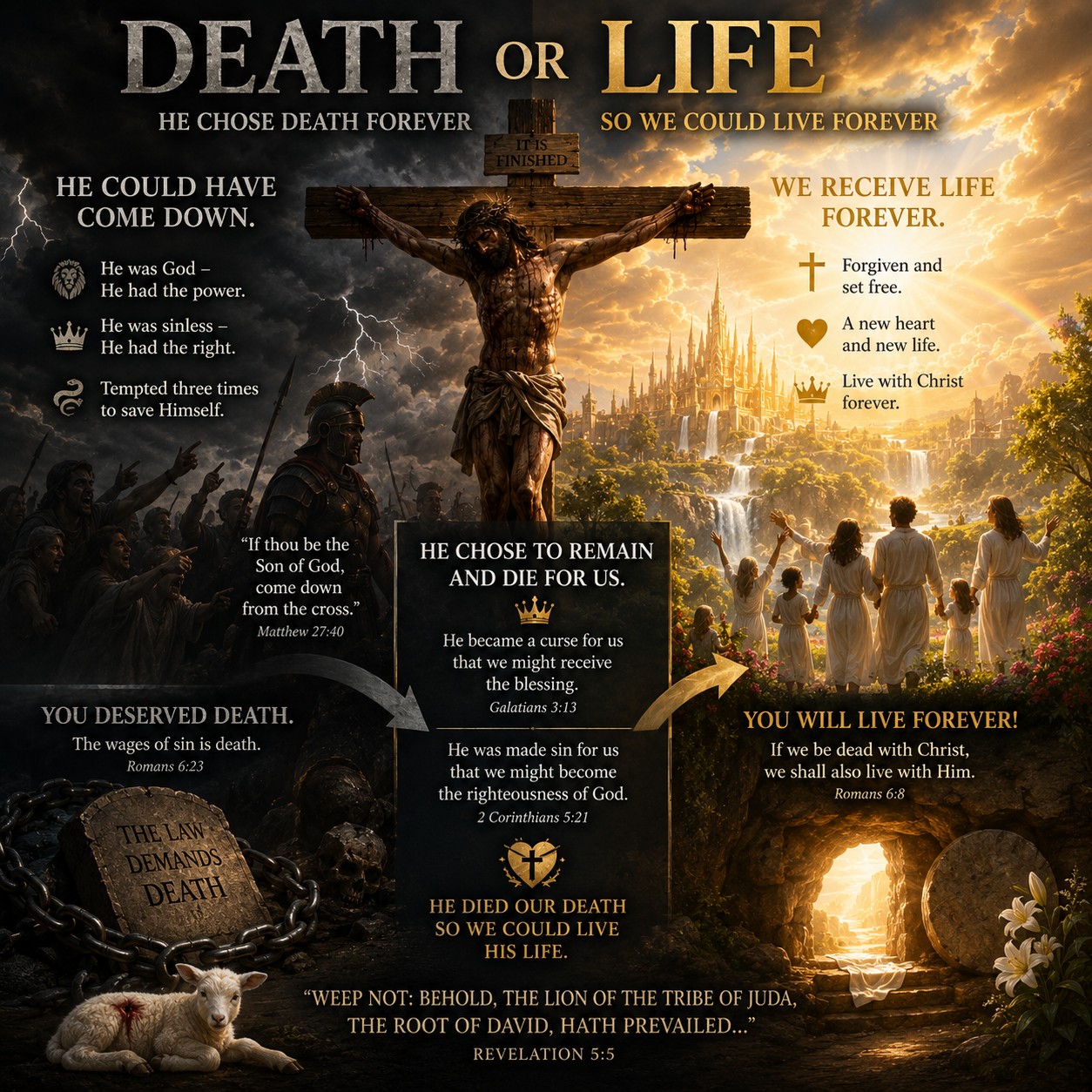
Because the Saviour knew what constituted the penalty for breaking the Law and how very repulsive and loathsome sin was to God, at a certain moment feelings began to suggest to Him that if He did not come down from the cross, He would become the eternal guarantor of humanity’s salvation.
And at this dramatic moment, the Son of God had to make a decision: save humanity and perish, or save Himself, thereby condemning us to certain death and stripping us of all hope of rescue.
There is no doubt that even hanging on the cross, the Son of God could easily have saved His life.
On what basis can we suppose that He could have come down from the cross?
It was possible because, although He was a man, He was still also God, and no one could strip Him of the right to decide His own fate, and also because, even as a man, He had never sinned, maintaining perfect righteousness and holiness.
That Christ could have come down from the cross is also evidenced by the fact that the author of evil urged Him to do so three times.
The devil will never tempt me to turn stones into bread, because he knows that for me it would be impossible, but when he urged Christ to do so, he knew that He could accomplish it. Since, therefore, he tried to induce the Saviour to save Himself, it means that it was possible:
“If thou be the Son of God, … come down from the cross.” Matthew 27:40
During the temptation in the wilderness, Satan also declared to Jesus:
“If thou be the Son of God, cast thyself down…”
“The Desire of Ages”, p. 746: “Satan with his angels was present in human form beneath the cross.”
Luke 23:35-37,39: “And the people stood beholding. And the rulers also with them derided him, saying, He saved others; let him save himself, if he be Christ, the chosen of God. And the soldiers also mocked him, coming to him, and offering him vinegar, And saying, If thou be the king of the Jews, save thyself… And one of the malefactors which were hanged railed on him, saying, If thou be Christ, save thyself and us.”
Could the Son of God save “Himself and us” at the same time?
It was impossible, because He actually represented the entire sinful humanity upon whom an irrevocable death sentence had been passed.
It was not the sinless Son of God who deserved death, but we, so we too had to be punished.
For this very reason, Jesus, through the assumption of our humanity, became our representative, became us, and when He died, everyone of us was simultaneously punished with death in Him:
Romans 6:6-7: “Knowing this, that our old man is crucified with him… For he that is dead is freed from sin.”
Gal. 2:20: “I am crucified with Christ: nevertheless I live; yet not I, but Christ liveth in me”
2 Cor. 5:14: “For the love of Christ constraineth us; because we thus judge, that if one died for all, then were all dead”
Our death in Christ was the only method of salvation allowing the just requirements of the Law to be fulfilled upon us, so that while bearing the penalty of death, we might still live. If, therefore, the Son of God had come down from the cross, then we would not have been punished (in Him) and the Law would still demand death from us as the wages of sin.
Had the Saviour not wished to remain on the cross and die on our behalf, it would have been synonymous with the end of our hopes for salvation, and the reaction of the Apostle John to the cry of the angel asking who is worthy to open the book of life of the human race would have ended with the words: “And I wept much, because no man was found worthy to open and to read the book, neither to look thereon.” Rev. 5:4
Fortunately, although the Son of God had to make a choice between Himself and us, before the eyes of the entire universe He chose eternal life for us and eternal death for Himself. Only thanks to this improbable sacrifice could one of the elders joyfully say to the despairing John and to everyone who believes:
“Weep not: behold, the Lion of the tribe of Juda, the Root of David, hath prevailed to open the book, and to loose the seven seals thereof” (Rev. 5:5).
And immediately upon hearing these comforting, wonderful words, John was given to see to whom humanity owes its salvation:
Rev. 5:6: “And I beheld, and, lo, in the midst of the throne and of the four beasts, and in the midst of the elders, stood a Lamb as it had been slain”
The Lamb, that is Christ, was “as it had been slain”, because although His fallen humanity representing the race had indeed died the eternal death, on the third day a new, transformed, in every respect perfect and glorified humanity was resurrected.
Besides, we must remember that Christ was also God all the time, and His divine nature could not die the second death:
SDA Bible Commentary, E. White Comments, vol. V, p. 1113: “When Christ was crucified, it was His human nature that died. Deity did not die; that would have been impossible.”
Since Christ’s human nature died the second death on the cross, we must answer the question: what kind of nature was it, sinful or sinless?
The human nature of Adam before the fall did not die on the cross, because that nature was perfect and holy and could not even die, especially since the second death is exclusively the wages of sin. Only a fallen human nature could die forever on the cross, and so it actually was! We do not know what happened to Christ’s divine nature after His death; perhaps it was hidden in God, perhaps it “fell asleep” for three days? None of us knows this, and it will certainly remain a mystery to us in this life.
The most essential thing for us, however, is that our representative human nature, condemned to death, which the Son of God assumed so that He could represent us in the battle against sin and death, hung on the cross (the tree) along with Him. Thanks to this, and believing in it, together with Paul we can say:
Romans 6:6: “…our old man is crucified with him, that the body of sin might be destroyed”
This means that our sinful, old, condemned, and death-sentenced life was crucified along with Christ so that the “BODY OF SIN”, that is, our fallen nature, might be destroyed.
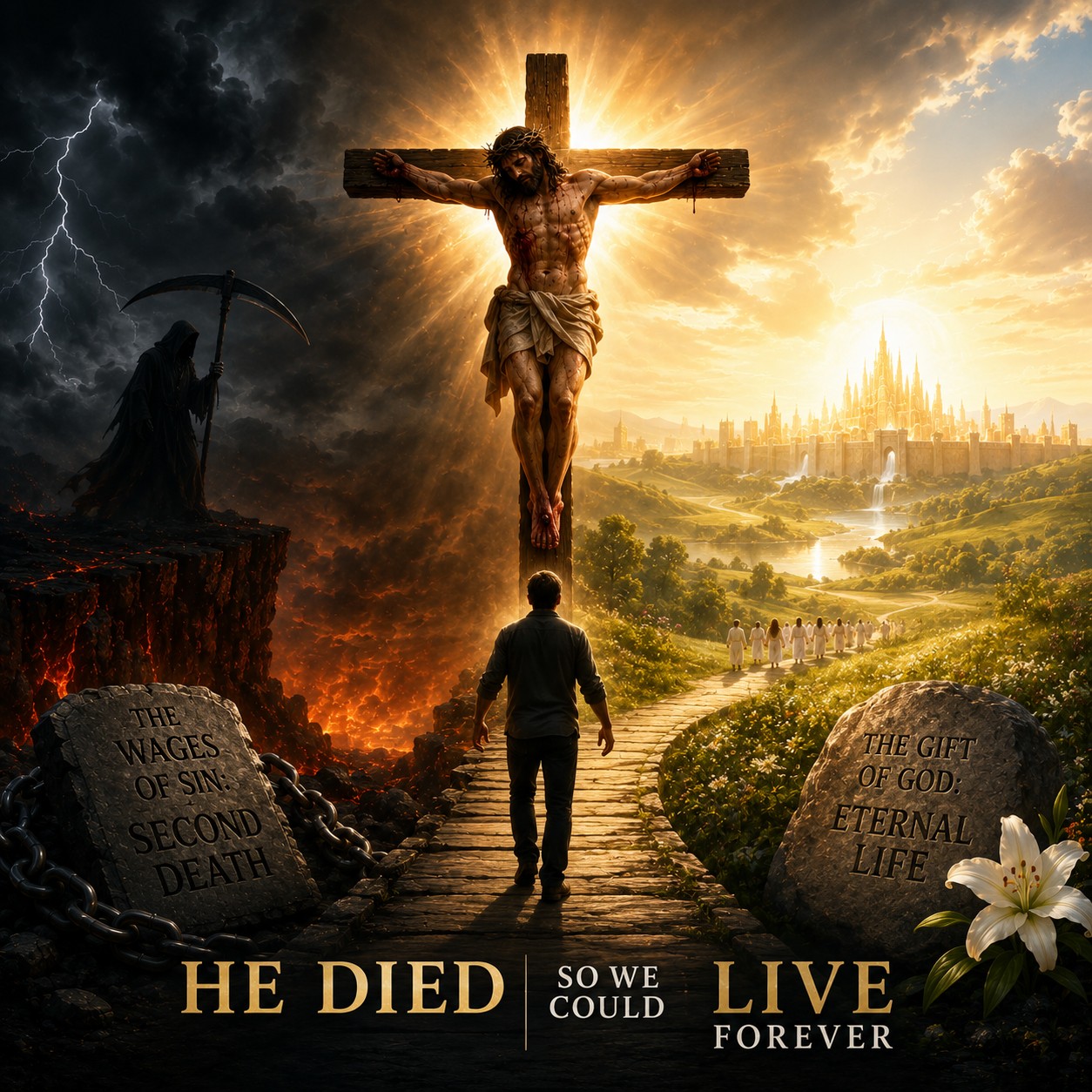
Romans 6:8: “Now if we be dead with Christ, we believe that we shall also live with him”
GOLDEN FLOWER
This true story happened in Taiwan. In that country, there was an old Chinese custom whereby parents chose a girl to be a wife for their son. One day, a God-fearing and experienced couple said to their son: “We have finally found a suitable girl for you; your wedding will take place in three weeks!”
This young man eagerly awaited the day when he would be able to meet his wife. Finally, the wedding day arrived. The beautifully dressed bride was brought in. According to custom, her face was covered. Her name was Golden Flower. When the wedding ceremony ended and they were left alone together, he could finally remove the veil from her face, but when he did so, he was surprised to notice that his wife was unattractive. So he threw the veil to the ground and, in a fit of anger, fled the house. For a long time, his parents tried to convince him that although the girl was not the prettiest, she was a wonderful Christian, had a very good character, was hardworking, wise, and that they would never find a better wife for him.
Eventually, after six months of absence, he gave in to his parents’ appeals and returned home, but although he agreed to live with his wife, he never went outside with her nor brought any friend to the house. He was so ashamed of her that he even wished she would die.
After some time, a daughter was born to them. When the girl was twelve years old, he suddenly began to see worse and worse out of one eye, and shortly afterwards, the sight in his other eye also began to fail. Very concerned about the state of his health, he went to a doctor who, after conducting detailed examinations, said: “You have a very rare eye disease. There is only one way to save your sight. It is a corneal transplant. Unfortunately, this operation costs over five hundred dollars, and besides, there is a very long list of people waiting in line for corneas. So I am sorry, but I must inform you that you will probably lose your sight…”
When his wife found out about this misfortune, she said to him: “For a long time, I made baskets at night and saved up five hundred dollars. Please, take this money for the operation.”
“The operation is not everything,” he replied. “Corneas are needed, for which many people are waiting in line. Forget about it…”
A few days later, someone from the hospital called him and said: “We have corneas for you! Please come to the hospital immediately for the operation!”
After the operation, when he regained consciousness and the bandages were removed, the doctor asked: “Do you see anything?”
“Yes,” he replied, “but faintly. I can see some light…”
“That’s wonderful!” said the pleased doctor. “You can see the light of the lamp. It was a success! In three weeks you can return home. You will see.”
The next day, his daughter came to visit him at the hospital. “Dad, we are so glad the operation was a success. Can Mum come to the hospital to visit you?”
“No,” he replied quickly. “I don’t want to see her here. You come alone in three weeks. You will take me home in a taxi.”
Three weeks later, his daughter came to take him home. On the way back, he said: “I heard that some man had an accident and that before his death he agreed to donate his corneas to me. I must go to the cemetery to honour this man.”
When they returned home and went inside, seeing his wife carrying a tray from the kitchen, somewhat embarrassed, he said: “I would like to thank you for that five hundred dollars you gave me for the operation…”
Hearing this, his wife began to weep quietly, and then he realised that for the first time he had thanked her for something.
Suddenly, their daughter began to cry loudly: “Mum, you must tell him! Tell him the truth! He doesn’t know that you gave him your corneas!”
When he heard this, he immediately approached his wife, turned her around, and looked into her eyes. “Why did you do it?” he asked, astonished by what he had just learned. “Why did you give me your sight?”
“I did it because you are my husband,” she replied quietly and bowed her head on his shoulder. Then he said: “Golden Flower.” For the first time, he spoke her name, after which he knelt at her feet.
To save us from eternal perdition, the Son of God decided to sacrifice everything for us. It was for us that He endured suffering which man will never be able to understand; for us He became sin and a curse. To open the gates of paradise to us, He decided to make the highest possible sacrifice. The awareness of how much the Saviour risked for us and how much He sacrificed makes us desire to surrender our lives to Him and express gratitude flowing from the depths of our hearts, kneeling at His feet and saying with adoration: “Golden Flower.”

“BLOOD AND WATER”
Have we considered why the Lord Jesus died much earlier than other people sentenced to death on a cross?
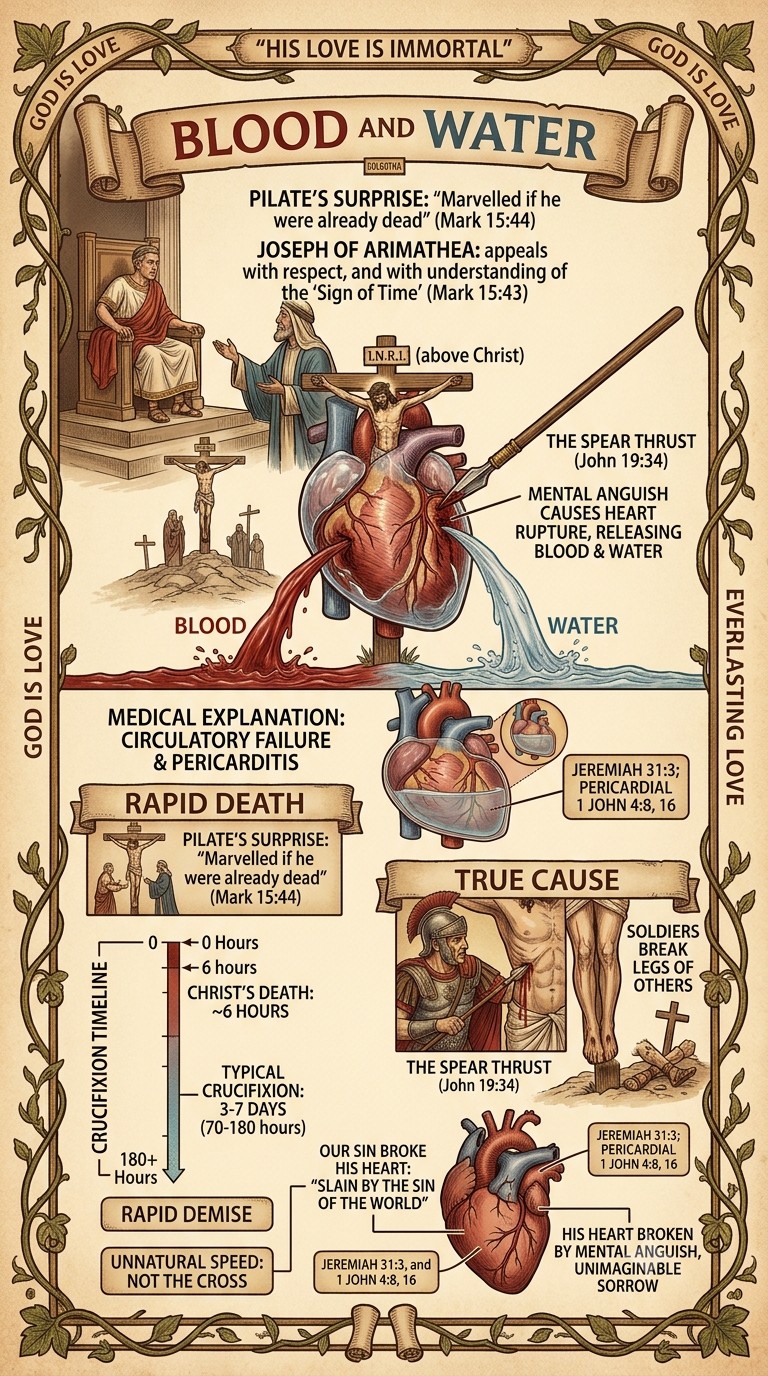
Death as a result of crucifixion usually occurred only after the lapse of three to seven days, that is, about 70 to 180 hours. Christ, however, died after just 6 hours.
For this very reason, when Joseph of Arimathea came to Pilate to ask him for the body of Jesus, Pilate was so surprised by this unusually rapid demise that he summoned the centurion to make sure it was true:
Mark 15:43-45
“Joseph of Arimathea, an honourable counsellor, which also waited for the kingdom of God, came, and went in boldly unto Pilate, and craved the body of Jesus. And Pilate marvelled if he were already dead: and calling unto him the centurion, he asked him whether he had been any while dead. And when he knew it of the centurion, he gave the body to Joseph.”
The fact that the Saviour’s death occurred unnaturally quickly for this method of execution means that it was not the result of being nailed to the cross.
What the true cause of Christ’s death was can be learned from John 19:32-35:
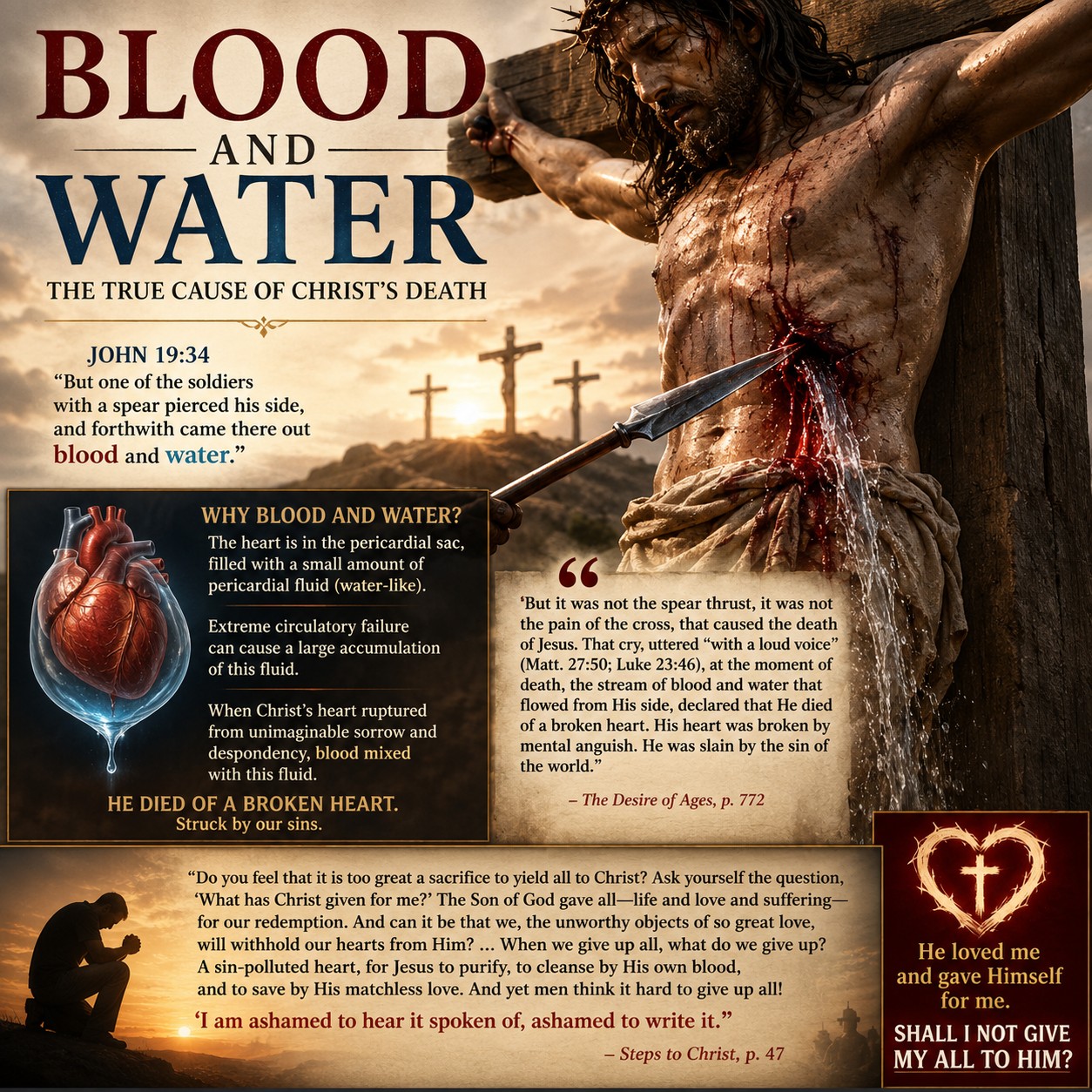
“Then came the soldiers, and brake the legs of the first, and of the other which was crucified with him. But when they came to Jesus, and saw that he was already dead, they brake not his legs: But one of the soldiers with a spear pierced his side, and forthwith came there out blood and water. And he that saw it bare record, and his record is true: and he knoweth that he saith true, that ye might believe.”
Why does John try so hard to assure us that what he wrote is the truth?
That blood flowed from Christ’s side is something obvious, but where did the water come from?
Can the explanation for this phenomenon be found in contemporary medical textbooks?
I did a bit of searching in books and found a few interesting explanations:
The heart muscle is located in the pericardial sac, the interior of which is filled with a small amount of pericardial fluid, resembling water in appearance.
Specialists state, however, that as a result of inflammation of the heart muscle or extreme circulatory failure, an accumulation of pericardial fluid in the pericardial sac can occur.
Encyclopedia of Health: “As a result, however, of extremely weak blood circulation, an accumulation of non-inflammatory (transudative) fluid can occur in the pericardial sac, which is the consequence of, among other things, circulatory failure” (Small Encyclopedia of Health, vol. II, p. 847)
Such extreme weakening of blood circulation certainly took on at Christ’s crucifixion.
Circulatory failure caused a large amount of pericardial fluid (water) to accumulate in Christ’s pericardial sac, and when the immense stress resulting from unimaginable sorrow and despondency caused the Saviour’s heart to rupture, then blood mixed with a large amount of water-like pericardial fluid escaped from the pericardial sac.
When one of the soldiers later pierced the Saviour’s side with a spear, blood and water immediately flowed out of it, which proves that the death of the Son of God occurred as a result of a ruptured heart.
“The Desire of Ages”, p. 772: “But it was not the spear thrust, it was not the pain of the cross, that caused the death of Jesus. That cry, uttered ‘with a loud voice’ (Matt. 27:50; Luke 23:46), at the moment of death, the stream of blood and water that flowed from His side, declared that He died of a broken heart. His heart was broken by mental anguish. He was slain by the sin of the world.”
Why did Christ’s heart rupture?
It ruptured because it was struck by my sins!
If, therefore, I know this and Jesus is still not the most important Person in my life, it can be commented on with only one word: SHAME!!!
And this is precisely the way E. White put it in the book Steps to Christ:
“Do you feel that it is too great a sacrifice to yield all to Christ? Ask yourself the question, ‘What has Christ given for me?’ The Son of God gave all—life and love and suffering—for our redemption. And can it be that we, the unworthy objects of so great love, will withhold our hearts from Him? … When we give up all, what do we give up? A sin-polluted heart, for Jesus to purify, to cleanse by His own blood, and to save by His matchless love. And yet men think it hard to give up all! I am ashamed to hear it spoken of, ashamed to write it.”
AGAPE LOVE IN BELIEVERS
Initially, Jesus’ disciples, seeing their Master hanging on the cross between heaven and earth and personifying a curse, had doubts as to whether He was indeed the Messiah, since God allowed Him to be treated in such a shameful way?
But when the Saviour rose again and when the disciples understood that it was for them He had to pass through these unimaginable sufferings and endure this great humiliation, then this incomprehensible love moved their hearts so much that they were never the same disciples again.
Out of love for the Lord, they all died a martyr’s death, except for John, who, in accordance with Christ’s promise, died a natural death, despite being subjected to torture and unsuccessfully having his life attempted by being boiled in oil.
Even Peter, who had previously denied the Lord three times, changed to such an extent after what he saw on Golgotha that when the Romans wanted to crucify him, he said he was not worthy to die as the Saviour did and asked his executioners to crucify him upside down.
What was the reason that Christ’s disciples changed so much that they became humble, showing love to one another, and boundlessly self-sacrificing? What was the reason that they followed “the Lamb whithersoever he goeth” (Rev. 14:4) even unto death?
The reason for this extraordinary change was that in the Son of God hanging on the “tree” they saw a love that “passeth knowledge” and because they were carried away by this unselfish and eternal love.
Thanks to the testimony of the apostles, as well as the doctrine Paul preached on the basis of many revelations, the early Christians also perfectly understood the depth of God’s love hidden in the cross. It had such a great influence on their lives that they were the “light of the world” and the Gospel was preached with great power, and the church of Christ grew at an enormous pace.
Unfortunately, with the passage of time, the devil succeeded in making Christians lose this wonderful doctrine of the cross, and for many centuries the church did not know the truth that Christ had tasted eternal death for us.
Because the prince of darkness knows that understanding what actually happened on Golgotha can carry a sinner away to God and awaken a feeling of love for Him, he does everything to prevent man from understanding what the words mean: “Christ hath redeemed us from the curse of the law, being made a curse for us.” (Gal. 3:13)
Even today, among many Christian fellowships, I personally know of only one church that officially teaches this priceless truth that to save us, the Son of God had to pass through the experience of the second death.
The following quote comes from the book “Seventh-day Adventists Believe”, which constitutes a collection of the 27 fundamental doctrines of this church:
“The death Christ tasted for everyone was the eternal death – the full curse of death.”
This astonishing and biblically justified truth should be presented to every person, because it gives the best motivation to reciprocate God’s love and can constitute a turning point in many people’s lives.
In the beginning, God created man as a perfect being whose portion was AGAPE love. Unfortunately, sin caused this love to vanish, and its place was taken by an excessive love for self.
For this reason, we all come into this world deprived of this greatest value, and none of us is able to demonstrate the possession of such love by our own strength.
Agape can become our portion only when we invite Jesus Christ into our hearts in prayer.
Shortly before His death, He Himself prayed that He might dwell in us along with His love:
“And I have declared unto them thy name, and will declare it: that the love (AGAPE) wherewith thou hast loved me may be in them, and I in them.” John 17:26
Every day we should ask our Saviour to dwell in our hearts and reveal His love to the world once again, this time through His presence in us.
If we dedicate time daily to look at the love revealed in the life of the Son of God by reading, meditating, and talking about Him, then a wonderful promise will be fulfilled in our lives:
“But we all, with open face beholding as in a glass the glory of the Lord, are changed into the same image from glory to glory, even as by the Spirit of the Lord.” 2 Cor. 3:18
By reading about Christ in Holy Scripture, talking, meditating, singing, and hearing about Him, we give the Holy Spirit the basis to pour more and more of God’s love into our hearts and transform our characters into the likeness of Jesus’ perfect character.
How a naturally selfish person can reflect the love of Christ is best evidenced by the life story of the Apostle John:
“Even John, the beloved disciple, the one who most fully reflected the likeness of the Saviour, did not naturally possess that loveliness of character. He was not only opinionated and ambitious for honour, but impetuous, and resentful under injuries. But as the divine character of the Saviour was manifested to him, he saw his own deficiency, and was humbled by the knowledge. The strength and patience, the power and tenderness, the majesty and meekness, that he witnessed in the daily life of the Son of God, filled his soul with admiration and love. Day by day his heart was drawn out toward Christ, until he lost sight of self in love for his Master. His resentful, ambitious temper was yielded to the moulding power of Christ. The regenerating influence of the Holy Spirit renewed his heart. The power of the love of Christ wrought a transformation of character. This is the sure result of union with Jesus. When Christ abides in the heart, the whole nature is transformed. Christ’s Spirit, His love, humbles the heart, subdues the soul, and inspires the thoughts and desires toward God and heaven.” (Steps to Christ, pp. 73-75)
Holy Scripture provides many examples of people who, although naturally sinful, through faith in the Son of God and fellowship with God, came to possess this greatest gift – God’s love.
One such example can be Moses, who asked God to blot him out of the book of life in exchange for forgiving Israel’s guilt:
Exodus 32:31-33
“And Moses returned unto the Lord, and said, Oh, this people have sinned a great sin, and have made them gods of gold. Yet now, if thou wilt forgive their sin—; and if not, blot me, I pray thee, out of thy book which thou hast written. And the Lord said unto Moses, Whosoever hath sinned against me, him will I blot out of my book.”
In New Testament times, the Apostle Paul wanted to make a similar sacrifice:
Romans 9:3
“For I could wish that myself were accursed from Christ for my brethren, my kinsmen according to the flesh”
The love of God was undoubtedly also Stephen’s portion, for without AGAPE, he could not have loved his enemies and executioners and prayed for them, and that at the moment when they were taking his life:
Acts 7:59-60
“And they stoned Stephen, calling upon God, and saying, Lord Jesus, receive my spirit. And he kneeled down, and cried with a loud voice, Lord, lay not this sin to their charge. And when he had said this, he fell asleep.”
Today as well, the portion of everyone who only desires it can be this priceless and greatest among God’s gifts – the unselfish and never-failing AGAPE love, which is the highest value a human being can obtain.
A certain now-deceased preacher personally told me about how he was once standing on a platform with his little son, waiting for a train. At one point, to his horror, he noticed that the boy had fallen from the platform onto the railway track at the moment when a train was entering this track at high speed. It was too late to save the boy, so the preacher only managed to call out: – Lord, save him!
And at that same moment, to his astonishment, he noticed how some mysterious force caught the boy upward and placed him back on the platform, saving his life.
This boy, saved in a miraculous way by God, grew up and today, like his father, is a very dedicated pastor in the Seventh-day Adventist Church.
I remember, while participating in his ordination, listening to him with emotion as with tears in his eyes he read from the Word of God about what should constitute the highest value in every person’s life:
Ephes. 3:14,16-19
“For this cause I bow my knees unto the Father of our Lord Jesus Christ, … That he would grant you, … That Christ may dwell in your hearts by faith; that ye, being rooted and grounded in love, May be able to comprehend with all saints what is the breadth, and length, and depth, and height; And to know the love of Christ, which passeth knowledge, that ye might be filled with all the fulness of God.”
The highest value we can obtain in this temporal life is not wealth, fame, or even knowledge, but the love of Christ, which “passeth knowledge”.
Therefore, every day we should read the Word of God, focusing on getting to know Christ’s character and His love better and better, and asking God that this love might become our portion. If we do so, then together with the Apostle Paul we will be able to say:
Romans 8:31-35, 38-39
“What shall we then say to these things? If God be for us, who can be against us? He that spared not his own Son, but delivered him up for us all, how shall he not with him also freely give us all things? Who shall lay anything to the charge of God’s elect? It is God that justificeth. Who is he that condemneth? It is Christ that died, yea rather, that is risen again, who is even at the right hand of God, who also maketh intercession for us. Who shall separate us from the love of Christ? shall tribulation, or distress, or persecution, or famine, or nakedness, or peril, or sword? … For I am persuaded, that neither death, nor life, nor angels, nor principalities, nor powers, nor things present, nor things to come, Nor height, nor depth, nor any other creature, shall be able to separate us from the love of God, which is in Christ Jesus our Lord.”
Does it really matter what place the Lord Jesus occupies in my life?
It does! Because either He will be the most important, or He will not be there at all. Either He will be first in my life, or He will not be there at all. Either first, or last.
JAR FILLED WITH STONES
A certain experienced professor was invited to conduct a lecture for a group of twelve directors of the largest American enterprises.
This training was to concern wise planning and use of time.
The professor had only one short lecture at his disposal to present this matter. So he decided to expound it in such a figurative way.
To this end, he pulled a fairly large jar out from under the desk and set it on the table. Next, he placed a dozen or so fairly large stones, the size of a tennis ball, inside it. When the jar was full and not a single stone could be added to it, the professor asked these directors of the largest American enterprises whether the jar was full.
And when he received an affirmative answer, he pulled a container with smaller stones out from under the desk and poured them into the jar so that they took up the space between the larger stones, and then asked again whether the jar was full?
This time no one gave an affirmative answer, and as could be expected, he poured sand into the jar and then topped everything up with water.
When the jar was actually full and nothing could be added to it, the professor asked what lesson flowed from this experiment. What can this experiment with the jar teach us?
And when no one could find the correct answer to this question, the professor said:
The great truth that this experiment presents tells us that if we do not put the large stones into the jar in the first place, then it will no longer be possible later!
A deep silence fell over the room, and while each of the participants in this training admired the simplicity and wisdom of this statement, the professor asked again:
What constitutes those large stones in your life?
Is it your health, family, work, and making a career, or perhaps some entertainment or sport?
Every day you must put this question before yourselves and try to find the correct answer.
If you act in this way and find the correct answer to this most important question, and each day place these large stones first into the jars of your hearts, then your time will never run out.
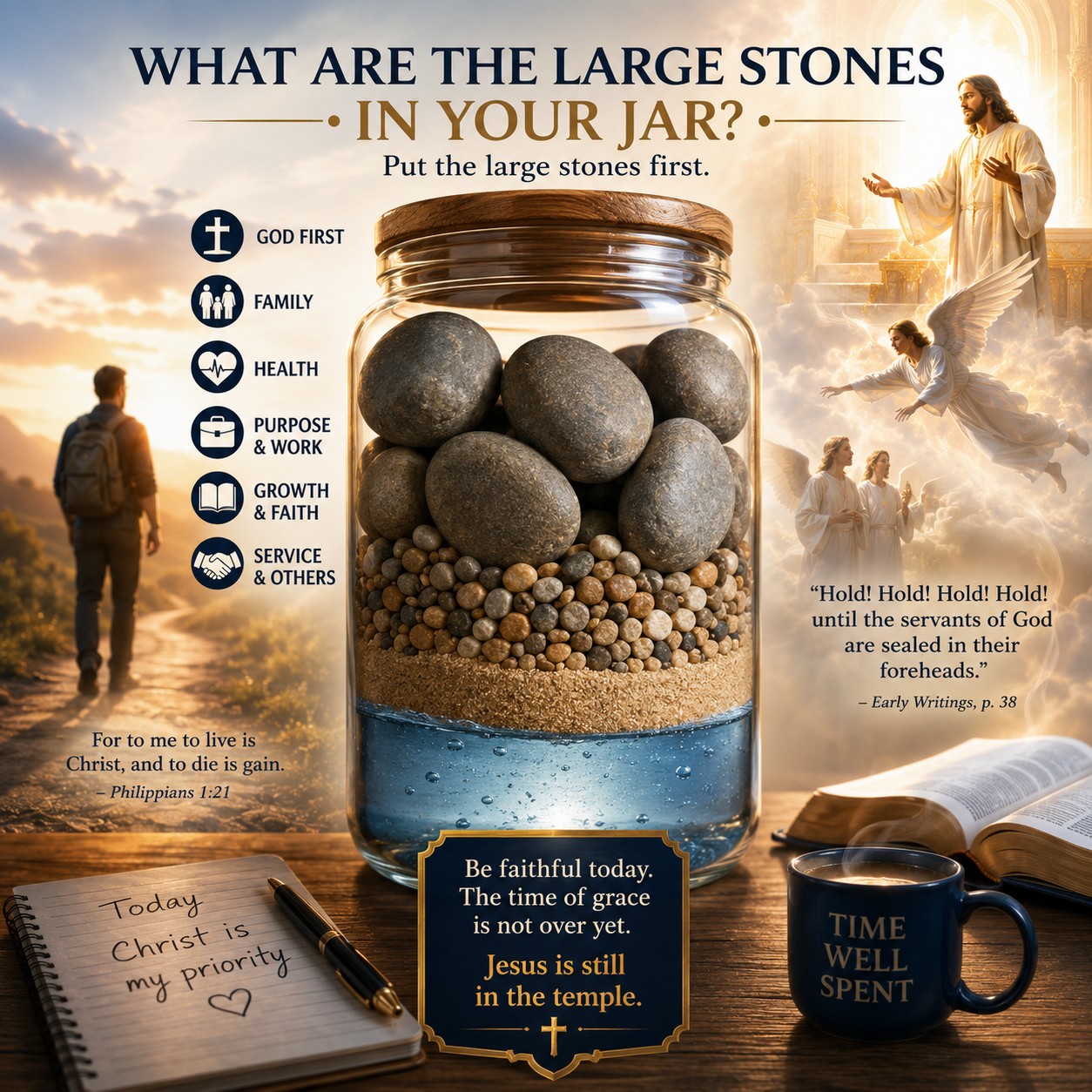
We too should ask ourselves this extremely important question, namely, are those large stones in my life Jesus Christ?
Is He that highest value to me?
Could I honestly say today together with the Apostle Paul (Phil. 1:21):
“For to me to live is Christ, and to die is gain.”
Would I be able to say with a clear conscience (Philippians 3:8):
“Yea doubtless, and I count all things but loss for the excellency of the knowledge of Christ Jesus my Lord: for whom I have suffered the loss of all things, and do count them but dung, that I may win Christ”
If, however, I honestly admit that unfortunately these words do not find an echo in my life, then although it is very sad, we do not yet have to fall into despair. Not all is lost yet!
It is not too late yet to change this. The Lord Jesus has not left the temple yet; the time of grace has not ended yet!
“Early Writings”, p. 38:
“I saw four angels who had a work to do on the earth, and were on their way to accomplish it. Jesus was clothed with priestly garments. He gazed in pity on the remnant, then raised His hands, and with a voice of deep pity cried, ‘My blood, Father, my blood, my blood, my blood!’ Then I saw an exceedingly bright light come from God, who sat upon the great white throne, and was shed all about Jesus. Then I saw an angel with a commission from Jesus, flying swiftly to the four angels who had a work to do on the earth, and waving something up and down in his hand, and crying with a loud voice, ‘Hold! Hold! Hold! Hold! until the servants of God are sealed in their foreheads.'”
As long as the Lord Jesus is still in the temple and interceding for us, it is not too late yet to be converted, but such a decision I must make not tomorrow, but today!
Now I must make a firm decision that from today Christ will become the central figure in my life, and daily I will find time for prayer and the study of the Word of God.
The effects will certainly come; only patience and perseverance are needed.
I once spoke with an elderly woman who, as a result of probably a fungal infection or some other cause, suffered a complete loss of the toenail on her big toe. I recommended to her then the regular application of propolis ointment to this toe. However, initially, despite her using this ointment for a week or two, no beneficial changes were visible. But this elderly lady did not give up on this treatment because she believed it would help her. And after the lapse of a month, a completely new nail grew back! Many other people in her place would have given up, seeing no improvement already at the beginning of the treatment, but she patiently, persistently, and regularly applied this medicine until healing occurred.
It is similar with prayer and Bible reading.
A firm decision and persevering in this resolution will certainly bring results. Let us pray, therefore, that the Lord will help us realise this plan, and then the Holy Spirit will increasingly reflect the love of Jesus Christ in us, and then we will finally become the “light of the world” and the “salt of the earth”, for the world will finally see in us the “love of Christ, which passeth knowledge”, and the time for the return of our Lord and Saviour will arrive, as the prophecy from Rev. 18:1 will be fulfilled:
“And after these things I saw another angel come down from heaven, having great power; and the earth was lightened with his glory.”
Amen
PRAYER
Dear Father, we are very grateful to Thee that although through no fault of our own we all became sinful people in Adam and condemned to eternal damnation, Thou, in order to save us, didst decide together with Thy Son to pass through unutterable sufferings and bear the harshest possible penalty for us. And it is true, because Thy Word says that Thy Son became a “curse” for us, and if He did, then so didst Thou and the Holy Spirit, since Ye constitute “one”.
We thank Thee for this wonderful message of the gospel – for the truth which is in Christ, as it reveals the depth of Thy extraordinary love.
However, Thou Thyself knowest best – dear Father – how greatly Thy adversary hates this truth and how he strives to prevent us from knowing it and realising what a huge and priceless value it has for us. This is precisely why there are so many different theories and claims through which the devil wants to distance us from the Minneapolis message. This is why, even among us, there are those who – despite such numerous biblical proofs and statements of the Spirit of Prophecy – dare to deny this truth, claiming, for example, that we did not die in Christ. Forgive us for this, Lord, forgive us that we are still – just as over 100 years ago – slow in accepting this most important truth. However, we ask not only for forgiveness, but also that Thou wouldst remove all obstacles so that in the end this wonderful message may be properly appreciated and accepted by us, and that as a consequence of this, the expected outpouring of the Holy Spirit and the return of Thy Son and our Saviour may take place.
We ask that we might exalt Jesus Christ not only as a Church, but that He might also constitute the highest value in the personal life of each of us. Because the enemy of the gospel does everything so that we run out of time for Christ…
And often he succeeds. Therefore, we are ashamed because of this. We are ashamed because we know how much we owe Him… We know what the cup symbolises which He agreed to drink. We know what the crown of thorns is a symbol of, which was placed on His holy divine-human head. We know why His heart broke. We know what the “tree” – the cross on which He hung – was a symbol of. The meaning of all these three symbols: the cup, the crown of thorns, and the cross, boils down to one word, to the word “curse”. But we also know that – as Adam Mickiewicz wrote – “the sign of the cross of Golgotha alone will not save a man unless he places a cross upon his heart”. Therefore, we greatly desire that the Lord Jesus should always be someone most important to us, that He should always be those large stones that each day will be the first to take up space in the jars of our hearts.
Help us also to remember that Thou canst not save us in sin, but from sin, and to understand what a drama is now taking place in heaven, that it is because of our sins and indifference that the Lord Jesus cannot finish the work of saving humanity and return for His people, and that our every sin, even if it is forgiven us, leaves a wound in His and Thy heart.
Therefore, we now open our hearts to our Saviour and resolve to do so each day; we ask only for Thy help, that we might persevere in this decision. We also ask that we do not stop at preaching the gospel merely in the typical Protestant version, because although it is also a wonderful message, it does not contain the full truth and differs on the matter of Christ’s humanity. But grant, we pray, that we may finally unite in accepting and heralding with the power of the Holy Spirit this message which was given to us already over 100 years ago, which allows for an even deeper understanding of this wonderful truth. We ask, therefore, that this truth which is in Christ, that is, this true and full gospel, may finally be properly accepted by us and prove to be Thy power in our lives and the lives of those to whom we will herald it. We ask all this in the name and through the merits of our Lord and Saviour – Jesus Christ.
Amen