
Slawomir Gromadzki

Definition of God
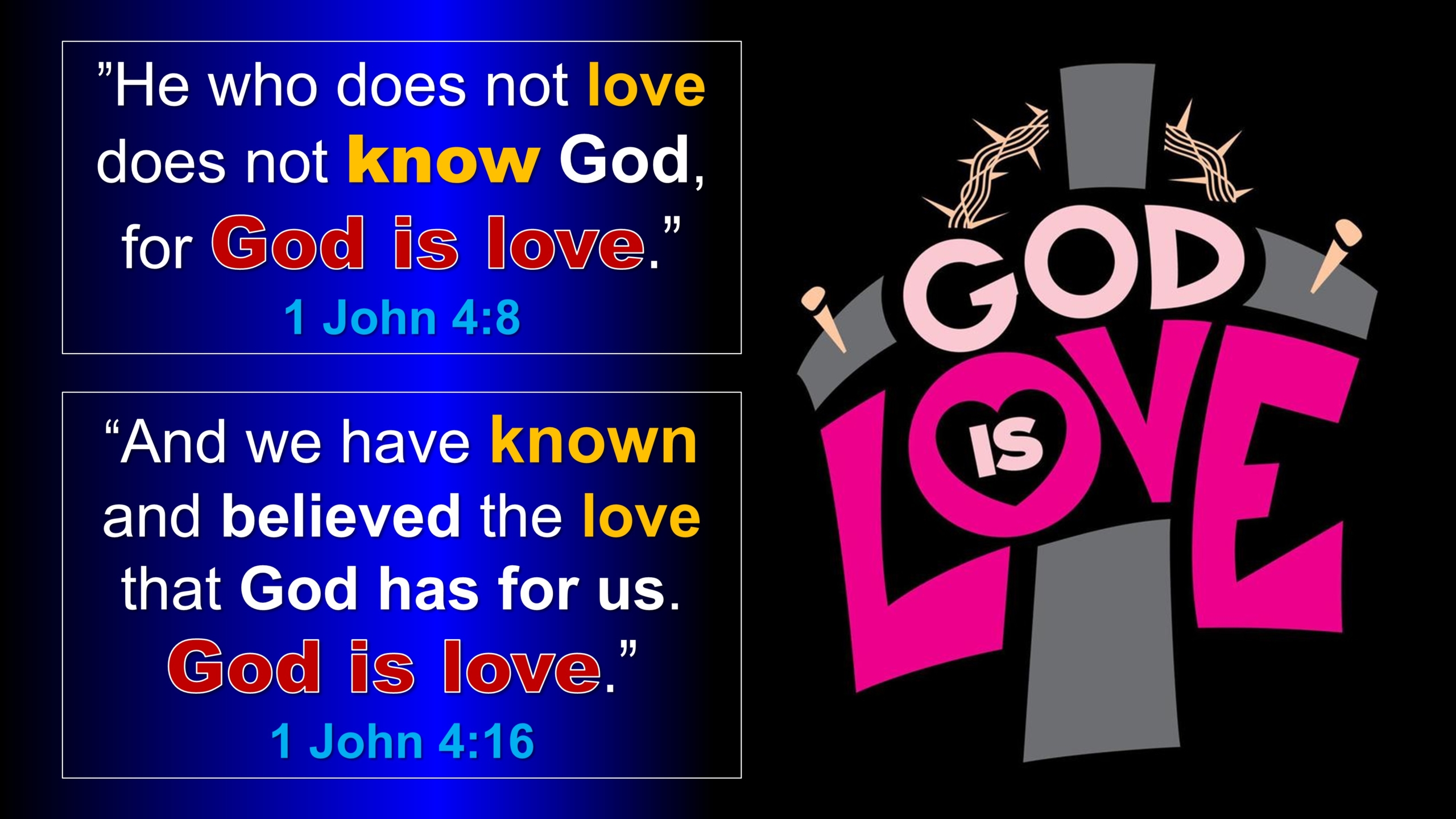
The best definition of God is found in the first epistle of John, in chapter 4, where two times he repeats that God is love. We see this explicitly stated in the Scriptures: “He who does not love does not know God, for God is love.” 1 John 4:8 and “And we have known and believed the love that God has for us. God is love.” 1 John 4:16.
Since God is an unending, self-sacrificing, unconditional love, and everything He does is motivated by that love, it means that every truth included in the three angels’ message—whether it is the everlasting gospel, the pre-advent judgment, or the Sabbath—should be understood and proclaimed by us in the light of God’s love.
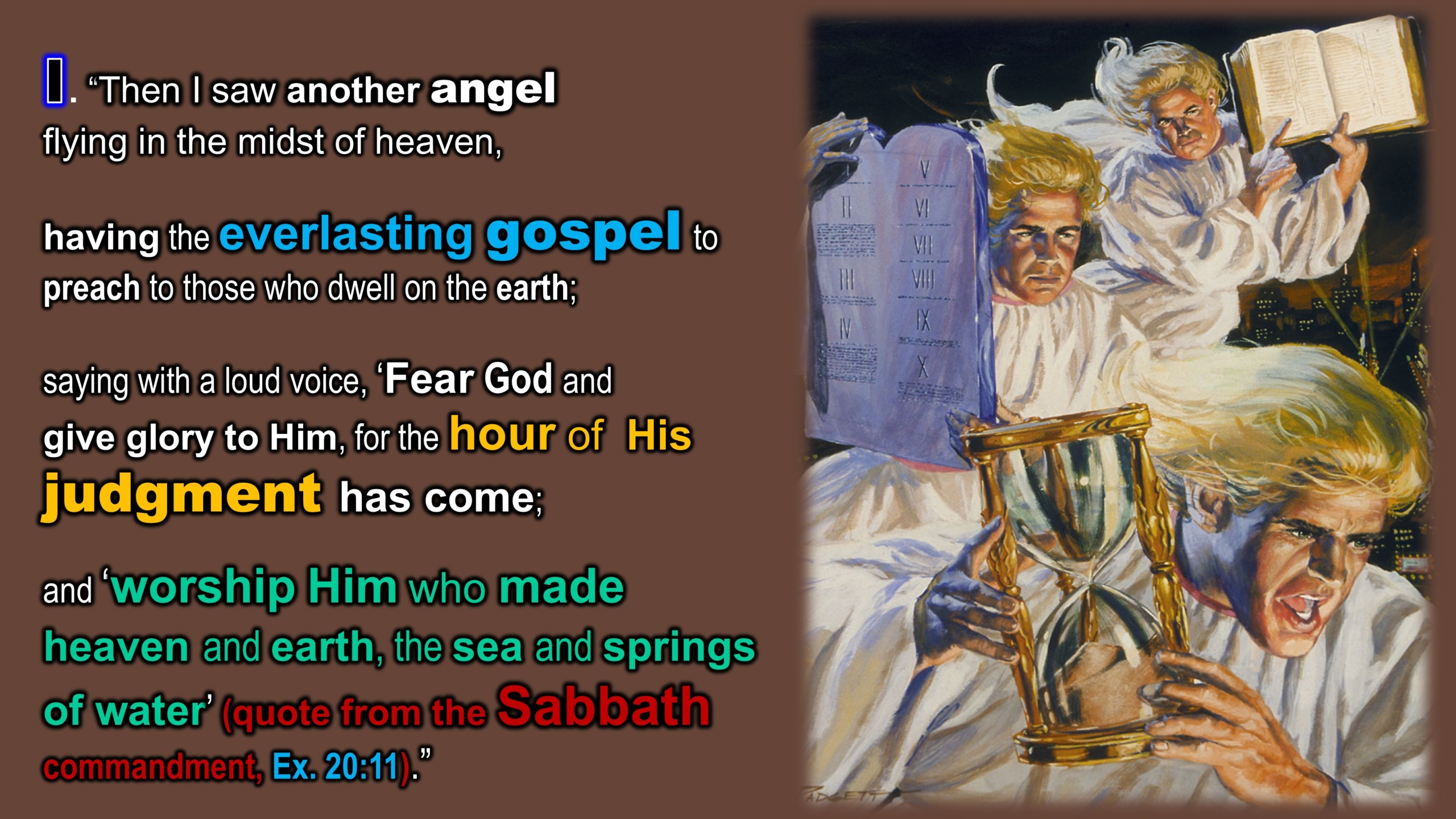
This is framed by the first angel’s proclamation: “Then I saw another angel flying in the midst of heaven, having the everlasting gospel to preach to those who dwell on the earth; saying with a loud voice, ‘Fear God and give glory to Him, for the hour of His judgment has come; and worship Him who made heaven and earth, the sea and springs of water.'” Revelation 14:6-7, which directly quotes from the Sabbath commandment, Exodus 20:11.
Also, the truth about God’s wrath and the destruction of the wicked sinners must be studied, understood, and proclaimed in the light of the statement, “God is love.” The subsequent warnings state: “And another angel followed, saying, ‘Babylon is fallen, that great city, because she has made all nations drink of the wine of the wrath of her fornication.'” Revelation 14:8 and “Then a third angel followed, saying with a loud voice, ‘If anyone worships the beast and his image, and receives his mark on his forehead or on his hand, he shall drink of the wine of the wrath of God.'” Revelation 14:9-10. If we do not study these warnings in the light of God’s love, we distort the solemn truth of the three angels’ message.

Love of God in Spirit of Prophecy
When Ellen White wrote the book Steps to Christ, the original opening chapter was about the sinner’s need of salvation, reflecting the theme: “Man was originally perfect… But through disobedience, selfishness took the place of love… It was impossible for him, in his own strength, to resist the power of evil. He was made captive by Satan.” Steps to Christ, p. 17.1.

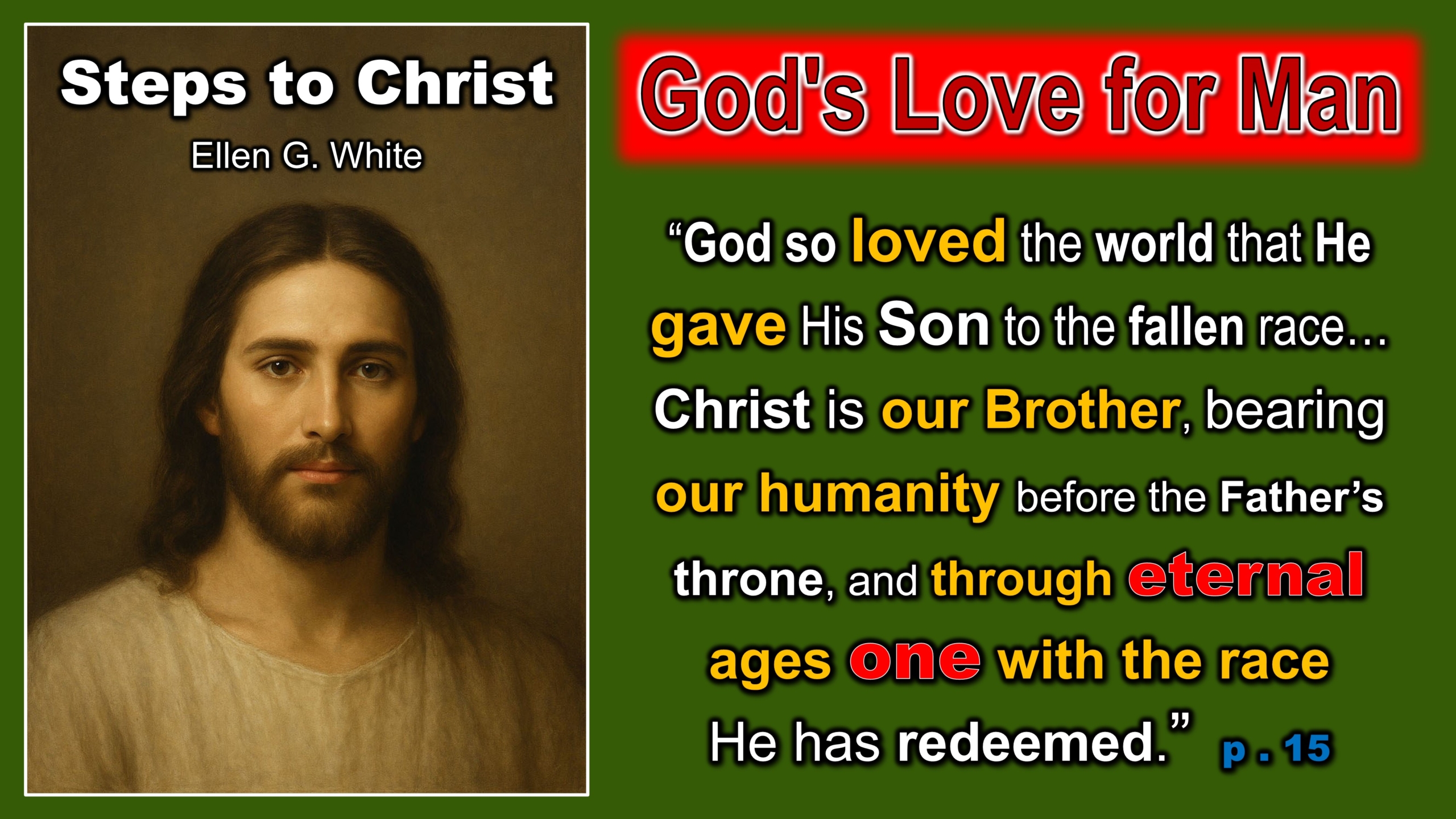
But God instructed her that the opening chapter of this book should express God’s love for the sinful world instead. So, she changed the first chapter and titled it “God’s Love for Man,” writing: “God so loved the world that He gave His Son to the fallen race… Christ is our Brother, bearing our humanity before the Father’s throne, and through eternal ages one with the race He has redeemed.” Steps to Christ, p. 15.
Before the cross, Christ is called the only begotten Son of God, but after the cross, He is never called this way, but rather the first-born Son of God. After the cross, He gave us the right to become children of God. Behold what manner of love!
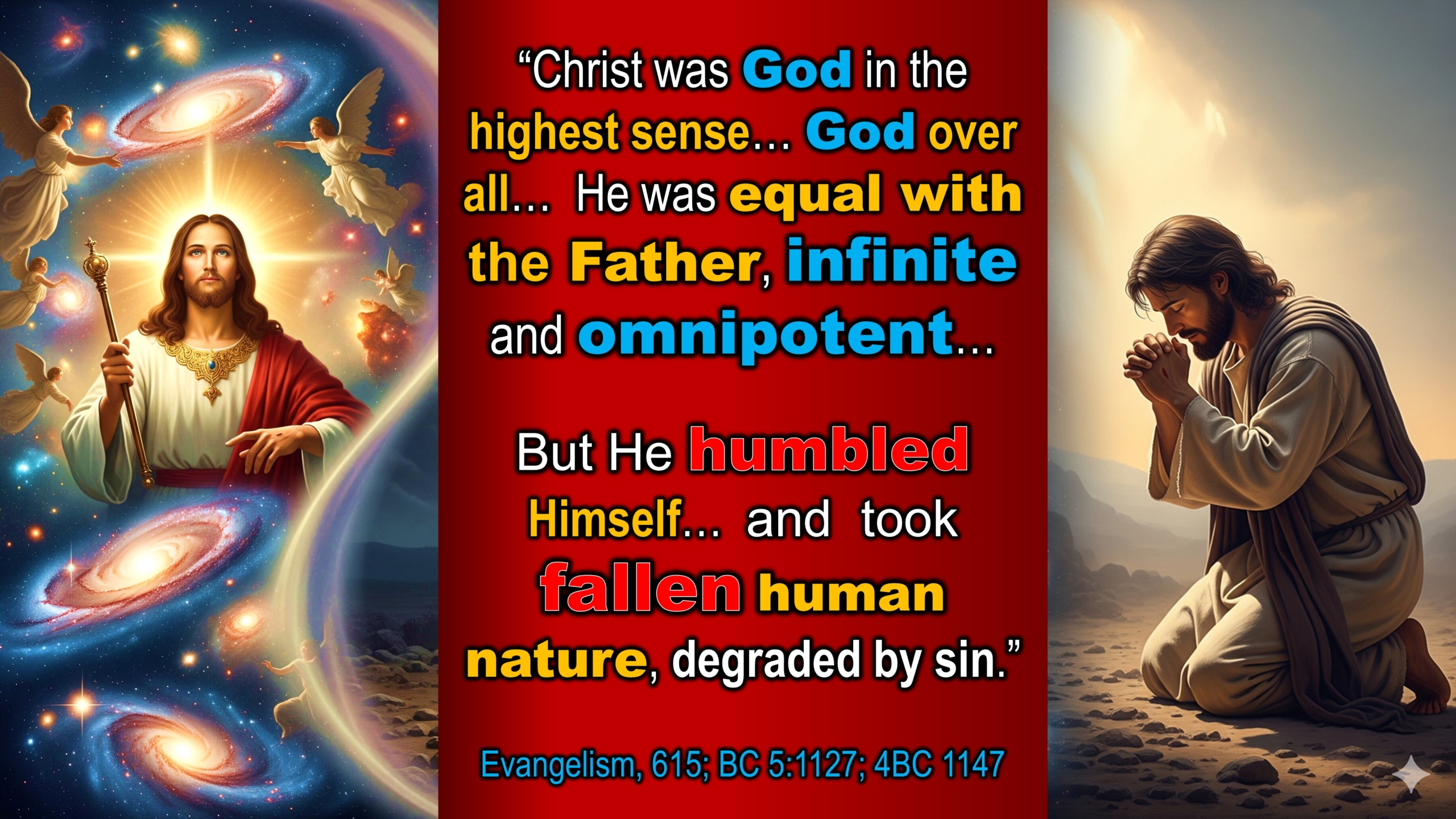
In the book Evangelism, she further expressed the love of God and Christ in the following words: “Christ was God in the highest sense… God over all… He was equal with the Father, infinite and omnipotent… But He humbled Himself… and took fallen human nature, degraded by sin.” Evangelism, p. 615; BC 5:1127; 4BC 1147.
It is highly interesting that the entire five-volume Conflict of the Ages Series by Ellen White begins and ends with the exact same words: “God is love.”
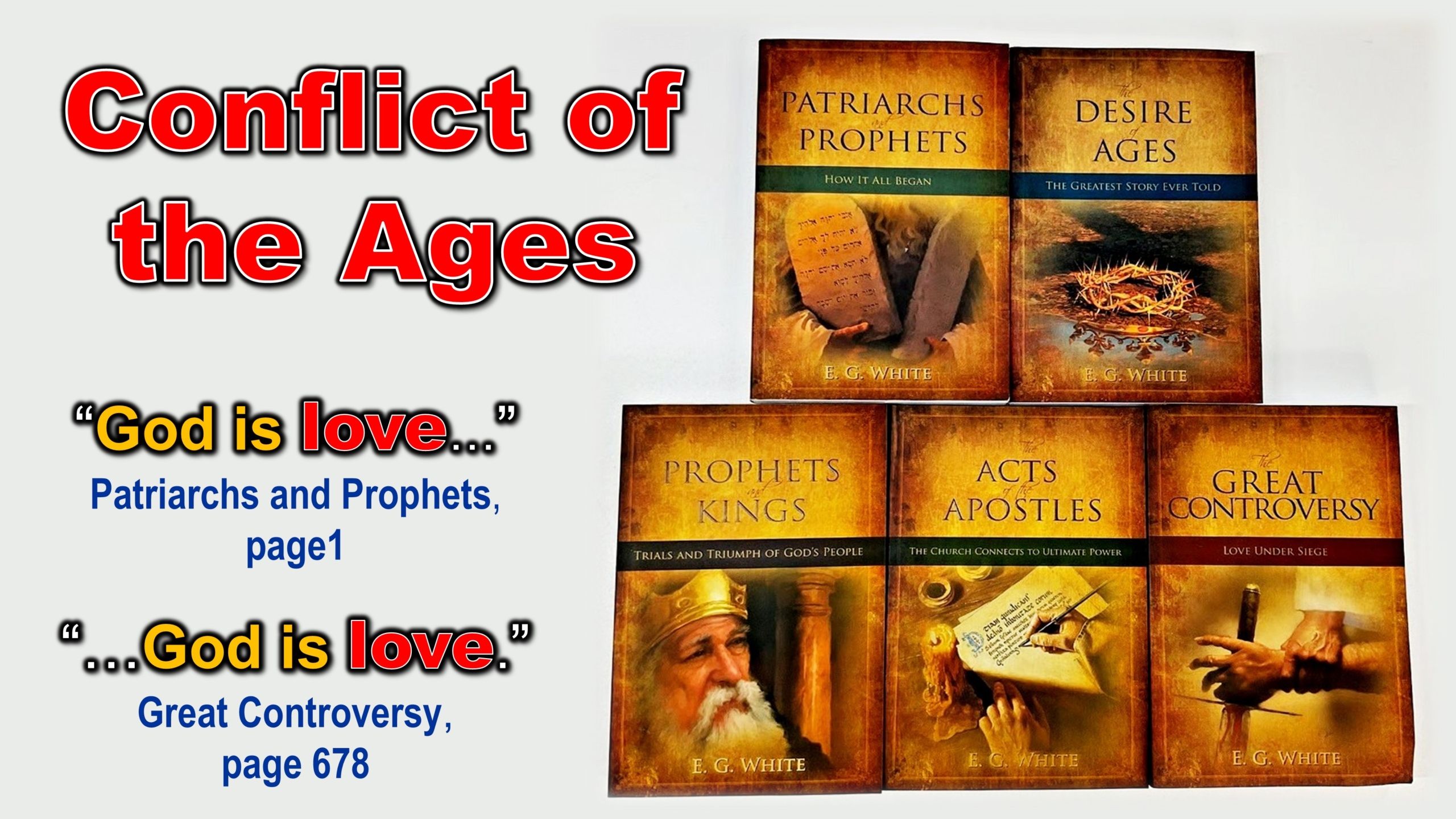
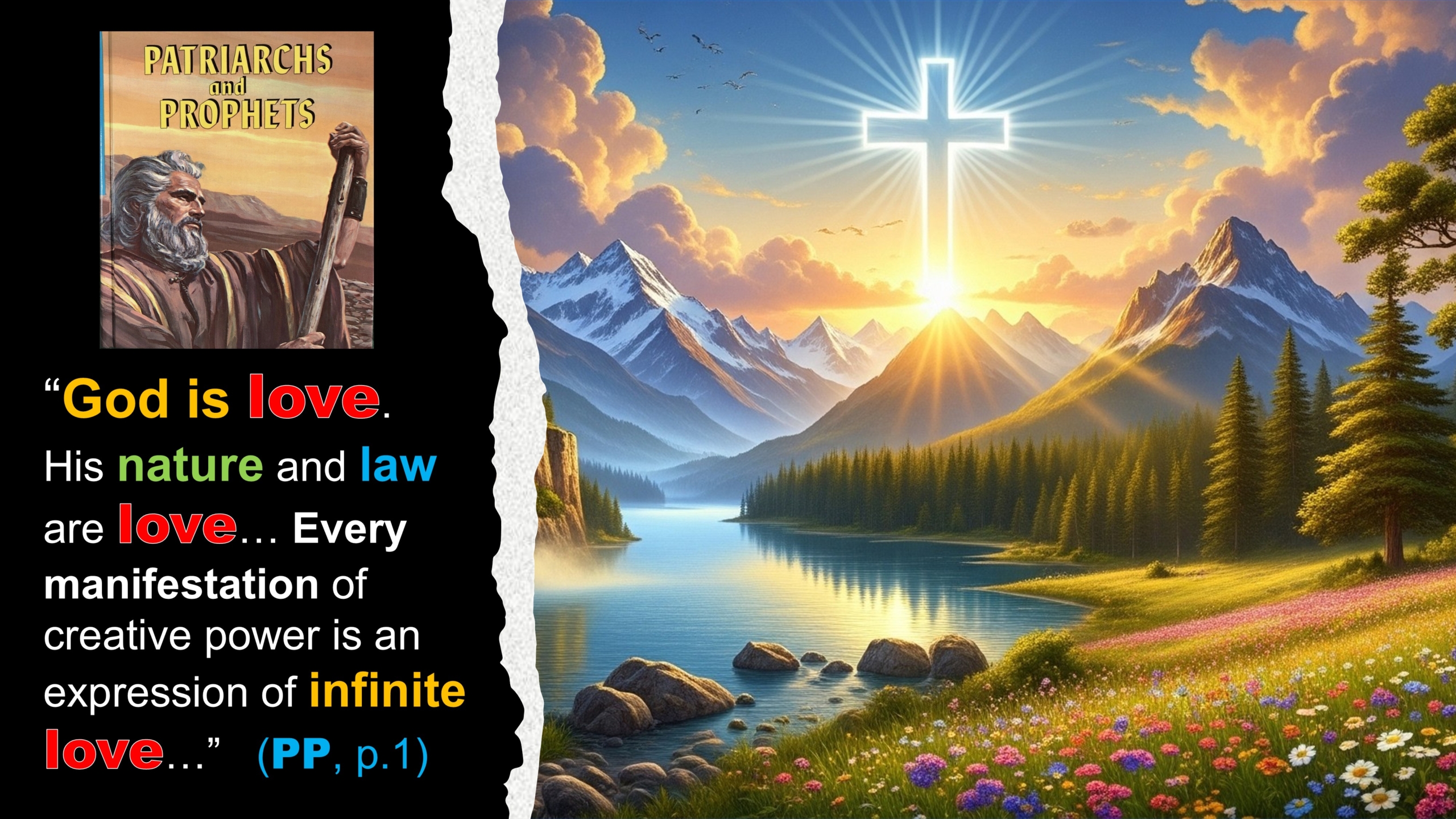
The first volume of the set, the book Patriarchs and Prophets, opens with the words: “God is love. His very nature and His law are love. It has ever been so; it ever will be so. Every manifestation of creative power is an expression of infinite love…” Patriarchs and Prophets, p. 1.
The final book of the series, The Great Controversy, closes with these triumphant words: “The great controversy is ended. Sin and sinners are no more… From the smallest atom to the largest world, all things, animate and inanimate, in their unshadowed beauty and perfect joy, declare: God is love.” The Great Controversy, p. 678.

God’s Love In the Cross of Christ
The greatest expression and evidence of God’s everlasting and self-sacrificing love is found in the cross of Christ and the fact that He was willing to taste the second death for us. The Seventh-day Adventist Church is the only denomination teaching that for our salvation Christ tasted the second (everlasting) death.
In chapter 9 of the book Seventh-day Adventists Believe, we read the following statement: “The death that Christ tasted for everyone was the second death—the full curse of death.” Seventh-day Adventists Believe, ch. 9, p. 115.
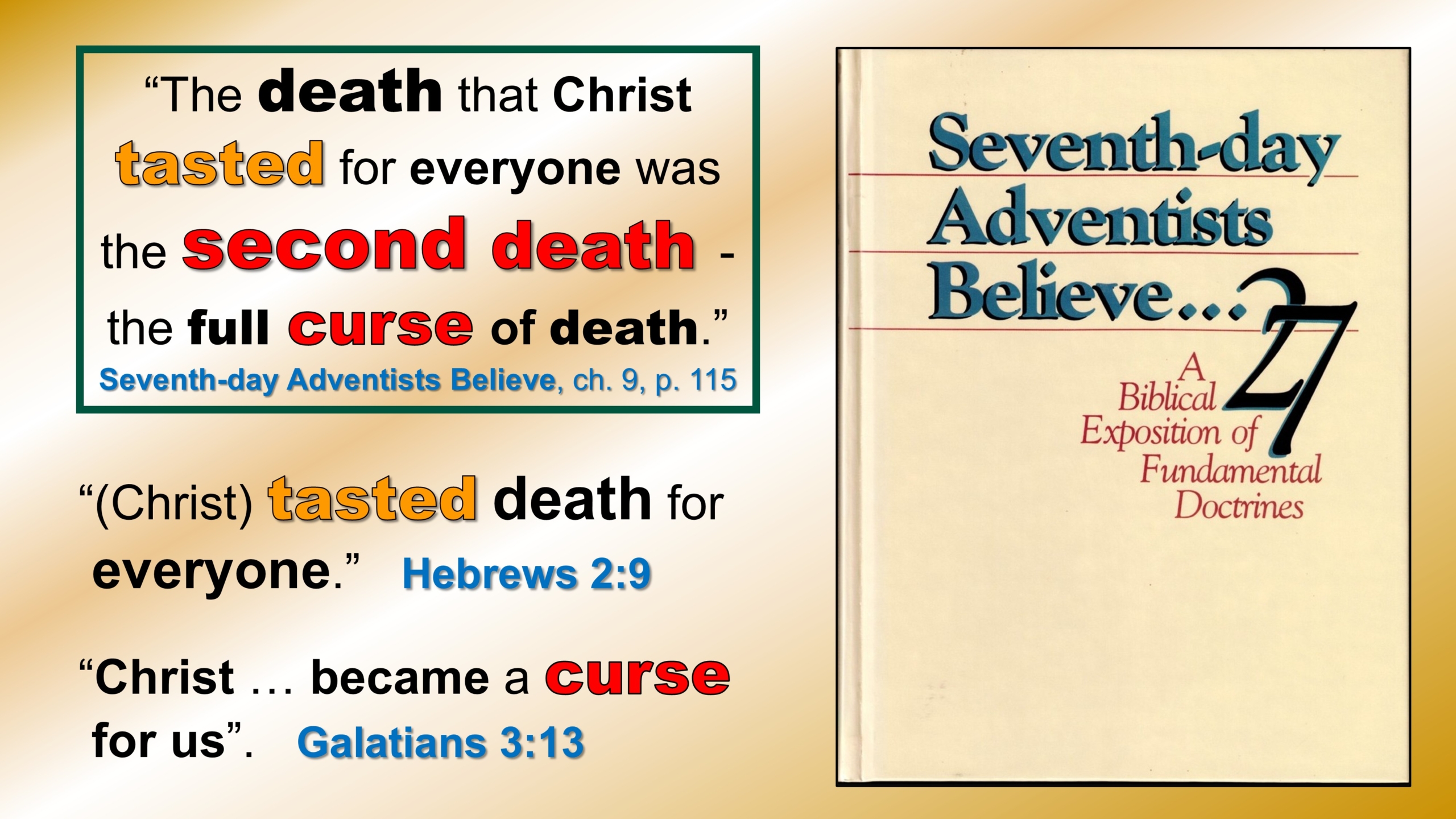
This statement is based on two scriptures: the first is Hebrews 2:9 where Paul wrote that Christ “tasted death for everyone”, and the second text is found in Galatians 3:13, where the same author states that “Christ became a curse for us”.
False Doctrines Oposing God’s Love Revealed in the Cross
Unfortunately, because Satan knows that the great love of God—revealed in the fact that Christ took the same nature we have, including the law of sin, and was willing to go through the experience of the second death for our salvation—is the most powerful weapon to attract sinners to God, he introduced two false doctrines to prevent Christians from believing this truth.
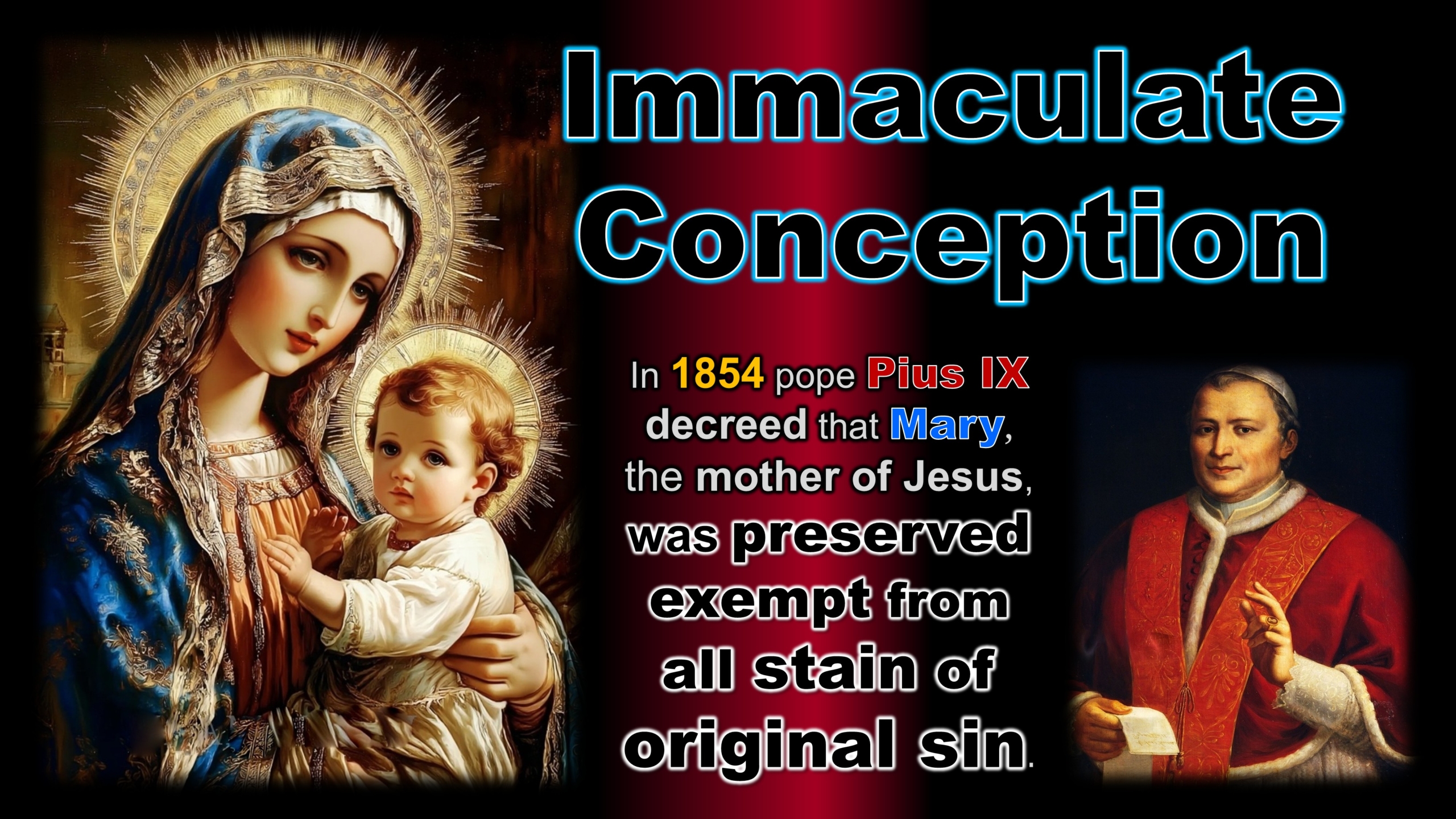
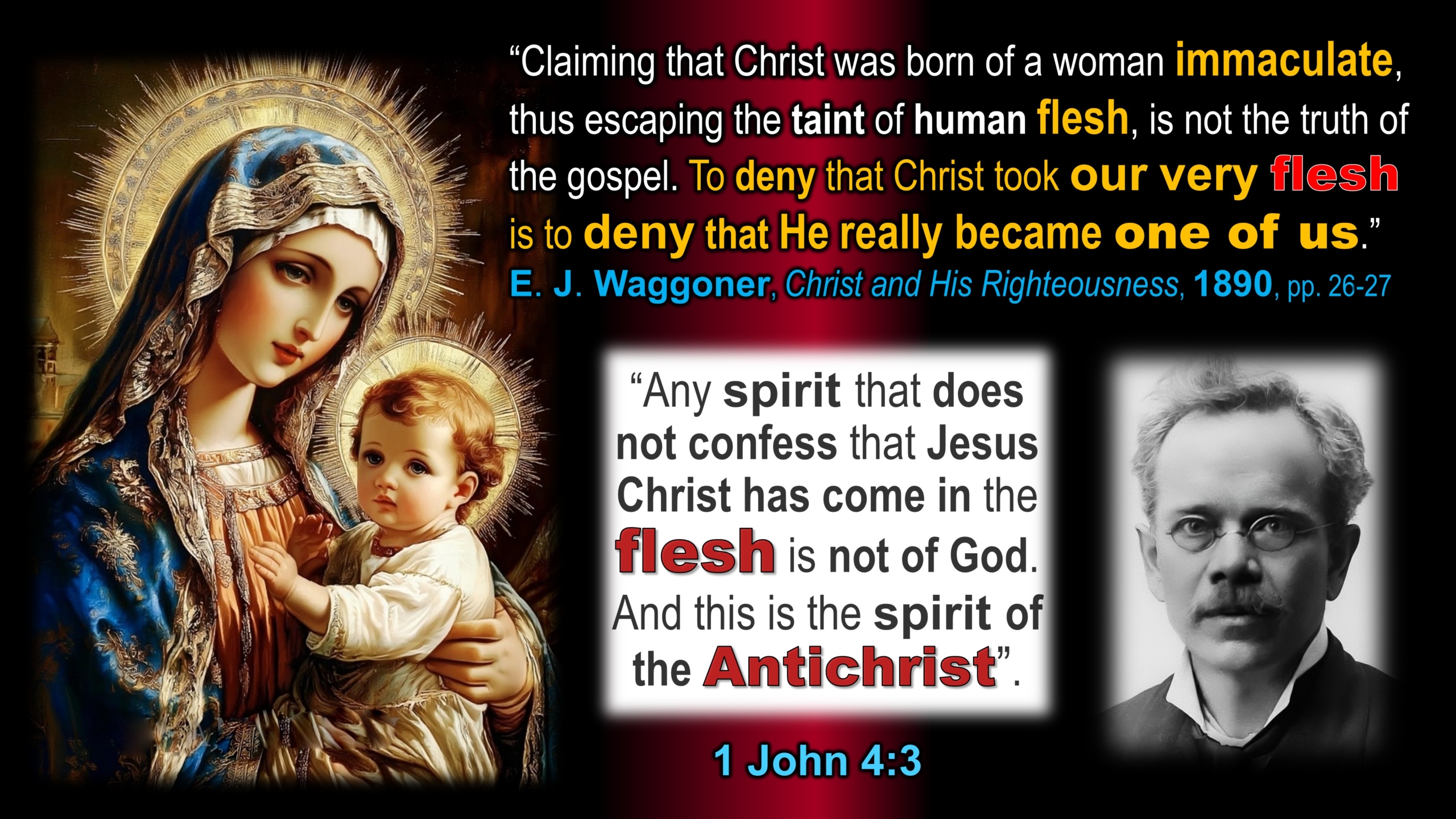
The first was the false doctrine of the Immaculate Conception of Mary, the mother of Jesus. In 1854, Pope Pius IX decreed that Mary, the mother of Jesus, was preserved exempt from all stain of original sin. Satan attacked the love of God with this false doctrine because if Mary was free from a sinful nature, then her Son could inherit only a sinless human nature deprived of the law of sin. For this reason, there would be nothing in Him that could be, as Romans 8:3 says, condemned by God in His flesh and punished with everlasting death.
Obviously, this doctrine was completely unbiblical, as E. J. Waggoner noted: “Claiming that Christ was born of a woman immaculate, thus escaping the taint of human flesh, is not the truth of the gospel. To deny that Christ took our very flesh is to deny that He really became one of us.” E. J. Waggoner, Christ and His Righteousness, 1890, pp. 26-27.
The Apostle John strongly warns us against accepting any false idea teaching that Christ didn’t take our true nature: “Any spirit that does not confess that Jesus Christ has come in the flesh is not of God. And this is the spirit of the Antichrist.” 1 John 4:3.
The second false doctrine Satan used to contaminate Christianity is the natural immortality of the human soul. Satan managed to introduce this very early into the Christian Church through the so-called Church Fathers, who borrowed it from Greek philosophers—especially Plato (4th Century BC), who taught about the natural immortality of the human soul.
Later, Tertullian and Origen (2nd–3rd Century AD), heavily influenced by Plato, strongly promoted the soul’s natural immortality. St. Augustine of Hippo (4th–5th Century AD) then systematized the doctrine of the immortal soul and hell, integrating it into Western Christian theology. This was eventually accepted broadly by Catholic and Protestant Churches, although a majority of great Reformers, including Luther and Tyndale, rejected it.
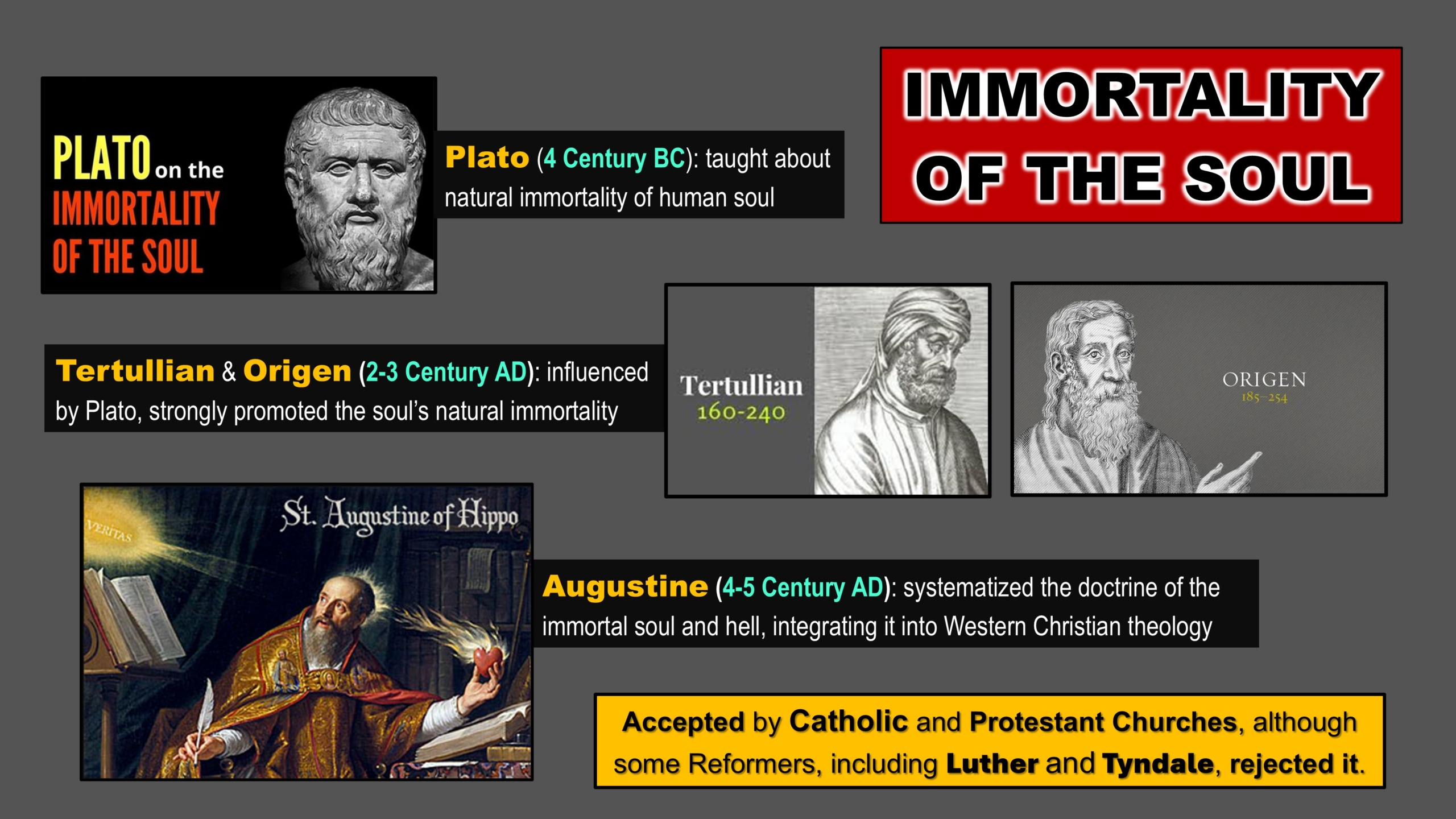
Satan polluted Christianity with this idea because if Christ’s human soul was naturally immortal, then He couldn’t truly experience the second death. In addition, combined with the idea of an immaculate, sinless human nature, there would be nothing in Him that could be condemned and destroyed with the second death.
Four Greek Words Referring to Love
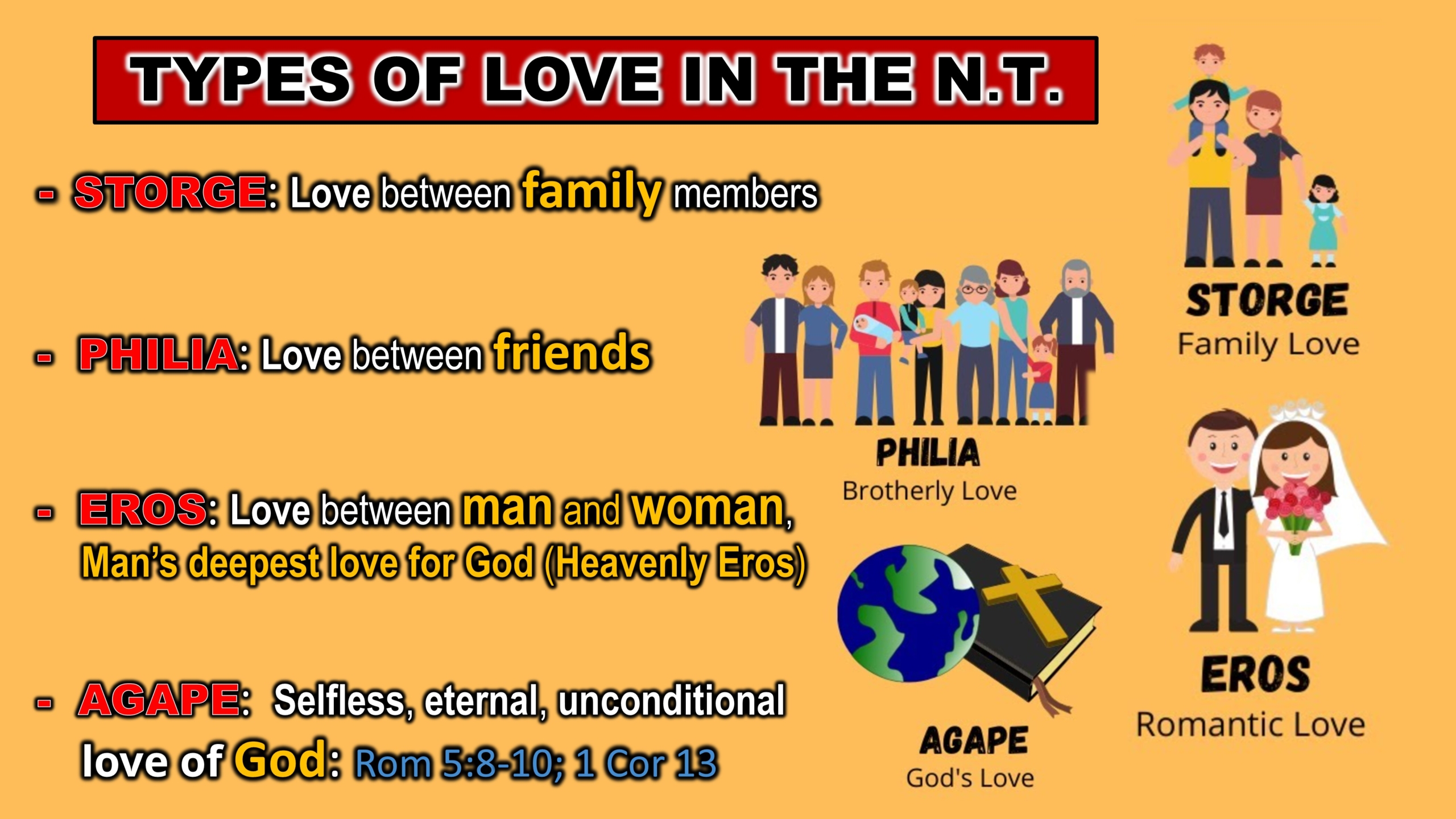
One of the reasons why we experience problems with understanding how great God’s love is stems from our language, which uses only one word to express love. When we read in the English Bible that “God is love,” we easily confuse it with mere human love, which is completely different. However, when the New Testament was written, the Greek language had at least four different words to express various types of love:
-
Storge: Love between family members.
-
Philia: Love between friends (brotherly love).
-
Eros: Romantic love between a man and a woman. In ancient times, Greeks also used “eros” to express the deepest kind of human love that was able to sacrifice its own life, but only for a good or loved person. Plato gave it a profound meaning, calling it “heavenly eros” (man’s deepest love for God), later known as “platonic love”.
-
Agape: Selfless, eternal, unconditional love of God, able to love and die for bad sinners and enemies, as illustrated in Romans 5:8-10 and 1 Corinthians 13.
It is highly significant that the inspired authors of the New Testament never used the word “eros” in the entire New Testament. The Holy Spirit did not want them to express God’s love with a word that represented imperfect, human love contaminated with self and sin. Instead, they used the little-known Greek word “agape,” giving it a unique meaning based on the life and death of the Son of God. When early Christians read the 13th chapter of First Corinthians, stating that “love (agape) never ends,” they knew Paul was referring exclusively to divine love.
The author of the Adult Sabbath School Lessons for the First Quarter 2025, titled “God’s Love and Justice” (Lesson 2, “Covenantal Love”), wrote: “The Greek term agape refers not only to God’s love but also to human love, even sometimes misdirected human love (2 Tim. 4:10).” Adult Sabbath School Bible Study Guide, First Quarter 2025.
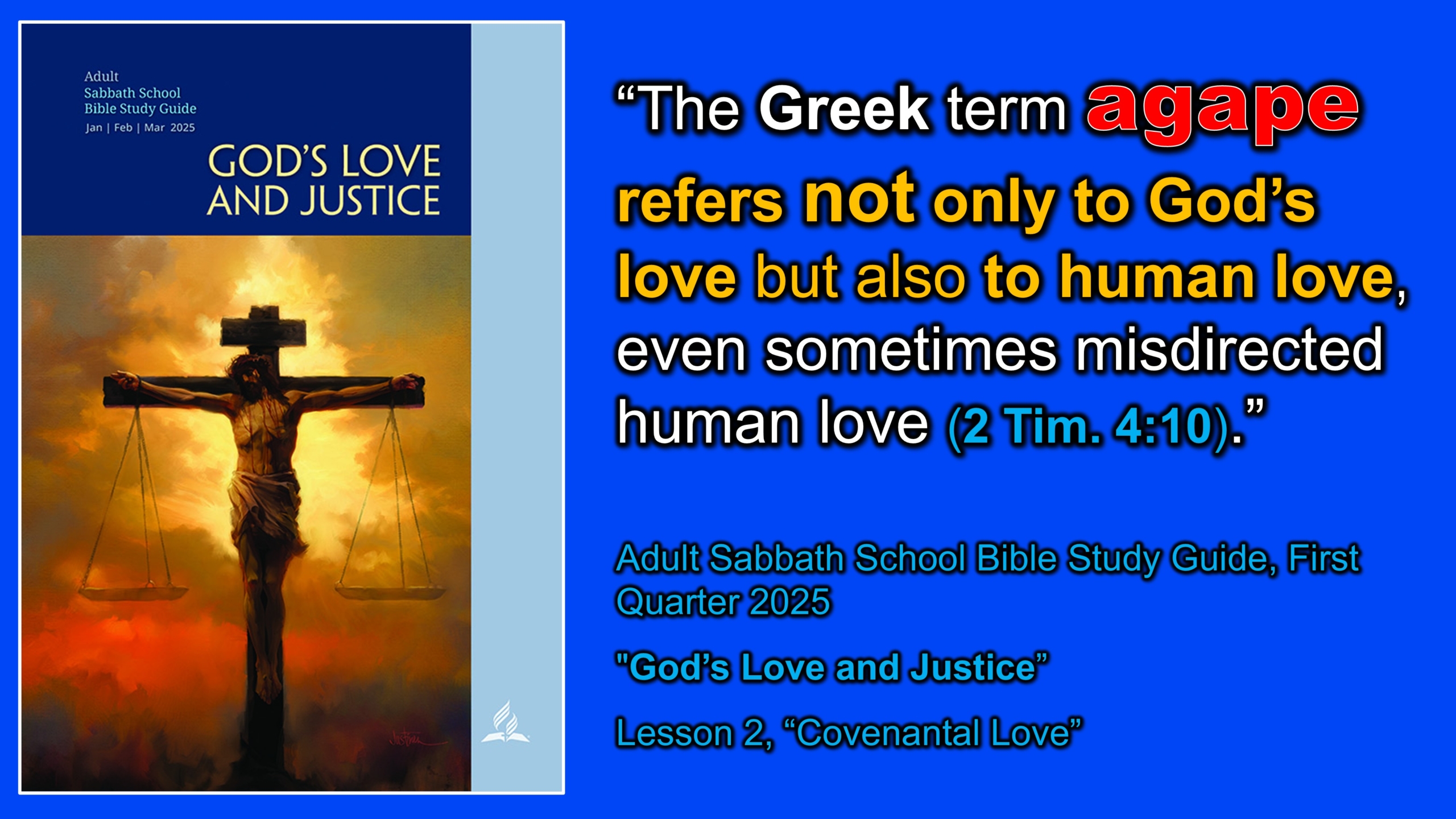
However, for some reason, he didn’t mention that while this may happen as a verb, as a noun, agape is always used in the New Testament to express only God’s love and never human love.
Peter’s Love
It was a lack of agape love that caused Peter to deny Christ. During the Last Supper, the Savior told his disciples that they would all stumble because of Him that night. But Peter spoke more fervently: “Even if all deny you, yet I will not… If I have to die with You, I will not deny You!” Mark 14:27-31. Jesus responded: “Assuredly, I say to you that… before the rooster crows twice, you will deny me three times.” Mark 14:30.
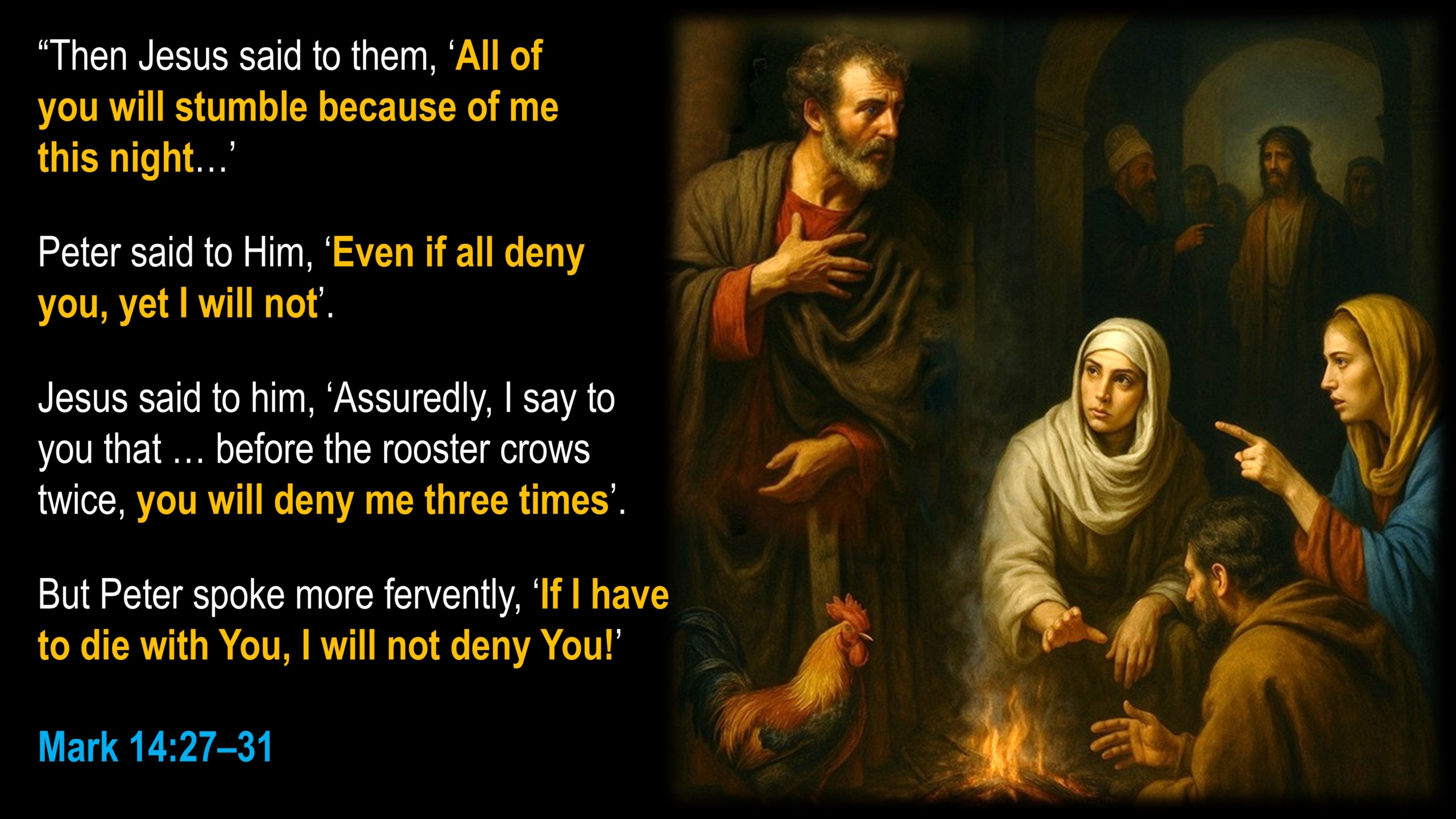
Unfortunately, Peter did deny Him three times. Because denying God was synonymous with an unpardonable sin in the Jewish community, Peter thought he could never be forgiven. Wanting to lift Peter’s spirits, Christ instructed the angel at the empty tomb to tell the women: “Go, tell His disciples and Peter…” Mark 16:7. The Savior wanted to say, “If you think I stopped loving you because you denied me, you are mistaken. My love is eternal.”
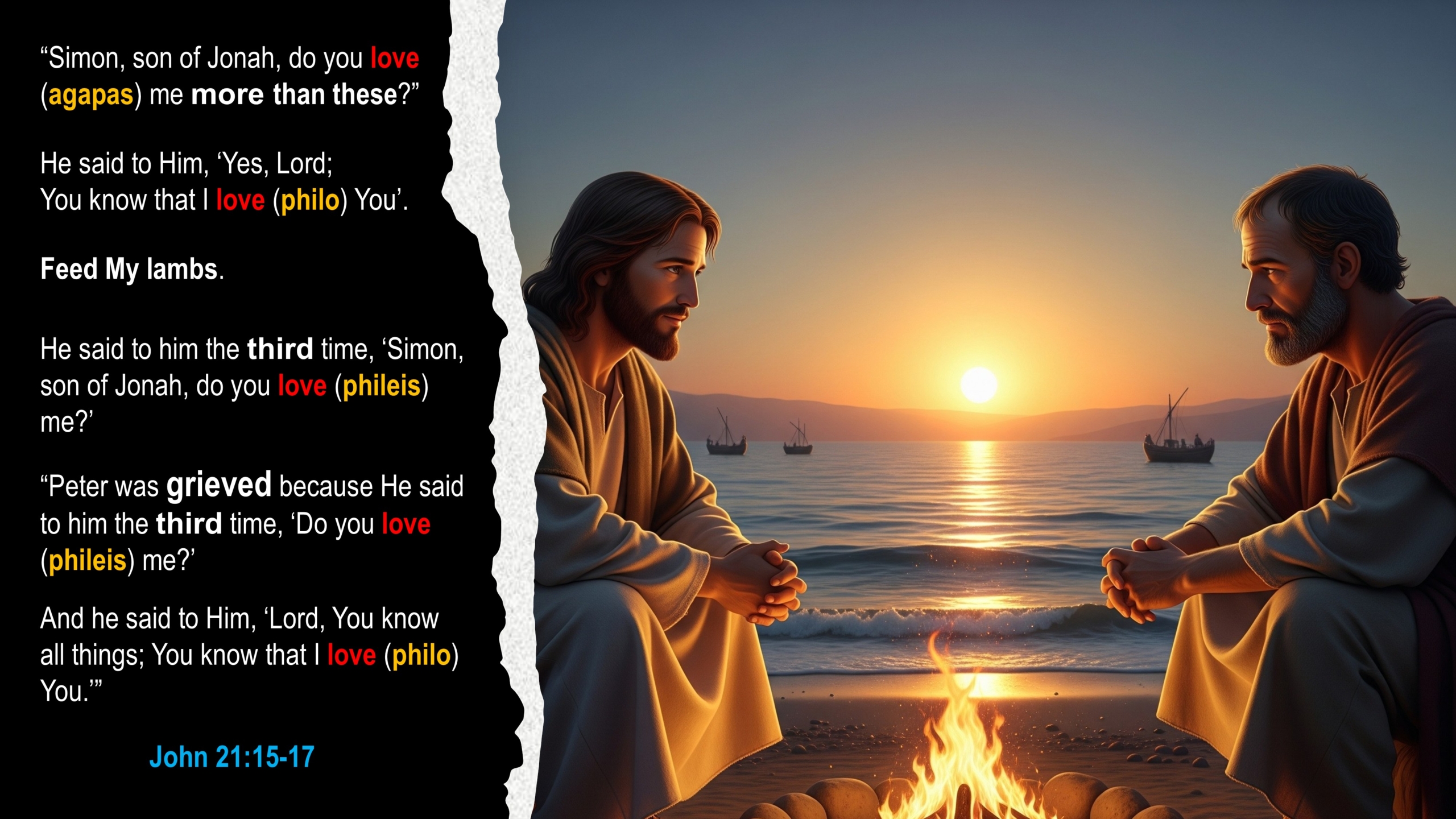
To help Peter understand his true problem, Jesus later asked him a vital question: “Simon, son of Jonah, do you love (agapas) me more than these?” John 21:15. Christ used the Greek verb agapao, asking Peter if he still claimed to possess a never-failing, superior agape love. Peter humbly responded: “Yes, Lord; You know that I love (philo) You.” John 21:15. In English, it looks like Peter is repeating the same claim, but in Greek, he switched to the verb phileo, admitting he only had imperfect human affection.
Jesus asked a second time with agapao, and Peter responded again with philo. Finally, the third time, Jesus lowered His word to Peter’s level: “Simon, son of Jonah, do you love (phileis) me?” John 21:17. “Peter was grieved because He said to him the third time, ‘Do you love (phileis) me?’ And he said to Him, ‘Lord, You know all things; You know that I love (philo) You.'” John 21:17. Peter humbly confessed his lack of agape, and the Savior, satisfied with his humility, said, “Feed My lambs.” Now that Peter understood his need, he was ready to lead.
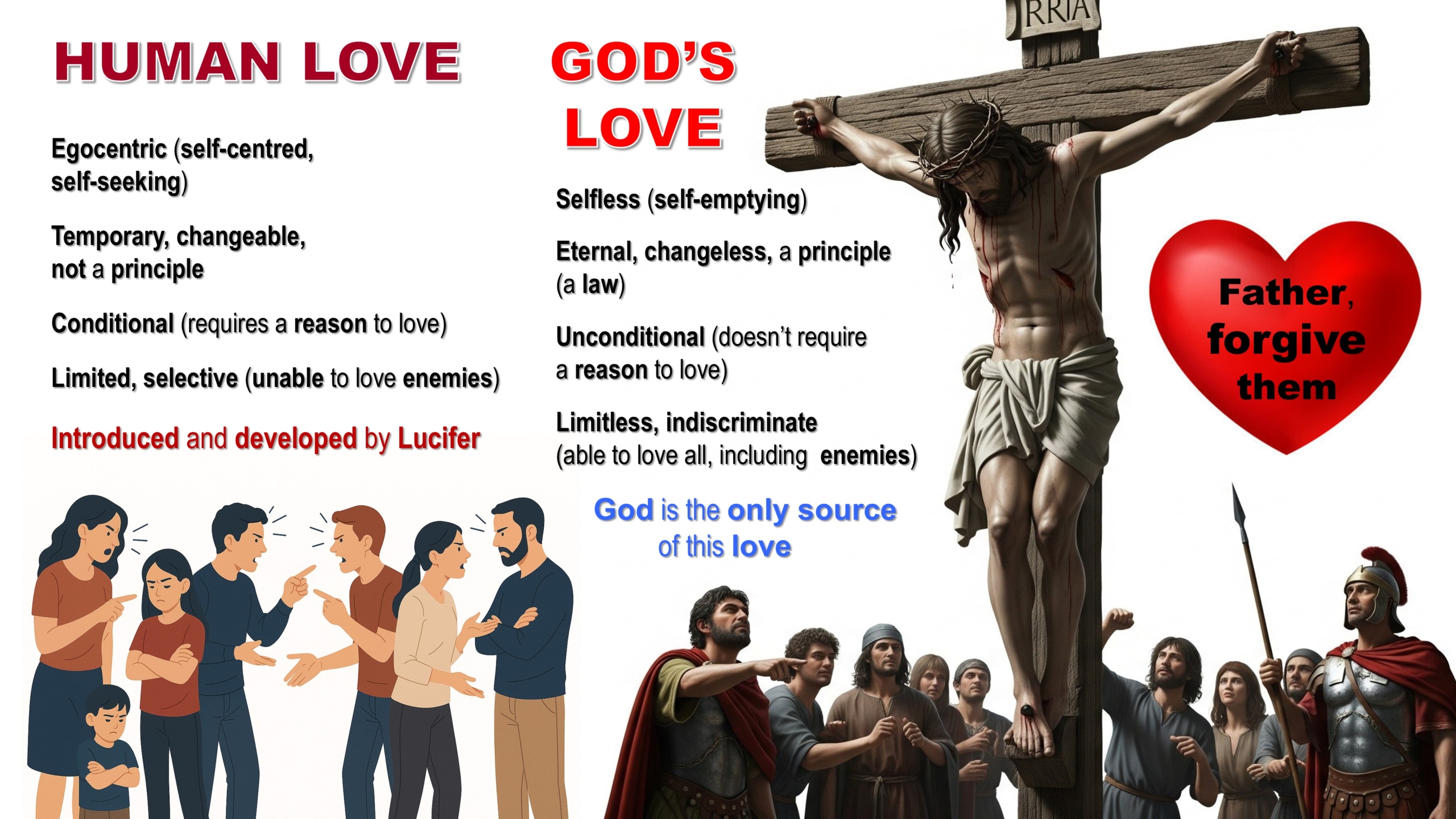
Human Love vs. God’s Love
| Human Love (Eros / Philia / Storge) | God’s Love (Agape) |
| Egocentric (self-centered, self-seeking) | Selfless (self-emptying); “does not seek its own” (1 Cor 13:5) |
| Temporary, changeable, not a principle | Eternal, changeless, a constant principle or law |
| Conditional (requires a reason, beauty, or goodness) | Unconditional (spontaneous, requires no external cause) |
| Limited, selective (unable to love enemies) | Limitless, indiscriminate (loves all, including enemies) |
| Introduced and developed by Lucifer | God is the only source |
There is a big difference between God’s agape love and human love.
Human love is egocentric, but agape “does not seek its own” (1 Corinthians 13:5). It is selfless, self-sacrificing love.
Our natural human love is temporary, changeable, and not a fixed principle. God’s love, on the other hand, is eternal, unchanging, and a principle—or a law. Like the law of gravity, it is a constant force because its source is “the law of the Spirit of life” (Romans 8:2).
Human nature needs certain conditions or reasons to love, such as another person’s goodness, kindness, beauty, or the benefits they provide. Agape, however, is unconditional. It does not require any reason to love. It loves simply because love is its very nature.
Human love is limited and selective. It cannot naturally love its enemies. Agape, however, is limitless and impartial. It extends even to those who hate it.
In Romans 5:8–10 we read: “God demonstrates His own love toward us, in that while we were still sinners, Christ died for us… For if when we were enemies we were reconciled to God through the death of His Son, much more, having been reconciled, we shall be saved by His life.”

Finally, let us remember that the selfish, pride-filled love we are born with did not originate with God. It was first introduced and cultivated by Lucifer, who became the source and promoter of this counterfeit form of love.
The only source of self-emptying agape love is God. Therefore, whenever we choose to live independently of Him, we separate ourselves from the only source of agape. The longer we remain separated from God, the more selfish we become.
The greatest example of the results of a life separated from the source of agape love is Lucifer himself. Having been cut off from God’s agape for over six thousand years, he has become so consumed by selfishness and pride that he now seeks only to “steal, kill, and destroy” (John 10:10).
Human love is fundamentally limited. For instance, in Ethiopia, if a couple gets married without a communion service, they are legally allowed to divorce. But if they have a communion service at their wedding, they are bound forever before the Lord and cannot separate. Guess how many couples choose to get married with a communion service? Almost none! This highlights the inherent weakness and temporary nature of human commitment.

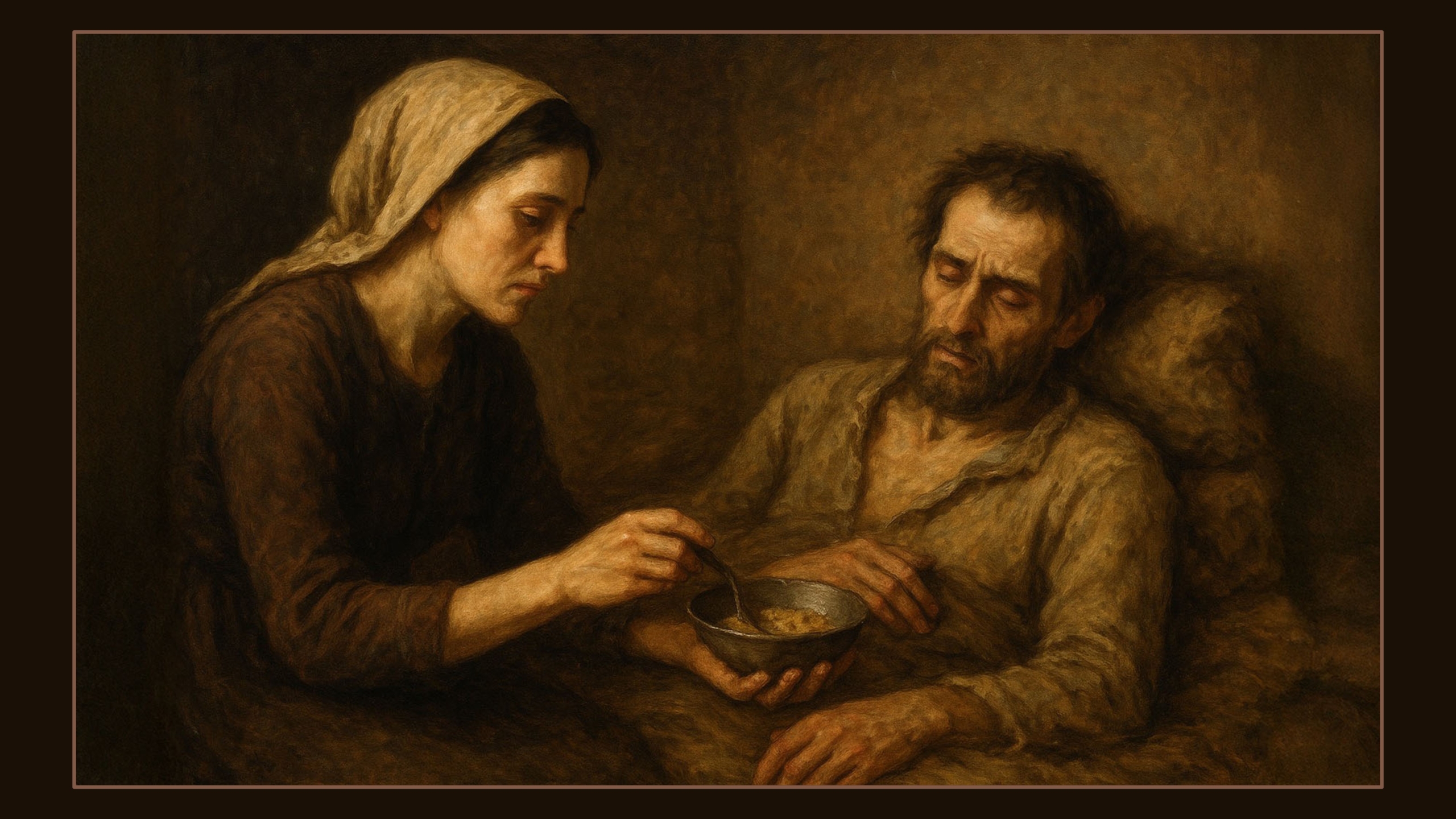
Long ago I read a story about a wife who, during a time of famine and severe starvation, had only a tiny amount of food left.
Each day, she secretly gave her own portion to her sick, weak, and hungry husband, pretending that she had already eaten. She continued doing this until she finally died of starvation, but in doing so, she saved her husband’s life.
Yet even this beautiful, heart-felt example of self-sacrificing love cannot fully express God’s everlasting love for us, because that wife gave her life for someone who loved her. Christ and God the Father in His Son, however, suffer and gave Their life for us when we were enemies and ungodly and when we did not love Him (Rom 5:8-10)!
In contrast, God’s love operates on a completely different plane: “For if when we were yet enemies, we were reconciled to God by the blood of His Son, how much more being reconciled we shall be saved now through His life.” Romans 5:10. God died for us when we were ungodly, sinners, and enemies!

Furthermore, “Christ redeemed us from the curse of the law, having become a curse for us.” Galatians 3:13. This means Christ was willing to bear eternal condemnation and the second death for His enemies—forever! The sufferings of Christ, caused by the horrible feeling of being separated from His Father’s love, were so immense that we will never fully comprehend them, even throughout eternity.
Love as Energy and Light
According to Ellen White, when Adam and Eve were created perfect, they were covered with a beautiful light. She writes: “This sinless pair wore no artificial garments. They were clothed with a covering of light and glory, such as the angels wear.” (The Spirit of Prophecy, vol. 1, p. 25).
Why were Adam and Eve filled and surrounded with this beautiful light? Because they possessed the presence of the Holy Spirit and God’s selfless agape love.
But something terrible happened when Adam and Eve sinned. God’s agape love no longer filled their hearts, egocentric love took its place, and at the same time the beautiful light disappeared.
Ellen White states this very clearly: “But when sin entered, they severed their connection with God, and the light that had encircled them departed.” (Christ’s Object Lessons, p. 311).
What a remarkable connection! They lost the indwelling Holy Spirit and God’s love—and the light disappeared. They became darkness instead of light, spiritually dead instead of spiritually alive.
This is why Paul wrote to converted Christians: “For you were once darkness, but now you are light in the Lord” (Ephesians 5:8). Notice that Paul does not merely say that we were in darkness. He says, “you were once darkness.” But when Christ restores His life in us, we become “light in the Lord.”
And here we come to something fascinating. Love is not merely a feeling. Love is also a form of energy. Even human love, which is extremely weak compared with the infinite agape love of God, appears to generate some light.
Scientists have discovered something remarkable: the human body actually produces light. Living cells emit small quantities of photons—particles of light. This phenomenon is usually called ultraweak photon emission, or sometimes “biophoton emission.” The light is too weak for the naked human eye to see, but sufficiently sensitive light meters can detect and measure these photons.
And guess who, what kind of people can produce strongest light? People experiencing powerful emotions—especially people in love! Of course, we cannot see this light because it is too weak. But if we had an extremely sensitive photon detector, we might discover that some of us produce more photons than others!
But how can love emit photones and produce light?
When we place an iron bar in a fire, after some time it becomes red and produce light. But how does this happen?
When we place an iron bar in a fire, the heat energy excites the electrons in the iron. They gain energy and can move to higher orbit. However, they have a tendency to return to their original orbit, and every time they change their orbit, energy can be released in the form of particles of light called photons. In this way, love can produce light because it excites electrons!
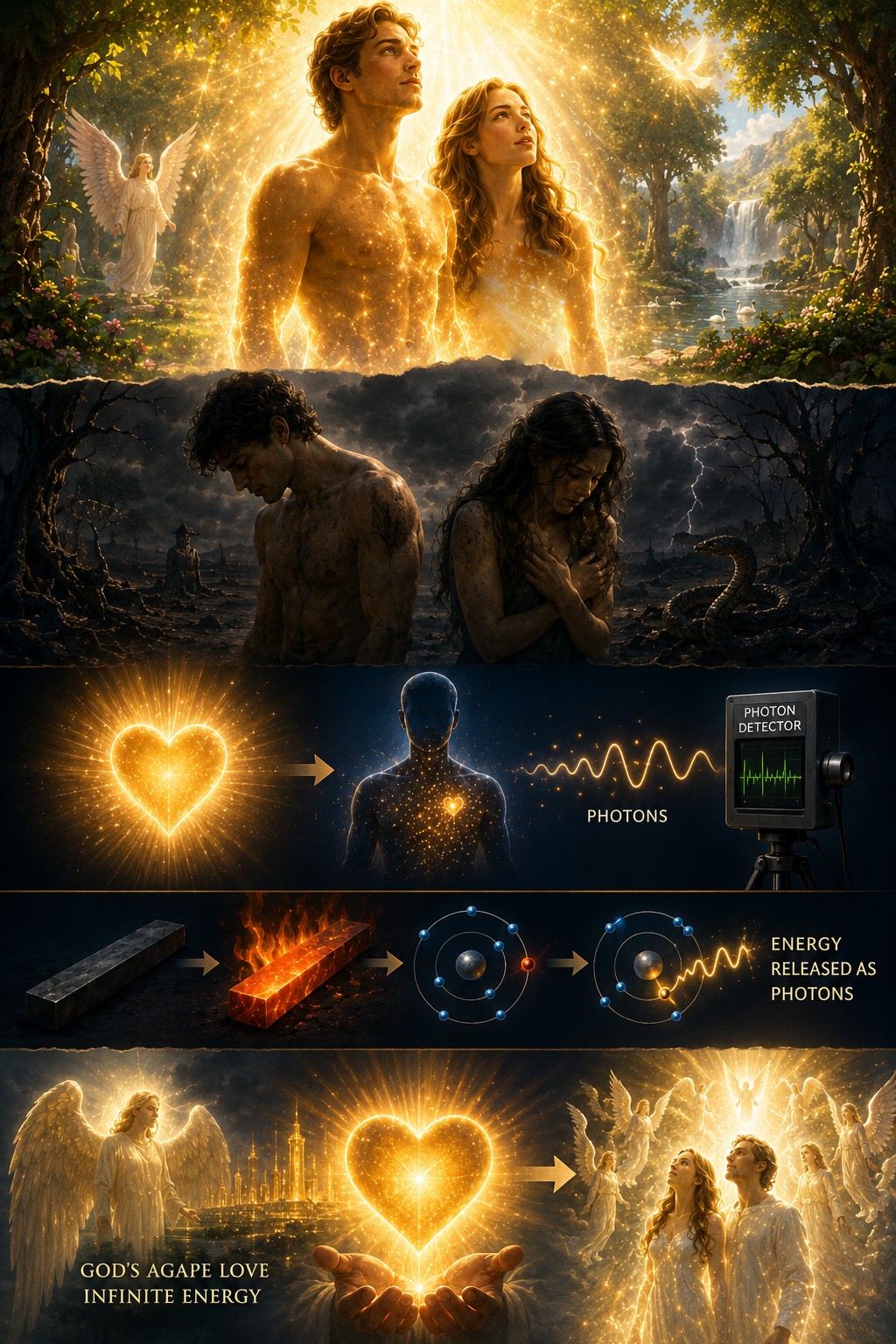
So love is also an energy—but God’s agape love is infinitely more powerful than human love. Human love is weak, imperfect, fluctuating and contaminated by selfishness. Therefore, whatever physical effects accompany human emotions are exceedingly small. But God’s agape love is infinite, pure, selfless and unimaginably powerful. God’s agape love is so incredibly powerful, it can produce visible light and glory—the glory of God, the glorious light associated with angels, and the glory that surrounded perfect and holy Adam and Eve when they were created and enjoyed internal presence of Holy Spirit and God’s love.
Attempts to Replace Agape with Eros
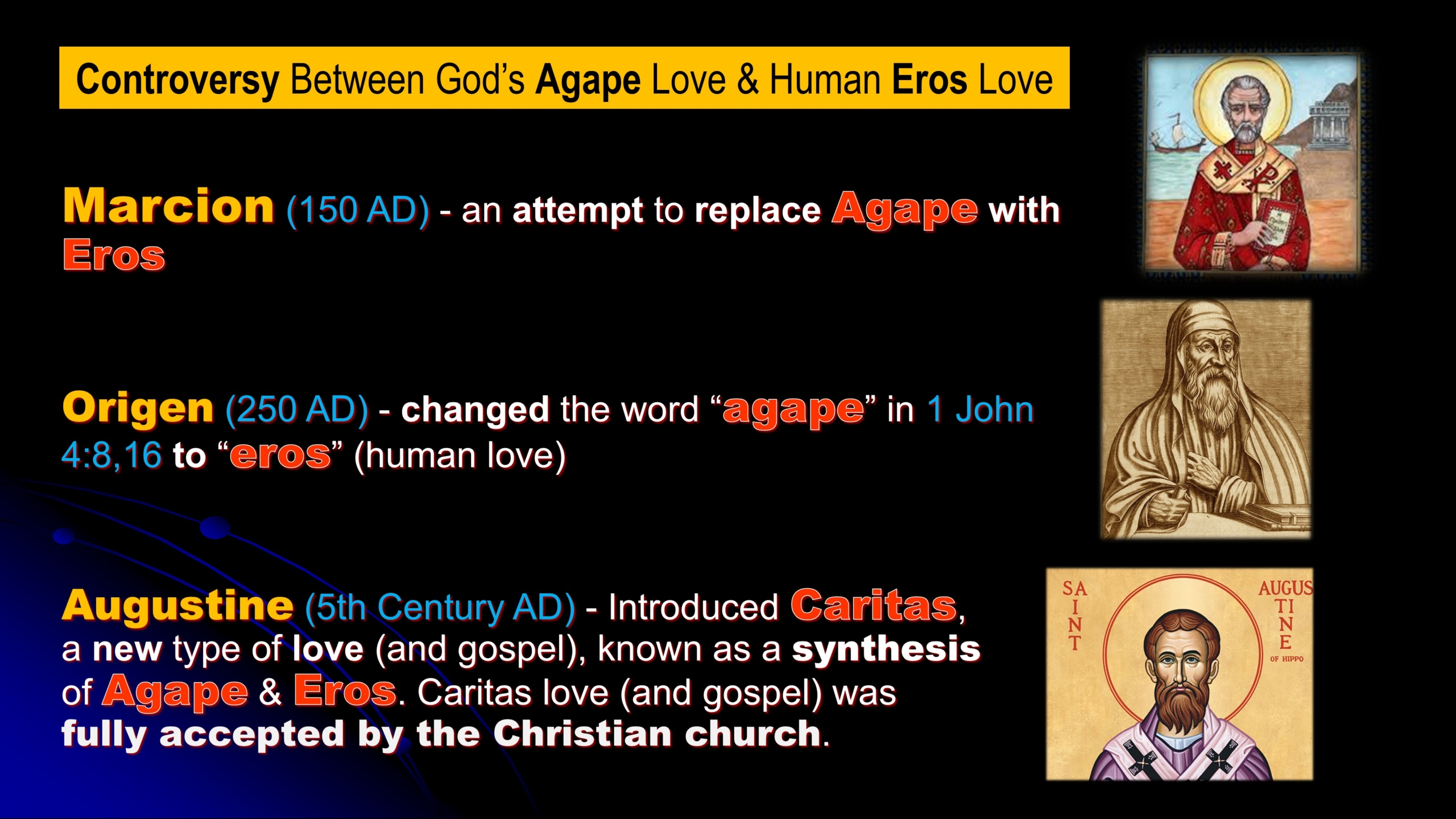
History reveals a direct controversy between God’s agape love and human eros love:
-
Marcion (150 AD): An early attempt to replace Agape with Eros.
-
Origen (250 AD): Altered the text of 1 John 4:8, 16, replacing “agape” with “eros”.
-
Augustine (5th Century AD): Introduced Caritas (charity), a synthesis of Agape and Eros. This compromise was fully accepted by the mainstream Christian church.
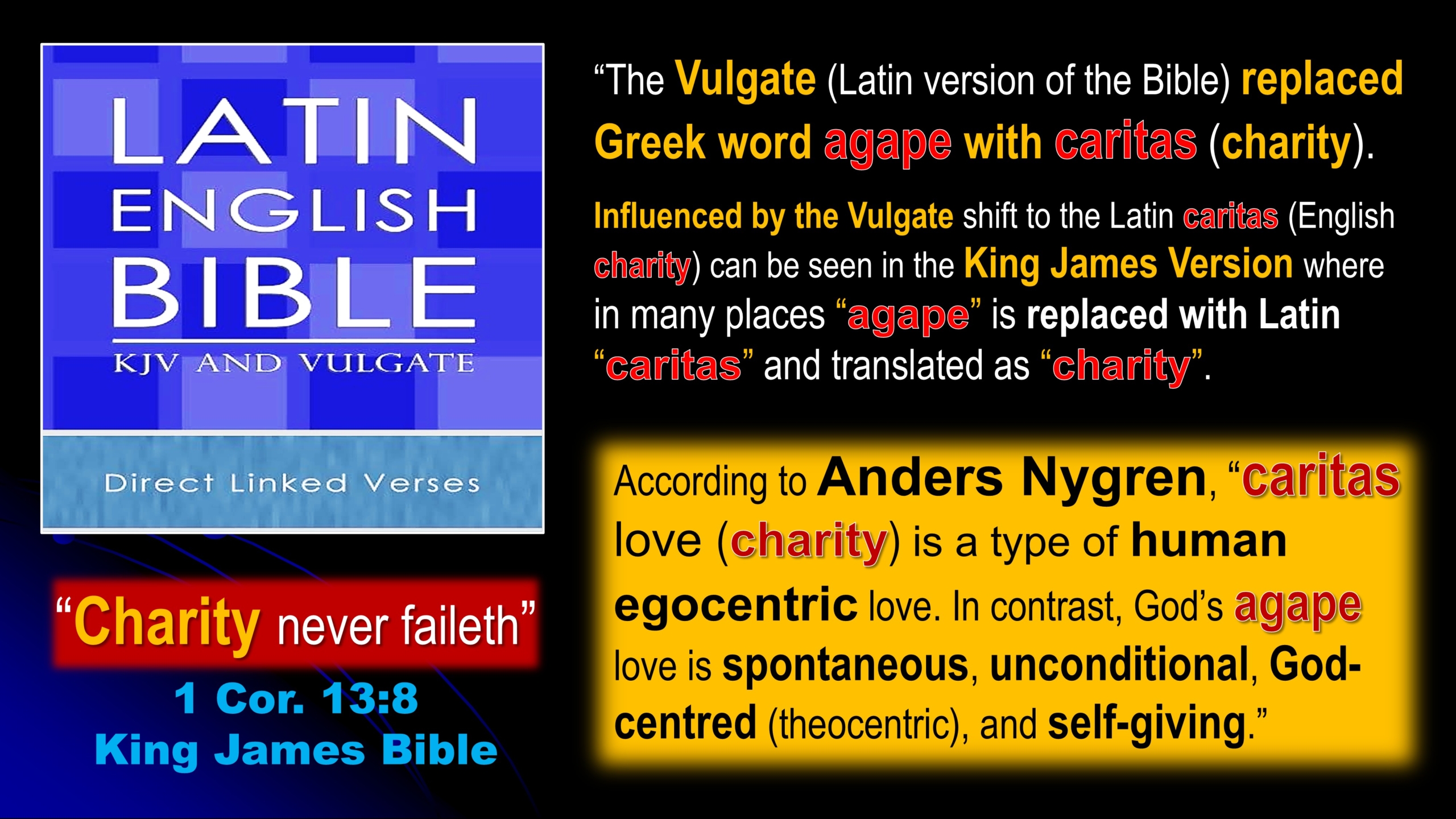
This shift severely impacted Bible translations. In the Latin Vulgate, the Greek agape was systematically replaced with the Latin caritas. Influenced by this, the King James Version translated agape as “charity” in many places, such as: “Charity never faileth.” 1 Corinthians 13:8.
As Anders Nygren explains in his book Agape and Eros, caritas (charity) remains a desire-based, human egocentric love. In contrast, God’s true agape love is entirely spontaneous, unconditional, theocentric, and self-giving. This historical shift perverted the Gospel from being “good news” into mere “good advice.”
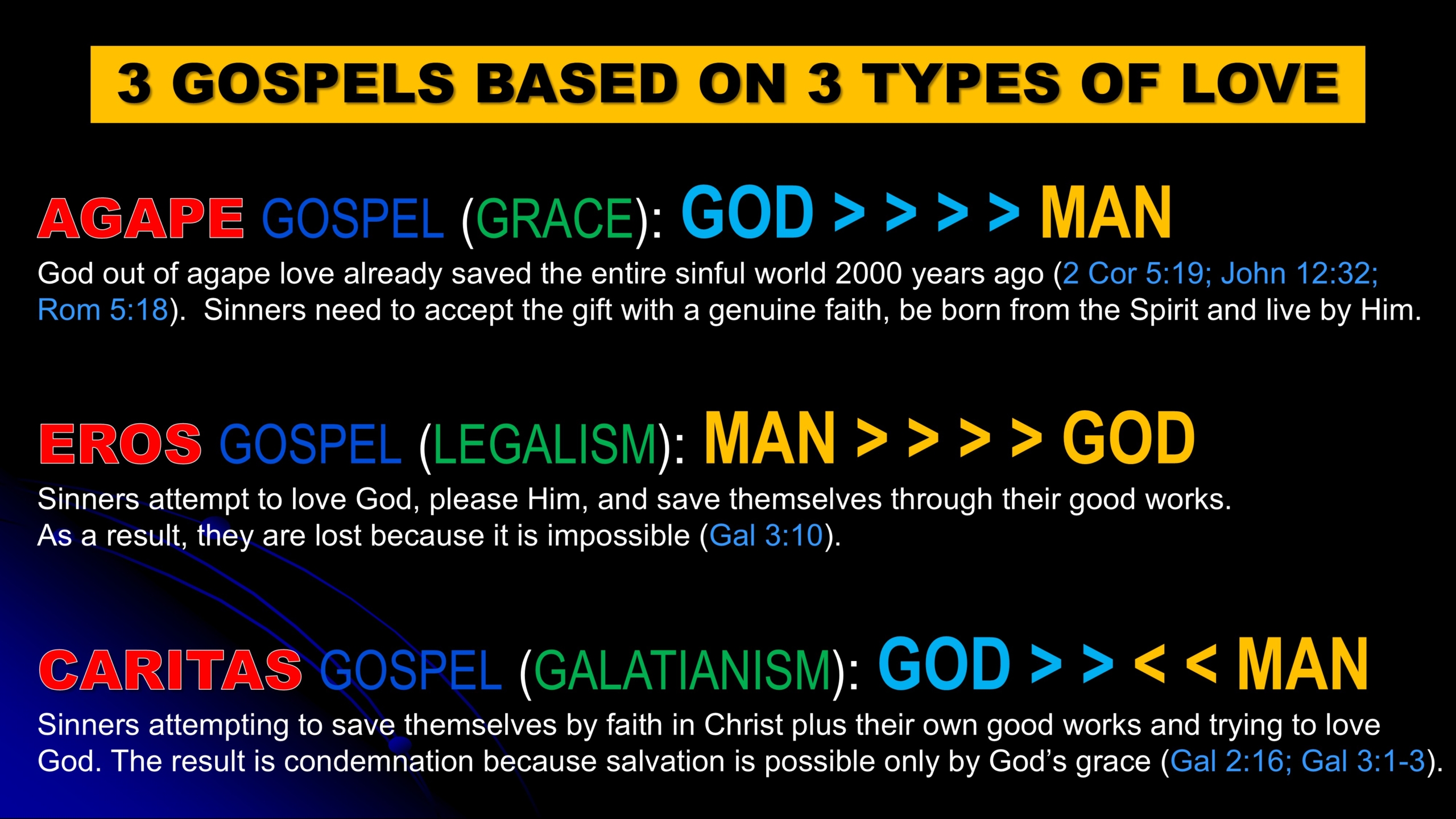
Three Gospels Based on Three Types of Love
-
The Agape Gospel (Grace): Configured as God going to man. Out of agape love, God already saved the entire sinful world 2,000 years ago, as supported by 2 Corinthians 5:19, John 12:32, and Romans 5:18. Sinners simply need to accept this gift with genuine faith, be born of the Spirit, and live by Him.
-
The Eros Gospel (Legalism): Configured as man attempting to reach God. Sinners try to love God, please Him, and save themselves through their own good works. The result is total failure, because salvation by human effort is impossible: “For as many as are of the works of the law are under the curse.” Galatians 3:10.
-
The Caritas Gospel (Galatianism): Configured as a mutual, conditional effort between God and man. Sinners attempt to save themselves by combining faith in Christ with their own good works and self-generated love for God. This results in condemnation because salvation is exclusively by God’s grace, a truth corrupted by this mindset: “Knowing that a man is not justified by the works of the law but by faith in Jesus Christ…” Galatians 2:16, see also Galatians 3:1-3.
The cross remains our singular focus. The Apostle Paul understood this completely: “For I determined not to know anything among you except Jesus Christ and Him crucified.” 1 Corinthians 2:2.
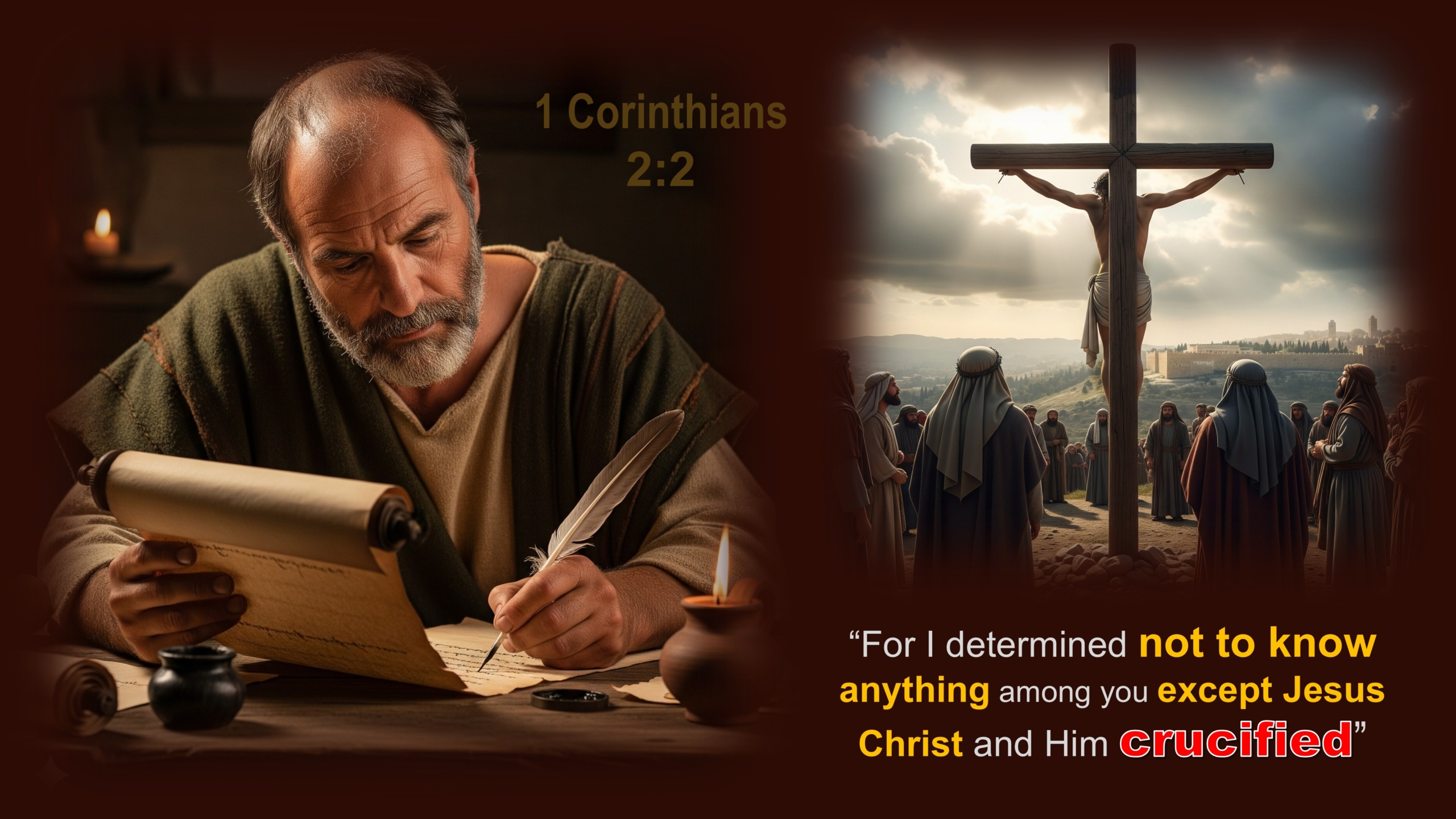
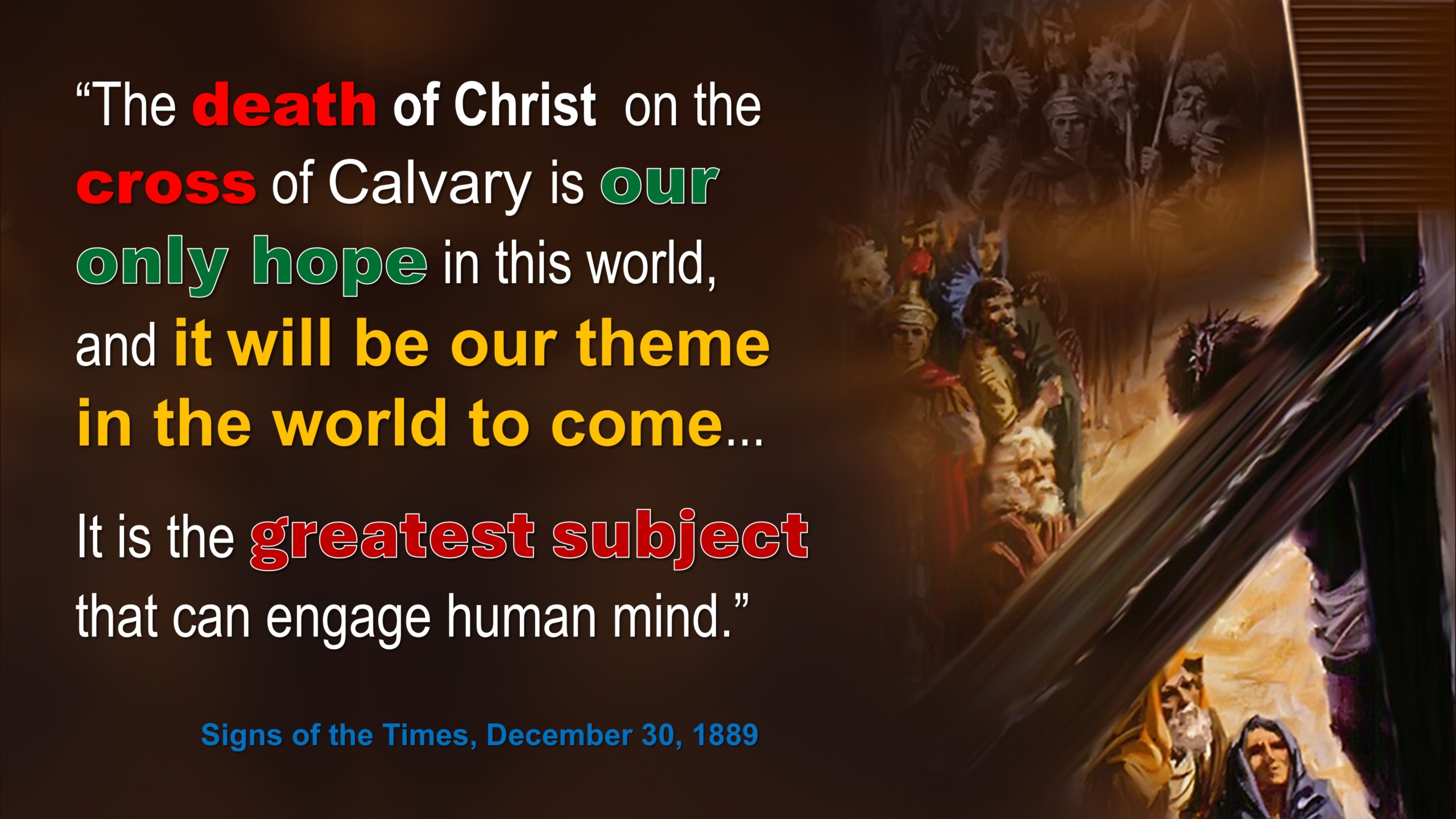
Paul preached the cross constantly, which is why early Christians were so deeply dedicated and willing to suffer and die for their Lord. Ellen White affirms this: “The death of Christ on the cross of Calvary is our only hope in this world, and it will be our theme in the world to come… It is the greatest subject that can engage human mind.” Signs of the Times, December 30, 1889.
Greatest Revelation of God’s Love
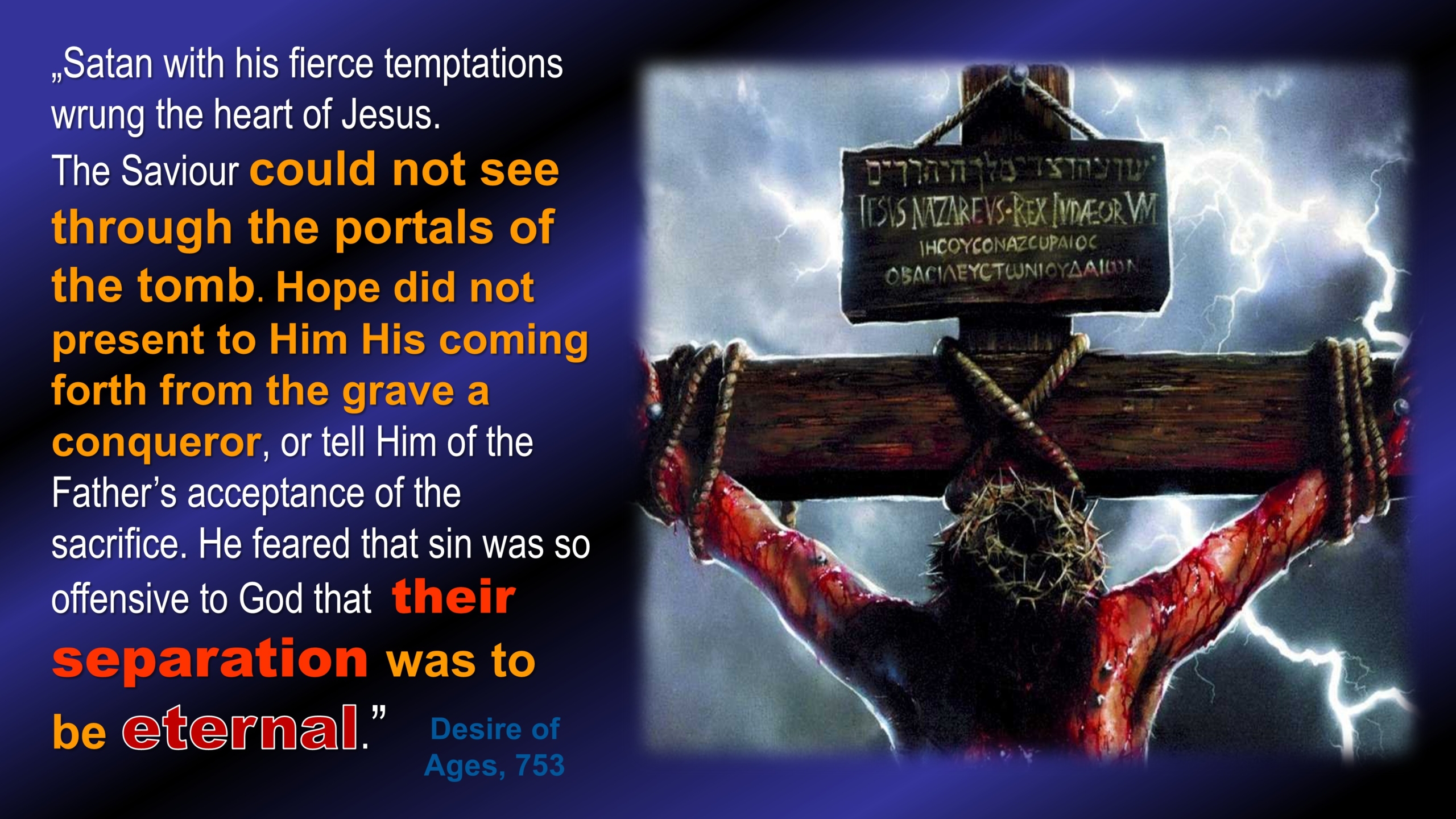
During that ultimate sacrifice, the separation was devastating: “Satan with his fierce temptations wrung the heart of Jesus. The Saviour could not see through the portals of the tomb. Hope did not present to Him His coming forth from the grave a conqueror, or tell Him of the Father’s acceptance of the sacrifice. He feared that sin was so offensive to God that their separation was to be eternal.” The Desire of Ages, p. 753.
Command to Love Enemies
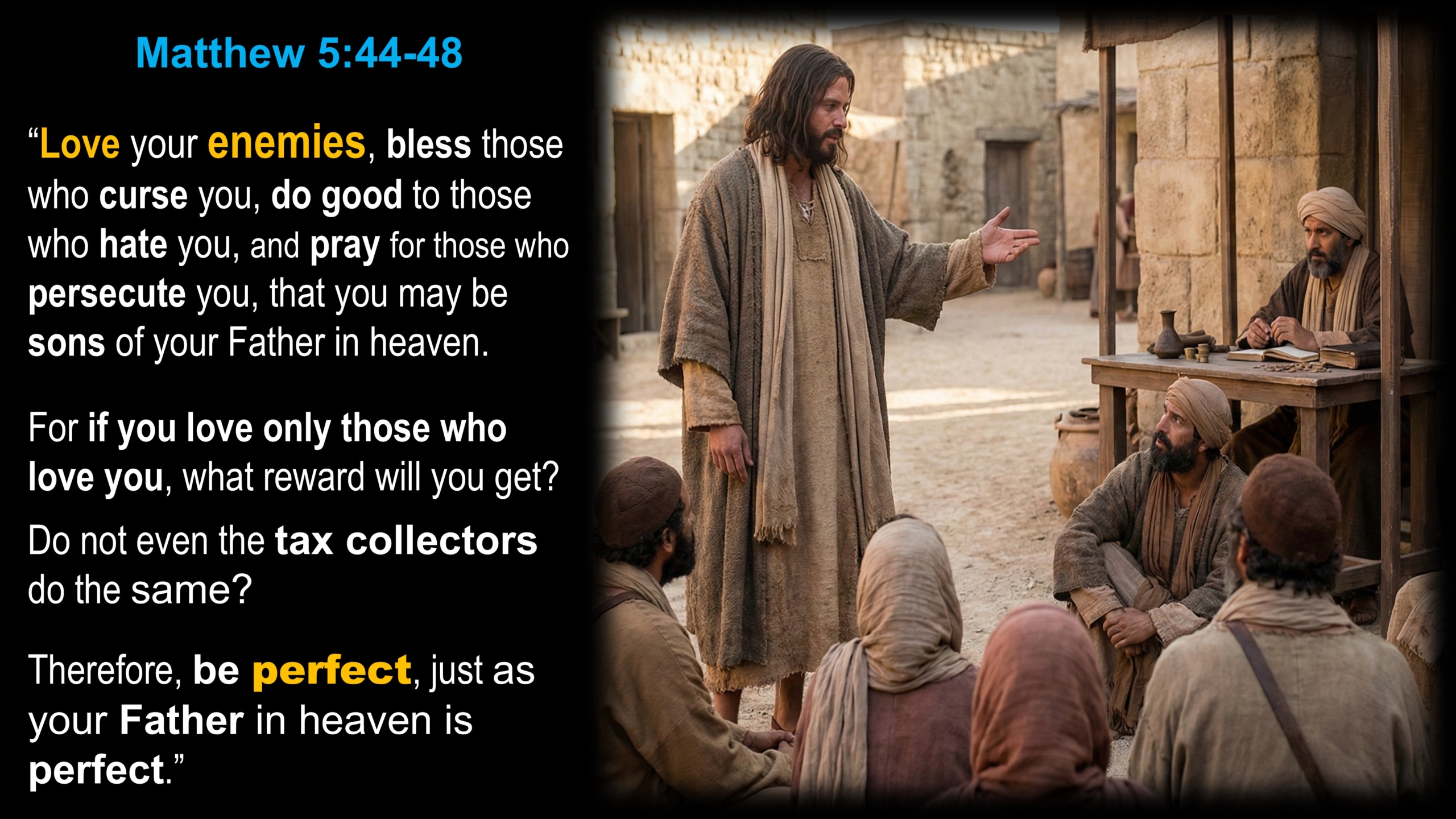
The amazing truth is that the same agape love Christ revealed in our flesh—in spite of having a human nature, which was a miracle—He wants to reveal through us today! He expects us to manifest this love: “Love your enemies, bless those who curse you, do good to those who hate you, and pray for those who persecute you, that you may be sons of your Father in heaven. For if you love only those who love you, what reward will you get? Do not even the tax collectors do the same? Therefore, be perfect, just as your Father in heaven is perfect.” Matthew 5:44-48.
How can we possibly produce this fruit? We cannot do it apart from Him: “I am the vine; you are the branches.
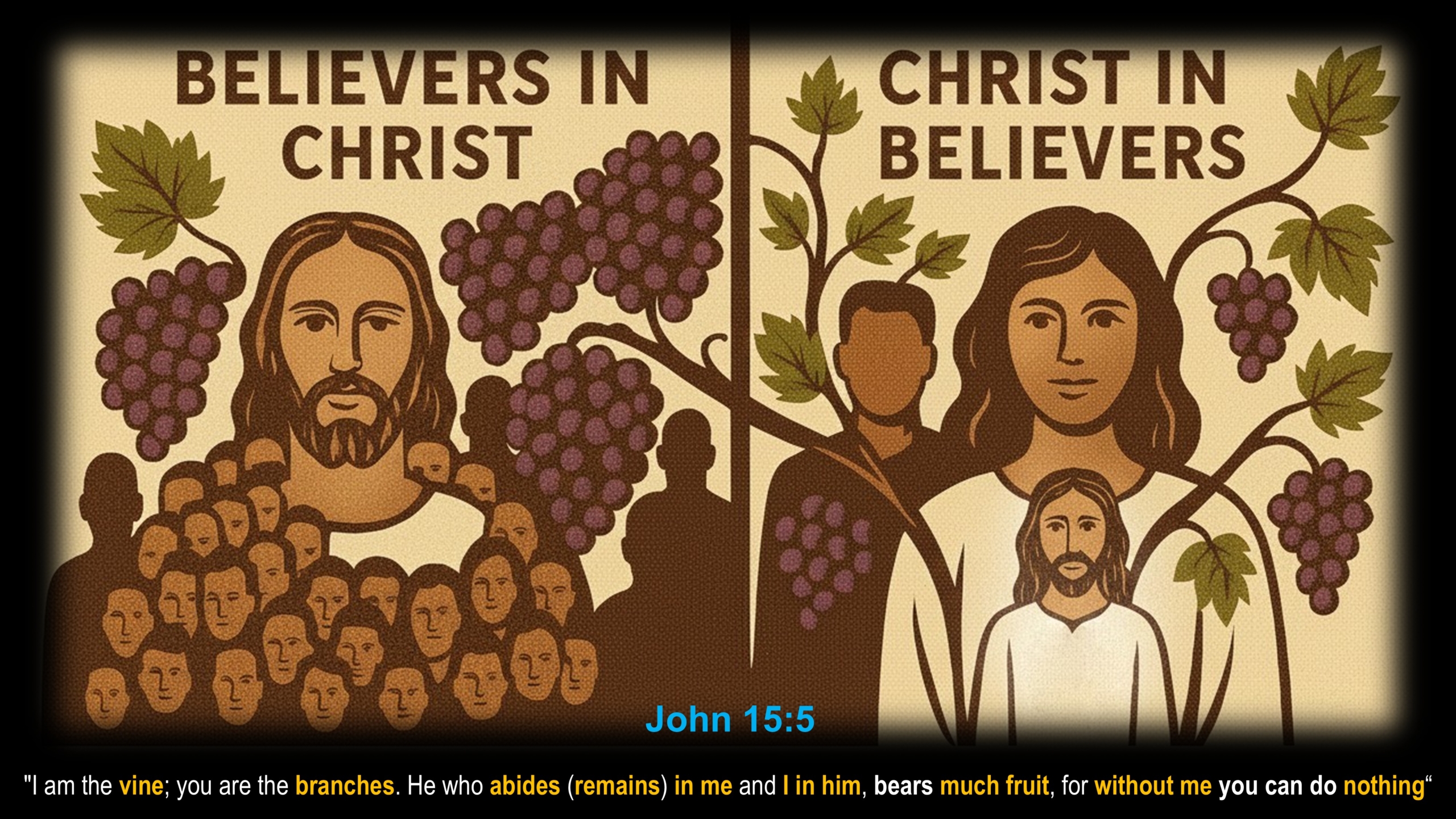
He who abides in me and I in him, bears much fruit, for without me you can do nothing.” John 15:5. The “fruit” of Christ in us is agape, and “without me you can do nothing” means we are completely incapable of loving with agape without Christ living within us.

Transformed by Beholding
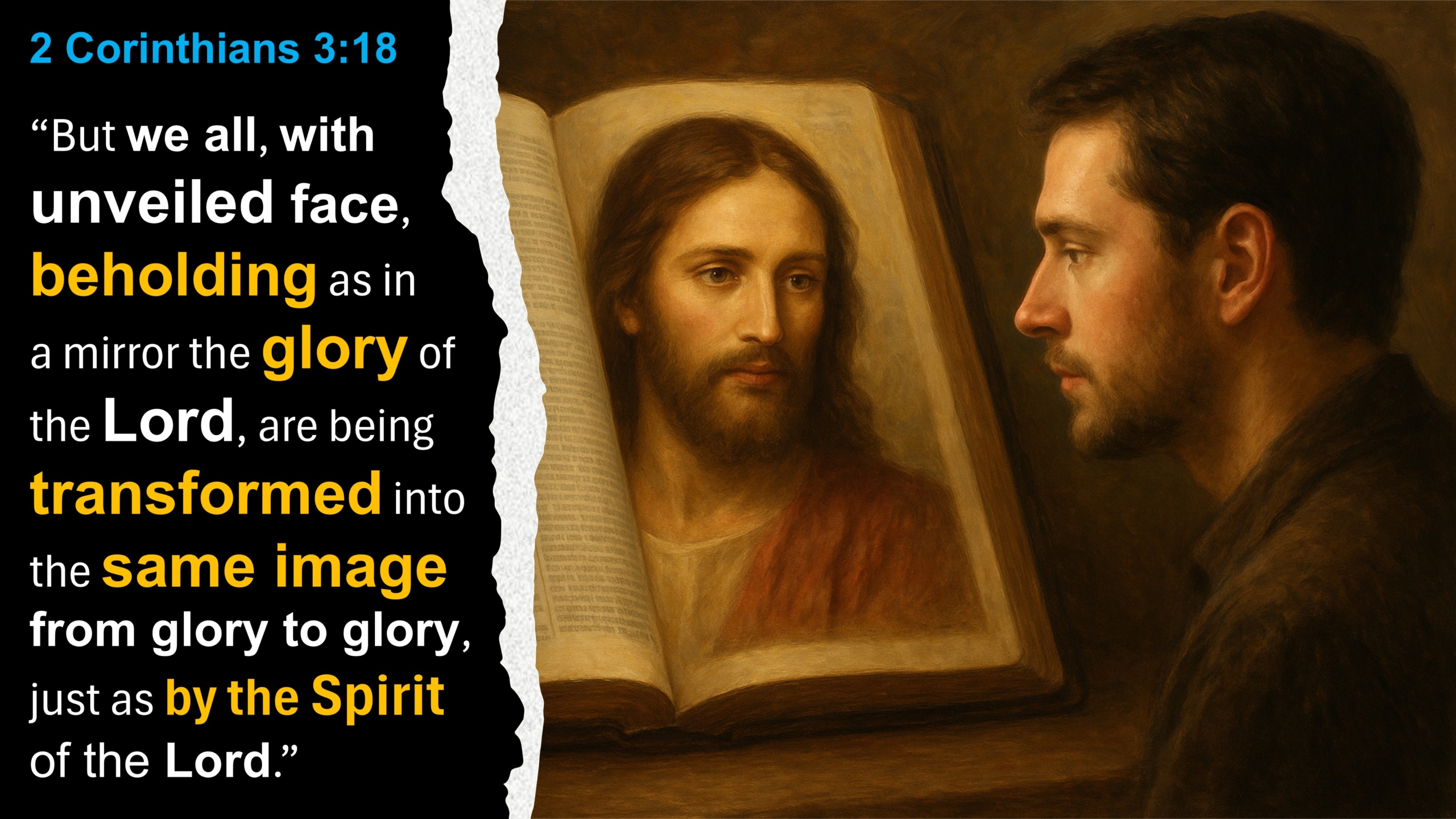
We are changed by our focus: “By beholding we become changed. By dwelling upon the love of God and our Saviour, by contemplating the perfection of the divine character and claiming the righteousness of Christ as ours by faith, we are to be transformed into the same image (2 Cor 3:18). Then let us not gather together all the unpleasant pictures—the iniquities and corruptions and disappointments, the evidences of Satan’s power—to hang in the halls of our memory.” Lift Him Up, p. 251.

This perfectly mirrors the word of Scripture: “But we all, with unveiled face, beholding as in a mirror the glory of the Lord, are being transformed into the same image from glory to glory, just as by the Spirit of the Lord.” 2 Corinthians 3:18.
To illustrate the power of environment and constant beholding, scientists once conducted an experiment where they placed common grey sparrows in white cages inside a completely white room. The caretakers who fed them also wore entirely white uniforms. Everything the sparrows saw was white. When the first generation of baby sparrows appeared, their feathers were still grey. The second generation was also grey.

But when the third generation of baby sparrows arrived, a biological shift occurred: they were born with completely white feathers! By constantly beholding their white environment over generations, they were transformed.

144,000 and Song of Moses and the Lamb
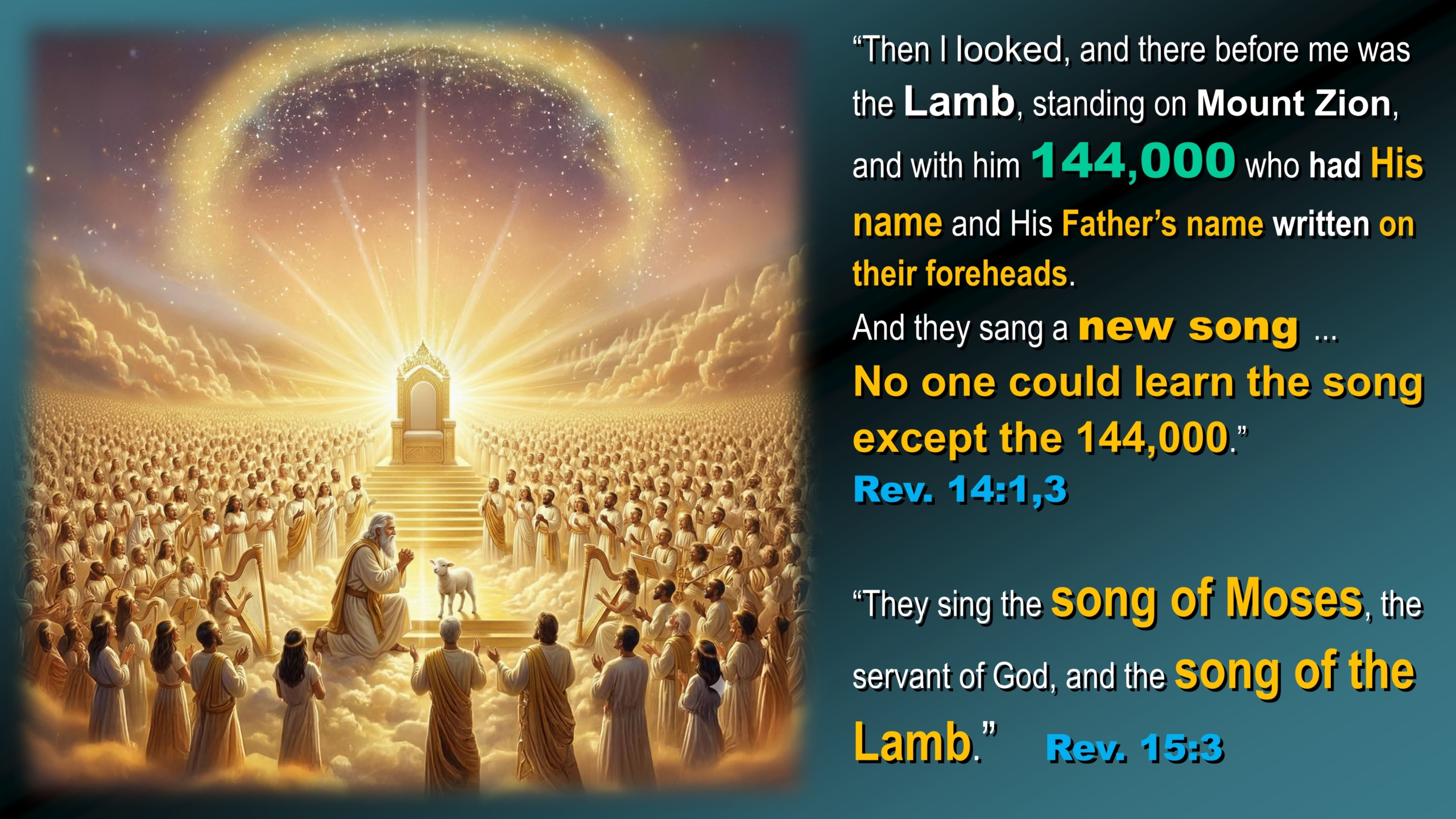
This transformation prepares us for eternity: “Then I looked, and there before me was the Lamb, standing on Mount Zion, and with him 144,000 who had His name and His Father’s name written on their foreheads… And they sang a new song… No one could learn the song except the 144,000.” Revelation 14:1,3. “They sing the song of Moses, the servant of God, and the song of the Lamb.” Revelation 15:3.
Our Glorious Brother and Our Victory
“The Son of man” was the favorite title Christ used for Himself because it reflects God’s immense love for us. Although all the fullness of the Godhead dwelt in Him, He emptied Himself of His divine prerogatives, took our nature, and became our Brother in the flesh. Forever He will remain not only the Son of God, but the Son of man—our glorious Brother, our family, and our everything for eternity.
Therefore, do not try to fight Satan and the law of sin on your own ground. The way eagles deal with venomous snakes provides a perfect lesson. The Brown Snake Eagle regularly preys on highly venomous cobras and black mambas without being harmed. They succeed because they never fight the snake on the ground, where the snake is agile and lethal. Instead, the eagle strikes quickly, catches the snake, and immediately lifts it high into the air. Deprived of the ground, the snake loses its leverage, cannot move properly, and becomes virtually powerless.
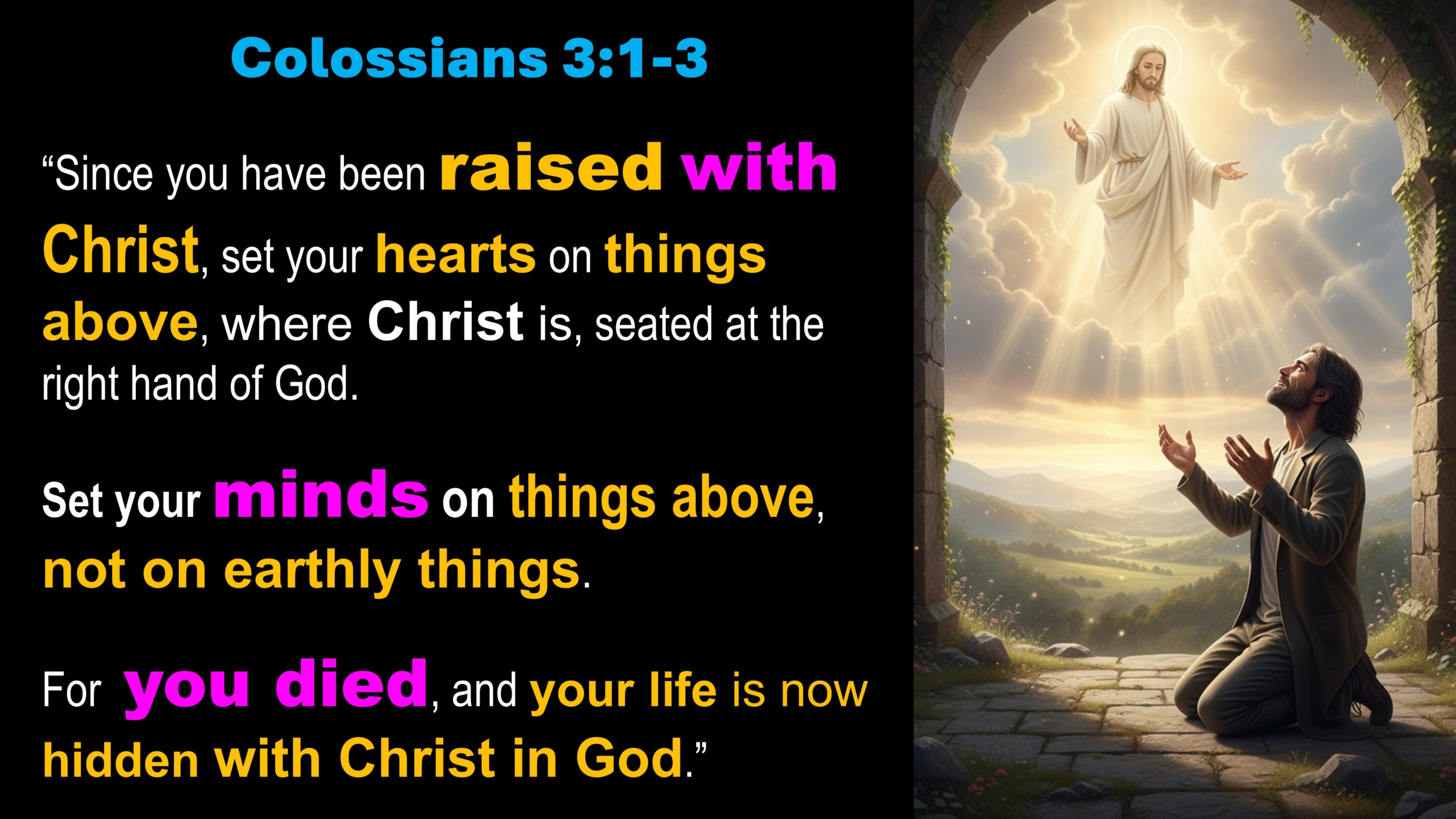
We must use this exact strategy. We cannot defeat Satan on the ground of our own willpower or earthly strength. To overcome the enemy and the law of sin injected into humanity, we must lift ourselves above the ground to heavenly places through heartfelt, constant prayer. Only in the atmosphere of heaven do temptation and sin lose their power. This is why the Apostle Paul admonishes us: “Since you have been raised with Christ, set your hearts on things above, where Christ is, seated at the right hand of God. Set your minds on things above, not on earthly things. For you died, and your life is now hidden with Christ in God.” Colossians 3:1-3.

Poem of Devotion
In the quiet of the night, a light so pure,
A promise of salvation, steadfast and sure.
Through faith in Christ, our hearts find peace,
A love eternal, that will never cease.
From the cross, His grace did flow,
A gift of mercy, all should know.
In every trial, in joy or strife,
He offers hope, He offers life.
With open arms, He calls us near,
Dispelling doubt, and calming fear.
Through faith alone, we are made whole,
His love, a balm to every soul.
So let us walk this path of grace,
With eyes uplifted, seeking His face.
For in His love, we find our place,
A home eternal, in His embrace.