Slawomir Gromadzki
Biblical Archaeology & Faith
Archaeological excavations and the statements of archaeologists confirming the historical accounts recorded in the Word of God are not necessary in order for us to believe that these biblical events truly happened.
Faith is “the assurance of things hoped for, the conviction of things not seen.”
I once heard a sister from Belarus say:
“I would believe the Bible even if it said that Jonah swallowed the whale instead of the whale swallowing Jonah, because with God all things are possible.”
Nevertheless, although archaeology and excavations are not essential for our faith in the authenticity of the biblical record, whenever we learn about archaeological discoveries that confirm the Bible, we are deeply moved. Such discoveries strengthen our conviction that the Word of God is true. And if God’s Word is true, then the promises of Jesus Christ are true as well.
John 5:24
“Most assuredly, I say to you, he who hears My word and believes in Him who sent Me has everlasting life, and shall not come into judgment, but has passed from death into life.”
Moses
According to biblical chronology, Moses was born during the reign of Egypt’s Eighteenth Dynasty, around 1530 BC (some scholars suggest 1525 BC, while others propose slightly different dates). At that time Egypt was ruled by Thutmose I, whose reign lasted approximately from 1532 to 1508 BC.
It was Thutmose I who issued the decree ordering the killing of all Hebrew baby boys.
Exodus 1:8–22
“Now there arose a new king over Egypt, who did not know Joseph.”
This new Pharaoh was almost certainly Thutmose I, the third ruler of Egypt’s Eighteenth Dynasty.
Before this dynasty came to power, Egypt had been ruled by the Hyksos, who were Semitic people, like the Israelites. This helps explain how Joseph, who lived in Egypt during the Hyksos period, was able to become second only to Pharaoh.
After Joseph’s death, however, the Egyptians defeated the Hyksos (around 1580 BC), drove them out of Egypt, and regained control of the country. This explains why the Bible says that “a new king arose who did not know Joseph.”
The expression does not necessarily mean that Pharaoh had never heard of Joseph. Rather, as Patriarchs and Prophets suggests:
“He had heard of Joseph’s remarkable services, but he refused to acknowledge them and sought, as far as possible, to erase them from the memory of the people.”
This is understandable because the Egyptians hated the Hyksos, and Joseph had been closely associated with them.
This was the command Thutmose I gave to his people:
“Behold, the people of the children of Israel are more and mightier than we. Come, let us deal wisely with them, lest they multiply, and it happen, in the event of war, that they also join our enemies and fight against us… Therefore they set taskmasters over them to afflict them with their burdens. And they built for Pharaoh supply cities, Pithom and Rameses.”
Because this passage mentions the city of Rameses, many scholars have concluded that the Israelites were oppressed during the reigns of Rameses I or Rameses II, and that the Exodus took place under Merneptah.
However, this is impossible.
The life of Moses, the biblical chronology, and the entire sequence of events surrounding the Exodus do not fit the reigns of either Rameses or Merneptah.
Why, then, does the Bible mention the city of Rameses?
Rameses did not begin his reign until approximately 1389 BC, whereas the events described here took place much earlier.
So why is the name “Rameses” used?
The most likely explanation is that the copyist of the books of Moses lived much later, during the period when Rameses was already a familiar geographical designation. As was often the case in ancient writings, he updated place names so that readers of his own time would recognize them. It was only during the reign of Rameses I, the first Pharaoh to bear that name, that this region became known as the land of Rameses.
The theory that the Israelites left Egypt during the reign of Merneptah is also highly unlikely.
One important piece of evidence is the famous Merneptah Stele, dating from the late thirteenth century BC, discovered by the renowned archaeologist Sir Flinders Petrie at the end of the nineteenth century.
The stele had been lying face down in the ground. Egyptologist Wilhelm Spiegelberg lay beneath it and spent many hours deciphering the hieroglyphic inscription. Among the hieroglyphs he identified the name ISIRAR.
At first Spiegelberg did not realise what the word meant. Then he and Petrie remembered that Egyptian scribes often used the letter “r” where a later pronunciation would correspond to “l.” They recognised that the inscription referred to Israel.
The stele lists various peoples living in Canaan, including Israel. This demonstrates that Israel was already living in the land of Canaan long before Merneptah’s reign, meaning that the Exodus had already taken place.
The name Israel is preceded by the hieroglyphs of a seated man, a seated woman, and the plural sign.
This indicates that the Egyptians regarded Israel as a people rather than an established nation-state, which agrees well with the biblical period of the Judges, when the Israelites had not yet fully settled throughout the land.
There can therefore be little doubt that the Pharaoh who ordered the Hebrew midwives to kill the Hebrew baby boys was not Rameses but Thutmose I, the father of Hatshepsut, the adopted mother of Moses.
The Hebrew midwives, however, feared God and refused to obey Pharaoh’s command.
As a result, Thutmose I issued an even broader decree:
Exodus 1:22
“Then Pharaoh commanded all his people, saying, ‘Every son who is born you shall cast into the river, and every daughter you shall save alive.'”
It was during the time when this decree was already in force that Moses was born.
Although Satan, knowing that the promised deliverer would one day come, influenced Pharaoh to order the death of the Hebrew boys, God sent His angels to influence Pharaoh’s own daughter to rescue and care for the very child whom Satan sought to destroy.
This remarkable story demonstrates how wonderfully God overturns the plans of the enemy.
Hatshepsut – Adoptive Mother Of Moses
The daughter of Pharaoh Thutmose I was Hatshepsut, the most famous female ruler of ancient Egypt after Cleopatra.
An especially interesting fact, which fits remarkably well with the biblical account, is that Thutmose I had no surviving male heir. Likewise, his daughter Hatshepsut and her husband Thutmose II also had no son.
It is therefore not surprising that Hatshepsut would have wanted to adopt Moses as her own son.
Stela at Serabit El-Khadim
At Serabit el-Khadim there is a famous stela which, according to the official interpretation, depicts Senenmut, one of Hatshepsut’s highest officials, together with Princess Neferure, the daughter of Hatshepsut.
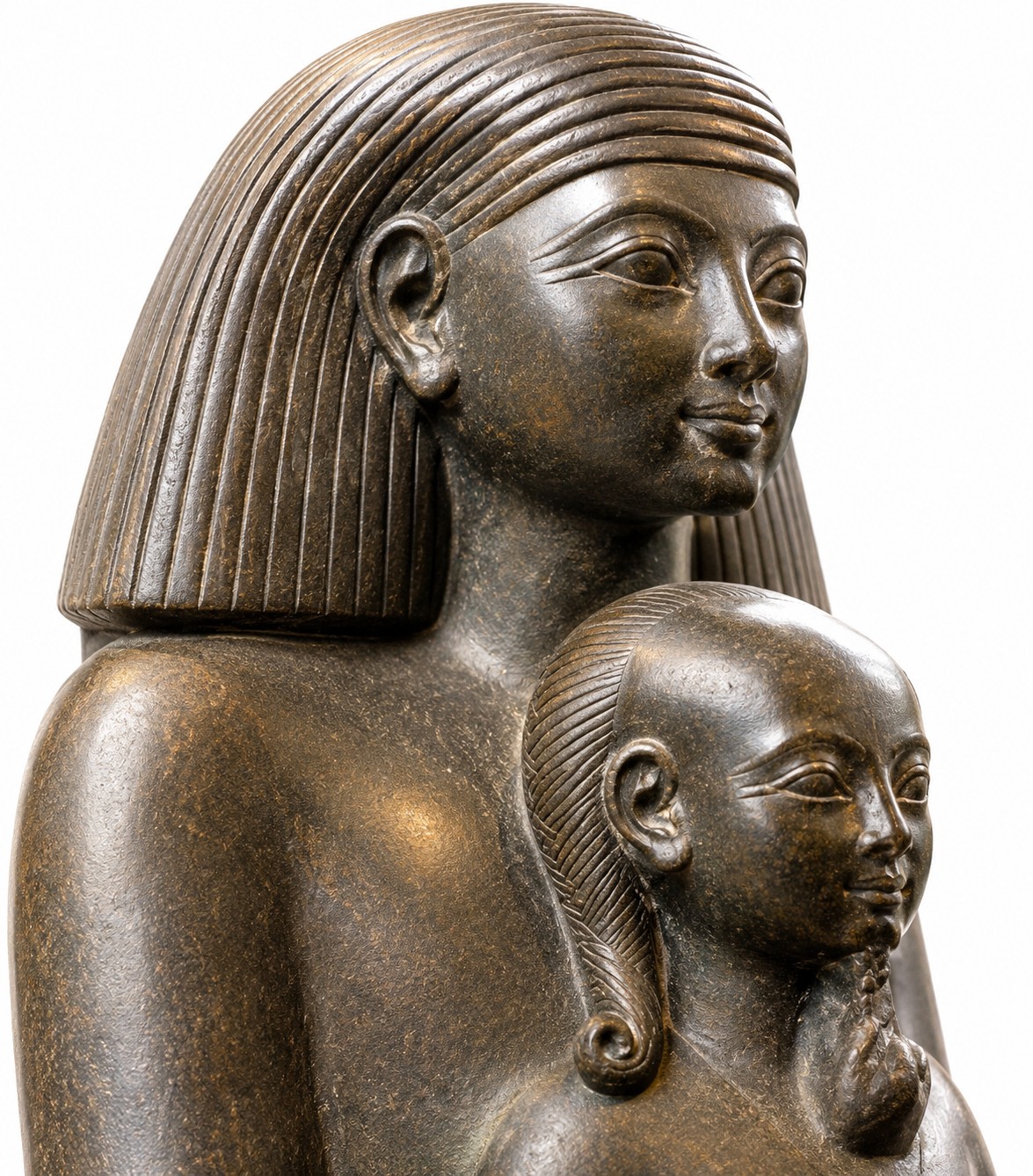
Senenmut holding Princess Neferure in his arms (18th Dynasty). He is described as the tutor of Princess Neferure and confidant (and possibly lover) of Queen Hatshepsut who ruled as Pharaoh after the death of her husband. Senenmut was also an architect and government official. He was allowed to erect his own statues in Thebes (reflecting his high status) (Location : The British Museum)
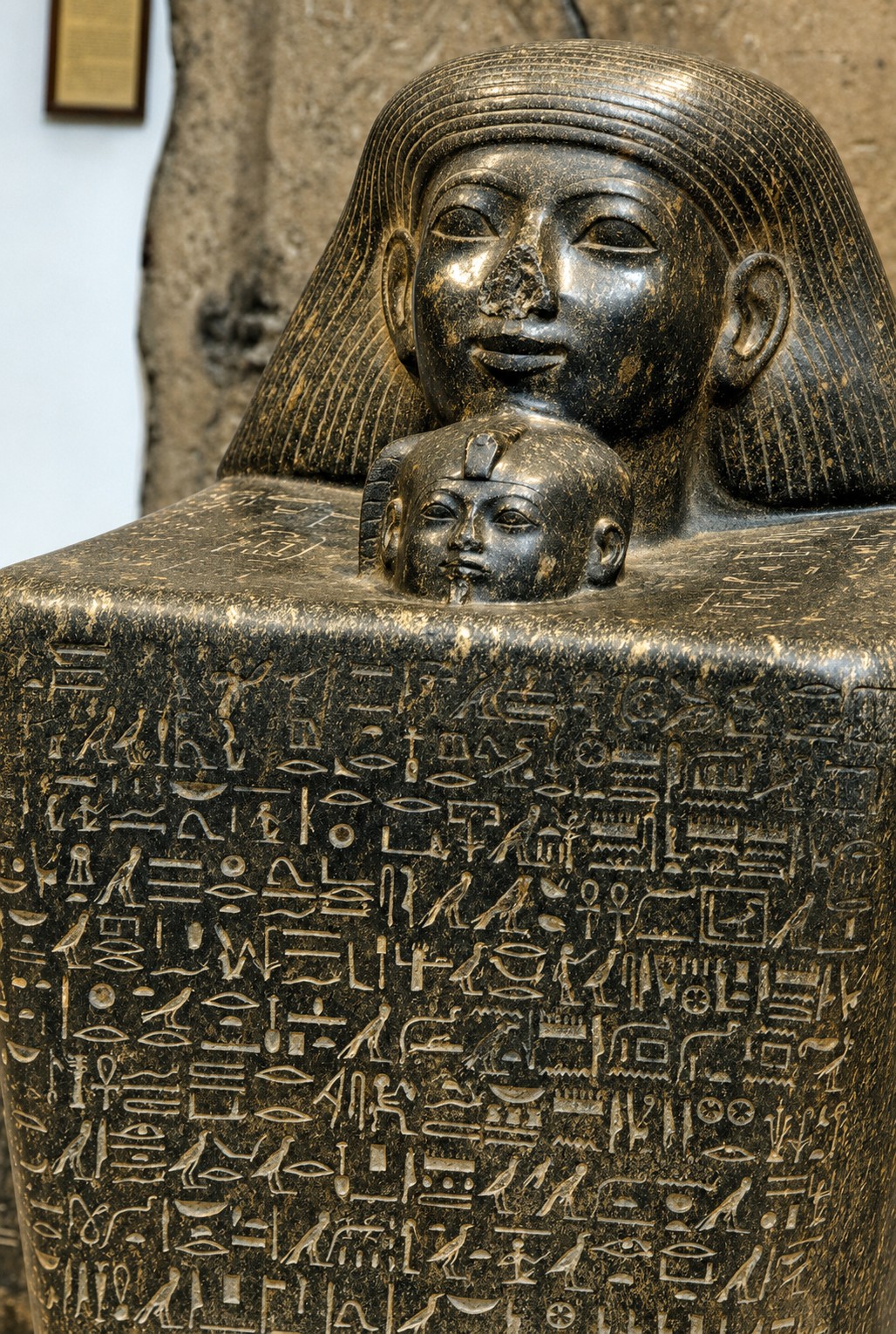
Block statue of Senenmut with the daughter of Queen Hatshepsut – Nefrure
However, some researchers have suggested another possibility. According to this view, the figures may actually represent Hatshepsut and her adopted son Moses, who was being prepared as the Prince of Egypt.
Those who support this interpretation point to several details. They note the side-lock of youth (the distinctive braided lock of hair worn by royal Egyptian boys) and the uraeus—the royal cobra displayed on the forehead. Both symbols indicate that the younger figure represents a royal prince and heir to the throne. At that particular period in Egyptian history, they argue, Moses would have been the only plausible candidate.
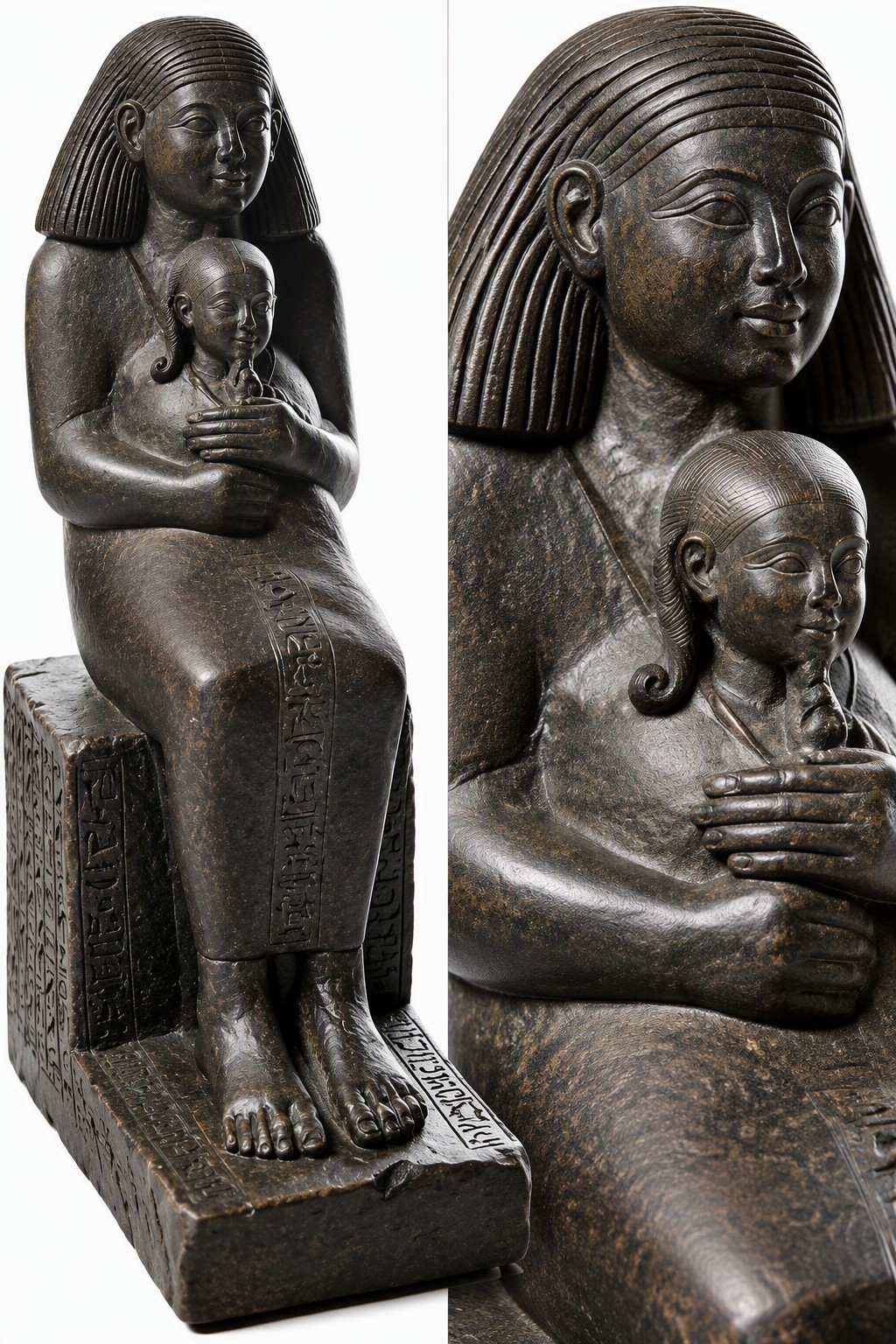
It is also suggested that Thutmose III, who is known for attempting to erase Hatshepsut’s memory, may likewise have altered the names associated with these monuments.
One archaeologist commented:
“At Serabit el-Khadim a stela was erected in the eleventh year of Hatshepsut’s reign. It depicts Princess Neferure. Strangely, however, the regnal years are attributed to her. Accompanying the princess is her guardian, Senenmut.”
This raises an important question. How could regnal years be assigned to Neferure, when she never ruled Egypt? It appears that something does not fit. According to this interpretation, Senenmut may actually represent Hatshepsut, while the figure identified as Neferure may instead represent Moses, Hatshepsut’s adopted son and the Prince of Egypt. If this interpretation is correct, Moses may have been the only serious claimant to the Egyptian throne for many years.
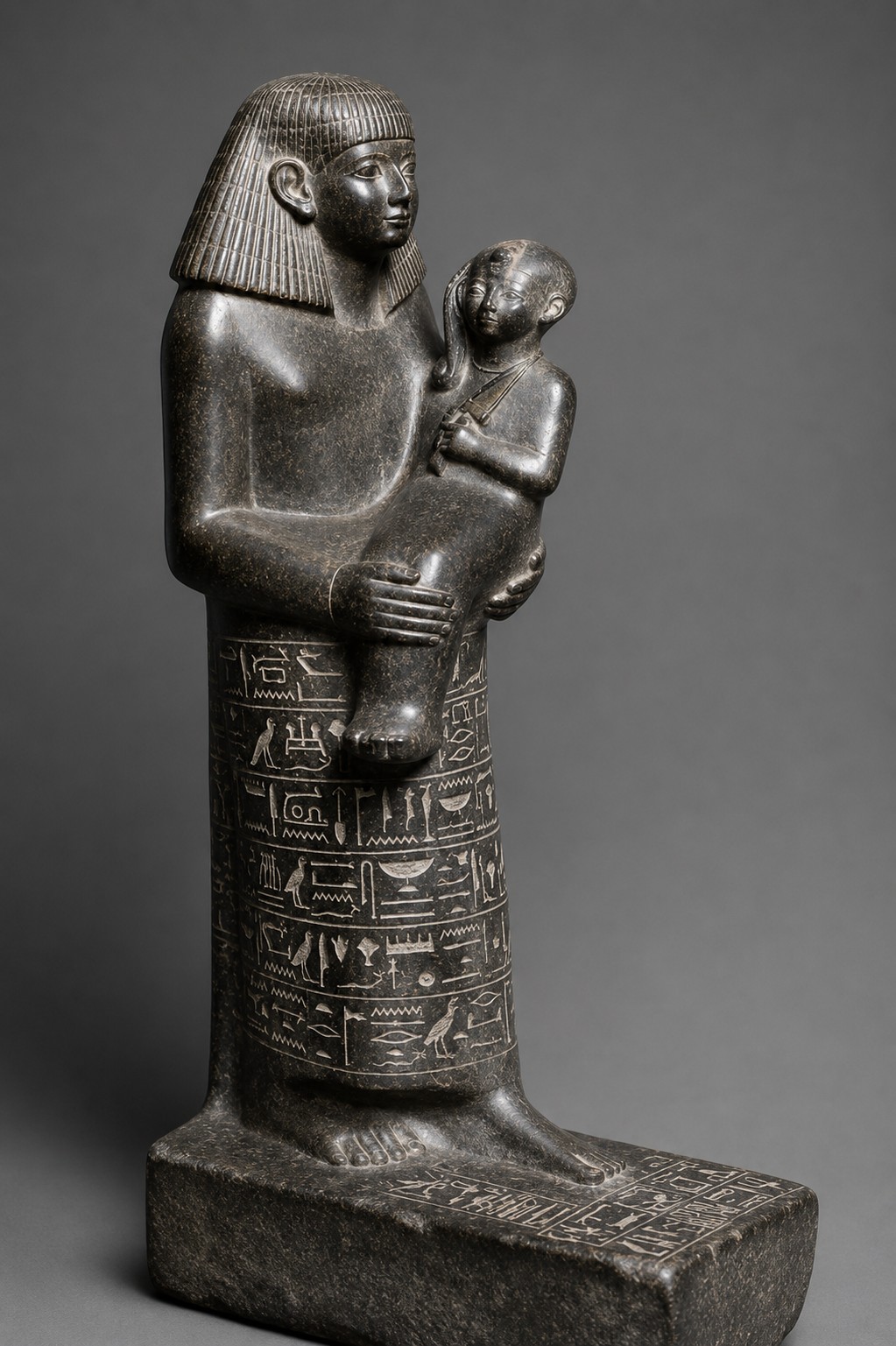
This standing statue of Senenmut holding Princess Neferure, daughter of Queen Hatshepsut. The statue was found in Karnak and was a gift from the Queen. Senenmut lists his duties as Architect’
Heir to the Throne of Egypt
Acts 7:22
“And Moses was learned in all the wisdom of the Egyptians, and was mighty in words and deeds.”
Ellen G. White writes in Patriarchs and Prophets:
“At Pharaoh’s court Moses received the highest civil and military education. The monarch had determined to make his adopted grandson his successor to the throne, and the young man was trained for this exalted position… As a military leader he became the favourite of the Egyptian armies… Moses expected that his people would obtain their freedom through military force, and he anticipated leading the Hebrew hosts against the armies of Egypt. With this in view he guarded his affections so that he would not become attached either to his foster mother or to Pharaoh, and thus be free to carry out the will of God.”
Only Thutmose I could have been Moses’ adoptive grandfather, since Moses would have been about twenty years old at the time of Thutmose I’s death. Since Moses was being trained as Pharaoh’s successor and was, for many years, the leading heir to the throne, an obvious question arises:
Why did he never become Pharaoh? The Seventh-day Adventist Bible Commentary, commenting on Hebrews 11:26, suggests:
“Moses may have thought that, as king of Egypt, he could deliver his people. Yet he also realised that as ruler of Egypt he would be required to serve as high priest of its idolatrous religious system.”
Ellen White further explains in Patriarchs and Prophets:
“According to the laws of Egypt, everyone who ascended the throne of the Pharaohs had first to become a member of the priestly caste. Moses, as the rightful heir to the throne, was therefore instructed in the mysteries of the Egyptian religion. This responsibility was entrusted to the priests.
Although Moses was an eager and diligent student, they could never persuade him to participate in the worship of idols.
He was threatened with the loss of the crown and warned that the princess would disinherit him if he remained faithful to the Hebrew religion.
Yet he remained firm in his determination to worship only the one true God, the Creator of heaven and earth.
He reasoned with the priests and idol worshippers, exposing the folly of their superstitious reverence for lifeless objects.
No one could refute his arguments or change his convictions, but for a time his steadfastness was tolerated because of his high position and because both the king and the people held him in great favour.”
This brings us again to the question: Why did Moses never become king of the greatest empire in the world? Was it because he could not? Or because he chose not to?
Hebrews 11:24–26 (NKJV)
24 By faith Moses, when he became of age, refused to be called the son of Pharaoh’s daughter,
25 choosing rather to suffer affliction with the people of God than to enjoy the passing pleasures of sin,
26 esteeming the reproach of Christ greater riches than the treasures in Egypt; for he looked to the reward.
Why Moses Never Became Pharaoh
Moses did not become Pharaoh because he refused to acknowledge the idols and lifeless gods of Egypt. Naturally, this made the priests hostile toward him, and they undoubtedly sought to remove him from power—or, better still, to eliminate him altogether.
As long as Hatshepsut was alive, and as long as her father Thutmose I and her husband Thutmose II were still living, Moses could feel secure at Pharaoh’s court.
The danger arose when the priests compelled Hatshepsut to share her authority with Thutmose III.
Thutmose III
Thutmose III was the son of Hatshepsut’s husband, Thutmose II, but by a secondary wife.
Seeing that Moses, for religious reasons, could never become king, the priests resolved at all costs to place Thutmose II’s illegitimate son upon the throne.
Hatshepsut Removed From Power
There is a strong possibility that even before her death, Hatshepsut was removed from power in favour of Thutmose III.
One reason for this view is that in 1488 BC, six years before her death (1482 BC), all official Egyptian records concerning her suddenly cease.
The wall paintings depicting the events of her life in her temple at Deir el-Bahri were defaced, her monuments were destroyed, and only a few statues survived because they had been discarded and were later rediscovered by archaeologists.
Such drastic measures against a Pharaoh could only have been taken if that ruler had been regarded as disloyal to the gods of Egypt.
Did Hatshepsut Accept God of Israel?
This raises an interesting possibility.
Could it be that before her death Hatshepsut accepted the faith of her adopted son, Moses? Could she have rejected the gods of Egypt and embraced belief in the one God of the Hebrews—Yahweh?
While we cannot prove this with certainty, such a possibility would help explain the extraordinary attempt to erase her memory from Egyptian history.
Death of which Pharaoh did Moses hear about in Midian?
Moses’ position in Egypt must already have become dangerous before Hatshepsut lost her authority, because his flight from Egypt took place approximately two years before she herself was removed from power.
Two Possible Chronologies of Exodus. Two Views of What Happened Next in Egypt
Exodus 2:23
“Now it happened in the process of time that the king of Egypt died. Then the children of Israel groaned because of the bondage, and they cried out; and their cry came up to God because of the bondage.”
Many theologians believe this verse indicates that Thutmose III died in 1450 BC, and therefore could not have been the Pharaoh of the Exodus. According to this interpretation, the Pharaoh of the Exodus must have been his son, Amenhotep II.
However, the expression “after a long time” is translated somewhat differently in the New American Standard Bible, which renders it:
“during those many days”
In other words, during the entire forty-year period of Moses’ stay in Midian.
Likewise, Young’s Literal Translation reads:
“during these many days” rather than “after a long time.”
Ellen G. White also wrote:
“A secret dread of Pharaoh and the Egyptians, whose anger had been kindled against him forty years before, had rendered Moses still more reluctant to return to Egypt; but after he had set out to obey the divine command, the Lord revealed to him that his enemies were dead.” (Patriarchs and Prophets, p. 255)
With regard to this statement by Ellen White, it should be noted that the words “his enemies were dead” do not necessarily have to refer to Pharaoh himself. They could just as easily refer to the priests who sought Moses’ life.
This raises another important question: Whose death did Moses actually hear about?
Was it the death of Hatshepsut, or the death of Thutmose III?
The next section (Part 4) continues with the two competing theories regarding the Pharaoh of the Exodus—Amenhotep II versus Thutmose III—including the chronology, Egyptian records, Amenemhab’s biography, James Henry Breasted’s research, and the evidence concerning the mummy of Thutmose III.
Two Possible Identities of the Pharaoh of Exodus
Theory 1 – Amenhotep II as Pharaoh of Exodus
If we assume that the Pharaoh who died in Exodus 2:23 was Thutmose III, then we must conclude that the Pharaoh of the Exodus was Amenhotep II. At this point, however, a serious difficulty arises.
If Amenhotep II was indeed the Pharaoh of the Exodus, then his death should have occurred around 1450 or 1445 BC, since Israel left Egypt during that period, and Scripture strongly suggests that Pharaoh perished during the pursuit of the Israelites.
Ellen G. White wrote:
“The monarch hardened his heart more and more in unbelief until all the firstborn, the pride of the Egyptian families, were laid in the grave. After this, together with his army, he hastened in pursuit of Israel. But he fought against a Power mightier than any human strength, and he and all his hosts perished in the waters of the Red Sea.” (Manuscript 126, 1901; quoted in 1BC 1101.8)
According to the Egyptian historical records, however, Amenhotep II did not die until approximately 1425 BC—about twenty-five years after the Exodus. How can this be explained?
One possibility is that the Egyptians, under the leadership of Amenhotep II’s son, deliberately altered the historical inscriptions relating to the date of Amenhotep’s death. The fact that such manipulation was possible is suggested by what Thutmose III did to the monuments and inscriptions commemorating the life and achievements of Hatshepsut.
As for the mummy of Amenhotep II, even if he had drowned in the Red Sea, this does not necessarily mean that his body would have remained there. Ellen White states that despite their armour, the bodies of the Egyptians were washed ashore. Therefore, the discovery of a mummy would not, in itself, rule out such a possibility.
Theory 2 – Thutmose III as Pharaoh of Exodus
A more convincing reconstruction of the Exodus places Thutmose III as the Pharaoh who perished while pursuing the Israelites. Some biblical scholars date the Exodus to 1445 BC, which would make it impossible for Thutmose III to have been the Pharaoh of the Exodus, requiring Amenhotep II instead.
Others, however, maintain that according to 1 Kings 6:1, the Exodus took place in 1450 BC.
“In the four hundred and eightieth year after the children of Israel had come out of the land of Egypt, in the fourth year of Solomon’s reign over Israel, in the month of Ziv, which is the second month, he began to build the house of the Lord.” (1 Kings 6:1)
According to this chronological calculation, the Exodus occurred at the time of the Passover, on 17 March 1450 BC.
What is particularly remarkable is that, according to ancient Egyptian sources, Thutmose III died not only in the same year, but on exactly the same month and day.
The renowned Egyptologist James Henry Breasted studied the biography of Thutmose III written by Amenemhab, a high-ranking military official who lived during the reigns of Thutmose III and Amenhotep II. Amenemhab recorded:
“On the last day of the third month of the second season… (Thutmose III) ascended to heaven and united with the sun.”
James Henry Breasted, founder of the American school of Egyptology, concluded that the date of Thutmose III’s death was 17 March 1450 BC.
Mummy of Thutmose III
The mummy of Thutmose III was examined in detail at the Cairo Museum in 1973 by the Egyptologists Harris and Weeks. To their surprise, they concluded that the mummy belonged to a young man. Yet Thutmose III should have been an elderly man—approximately eighty years old—when he died.
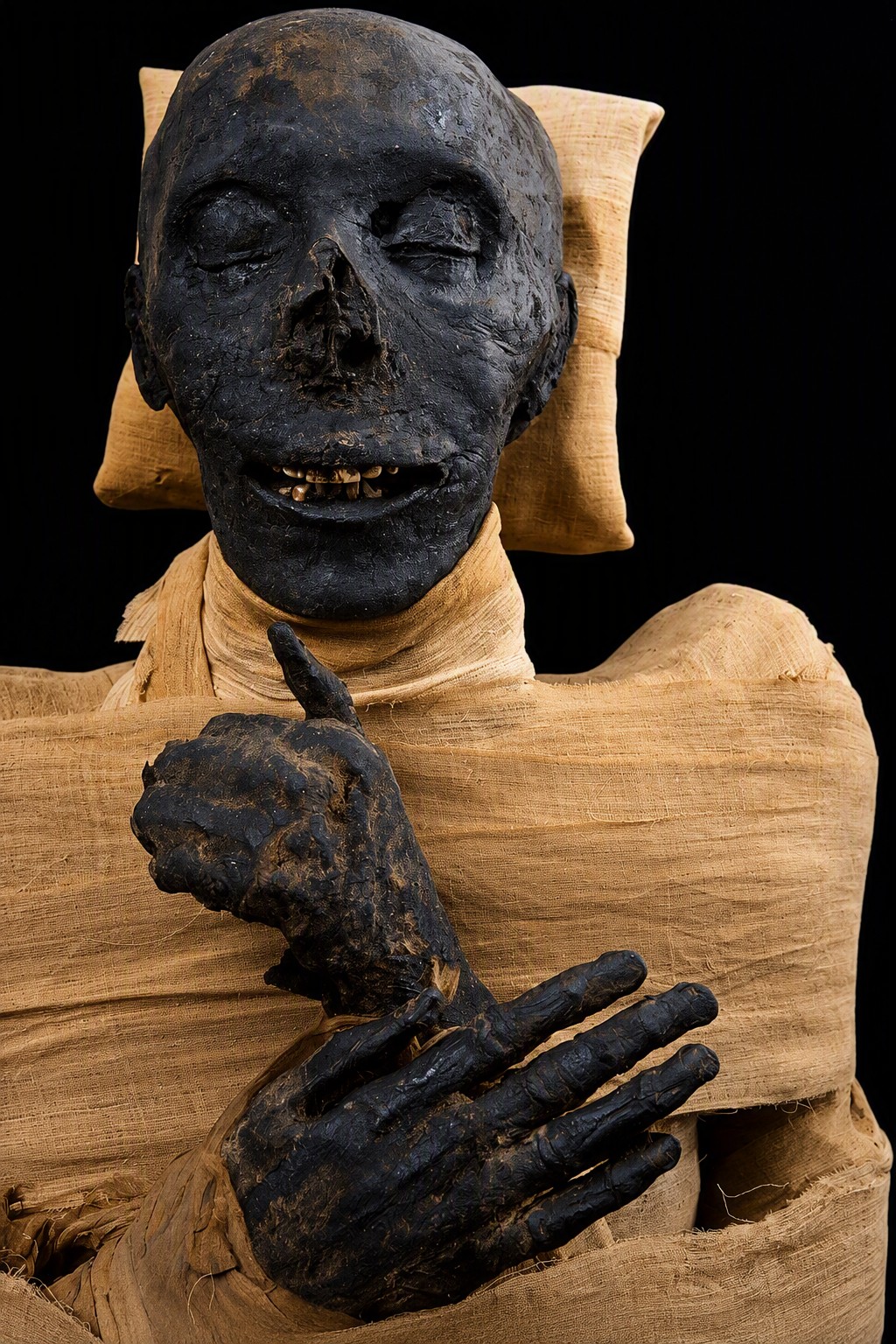
His reign alone lasted 32 years, plus 22 years of co-regency with Hatshepsut, giving him a reign of more than fifty years, to which must be added his childhood and youth.
This suggests that the Egyptians were capable of concealing embarrassing events in their history.
It is possible that they never recovered the body of Thutmose III after he drowned in the Red Sea. In order to hide this humiliating fact from future generations, another mummy may have been placed in his tomb instead.
Another Important Argument
There is another very important argument that may support this view.
Toward the end of his reign, Thutmose III ruled Egypt together with his son, Amenhotep II. At the time of the Exodus, Amenhotep II was not in Egypt but was campaigning with the Egyptian army in Syria and Palestine.
According to Egyptian sources, he did not return until June 1450 BC, several months after Israel had left Egypt. Immediately upon his return, he destroyed many Egyptian statues.
How can such behaviour be explained?
The Bible tells us that all the firstborn in Egypt died during the final plague. This would certainly have included the firstborn son of Amenhotep II. He also learned that his father had perished while pursuing Israel. In addition, Egypt had suddenly lost its vast supply of cheap labour—the Israelites.
It is therefore not surprising that his reaction upon returning to Egypt was so violent.
Thutmose IV
The next Pharaoh was Thutmose IV.
It is noteworthy that he was not the firstborn son, but the second son of Amenhotep II, which may indicate that the firstborn had indeed died during the final plague.
An explanation of how Amenhotep II’s firstborn son died, and how his second son became Pharaoh, is found on the famous Dream Stele, located between the paws of the Great Sphinx.
According to the inscription, one day Amenhotep’s younger son (the future Thutmose IV) was resting between the paws of the Sphinx when he suddenly heard a voice commanding him to clear away the sand that had accumulated around it. If he did so, the Sphinx would acknowledge that he, rather than his elder brother, would become Pharaoh. (Implying that the firstborn would die?)
Akhenaten
Another fascinating ruler of Egypt’s Eighteenth Dynasty was Amenhotep IV, who reigned during the period when Israel was conquering Canaan.
What is particularly remarkable is that this Pharaoh made determined efforts to carry out a religious reform by persuading the Egyptians to worship one God—a monotheistic faith symbolised by the sun.
For this reason, he changed his name from Amenhotep to Akhenaten. The former honoured the god Amun, while the latter honoured Aten.
Atenism centred on the worship of one Creator God. The sun and its rays merely served as symbols expressing the Creator’s care for humanity. The sun itself was not worshipped but functioned only as a symbol.
There is evidence suggesting that this new religion introduced by Akhenaten had much in common with the religion of Israel.
It is quite possible that Akhenaten, along with many other Egyptians, was deeply impressed by the way the God of the Hebrews had humiliated the gods of Egypt. Nearly all of the plagues were directed against those Egyptian deities—the Nile, frogs, cattle, and others.
In honour of his god, Akhenaten composed a hymn in which as many as seventeen lines closely resemble the words of Psalm 104.
Akhenaten’s wife was the famous Nefertiti, whose celebrated bust is now displayed in the Berlin Museum.
Together they had six daughters, one of whom married the young man who later became known as Tutankhamun.
Amarna Letters
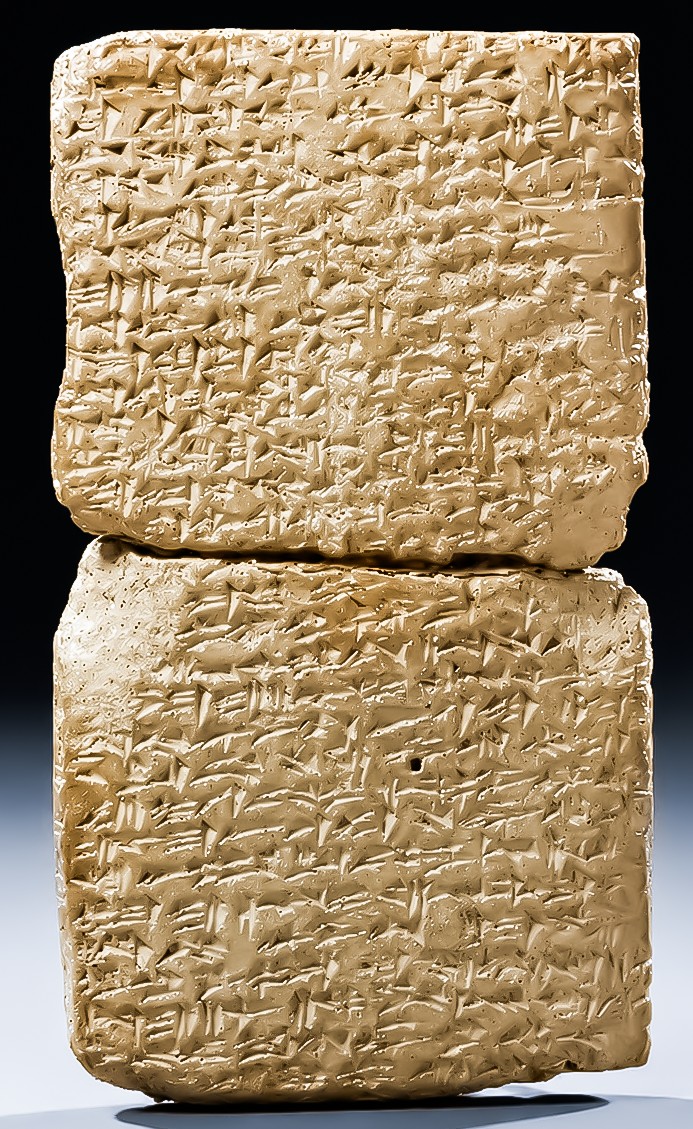
In connection with Akhenaten, it is worth mentioning another extremely important archaeological discovery made by Sir Flinders Petrie. At Tell el-Amarna, Petrie excavated the long-forgotten capital city founded by Akhenaten. There he discovered a large collection of clay tablets known today as the Amarna Letters.
During Akhenaten’s reign, hundreds of letters written in cuneiform script on clay tablets arrived from Egypt’s vassal rulers throughout Canaan. The contents of these letters consist of desperate appeals from the rulers of Palestine, who were Egyptian vassals, pleading for military assistance against an invading people referred to in the letters as the Habiru.
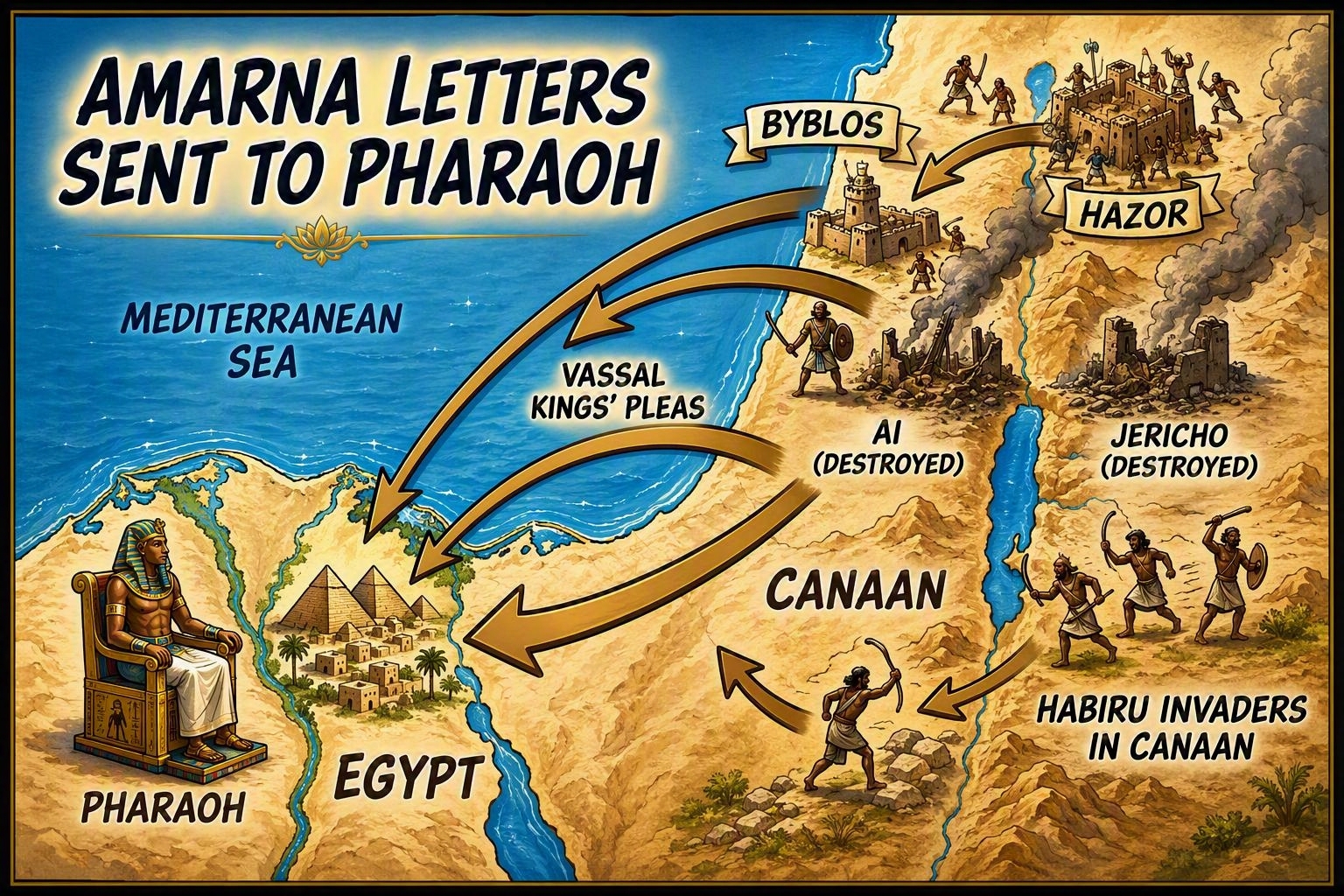
For example, Abdi-Heba, the ruler of Jerusalem, repeatedly begged Pharaoh for help against the Habiru, who were capturing one city after another.
Finally, after receiving neither military assistance nor perhaps even a reply, he wrote in desperation (Letter No. 286):
“Why do you favour the Habiru and hate the rulers?”
Nevertheless, the Egyptians never came to the aid of the king of Jerusalem, and Jerusalem, like many other cities, was eventually conquered by the Israelites.
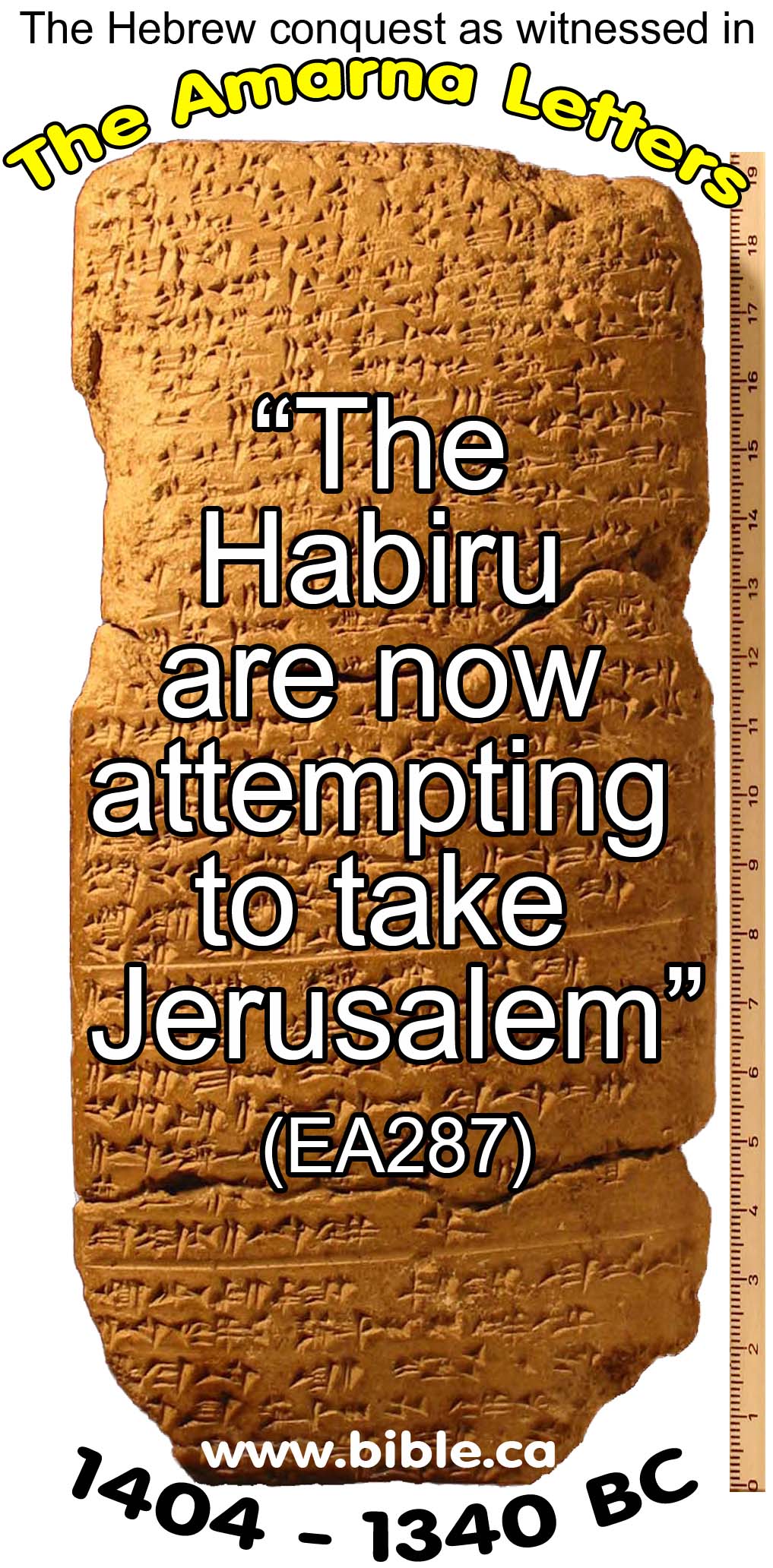
In another letter (No. 289), the same ruler informed Pharaoh that Shechem had fallen to the Habiru and that its king, Labaya, had surrendered, once again pleading for Egyptian troops. In his final letter, he pleaded with Pharaoh to take him to Egypt for safety.
LINK TO DETAILED ARTICLE ON AMARNA LETTERS
All of these desperate appeals, however, proved unsuccessful.
Under the leadership of Joshua, the Hebrews occupied a large portion of Canaan and settled there without any resistance from Egypt—even though Canaan was, at that time, an Egyptian province.
The Amarna Letters, like many other archaeological discoveries, once again confirm the historical reliability of the biblical record.