Slawomir Gromadzki
Adam and Christ as Representatives of Humanity
The heart and most important part of the gospel is undoubtedly chapters 6, 7, and 8 of the Epistle to the Romans. However, as I have suggested previously, these chapters will be of priceless value to us and can only be properly appreciated if we correctly understand the second part of chapter 5 of the Epistle to the Romans 5:12-21.
Therefore, let us read once more at least two verses of chapter 5 to remind ourselves of this exceptionally important and key truth that the Apostle Paul included there:
“Wherefore, as by one man sin entered into the world, and death by sin; and so death passed upon all men, for that all have sinned” Romans 5:12
The Apostle Paul is saying here that because through one man—namely, Adam—sin entered the world, we must all die, because we all sinned in him. Further on, however, in verse 18, the author adds that thanks to this seemingly unfair fact, God has the opportunity to save us in a legal, lawful manner. Just as we must die because we sinned in one man, Adam, so we can all live eternally because we were perfectly obedient and died in one man, Jesus Christ—the Second Adam:
“Therefore as by the offence of one judgment came upon all men to condemnation; even so by the righteousness of one the free gift came upon all men unto justification of life.” Verse 18
This means that both Adam and Christ—the Second Adam—represented all people. And it is precisely because of this that what Adam did is shared by us, and what Christ—the Second Adam—did is also shared by us. The Bible clearly confirms that the death of Christ was a representative death, and that we all died in Him:
“For the love of Christ constraineth us; because we thus judge, that if one died for all, then were all dead” 2 Corinthians 5:14
And in Romans 6:6, Paul adds that: “…our old (condemned) man has been crucified with him…” Romans 6:6
We can therefore say that the holy history of Christ’s life and death is also our history.
However, the fact that Christ as the Second Adam could represent all of us was possible, firstly, because we had to die as a result of the sin of one man, Adam, and secondly, because at His incarnation Christ identified Himself with our fallen humanity.
Were it not for these two very important facts, the Son of God could not have acted as the representative of a fallen world and legally redeemed and delivered us from the power of the law, sin, and death.
Liberty We Have in Christ
Paul wrote about this wonderful freedom we have in Christ, for example, in chapter 5 of the Epistle to the Galatians:
“Stand fast therefore in the liberty wherewith Christ hath made us free, and be not entangled again with the yoke of bondage.” Galatians 5:1
“For, brethren, ye have been called unto liberty…” Galatians 5:13
What did Paul understand by freedom in Christ? What kind of freedom is Paul speaking about here?
The answer to this question is found in Romans 8:1–2:
“There is therefore now no condemnation to those who are in Christ Jesus.” Romans 8:1
Freedom in Christ is full justification from sin and deliverance from the punishment for sin, which is the second death.
But in what way and thanks to what were we able to obtain this freedom? Who condemns us because of our sins and because we are sinful? It is the law that “condemns” us, saying that “the wages of sin is death”.
In this way, the law grants power to sin and enables sin to kill us. In other words, if the law did not say that “the wages of sin is death,” then sin could not cause our death:
“The sting of death is sin; and the strength of sin is the law.” 1 Corinthians 15:56
Electric Chair Illustration
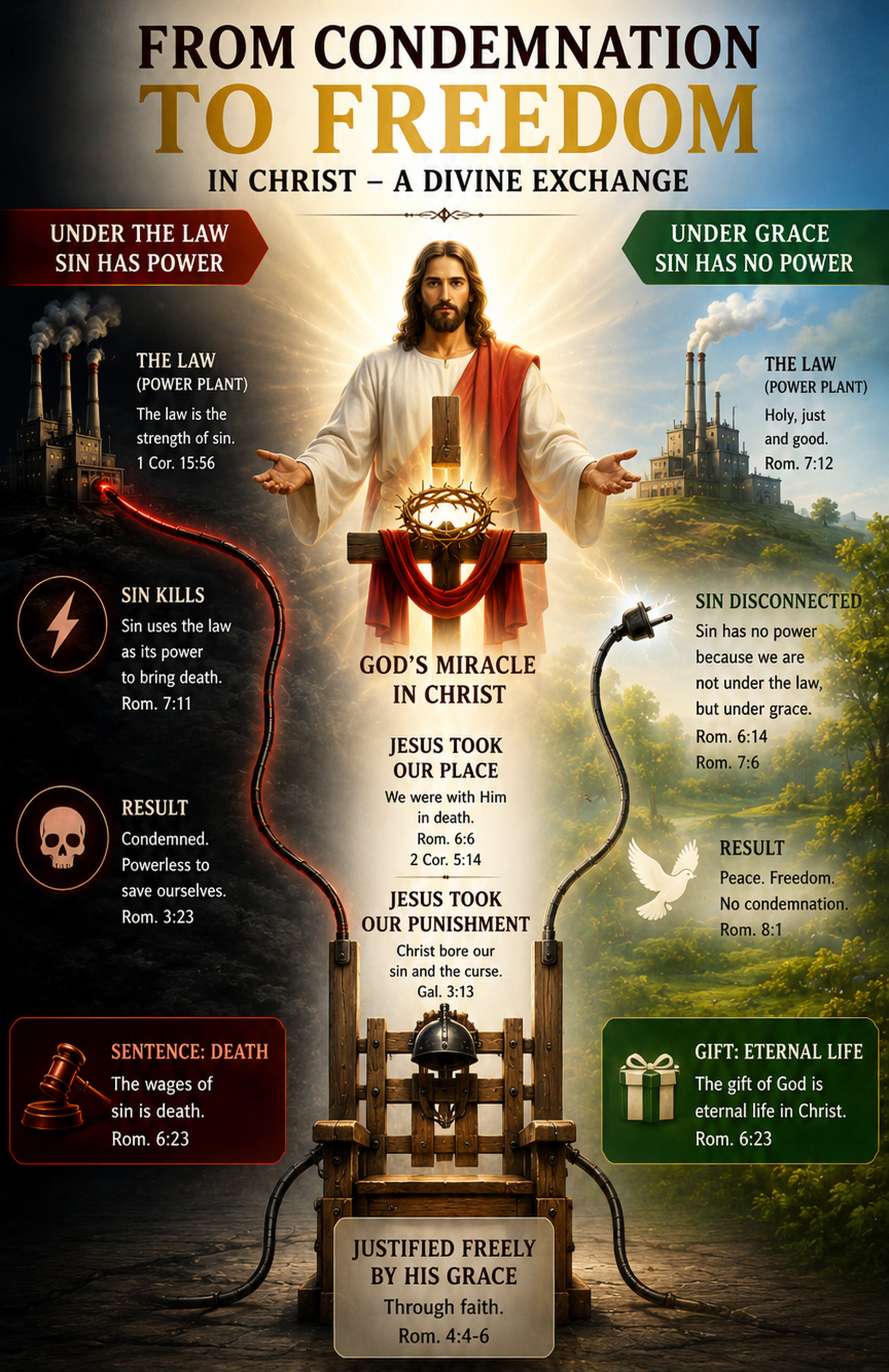
Let us now try to engage our imagination and, using symbolic language, say that the electric chair on which convicts are executed is the “sting of death,” which is sin. The power plant, on the other hand, which supplies energy (power) to this chair is the law.
Let this symbolic electric chair—sin—serve in this illustration as the tool used by Satan to kill us. However, just as an electric chair could not deprive anyone of life if it were not connected to a source of power (the power plant), so sin would not be able to kill a sinner if the law did not grant it power, because as Paul explains, “the law is the strength (power) of sin”.
In what way, then, did God in Christ manage to legally save the sinner from the “sting of death”—the sin that kills him?
It happened in the exact same way one can save a convict from death in an electric chair. You cannot save him by changing the sentence on the part of the law, because this person has already been judged, condemned, and the sentence has already been passed. The law itself cannot be changed either. Furthermore, no close relative or friend can face death instead of the condemned person, because the law does not permit this under any circumstances. How then could this rightly condemned man, sentenced to death, be saved? From a human point of view, there is no such way; in other words, only a miracle could save this convict.
And it is exactly in this kind of hopeless situation that we all found ourselves in Adam. The entire universe knew that we had sinned, and that according to the irrevocable judgment of the law, only eternal death could await us. Therefore, all the angels and inhabitants of unfallen worlds were convinced that there was no rescue for us, and that only a miracle could deliver us from this punishment. Fortunately, God is a God of miracles, and the greatest miracle He ever performed was the one He accomplished in Christ by saving sinful humanity.
How could God protect irrevocably condemned and sentenced sinful people from death?
There was only one legal, lawful way in which He could save us. God had no choice but to allow us to sit in the “electric chair,” but we did not find ourselves on it alone. God placed us on it together with Christ. The entire fallen human race had to bear the punishment for sin and take its place on this symbolic chair, but it found itself there in Christ, “in His loins”.
It could not be that the Son of God died only instead of us (without us), but rather as us, as our Representative, identifying Himself with us, with our fallen nature, and He took us to the cross where we were punished in Him with the second death (Rom 6:6; Rom 8:3; 2 Cor 5:14).
However, there is another problem that had to be solved. God knew that although justification for all our sins—not only past but also future—was included in the death of His Son, the sins we commit even after conversion and the acceptance of justification would cause a loss of peace and the reappearance of the dread of punishment.
God, on the other hand, does not accept service motivated by fear. He desired, therefore, despite our imperfections and falls, to endow us with lasting peace and full freedom from punishment and fear.
How did He accomplish this and legally remove this obstacle?
He accomplished this also in Christ, by cutting off sin—that symbolic electric chair we are sitting on—from its source of power, from the “power plant,” which is the law.
Yet He did not bring this about by removing the “power plant,” for it still exists; but now it can no longer supply power to the “electric chair” (sin). Thanks to this, sin—this symbolic electric chair—has been deprived of power, and though we still sit on it, because we constantly still possess fallen natures and have a connection to sin, we now sit on it already in Christ, and sin can no longer put us to death because it has been deprived of its source of power, which was the law. It is precisely because of this that we can right now, despite the sins that still appear in our Christian life, enjoy constant peace and the awareness that we continually find ourselves Christ who is our perfect righteousness.
Since the source of sin’s power was the law, and only the law could grant sin the power to put us to death, it clearly follows that God could deliver us from the resulting condemnation and fear only by changing our position relative to the law. In other words, since sin is the “sting of death,” since sin kills us and can do so only by the power of the law, God could permanently deliver us from punishment, condemnation, and fear exclusively by depriving sin of its source of power—that is, by delivering us from under the power of the law! And this is exactly what the Apostle Paul speaks about in Romans 6:14:
“For sin shall not have dominion over you: for ye are not under the law, but under grace.” Romans 6:14
This means that sin can no longer kill us, because we are not under the power (dominion) of the law, but under grace.
Thanks to this, sin can no longer receive power from the law to put us to death.
The same author wrote similar words in Romans 7:6:
“But now we are delivered from the law…” Romans 7:6
Which Law We are Delivered From and In What Sense?
What law did Paul have in mind here, ceremonial or moral?
We do not have to guess, because the author himself answers this question in the very next verse—verse 7:
“What shall we say then? Is the law sin? Certainly not! On the contrary, I would not have known sin except through the law. For I would not have known covetousness unless the law had said, ‘You shall not covet.'” Romans 7:7
There is no doubt that Paul had in mind primarily the moral law here, because at the end of the very next verse 7, he quotes one of the Ten Commandments!
Ellen White also believed that when the Apostle Paul wrote that we are not under the law, he meant primarily the moral law. Here is a fragment of her commentary on Galatians 3:23–25, where Paul, having the law in mind, wrote that we are no longer “under a schoolmaster”:
“The law was our schoolmaster to bring us unto Christ, that we might be justified by faith. In this scripture, the Holy Spirit through the apostle speaks primarily of the moral law. This law reveals sin to us and makes us feel our need of Christ.” — Selected Messages, Book 1, p. 234.1
Because Paul’s statements in Romans 6:14 and Romans 7:6 were very radical and could be misunderstood, he had to explain exactly what he meant by writing that “we were delivered from the law,” as otherwise he could have been accused of heresy by the Jews and Christians of Jewish origin.
In all these passages, Paul implies only that when we bind ourselves to Christ, we are free not from observing the law as a standard of Christian living, but only from its power and condemnation! Thanks to this, the law can no longer condemn us, punish us, sentence us, deprive us of inner peace, or grant sin the power to kill us.
The Apostle Paul explains this in detail in the first part of chapter 7 of the Epistle to the Romans:
“Know ye not, brethren, (for I speak to them that know the law,) that the law has dominion over a man as long as he lives?” Romans 7:1
The God’s moral law, or any other just law, can sentence and condemn us only as long as we live. When we die, the law can no longer condemn us by saying that “the wages of sin is death”.
Marriage Illustration (Romans 7)
To explain this, Paul uses the example of marriage. According to this illustration, the wife (the woman) is undoubtedly us—sinful people under the law; the husband is certainly the law; and the second, or “other man,” with whom the wife would like to bind herself is Christ.
Let us therefore trace this passage very carefully to understand what the author wanted to convey to us using this symbolic language:
“For the woman which hath an husband is bound by the law to her husband so long as he liveth…” Romans 7:2
We can read about what kind of law it was by which the woman was bound to this husband in Genesis 3:16, where it is written that according to this law, the husband was to rule over the wife—exactly as the law rules over us.
Next, Paul explains how this woman could free herself from this husband (the law):
“…but if the husband be dead, she is loosed from the law of her husband.” Romans 7:2
Only seemingly—as we will see in a moment—does Paul suggest here that we, meaning the woman, could free ourselves from the law (the first husband) if he were to die, that is, if the law were annulled.
Paul wrote about why this marriage—the union of a sinful person with the law—was unsuccessful and unhappy in Romans 8:7 and Romans 7:14:
“Because the carnal mind is enmity against God: for it is not subject to the law of God, neither indeed can be.” Romans 8:7
“For we know that the law is spiritual: but I am carnal, sold under sin.” Romans 7:14
This marriage was unsuccessful because the law, or the “husband,” is spiritual, holy, and perfect in every respect, while we, or the “wife,” are not spiritual but carnal, possessing a fallen nature and sold under sin.
The husband demands perfect obedience from her, but she—even if she wants to—is unable to meet his expectations. This, in turn, causes her to be constantly condemned by her husband and to live in continuous fear.
Although her husband is perfect, faultless, and holy, he cannot sympathize with her or help her in her weaknesses; instead, he constantly demands perfection and condemns, because he is only the law.
Policeman Illustration
When a police officer stops us because we exceeded the speed limit while driving a car, and as a result of our pleas forgives our offense, remember that it was not the law that pardoned us, but the police officer, because he can sympathize, whereas the law cannot.
The law cannot sympathize with us or help us, because although it is good, it is not a person, but a rule, a principle.
For this reason, this poor, lost, constantly condemned, and fearful woman deeply desires to free herself from this unhappy relationship and bind herself to someone who is as perfect and holy as the law, but at the same time would be able to help her and sympathize with her weaknesses.
And she finds such a man—Christ—but she cannot bind herself to Him, because according to the law, only the death of her husband or adultery could allow her to do so.
Immortal Holy Husband Cannot Die
The woman is therefore in despair, because she knows that her husband cannot die, and even if she tried to poison him, it would achieve nothing because her husband—the law—is immortal:
“And it is easier for heaven and earth to pass, than one tittle of the law to fail.” Luke 16:17
“The works of his hands are verity and judgment; all his commandments are sure. They stand fast for ever and ever, and are done in truth and uprightness.” Psalm 111:7-8
Thus, the woman is in despair because she knows that her husband is immortal. She also realizes that her husband will not commit adultery or do anything wrong, because he himself is holy and spiritual:
“Wherefore the law is holy, and the commandment holy, and just, and good.”
“For we know that the law is spiritual: but I am carnal, sold under sin.” Romans 7:12,14
Because this husband is immortal, holy, and spiritual, he also has his seat in heaven, specifically in the heavenly temple:
“And the temple of God was opened in heaven, and there was seen in his temple the ark of his testament…” Revelation 11:19
Since the “casing” of the law, meaning the ark of the covenant, is in heaven, the eternal and holy law of God itself must also be there.
Consequently, Christ could not help the woman change her unhappy situation by putting her husband—the law—to death, because that was impossible.
Fortunately, although the woman had lost all hope of freeing herself from her husband, Christ restored her hope, saying:
“I know how you can free yourself from your husband and bind yourself to Me, but that depends only on you.”
“Really?!” replied the surprised and overjoyed woman. “Can You make my husband die?”
“No,” answered Christ. “He will never die, because he himself is holy, spiritual, and immortal, and endures forever.”
“How, then, can I divorce him?” asked the woman.
“According to the law, not necessarily your husband, but one of you must die. Since your husband is immortal, you yourself must die, and then you will become free and will be able to bind yourself to Me.”
“But if I die, how will I be able to bind myself to You?” asked the woman.
Woman (We) Died in Christ to the First Husband (Law)
Then Jesus replied: “I am not asking you to commit suicide, but I will cause you to be found in Me. By assuming your nature and by becoming the Second Adam, I will be able to represent you. Thanks to this, when I die, you too will die in Me, and then you will rise again in Me, and then you will be free from the bond with your husband and obtain the right to bind yourself to Me.”
This is exactly what the method looks like by which God freed the woman—meaning us—from the connection with that first husband, the law, and thanks to this deprived sin of its power so that sin cannot put us to death.
Although in verse 2 of chapter 7 Paul suggests that “if the husband be dead” we would be free from the legal bond with him, in verse 4 he explains that it was not the husband, but actually the wife—meaning us—who was put to death in Christ:
“Wherefore, my brethren, ye also are become dead to the law by the body of Christ; that ye should be married to another…” Romans 7:4
Thus, it was not the law, the first husband, that died, since he is immortal, but the wife died—we died!
In what way did we die?
Paul wrote that we died “by the body of Christ.”
Christ, by identifying Himself with our fallen humanity, became us, our representative; thanks to this, when He died, His representative humanity bore death—the second death—and thereby we all died in Him.
This also follows from many other biblical statements: “For the love of Christ constraineth us; because we thus judge, that if one died for all, then were all dead.” 2 Corinthians 5:14
The substitutionary sacrifice of Christ did not consist in the fact that ONE DIED FOR ALL, but that ALL DIED IN ONE. Similarly, in Romans 6:6, the Apostle Paul wrote: “…knowing this, that our old man is crucified with him, that the body of sin might be destroyed, that henceforth we should not serve sin.” Romans 6:6
Therefore, it was not the law, but we who were nailed to the cross along with Christ.
But for what purpose did God cause us to die in Christ?
The Apostle Paul provides the answers to this question in verses 4 and 6 of chapter 7: “Wherefore, my brethren, ye also are become dead to the law by the body of Christ; that ye should be married to another, even to him who is raised from the dead, that we should bring forth fruit unto God.” Romans 7:4
“But now we are delivered from the law, that being dead wherein we were held; that we should serve in newness of spirit, and not in the oldness of the letter.” Romans 7:6
Our death in Christ gave us the right to be freed from under the power of the law and to bind ourselves to Christ, thanks to which that first husband—the law—can no longer condemn us and deprive us of inner peace.
The second husband, Christ, is our perfection and holiness, thanks to which God—despite the fact that we are not perfect—looks at us as if we were holy and righteous.
Besides, Christ—unlike the first husband, the law—is able to sympathize with us in our weaknesses and can assist us in temptations, because He Himself “was in all points tempted like as we are, yet without sin.”
Thanks to all of this, we can now serve God “in newness of spirit, and not in the oldness of the letter.”
Serving God “in newness of spirit” means that we now desire to act according to God’s will not out of fear or in order to obtain salvation, but out of love for Him and because He already now in Christ regards us as righteous and deserving of salvation.
Thanks to this, we can say: “I work not to save my soul, for God has already accomplished this, but I—a servant—must work out of love for the Son of God.”
When a woman divorces her husband and marries another, can the one she divorced continue to punish and criticize her if, for example, she burns the soup? No, he has no such right!
It is similar in our case. We too, according to what the Bible says, are no longer under the first husband. We were freed from under the power of that first husband thanks to our death with Christ, to whom we are now legally bound.
And since we are no longer under the law, then even if we sin again, that first husband—the law—cannot punish or condemn us, because we are not under him, but under grace:
“For sin shall not have dominion over you: for ye are not under the law, but under grace.” Romans 6:14
First Husband (Law) Cannot Condemn Us Again
Furthermore, the law can no longer condemn and punish us, because we died in Christ, and this death constituted payment for all our sins, not only past but also future ones.
If a man commits a crime and by virtue of the law is sentenced to the death penalty, and this sentence is carried out, can the law sentence him once more?
No!
Why can it not sentence him again?
It is impossible, because that man died.
And according to Romans 6:6, “our old man is crucified with” Christ.
In Christ, we died the second death and were punished for all our sins.
Therefore, if we sin now, can the law sentence us and sin kill us?
No, because we died, and a dead man cannot be put to death a second time.
For this reason, as long as we remain in Christ and endure in faith, the law cannot punish us a second time.
Hence the Bible says that right now there is no condemnation to them which are in Christ Jesus.
“There is therefore now no condemnation to them which are in Christ Jesus…” Romans 8:1
Therefore, a Christian who is under grace should not fear the punishment for sin, which is the second death, because he has already died that death in Christ and thanks to this has been freed from it.
For this reason, the Apostle Paul wrote in Hebrews 2:15 that Christ came:
“…and deliver them who through fear of death were all their lifetime subject to bondage.” Hebrews 2:15
If, however, a Christian still fears the second death, it is either because he has not believed, or because he continues in sin.
In both the first and second cases, this fear is justified, because a lack of faith and continuing in sin can lead to total separation from Christ and falling away from grace.
However, a sincerely believing Christian who bases his salvation solely on the righteousness he has in Christ and on the death he suffered in Christ—a Christian who does not continue in sin, does not indulge sin, but if he sins, sincerely repents and grieves not because he is afraid of punishment, but because he hurt the Author of grace—such a Christian, though he still sometimes falls, enjoys constant inner peace and has no reason to continue feeling fear toward that death which is the wages of sin.
Freedom From the Law In Galatians
Also in the Epistle to the Galatians, the Apostle Paul clearly implies that in Christ we are freed from the power of the law.
This passage is found in Galatians 3:23-25, and it was the primary subject of theological discussion during the General Conference in Minneapolis in 1888:
“But before faith came, we were kept under the law, shut up unto the faith which should afterwards be revealed.
Wherefore the law was our schoolmaster to bring us unto Christ, that we might be justified by faith.
But after that faith is come, we are no longer under a schoolmaster.” Galatians 3:23-25
Paul addresses exactly the same topic here that he raised in Romans 7:6 and 6:14, namely, that since we believed in Christ and united with Him, we are freed from the power of the law (“we are not under a schoolmaster”).
It just so happens that my father was an educator (“pedagogue”) and for many years I was “under him.”
This meant that he established certain rules at home and expected obedience from me. And if I was not obedient, he had a so-called “discipline” with which he administered punishment when necessary.
Did this mean, however, that my father was a bad person?
No!
He was only fulfilling his rightful educational duties toward me.
Therefore, being “under my father—the pedagogue” meant that he demanded obedience from me and could punish me when I was disobedient. So I tried to listen to him and act according to his will, but I did so out of fear rather than out of love.
However, after many years passed, I became independent and am no longer “under the pedagogue,” that is, my father, but have instead bound myself to my wife.
Because of this, I am no longer condemned or punished by my father, because I am no longer under him, and he has lost his power over me.
Does this mean, however, that my attitude toward him became negative, and that he ceased to exist for me, or that I stopped listening to him and considering his opinion?
No!
Only my relationship with him and his authority over my person have changed.
Thanks to this, my relationship with my father actually improved, and additionally, I stopped being afraid of him and began to have greater respect for him, but not out of fear, as I no longer felt dread regarding potential punishment for insubordination.
My father’s belt no longer has power over me because I am no longer under a tutor, but under my wife, and my wife does not punish me, but helps and sympathizes with me in my weaknesses.
And is this exactly what Paul meant when he wrote that we have been “released from the law”?
He only wanted to make us understand that we were released not from the presence of the “tutor” nor from keeping his commandments, but from his power, from the power of the law.
And this is exactly how the Millennium Bible renders this passage:
Romans 7:6
“But now we have been released from the Law, having died to that by which we were bound, so that we serve in newness of the Spirit and not in oldness of the letter.”
When we sinned while being under the law—that is, at the time when the law was our spouse—then every time we fell, it would say to us:
“The wages of sin is death.”
In this way, the law armed sin with the sting of death aimed at us, for as we read in 1 Corinthians 15:56:
“The sting of death is sin, and the power of sin is the law.”
Sin is something that kills us, but where does sin get the power to kill us?
It is precisely the law, which in itself is good, by stating that if we transgress it we deserve death, that gives sin the power to kill us.
So if the law now has no power over us, then by the same token sin cannot kill us.
Now, thanks to our death in Christ, we are no longer under the law, but Christ is our spouse; therefore, this former husband, although he still exists, can no longer condemn us.
What lesson flows from this?
The truth that Paul wanted to convey to us in this way is wonderful Good News!
This means that now, when we sin as beings already united with Christ, sin can no longer cause us any harm in such a situation; it is unable to kill us, because the law can no longer grant it the power necessary for sin to put us to death.
This new situation in which we find ourselves in Christ means that:
“Therefore being justified by faith, we have peace with God through our Lord Jesus Christ.” Romans 5:1
When I sinned while being under the law, then the law condemned me and said that the wages of this sin is death, whereby sin “used what is good (the law) to bring about my death.” Romans 7:13
But when I became united with Christ and am no longer under the law, then when I sin now, the law can no longer condemn me.
And it is precisely because of this that in Romans 8:1, Paul could present us with the wonderful news:
“There is therefore now no condemnation to them which are in Christ Jesus.”
There is only one condition we must meet to free ourselves from all condemnation right now.
This sole condition is the acceptance of the historical truth that Paul wrote about in the fifth chapter of the Epistle to the Romans, verses 12-21, which is why understanding it is so important.
This historical truth is that Christ came into this world as the Second Adam, that is, as the second representative of all humanity.
Thanks to this, everything He accomplished, we accomplished in Him, because He was us.
Only through the recognition and acceptance of this historical truth can we find ourselves in Christ, and thanks to this, through faith, this wonderful promise becomes our portion, and we can say:
“There is therefore now no condemnation for me, because I am in Christ Jesus.”
It is not without reason that the Apostle Paul used the word “now” here.
This means that we can enjoy this freedom—freedom from condemnation and punishment, and freedom from fear—right now, even while we still notice many imperfections and stumbles in ourselves.
However, this truth is so wonderful that many even sincere Christians have significant trouble accepting it, despite the fact that the Word of God speaks about it clearly and plainly.
Proclamation of Freedom
On January 1, 1863, Abraham Lincoln presented a document by virtue of which he announced the abolition of slavery in the United States. However, when this good news quickly spread across the American South, many slaves did not believe it and continued to remain in bondage to their masters, thinking that the proclamation of freedom was a joke. Their masters kept telling them it was a false rumor. And those deceived slaves believed they were free only when they noticed that other former slaves were actually free. Others heard about their freedom but could hardly believe that such wonderful news could be true. As a result, they continued living in bondage even though legally they were already free.
The same thing often happens in Christianity. Many Christians have been set free in Christ, but they do not know it. Others hear about this freedom but find it difficult to believe.
As a result, they continue living under condemnation, guilt, uncertainty, and fear, despite the fact that God has already provided freedom in Christ. They live as though they were still slaves, even though Christ has already legally set them free.
The problem is not with what Christ accomplished. The problem lies in not believing or not understanding what He accomplished. Just as the slaves had to believe the proclamation of freedom and accept it as applying to them personally, so we must believe what God declares concerning us in Christ.
Only then can we enjoy the peace, assurance, and freedom that already belong to us in Him. Freedom becomes a living reality when faith lays hold of what God has already accomplished in Christ.
The Word of God says that we also found ourselves in the bondage of the “body of sin and death.” But the good God found a way to restore our freedom. He sent His Son “in the likeness of sinful flesh and, offering it for sin, condemned sin in the flesh,” so that He can offer all of us a document proclaiming our freedom.
The contents of this document were written precisely in the previously quoted 1st verse of the 8th chapter of the Epistle to the Romans: “There is therefore now no condemnation for those who are in Christ Jesus. For the law of the Spirit of life in Christ Jesus has set you free from the law of sin and death.” This is how the legal document proclaiming our freedom in Christ sounds, freedom from our former “master”—the “law of sin and death.”
Deceived Elephants
A man once visited a circus and was amazed to see that the huge elephants were not kept in strong cages or secured with heavy chains. Instead, each elephant was restrained only by a thin rope tied to an iron collar around its leg.
Curious, the man asked a trainer, “Why don’t these powerful animals break the rope and escape?”
The trainer replied, “When the elephants are young, we place an iron collar on their leg and chain them to a tree. They struggle desperately to break free, but they are too weak. After many failed attempts, they eventually give up and come to believe that escape is impossible.”
“As they grow older and much stronger, the chain is removed and replaced with nothing more than a thin rope. But the iron collar remains. Whenever the elephant feels the collar, it remembers its past failures and assumes it is still a prisoner. Although it now has more than enough strength to break free, it never even tries.”
Many Christians are like those elephants.
Through His life, death, and resurrection, Jesus has already broken the chains of sin and set us free. Yet Satan works tirelessly to convince us that we are still in bondage.
Like the elephant’s iron collar, he constantly points us to our sinful nature, past sins, weaknesses, failures, feelings, and circumstances. He wants us to believe that because we still feel the struggle, we are still slaves.
But this is one of his greatest deceptions.
The chain has been broken. Christ has already won the victory. We are not condemned prisoners trying to earn our freedom; we are people whom Christ has already set free.
Satan wants us to focus on the collar. God wants us to focus on the broken chain and on Christ’s finished work.
True freedom begins when we stop trusting our feelings and start believing God’s Word. Then, by faith, we step into the liberty that Christ has already secured for us.
Freedom from Condemnation Is Not Freedom to Sin
At this point, someone may object: “If what you are saying is true, does this not encourage carelessness and disobedience? If the law can no longer condemn us, does that mean we may continue in sin without concern?”
The Apostle Paul anticipated this objection long ago. After explaining justification by faith and our freedom from condemnation, he immediately asked: “What shall we say then? Shall we continue in sin, that grace may abound?” Romans 6:1
And his answer was immediate and emphatic: “God forbid.” Romans 6:2
Many Christians fail to distinguish between justification and sanctification.
Justification deals with our standing before God. Sanctification deals with our experience and growth in the Christian life.
Justification concerns freedom from the guilt and condemnation of sin. Sanctification concerns freedom from the power and control of sin.
The first is entirely the work of Christ for us. The second is the work of Christ in us through the Holy Spirit.
The gospel therefore offers two kinds of freedom.
First, it frees us from condemnation and the punishment of sin. Second, it frees us from the dominion and power of sin.
These two freedoms are inseparably connected, but they are not identical. A believer may immediately possess complete freedom from condemnation while still growing in freedom from the power of sin. This distinction is extremely important.
God first establishes us securely in Christ through justification. Only then does He begin transforming our lives through sanctification. If God required complete victory over every sin before accepting us, no one could be saved. Therefore, He first gives us acceptance, peace, assurance, and justification in Christ. Then, from that secure position, He begins the work of transformation.
God does not desire obedience motivated by fear. Fear may temporarily restrain behavior, but it cannot produce genuine righteousness. Only love can do that. When we know that God accepts us in Christ, when we know that there is no condemnation resting upon us, then gratitude awakens within the heart. And gratitude produces willing obedience. The believer serves God not in order to become accepted but because he already is accepted in Christ.
However, freedom from condemnation must never be confused with permission to continue in sin. Some have turned grace into an excuse for disobedience. Others have used justification as a license for careless living.
This is not the teaching of Scripture. The same Christ who justifies also sanctifies. The same Savior who delivers us from condemnation also delivers us from the power of sin. A gospel that only forgives but does not transform is not the full gospel.
Jesus did not come merely to save us from the consequences of sin. He came to save us from sin itself. The gospel is not merely a legal transaction.
It is also a living relationship with Christ. When we are united with Him, His life begins to work within us. His Spirit begins changing our desires, motives, and character.
For this reason, Romans chapter 6 follows immediately after Romans chapter 5. After establishing the truth of justification, Paul turns his attention to sanctification. He explains that those who died with Christ also rose with Christ. And because they rose with Christ, they are now called to walk in newness of life. The Christian life is therefore not an attempt to earn salvation. Rather, it is the natural result of already possessing salvation in Christ.
The believer is not only united with Christ in His death. He is also united with Christ in His resurrection. Just as Christ died unto sin and rose again, so the believer is called to reckon himself dead indeed unto sin but alive unto God through Jesus Christ our Lord. This union with Christ becomes the foundation of Christian victory.
Victory over sin is not achieved through human effort alone. It is not the result of stronger willpower, self-discipline, or determination. It is the result of the indwelling Holy Spirit. The same power that raised Christ from the dead now works in the believer. And it is through this power that genuine sanctification takes place.
The gospel therefore produces two wonderful results. First, it gives assurance because there is no condemnation for those who are in Christ Jesus. Second, it produces victory because the Spirit of Christ dwells within the believer. The first removes fear. The second produces transformation. Both are essential parts of the good news of salvation.
Many Christians attempt to reverse God’s order. They seek victory first and assurance second. They try to become holy in order to gain acceptance. But the gospel reverses that order. God first gives acceptance. Then He gives power. He first justifies. Then He sanctifies. He first declares the believer righteous in Christ. Then He begins making that believer righteous in experience. And only when this order is understood can the Christian truly enjoy the freedom that is found in Christ.
Devil’s Strategy to Kep Us In Slavery
But we must ask ourselves a very important question: Have we truly believed that there is now no condemnation for us, thanks to being in Christ? Has this wonderful freedom, freedom from death and fear, truly become our portion? Or perhaps, like those slaves, do we still remain in bondage because this truth about freedom seems too beautiful to be true?
Could it be that the devil has managed to convince us that we are still in bondage, despite the fact that a legal document has already been officially announced stating that we have freedom in Christ?
This is a matter of extraordinary importance, because according to what Paul wrote in Romans 7:4-6, the acceptance of this freedom is necessary in order to “serve God in the newness of the spirit” and bear “fruit” in the form of a truly sanctified life.
And exactly the same can happen in our case. The enemy captured us, put on the “collar” of our fallen nature, and bound us to the “tree of the knowledge of good and evil” with the chain of death.
However, the Lord Jesus came into this world, identified with our condition, and allowed the “fleshly collar” to be put on Him. Despite this, however, He managed to accomplish what was impossible for us; He succeeded in breaking the chain on our behalf. Thanks to this, in Him, we too have freedom from the “chain of death” right now, and from the “collar of fallen nature” at His second coming.
However, the devil is very cunning, and although the “chain” has already been broken, he exploits the fact that we still feel the presence of the “collar” of our fallen nature, our imperfections, and our falls, and convinces us that we are still in the bondage of death, despite the fact that the Lord Jesus has already guaranteed us freedom.
Unfortunately, the truth is that very often we allow ourselves to be deceived by the devil to such an extent that despite the Savior constantly assuring us through His Word that we are free, we do not believe and do not accept this freedom.
However, if we constantly allow ourselves to be led by the nose by the devil and submit to the yoke of bondage, it could prove tragic in its consequences, and in the end, we will find ourselves in the “circus.”
And from there, there is no way back, and we will find ourselves in bondage forever.
The apostle Paul understood this perfectly when he wrote in Galatians 5:1:
“It was for freedom that Christ set us free; therefore keep standing firm and do not be subject again to a yoke of slavery.”
This text is even more expressive when we read it in one of the English translations of the Holy Scriptures, The Living Bible:
“Christ has made us free. Now make sure that you stay free and don’t get all tied up again in the chains of slavery.”
Danger of Cheap Grace
However, this extraordinary truth, although it is wonderful news, can on the other hand turn out to be something dangerous if it is misunderstood.
And indeed, among Christians there are many who believe that Paul, by writing that we are “released from the law” and that “there is now no condemnation for us,” declared that the law has been canceled, and thanks to this every Christian can enjoy full and unconditional freedom, guided at most by their own conscience and feelings rather than the moral norm that is the commandments.
The well-known Protestant theologian Dietrich Bonhoeffer always opposed such a claim, and he was the first to term it “cheap grace.”
But does true Christian freedom—freedom from the power of the law, punishment, and fear—consist of being able to live according to the principle of “Do whatever you want”?
Let the Word of God answer this question:
“For you were called to freedom, brethren; only do not turn your freedom into an opportunity for the flesh.” Galatians 5:13
Although Christ has endowed us with freedom, we nevertheless read that He did so not for the purpose of us “indulging the flesh”—that is, not so that by distorting the meaning of this freedom we would conclude that we can now indulge the inclinations of our fallen nature, breaking the commandments with impunity.
Similarly, the woman symbolizing us from the 7th chapter of the Epistle to the Romans, although she received the right to break the bond with her first husband, the law, does not continue to live alone and does not become a widow, but is united with Christ in order to “bear fruit,” as we read in Romans 7:4.
What kind of fruit are we to bear?
The same author explains in Colossians 1:10:
“So that you will walk in a manner worthy of the Lord… bearing fruit in every good work.”
Therefore, Christian freedom is not freedom to disobedience, but freedom to obedience, freedom to bear fruit, that is, righteous good works.
In Romans 6:14-15, the same Paul adds: “What then? Shall we sin because we are not under law but under grace? May it never be!”
If, on the other hand, we claim that we are saved while remaining in sin, it means that we do not abide in Christ.
This, in turn, may indicate that we are not under grace at all, but under the law; and being under the law, our sins once again possess power from the law and are able to kill us.
This is exactly what Christ meant when He said: “If anyone does not abide in Me, he is thrown away as a branch and dries up; and they gather them, and cast them into the fire, and they are burned.” John 15:6
A truly converted Christian, though he may still make mistakes, does not indulge sin, does not justify it, and does not continue in sin, because he is aware that now, with every sin of his, he hurts no longer himself, but the Author of grace.
A true Christian should also not plan sins and sin deliberately, thinking to himself that after all, he will still be able to confess that sin.
Starving Pirates Illustration
I recall a scene from a certain movie when only two pirates remained on a ship, and since they had nothing to eat, at one point the stronger of them began to look at the other as a potential meal and started chasing him across the deck.
In the end, the weaker one, saving his life, climbed up the mast. However, that was of little use because the other one took an axe and began to chop the mast.
But while he was doing that, the one from above cried out:
“If you do that, you will fry in hell for eternity!”
To which the one who wanted to eat him looked up from below and replied indignantly:
“And what about confession? Does that mean nothing?”
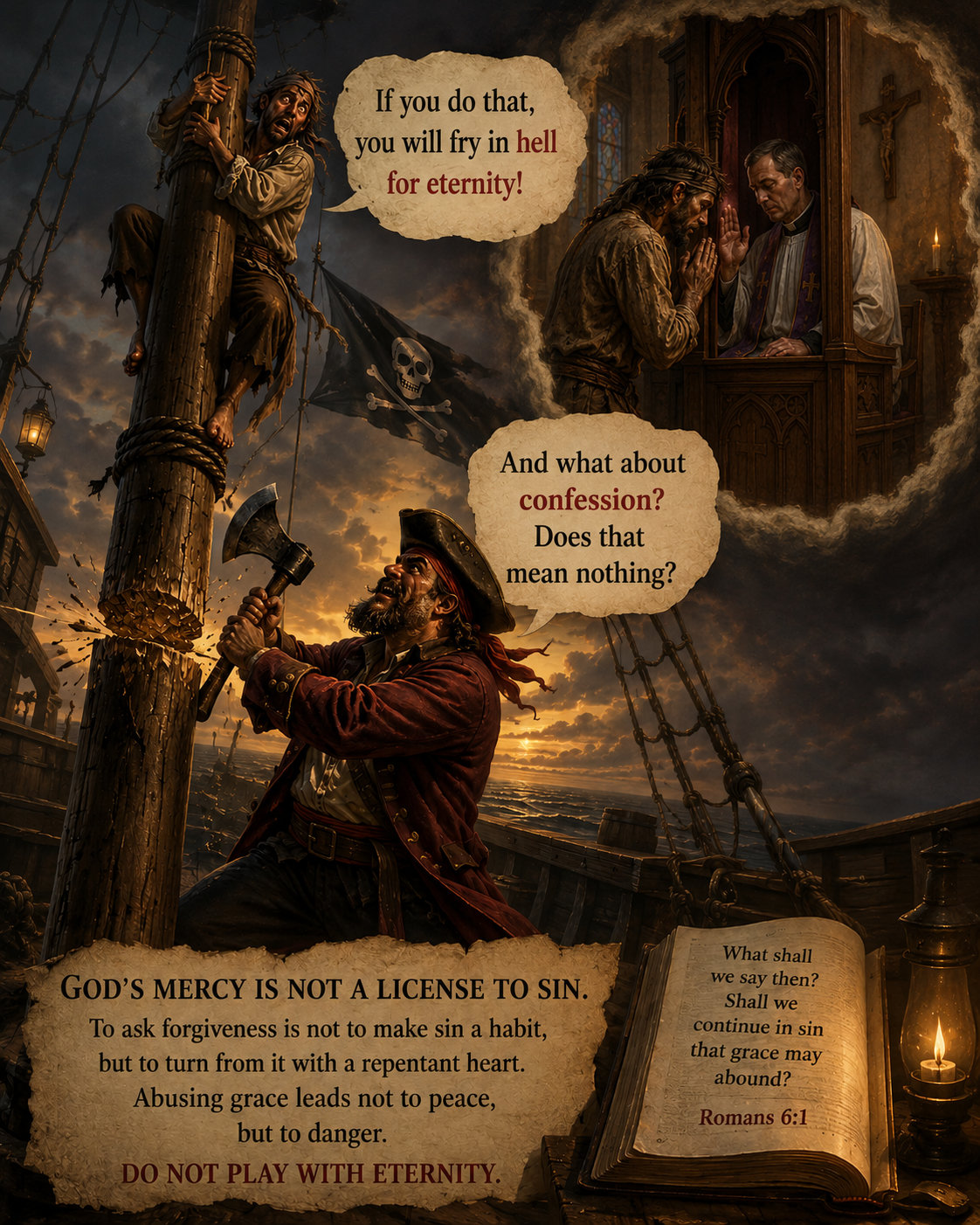
If someone who considers himself a Christian justified by grace exploits the possibility of confessing sins in such a perfidious way, planning them with the thought that he will receive forgiveness anyway, it may indicate that he has not been born of the Spirit, has not yet united with Christ, but is on a direct path to the sin against the Holy Spirit.
Such a person is not an authentic Christian, for the apostle John wrote in 1 John 5:18 that “he who was born of God does not sin”—meaning he does not commit the sin against the Holy Spirit and does not continue in sin.
Hurting the Author of Grace
In the Old Testament, when an Israelite sinned, he had to bring a lamb to the temple, which symbolized Christ.
This showed that the sinner was under grace, because by bringing the lamb he expressed faith in the promised Savior.
The sinner would then confess his sin while placing his hands upon the head of the lamb. Afterward, he would take a knife and plunge it not into himself, but into the lamb.
Had he been under the law alone, his sin would have brought about his own death. But because he was under grace and had expressed faith in the coming Redeemer, it was the lamb that died.
The same principle applies to us today.
If we sin while already being believers and united with Christ, we no longer wound ourselves in the ultimate sense, because Christ has already borne the condemnation.
Instead, we wound the Author of grace.
This realization should produce not carelessness, but gratitude, humility, and sincere repentance.
Removed Nails Leave Permanent Holes in the Fence
A certain father had considerable behavioral problems with his young son. The boy was unruly and frequently saddened his father by his conduct.
In order to teach him an unforgettable lesson, the father gave him a bag of nails and instructed him to drive a nail into a wooden fence every time he lost his temper, argued with someone, or behaved wrongly.
On the first day, the boy drove thirty-seven nails into the fence.
In the weeks that followed, however, he learned to control himself more effectively, and the number of nails steadily decreased.
Finally, a day came when he did not drive a single nail into the fence.
Filled with joy, he told his father about his success.
The father then instructed him to remove one nail for every day in which he did not lose his temper or behave wrongly.
Eventually all the nails were removed.
When the last nail had been pulled out, the father led his son to the fence and said:
“I am very glad, son, that you have made such progress and become a better boy. But look carefully at the fence. It will never be the same again. The holes remain.
Whenever you hurt someone or do something wrong, even if you later make things right, a wound remains. Every wrong action leaves a mark.”
Can Christ forgive every sin?
Yes.
The Lord Jesus can forgive every sin except the sin, against the Holy Spirit. But even forgiven sin leaves wounds.
For this reason, a genuinely converted Christian, although still possessing a fallen nature, develops a growing hatred for sin and a delight in the law of God.
When he sins, he confesses not because he fears condemnation, but because he grieves that he has hurt the Savior whom he loves.
The converted Christian never excuses sin and never cherishes it.
This does not mean that he will never fall again.
But even if he stumbles because for a moment he turned his eyes away from Christ, it does not mean that he has suddenly fallen from grace or come once again under condemnation.
God continually views him through the righteousness of Christ.
This is why Scripture declares:
“There is therefore now no condemnation for those who are in Christ Jesus.” Romans 8:1
Child Learning to Walk
Although the believer has been born again and has received the indwelling Holy Spirit, God knows that he still possesses a fallen nature and can fail.
But does God stop loving him when he falls?
Does a loving mother reject her child every time it falls while learning to walk?
Would she say:
“I am tired of your falling. Leave my house. I do not want you anymore”?
Of course not.
And if imperfect human parents respond with such patience and love, how much more does our heavenly Father respond with patience and mercy?
Why do we assume that God rejects us every time we stumble?
Why do we imagine that He turns away from us when we fail?
His love is infinitely greater than the love of any earthly parent.
Indeed, according to Romans chapter 5, God loved us even while we were still His enemies.
If He loved us then, how much more does He love us now that we have come to Him?
One of the greatest tragedies is when a sincere Christian who has accepted Christ’s righteousness believes that God rejects him every time he sins.
Such thinking dishonors God’s character and destroys peace of mind.
Pastor and Girl who Dreamed About Christ and Spoke With Him
A believing girl often claimed that she dreamed about Christ and even spoke with Him.
Her pastor was somewhat skeptical.
So one day he said:
“If you speak with Christ again, ask Him what sin I most recently confessed.”
Some time later they met again.
The pastor asked:
“Did you ask Him?”
“Yes,” replied the girl.
“And what did He say?”
The girl answered:
“He said, ‘I do not remember.'”
Whenever we sincerely repent and confess our sins while relying entirely upon Christ’s righteousness, God treats us as though those sins had never been committed.
Moreover, He fulfills His promise:
“This is the covenant that I will make with them after those days, says the Lord: I will put My laws upon their heart, and on their mind I will write them… And their sins and their lawless deeds I will remember no more.” Hebrews 10:16-17
The book Steps to Christ contains many beautiful statements intended to free believers from fear and uncertainty.
“Satan continually attempts to direct our attention toward our weaknesses, failures, and imperfections. His purpose is to separate us from Christ. But we are not to make self the center of our attention. Instead, we are to think about Christ, speak about Christ, trust Christ, and keep our eyes fixed upon Him. Even when we fall, we are not cast off, forsaken, or rejected by God. Christ remains our Advocate before the Father.”
The apostle John wrote:
“And if any man sin, we have an advocate with the Father, Jesus Christ the righteous.”
Why did John emphasize that Christ is righteous?
Certainly not because believers are unaware of this fact.
Rather, John wanted us to understand that Christ remains our Representative before the Father just as surely as He was our Representative on earth.
His righteousness still stands in our place.
His perfection still covers our imperfections.
God sees us through the righteousness of His Son.
Who Is a Saint? (Stained-Glass Illustration)
According to Scripture, a saint is not someone who earned holiness through extraordinary works.
A saint is someone who has accepted Christ’s holiness as his own through faith.
A little boy once struggled to understand the meaning of the word “saint.”
No one seemed able to explain it in a way he could understand.
One day, while sitting in a church, he noticed a beautiful stained-glass window portraying one of God’s faithful servants.
As he gazed at it, the sun suddenly emerged from behind the clouds and shone through the stained glass.
The figure was illuminated with brilliant light.
At that moment the boy understood.
“I know what a saint is,” he thought.
“A saint is a person through whom the light shines.”
A saint is not someone who earned that title through personal achievement.
We become saints only when we allow the light of the Sun of Righteousness—Jesus Christ—to shine through us.
As we receive His righteousness and love, we naturally begin to bear fruit in our lives.
These fruits do not make us saints.
Rather, they testify that we have already received Christ’s righteousness, holiness, salvation, and freedom.
Thus we remain righteous in Christ even while our experience is still developing.
God accepts us now because of Christ.
Yet this acceptance does not mean that victory over sin is impossible.
On the contrary, every Christian should believe that the same Christ who condemned sin in the flesh two thousand years ago is able to reproduce that victory in the believer’s life today.
Although we remain accepted in Christ even while still growing spiritually, this does not mean that victory over sin is impossible.
No Christian should doubt that since the Lord Jesus perfectly condemned sin in the flesh two thousand years ago, He can also do it a second time—this time in us.
This is precisely what Paul wanted to assure us of when he wrote about the great mystery: “Christ in you, the hope of glory.” Colossians 1:27
Christ dwelling within us is the hope of glory, the hope of reflecting the character, righteousness, and love of God.
Misunderstanding of Perfectionism
I have often noticed that this biblical truth is criticized and accused of promoting perfectionism.
However, such criticism usually results from an incorrect understanding of what perfectionism actually means and from opposition to the truth that Christ assumed our sinful humanity.
Perfectionism in its false sense is the belief that a sanctified person can no longer sin.
It is the belief that all desires and feelings must always be perfectly holy and that fallen human nature can be completely removed before glorification.
Perfectionism may also appear in the form of attempting to earn salvation through personal perfection while criticizing and condemning others for their imperfections.
A much more balanced definition of Christian perfection appears in Bible Lessons and is also reflected in Christ’s Object Lessons:
“In this life and in eternity, total spiritual, mental, physical, and social perfection will never be attained, for that would mean the end of the possibility of growth. However, perfection in the sense of victory over sin is available to all through Christ. God primarily requires moral perfection from us.”
What kind of perfection does God require? Moral perfection. This means surrendering all to God, allowing Holy Spirit to control the indwelling in us law of sin selfishness and pride, and increase God’s love in us. It means continual progress in learning to walk in the Spirit (or live by the power of indwelling Holy Spirit).
If this is what God expects from His children, then He certainly provides the power necessary to achieve it.
He does this through the indwelling Holy Spirit and through Christ living within us. Our responsibility is to maintain fellowship with Christ through prayer and the Word of God. As Jesus Himself said: “Apart from Me you can do nothing.” John 15:5
Working Out Salvation With Fear and Trembling – Adidas Shoes Illustration
About twenty years ago, I visited my sister’s family in Szczecin.
My brother-in-law, who was a well-known football player, gave me a pair of original Adidas trainers.
I was delighted with this unexpected gift.
That same day I put them on and went to a swimming pool.
Since the weather was hot, I decided to go for a swim.
But when I came out of the water, I discovered to my horror that the shoes were gone.
Someone had stolen them.
Ashamed and disappointed, I returned home wearing an old pair of worn-out shoes I had found near the pool.
Whenever I remember that experience, I am reminded of salvation.
Those Adidas shoes were an entirely undeserved gift.
They belonged to me.
I had complete confidence that they were mine and rejoiced in possessing them.
Yet I should have watched over them more carefully.
I should have remembered that someone might try to steal them.
The same principle applies to salvation.
God gives salvation as a free and undeserved gift.
It is an accomplished fact in Christ.
We may rejoice in it now.
We may possess assurance that salvation belongs to us through faith.
But faith must continually be nourished.
It must be strengthened through prayer and through feeding the soul upon the Word of God.
If we neglect this relationship, the enemy of souls will do everything possible to weaken our faith and steal our confidence in Christ.
Many people once rejoiced in salvation and even preached about it, but later drifted away because they neglected their relationship with God.
For this reason we are called to care for the salvation that has already been given to us in Christ. We possess this treasure in earthen vessels. Therefore Paul writes: “Work out your own salvation with fear and trembling.” Philippians 2:12 The apostle is not teaching salvation by works. Rather, he is urging believers to carefully preserve and cultivate the gift they have already received through faith.
The book Steps to Christ emphasizes this need for vigilance: “Satan continually attempts to break our connection with Christ. Therefore we must watch, pray, and remain alert so that nothing draws us away from our Savior. As long as our eyes remain fixed upon Jesus, we are safe. Nothing can separate us from His protecting hand.”
If we accept Christ’s righteousness and maintain communion with Him through prayer and Scripture, then Christ dwelling within us and the Holy Spirit working through us will produce victory over sin. This victory is not the result of self-effort. It is the result of abiding in Christ.
Stop Repeating the Same Sins – Lesson From Pigs
In 1890 Ellen White wrote: “We must no longer stumble, complain, and then pour out tears of despair upon God’s altar.” This statement reminds us that God desires confidence, trust, and perseverance rather than continual discouragement.
A certain farmer noticed something interesting while feeding pigs. Occasionally he poured food into the trough that was still too hot. The first pig would rush eagerly to the food, burn its snout, jump back, and squeal loudly. One would expect the other pigs to learn from this example. But they did not. Each pig in turn repeated exactly the same mistake and suffered the same result.
We, human beings often behave in a similar way. We repeat mistakes we have already made, even though we know about painful consequences. We repeat mistakes that others have already made. Instead of learning from experience, we continue making the same errors again and again.
God desires something better for His children. We should continually look to Christ and grow in wisdom so that old mistakes become increasingly rare.
Therefore we should remember to “no longer stumble, complain, and then pour out tears of despair upon God’s altar.” Our task is to keep our eyes fixed upon Christ, the Author and Finisher of our faith. As we look to Him, we are safe. The Holy Spirit transforms us into His likeness.
This transformation can be clearly seen in the life of the Apostle John. “John was not naturally gentle and loving. He was ambitious, impulsive, and sometimes harsh. Yet as he spent time with Christ, everything changed. Day after day he beheld the character of Jesus. Gradually the love of Christ displaced self-love. The transforming influence of the Holy Spirit renewed his heart. And the power of Christ’s love completely transformed his character. Such is the effect of genuine fellowship with Christ.” Steps to Chris.
Sparrows Transformed By Beholding & Jacob’s Experiment with Sheep
Some time ago I heard about a fascinating experiment conducted by Japanese scientists. They placed ordinary grey sparrows into completely white environments. The cages were white. The rooms were white. Even the caretakers wore white clothing. The scientists then observed several generations of birds.
The first generation remained unchanged. The second generation remained unchanged. But by the third generation, sparrows with entirely white plumage began to appear.
This remarkable experiment illustrates an important spiritual principle. As we continually behold something, we are influenced by it. The Bible taught this truth long before modern science began investigating it.
Thousands of years earlier, Jacob carried out a similar experiment. According to Genesis 30:37-43, he placed striped rods before the flocks as they came to drink. The result was that the offspring reflected what they continually beheld.
Whether one agrees entirely with Jacob’s understanding or not, the biblical principle remains clear: What occupies our attention influences our character. This principle reaches its highest application in the Christian life.
Paul wrote: “But we all, with unveiled face, beholding as in a mirror the glory of the Lord, are being transformed into the same image from glory to glory, just as by the Spirit of the Lord.” 2 Corinthians 3:18
As we contemplate the character, righteousness, and love of Christ, the Holy Spirit transforms us into His likeness. Therefore we should daily study the Word of God and meditate upon the beauty of Christ’s character. We should never neglect prayer. Through these means we maintain living communion with our Savior. And through this communion, victory over sin increasingly becomes our experience.
The Law Written in the Heart
This is also why God promises:
“For this is the covenant that I will make with the house of Israel after those days, says the Lord: I will put My laws in their mind and write them on their hearts.” Hebrews 8:10
God does not merely command obedience from outside. Through the Holy Spirit He implants His law within the heart. When the law is written upon the heart, obedience ceases to be motivated by fear. Instead, obedience becomes the natural expression of love. The believer obeys because he delights in God’s will. The commandments become part of his desires. This is the experience of those who are no longer under law but under grace.
Was the Law Abolished?
Did the Apostle Paul, by writing that “we are no longer under the law” or that we are “released from the law,” believe that the holy law of God had been abolished?
According to Paul, are Christians exempt from keeping the commandments?
Paul himself answers this question:
“What then? Shall we sin because we are not under law but under grace? Certainly not!” Romans 6:14-15
Likewise, in chapter seven he again makes it clear that he has nothing against obedience to God’s commandments:
“What shall we say then? Is the law sin? Certainly not!”
“Therefore the law is holy, and the commandment holy and just and good.”
“Has then what is good become death to me? Certainly not! But sin, that it might appear sin, was producing death in me through what is good, so that sin through the commandment might become exceedingly sinful.”
“For we know that the law is spiritual, but I am carnal, sold under sin.” Romans 7:7, 12-14
These and many other biblical statements demonstrate that Paul had nothing against keeping the Decalogue when obedience springs from the proper motivation.
What he opposed was the idea that the law can save us.
Therefore, when Paul speaks of freedom from the law, he means freedom from its condemning power, not freedom from obedience.
John Stott, David Wilkerson and Charles Spurgeon on Grace and Law
This understanding is not held only by Seventh-day Adventists. Many respected Protestant theologians have reached the same conclusion. One example is John Stott. Pastor Jack Sequeira once attended a major theological conference in Nairobi in 1980 where Stott addressed representatives of many Protestant denominations. During his speech, Stott made a remarkable statement:
“We evangelicals know how to preach the Good News (grace). We have forgotten, however, the duty to also preach a good life. And I will tell you why this is so. It is because we got rid of the law!”
According to Sequeira’s testimony, Stott went on to explain: “We made a mistake, because the New Testament does not invalidate the law as a norm, a model for Christian living.”
These words made a deep impression because they came from one of the most influential Protestant theologians of the twentieth century. Stott maintained that the gospel does not abolish God’s moral standard. Instead, it restores the law to its proper place.
John Stott explained Romans 10:4 in this way: “There are evangelical Christians who believe that Paul’s statements ‘Christ is the end of the law’ and ‘you are not under the law’ mean that Christians are no longer obligated to obey the moral law of God. Attempts to carry it out, they claim, are legalism. However, they misunderstand Paul. The legalism that Paul rejected is not God’s law itself, but attempts to gain God’s favor and forgiveness through obedience.”
A similar position was taken by David Wilkerson. In an article entitled Love, Fear and Obedience, he argued that many Christians misunderstand grace. Wilkerson emphasized that true love is not merely a feeling or emotion. True love expresses itself through obedience. He warned against the idea that Christians may ignore God’s commandments while claiming to possess saving faith. According to Wilkerson, the New Testament opposes salvation by works, but it never opposes obedience motivated by love.
Charles Spurgeon likewise defended the permanence of God’s law. He wrote: “Our King did not come to abolish the Law, but to strengthen and establish it. His commandments are eternal.” Spurgeon insisted that salvation is entirely through faith in Christ, yet he also affirmed the continuing validity of God’s moral law.
In What Sense Christ Is the End of the Law?
One of the most frequently misunderstood passages is Romans 10:4: “For Christ is the end of the law.”
Many Christians interpret this verse as proof that the law has been abolished. But is that what Paul intended? To answer that question, we must examine the context.
The preceding verse states: “For they being ignorant of God’s righteousness, and seeking to establish their own righteousness, have not submitted to the righteousness of God.” Romans 10:3
Paul is discussing attempts to obtain righteousness through the works of the law. He is not discussing the abolition of the law itself.
When Paul writes that Christ is “the end of the law,” he means that Christ brings to an end all attempts to obtain salvation through law-keeping.
Furthermore, Christ fulfilled the law perfectly on our behalf. The Greek word telos can mean “end,” “goal,” “purpose,” or “fulfillment.” Therefore the passage may also be understood as: “The goal of the law is Christ.”
The law was never intended to save us. Its purpose is to lead us to Christ, who alone can save.
John Stott explained the verse in this way: “There are evangelical Christians who believe that Paul’s statements ‘Christ is the end of the law’ and ‘you are not under the law’ mean that Christians are no longer obligated to obey the moral law of God. Attempts to carry it out, they claim, are legalism. However, they misunderstand Paul. The legalism that Paul rejected is not God’s law itself, but attempts to gain God’s favor and forgiveness through obedience.”
Accusation Faced By Paul
In Acts 21:20, some accused Paul of teaching against the law. The same accusation is often directed against those who preach righteousness by faith today.
But does the gospel really undermine God’s law? Paul asked exactly this question: “Do we then make void the law through faith?” Romans 3:31
Paul’s answer is immediate: “Certainly not! On the contrary, we establish the law.” Romans 3:31
The gospel does not weaken the law. It strengthens it. God did not save humanity by ignoring the law’s demands. He did not simply set aside justice. Instead, He satisfied every just claim of the law through Christ.
The law demanded death. Christ bore that death. The law demanded perfect righteousness. Christ provided that righteousness. The law demanded obedience. Christ rendered that obedience. In this way, the gospel establishes rather than abolishes the law.
The Final Test of Any Gospel
Paul also asked: “What shall we say then? Shall we continue in sin, that grace may abound?” Romans 6:1
His answer was the same: “Certainly not!”
Therefore, any interpretation of the gospel that encourages disobedience cannot be the true gospel. If a person’s understanding of grace leads him to think that God’s commandments are unnecessary, then he has misunderstood Paul’s message.
True freedom in Christ never leads to lawlessness. It produces loving obedience. The believer obeys not in order to be saved, but because he has already been saved in Christ. He obeys not out of fear, but out of gratitude. He obeys not through self-effort alone, but through the power of the indwelling Christ.
Summery and Final Appeal
God preferred to take the immense risk of sending His Son into this fallen world in the likeness of sinful flesh rather than alter even one principle of His law.
The Father permitted His Son to experience suffering, rejection, and the second death rather than weaken the claims of His government.
Nothing could demonstrate more clearly the permanence and sacredness of God’s law.
Many Christians make the mistake of claiming that the Decalogue has been abolished. Yet Adventists can also fall into an opposite error. We may become suspicious of the gospel itself whenever justification by faith is strongly emphasized. This happened during the Minneapolis Conference of 1888. It can still happen today.
The central message of Romans is therefore this: We are saved entirely through the righteousness of Christ. We are justified entirely through faith. We are accepted entirely through grace. And because of this wonderful salvation, the Holy Spirit writes God’s law upon our hearts and enables us to walk in obedience.
Let us therefore believe the good news, accept the freedom that Christ has already secured for us, refuse to live as slaves when God has declared us free, reject both legalism and cheap grace, and fix our eyes continually upon Jesus Christ—the Author and Finisher of our faith.
And as we behold Him, trust Him, and abide in Him, we will discover that there is indeed: “No condemnation for those who are in Christ Jesus.” And through His grace, we will also experience victory, transformation, peace, and eternal life.
Amen.