Slawomir Gromadzki
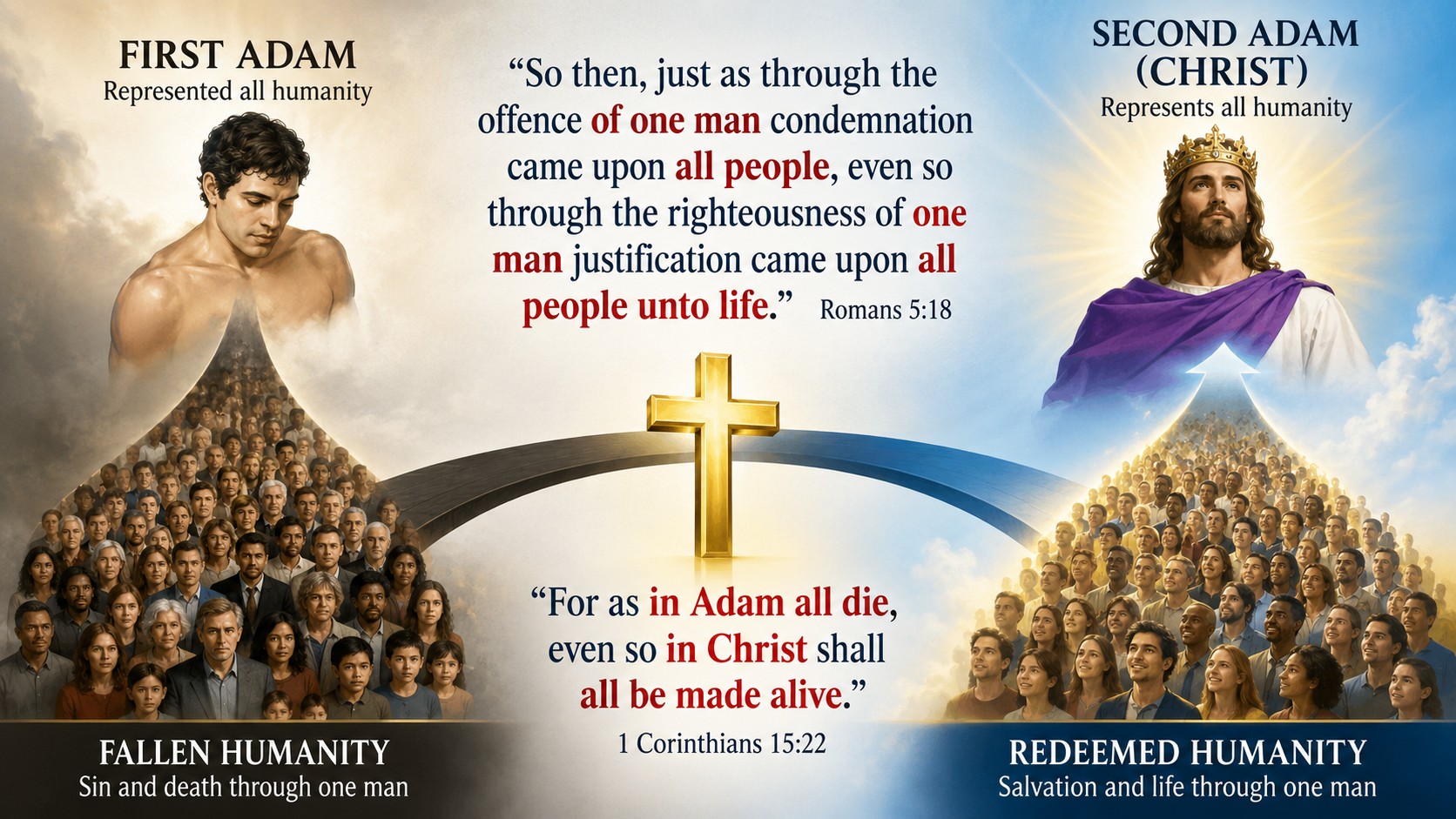
Bible Study Based on Romans 5:12-21
This part of the Epistle to the Romans, in which Paul discusses our position in Adam and Christ, is considered by many theologians to be one of the most essential passages of Holy Scripture. It is the key to understanding the Gospel and the doctrine of justification by faith. Without a proper understanding of what Paul meant in this second part of the fifth chapter of Romans, it is impossible to understand the heart of the Gospel, namely chapters 6, 7, and 8 of this epistle, which can without hesitation be considered the most important chapters in the entire Bible. Therefore, this topic is of immense and priceless significance for us, which is why the content of this passage should be analyzed as thoroughly and carefully as possible.
And here is what the well-known Swedish theologian, Anders Nygren—author of the wonderful book entitled “Agape and Eros” and a very popular commentary on the Epistle to the Romans—wrote about this part of Romans. Doctor Froom, an Adventist professor of theology, wrote in his book “The Movement of Destiny” about this Swedish theologian, stating that he is one of the few non-Adventist theologians teaching the same Gospel message that was proclaimed by Waggoner, Jones, and E. White. Here is what Anders Nygren wrote regarding the aforementioned passage of the Epistle to the Romans: “The best place to start in order to gain a correct view of the Epistle to the Romans is the part of the fifth chapter comparing Adam to Christ. It is the key to understanding the entire epistle. If we properly understand this part, then everything that precedes this chapter and everything that follows it will be revealed to us as one harmonious whole.”
If we manage to grasp the meaning of this part of the Epistle to the Romans, we will also understand the entire Gospel and the doctrine of justification by faith. There is also no doubt that this is a very difficult passage and can cause spiritual indigestion, because what Paul presents here contradicts the mentality of modern man. Therefore, if we want to correctly understand this chapter, we must change our way of thinking and begin to think like Paul, rather than trying to change his way of reasoning!
Romans 5:12
Let us begin with Romans 5:12: “Therefore, just as sin entered the world through one man, and death through sin, and in this way death came to all people, because all sinned.” Paul says here that “sin entered the world” through how many people? Through “one man”, namely Adam. Further on, however, the author clearly suggests something that is difficult for modern man to accept, namely, that when Adam sinned, who else sinned? Everyone, all of us. However, that is still not all, as Paul clearly suggests that this very sin, the sin that each of us committed in Adam, is the main reason we are condemned to death.
Unfortunately, this last expression in Romans 5:12, “all sinned”, was not finished by Paul and is a cause of misunderstanding today. Many theologians argue over whether the author meant here that we all must die because we sinned in Adam and his sin became our share, or perhaps Paul meant that we all must die because we sinned like Adam, meaning as a result of our own sins? I believe that if we could ask this question to Paul himself today, he would ask us in surprise, “Why did you not pay attention to the context, that is, to what I wrote next?” Let us therefore read the context carefully, namely verses 13 and 14 of the fifth chapter, and they will certainly help us solve this riddle:
Romans 5:13-14
“To be sure, sin was in the world before the law was given, but sin is not charged against anyone’s account where there is no law.Nevertheless, death reigned from the time of Adam to the time of Moses, even over those who did not sin by breaking a command, as did Adam, who is a pattern of the one to come.”
More than one person, after reading this passage, has concluded that one would need to be an angel to understand what Paul is actually trying to prove here. However, we can be certain that it is precisely in these verses that he explains what he meant at the end of verse 12. Thus, in verses 13 and 14, we must find the answer to the question of whether we die because we sinned in Adam or whether we are condemned to death as a result of our own sins. Let us therefore read verse 13 once again: “To be sure, sin was in the world before the law was given, but sin is not charged against anyone’s account where there is no law.”
It follows from verse 13 that, according to Paul, there was a period on earth when there was no law. Of course, it is true that the commandments could have existed in the sense that they were passed down by word of mouth. However, Paul means here that “from Adam to Moses”, that is, until the law was given on Mount Sinai, the law did not yet exist as a legal code. Until that time, there was no law in written form, in black and white. But does the fact that the law was not yet officially proclaimed mean that those people were without sin? Of course not! Therefore, at the beginning of verse 13, Paul wrote: “before the law (before the law was given in written form on Sinai) sin was in the world.”
Further on, however, in the same 13th verse, he explains that the sins of the people living before the official proclamation of the law on Mount Sinai could not legally condemn them to death, because there were no commandments in written form at that time. In other words, God could not remain just if He had punished sinners with death for breaking commandments when He had not yet officially proclaimed those commandments.
Let us say that I am currently traveling by car and, while listening to the radio, I learn that on the highway I am driving on, the speed limit has been changed from 120 to 100 km/h. Will any police officer have the right to fine me if the information on the traffic signs regarding the change in the speed limit has not also been altered? Of course not! Why would no police officer have the right to punish me for driving over 100 km/h, even though the media has already reported information about this change? Because this law has not yet been legally introduced, as the information displayed on the signs has not been changed. On the same principle, God would be unjust if He punished those who sinned before the law was given on Mount Sinai with death because of their own sins, because the Law was not yet officially given at that time, and because “where there is no law, sin is not charged” (Romans 5:13).
However, although Paul implied here that sins before Sinai could not give the right to condemn a sinner to death, because it was before the giving of the law, nevertheless—as he further explains in verse 14—those sinners were already dying then (“death reigned from Adam to Moses”): “Nevertheless, death reigned from the time of Adam to the time of Moses, even over those who did not sin by breaking a command, as did Adam, who is a pattern of the one to come.” So by what right did they die, since they could not yet be legally condemned to death because of their own sins? There can be only one answer to this question: If the cause of their death was not their own sins, why did they die? They died because they sinned in Adam! There is no other possibility of a correct interpretation of this passage, and this is the only thing Paul could have meant here. Therefore, the context of verse 12 clearly indicates that the Apostle Paul in this verse must have meant that everyone dies because they sinned in Adam, and not like Adam.
A passage from the 7th chapter of the Epistle to the Hebrews can be very helpful in understanding this topic, where Paul wrote about Levi paying tithes in Abraham:
Hebrews 7:9-10: “And as I may so say, Levi also, who receiveth tithes, payed tithes in Abraham. For he was yet in the loins of his father, when Melchisedec met him.” (BG)
Although at the time when Abraham was giving a tithe to Melchizedek, Levi was not yet in the world, Paul explains here that Levi also gave a tithe to Melchizedek then, because he was in Abraham, in his loins. Therefore, using the same expression, we can also say that even though we were not yet in the world when Adam committed sin, we also sinned because we were in him, in his loins, and for this reason we too must die.
That it is untrue that everyone must die because everyone sinned like Adam, meaning because of their own sins and not because of sin in Adam, can be explained with a simple example: Do infants sin like Adam, or to put it another way, do they have their own sins? No. And do infants die, despite the fact that they do not yet possess their own sins? Yes. Then for what reason do they die, if they do not yet have their own sins, and since death is the wages of sin? If they have no sins of their own and no other sin, they should not die, because death is only the result of sin. There is only one possible correct answer: They die because they sinned in Adam!
Psalm 51:5: “Surely I was sinful at birth, sinful from the time my mother conceived me.”
For this reason, if any infant is found in heaven, it will certainly not be due to sinlessness, since it sinned in Adam, but solely thanks to what Christ accomplished.
Another undeniable argument showing that in verse 12 Paul meant that we must die because we sinned in Adam is grammar, specifically the tense the author used to express the phrase “because all sinned” (the end of verse 12):
Romans 5:12
“Therefore, just as sin entered the world through one man, and death through sin, and in this way death came to all people, because all sinned.”
This last statement found in this 12th verse, “all sinned”, was deliberately written by the inspired Paul in the past perfective tense—the AORIST. In Greek grammar, this tense defines something that happened in some distant past once and for all and belongs to history. When did we sin in the past once and for all? Obviously in Adam!
Paul used the same past aorist tense in Romans 3:23, writing: “For all have sinned and fall short of the glory of God.” The phrase “ALL HAVE SINNED” was also written in the aorist tense, suggesting that all sinned in Adam. However, the author does not stop there, but adds “and fall short of the glory of God.” It is interesting that this second statement, which already refers to our personal sins and imperfections, was written in the present continuous tense. Thus, Paul assures us that we found ourselves in a hopeless situation, because not only did we all sin in the distant past in Adam, but we also add to this our own sins, which we commit throughout our entire lives. However, the true cause of why we all must die is the sin we committed in Adam, and our personal sins are merely the fruit of that sin which we committed in him.
In the past, no one would have had major problems understanding the fact that they must die because they sinned in Adam, since everything was inherited from generation to generation. If a grandfather was, for example, a blacksmith, the son and grandson were blacksmiths, and everyone could even bear the same surname, for example, Kowalski. From generation to generation, not only the profession, surname, and property were inherited, but also the debts of their ancestors, and this was something normal and understood. For us, however, it is much harder to accept that we inherit everything from our forefather Adam, including the debt, which is death, the wages of sin. The reason for this is that we currently live in a different culture and our way of thinking is different.
But despite the passing of years, even nowadays such collective responsibility is still sometimes applied. The best example is the military. I remember perfectly well how, during my military service, our entire squad or company was punished, despite the fact that only one soldier was at fault. Similarly, the crime committed by Adam entails a kind of collective responsibility for all people.
If, however, we continue to insist that we have nothing to do with Adam, it would be worth asking what would have happened to us if Adam had died on the very day he sinned? Because we must remember that according to the original Hebrew text of Genesis 2:17, Adam should have died on the day he sinned:
Genesis 2:17: “But of the tree of the knowledge of good and evil, thou shalt not eat of it: for in the day that thou eatest thereof thou shalt surely die.”
Did Adam die on the same day he sinned? In a certain sense, yes, because with the fall, Adam was deprived of the Holy Spirit who dwelt in him and of God’s Agape love. We can therefore say that his spiritual death occurred on that day. God, however, already had a plan of salvation prepared back then, and it was only because “the Lamb was slain from the creation of the world” (“Revelation 13:8”) that Adam did not suffer death on the physical and psychological level that day. Thanks to this, both he and his descendants were given the opportunity to repent and regain the Holy Spirit and Agape love.
What, however, would have happened to each of us if the Son of God had not decided to bear the consequences of Adam’s sin, and if Adam had perished by the second death on the very day he sinned? What would have happened to us then? We would all have died in Adam, and none of us could have even been born. It is therefore absurd to claim that we have nothing to do with Adam and the history of his life.
The fact that we are condemned to death because of sin in Adam may be associated with the Catholic doctrine of ORIGINAL SIN, which is not entirely in line with the truth. The difference between what this doctrine teaches and the truth contained in the 5th chapter of the Epistle to the Romans is that, according to Paul, we are condemned to death in Adam not because God transferred Adam’s sin to us, but because we actually participated in Adam’s sin, because we were in him.
All Christians must agree that Adam’s sin affected us all, but in what sense? Does God hold us guilty because of Adam’s sin? Of course not! We were simply “in the loins” of Adam when he sinned, and we inherit the consequences of this sin in the form of condemnation, a sinful nature, and death, but not guilt.
Let us say that a pregnant woman smokes a lot of cigarettes, does not take care of her health, and dies of lung cancer, and along with her, the fetus in her womb also perishes. Was this fetus guilty of the mother smoking cigarettes and causing a fatal disease? Of course not! However, this unborn child suffered the same fate and had to bear the consequences of what the mother did, because it was in her womb. It is similar in our case. God does not transfer Adam’s guilt to us, but because we were in his “loins”, we must also bear the consequences together with him in the form of taking over a fallen nature, condemnation, and death from him.
The statements of Ellen White also fully harmonize with the fact that our death is primarily a consequence of sin in Adam:
“Adam sinned, and the children of Adam share his guilt and its consequences; but Jesus bore the guilt of Adam, and all the children of Adam that will flee to Christ, the second Adam, may escape the penalty of transgression.” (“Faith and Works”, 86)
“Man received from him nothing but guilt and the sentence of death.” (“The Seventh-day Adventist Bible Commentary”, vol. 6, 1074)
“Blessed is the soul who can say, I am guilty before God, but Christ is my advocate… I am lost in Adam, but restored in Christ.” (“Sons and Daughters of God”, 120)
Thus, there is no doubt that Sister White agreed with the statement that everyone must die because they sinned in Adam.
Let us now look at another extremely important reason why in verse 12 Paul must have meant that we are condemned to death primarily as a result of sin in Adam. In Romans 5:14 we read that Adam is a “PATTERN OF CHRIST”. In other words, the Apostle Paul wants us to understand that just as what Adam did is shared by all of us, so what the Second Adam—Christ—accomplished is also our share. And therefore, according to Paul’s theology, we are condemned to death because we sinned in Adam, and we were justified because we were obedient and perfect in Christ.
TRUTH: WE SINNED in ADAM = DEATH, WE WERE OBEDIENT in CHRIST = JUSTIFICATION
If, however, we say that we die because we sinned like Adam, then according to the pattern used by Paul, we must also say that we are all justified because we were obedient and perfect like Christ. Such a claim is unacceptable and would be heresy, because in this way we would be teaching that salvation is by works.
FALSEHOOD: WE SINNED like ADAM = DEATH, WE WERE OBEDIENT like CHRIST = JUSTIFICATION
Can any of us be obedient, perfect like Christ? No! Therefore, according to this principle, this comparison, no human being could be saved. Thus, the view that we all must die because we sinned like Adam, meaning as a result of our personal sins and not sin in Adam, would make salvation impossible to achieve, because then we would have to be obedient like Christ—the second Adam.
If, however, we still have doubts as to whether we all must die because we sinned in Adam, Paul dispels these doubts in the following verses of the 5th chapter of the Epistle to the Romans: Verses 15 to 19 constitute the further context of verse 12. In each of these verses—a total of 5 times—the author assures us that we all must die, are judged, and condemned because of Adam’s sin and not our personal sins:
Romans 5:15-19
“But the gift is not like the trespass. For if the many died by the trespass of the one man, how much more did God’s grace and the gift that came by the grace of the one man, Jesus Christ, overflow to the many!Nor can the gift of God be compared with the result of one man’s sin: The judgment followed one sin and brought condemnation, but the gift followed many trespasses and brought justification.For if, by the trespass of the one man, death reigned through that one man, how much more will those who receive God’s abundant provision of grace and of the gift of righteousness reign in life through the one man, Jesus Christ!Consequently, just as one trespass resulted in condemnation for all people, so also one righteous act resulted in justification and life for all people.For just as through the disobedience of the one man the many were made sinners, so also through the obedience of the one man the many will be made righteous.”
Including verse 12, in this second part of the 5th chapter, the Apostle Paul repeats the exact same thing 6 times! This is the only such biblical passage where the author repeats the same statement as many as 6 times! What could this indicate? Why did Paul, inspired by the Holy Spirit, make so many repetitions of the statement saying that just as in one, namely the first Adam, we have sin and death, so also in one, namely Christ (the second Adam), we have perfection, righteousness, and life? Since he repeats this truth so often, it must mean that it is of unimaginably great importance for us and our salvation!
The statement expressed here six times by Paul, saying that in Adam we sinned and die, and in Christ (the second Adam) we were righteous and have life, is extremely important because a key principle of salvation is hidden here. Why is Paul so keen for us to understand and agree that we must die because we collectively sinned in one man—Adam? Why does the author of the Epistle to the Romans want to convince us that the entire Human Race was concentrated in Adam, and that Adam was responsible for the fate of all humanity? Why is this so crucial? This fact is of such great importance precisely because if we acknowledge that we all sinned in one man—Adam—and for this reason must die, then thanks to this, God can and has the right, on the same principle, to reverse this tragic situation and save us all through one man—Jesus Christ.
It is extremely important for us to remember that in the Hebrew language, the word “Adam” means “HUMAN RACE”! It follows that when God created Adam, He also created all of humanity in him. Adam was US, our REPRESENTATIVE, and we were in his loins. According to the authors of the “Small Biblical Encyclopedia”, the word “Adam” means “the original generic name for man or all of humanity.” In Genesis 2:7 it is written that God “formed a man from the dust of the ground and breathed into his nostrils the breath of life.” (BT) It is extremely interesting that the phrase “breath of life” found in this passage was written in the plural in the original Hebrew, which can also mean that in Adam, God created all people.
Remembering that the word Adam means “human race”, and that in Adam God created all people, and that Adam was the representative of us all, it should be noted that Jesus Christ is called in Holy Scripture “the last Adam”:
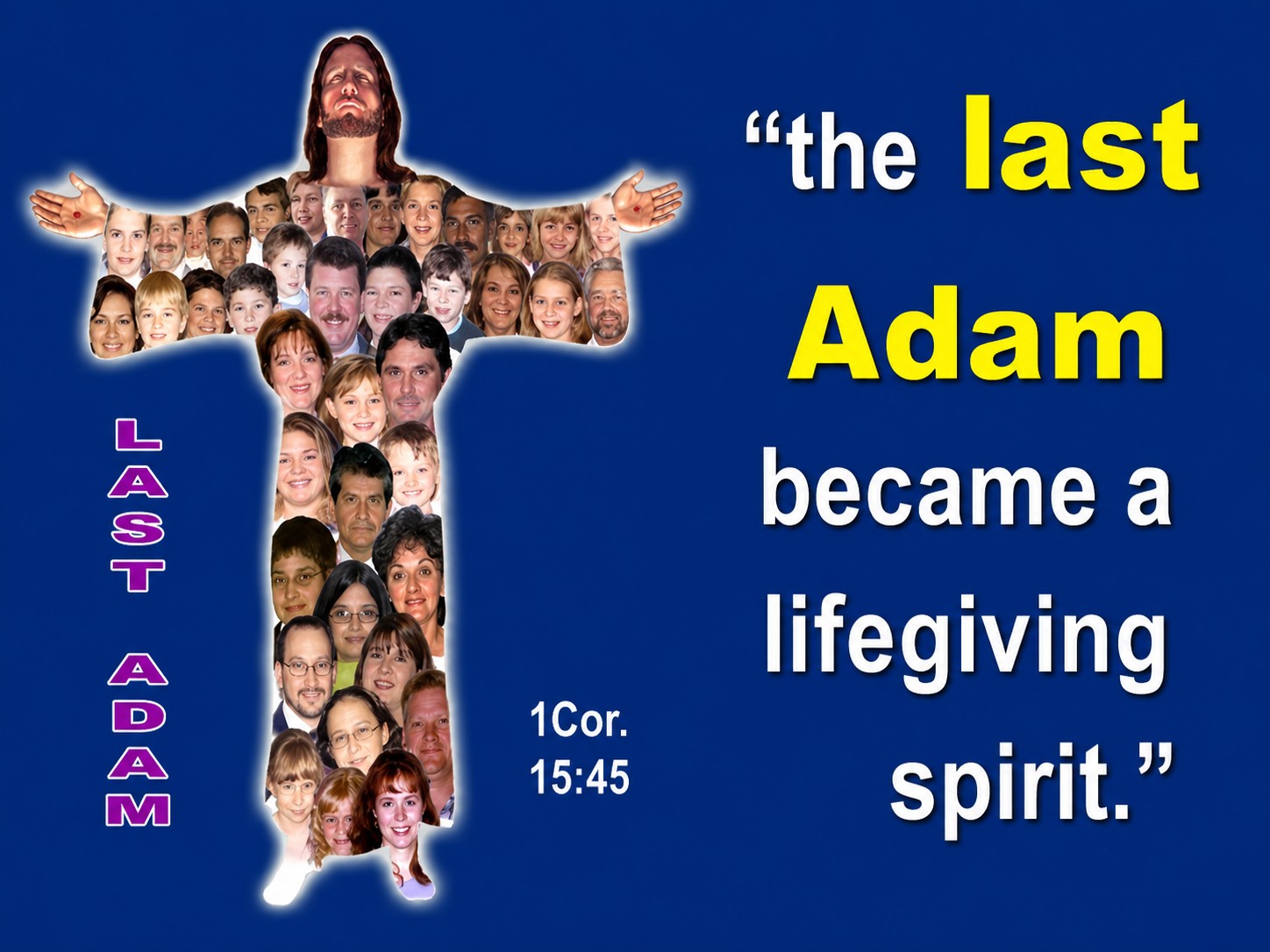
1 Corinthians 15:45
“So it is written: “The first man Adam became a living being”; the last Adam, a life-giving spirit.”
Why is Christ called “the last Adam” in the Bible? This is an extremely important question. Finding the correct answer to this key question will allow us to understand the basic principle of the Gospel and the method of humanity’s salvation. Christ was called “the last Adam” because the word Adam means “HUMAN RACE” in Hebrew, thanks to which the Son of God could become the representative of all humanity. And just as the first Adam represented the entire human race, so Christ as “the last Adam” also personified all people.
“Christ, personifying humanity, was to suffer outside the boundaries of Jerusalem.” (“The Desire of Ages”, 588)
“The Savior’s glance seemed to penetrate heaven as His soul poured out in prayer… In this prayer Jesus asked the Father for a witness that in the Person of His Son He accepts the human race into His bosom.” (“The Desire of Ages”, 74)
When discussing our situation in Adam and Christ, we must also pay attention to another very important matter, namely, that the Lord Jesus could legally represent fallen humanity only by assuming our sinful nature. If He had only shared the sinless nature of Adam before the fall, then the Son of God could only represent in His life and on the cross the sinless Adam, who as a perfect being did not need redemption. Therefore, so that Christ could become the representative of the fallen human race, so that He as us could perfectly fulfill the Law and take us to the cross, so that we might be punished there in Him with the second death, He had to assume the kind of humanity that became man’s share after the fall, since only fallen man needs redemption. Only in this way can the perfection of Christ and His death legally become our share. For this very reason, Sister White also believed that Christ could be our representative precisely because He identified with our fallen nature:
“Christ became sin for the fallen race (2 Cor. 5:21). He stood at the head of humanity as its representative. In the likeness of sinful flesh, He condemned sin in the flesh (Romans 8:3).” (Review and Herald, May 6, 1875, par. 11)
“Notwithstanding that the sins of a guilty world were laid upon Christ, notwithstanding the humiliation of taking upon Himself our fallen nature, the voice from heaven declared Him to be the Son of the Eternal… The words spoken to Jesus at the Jordan, ‘This is My beloved Son, in whom I am well pleased,’ embrace humanity.God spoke to Jesus as our representative.” (“The Desire of Ages”, 74)
A careful analysis of this text clearly demonstrates that Christ’s assumption of our fallen nature gave Him the opportunity to represent the whole of sinful humanity.
“The Savior gathered all humanity into Himself, encompassing it with His infinite mind, and stood as the representative of the entire human family. He came to redeem this family by uniting divinity with the flesh of sin and condemning sin in the flesh. Each of us was represented in Christ through His incarnation, when ‘the Word became flesh and dwelt among us.’ We were all gathered into Jesus Christ, just as we were all gathered according to the flesh in Adam, who represented us.” (W. W. Prescott)
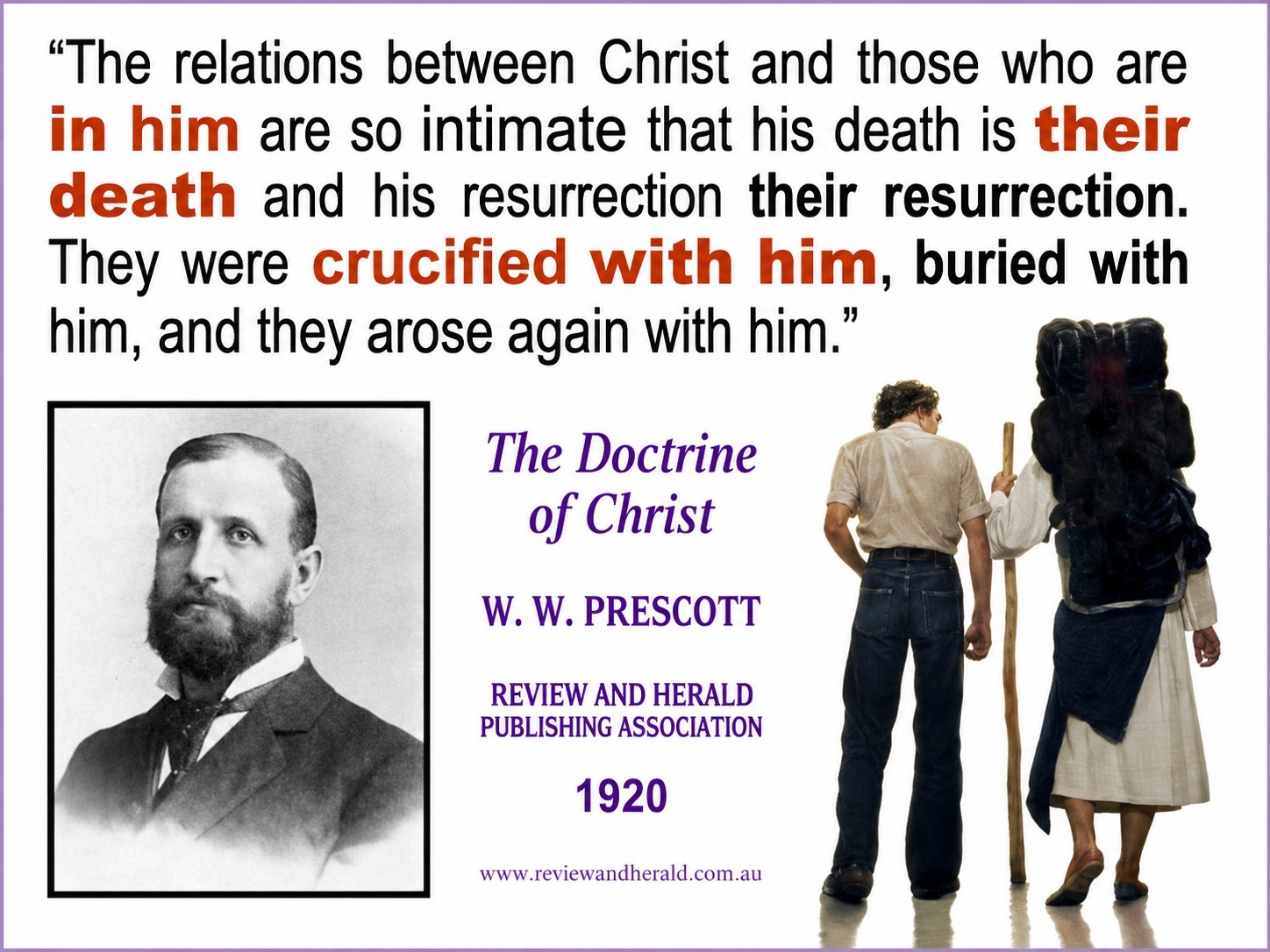
The fact that the Son of God personified us all is of priceless, unimaginably great, and saving significance for the fallen Human Race, which finds itself in a hopeless situation, because it is precisely thanks to Christ being able to act in the role of the second Adam, that is, the second representative of humanity, that God was able to prepare a plan of salvation that allowed us to be saved according to the requirements of the Law.
If, therefore, we accept this seemingly unfair fact that we must die as a result of the sin of one man—Adam, because we were in him, and because he was us, then on the same principle, God has wonderful, magnificent news for us, which says that we can be considered holy, perfect, and righteous, and we can regain lost immortality, because we were all in Christ—the second Adam—and everything that He, as our representative and as the “human race”, accomplished in the holy history of His life and death has become our share! In short, because we die because of the representative sin of one man—Adam, so we are justified and have eternal life thanks to the representative righteousness and death of also one man—Jesus Christ.
Romans 5:18
“Consequently, just as one trespass resulted in condemnation for all people, so also one righteous act resulted in justification and life for all people.”
1 Corinthians 15:21-22: “For since death came through a man, the resurrection of the dead comes also through a man. For as in Adam all die, so in Christ all will be made alive.”
Paul, therefore, suggests to us that just as we participated in Adam’s sin—similarly, we also participate in the perfect obedience, death, and resurrection of Christ, because He was the second Adam, He was us, and we were all in HIM! And therefore, what He accomplished, each of us accomplished in Him!
This undeniable Truth leads to another extremely important conclusion, namely, that in that case, the Son of God could not live righteously and die INSTEAD OF US, but rather AS US! Of course, in a certain sense, we can also say that Christ died instead of us, but considering the requirements of God’s immutable law, which requires death from the sinner and not from the righteous, Christ had to die not instead of us, but as us! He was the second Adam, meaning the second human race, our representative; He was us, and we were in Him. Thus, when He died, we all died in Him! (Galatians 2:20; Romans 6:6, 8; 2 Corinthians 5:14).
Pastor Sequeira used to tell a story about how one time, while he was still working in Africa, a young man approached him and, thinking that Brother Sequeira was a follower of Islam, asked, “Are you saved?” Then Pastor Sequeira, guessing that he was a Pentecostal, asked, “Saved from what? From guilt, the penalty for sin, from the presence of sin, or perhaps from its power? What do you mean?” When this young man heard this question, he said in surprise, “You talk like a pastor…” “You are right,” replied Brother Sequeira, and added, “And may I ask you a question?” “Yes.” “Tell me then, are you saved?” In response to this question, this young man raised his hand and enthusiastically said, “Brother! Praise the Lord! I was saved three months ago!” “Then in that case, what are you still doing here on earth?” asked the pastor, and explained to him that he was saved two thousand years ago, and three months earlier he had merely accepted this salvation, and that faith itself cannot be a saving means. Faith does not save, but it makes effective what has already happened in Christ. “Besides,” the pastor continued, “since you are saved, why do I smell beer on you?” “Brother!” replied the young Pentecostal, “Don’t you know? I was saved by grace and Christ died instead of me!” “Oh really?” said Pastor Sequeira, pretending to be surprised, “Then, adopting your way of reasoning and reasoning according to the principle used by the Apostle Paul, since Christ died instead of you, He also went to heaven instead of you.”
The Christian church commonly teaches that one man (Christ) died in place of, or instead of, all people. The Gospel, on the other hand, teaches that all people died in one man—Christ. The true, biblical definition of Christ’s substitutionary sacrifice does not say that one died instead of all, but that all died in one.
Mombasa Case and Accusation of Unethical Gospel
Ever since the Reformation, the Christian church has been accused by non-Christian churches and the Catholic Church of preaching an UNETHICAL GOSPEL.Christians were accused of teaching something that no law allows. According to them, this erroneous teaching consists in Christians wrongly teaching that our guilt was TRANSFERRED to Christ and that the righteous Christ died INSTEAD OF unrighteous sinners. According to them, something like this is unacceptable and they called it a “legal fiction,” because no law, and especially not God’s law, allows such a possibility. In making these accusations, they rightly refer to what God Himself said about this in His Word, namely, that guilt cannot be transferred from one person to another: 2 Kings 14:6; Deuteronomy 24:16; Ezekiel 18:5, 20; Exodus 32:31-33.
During one of his lectures, Pastor Sequeira also spoke about how in 1980 an American ship stopped in Mombasa—a port located in East Africa. Several sailors from this ship went to a nightclub in the evening to have some fun. However, when they started brawling under the influence of alcohol, tragedy struck. One of them beat a woman, who was Kenyan, to death. This sailor was detained by the police and placed in custody. But when his mother found out about it, she went to a US Senator from New York, begging him to try to save her son. And the senator managed to restore his freedom, taking advantage of the friendly relations that existed at that time between Kenya and the United States. Thanks to this, this sailor returned home unpunished, as a free man. But when the Kenyans found out about it, they were furious. Pastor Sequeira was working at that time in Kenya at the University of Nairobi and personally witnessed a law professor, who was a follower of Islam, stand before a gathering of 15,000 students and say: “Kenya has completely lost its sense of justice! And I blame neither the government of Kenya nor the government of Great Britain, from which Kenya inherited its legal system. I blame the Christian church for this! Because it is Christianity that teaches that you can sin, and then transfer this sin and guilt onto an innocent man called Christ, who was killed instead of the guilty sinners, thanks to which these guilty sinners are free! No law allows this, and therefore it is the most unethical religion in the world!” And when this professor finished his speech, none of the many Christians present there knew what to say in defense of Christianity and the truth. They could not do so because they were all brought up on the basis of the doctrine of Christ’s substitutionary sacrifice. Therefore, until we solve this problem, we will always encounter similar criticism of the gospel. That is precisely why God gave us the message heralded in 1888, because it brought a solution to this problem based on the epistles to the Galatians and Romans.
The Gospel is not a “legal fiction” because according to the Bible, Christ died not only INSTEAD OF us, but AS US! Every sinful human being, every transgressor of the law, was punished with death in Christ. The plan of salvation was therefore implemented in accordance with the Law, which says “the soul who sins must die.” There are many biblical texts that speak about us dying in Christ:
2 Corinthians 5:14
“For Christ’s love compels us, because we are convinced that one died for all, and therefore all died.”
This verse does not stop only at the statement that one—”Christ died for all”—but goes on to say that also “ALL DIED” in one—in Christ. And here is what commentary our Adventist theologians provided for this extremely important biblical statement of the Apostle Paul in the SDA BIBLE COMMENTARY (commentary on 2 Cor. 5:14): “Taking the place of Adam (1 Cor. 15:22, 45) Christ became the head of the fallen human race and died on the cross as its Representative. Consequently, when He died, the entire human race died in Him. His death personifies the death of all, as He represented all people. In Him all people died. In this way He fully satisfied the requirements of the law.”
Huper & Anti
In the New Testament, there are two primary words that are translated into Polish as “zamiast” or “za” [instead of/for]. One of them is the word “huper“, which—according to the information I found in the dictionary—can just as well mean “for the benefit of someone” or “on (someone’s) behalf”. This word appears, for example, in 2 Corinthians 5:20. Here is how this passage was rendered in the Warsaw Bible translation: “Therefore, we are ambassadors in Christ’s stead…”. (BW) And now let us hear how the same passage sounds in the Millennium Bible translation: “So we are ambassadors for Christ, as though God were making his appeal through us…”. (BT) Similarly, in the leading biblical translations in the English language, this same phrase was translated as “on behalf of” and not “in place of”.
The same Greek word “huper” appears in 2 Corinthians 5:14, where the Apostle Paul wrote: “For Christ’s love compels us, because we are convinced that one died for (huper) all, and therefore all died.” (BW) We could just as well translate this text in the following way: “For Christ’s love compels us, because we are convinced that one died on behalf of (huper) all, and therefore all died.” (BW) Such a translation allows a better understanding of the fact that Christ died not so much instead of us as He did as us, as our representative, that He lived and died on our behalf.
The second Greek word usually translated as “for” is “anti“. However, this word too—just like the previous one—can mean “on behalf of”. This word was used, for example, in Matthew 20:28, where we read about Christ, who “…gave his life as a ransom for (anti) many.” However, it would not be an error if we read that Christ “…gave his life as a ransom on behalf of (as a representative of) many.” This means that we can say that Christ lived and died for us, but not in the sense as if He did it instead of us or in our place, but rather as us, or on our behalf, because only such reasoning is consistent with the truth of the gospel and the theology contained in the epistles of the Apostle Paul.
That Christ’s death was a representative death for us all is also very clearly stated by the Apostle Paul in the 6th chapter of the Epistle to the Romans:
“For we know that our old self was crucified with him so that the body ruled by sin might be done away with, that we should no longer be slaves to sin—because anyone who has died has been set free from sin. Now if we died with Christ, we believe that we will also live with him.” Romans 6:6-8
“So, my brothers and sisters, you also died to the law through the body of Christ…” Romans 7:4
Dietrich Bonhoeffer
The famous, young, and extremely talented German theologian—Dietrich Bonhoeffer—was one of those theologians who perfectly understood the truth that is in Christ and the meaning of the words we have just read. Bonhoeffer had no doubt that it was not the law that died with Christ, but us. It was he who coined the saying “CHEAP GRACE”, which is so popular in Christian circles today, through which he expressed his disapproval of the claim that in the new covenant, the believing person has been exempted from keeping the commandments.
That Bonhoeffer truly believed that we died in Christ is evidenced by his attitude in the face of life-threatening danger that he faced from Hitler during the war. During the war, Bonhoeffer, as a young and talented lecturer and theologian, gave lectures at American universities. However, at a certain point, he felt that he should return to his homeland to support anti-Nazi organizations. But when his friends in the United States found out about this, they warned him against it, saying that Hitler would kill him as soon as he found out he was in Germany. Then Bonhoeffer replied: “What can Hitler do to me? I have already died, I died in Christ two thousand years ago! Hitler can at most kill this body, which will be destroyed anyway.”
Thus, Bonhoeffer returned to Germany and in 1943 was imprisoned in the Buchenwald concentration camp. And just three months before the end of the war, when he was 39 years old, he was hanged by Hitler’s order. The doctor who witnessed this execution was greatly impressed by what he saw and said: “I have seen many dying men, but I have never seen a man die in such a way! I have not yet seen anyone who would die with such peace and without the slightest sign of fear.”
Why did this young German theologian die without fearing death at all? Certainly, the best answer to this question will be his own statement, which serves as a commentary on the previously quoted verses from the 6th chapter of the Epistle to the Romans: “When the Son of God donned flesh… He took our being, our nature, He took us… Even now, we are still in Him. Where He is, we also are. We were in Him at the incarnation, on the cross, and at the resurrection. We belong to Him because we are in Him. That is why Scripture calls us the body of Christ.” (Dietrich Bonhoeffer)
Unfortunately, today many theologians do not agree that Christ was the representative of fallen humanity, died as us, and that we all—sinful people—died in Christ, because they would also have to admit that the HUMANITY which the Son of God put upon Himself was a humanity in need of redemption, and therefore sinful. An interesting example of such a statement, which denies what the Apostle Paul tries hard to demonstrate in the 5th chapter of the Epistle to the Romans, can be a passage coming from the Sabbath School Lessons for the third quarter of 1996, authored by Norman Gulley: “Just as we were not in Adam when he sinned, so we were not in Christ when He died. Christ died for us and we did not die when He died: however, we die to sin when we accept His suffering on the cross as the penalty for our sins.”
Also Raul Dederen, professor of theology at Andrews University, during lectures delivered in Podkowa Leśna, said: “Some claim that we were in Adam, and therefore when he sinned, we also sinned… We do not believe that we sinned in Adam. We believe that we become sinful when we begin to sin ourselves. We do not have to be punished for Adam’s sin, but for our own sins.” (end of tape no. 1)
During the same seminar, Dederen was brainwashing catholicising Polish pastors with the false idea according to which Christ took our sinless nature. Dederen was also known as a proponent of the ecumenical movement. He claimed that Christ inherited only the physical consequences of fallen humanity—such as tiredness, ageing, suffering and death—but not our inward sinful tendencies and predispositions. It means that Christ didn’t inherit the law of sin of humanity, the root of our sin problem. It clearly contradicts the teachings of apostle Paul who wrote that Christ was “made sin for us” (2 Cor. 5:21) and that God “condemned” that singular “sin” (“law of sin”) in Christ’s “flesh” (in fallen human nature) (Rom. 8:3) He took at the incarnation.
Dederen was not alone. The same or essentially the same understanding was promoted by influential SDA theologians including Edward Heppenstall, Roy Adams, Woodrow Whidden, Norman Gulley, Benjamin Rand and Ángel Manuel Rodríguez, while LeRoy Edwin Froom, Roy Allan Anderson and W. E. Read promoted a closely related prelapsarian position in Questions on Doctrine.
This represents a clear catholicising tendency within modern Adventist theology, bringing the Adventist understanding of Christ’s humanity increasingly into line with Roman Catholic and mainstream Protestant Christology rather than the historic postlapsarian understanding defended by earlier Adventists.
According to Catholic theology, Christ’s human nature was sinless (before the Fall): He was free from the internal stain that all humans inherit from Adam. Christ assumed only the physical defects of post-Fall humanity. For this reason, He experienced ageing, hunger, thirst, fatigue and physical pain. Therefore the catholic teaching on Christ humanity is basically the same as promoted by the listed above Adventist theologians.
The exact opposite of this statement is what Robert Folkenberg wrote in “Głos Adwentu” in 1993. This passage comes from the introduction to the readings for the week of prayer (November 1993): “Being in Christ is a precious truth repeated many times in Holy Scripture. The Bible points to two persons who symbolize all people who have ever lived on earth—Adam and Christ (1 Cor. 15:22). We are all “in Adam” because of our birth in him—condemned to sin and death. However, the wonderful truth of the gospel is that Christ died for us all: we were in Him on the cross! In Christ we have righteousness and life.”
Since this truth is extremely important and without it the gospel cannot be properly understood, let us read once again what opinion Adventist theologians expressed on this subject in the popular multi-volume bible commentary published by Review and Herald: “Taking the place of Adam (1 Cor. 15:22, 45) Christ became the head of the fallen human race and died on the cross as its Representative. Consequently, when He died, the entire human race died in Him. His death personifies the death of all, as He represented all people. In Him all people died. In this way He fully satisfied the requirements of the law.” (SDA Bible Commentary, commentary on 2 Cor. 5:14)
W. W. Prescott
On Sunday evening, October 31, 1895, during a tent meeting in Armdale, Australia, an extremely interesting sermon on “THE TRUTH AS IT IS IN CHRIST” was delivered by an experienced preacher held in particular high esteem among Adventists, Brother W. W. Prescott. Ellen White also listened to this sermon and subsequent presentations by Prescott, and she was so moved by it that she expressed this in very warm and enthusiastic words in her letters addressed to various people: “The Lord has visited Brother Prescott in a special manner and given him a special message for the people… The Holy Spirit has been poured out upon Brother Prescott. We recognized in him the voice of the true Shepherd. Truth flowed from his lips in a way that people had never experienced before… Truth was separated from error.” (Manuscript 19, 23, 47, 52, 1895; Letter W-25, 32, 83, 84, 1895; Review and Herald, Jan. 6, 1896)
Here is a passage from this unique sermon: “Christ is not the representative of man merely externally and substitutionally, but just as Levi paid tithes in Abraham, so everyone born into this spiritual family accomplished what Christ accomplished, thanks to being present in Him. Do we understand what this means in relation to the substitutionary sufferings of the Savior? It was not that Christ came from the outside and simply stood in our place as a stranger, but by uniting with us through His birth in the flesh, Jesus caused all humanity to be gathered in His divine head. He suffered on the cross, and therefore it can be said that all humanity was crucified in Him. What we need most in our Christian experience is to acknowledge the fact that we actually died in Him.” (W. W. Prescott)
Many recognized Protestant theologians have had and still have a similar understanding of this issue. One of them is the famous Greek theologian Brook Foss Westcott (1825-1903). Here is what he wrote on this topic: “Taking upon Himself our humanity, Christ did not assume the nature of one, but of all. He was not one man among many men, but all humanity was gathered in Him. In this way, the human race was united in Him forever. His actions are actually our actions, His death is our death, and His resurrection is our resurrection.” (Brook Foss Westcott)
E. White had exactly the same understanding of Christ’s representative righteousness and death, as clearly evidenced by her previously quoted statements, but in volume 1 of SELECTED MESSAGES, on page 250, I found another very interesting comment of hers: “Christ prepared salvation for men through His obedience to all of God’s commandments. He did not accomplish this by going out of Himself and entering someone else, but by placing humanity within Himself. In this way, He gave men life through Himself. The work of redemption consists in placing humanity in Christ and uniting the fallen race with divinity. Christ assumed human nature so that men could be one with Him, just as He is one with the Father, so that man could become a partaker of the divine nature and have fullness in Him.” (Selected Messages, vol. 1, 250, 251)
Reading the epistles of the Apostle Paul, we can notice how often he uses the phrase “in Christ”. This is because Paul understood and knew that we were all in Christ when He lived a perfect life and when He died on the cross, and that this historical fact is our share, if only we accept it. God took us all, united the entire human race, and placed us in His Son, making the holy history of His Son’s life and death legally OUR HISTORY. In this history, we have full, legal, and unconditional salvation.
In order for us to attain salvation, we had to meet two basic conditions. The first of them is perfection, and the second is death. We could meet these conditions exclusively in Christ, because we ourselves could in no way become perfect beings in the face of the law, nor could we ourselves bear the penalty for sin, meaning the second death, and live. This was possible solely because the Lord Jesus came into this world as our representative in the fight against sin and death. On our behalf, He defeated sin and death, and His victory is our share.
Football Team Example
When the Polish national team, for example in football, wins a match against another team, what expressions do our fans use in reference to this victory? Fans usually say then: “We won!” or: “Boy, did we give it to them!” Why and by what right do these fans speak this way, when in reality it was not them, but the football players who achieved victory? Although physically these fans were not on the pitch and personally took no active part in this match, they have the right to say “we won” because those players represented the entire nation! And the victory of those players, the victory of the country’s national team, represents the victory of the entire nation. That is precisely why we rejoice so much when our athletes, like Adam Malysz for example, achieve success.
In reference to this, we can say that when God sent His Son to our planet “in the likeness of sinful flesh,” He made Him our representative. He established Him as the representative of the entire sinful human race in a great match, a match of life and death against the devil and his team, meaning sin and death. In the first half of this match, the Lord Jesus defeated sin on our behalf, because although He was “in the flesh” and “tempted just as we are,” He never yielded to temptation in His mind in the slightest degree, thanks to which by half-time, sinful humanity was leading in this match in Christ by one goal to zero.
In the second half, the Son of God and Son of Man, as our representative, defeated death—which constitutes the penalty for sin—at the cost of unimaginable suffering. Thanks to this, He set the score of the match against the devil and his team at two to zero in favor of fallen humanity. And at that very moment, not only the earth but the entire universe could breathe a sigh of relief and let out a joyful shout of victory. And since in this match the Lord Jesus was the representative of us all, we too, just like the fans of the Polish national team, can say: “Boy, did we give it to them!”, because Christ’s victory is our victory! His perfection is our perfection, His righteousness is our righteousness, and His death is our death! If, however, the Lord Jesus had made even a single mistake in this match and allowed the opponent to score even one goal, He Himself would be lost, and we along with Him, because just as His victory is our share, so defeat would become our failure forever.
In Christ we have everything that is needed for salvation. Believing in His representative righteousness and death, we are already “forever sanctified” (Holy) and “perfect” in Him. This wonderful truth was expressed by Paul in Hebrews 10:10 and 14 in the following way:
“And by that will, we have been made holy through the sacrifice of the body of Jesus Christ once for all. For by one sacrifice he has made perfect forever those who are being made holy.” Hebrews 10:10, 14
In Christ, therefore, we are sanctified once for all, and if sanctified, then also perfect forever through faith. There is only one condition we must meet, and that condition is faith active in love, in which we must also endure until the end of life.
Illustration with Numbers
To help us understand a little better how God saved us, let us use numbers. When God created Adam at the beginning, He made him a being perfect in every respect and enjoying the internal presence of the Holy Spirit, and thus possessing agape love. We can therefore say, using symbolic language, that Adam was then a seven, which in the Bible symbolizes perfection. But when Adam sinned, then in accordance with the promise, his spiritual death occurred, which is equivalent to the fact that the Holy Spirit ceased to dwell in him, and through this, agape love also disappeared, and its place was taken by selfishness, meaning an exaggerated love for oneself. In accordance with what Paul wrote in 1 Corinthians 13:2, namely that without God’s Agape love we are “nothing”, we can say that sin caused Adam to also become “nothing”, that is, a zero, which is the numerical equivalent of the word “nothing”.
Subsequently, entire generations of sinful human beings deprived of the Holy Spirit and agape love came into this fallen world, meaning billions of descendants of Adam, or in other words, symbolic zeros. But even if we lined up all these zeros in a single row and tried to sum them up and calculate their total value, the result obtained would never amount to more than zero. This is because 0 + 0 + 0, and even 0 x 0 + 0, etc., will always equal zero! And no matter how many billions of zeros we add, their combined value will always be zero. For this reason, it seemed to both the holy angels and the inhabitants of the unfallen worlds that there was no rescue for sinful humanity, which found itself in a hopeless situation.
Fortunately, however, God is a perfect and wonderful “Mathematician” and managed to find a marvelous solution to this seemingly unsolvable problem. But to solve it, He had to take a great risk and agree to incomprehensible suffering. God sent His only Son, who was the personification of perfect love, into this sinful world. He sent Him to earth as a symbolic seven, signifying fullness and perfection. Then God placed this seven, that is, His Son, inside one of the billions of zeros, meaning inside a sinful human body (Romans 8:3). In this way, divinity, that is, the seven, united with the flesh of sin (the zero), but despite this, the Son of God did not become a sinful being, and although He bound Himself to a sinful human nature, He was not robbed of His holiness in the slightest degree, just as combining 7 with 0 detracts nothing from the value of 7.
It is also very important that we remember that in Christ’s case, the “zero” (humanity) did not utilize the power of the “seven” (divine nature) in order to never fall and maintain perfect obedience, because then the Lord Jesus would actually have an advantage over us when fighting sin. This “seven” merely ensured that the “zero” did not manage to bring Christ down to the level of a sinful being. In other words, the “seven” only sanctified the “zero”, meaning His fallen humanity. We must also agree that if Christ had come to our sinful world merely as a 7, then He could have acted at most as a representative of the sinless Adam. However, the content of God’s Word clearly demonstrates that the Son of God appeared among us as a representative of sinful humanity, and He obtained the right to represent us precisely because He, as a 7, bound Himself to a 0, that is, fallen humanity.
Next, as a “seven in a zero”, Christ perfectly overcame sin, because despite the fact that “He was tempted in every way, just as we are,” He never yielded to temptation, even in His mind (Hebrews 4:15). And since He was our Representative, we too, as the representative zero bound to Him, were perfectly obedient and achieved victory over sin in Him. In this way, we fulfilled in Christ the first condition necessary for salvation, which was perfection. But since we were actually already sinful, we also had to fulfill the second condition, which was death, the wages of sin. And we also fulfilled this second condition in Christ, when as a seven He took this representative zero (all of us) onto the “tree”. And right there, on the cross of Golgotha, all of sinful humanity fulfilled in Christ the second condition necessary for salvation. This condition was met when this symbolic zero, representing our fallen representative nature, was put to death once for all in Christ, suffering the second, eternal death (Galatians 3:13).
It was not the divine, but only the human nature of Christ that could die and did die, thanks to which Christ satisfied the righteous requirements of the law in relation to us. Subsequently, when Christ rose from the dead on the third day after His death, He rose to life again as the representative of humanity, but already in a glorified, transformed, and perfect body. Then, as a seven, the Savior stood at the head of all those billions of worthless zeros lined up in a row, whereby they acquired an unbelievable value.
7000000000000000000000000000000000000000000000000000000000000000000000000000000000000000000000000000000
However, these zeros have this immense value only when they stand in line behind the seven (behind Christ), and when any of these zeros steps out of this line, it ceases to have any value once again.
That is why in John 8:12 Christ said: “I am the light of the world. Whoever follows me will never walk in darkness, but will have the light of life.”
This means that we cease to be zeros and possess immense value only when we stand behind Jesus, because He, as the Second Adam, overcame sin and death on our behalf and “in the likeness of sinful flesh,” and since we were located in His “loins,” His history becomes our history, but on the condition that we stand in line behind Him, meaning on the condition that we believe it. However, that is still not all, because now, when Christ has already legally justified and redeemed us, He wants once again—this time in our sinful bodies—to live that same sanctified life motivated by unselfish agape love that He lived two thousand years ago. Yet we must not forget that the Savior desires to live in us no longer to save us, since the work of humanity’s salvation has already been accomplished. But now, He wants to be found in us in order to reveal His agape love to the world through us, to become the “light of the world” in us, and to demonstrate the transforming power of the gospel in a sinful human life, thereby refuting the accusations of the devil, who claims that man is unable to live in accordance with God’s will expressed in the commandments.
This is exactly what the Lord Jesus had in mind when in John 17:26 He said: “I have made you known to them, and will continue to make you known in order that the love you have for me may be in them and that I myself may be in them.”
Rallied with this, the Apostle Paul also knew this extraordinary mystery perfectly when he wrote in Galatians 2:20: “I have been crucified with Christ and I no longer live, but Christ lives in me…”
The Lord Jesus, however, has the right to dwell in our sinful bodies solely because He already lived in a sinful body once and achieved victory in it. Thanks to this, He gained the legal right to be able to dwell in all those who believe in Him and choose to bind themselves to Him, thereby becoming “partakers of the divine nature,” in accordance with what Peter expressed in 2 Peter 1:4, writing: “Through these he has given us his very great and precious promises, so that through them you may participate in the divine nature…”
Additionally, because even as believing and converted individuals we still possess fallen natures, and because from the moment of conversion our faith is not perfect right away but develops, it happens that even as Christians we still fall. And that is precisely why the Lord Jesus, still as our representative and the Son of Man, ascended in an already transformed human body to the most holy place of the heavenly sanctuary. He found Himself there, among other reasons, so that when God looks at Him as our perfect Representative, He sees us as if we had never sinned, thereby ensuring us lasting inner peace even in this temporal life.
The wonderful truth of the gospel is that ALL people have been redeemed in Christ. This does not mean, however, that everyone will be saved. This is because Adam’s sin, including the penalty for this sin, which is death, constitutes our natural inheritance, whereas what Christ accomplished for us is a gift (Romans 5:15), and with a gift, it becomes our property only when we accept it. Unfortunately, the sad and incomprehensible truth is that not everyone accepts this wonderful gift that is in Christ.
Despite so many manifestations of God’s extraordinary love, even among Christians there are many individuals who constantly doubt God’s love and justice, complaining and constantly asking why God allowed Adam’s sin. God is certainly not responsible for Adam disobeying Him and placing greater trust in the author of evil, but even if we do not fully understand this, let us not complain, because according to what Paul wrote, now in Christ we have much more than we lost in Adam.
In the 5th chapter of the Epistle to the Romans, in verses 15 and 17, in reference to what Christ accomplished for us, Paul uses phrases such as: “grace overflowed much more” or “how much more”. What did the author want to express in this way? By using these phrases, Paul wants to imply that in Christ we received much more than we lost in Adam. If God had only restored to us what we lost in Adam, it would still be wonderful, but in Christ He gives us much more than what we lost in Adam.
According to Hebrews 2:6-7, God created us in Adam as third-class citizens in the universe. First in the hierarchy was God, then the angels, and then us, along with all the beings created by God. Sin, however, caused us to fall much lower and become slaves to sin and death. But God, in His boundless love, developed such a wonderful plan of salvation for us that now in Christ, God exalts us incredibly, establishing us even above the angels, making us a “royal priesthood” and sharing His throne with us!
Romans 5:17
“For if, by the trespass of the one man, death reigned through that one man, how much more will those who receive God’s abundant provision of grace and of the gift of righteousness reign in life through the one man, Jesus Christ!”
Revelation 20:6: “Blessed and holy are those who share in the first resurrection. The second death has no power over them, but they will be priests of God and of Christ and will reign with him for a thousand years.”
Reading this passage, someone might come to the conclusion that the saved will reign, but only over the earth and not the entire universe. But such a view is certainly far from the truth, if only for the reason that during the millennium, the earth will be a wasteland, so over whom would the redeemed reign with Christ during this time? Over a desert? This passage also says that we are to reign with Christ, but only for how long a period? Only for a thousand years, and after the passing of a thousand years, dethronement will occur? Surely it will not be so, but after the millennium period, there will merely be a transfer of the throne from the “heavenly realms” (Ephesians 2:6) to the earth, from where we will reign with Christ into infinity, and that over the entire universe:
Revelation 22:5
“There will be no more night. They will not need the light of a lamp or the light of the sun, for the Lord God will give them light. And they will reign for ever and ever.”
Why will the human race be exalted so highly? Undoubtedly, it will be because Jesus, meaning “the Word,” who “was God, became flesh and dwelt among us.” This small, fallen planet will be incredibly exalted because God—Christ—who has no beginning of existence and is equal to His Father, took upon Himself our humanity, became one of us, our friend, brother, and the Son of Man, and will remain so forever.
“He who was one with the Father has linked Himself with the children of men by a tie that is never to be broken. For this reason He is not ashamed to call them brethren (Hebrews 2:11). He became a sacrifice for us, an Advocate, a Brother, one who bears our humanity before the Father’s throne, and through eternity will remain one with the one He redeemed—with man.” (“Steps to Christ”, 14)
Therefore, let us never complain and ask why God allowed Adam’s sin. He is not responsible for it in the slightest degree, but even if we do not understand it, let us not complain, because in Christ we have MUCH MORE than we lost in Adam.
Let us say that I lost a thousand zlotys and complained heavily because of it, but one of my friends found out about it, came to me, and said: “I heard that you lost a thousand zlotys, here is ten thousand so that you don’t worry.” If that happened, then nothing would be left for me but to stop complaining and joyfully say: “Praise the Lord that I lost that thousand zlotys!” I even know a man who, after realizing what wonderful and unimaginable blessings God bestowed upon us in Christ, said that he would even be willing to thank Adam in heaven for sinning, because now in Christ we have incomparably more.
The truth saying that we were in Christ, and that thanks to this everything He accomplished also became our share, may seem to someone to be a new teaching, but such a view is far from the truth. Sister White knew this truth perfectly well. To be convinced of this, it is enough to read the chapter on the baptism of Christ from the book “The Desire of Ages”. Waggoner and Jones also knew and understood this message perfectly, and it was one of the favorite topics of sermons delivered by Brother W. W. Prescott. This is evidenced, if only, by the content of the sermon he delivered once upon a time in Armdale, Australia. Ellen White also listened to this sermon, among others, and afterwards expressed herself about its content in nothing but superlatives.
Let us therefore listen to a passage from this sermon, in which Brother Prescott spoke about something wonderful for us, namely, that the Lord Jesus was our representative, not only here on earth, but still is in the heavenly sanctuary, thanks to which God can look at us through the prism of His Son’s righteousness and see us as perfect: “The work of Christ consists in restoring God’s character in us. Before this work is completed, however, God looks at His Son, seeing us in Him as well. In Christ, God sees us as perfect beings, although in reality our character is still sinful and far from perfection. This is thanks to the fact that the Son of God continues to be our representative. As soon as we believe in Him and acknowledge Him as our Savior, then God truly looks at Him as our representative and does not see us and our sins, but sees Christ. There is now a Man in heaven who still bears our human nature. This Man is Jesus Christ. But the body He bears now is no longer a body of sin, but a glorified one.” (W. W. Prescott)
AMEN!