Slawomir Gromadzki
SIGNIFICANCE OF SABBATH
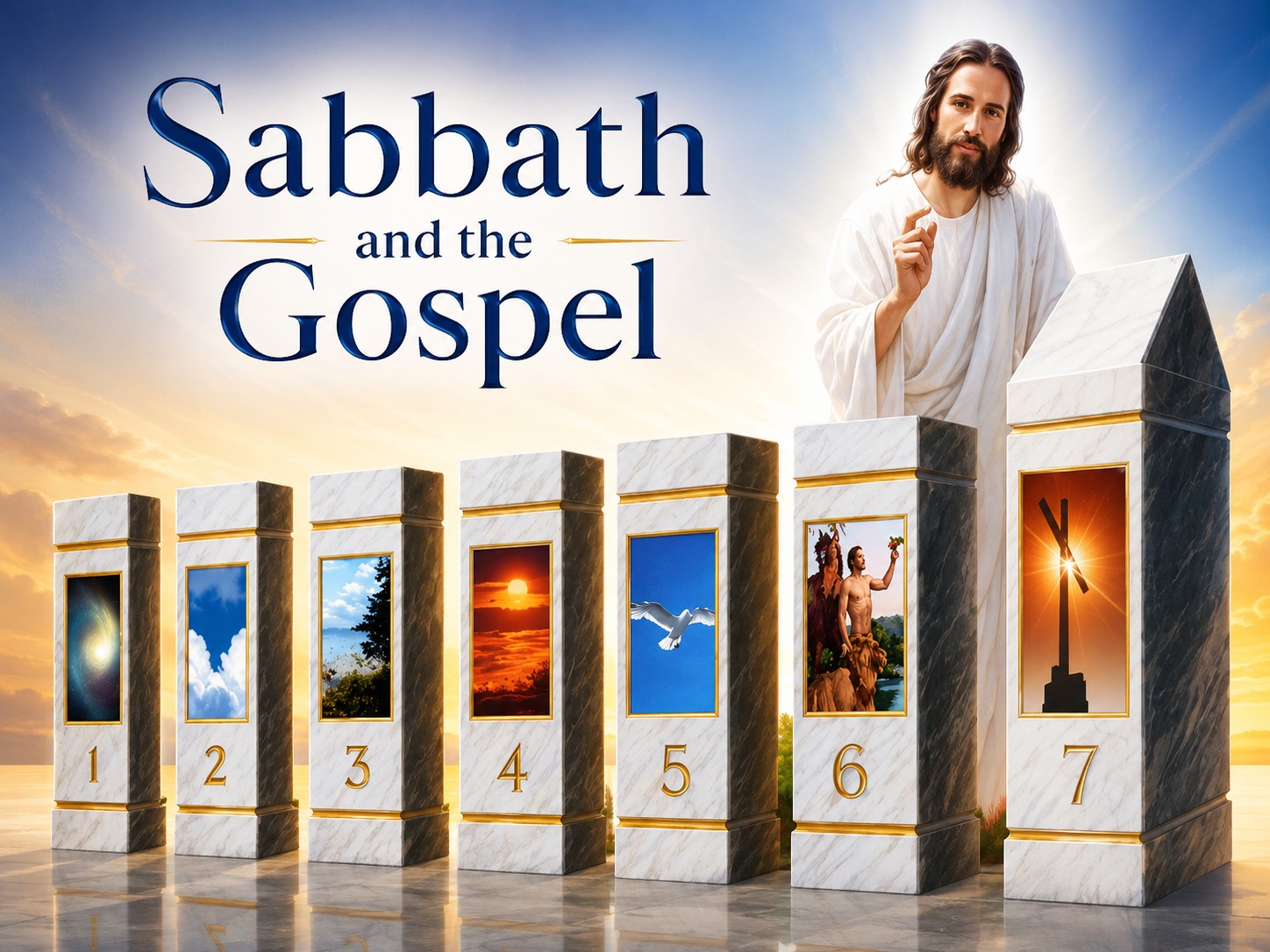
- The Sabbath is more than a day of rest and worship. The Sabbath has a distinct connection with the gospel.
- God set aside the Sabbath as a day of rest to signify His perfect and finished work of creation (see Genesis 1:31; 2:1-3; Hebrews 4:4). God rested only when His work “was perfect and complete. Adam and Eve, on the other hand, spent their first whole day of life resting on God’s Sabbath. Only then did they take up their work.
- Like creation, salvation begins by resting in the perfect, finished work of Christ—not by doing something.
- Just as Christ finished creation at the end of the sixth day and rested on the seventh, so He also finished redemption on the cross on the sixth day and rested in the tomb on the seventh day.
- When sin came into the world, it destroyed God’s original significance for Sabbath rest. Humanity rebelled against God and demanded to depend only on self. Mankind introduced his own rest day—Sunday. But his substitute could not point to a finished, perfect work—either of creation or redemption.
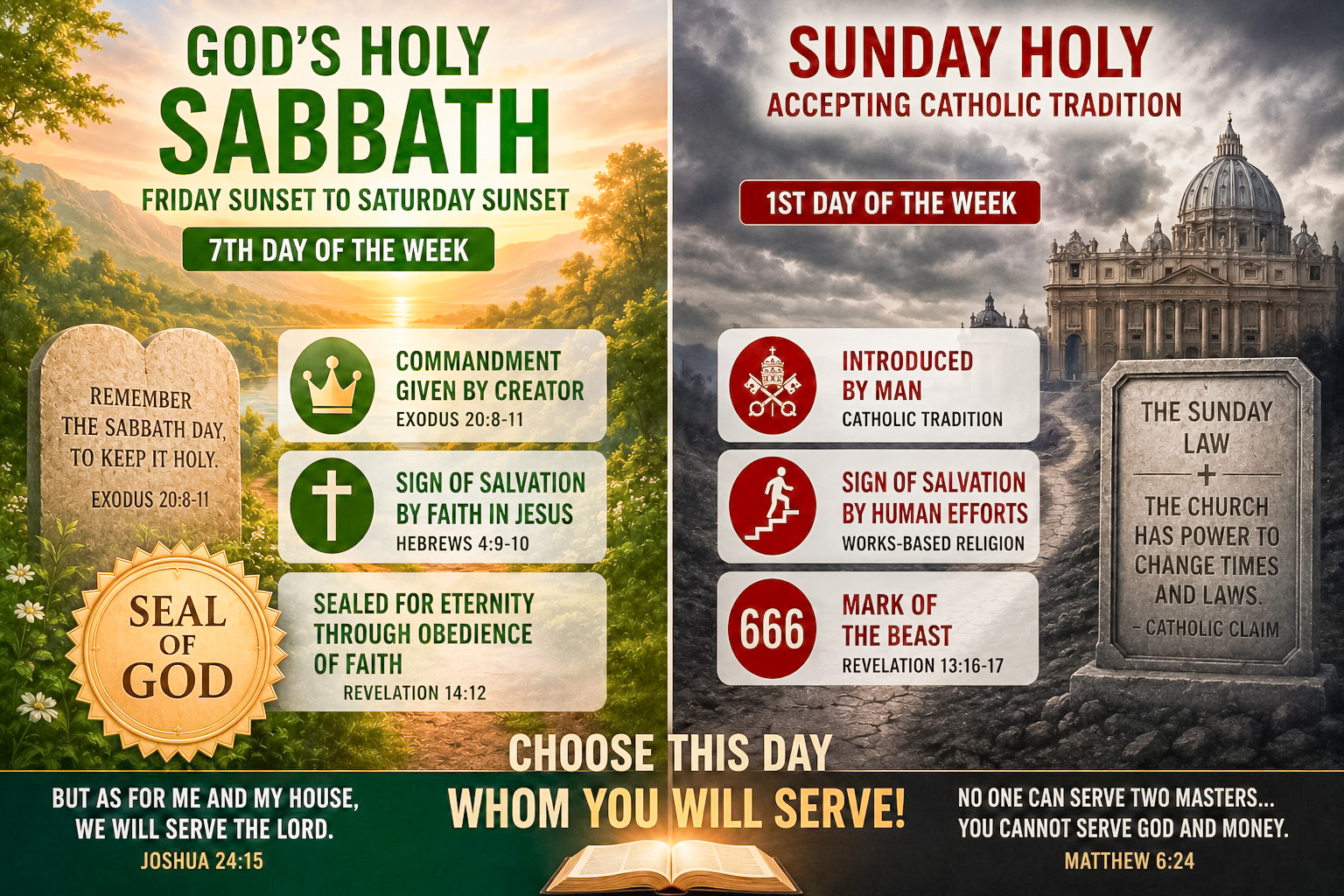
- The final showdown in the great controversy will take place between salvation by faith (symbolized by God’s Sabbath) and salvation by works (symbolized by man’s Sunday).
- All who receive the gospel by faith once again enter into God’s saving rest, of which the Sabbath is a sign (see Hebrews 4:2,3; Exodus 31:13; Ezekiel 20:12; Isaiah 58:13,14).
- Anyone who is keeping the Sabbath to be saved is perverting the very nature of Sabbath rest. If we make Sabbath keeping a requirement for being saved, we are not entering into rest. We are not pointing to a finished, perfect work. We are making the Sabbath into a means of salvation by works—a burden.
- In the final conflict, the issue will not be between two groups of Christians, or even between two rest days, but between two opposing methods of salvation. The conflict will be between the seventh-day Sabbath, signifying salvation by faith alone, and Sunday, signifying salvation by human effort.
- When the two opposing methods of salvation come clearly into focus, the true importance of the Sabbath will also be clearly seen. At that time, Sabbath keeping will become a test of faith.
READ MORE ABOUT SABBATH AND THE GOSPEL
SABBATH RESTORED IN NEW COVENANT
The majority of evangelical Christians say today that we should keep the 10 commandments except the fourth one. They base their views on the two key arguments. The first key argument the evangelicals use against the fourth commandment is that, unlike all other commandments the Sabbath has not been restored in the New Testament, therefore, it is not part of the New Covenant.
There are NT verses where the fourth commandment is quoted and therefore restored in the new covenant:
Revelation 14:7 “And give Him glory who made heaven, and earth and all that is in them is”. Here the fourth commandment is restored directly in the context of the everlasting gospel, which happens to be the New Covenant.
Acts 14:15 “Men, why are you doing these things? We also are men with the same nature as you, and preach to you that you should turn from these useless things to the living God, who made the heaven, the earth, the sea, and all things that are in them“.
The above BT texts contain the quotation from the fourth commandment:
Exodus 20:11 “For in six days the Lord made heaven and earth, the sea and all that is in them and rested the seventh day”.
Therefore, according to the argument used by evangelicals, the fourth commandment has been restored in the New Covenant!
Before the second coming of Christ, breaking the Sabbath will be regarded by God as an outward expression of rejecting His gift of salvation and eternal life by faith in Jesus.
The first key argument the evangelicals use against the fourth commandment is that, unlike all other commandments the Sabbath has not been restored in the New Testament, therefore, it is not part of the New Covenant.
Pastor Jack Sequeira in one of his articles wrote about discussing this issue with a minister from the Church of Christ who used this very argument. So pastor Sequeira asked him to show in the Bible where all nine commandments are restored in the new covenant beginning with the first one. The minister opened the book of Acts, chapter fourteen, which says that when Paul and Barnabas had performed a miracle in Lystra the people wanted to worship them as Gods. Therefore, Paul and Barnabas immediately said in verse fifteen: “Men, why are you doing these things? We also are men with the same nature as you, and preach to you that you should turn from these useless things to the living God, who made the heaven, the earth, the sea, and all things that are in them” (Acts 14, 15).
As soon as he finished reading pastor Sequeira said: “Well, it is very interesting, but what you have just read is the very quotation from the fourth commandment and not from the first!” When the evangelical minister heard that he was horrified. Then, pastor Sequeira turned to Exodus 20:11 and read the following words: “For in six days the Lord made heaven and earth, the sea and all that is in them and rested the seventh day”. After reading he asked, which commandment was quoted by Paul and Barnabas in the New Testament? “The fourth” was the answer. Therefore, said pastor Sequeira, according to your own argument, the fourth commandment has been restored in the New Covenant.
There are more NT verses where the fourth commandment is quoted and therefore restored in the new covenant. One such text is found in Revelation chapter fourteen: “And give Him glory who made heaven, and earth and all that in them is”. Here the fourth commandment is restored directly in the context of the everlasting gospel, which happens to be the New Covenant.
By the way, it is possible to prove that the Sabbath is the memorial of the gospel and seal of righteousness by faith alone while Sunday keeping represents salvation by works. Before the second coming of Christ, breaking the Sabbath will be regarded by God as an outward expression of rejecting His gift of salvation and eternal life by faith in Jesus.
THE SEVENTH DAY PENTECOSTAL CHURCH
Some time ago I could listen to pastor Jack Sequeira in the Central London Church where he said that one day certain Pentecostal pastor asked him, “How it is possible brother that you preach the gospel truth so wonderfully and at the same time you keep the Sabbath?” To this question, Pastor Sequeira replied, “Do you want me to answer your question privately or in front of all your congregation?” And he was asked to present a series of Bible studies on the Sabbath in front of 800 members of the biggest Pentecostal church in Addis Ababa, proving that the Sabbath is God’s seal of righteousness by faith and memorial of the gospel. As a result of that the whole Pentecostal congregation (800 members) started to keep the fourth commandment and they also changed their name to the Seventh Day Pentecostal Church!
Read more about Sabbath and the Gospel
SABBATH DOESN’T BELONG TO NATURAL LAW?
The second key argument evangelical Christians use against Sabbath is based on the idea mentioned by Martin Luther. Luther divided commandments into two groups: natural and ceremonial. Luther said that the commandments such as Thou shalt not steal, Thou shalt not kill, Thou shalt not commit adultery, etc., are natural because by nature and without knowing the law we know we shouldn’t break them. Therefore, the Sabbath belongs to the ceremonial law because we don’t know by nature we should keep it.
Romans 7:7 “What shall we say then? Is the law sin? God forbid. I had not known sin but by the law, for I had not known lust except the law said, Thou shalt not covet.”
Paul is clearly stating here that without reading about it in the Law we don’t know by nature that covetousness is a sin. So, is the Sabbath commandment the only one we don’t know by nature that we should keep it? No, because the last commandment that forbids us to covet is not natural too!
For instance, if I see a new beautiful car of my neighbour and I covet it, can a policeman arrest me? No, because I haven’t committed the act. However, in God’s eyes and according to God’s law I have sinned. It is a law that was given by God which hits at the heart of sin. Therefore, if the last commandment is not natural then Luther and evangelical Christians should remove it as well, but they don’t. They say only the Sabbath commandment should be removed because it is not natural!
SABBATH-KEEPING BEES AND OTHER ANIMALS
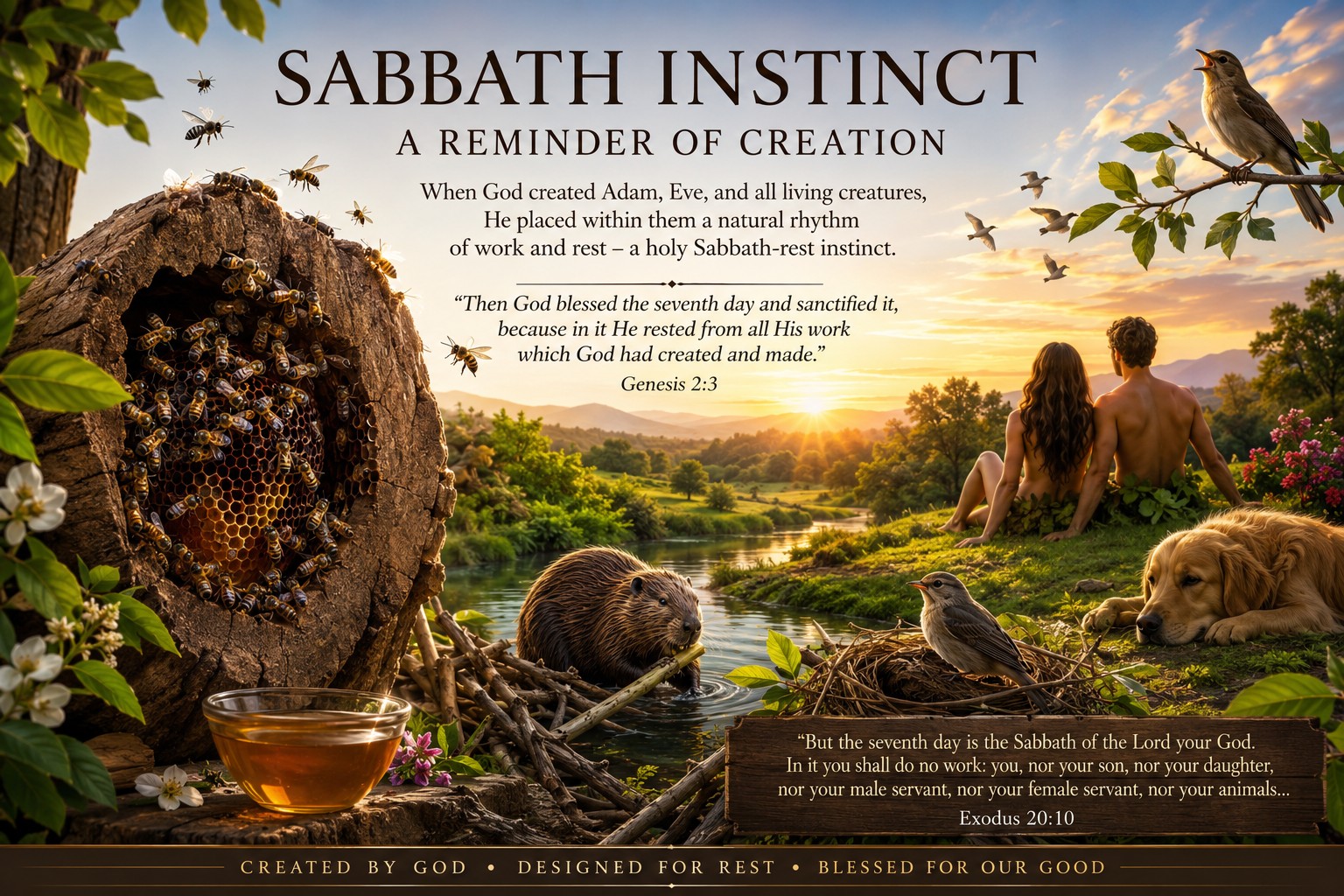
Some time ago back in Poland, I had the privilege to translate a series of health lectures by American physician, Dr San Lee who shared with us a very interesting idea about Sabbath-keeping bees. Later on, he repeated the same idea also on 3abn TV. On the basis of his discoveries, he postulated that it is very possible that when in the beginning God created perfect Adam and Eve as well as all the animals He also gave them a Sabbath instinct. It means that not only Adam and Eve but also all animals instinctively or naturally rested on each seventh-day Sabbath. Therefore, also Sabbath was in the beginning the natural commandment.

Unfortunately, when sin appeared on Earth it introduced death and pain with associated fears and chronic stress, thus leading to a gradual eradication of that natural Sabbath instinct. Nevertheless, Dr Lee claimed that according to his observations, in some animals especially those that managed to exist in a more peaceful mostly free from dangers and pollution environment this Sabbath instinct was somehow preserved. He said that some time ago (probably in the 1980s) he went to Brazil in order to present a series of health lectures to a group of Adventist pastors. And during one of them, when he spoke about the Sabbath instinct idea, one of those Brazilian pastors told him that he knew a certain beekeeper whose bees never worked on Sabbath! When Dr. Lee heard that shocking news he got very excited because although he had suspected that there could be some species still existing that managed to preserve that instinct but he never found any proof for that. So, he was extremely happy and grateful to God that his assumption was correct.
Later on, when Dr Lee came back to the place where he was teaching the same group of Brazilian pastors, one of them remembered that when he was a child often after attending the Church on Sabbath his father took him for a walk and showed him Sabbath-keeping birds. Every day the birds were very busy building and rebuilding their nests, but on Sabbath, they never worked! Below I have also included a link to a very interesting video about beavers that seem to keep the fourth commandment by resting on every Sabbath.
Obviously, as sincere Bible students and believers, we don’t need any extra-biblical evidence to support the validity of the Sabbath commandment because the authority of the Word of God is more than enough for us. However, it is so exciting to know about the existence of some animal species that seem to be a living proof that Sabbath rest instinct really exists and therefore it had to be encoded in the beginning in all living creatures including us.
However, the fact that some animals still seem to rest on Sabbath shouldn’t surprise us so much because as a matter of fact, the fourth Biblical commandment embraces not only men but also animals: “Remember the Sabbath day, to keep it holy. Six days you shall labour and do all your work, but the seventh day is the Sabbath of the Lord your God. In it you shall do no work: you, nor your son, nor your daughter, nor your male servant, nor your female servant, nor your animals, nor your stranger who is within your gates. For in six days the Lord made the heavens and the earth, the sea, and all that is in them, and rested on the seventh day. Therefore the Lord blessed the Sabbath day and made it holy” (Exodus 20:8-11).
It is so thrilling to find some evidence that something like Sabbath instinct really seems to exist. It means that in the beginning, not only animals but also humans were created with it. And, although it was lost as a result of sin, we may pray to the loving God to restore it in us, because this weekly rest is an essential element of life and a special time of regeneration and healing for the spirit, soul (mind) and the body. For this reason, the Son of God performed more healing miracles on the Sabbath day than on any other day of the week. It was so because Sabbath also points to the final restoration and perfect redemption of sinful humankind which we can experience only through faith in Christ. Keeping the Sabbath doesn’t contribute to this gift of eternal life and salvation but by keeping this day holy we give evidence that we have already accepted this supreme gift of eternal life through believing in God’s Son and that we rest in Him.
By keeping the Sabbath holy and resting on this special day, we manifest that we have accepted this finished and perfect salvation in Christ and that we, at last, ceased from our own works (from trying to gain salvation and eternal life by our own good works). And, this is exactly what Apostle Paul meant in Hebrews 4:9-10: “There remains, then, a Sabbath rest for the people of God; for anyone who enters God’s rest also ceased from his own works”. On the other hand, if we know all this and keep on refusing to rest on every Sabbath we may give evidence that we haven’t yet accepted God’s supreme gift of eternal rest and salvation in His Son (read more on Sabbath and the Gospel). For Paul, the Sabbath of the fourth commandment was a memorial of salvation by faith alone. And, keeping it was an outward sign showing that salvation by faith in Jesus Christ alone has been already accepted.
What makes the testimony about Sabbath-keeping bees, birds, beavers, and other animals even more fascinating is the fact that modern science has discovered the existence of biological rhythms that follow an approximately seven-day cycle. These rhythms are called “circaseptan rhythms.” They have been observed in living organisms at different levels, including humans, animals, plants, insects, fish, birds, and mammals. This is very interesting because the seven-day week does not come from the sun, moon, or stars in the same way as the day, month, or year. According to Scripture, it comes directly from Creation itself, when God worked six days and rested on the seventh day.
“Then God blessed the seventh day and sanctified it, because in it He rested from all His work which God had created and made” (Genesis 2:3).
From a Biblical point of view, this is extremely meaningful. It suggests that the seven-day rhythm is not merely a human tradition or religious invention, but may be deeply connected with the way life was originally designed by the Creator. When God created Adam, Eve, and all living creatures in a perfect world, He may have placed within them a natural rhythm of work and rest — a holy Sabbath-rest instinct, harmonising all creation with His own example.
- SABBATH KEEPING BEES AND SABBATH INSTINCT
- BEAVERS THAT REST ON SATURDAY (VIDEO)
- THE ADVENTIST DOG
- A SATURDAY RESTING OX STORY (VIDEO)
- DO BIRDS TAKE A SABBATH REST?
WEAKNESS OF EVANGELICAL SUNDAY ARGUMENT
One of the most influential Protestant responses to Samuele Bacchiocchi’s landmark book From Sabbath to Sunday was the scholarly volume From Sabbath to Lord’s Day, edited by evangelical theologian D. A. Carson. The purpose of this book was to defend Sunday worship and challenge Bacchiocchi’s conclusion that the seventh-day Sabbath continued to be observed by the apostolic church.
Surprisingly, however, a careful reading of this volume reveals several important facts that actually strengthen the biblical case for the seventh-day Sabbath. Perhaps the most significant fact is that those evangelical theologians agree the New Testament never explicitly teaches that the Sabbath was transferred from the seventh day to the first day of the week. While the contributors attempt to justify Sunday worship on the basis of Christ’s resurrection and the practice of some early Christians, they are unable to point to a single biblical passage where God changed the fourth commandment, where Christ declared Sunday holy, or where the apostles commanded Christians to keep Sunday instead of the Sabbath.
The New Testament never calls Sunday the Sabbath. It never states that the sanctity of the seventh day was transferred to the first day. It never records Christ announcing such a change, nor do the apostles ever issue a command requiring believers to keep Sunday holy. This creates a serious problem. If God intended to change one of the Ten Commandments, surely such a change would have been clearly revealed in Scripture. Yet no such command exists.
Even more surprising is the fact that those evangelical scholars recognize the profound Gospel significance of the Sabbath. They acknowledge that the Sabbath points to God’s rest, God’s completed work, and the believer’s rest in Christ. They correctly understand that the Sabbath teaches salvation by grace rather than salvation by works.
Here lies the great contradiction. If the Sabbath truly symbolizes salvation by grace through faith in Christ’s finished work, why would God abolish the very sign that teaches salvation by grace through faith in Christ’s finished work? This question strikes at the heart of the entire debate.
Popular Adventist preacher and author, Jack Sequeira repeatedly emphasized that the Sabbath is not merely a day. It is the Gospel in time. It is God’s weekly sermon on righteousness by faith.
The Sabbath was established in Eden before sin entered the world, before there was a Jew or a Gentile, before Abraham, before Moses, before circumcision, and before the ceremonial law. Therefore it cannot be merely a Jewish institution.
The ceremonial law, which includes the ceremonial sabbaths and Jewish holidays, should not be confused with the moral law and the Sabbath day of the fourth commandment (Hebrews 10:1,9,10; Colossians 2:14,16; Galatians 4:10-11).
Jesus Himself declared: “The Sabbath was made for man, and not man for the Sabbath.” Mark 2:27. Christ did not say that the Sabbath was made for the Jews. He said it was made for mankind. The Sabbath therefore belongs to the entire human race because it was given at Creation.
The creation account reveals a beautiful Gospel truth. God worked for six days and completed His creation. Then God rested on the seventh day. Adam was created on the sixth day. Therefore his first full day of life was not a workday but a Sabbath day. Before Adam could perform a single act of obedience, before he could accomplish anything for God, before he could earn anything, he entered God’s completed work through rest.
This is precisely how salvation operates. God acts first. God accomplishes the work. Man enters God’s finished work by faith. This is why the Sabbath is unique among the Ten Commandments. At creation, it points to God’s gift of eternal life accepted by Adam and Eve (Humankind) on Sabbath. At redemption (recreation of fallen humanity) it points to God’s gift of the finished work of salvation in Christ on the cross accepted by humanity in Christ also on Sabbath.
The other commandments tell us what we should or should not do. The Sabbath commandment tells us how salvation works. It teaches us to cease from our own works and trust entirely in God’s finished work. The Apostle Paul expressed this same truth when he wrote: “For by grace are ye saved through faith; and that not of yourselves: it is the gift of God: not of works.” Ephesians 2:8-9. The Sabbath proclaims this truth every week. God finished creation. God rested. Adam entered that rest.
The same pattern appears in redemption. On the sixth day of the week, shortly before His death, Christ cried out: “It is finished.” John 19:30. The work of redemption had been completed. Then Christ rested in the tomb during the sacred Sabbath hours.
The parallel is remarkable. At Creation, God completed His work and rested on the seventh day. At Redemption, Christ completed His work and rested on the seventh day.
The seventh-day Sabbath, therefore, stands as a memorial of both finished creation and finished redemption. This is why we should present the Sabbath as God’s sign of righteousness by faith. The believer does not work in order to be saved. The believer rests because salvation has already been accomplished in Christ.
The divine order never changes: God works first. Man rests afterwards. Creation follows this pattern. Redemption follows this pattern. The Sabbath preserves this pattern perfectly.
Rather than abolishing the Sabbath, Hebrews explains its deepest meaning. The apostle points back repeatedly to God’s seventh-day rest at Creation and then applies that rest to the believer’s experience in Christ. The chapter concludes:
Hebrews 4:9-10 “There remains therefore a rest (Gr. “sabbatismos” = keeping of the Sabbath) for the people of God. For he who has entered His rest has himself also ceased from his works as God did from His.”
Here Paul tells the legalistic Jews and modern legalists that they must accept the gift of eternal rest (symbolized by Sabbath rest) by ceasing from trying to obtain that eternal rest by their own works (legalism). Today, if we keep the Sabbath in order to gain salvation, we lie and commit a horrible sin because by keeping the Sabbath we should manifest that we have already accepted the gift of eternal rest by faith alone and that we ceased from trying to gain that rest (salvation) by good works.
The inspired writer deliberately uses the word sabbatismos (“Sabbath rest” or “Sabbath observance”), linking the believer’s rest in Christ with God’s seventh-day rest mentioned earlier in the chapter. Hebrews does not abolish the Sabbath. Rather, it reveals the Gospel meaning already contained within the Sabbath from the very beginning. The Gospel rest and the Sabbath rest are therefore not enemies. They belong together. The Sabbath becomes the weekly reminder that we rest entirely in Christ’s finished work.
Historically, many scholars acknowledge that the concept of Sunday as the Christian Sabbath cannot be clearly demonstrated from the New Testament itself and became more fully developed in later church history.
Ironically, although many evangelical scholars explain the Gospel meaning of the Sabbath remarkably well, they deny the continuing validity of the Sabbath itself. They preserve the meaning while discarding the sign. But God never separates the two. The seventh-day Sabbath remains God’s memorial of Creation, God’s memorial of Redemption, and God’s memorial of righteousness by faith. It is the only day blessed by God, sanctified by God, written by God in stone, observed by Christ, honoured by the apostles, and rooted in Eden itself.
The greatest weakness of the Sunday position is therefore not historical but theological. Many sincere Christians correctly recognize that the Sabbath points to God’s rest, God’s completed work, and salvation by grace through faith. Yet after acknowledging the meaning of the Sabbath, they deny the continuing validity of the sign itself. To them the real issue is not merely which day Christians attend church. The real issue is the Gospel itself.
The seventh-day Sabbath stands as God’s memorial of finished Creation, finished Redemption, and righteousness by faith. It reminds us every week that salvation is not achieved by human effort but received through faith in Christ’s completed work. Remove the Sabbath and the clearest weekly symbol of the Gospel disappears. Preserve the Sabbath and the Gospel continues to be preached in time every seventh day. Every Sabbath God invites humanity to cease from its own works and rest completely in the finished work of the Creator, Redeemer, and Sanctifier. For this reason the seventh-day Sabbath remains one of the most beautiful and powerful symbols of the everlasting Gospel ever given to mankind.
IS SUNDAY THE MEMORIAL OF CHRIST’S RESURRECTION?
The New Testament repeatedly states that Christ rose on the first day of the week, yet nowhere does it command Christians to keep that day holy. Not a single verse declares that God transferred the holiness of the seventh day to the first day, calls Sunday the Christian Sabbath, or instructs believers to observe it as a weekly memorial of the resurrection.
The strongest Protestant argument is therefore not that Scripture explicitly changed the Sabbath to Sunday, but that the resurrection gave special significance to the first day of the week. Yet significance does not equal sanctification. Many events recorded in Scripture are of immense importance, but God did not establish a weekly holy day to commemorate them. The birth of Christ, the crucifixion, the ascension, and the outpouring of the Holy Spirit are all central events in salvation history, yet none of them resulted in a new weekly day of worship. The question remains unchanged: Where did God ever transfer the blessing, holiness, and sanctity of the seventh day to the first? Scripture never records such a command.
Even more importantly, the New Testament already identifies God’s appointed memorial of Christ’s death, burial, and resurrection. According to Paul, that memorial is baptism, not Sunday. “Therefore we were buried with Him through baptism into death, that just as Christ was raised from the dead by the glory of the Father, even so we also should walk in newness of life” (Romans 6:4). Through baptism the believer publicly participates in Christ’s death, burial, and resurrection. If God intended Sunday to be the memorial of the resurrection, it is remarkable that the New Testament never says so, while repeatedly presenting baptism as the divinely appointed symbol of these saving events.
SABBATH KEEPERS BEFORE ADVENT MOVEMENT
One of the most common misconceptions is that the seventh-day Sabbath was rediscovered for the first time by Seventh-day Adventists in the nineteenth century. In reality, the Sabbath never completely disappeared from Christian history.
Andreas Karlstadt (1486-1541)
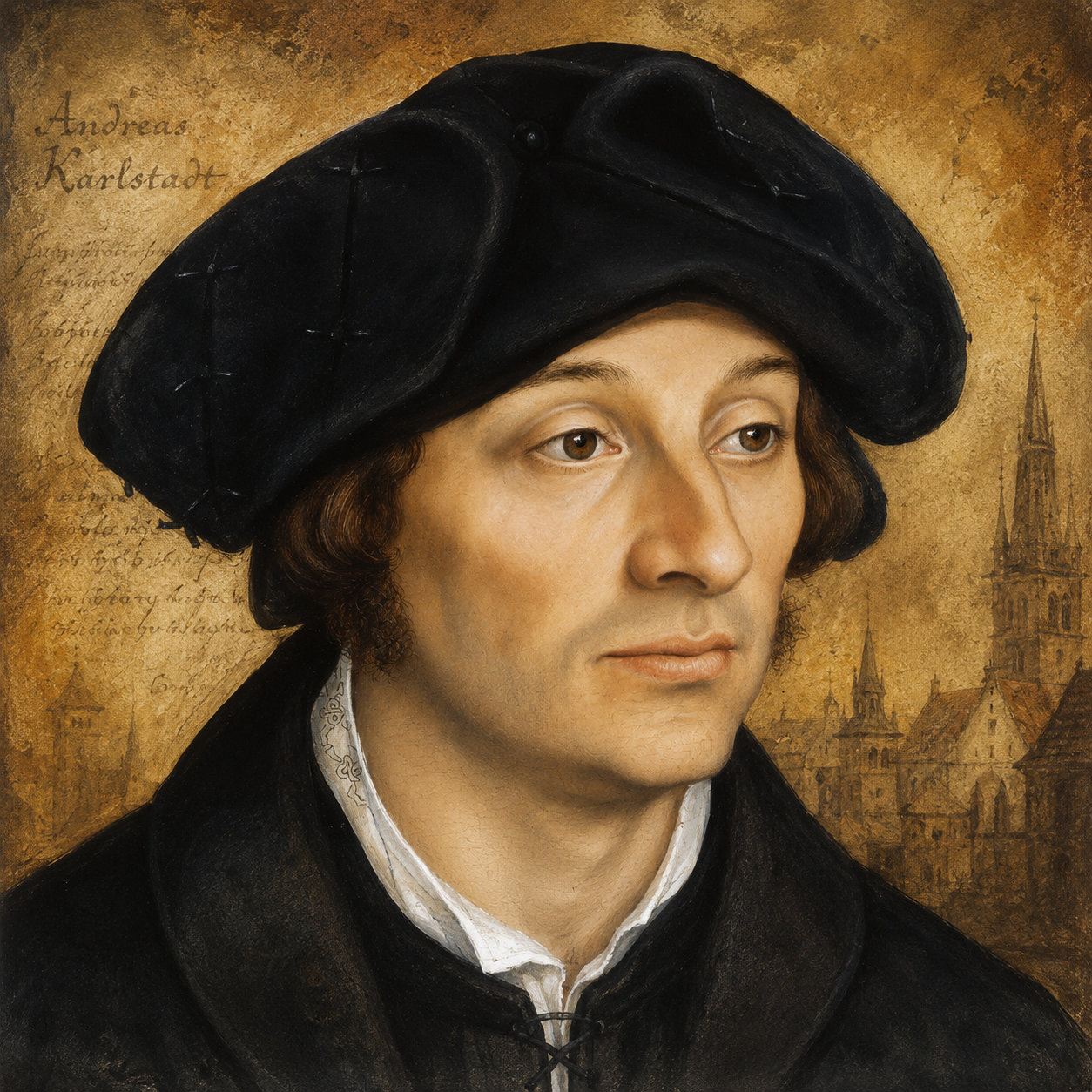
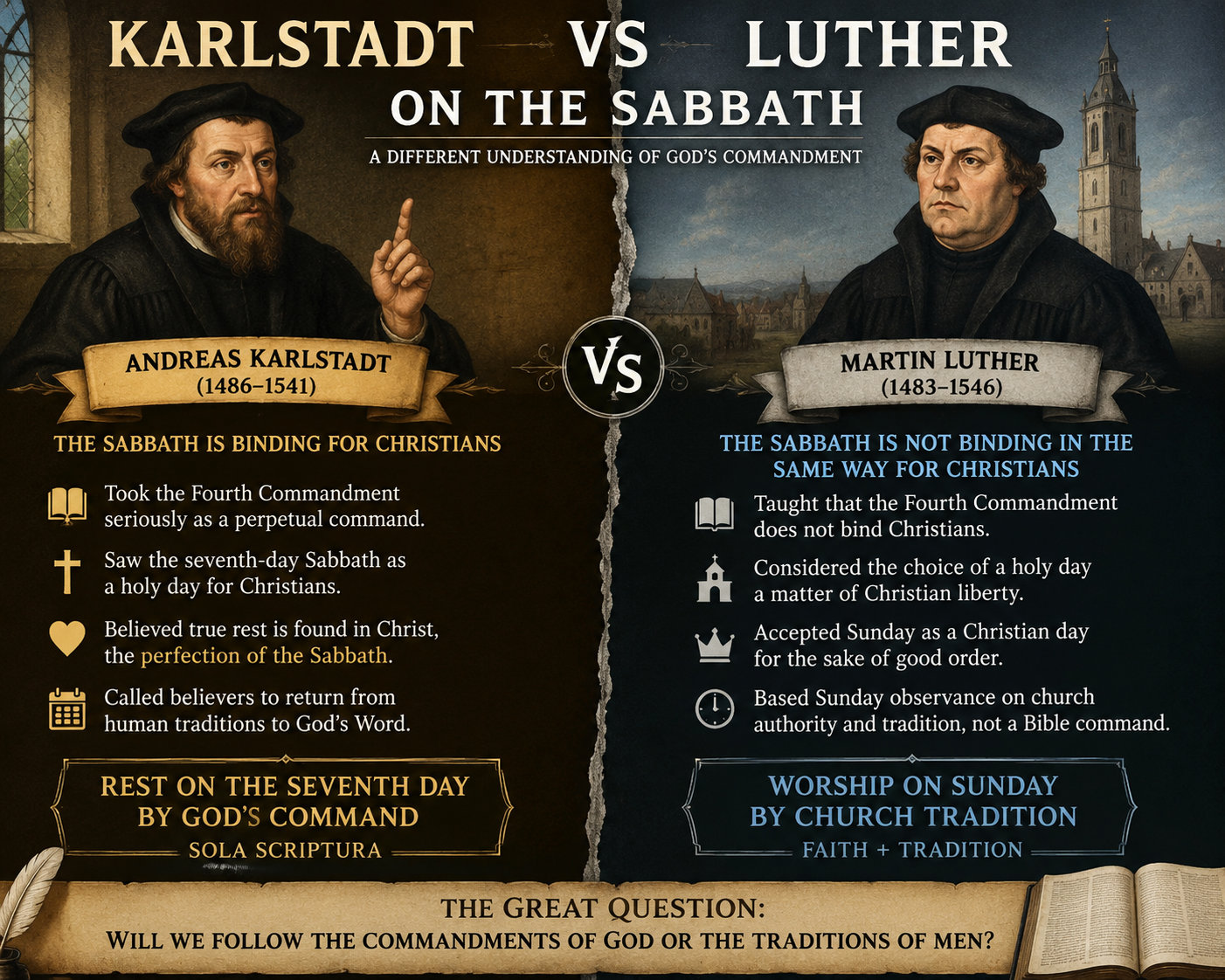
During the Protestant Reformation, Andreas Karlstadt (1486-1541), one of Martin Luther’s closest associates, defended the observance of the seventh-day Sabbath and believed Christians should follow the plain teaching of Scripture rather than church tradition. Luther, however, opposed Karlstadt’s tendency to introduce reforms rapidly and without broad acceptance. While Luther restored the great truth of justification by faith, Karlstadt increasingly questioned the biblical basis for Sunday observance and called for greater faithfulness to the fourth commandment.
In his work On the Sabbath and Commanded Holy Days (1524), he wrote, “Christ is the perfection of the Sabbath.” Unlike many Reformers, Karlstadt saw that the authority for Sunday observance could not be established from Scripture alone. His position became so influential that Luther reportedly remarked: “If Karlstadt were to write further about the Sabbath, Sunday would have to give way, and the Sabbath—that is to say Saturday—must be kept holy.”
During the Leipzig debate, Johann Eck reportedly challenged Luther using the argument that Luther refused to keep the Sababth. He argued that if Scripture alone were the authority, then Luther and his followers should keep the biblical Sabbath rather than Sunday, since Sunday observance rested upon Catholic church authority and tradition. To break Luther’s sola scriptura logic, Eck needed to find a universally accepted Christian practice that could not be proven by the Bible alone but relied entirely on the authority of Church tradition. He found the perfect example in the Sabbath.
If Luther truly wanted to live strictly by “the Bible and the Bible alone,” Eck argued, he was being completely inconsistent. To be entirely biblical, Luther would have to abandon Sunday keeping and return to the seventh-day Sabbath (Saturday). Because Luther continued to keep Sunday, Eck argued that Luther was implicitly acknowledging and relying upon the very authority of Catholic tradition that he claimed to reject.
The argument was so robust that it was later echoed during the Council of Trent (1545–1563) by figures like Gaspare de Fosso (the Archbishop of Reggio), who used it to rally the council into declaring that Tradition is an absolute necessity alongside Scripture, because the Protestant world itself still obeyed a day (Sunday) changed solely by the Church’s authority.
Karlstadt appears to have taken this challenge far more seriously than Luther did. His writings demonstrate that the Sabbath question arose naturally whenever sincere Reformers attempted to follow the principle of Sola Scriptura to its logical conclusion.
The Sabbath was also accepted by some groups within the Radical Reformation. Certain Anabaptists rejected church tradition and sought to build their faith upon Scripture alone. Among them were Sabbatarian believers such as Oswald Glait and others who defended the seventh-day Sabbath and suffered persecution for their convictions. Their existence demonstrates that the Sabbath question did not disappear after the apostolic age but continued to emerge wherever sincere believers followed Scripture above tradition.
Ellen White wrote that among those who resisted the corruptions of Rome were Waldenses who “kept the true Sabbath.”
Whenever believers returned to Scripture as their final authority, some inevitably rediscovered the Sabbath. This suggests that the Sabbath was not an invention of nineteenth-century Adventism but a biblical truth repeatedly recovered by those who chose the authority of God’s Word above the traditions of men.
The Advent Movement therefore did not create the Sabbath truth. It brought together truths that had been scattered throughout the centuries and restored the Sabbath to its central place within the everlasting Gospel and the Three Angels’ Messages of Revelation 14.
ADVENT MOVEMENT AND RESTORATION OF SABBATH
The book of Revelation reveals that shortly before the return of Christ, God would raise a special movement to proclaim the Three Angels’ Messages to the world and restore forgotten biblical truths. After the end of the 1260-year prophecy in 1798 and around the close of the 2300-year prophecy in 1844, Revelation 10 predicts the rise of a movement that would study the previously sealed prophecies of Daniel, experience a great disappointment, and then receive the command: “You must prophesy again before many peoples, nations, tongues, and kings.” Revelation 10:11.
The fulfilment of this prophecy can be seen in the Advent Movement of the nineteenth century. The Millerite believers joyfully expected Christ’s return in 1844, only to experience the bitter disappointment foretold in Revelation 10:10. Yet God did not abandon the movement. Instead, He led it to a clearer understanding of Bible prophecy, Christ’s ministry in the heavenly sanctuary, and the Three Angels’ Messages.
Significantly, the first angel’s message contains a direct quotation from the Sabbath commandment: “Worship Him who made heaven and earth, the sea and springs of water.” Revelation 14:7.
This language comes directly from Exodus 20:11 and points humanity back to the Creator and His Sabbath. Immediately after the Three Angels’ Messages, Revelation describes God’s end-time people: “Here are those who keep the commandments of God (including the 4th commandment) and the faith of Jesus.” Revelation 14:12. Notice that God’s final remnant possesses both faith and obedience. They trust completely in Christ for salvation while honouring all of God’s commandments, including the fourth commandment.
One of the most remarkable developments within the Advent Movement was the rediscovery of the biblical Sabbath. Through the influence of Seventh Day Baptists, Rachel Oakes Preston introduced the Sabbath truth to Frederick Wheeler. Soon afterwards Thomas M. Preble began publicly defending the seventh-day Sabbath. Joseph Bates carefully studied the subject and became one of its most powerful advocates. Through Bates’ influence, James and Ellen White also accepted the Sabbath truth.
At first Ellen White did not receive the Sabbath through visions but through Bible study. Later, however, God confirmed the importance of the Sabbath through the Spirit of Prophecy. In one of her earliest visions she saw the ark of God in the heavenly sanctuary and the Ten Commandments within it, with a special halo of light surrounding the fourth commandment. This confirmed that the Sabbath would play an important role in God’s last-day message to the world.
SABBATH IN THREE ANGELS MESSAGE
Revelation 14:6-10
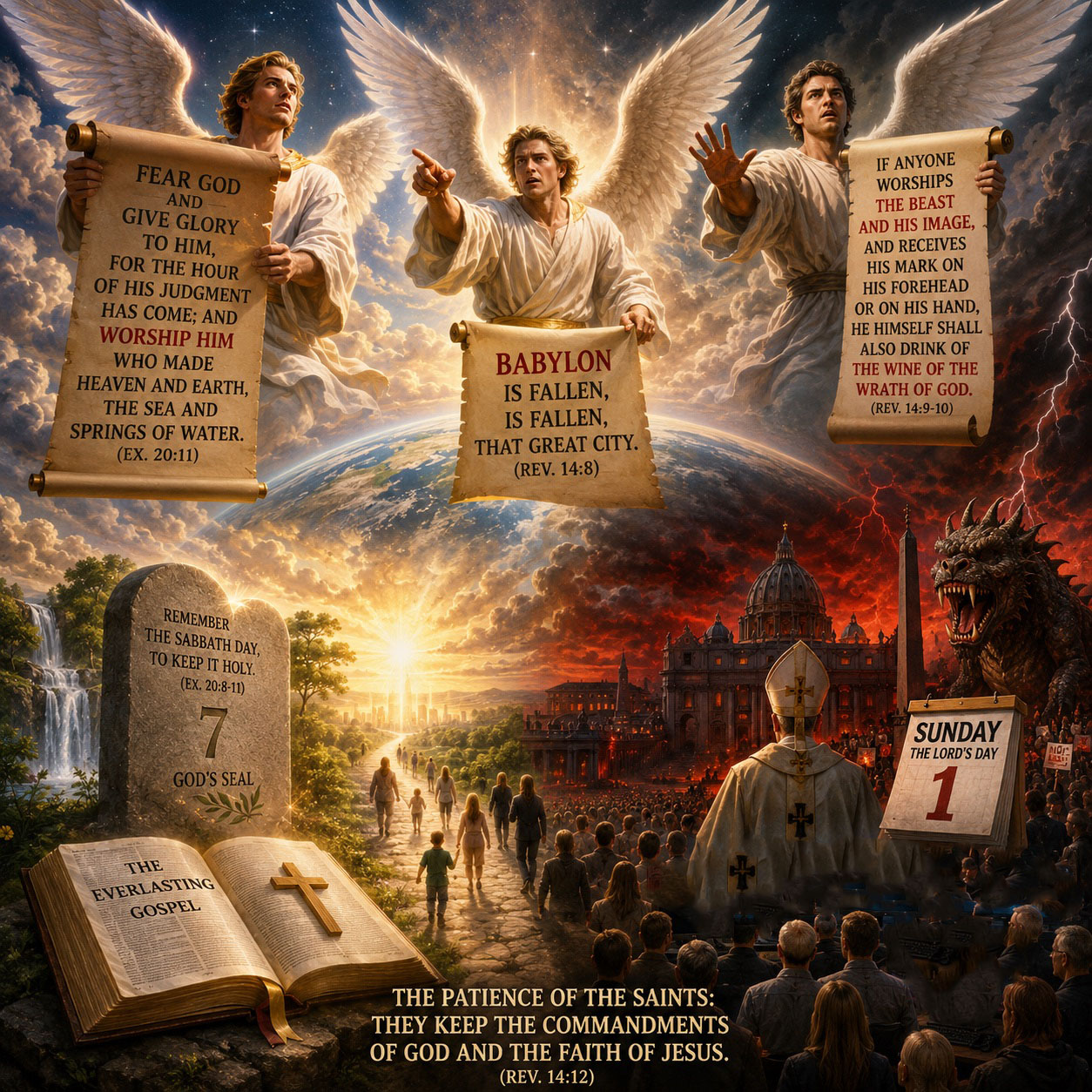
I. “Then I saw another angel flying in the midst of heaven, having the everlasting gospel to preach to those who dwell on the earth; to every nation, tribe, tongue, and people; saying with a loud voice, ‘Fear God and give glory to Him, for the hour of His judgment has come; and ‘worship Him who made heaven and earth, the sea and springs of water’ (quote from the Sabbath commandment, Ex. 20:11).
II. And another angel followed, saying, ‘Babylon is fallen, is fallen, that great city, because she has made all nations drink of the wine of the wrath of her fornication.’
III. Then a third angel followed them, saying with a loud voice, ‘If anyone worships the beast and his image, and receives his mark on his forehead or on his hand, ‘he himself shall also drink of the wine of the wrath of God, which is poured out full strength into the cup of His indignation’.”
1a. This language of the first angel’s message makes an unmistakable allusion to the Sabbath command with reference to creation (Ex. 20:8–11), thus indicating that the Sabbath has particular relevance in end-time gospel proclamation. To rest from one’s attempts to salvation through works (from legalism) is the ideal response to the gospel (see Heb. 4:1–11). The admonitions to “fear” and to “worship” in this verse are placed directly in the larger immediate context of keeping God’s commandments (see Rev. 12:17; 14:12), with obvious references to the Decalogue. Immediately after the three angels’ message, we have verse 12, where we see the characteristic of the true God’s church before the return of Christ: Revelation 14:12 “Here is the patience of the saints; here are those who keep the commandments of God and the faith of Jesus.”
1b. In the first angel’s message we also see that the everlasting gospel is the basis for the judgment, what does it mean? It means that the investigative premillennial judgement is to find out and demonstrate before the universe who among the professed believers truly accepted Christ’s righteousness by faith and who only pretends (who is a fake follower of Christ). And what is the evidence that we truly accepted Christ’s righteousness and are saved by faith? True acceptance of salvation by faith and forgiveness and amazing eternal life always leads to the new birth and walking in Spirit and always produces good deeds (2 Cor 5:10) with the right motivation (out of love and not for egocentric reasons). Those deeds don’t contribute to our salvation but prove we truly accepted the gift of salvation and are born from the Spirit.
Read more about INVESTIGATIVE JUDGEMENT
2. In the second angel’s message (Revelation 14:8), God warns people about being a part of “Babylon,” a false religious and political system that includes papal Rome (forcing Sunday worship), fallen Protestantism, atheism, evil proponents of the great reset (WHO, WEF, big pharma, google, corrupt NHS, constantly lying mainstream media, corrupt governments, etc.) that prepares the way for persecution, and everything that denies Gods truth.
3. In Revelation 14:9-10, the third angel warns against worshipping the beast and his image and against receiving the mark of its authority which is Sunday keeping while rejecting the Sabbath as God’s seal and sign of accepting salvation by faith alone. The angel declares in a loud voice, “ ‘If anyone worships the beast and his image, and receives his mark on his forehead or on his hand, he himself shall also drink of the wine of the wrath of God’.” The third angel warns that if you don’t get out of that fallen evil system called Babylon, if you accept Sunday worship instead of the true Sabbath, you will suffer and die during the last plagues.
CHANGED COMMANDMENTS
The first day of the week, commonly called Sunday, was dedicated anciently to the worship of the sun. As the Christian church fell away from the true doctrine of the apostolic days, the seventh-day Sabbath was gradually displaced by the first day. Sunday, with other pagan institutions, was eventually adopted by the Christian church. Sunday observance is not found in the Bible.
Daniel 7:25 “He (little horn = papal Rome) shall speak pompous words against the Most High, Shall persecute the saints of the Most High, And shall intend to change times and law. Then the saints shall be given into his hand For a time and times and half a time.”
The fourth Biblical Commandment was never changed neither by Christ nor the Apostles. In fact, the first Christians (both Jewish and pagan) kept Sabbath holy until the fourth century when Constantin the Great supported by the rising power of papal Rome, issued a decree enforcing the observance of Sunday – the first day of the week.
For centuries the Roman Catholic Church has maintained that it possesses authority to regulate certain aspects of Christian practice. Consequently, Catholic apologists have frequently pointed to Sunday observance as evidence of the church’s authority. The Bible nowhere commands the observance of Sunday. Therefore, if Christians keep Sunday instead of the Sabbath, they are following a tradition that developed after the apostolic age rather than an explicit command of Scripture.
This point has often been acknowledged by Catholic authors themselves. Cardinal James Gibbons wrote: “You may read the Bible from Genesis to Revelation, and you will not find a single line authorizing the sanctification of Sunday. The Scriptures enforce the religious observance of Saturday.” James Cardinal Gibbons, The Faith of Our Fathers
Likewise, Catholic literature has repeatedly argued that Sunday observance demonstrates the authority of the church because Scripture itself does not explicitly command the change. For this reason the Sabbath issue ultimately becomes a question of authority. This is why many Adventist writers have argued that Protestants face an important inconsistency. The Protestant Reformation was built upon the principle of Sola Scriptura—the Bible and the Bible alone as the supreme authority in matters of faith and practice.
Yet when it comes to the observance of Sunday, most Protestants follow a practice for which there is no explicit biblical command. The issue is authority. Will God’s people follow the commandments of God or the traditions of men? The final conflict described in Revelation centres upon worship and obedience. For this reason the Sabbath question is ultimately not about a particular day but about submission to the authority of God’s Word above all human traditions. “Here are those who keep the commandments of God and the faith of Jesus.” Revelation 14:12.
In Daniel 7:25 we read that “little horn (papal Rome) shall speak pompous words against the Most High, Shall persecute the saints of the Most High, And shall intend to change times and law. Then the saints shall be given into his hand For a time and times and half a time.” This prophecy was fulfilled many centuries later when papal Rome changed “times” and the “law” (God’s 10 commandments) by removing the second commandment and replacing the Sabbath commandment with Sunday worship (false sabbath). Millions of Christians were persecuted and killed through the papal inquisitions. READ MORE
“Papal Rome has attempted to change the law of God. The second commandment, forbidding image worship, has been removed from the law, and the fourth commandment was changed to the observance of Sunday – the first instead of the seventh day Sabbath. This was foretold by the prophet: ‘He shall persecute the saints of the Most High, and shall intend to change times and law’ (Dan 7:25). Here the papal power openly sets itself above God.” — The Great Controversy, p. 446
“Roman Catholics acknowledge that the change of the Sabbath was made by their church and declare that Protestants by observing the Sunday are recognizing her power. In the Catholic Catechism, this statement is made: ‘The church has substituted Sunday for Saturday; so now we sanctify the first, not the seventh day’.” — The Great Controversy, p. 448
“The claim that Christ changed the Sabbath Commandment (from Sabbath to Sunday) is disproved by His own words: ‘Do not think that I have come to abolish the Law or the Prophets; I have not come to abolish but to fulfill. For truly, I say to you, until heaven and earth pass away, not an iota, not a dot, will pass from the Law until all is accomplished’ (Mat 5:17-18).” — The Lord’s Day Controversy, chapter 8
“Had the Sabbath been changed, then Christ would have given directions concerning its observance; but He never spoke of it as having been changed.” — The Great Controversy, p. 447
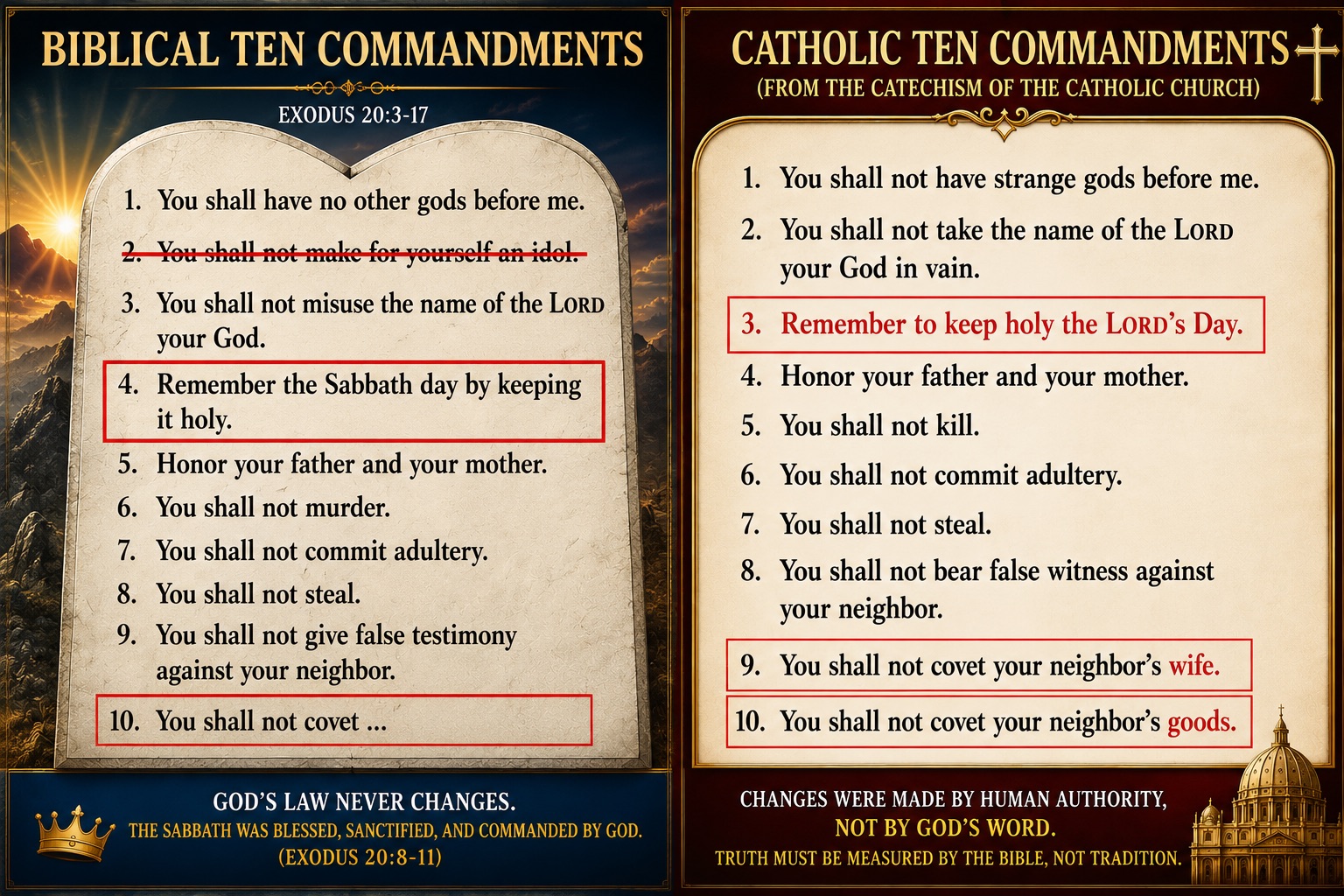
“Remember the Sabbath day to keep it holy. Six days you are to do all your work, but the seventh day is the Sabbath of the Lord your God…” (Exodus 20:8-11).
According to the Encyclopaedia Britannica, “Sabbath is the day of rest observed from sunset on Friday to sunset on Saturday”.
The fourth Biblical Commandment was changed neither by Christ nor by the apostles. In fact, the first Christians (both Jewish and pagan) kept Sabbath holy until the fourth century when Constantin the Great supported by the rising power of papal Rome, issued a decree enforcing the observance of Sunday – the first day of the week.
“Papal Rome has attempted to change the law of God. The second commandment, forbidding image worship, has been removed from the law, and the fourth commandment was changed to the observance of Sunday – the first instead of the seventh day Sabbath. This was foretold by the prophet: ‘He shall persecute the saints of the Most High, and shall intend to change times and law’ (Dan 7:25). Here the papal power openly sets itself above God.”
“Roman Catholics acknowledge that the change of the Sabbath was made by their church and declare that Protestants by observing the Sunday are recognizing her power. In the Catholic Catechism, this statement is made: ‘The church has substituted Sunday for Saturday; so now we sanctify the first, not the seventh day’.”
“The claim that Christ changed the Sabbath Commandment (from Sabbath to Sunday) is disproved by His own words: ‘Do not think that I have come to abolish the Law or the Prophets; I have not come to abolish but to fulfill. For truly, I say to you, until heaven and earth pass away, not an iota, not a dot, will pass from the Law until all is accomplished’ (Mat 5:17-18).”
SATAN’S COUNTERFEIT TO GOD’S SABBATH
Throughout Scripture and church history, Satan has repeatedly attempted to counterfeit the truths established by God.
He has sought to replace salvation by grace through faith with salvation by human effort, merit, penance, rituals, and works. Instead of directing sinners to trust entirely in Christ’s finished work, he encourages them to place confidence in their own performance.
He has obscured Christ’s heavenly ministry by promoting earthly priesthoods, mediatorial systems, and human intercessors that draw attention away from the Saviour and His perfect priesthood in the heavenly sanctuary.
By persuading humanity that the soul cannot truly die, Satan undermined the glorious truth that Jesus bore the curse of sin and tasted the second death on behalf of the fallen human race.
With the false doctrine of the immaculate conception of Mary Satan attacked the glorious truth that Christ came in the likeness of sinful flesh (Rom 8:3) fully identifying Himself with those He came to save.
He has corrupted the biblical understanding of God’s character by replacing the self-sacrificing agape love revealed at Calvary with distorted eros and caritas concepts of love centred upon self rather than self-sucrificing.
In the book of Revelation, Satan even presents a counterfeit of the biblical concept of Triune God through the false trinity (dragon, beast, and false prophet)—a counterfeit trinity designed to receive the worship, loyalty, and allegiance that belong to God alone.
The Sabbath truth is no exception as the enemy was very succesful to replace the true biblical Sabbath rest with false sabbath in the form of Sunday worship. In fact, few biblical doctrines have been attacked more persistently than the Sabbath. This should not surprise us. The Sabbath points directly to God’s authority as Creator, to Christ’s finished work as Redeemer, to His ministry as our High Priest, and to salvation by grace through faith.
Every seventh day the Sabbath reminds humanity that God created the world, that Christ redeemed the world at an infinite cost, and that sinners are saved not by their own works but by resting in the completed work of their Saviour.
For this very reason Satan hates the Sabbath and deceived Christianity by introducein the counterfit day of rest, the Sunday. He did it because Sabbath magnifies God’s love revealed in Creation and Redemption and because true Sabbath proclaims that salvation is accomplished entirely by God out of love and received entirely by faith.
SUNDAY — THE ANCIENT DAY OF THE SUN
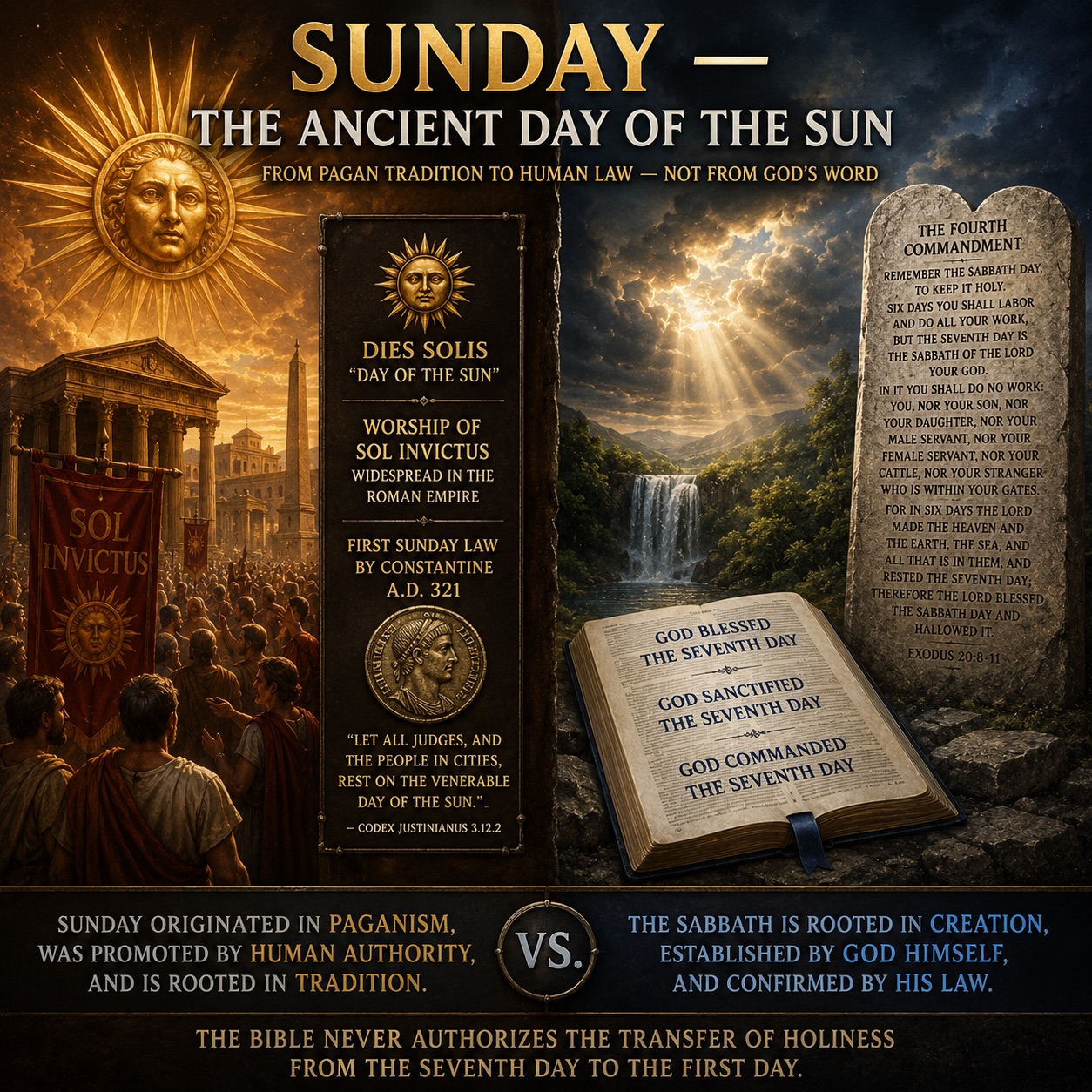
One of the most striking facts in the Sabbath controversy is that the day which eventually replaced the biblical Sabbath was already known throughout the Roman Empire as dies Solis—the “Day of the Sun.” The English word “Sun-day” still preserves this ancient pagan title.
This fact alone does not prove that Christians worshipped the sun. However, it becomes highly significant when viewed together with the historical evidence.
First, the rise of Sunday observance occurred during the very period when the worship of Sol Invictus (“The Unconquered Sun”) was becoming one of the most popular religions in the Roman Empire. While the biblical Sabbath was increasingly associated with the Jews, the Day of the Sun enjoyed widespread acceptance throughout pagan society. Thus the day that eventually displaced the Sabbath already possessed powerful religious and cultural prestige.
Second, the first Sunday law in history was issued by Emperor Constantine in AD 321. Significantly, Constantine did not refer to Sunday as the Sabbath, nor did he appeal to the fourth commandment. Instead, he commanded rest on “the venerable Day of the Sun.” The first civil legislation supporting Sunday observance therefore used the traditional pagan title rather than biblical language.
Thus, the rise of Sunday observance cannot be separated from the influence of pagan solar worship and the gradual departure of Christianity from the biblical Sabbath established at Creation.
Third, and most importantly, the Bible never authorizes the transfer of holiness from the seventh day to the first day. God blessed the seventh day. God sanctified the seventh day. God commanded the observance of the seventh day. Yet nowhere does Scripture declare Sunday to be holy.
INCOMING SUNDAY LAW
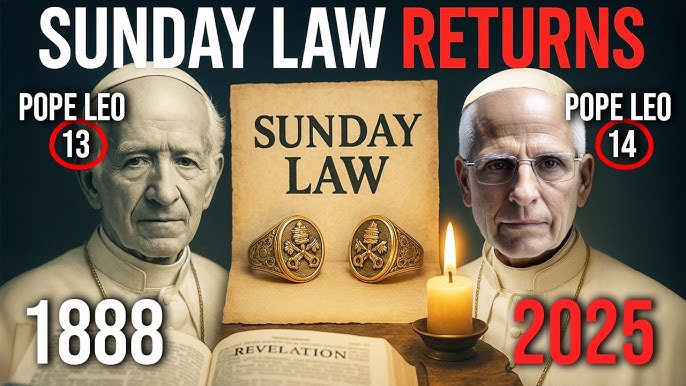
“The prophecy of Revelation 13 declares that the power represented by the beast with lamblike horns shall cause the world to worship the papacy—symbolized by the beast…This prophecy will be fulfilled when the United States shall enforce Sunday observance, which papal Rome claims as the acknowledgment of her supremacy. Then we may know that the time has come for the marvellous working of Satan and that the end is near.”
“Protestantism shall give the hand of fellowship to the Roman power. Then there will be a law against the Sabbath of God’s creation, and then God will do His ‘strange work’ on the earth.”
“The union (between Catholicism and Protestantism) will not, however, be effected by a change in Catholicism, for Rome never changes. She claims infallibility. It is Protestantism that will change.”
“Through the two great errors, the immortality of the soul and Sunday sacredness, Satan will bring the people under his deceptions. While the former lays the foundation of spiritualism, the latter creates a bond of sympathy with Rome. The Protestants of the United States will be foremost in stretching their hands across the gulf to grasp the hand of spiritualism; they will reach over the abyss to clasp hands with the Roman power; and under the influence of this threefold union, this country will follow in the steps of Rome in trampling on the rights of conscience.”
FINAL GLOBAL DECEPTION
“In different parts of the earth, Satan will manifest himself as a majestic being of dazzling brightness, resembling the Son of God. The glory that surrounds him is unsurpassed by anything that mortal eyes have beheld. His voice is soft yet full of melody. In gentle, compassionate tones he presents truths which the Saviour uttered; he heals the sick and claims to have changed the Sabbath to Sunday, and commands all to hallow the day which he has blessed. He declares that those who persist in keeping holy the seventh day are blaspheming his name. This is the strong delusion…However, Satan is not permitted to counterfeit the manner of Christ’s second coming…When Christ shall make His appearance, it will be with power and great glory, accompanied by millions of glorious angels.”
DID PAUL ABOLISH SABBATH?
One of the most common arguments against the Sabbath comes from Colossians 2:16-17, Romans 14:5-6, and Galatians 4:10.
Many evangelical scholars argue that these texts prove the Sabbath is no longer binding upon Christians. However, a careful examination reveals that Paul was not attacking the biblical Sabbath but legalism and the misuse of religious observances as a means of salvation.
The strongest evangelical argument comes from Colossians 2:16-17: “Let no one judge you in food or in drink, or regarding a festival or a new moon or sabbaths, which are a shadow of things to come, but the substance is of Christ.”
Evangelical scholars often argue that the word “sabbaths” includes the weekly Sabbath and therefore proves it was abolished at the Cross. However, there are serious problems with this interpretation.
First, the expression “festival, new moon, or sabbaths” follows the well-known Old Testament sequence referring to annual, monthly, and ceremonial religious observances connected with the sanctuary services (1 Chron. 23:31; 2 Chron. 2:4; Ezek. 45:17; Hos. 2:11).
Second, Paul describes these observances as “a shadow of things to come.” The ceremonial feast sabbaths pointed forward to Christ’s sacrifice and priestly ministry. Once these prophetic shadows met their fulfilment in Christ, they no longer carried the same binding significance. The weekly Sabbath, however, is fundamentally different. It points back to Creation, reminds us of our re-creation in Christ through the Gospel, and points forward to the eternal rest of God’s redeemed people. For this reason its significance did not end at the Cross. On the contrary, Scripture indicates that the Sabbath will continue to be observed in the new earth (Isaiah 66:22-23). Unlike the ceremonial sabbaths, the weekly Sabbath was established before sin entered the world, before the sanctuary services existed, before sacrifices were instituted, and before the Jewish nation came into existence. Therefore it cannot be merely one of the ceremonial shadows that passed away at the Cross.
Third, Paul does not say, “Do not keep the Sabbath.” He says, “Let no one judge you.” The issue is judgmental legalism (keeping Sabbath to gain salvation), not Sabbath observance as memorial of finished salvation offered to sinners as a free gift received by faith alone.
The context of Colossians is the sufficiency of Christ. False teachers (judaisers) were adding regulations, ascetic practices, and human requirements to the Gospel. Paul responds that believers are complete in Christ. He is attacking salvation by works, not obedience motivated by faith.
Romans 14 presents a similar situation. Paul writes: “One person esteems one day above another; another esteems every day alike.”
The context concerns eating, drinking, and personal devotional practices. The Sabbath is never mentioned. If Paul intended to abolish one of the Ten Commandments, it is remarkable that he never refers to the fourth commandment directly. The discussion concerns optional devotional days, not the Sabbath established at Creation.
Galatians 4:10 is also frequently cited: “You observe days and months and seasons and years.”
Again, Paul is opposing legalism. The Galatians were being taught that religious observances contributed to acceptance before God. Paul rejects any attempt to add human performance to Christ’s finished work. His concern is salvation by works, not obedience flowing from faith.
Perhaps the strongest argument against the evangelical interpretation is Paul’s overall attitude toward God’s law. “Do we then make void the law through faith? Certainly not! On the contrary, we establish the law.” Romans 3:31. “The law is holy, and the commandment (including Sabbath) holy and just and good.” Romans 7:12.
Paul never says that the fourth commandment was abolished. He never says that God transferred the holiness of the seventh day to Sunday. He never calls Sunday holy. He never commands Sunday observance.
The real issue is therefore not whether Paul opposed the Sabbath. The real issue is whether Paul opposed using the Sabbath—or any religious observance—as a method of earning salvation.
Paul fiercely opposed legalism and salvation by works. Yet the Sabbath itself teaches the very opposite of legalism. It teaches that God works first and man rests afterward. It teaches that salvation is accomplished by Christ and received by faith. Far from abolishing the Sabbath, Paul’s writings protect it from legalistic distortions and reveal its true Gospel meaning as a sign of resting entirely in Christ’s finished work.
The greatest weakness of the evangelical interpretation is that it confuses the Sabbath with legalism. Paul never teaches that the fourth commandment was abolished. He attacks the misuse of religious observances as a means of salvation. The false teachers at Colossae were judging believers on the basis of ritual requirements, dietary regulations, and ceremonial observances. Paul’s answer was not to abolish God’s Sabbath but to exalt the sufficiency of Christ. Ironically, the Sabbath itself teaches the very Gospel Paul defended. It reminds believers that salvation is not earned through human effort but received through faith in God’s finished work. Thus Paul was not attacking the Sabbath. He was attacking legalism, which is the very opposite of the Sabbath’s true meaning.
HAS WEEKLY CYCLE BEEN LOST?
One objection occasionally raised against Sabbath observance is the claim that the weekly cycle has somehow been lost and that nobody can know which day is the true seventh-day Sabbath. This argument sounds impressive until it is carefully examined.
In reality, there is overwhelming evidence that the weekly cycle has been preserved throughout history. The Jews have been keeping the seventh-day Sabbath continuously for thousands of years. Long before Christianity existed, Jewish communities scattered throughout the world were observing the same weekly cycle. When Jesus lived on earth, He kept the same Sabbath observed by the Jewish nation. Christians inherited the same weekly sequence that existed in Christ’s day.
Furthermore, when the calendar was changed from the Julian to the Gregorian system in 1582, individual dates were adjusted, but the weekly cycle was not interrupted. Thursday was followed by Friday exactly as before. No days of the week were lost.
Even modern historians, astronomers, and calendar experts recognize that the seven-day weekly cycle has continued without interruption from ancient times to the present.
Some point to crossing the International Date Line as evidence that the Sabbath cannot be known. However, the International Date Line merely adjusts civil dates as people travel around the globe. It does not alter the continuous sequence of the seven-day week any more than travelling across a time zone changes the order of the days.
Most importantly, God would not command the observance of a specific day and then allow humanity to lose all knowledge of which day He intended. The same God who preserved His Word has also preserved the weekly cycle upon which the Sabbath commandment depends.
KEY BIBLE VERSES ON SABBATH
Genesis 2:1-3 “Thus the heavens and the earth, and all the host of them, were finished. And on the seventh day God ended His work which He had done, and He rested on the seventh day from all His work which He had done. Then God blessed the seventh day and sanctified it, because in it He rested from all His work which God had created.”
Exodus 20:8-11 “Remember the Sabbath day, to keep it holy. Six days you shall labor and do all your work, but the seventh day is the Sabbath of the Lord your God. In it you shall do no work: you, nor your son, nor your daughter, nor your male servant, nor your female servant, nor your cattle, nor your stranger who is within your gates. For in six days the Lord made the heavens and the earth, the sea, and all that is in them, and rested the seventh day. Therefore the Lord blessed the Sabbath day and sanctified it.”
According to the Encyclopaedia Britannica, “Sabbath is the day of rest observed from sunset on Friday to sunset on Saturday”.
Deuteronomy 5:12-15 (Sabbath Commandment repeated with different reason) “Observe the Sabbath day, to keep it holy, as the Lord your God commanded you. Six days you shall labor and do all your work, but the seventh day is the Sabbath of the Lord your God. In it you shall do no work: you, nor your son, nor your daughter, nor your male servant, nor your female servant, nor your animals, nor your stranger who is within your gates. And remember that you were a slave in the land of Egypt, and the Lord your God brought you out from there by a mighty hand and by an outstretched arm. Therefore, the Lord your God commanded you to keep the Sabbath day.”
NOTE: God wanted His people to keep the Sabbath holy because He gave them freedom from slavery! And for the same reason God wants us today to rest on the Sabbath. He says to you and me: “Remember (or, engrave in your memory and seal it) that you were condemned to death slave of sin, and that the Lord your God brought you out of that slavery with a mighty hand and an outstretched on the cross arm. Therefore (this is the reason), the Lord your God has commanded you to observe the Sabbath day.” God gave us the Sabbath so that we may remember that in Jesus, He gave us freedom from slavery of sin and death.
Exodus 31:13-17 “Above all, you shall keep my Sabbaths, for this is a sign between me and you throughout your generations, that you may know that I, the Lord, sanctify you. You shall keep the Sabbath, because it is holy for you. Everyone who profanes it shall be put to death. Whoever does any work on it, that soul shall be cut off from among his people. Six days shall work be done, but the seventh day is a Sabbath of solemn rest, holy to the Lord. Whoever does any work on the Sabbath day shall be put to death… It is a sign forever between me and the people of Israel that in six days the Lord made heaven and earth, and on the seventh day he rested.”
Matthew 5:17-19 “Do not think that I came to destroy the Law or the Prophets. I did not come to destroy but to fulfil. For assuredly, I say to you, till heaven and earth pass away, one jot or one tittle (dot) will by no means pass from the law till all is fulfilled. Whoever therefore breaks one of the least of these commandments, and teaches men so, shall be called least in the kingdom of heaven; but whoever keeps them and teaches others, shall be called great in the kingdom of heaven.”
Matthew 11:28-30 “Come to me, all who labor and are heavy laden, and I will give you rest. Take my yoke upon you, and learn from me, for I am gentle and lowly in heart, and you will find rest for your souls. For my yoke is easy, and my burden is light.”
Mark 7:7-8 “In vain they worship me, teaching as doctrines the commandments of men. Neglecting the commandment of God, you hold to the tradition of men.”
Luke 13:15-16 “The Lord answered, You hypocrites! Doesn’t each of you on the Sabbath untie his ox or donkey from the stall and lead it out to give it water? Then should not this woman, a daughter of Abraham, whom Satan has kept bound for eighteen long years, be set free on the Sabbath day?” NOTE: Why did Jesus suggest that the woman should have been set free from Satan’s slavery, especially on the Sabbath day? Because the Sabbath is the memorial of the gospel of freedom!
Hebrews 4:9-10 “There remains therefore a rest (Gr. “sabbatismos” = keeping of the Sabbath) for the people of God. For he who has entered His rest has himself also ceased from his works as God did from His.”
NOTE: Here Paul tells the legalistic Jews and modern legalists that they must accept the gift of eternal rest (symbolized by Sabbath rest) by ceasing from trying to obtain that eternal rest by their own works. Today, if we keep the Sabbath in order to gain salvation, we lie and commit a horrible sin because by keeping the Sabbath we should manifest that we have already accepted the gift of eternal rest by faith alone and that we ceased from trying to gain that rest (salvation) by good works. For Paul, the Sabbath of the fourth commandment was a memorial of salvation by faith alone. And, keeping it was an outward sign showing that salvation by faith in Jesus Christ alone has been already accepted.
Isaiah 56:4-7 “For thus says the Lord: To the eunuchs who keep my Sabbaths, who choose the things that please me and hold fast my covenant, I will give in my house an everlasting name that shall not be cut off. And the foreigners who join themselves to the Lord, to love the name of the Lord, everyone who keeps the Sabbath and does not profane it, and holds fast my covenant— these I will bring to my holy mountain, and make them joyful in my house of prayer; for my house shall be called a house of prayer for all peoples.”
Isaiah 58:13-14 “If you keep your feet from breaking the Sabbath and from doing as you please on my holy day, if you call the Sabbath a delight and the Lord’s holy day honorable, and if you honor it by not going your own way and not doing as you please or speaking idle words, then you will find your joy in the Lord, and I will cause you to ride in triumph on the heights of the land and to feast on the inheritance of your father Jacob. For the mouth of the Lord has spoken.”
James 2:10 “For whoever shall keep the whole law, and yet stumble in one point, he is guilty of all.”
Revelation 14:12 “Here is the patience of the saints; here are those who keep the commandments of God and the faith of Jesus.”
1 Corinthians 7:19 “Circumcision (part of ceremonial law) is nothing and uncircumcision is nothing, but keeping the commandments of God is what matters.”
Gen. 2:1-3; Ex. 20:8-11; Luke 4:16; Luke 23:56; Isa. 66:22-23; Isa. 56:5, 6; 58:13, 14; Mark 2:27,28; Matthew 24:20; Matt. 12:1-12; Ex. 31:13-17; Eze. 20:12, 20; Deut. 5:12-15; Heb. 4:1-11; Lev. 23:32; Mark 1:32
MORAL LAW OF TEN COMMANDMENTS
Exodus 20 (10 Commandments):
1 And God spoke all these words, saying:
2 “I am the Lord your God, who brought you out of the land of Egypt, out of the house of slavery.
3 I. “You shall have no other gods before Me.
4 II. “You shall not make for yourself a carved image… you shall not bow down to them nor serve them. For I, the Lord your God, am a jealous God, visiting the iniquity of the fathers upon the children to the third and fourth generations of those who hate Me, but showing mercy to thousands, to those who love Me and keep My commandments.
7 III. “You shall not take the name of the Lord your God in vain, for the Lord will not hold him guiltless who takes His name in vain.
8 IV. “Remember the Sabbath day, to keep it holy. Six days you shall labor and do all your work, but the seventh day is the Sabbath of the Lord your God. In it you shall do no work: you, nor your son, nor your daughter, nor your male servant, nor your female servant, nor your cattle, nor your stranger who is within your gates. For in six days the Lord made the heavens and the earth, the sea, and all that is in them, and rested the seventh day. Therefore the Lord blessed the Sabbath day and sanctified it.
12 V. “Honor your father and your mother, that your days may be long upon the land which the Lord your God is giving you.
13 VI. “You shall not murder.
14 VII. “You shall not commit adultery.
15 VIII. “You shall not steal.
16 IX. “You shall not bear false witness against your neighbor.
17 X. “You shall not covet your neighbor’s house; you shall not covet your neighbor’s wife, nor his male servant, nor his female servant, nor his ox, nor his donkey, nor anything that is your neighbor’s.”
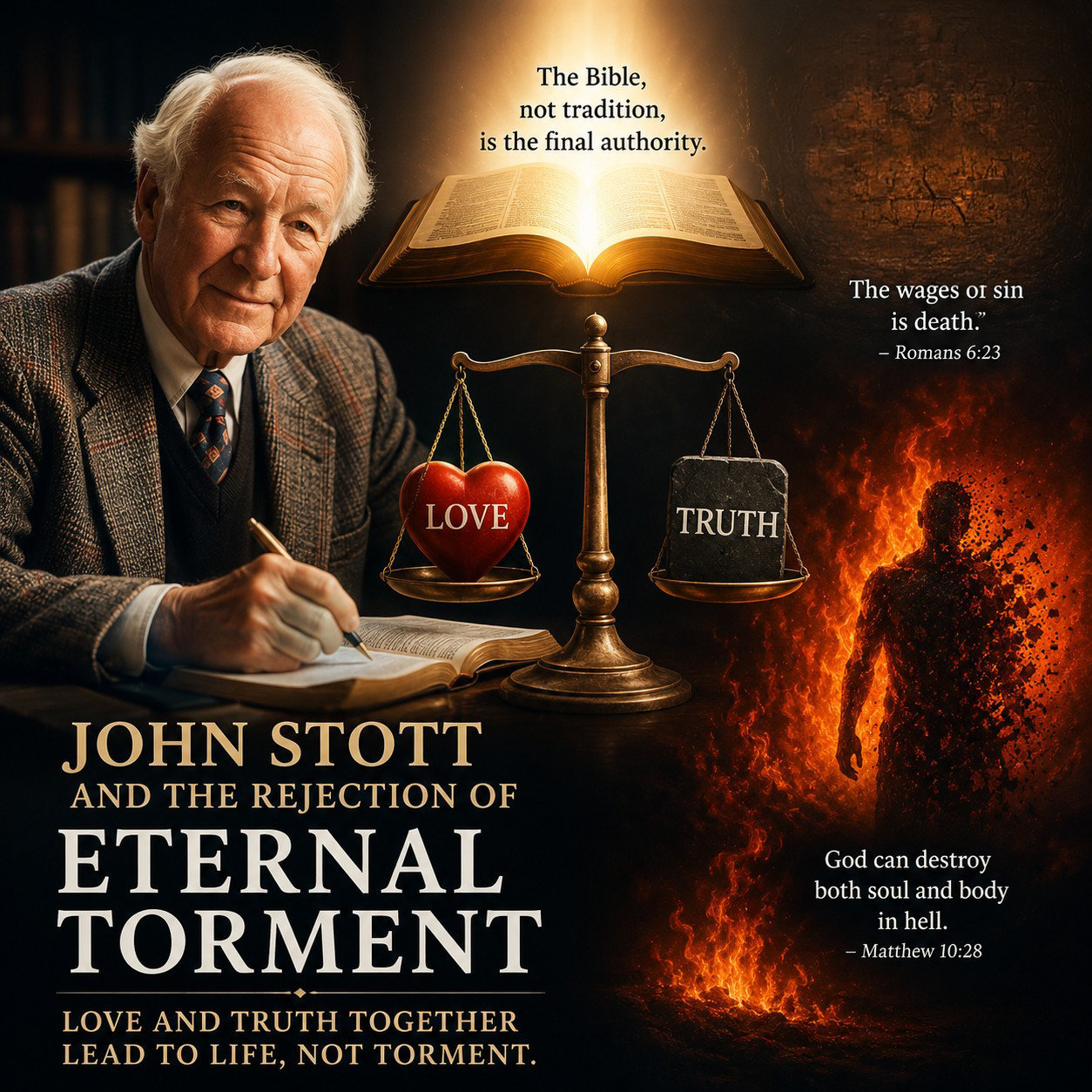
JOHN STOTT ON GRACE AND LAW
Unfortunately, the sad truth is that the extremely important principle of combining love with truth has been forgotten by the vast majority of contemporary evangelical Christians. They claim that under the New Covenant only love matters, and the truth associated with the Decalogue (including the Sabbath commandment) is no longer binding upon us.
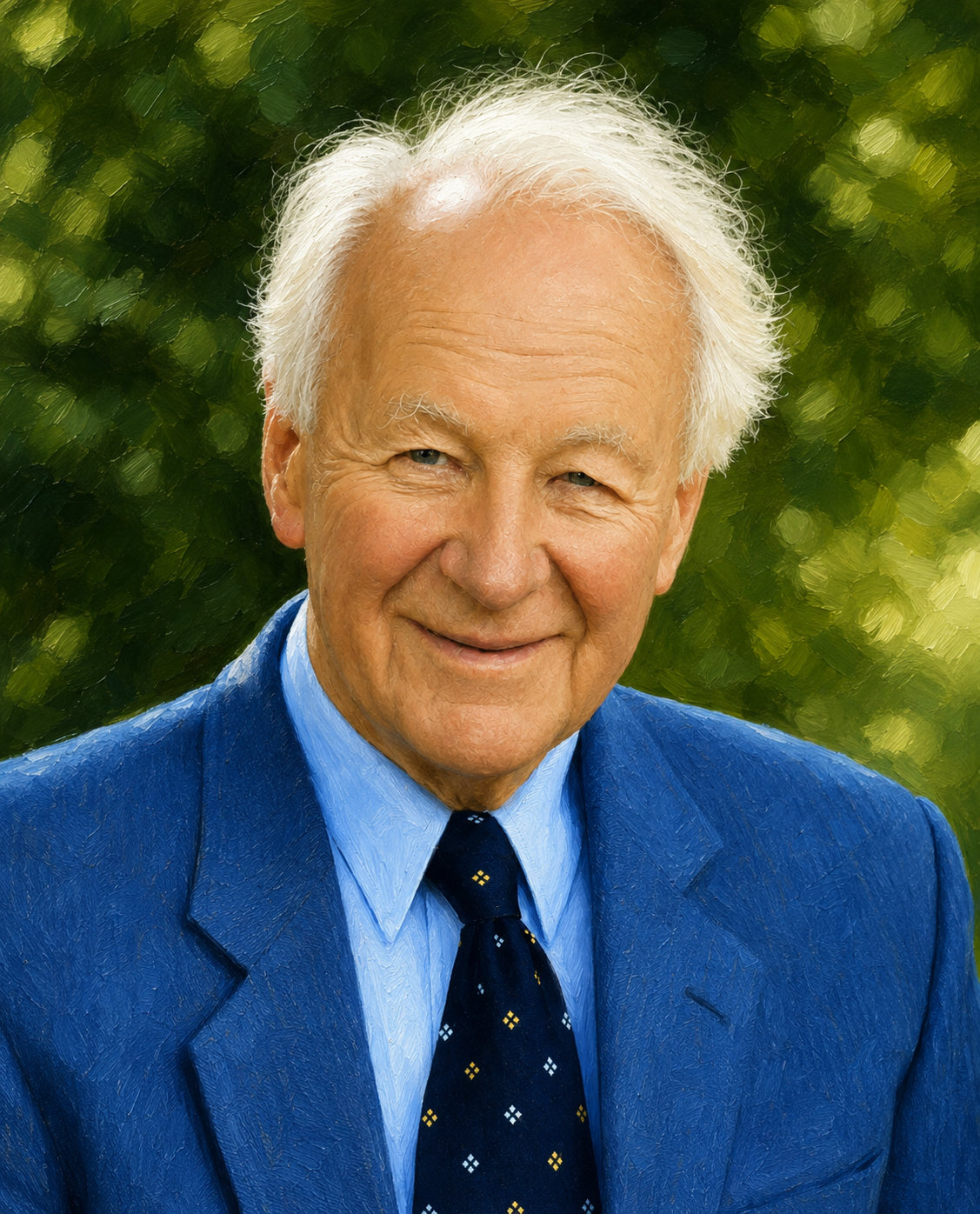
They commit a cardinal error by focusing exclusively on love and grace alone, whilst disregarding the whole truth. And this is not merely my opinion, but such a view on the subject is currently expressed, among others, by one of the greatest authorities in the Protestant church, who is undoubtedly John Stott.
“For justification we look to the cross, not the law, and for sanctification we look to the Spirit, not the law. Legalists fear the law and are in bondage to it. Antinomianists hate the law and repudiate it. But the law-abiding free people love the law and fulfil it.” – Stott, J. R. W. (1994). The Message of Romans: God’s Good News for the World. The Bible Speaks Today, Chapter 7.
In the article “Grace and Law” he wrote the following statemen:
“In these days, God’s call to moral obedience (that is, to keeping God’s Commandments) needs to be particularly emphasised, because at least two groups of people oppose it. The first are the defenders of the so-called ‘New Morality’ developed in the 1960s. They claim that the only and absolute commandment of God is the commandment of love, and all other laws have been abolished, and that love alone is a sufficient guide for a Christian’s conduct. They forget, however, that love needs directions, and it is precisely such directions that God’s commandments provide. Love does not abolish the law, it fulfils it (Rom 13: 8-10). Secondly, there are evangelical Christians who believe that Paul’s statements ‘Christ is the end of the law‘ (Rom. 10:4) and ‘you are not under the law‘ (Rom. 6:14) mean that Christians are no longer obligated to obey the moral law of God. Attempts to keep it, they claim, are ‘legalism‘ which denies the freedom that Christ gave us. However, they misunderstand Paul. The ‘legalism’ that Paul rejected is not the law of God itself, but the attempt to gain God’s favour and forgiveness through obedience. He himself wrote that this is not possible, because ‘by the deeds of the law there shall no flesh be justified in his sight’ (Rom 3:20). Justified, however, solely by the grace of God, we are obligated to keep this law and we desire to do so. Therefore, our Christian freedom is a freedom to show obedience, not disobedience.”
This statement, whose author is not an Adventist but one of the world’s most prominent Protestant theologians, proves that the Protestant churches committed a cardinal error by separating love from truth. The Catholic Church, in turn, neglected both. We (SD Adventists), on the other hand, face yet another danger, which is that we may have a tendency to focus exclusively on the truth, whilst neglecting love and grace!