
Development of Trinity Doctrine in SDA Church
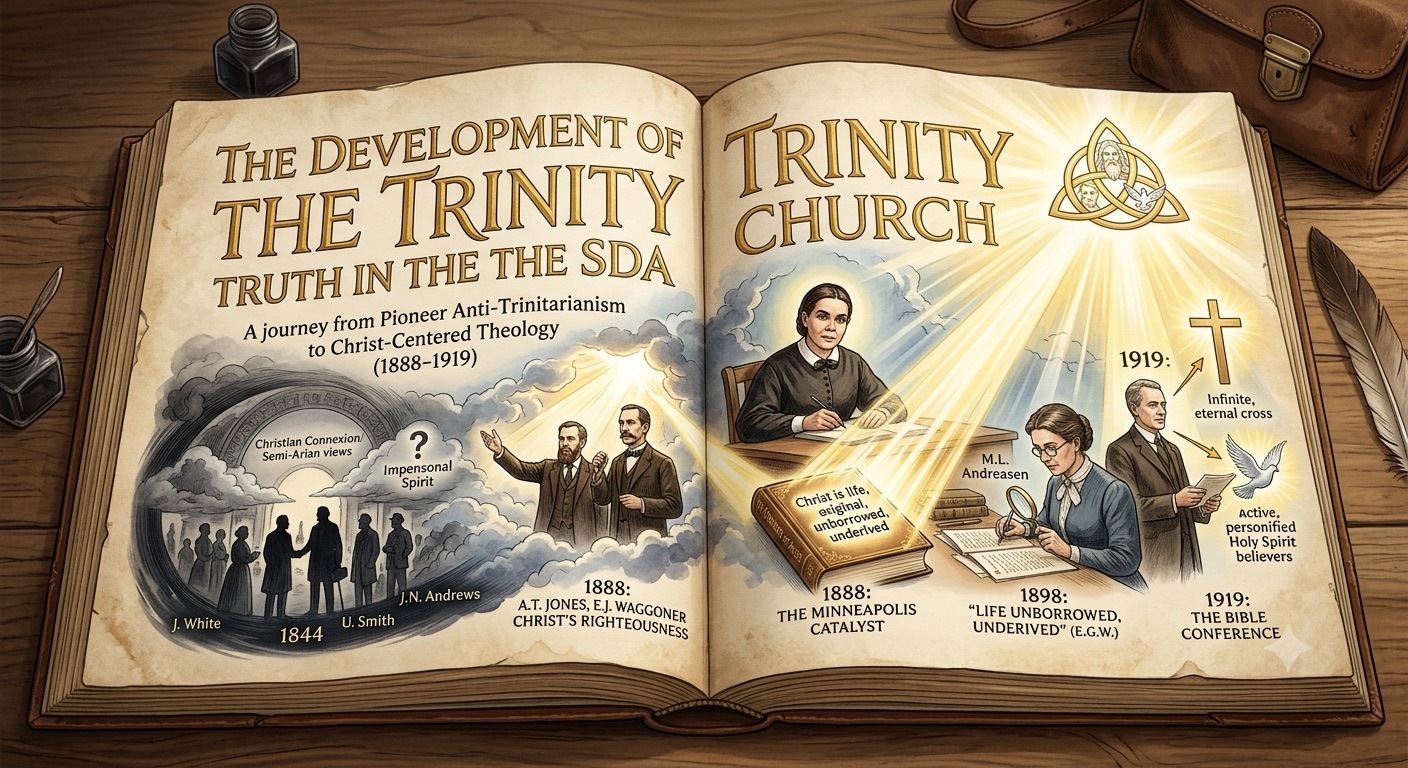
To understand the profound theological transformation that took place within Seventh-day Adventism between 1888 and the 1919 Bible Conference, one must examine the journey of the pioneers from a rigid anti-Trinitarian stance to a vibrant, Christ-centered understanding of the Godhead. Historical research from Adventist history outlines the intense theological tension regarding the Trinity, Ellen White’s role in ccorrecting it, and the contributions made by theologians like W.W. Prescott and M.L. Andreasen.
Historical Conflict: Pioneer Anti-Trinitarianism
It is a well-established historical fact that the vast majority of early Seventh-day Adventist pioneers—including James White, Uriah Smith, J.N. Andrews, and Joseph Bates—were anti-Trinitarian. Many had stepped out of the Christian Connexion movement, which rejected traditional creeds as unscriptural.
The early pioneers generally believed that Jesus had a beginning in the remote past (semi-Arianism). They held that He was begotten by the Father and therefore derived His existence from Him.
They also largely viewed the Holy Spirit not as a distinct, divine person, but as an impersonal power, influence, or the omnipresent breath of God.
When A.T. Jones and E.J. Waggoner began preaching righteousness by faith at the 1888 Minneapolis General Conference, they found it necessary to emphasize the absolute divinity of Christ. Waggoner argued that if Christ were not fully God, His sacrifice could not perfectly redeem humanity. This cracked the door open for a deeper, systematic study of the Godhead.
How Ellen White Clarified Their Understanding
As the pioneers struggled with these concepts, Ellen G. White acted as the theological course-corrector. While she did not formulate systematic creeds, her inspired writings forced the pioneers to completely abandon their semi-Arian views.
The definitive turning point came in 1898 with the publication of her masterpiece on the life of Christ, The Desire of Ages. In it, she wrote a phrase that shocked the traditionalists: “In Christ is life, original, unborrowed, underived” (The Desire of Ages, p. 530).
If Christ’s life is underived, He could not have been created or begotten by the Father at some point in the past; He had to be co-eternal with God.
Furthermore, she directly corrected their view of the Holy Spirit, explicitly establishing the Spirit’s distinct personality: “The Holy Spirit is a person, for He beareth witness with our spirits that we are the children of God… The Holy Spirit has a distinct personality, else He could not bear witness to our spirits and with our spirits” (Manuscript 20, 1906 / Evangelism, p. 616-617).
She reinforced this reality by stating, “We need to realize that the Holy Spirit, who is as much a person as God is a person, is walking through these grounds” (Manuscript 66, 1899 / Evangelism, p. 616).
Legal and Divine Necessity of Full Deity for Salvation
To the developing theological minds of the 1888 movement, the full, uncreated deity of Christ was not an abstract point of logic, but a legal prerequisite for human salvation. E.J. Waggoner argued intensely that if Christ were merely a created or derived being, His life and death could not possess infinite value, and therefore He could not legally redeem a broken law of infinite consequence.
Waggoner wrote, “The object of magnified Christ is to show that He has power to redeem. If He were a created being, He could not have that power. No created being has power to redeem another. He has not power to keep himself from falling, let alone keeping another” (E.J. Waggoner, General Conference Bulletin, 1891).
W.W. Prescott similarly emphasized that only an eternally pre-existent Divine Being could bridge the chasm caused by sin, ensuring that the Creator Himself bore the legal penalty of the broken law.
Ellen White underscored this profound legal necessity by confirming that no angel, let alone a derived being, could balance the ledger of cosmic justice. She wrote, “The law of God was as sacred as God Himself; and none but One equal with God could make atonement for its transgression. The transgression of a law so holy made the offender a debtor to the Lawgiver. None but Christ could redeem fallen man from the curse of the law, and bring him again into harmony with Heaven” (Signs of the Times, January 30, 1879).
Skeptics Convinced: Case of M.L. Andreasen
The theological shockwave caused by The Desire of Ages was met with intense skepticism by some who wondered if these revolutionary statements were actually written by Ellen White or if they had been slipped in by her editorial assistants.
M. L. Andreasen, who later became one of the denomination’s leading theologians, was deeply astonished by the book. He could hardly believe that Ellen White had penned words that so thoroughly upended the old pioneer positions. To satisfy his doubts, Andreasen traveled to the General Conference building and the Elmshaven estate to personally inspect her original, handwritten manuscripts.
He later recounted his experience: “I remember how astonished we were when Desire of Ages was first published, for it contained some things that we considered unbelievable; among others the doctrine of the Trinity, which was not generally accepted by the Adventists… I was sure Sister White had never written, ‘In Christ is life, original, unborrowed, underived.’ But now I found it in her own handwriting just as it had been published. It was so with other statements. As I checked up, I found that they were Sister White’s own expressions. In the final analysis it was her work all the way through” (M.L. Andreasen, Chapel Talk, 1948).
Andreasen spent months reviewing the documents, finding that the bold assertions of Christ’s eternal, underived deity and the personality of the Trinity were indisputably her own. This firsthand encounter compelled a complete revision of his own Christology and helped solidify the truth of the Trinity among his peers.
Prescott’s Definitive Texts and Theological Contributions
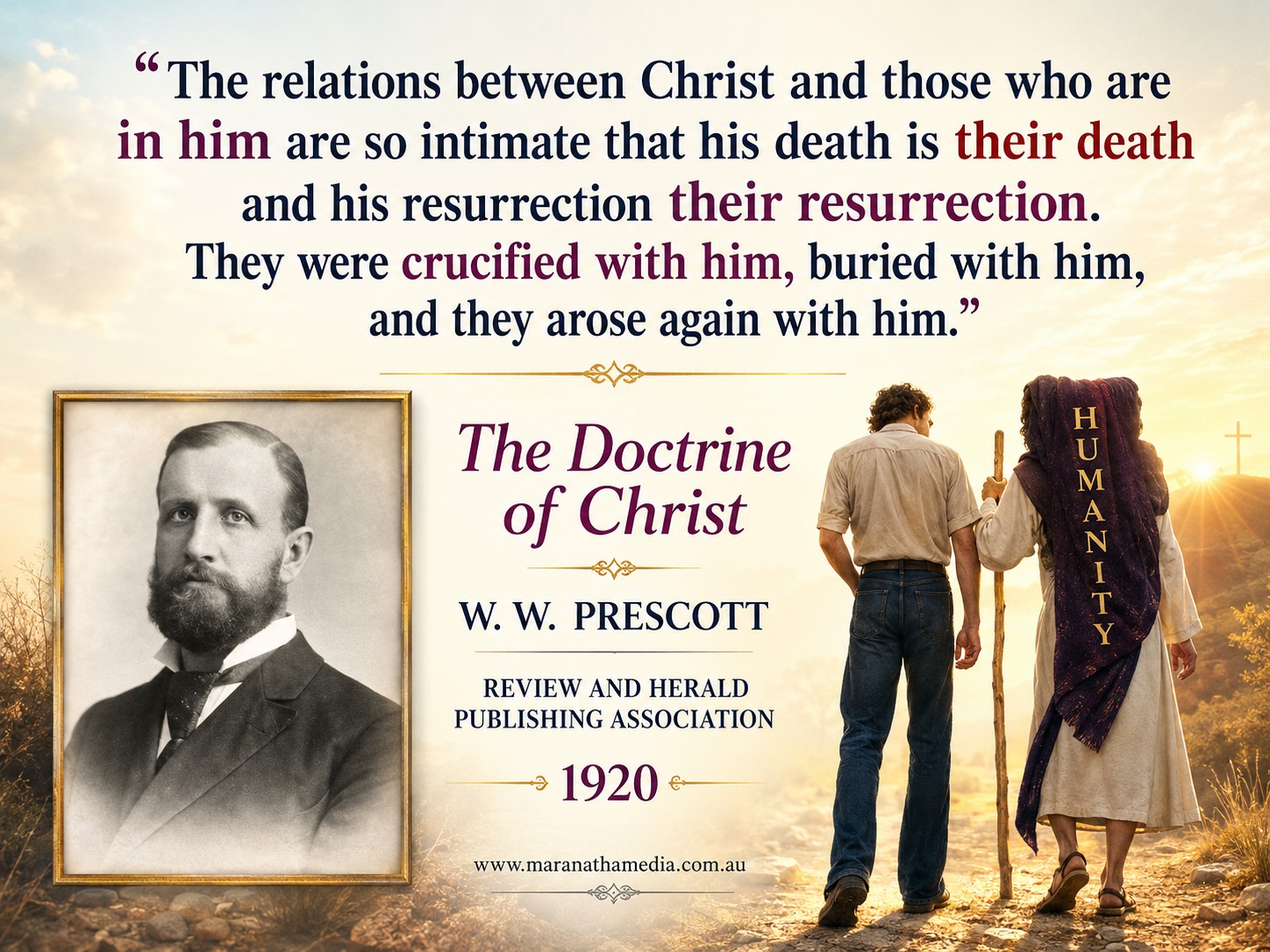
Following his own spiritual awakening in the 1890s, W.W. Prescott became the foremost theological champion of this Christocentric, Trinitarian understanding within the ministry. At the historic 1919 Bible Conference, Prescott led the presentation series on “The Person of Christ,” which was subsequently published in his monumental 1919 textbook, The Doctrine of Christ. Prescott’s focus was always on the practical reality of Christ’s full divinity: if Christ is not fully, eternally God, then our salvation is incomplete and we cannot be filled with the absolute fullness of the divine nature.
On the absolute divinity and eternity of Christ, he wrote: “Christ is the center of all Scripture, as he is the center of all God’s purposes and counsels… If he is to be to us a Savior from sin, we must receive him as ‘the way, the truth, and the life,’ and we must not permit the knowledge of doctrines about him to obscure him in his blessed fullness” (The Doctrine of Christ, 1919, p. 13).
He expanded this in his sermons, stating, “Jesus Christ was God in heaven, and he came to this world, and was born of the flesh, and thus he who had been born of the Spirit, was afterward born of the flesh, and by this double birth this family was established,—the divine-human family of which he is the head” (Sermon: “Part of God’s Family”).
Modern Resurgence of Anti-Trinitarianism
Despite the exhaustive historical evidence showing how the pioneers themselves transitioned to a Trinitarian understanding under prophetic guidance, some Seventh-day Adventists today still cling to anti-Trinitarian views. They argue that the doctrine is a product of pagan tradition or Roman Catholic theology, attempting to isolate the early writings of pioneers like Uriah Smith or James White while ignoring their later theological development.
Instead of acknowledging Ellen White’s clear, handwritten statements on the underived life of Christ, some modern critics go so far as to baselessly claim that her books were altered by publishers or assistants.
The contemporary anti-Trinitarian movement within Adventism usually advocates a form of semi-Arianism or eternal subordination, claiming that Christ was generated or begotten by the Father in the remote past and is therefore functionally subordinate to Him.
Adventist theologians note that this view fundamentally impacts how these groups view salvation, as it often shifts the focus away from the complete, infinite substitutionary atonement on the cross toward an intense focus on human effort and achieving sinless perfection by merely copying Christ’s example as a subordinate being.
READ MORE ON TRINITY HERE
Trinity In History of Seventh-Day Adventist Church
Merlin D. Burt, PhD
The last decade has seen increased antitrinitarian activity within the Seventh-day Adventist Church. Four reasons for this activity should be mentioned. (1) The availability of information through the Internet. (2) Several other Adventist groups that emerged from the Millerite movement continue to hold to an antitrinitarian perspective. Examples would be the Church of God (Seventh Day), also known as the Marion Party; the previous view of the Worldwide Church of God; the Atlanta Church of God in Georgia (formerly of Oregon, Illinois, or the Age to Come Adventists), and Jehovah’s Witnesses (that branched from the Advent Christian Church). It should be noted that the Advent Christians, like Seventh-day Adventists, have embraced the trinitarian view. (3) Some think that the Trinity doctrine comes from Catholic theology and therefore must be false. Many have not realized that the Catholic doctrine of the Trinity has differences from the Seventh-day Adventist biblical doctrine of the Trinity. These include eternal generation of the Son and Divine impassibility, which are influenced by Greek philosophy. (4) Perhaps most significant, over the last few decades, some Seventh-day Adventists have thought to return to early historical Adventist faith, or what might be called neo-restorationism.
Some have failed to recognize the dynamic nature of Seventh-day Adventist theology. Historically, our doctrines have developed in the context of the original distinctive core of the three angels’ messages and kindred concepts. A small, though significant and growing segment of “historic” Adventists, are advocating a return to an antitrinitarian stance. Sabbatarian Adventism and Seventh-day Adventists have always been Bible-centered in their theology and doctrine. They have rejected a static creed and have ever sought to study, understand, and follow the Bible as the source of doctrine and the guide for experience. Consequently, it should not be surprising that Adventist doctrine has developed over time building upon previous and new Bible study.
As Sabbatarian Adventism emerged during the late 1840s, it brought various Christian truths and placed them in the framework of fulfilled prophecy and ongoing discovery of biblical teachings. A cluster of biblical teachings explained what had happened in 1844 and why Jesus had not come. The heavenly sanctuary, the end-time ministry of Jesus in the Most Holy Place, and the Sabbath as the seal of God were a particular focus. Adventist understanding of various theological perspectives continued to develop and improve over time. Two examples are the Sabbath and tithing. Early Adventists initially concluded, through Joseph Bates’s influence, that the Sabbath should begin and end at 6:00 p.m. It was in 1855, nearly a decade after the initial Sabbath emphasis, that J. N. Andrews’s biblical and historical presentation influenced believers to adopt sundown as the correct time to begin and end the Sabbath. Tithing first began in 1859 as systematic benevolence and had little or no link to the biblical teaching of 10 percent. It was not until the 1870s that a careful restudy of the topic led Seventh-day Adventists to adopt the tithing framework we practice today. A similar process is evident in Adventist understanding on the nature of God and the Trinity.
Antitrinitarian Period (Until 1890)
Until near the turn of the twentieth century, Seventh-day Adventist literature was almost unanimous in opposing the eternal deity of Jesus and the personhood of the Holy Spirit. During the earlier years, some even held the view that Christ was created. It is very important to understand that Adventist views were not homogeneous. Theological tension within Adventism began during the Millerite movement and is illustrated by the two principal leaders, William Miller and Joshua V. Himes.
Miller, being a Baptist, was a trinitarian. He wrote, “I believe in one living and true God, and that there are three persons in the Godhead. . . . The three persons of the Triune God are connected.”1 Himes, a close associate of William Miller, was of the Christian Connexion persuasion. The northeastern branch of the Christian church “rejected the Trinitarian doctrine as unscriptural.”2 It is important to note that Millerite Adventists were focused on the soon coming of Jesus and did not consider it necessary to argue about the Trinity.
Two of the principal founders of the Seventh-day Adventist Church, Joseph Bates and James White, like Himes, had been members of the Christian Connexion and rejected the doctrine of the Trinity. Joseph Bates wrote of his views, “Respecting the trinity, I concluded that it was an impossibility for me to believe that the Lord Jesus Christ, the Son of the Father, was also the Almighty God.”3 James White wrote, “Here we might mention the Trinity, which does away [with] the personality of God, and of his Son Jesus Christ.”4 Both Bates and White were anxious to maintain the separate personalities of the Father and the Son. This concern was caused, in part, by the strong spiritualizing influence among Bridegroom Adventists during 1845 and 1846. A similar problem would resurface around the turn of the twentieth century with the de-personalizing of God and J. H. Kellogg’s pantheistic views.5
Though James White rejected the doctrine of the Trinity, he did believe in the three great Powers in heaven reflected in his first hymnbook.6 Though opposed to the Trinity, he did not believe that Christ was inferior to the Father. In 1877 he wrote, “The inexplicable trinity that makes the godhead three in one and one in three, is bad enough; but that ultra Unitarianism that makes Christ inferior to the Father is worse.”7
Not all agreed with James White on the equality of Father and Son. During the 1860s, Uriah Smith, long-time editor of the Review and Herald, believed that Jesus was “the first created being.”8 By 1881, he had changed to the belief that Jesus was “begotten” and not created.9
A selective list of Adventists who either spoke against the Trinity and/ or rejected the eternal deity of Christ include J. B. Frisbie, J. N. Loughborough, R. F. Cottrell, J. N. Andrews, D. M. Canright, J. H. Waggoner, and C. W. Stone.10 W. A. Spicer at one point told A. W. Spalding that his father, after becoming a Seventh-day Adventist (he was formerly a Seventh Day Baptist minister), “grew so offended at the antitrinitarian atmosphere in Battle Creek that he ceased preaching.”11
In surveying the writings of various pioneers, certain concerns frequently appear. In rejecting the Trinity, some saw the orthodox Christian view as pagan tritheism. Others argued that the Trinity degraded the personhood of Christ and the Father by blurring the distinction between Them. While the early positions on the Trinity and deity of Christ were flawed, there was a sincere attempt to oppose certain legitimate errors.
By about 1890, Adventists had come to a more-or-less harmonious position that viewed Jesus as the begotten or originated Divine Son of God. He was seen as the Divine Creator with the Father. The nature of the Holy Spirit was lightly discussed, though the Holy Spirit was generally considered to be the omnipresent influence from the Father or the Son rather than a person.
Emergence of Trinitarian Sentiment (From 1890 To 1900)
As the 1890s began, two of the key thinkers on each side of the righteousness by faith/law in Galatians issue agreed on the derived divinity of Jesus. E. J. Waggoner wrote in his 1890 Christ and His Righteousness, “There was a time when Christ proceeded forth and came from God . . . but that time was so far back in the days of eternity that to finite comprehension it is practically without beginning.”12 In 1898, Uriah Smith wrote in Looking Unto Jesus, “God alone is without beginning. At the earliest epoch when a beginning could be,—a period so remote that to finite minds it is essentially eternity,—appeared the Word.”13
The period after the 1888 Minneapolis General Conference saw a new emphasis on Jesus and the plan of salvation. This led to a consideration of His deity and what it meant for the redemption of humanity. A. T. Jones was among the first (with the exception of Ellen White) to suggest that Christ was eternally preexistent. Jones emphasized Colossians 2:9 and the idea that in Christ was the “fullness of the Godhead bodily.” He also described Christ as “ ‘the eternal Word.’ ”14 Though he avoided the word Trinity, in 1899 he wrote, “God is one. Jesus Christ is one. The Holy Spirit is one. And these three are one: there is no dissent nor division among them.”15
Ellen White played a prophetic role in confirming the eternal deity of Jesus and the Three-Person Godhead. As early as 1878, she referred to Jesus as the “eternal Son of God.”16 In The Desire of Ages, she wrote, “[Christ] announced Himself to be the self-existent One” and “In Christ is life, original, unborrowed, underived.”17 She wrote of the Holy Spirit as the “Third Person of the Godhead.”18 Ellen White played an important role in urging the church toward a biblical trinitarian position. However, for years after the publication of The Desire of Ages, the church generally avoided these and other statements. While she never used the term Trinity in her published writings, she repeatedly conveyed the concept.
M. L. Andreasen questioned whether Ellen White had actually written some of her statements in The Desire of Ages and other books. During 1909, Andreasen spent three months at Elmshaven, California, and was convinced of the accuracy of her published position.19
Transition and Conflict (From 1900 To 1931)
During the first three decades of the twentieth century, the church remained divided in its position on the deity of Christ. The use of the word Trinity in print continued to be avoided. W. W. Prescott and A.T. Jones, both editors of the Advent Review and Sabbath Herald, were key supporters of the full and eternal deity of Jesus. During the 1890s, Prescott was slower than Jones to accept the new view. But after 1900, as editor of the Advent Review and Sabbath Herald, he published articles on the personhood and eternal nature of the Father, Son, and the Holy Spirit.20 Still Prescott believed that Jesus had a derived existence from God the Father. At the 1919 Bible Conference, he presented a series of eight devotionals for the conference titled “The Person of Christ” that expressed this view. Careful discussion at this conference showed that there were varying opinions.21
The early twentieth century saw Adventists and Protestant Fundamentalists battling higher criticism and the “new modernism” growing in Christianity. Liberalism rejected the deity of Jesus and His virgin birth. Adventist articles defending the Bible view began to appear more frequently in church papers. Irrespective of individual differences on details, Adventist ministers pulled into line against liberal views. Naturally, those who rejected the eternal preexistence of Christ did not want to speak of His beginning and weaken the argument against higher criticism. Even articles on the Trinity were tolerated.22 The result was an increased appreciation of the full deity of the Son of God.
Acceptance of Trinitarian View (From 1931 To 1957)
F. M. Wilcox was crucial in facilitating the final transition to an accepted Seventh-day Adventist view on the Trinity through his guidance in the 1931 Statement of Fundamental Beliefs and his articles in the Review and Herald.23 Doctrinal summaries were carefully avoided during the first decades of the twentieth century, due in part to conflict on the Trinity. According to L. E. Froom, Wilcox was “respected by all parties for his soundness, integrity, and loyalty to the Advent Faith—and to the Spirit of Prophecy—he, as editor of the Review, did what probably no other man could have done to achieve unity in acceptance.”24 It was not until 1946 that the General Conference session officially voted a Statement of Fundamental Beliefs.25
During the 1940s, an ever-increasing majority of the church believed in the eternal, underived deity of Christ and the personhood of the Holy Spirit, yet there were some who held back and even actively resisted the change. These were mainly comprised of a few older ministers and Bible teachers such as J. S. Washburn, C. S. Longacre, and W. R. French. In 1944, Uriah Smith’s Daniel and the Revelation was revised and his comments on the derived nature of Christ’s divinity were removed.26
In 1957, the book Questions on Doctrine anchored the doctrine of the Trinity or Godhead for Adventists. While the book produced theological conflict in other areas, there was virtually no dissent on the book’s clear teaching of the Trinity.27 The current unambiguous statement on the Trinity in the Seventh-day Adventist Fundamental Beliefs was revised and voted at the 1980 General Conference Session.
The process of adopting the Trinity continued from 1900 to 1950. Key influences in the change were (1) repeated published biblical studies on the topic, (2) Ellen White’s clear statements, (3) Adventist response to the attacks of modern liberalism on the deity of Christ and His virgin birth, and (4) F. M. Wilcox’s statement of Fundamental Beliefs and his Review and Herald editorials.
We may learn several lessons from the history of the development of doctrine of the Trinity in the Seventh-day Adventist Church. First, we must acknowledge that the development of Adventist theology has usually been progressive and corrective. This is clearly illustrated in the doctrine of the Trinity. The leading of the Holy Spirit is dynamic. Other doctrinal concepts developed in a similar manner. This development never supposed a paradigm shift that contradicted the clear biblical teaching of the heavenly sanctuary ministry of Jesus and the prophetic foundation of the church. Second, the development of the Trinity doctrine demonstrates that doctrinal change sometimes requires the passing of a previous generation. For Seventh-day Adventists, it took more than 50 years for the doctrine of the Trinity to become normative. Third, Ellen White’s unambiguous statements subdued controversy and provided confidence to transition to our current view. Finally, Adventist theology is always supremely dependent upon Scripture. The Bible tells us that the “path of the just is as the shining light, that shineth more and more unto the perfect day.”28 Hebrews 2:1 reads, “Therefore we ought to give the more earnest heed to the things we have heard.” It was ultimately the Bible that led Seventh-day Adventists to adopt their present position on the Godhead or Trinity.
References
1 Sylvester Bliss, Memoirs of William Miller (Boston: Joshua V. Himes, 1853), 77, 78.2 Joshua V. Himes, “Christian Connexion,” in Encyclopedia of Religious Knowledge, ed. J. Newton Brown (Brattleboro, VT: Brattleboro Typographic, 1838), 363.3 Joseph Bates, Autobiography of Elder Joseph Bates (Battle Creek, MI: Steam Press, 1868), 205.4 James White,”Preach the Word,” Advent Review and Sabbath Herald, December 11, 1855, 85.
5 See J. H. Kellogg, The Living Temple (Battle Creek, MI: Good Health, 1903), 26–36, 396–398, 450–460, 484–486.
6 Arthur L. White to Hedy Jemison, July 2, 1969; James White, comp., Hymns for God’s Peculiar People (Oswego, NY: Richard Oliphant, 1849), 47.
7 James White, Advent Review and Sabbath Herald, November 29, 1877, 72.
8 Uriah Smith, Thoughts, Critical and Practical on the Book of Revelation (Battle Creek, MI: Steam Press, 1865), 59.
9 Smith, Thoughts, 1881, 74.
10 J. B. Frisbie, “The Seventh Day Sabbath Not Abolished,” Advent Review and Sabbath Herald, March 7, 1854, 50; J. N. Loughborough, “Questions for Brother Loughborough,” Advent Review Sabbath and Herald, November 5, 1861, 184; R. F. Cottrell, “The Trinity,” Advent Review and Sabbath Herald, July 6, 1869, 10, 11; J. N. Andrews, “Melchisedec,” Advent Review and Sabbath Herald, September 7, 1869, 84; D. M. Canright, “The Personality of God,”Advent Review and Sabbath Herald, August 29, 1878, 73, 74; September 5, 1878, 81, 82; September 12, 1878, 89, 90; September 19, 1878, 97; J. H. Waggoner, The Atonement (Oakland, CA: Pacific Press, 1884), 164–179; C. W. Stone, The Captain of our Salvation (Battle Creak, MI: n.p., 1886), 15–20.
11 A. W. Spalding to H. C. Lacey, June 2, 1947.
12 E. J. Waggoner, Christ and His Righteousness (Oakland, CA: Pacific Press, 1890), 21, 22.
13 Uriah Smith, Looking Unto Jesus (Battle Creek, MI: Review and Herald, 1898), 10.
14 A. T. Jones,“The Third Angel’s Message Number 20,” General Conference Bulletin, February 27, 1895, 378; ibid., “The Third Angel’s Message Number 17,” General Conference Bulletin, February 25, 1895, 332.
15 A. T. Jones, editorial, Advent Review and Sabbath Herald, January 10, 1899, 24.
16 Ellen G. White, Advent Review and Sabbath Herald, August 8, 1878, 49.
17 Ellen G. White, The Desire of Ages (Washington, DC: Review and Herald, 1898), 470, 530.
18 Ibid., 671.
19 M. L. Andreasen, “Testimony of M. L. Andreasen,” Ellen G. White Estate Document File 961, October 15, 1953.
20 W. W. Prescott, Review and Herald, April 4, 1896, 232; General Conference Committee Minutes for February 15, 1902, cited in Gilbert Valentine, William Warren Prescott (PhD dissertation, Andrews University, 1982), 351; W. W. Prescott, “Studies in the Gospel Message,” Advent Review and Sabbath Herald, September 2, 1902, 4; ibid., “Our Place as Sons,”Advent Review and Sabbath Herald, September 23, 1902, 6; ibid., “The Eternal Purpose,” Advent Review and Sabbath Herald, December 23, 1902, 4; ibid., “Our Personal Saviour Jesus Christ,” Sabbath School Lesson Quarterly, first quarter, 1921, 2, 9, 20; ibid., The Doctrine of Christ (Washington, DC:
Review and Herald, 1920), 3, 20, 21.
21 Donald E. Mansell, “How the 1919 Bible Conference Transcript Was Found,” Unpublished Paper, Ellen G. White Estate Document File, July 6, 1975.
22 Stemple White, Canadian Watchman, September 1923, 18; C. P. Bollman, Advent Review and Sabbath Herald, March 15, 1923, 4; Lyle C. Shepard, Canadian Watchman, September 1927, 12.
23 F. M. Wilcox, “Christ as Creator and Redeemer,” Advent Review and Sabbath Herald, March 23, 1944, 2; ibid., Advent Review and Sabbath Herald, January 3, 1945, 5, 6.
24 L. E. Froom, Movement of Destiny (Washington, DC: Review and Herald, 1971), 413, 415.
25 Robert Olson and Bert Haloviak, “Who Decides What Adventists Believe: A Chronological Survey of Sources, 1844-1977,” Unpublished paper, Ellen G. White Estate Document File 326, February 24, 1977.
26 Uriah Smith, Daniel and the Revelation (Nashville: Southern Publishing, 1941), 400; ibid., The Prophecies of Daniel and the Revelation (Nashville: Southern Publishing, 1944), 391.
27 Questions on Doctrine (Washington, DC: Review and Herald, 1957), 30, 31, 36.
28 Proverbs 4:18, KJV.