
W. W. Prescott and 1888 Message
Slawomir Gromadzki
The 1888 General Conference session in Minneapolis is remembered as a theological battlefield. It was the moment when righteousness by faith—the beautiful truth that salvation is a gift of grace rather than a reward for keeping the law—collided with a cold, rigid legalism that had crept into the Seventh-day Adventist Church.
While leaders like G.I. Butler and Uriah Smith fought openly against this “new” message brought by Alonzo T. Jones and Ellet J. Waggoner, another influential leader took a different path. William Warren Prescott, the highly educated president of Battle Creek College and Education Secretary for the General Conference, did not lead a vocal warfare. Instead, his opposition was far more dangerous: a polite, intellectual distance.
Prescott was deeply embedded in the “old covenant” institutional framework. He was an academic who viewed religion through the lens of strict logic, traditional landmarks, and rigorous standards. Surrounded by mentors who were deeply skeptical of Jones and Waggoner, Prescott naturally absorbed their caution. His religion was formally perfect but spiritually dry. He was the definition of the Laodicean condition—rich in knowledge, but blind to his own spiritual poverty.
The Day the Intellect Broke
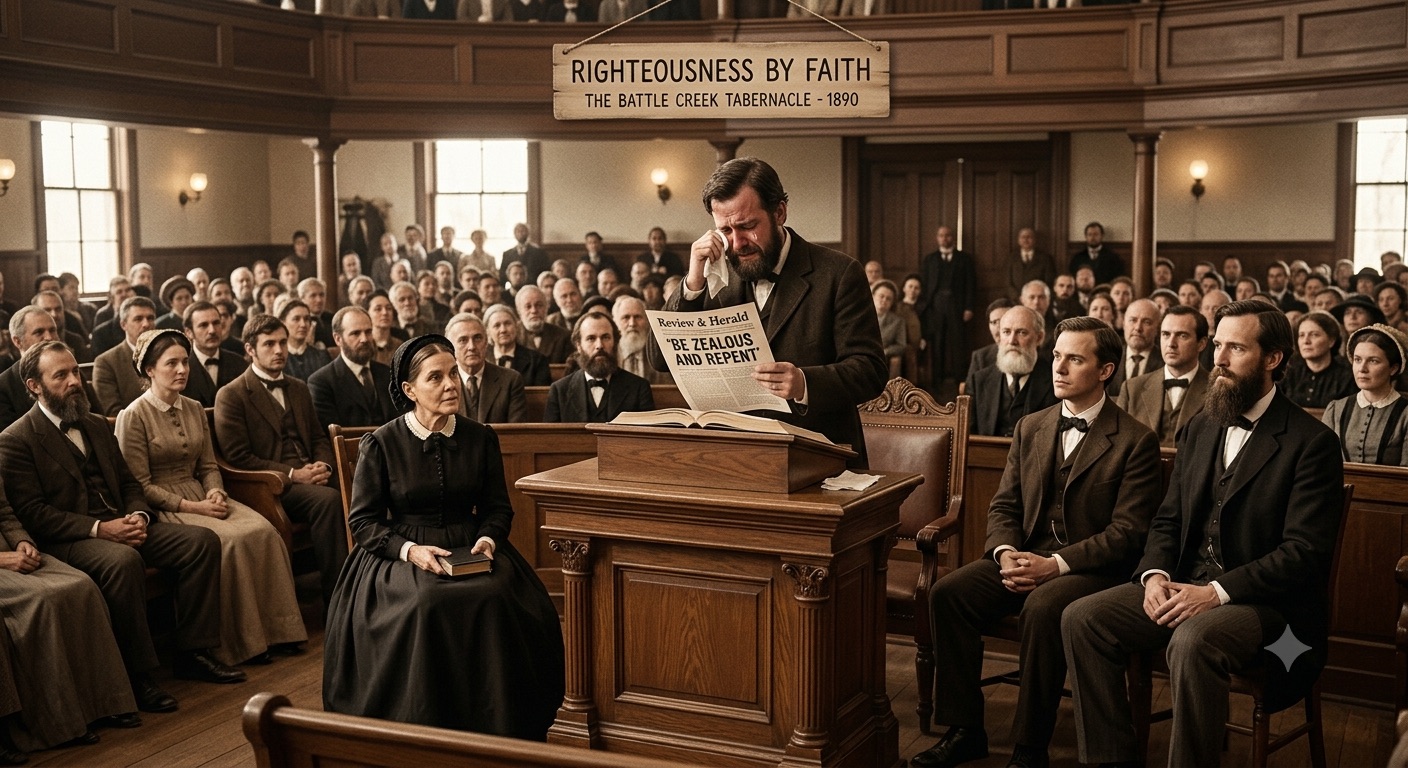
Prescott’s transformation did not happen during the heat of the 1888 debate. It took two years for the seeds of truth to crack his intellectual armor. The turning point arrived on a cold Sabbath morning in late December 1890 at the Battle Creek Tabernacle.
Ellen White had just published a searing, heartbreaking testimony titled “Be Zealous and Repent” in the Review and Herald Extra. Because of his prominent position, Prescott was asked to stand before the vast congregation and read it aloud. He stepped up to the pulpit as the poised, polished academic. He did not know that these inspired words would completely dismantle his life.
As Prescott read the testimony, the words began to pierce his soul. The text struck directly at the pride of the Battle Creek leadership:
“The Lord has seen our backsliding… Because the Lord has, in former days, blessed and honored them, they flatter themselves that they are chosen and true, and do not need warning and instruction and reproof… Light is to shine forth from God’s people in clear, distinct rays, bringing Jesus before the churches and before the world.” (Ellen G. White, Review & Herald Extra, Dec. 23, 1890)
The weight of his own spiritual nakedness crashed down on him. Mid-sentence, Prescott’s voice wavered. The polished educator began to weep. According to historical accounts documented by historians like George R. Knight, Prescott had to stop reading multiple times, gripped by intense emotion.
Right there, in front of the people he led, the intellectual defenses crumbled. Prescott openly confessed his pride and his lack of living faith. That morning, he stopped merely knowing about doctrines and finally met Jesus as his personal Savior. The message of 1888 was no longer a theological theory to be analyzed; it became his living reality.
A Voice Transformed
Once Prescott tasted the grace of the 1888 message, his life changed entirely. He instantly joined hands with Ellen White, A.T. Jones, and E.J. Waggoner, becoming one of the most powerful, Christ-centered preachers of righteousness by faith in Adventist history.
His conversion sparked a massive theological shift in the church. Prescott realized that if Christ’s righteousness is our only hope for salvation, then Christ must be fully, eternally God. He began to challenge the anti-Trinitarian and semi-Arian views held by most early pioneers who believed Jesus had a beginning in the remote past.
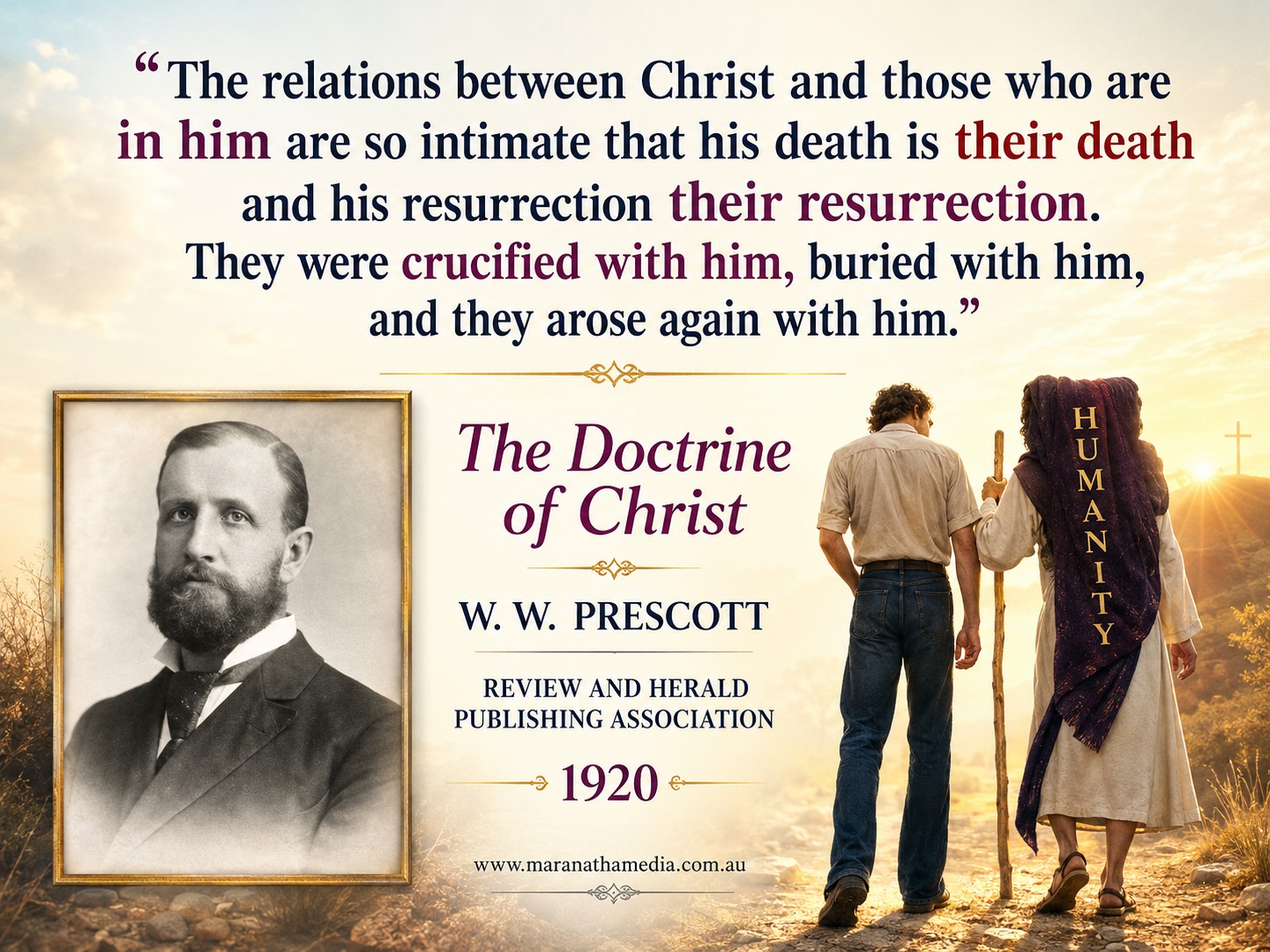
Supported by Ellen White’s landmark book The Desire of Ages, which declared, “In Christ is life, original, unborrowed, underived” (Ellen G. White, The Desire of Ages, p. 530), Prescott led the ministry into a deeper understanding of the Godhead. At the historic 1919 Bible Conference, he presented a profoundly Christocentric view of the Trinity, culminating in his textbook, The Doctrine of Christ:
“Christ is the center of all Scripture, as he is the center of all God’s purposes and counsels… If he is to be to us a Savior from sin, we must receive him as ‘the way, the truth, and the life,’ and we must not permit the knowledge of doctrines about him to obscure him in his blessed fullness.” (W.W. Prescott, The Doctrine of Christ, 1919, p. 13)
He also recognized that righteousness by faith is impossible without a personal, living connection to the Holy Spirit, moving the church away from viewing the Spirit as a mere impersonal force. He wrote:
“This victory is inseparable from Christ Himself, and when I learned how to receive Christ as my victory through union with Him, I entered upon a new experience… I hear Him saying to me, ‘My power is made perfect in weakness,’ and so I surrender my whole being to be under His control.” (W.W. Prescott, Sermon: Victory in Christ)
W.W. Prescott’s journey remains a powerful monument in Adventist history. He proved that the greatest barrier to the gospel is often not open hostility, but professional, intellectual religion. By allowing the Holy Spirit to break him at the pulpit, the proud educator became a humble witness to the truth that changes everything: Christ our righteousness.