
George Knight vs. Jack Sequeira: Missing Dimension of Adventist Gospel
INTRODUCTION
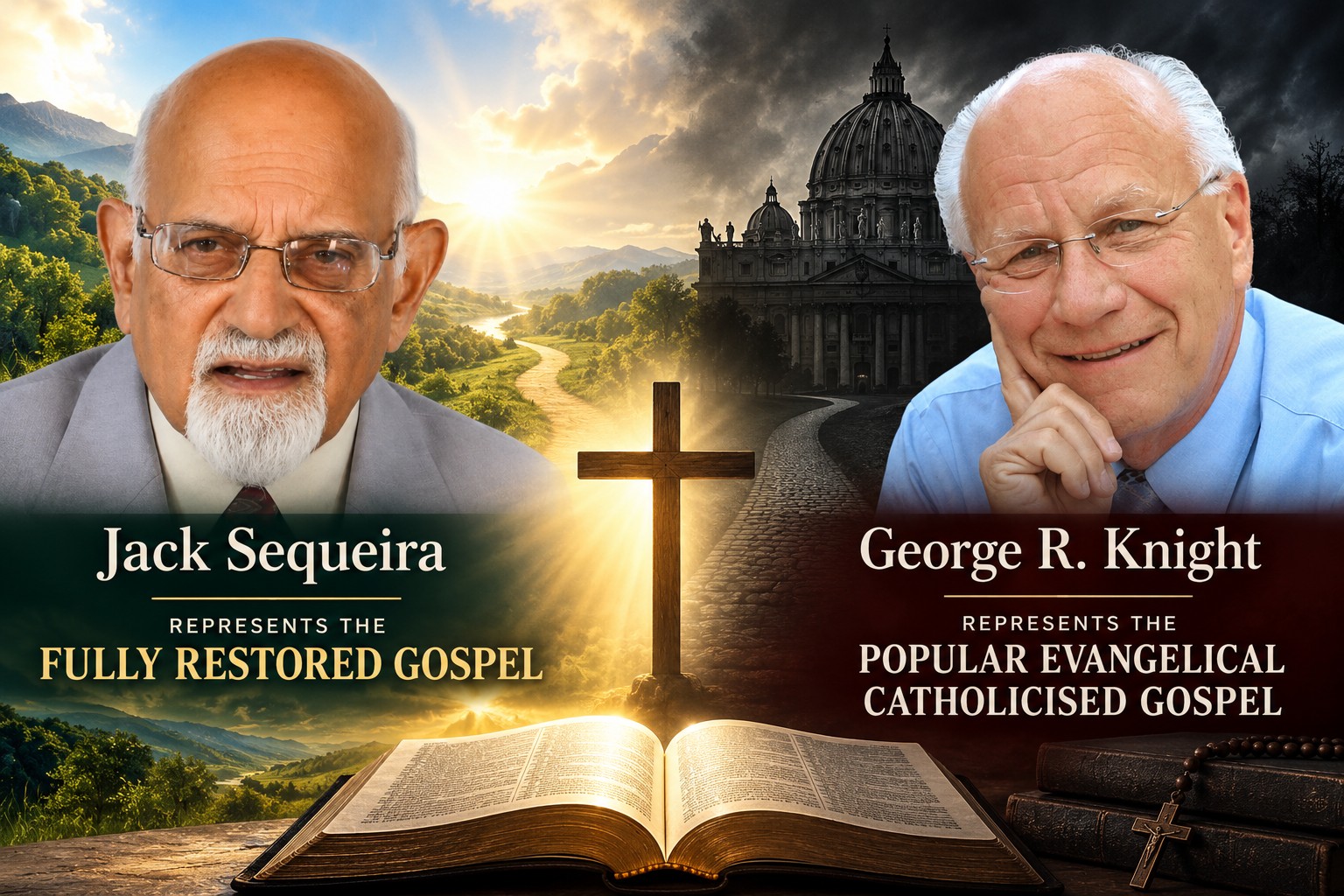
George R. Knight and Jack Sequeira both strongly proclaim salvation by grace through faith. Both reject salvation by works and teach that no amount of obedience to the law can justify a sinner. Yet when their explanations of Romans and other Pauline passages are carefully compared, an important difference appears.
Knight teaches that Christ accomplished everything necessary for the salvation of the whole world, but the individual is not justified until he accepts Christ by faith.
Sequeira agrees that salvation must be received by faith, but he goes further. He teaches that Christ, as the Second Adam and Representative of humanity, actually accomplished a new saving history for the human race in Himself 2000 years ago. His obedience, death and resurrection were not merely something done for humanity from the outside. Humanity was represented in Him. According to Sequeira, therefore, faith does not cause Christ’s work to become an accomplished reality. Faith receives and personally acknowledges what God has already accomplished for humanity in Christ.
This difference becomes especially clear in Romans 5:12–21, 2 Corinthians 5:14–21, Ephesians 2:4–10, Romans 7:4–6 and Romans 8:1–4.
Sequeira seems to agree that in a sense our salvation in Christ can be described as a provision or an offer that is made effective by faith alone (1 Cor. 3:11-13) but the word “provision” must not be confused with the word “provisional” as taught by Arminianism, that on the cross Christ did not actually secure salvation for anyone but only made it possible for all humankind to be saved.
According to the true gospel, in Christ the entire humankind was already actually saved 2000 years ago. The only thing that is needed for this supreme gift of God to be effective is our wholehearted acceptance of this already accomplished historic fact through authentic faith which always bears fruit in the form of the new birth.
Sequeira’s understanding of justification can be illustrated using the analogy of money deposited into our bank account. The “money” (salvation) was already transferred to our account 2000 years ago but it does not benefit us if we refuse to accept it, just as money deposited into our bank account, though legally ours, does not benefit us unless we lay claim to it.
On the other hand, according to the provisional gospel preached by most Adventists and Evangelical Christians, what happened 2000 years ago was not the actual salvation of humankind but only a provision that had been made to make salvation possible. Therefore, salvation requires a true faith in order to make it effective but in this case, our faith contributes to our salvation making such gospel a subtle form of legalism. We are not saved because of our faith but through faith.
According to this gospel, we must first apply for the available money and sign a document (accept the provision) and only then the money can be transferred to our account.
Bible, however, teaches that the salvation of all sinners has been already accomplished and secured (money already transferred) and the only thing we need to do to enjoy it is acknowledging our salvation history in Christ it through genuine faith.
According to Sequeira, “Adventists traditionally belong to the Wesleyan Arminian school of theology. Unlike the Calvinists, who believe that Christ saved only the elect on the cross, hence “limited atonement,” the Armenians believe that Christ only “potentially” or “provisionally” saved all of mankind on the cross.
For this provisional salvation to become a reality, one must repent and believe in Jesus Christ. Only then will God place that person into Christ and the provision will become a reality. Thus, traditionally, we Adventists have limited the in Christ motif only to believers.
The main argument that has often been used to prove that the in Christ motif applies only to believers is Romans 16:7. In this chapter of greetings, Paul makes this statement: “Greet Andronicus and Junias, my relatives who have been in prison on with me…. They were in Christ before I was”.
Clearly, what Paul is implying is that these two men accepted the truth as it is in Christ and were converted before Paul himself. According to Sequeira, to build a whole theology on this one text while ignoring all the other in Christ texts Paul uses many times is very poor exegesis, to say the least.
Further, this conclusion is a subtle form of legalism, salvation by works, since repentance and faith contribute towards one’s salvation. Whereas, according to Paul, it is “the goodness of God (the reality phase or objective facts of the gospel) that leads one to faith and repentance” (Romans 2:4).
Hence, faith is not allowing God or giving Him permission to put us into Christ but accepting with grateful hearts what God has already accomplished for mankind in Christ (1 Corinthians 1:30-31; 2 Corinthians 5:18-20; Ephesians 1:3-4).
It is here where Jack Sequeira disagrees with the teachings of the Biblical Research Institute (BRI) of the GC, as well as some of the Independent Ministries. He believes that the true everlasting gospel, which God raised the Advent Movement to proclaim to the world in its global mission, is neither the limited atonement of Calvinism nor the provisional salvation of Arminianism. Rather, it is the incredible good news that on the cross the entire human race was actually or objectively redeemed, justified, and reconciled to God by the death of His Son (John 3:17; 17:4; 19:30; Romans 5:5-10,18; Ephesians 2:5, 6, 8, 9; 2 Corinthians 5:19).
This is God’s supreme gift to the entire human race, made effective by faith (John 3:16; Romans 3:21-28). When we Adventists fulfill this global mission we will have truly proclaimed the everlasting gospel of the three angels of Revelation 14 with the power of the fourth angel of Revelation 18. When this is realized, it will become inexcusable for anyone to be lost. The end will then come (Matthew 24:4).
But when we limit the in Christ motif only to its third phase, the subjective experience of salvation, we make the experience of salvation the gospel itself, rather than its application or fruits. But since this experience is an ongoing process, until the Second Advent (Romans 5:19b, note future tense; Ephesians 2:7), it turns the gospel into good advice, rather than good news, thus robbing our people of the joy, peace, and assurance of salvation, as demonstrated by the Value-Genesis survey conducted some years ago.” (link)
George R. Knight
George R. Knight (1941–) is a Seventh-day Adventist historian, theologian, and professor emeritus of church history at Andrews University. Knight rejects Universal Legal Justification (ULJ)—the teaching that the entire human race was objectively and legally justified at the cross before personal faith. He argues instead that Christ provided salvation for all humanity, but that justification is received through faith: “Faith is the condition of salvation.” (George R. Knight, Sin and Salvation: God’s Work for and in Us, p. 85.)
Discussing Romans 5:18, one of the main texts used to support Universal Legal Justification, Knight states: “Without doubt Christ died for the sins of ‘everyone’ (see Heb. 2:9), but that does not imply universal justification. The ‘many,’ of course, are those who have complied with the faith condition that Paul has so aggressively argued for in Romans up to this point.” (George R. Knight, Sin and Salvation: God’s Work for and in Us, p. 86.)
There is no doubt that the above statement is not correct. According to Sequeira and many leading Protestant biblical theologians (quoted above), “the many” in Romans 5:15,19 refers to “all” sinners (Romans 5:18), and not to believers only. As all are condemned as a result of the first Adam’s sin, also all were saved as a result of the second Adam (Chris’s) perfect obedience in our representative flesh and death. Therefore, the salvation of all sinners was already accomplished by God on the cross (2 Cor. 5:14, 19; Rom. 5:10). Our role is to receive this historic fact wh have in Christ with genuine faith. In this case, however, faith does not contribute to our salvation; it only acknowledges something which has been already accomplished.
In the popular gospel promoted by Knight and other Adventist theologians, God did not yet actually save anyone on the cross but provided a provision of salvation which first requires faith, making sinner’s faith a contributor to our salvation and a subtle form of legalism (Galatianism), salvation by faith plus human factor.
Discussing 2 Corinthians 5, another important passage used in support of ULJ, Knight writes: “The real meaning concerning who is justified in 2 Corinthians 5 is that it is those who are ‘in Christ’ (verses 17–20).” (George R. Knight, Sin and Salvation: God’s Work for and in Us, p. 86.)
For Knight, however, those who are “in Christ” are believers only. Sequeira strongly disagrees with this interpretation. According to Sequeira and many leading biblical theologians, “in Christ” in this context embraces the entire human race: all sinners, past, present and future, were included in Christ in His representative saving work. This is why Paul can say that when “One died for all,” therefore “all died” (2 Cor. 5:14), and that “God was in Christ reconciling the world to Himself” (2 Cor. 5:19).
Here Knight makes another false interpretation, because there can be no doubt that in 2 Corinthians 5:14 and 2 Corinthians 5:19 Paul clearly states that it was not believers only, but “all” who died when “One” died, and that “God was in Christ reconciling” not believers only, but the entire “world” — all sinners — to Himself. Paul confirms this idea in Romans 5:9-10 where he states that God reconciled us to himslef (saved us), not when we were blievers, but when we were unbelievers and anemies!
To be honest, I find it difficult to understand how any theologian could carefully study 2 Corinthians 5 and conclude that Paul is referring only to believers in these statements. I am ashamed that well-known leading Adventist theologians including Knight, Rodriguez, Dederen could present such interpretation.
DID GOD SAVE US BEFORE WE BELIEVE OR AFTER WE BELIEVE?
There are many SDA theologians and popular authors who claim that the Bible and SOP do not teach the idea of universal legal justification prior to personal faith (link).
The ULJ does not claim that any sinner will be saved without accepting salvation through genuine faith. It only opposes the idea that faith itself contributes to or merits our salvation. This truth was expressed by theologians long ago. An excellent example is the following statement by Edward Irving (1792–1834):
“The redemption of the world is a past fact. The work of the Cross was the re-creation of the human race in Christ. Faith does not make it so; it only acknowledges what is already true in the Second Adam.” — The Incarnation of the Word (1828), Sermon 1.
The claim of the opponents of ULJ is simply false because inspired apostle Paul clearly wrote that “God was in Christ reconciling the WORLD (all sinners) to Himself” (2 Corinthians 5:19) and that Christ didn’t wait until we believe in order to save us but He saved us when “we were yet sinners” and “God’s enemies” (Romans 5:8-10).
It means that God saved us before we believed and accepted the gift. There are many universal Bible statements that give undeniable evidence that God already and actually saved in Christ the entire world (all past, present and future sinners) two thousand years ago without asking any of us for our approval or faith. He first unconditionally saved all sinners and the only thing He expects from us after saving us is to accept His supreme gift of love.
Unfortunately, antiuniversalists believe that salvation was only provisional and sinners must first believe, and only then they can be saved.
Let me try to explain the subtle but important DIFFERENCE BETWEEN THE TWO VIEWS OF SALVATION.
UNIVERSAL LEGAL JUSTIFICATION: Imagine you are completely broke but someone transfers £1 million directly into your bank account as a free gift before you even know about it. The money is already there and already yours. You don’t need to apply for it you just need to use it. Likewise, believing the good news does not cause the transfer. Faith simply acknowledges the gift and enjoys what has already been given.
PROVISIONAL SALVATION: Now imagine someone promises you £1 million, but your account still shows £0. The money is prepared to be transferred, but it can’t be yours until you first apply for it. Here, you have to do something to make it happen. Likewise, in provisional salvation model, faith must come first then the gift becomes yours. Here faith of the believer contributes to salvation and the concept becomes a subtle form of legalism!

THE CATHOLIC PARALLEL: SEPARATING CHRIST FROM THE HUMANITY THAT NEEDED REDEMPTION
Knight also differs from Sequeira concerning the humanity Christ assumed. He accepts that Christ took humanity after the Fall and experienced its physical weaknesses, but he does not believe Christ inherited moral and spiritual dimension of fallen human nature, meaning that His human nature was deprived of the indwelling “law of sin” (from Romans 7 and Romans 8:2-3).
There is another serious consequence of the position represented by George Knight, Raoul Dederen, Ángel Manuel Rodríguez and a number of other modern Adventist theologians. Although these writers do not formally accept the Roman Catholic doctrine of the Immaculate Conception of Mary, their understanding of Christ’s humanity produces an important Christological parallel with the result achieved in Catholic theology: Christ becomes separated from an essential aspect of the fallen humanity He came to redeem.
The Roman Catholic doctrine of the Immaculate Conception does not refer to Christ’s conception. It teaches that Mary herself, from the first moment of her conception, was preserved from original sin. Pope Pius IX formally defined the doctrine in 1854, declaring that Mary was preserved “free from all stain of original sin.”
This Catholic doctrine provides a theological means of maintaining that Christ genuinely received His humanity from Mary while remaining free from the inherited sinful condition attributed to ordinary descendants of Adam. Mary herself is first made an exception to the ordinary fallen condition of humanity; Christ can consequently receive humanity through a mother preserved from original sin.
Adventists such as Knight, Dederen and Rodríguez do not need an immaculate Mary to reach a partly similar Christological result. They reject the Catholic doctrine, yet the crucial question remains: If Christ inherited our physical infirmities but was exempted from the deeper fallen condition and sinful propensities regarded as characteristic of ordinary fallen humanity, has His humanity not again been separated at a crucial point from the humanity that actually needed redemption?
The theological mechanism is different, but the resulting Christological separation deserves serious attention.
This does not by itself prove that Knight, Dederen or Rodríguez consciously intended to introduce Catholic theology into Adventism. Intention would require separate historical evidence. But theological ideas must be judged by their consequences regardless of intention. An Adventist Christology can reject the Immaculate Conception by name while nevertheless moving toward a comparable separation between Christ’s humanity and the fallen humanity He came to redeem.
Knight’s reinterpretations are considered by critics as a attempts of Catholicising and ecumenical trend within modern Adventism, associated in different theological areas with figures such as Raoul Dederen, Ángel Manuel Rodríguez, Jon Paulien and others. From this perspective, distinctive historic Adventist teachings that created a clear theological separation between Adventism and Roman Catholicism have progressively been weakened, reinterpreted or abandoned, making Adventism increasingly compatible with the wider ecumenical movement.
A particularly important example is the interpretation of 666 in Revelation 13:18. Historic Adventist interpreters famously connected the number with the papal designation Vicarius Filii Dei, whose Roman-numeral letters total 666. Rodríguez moved away from making this identification the primary meaning of the number and promoted a symbolic interpretation:
“It appears that the triple six stands for the satanic triumvirate in contrast to the triple seven of the Godhead in Revelation 1:4–6.” (Ángel Manuel Rodríguez, Adult Sabbath School Bible Study Guide: Great Apocalyptic Prophecies, April–June 2002, pp. 85–86.)
Jon Paulien also rejects the traditional Adventist interpretation that 666 refers to the papal title Vicarius Filii Dei. Instead, he interprets 666 mainly as a symbol of human imperfection and rebellion against God.
From this critical perspective, these developments are not insignificant academic adjustments. They Catholicise Adventism by removing or weakening doctrines and prophetic interpretations that historically distinguished the Seventh-day Adventist message from Roman Catholic theology. The resulting theology is considerably more Catholic-friendly and makes Adventist participation in the wider ecumenical movement easier. Critics see this movement as ultimately serving the ecumenical objective of bringing separated Christian bodies increasingly closer to Rome.
THE BIBLICAL SOLUTION REQUIRES NO IMMACULATE MARY
The biblical solution does not require an immaculate Mary. Neither does it require Christ to receive an artificially insulated humanity.
Mary herself needed a Saviour: “My spirit has rejoiced in God my Savior.” (Luke 1:47) Christ therefore genuinely entered Adam’s fallen human family through Mary while remaining Himself absolutely without sin.
The solution is not to change the humanity Christ assumed. The solution is to distinguish fallen human nature from personal sin.
Christ could assume humanity damaged by the Fall without becoming a sinner. His person remained holy. His character remained spotless. His will never consented to sin. Yet He genuinely entered our fallen humanity and overcame where humanity had failed.
Thus Hebrews can declare that He “was in all points tempted as we are, yet without sin.” (Hebrews 4:15)
And Romans can declare that God sent His Son “in the likeness of sinful flesh” and “condemned sin in the flesh.” (Romans 8:3)
The glory of Christ’s victory is therefore not that He defeated sin from a humanity insulated from our fundamental problem. He entered our fallen humanity and conquered sin where sin had conquered us.
PRESCOTT TOOK A RADICALLY DIFFERENT APPROACH
Prescott did not safeguard Christ’s holiness by distancing His humanity from ours. He proclaimed: “The flesh which he took and in which he dwelt was our flesh, and we were there in him.”
And: “Jesus Christ was the representative of humanity, and all humanity centered in him.”
The difference is profound. Prescott’s Christ did not merely take something resembling our humanity. He took our humanity. Therefore Prescott could conclude: “What Jesus Christ in the flesh did, we did in him.”
This is why Prescott could also understand Christ as humanity meeting the claims of God’s law for humanity. The humanity that failed in Adam was represented by humanity’s new Head in Christ.
SEQUEIRA RECOVERS PRESCOTT’S CORPORATE CHRISTOLOGY
Sequeira follows essentially the same corporate logic when he says that Christ assumed “our corporate fallen human nature that needed redeeming.”
Again, the words “that needed redeeming” are decisive.
If our fallen humanity needed redemption, Christ had to become genuinely identified with that humanity to become its Second Adam. He could not redeem fallen humanity merely by standing alongside it as a separate kind of humanity.
Therefore: Our humanity was represented in Him. Our humanity met the law’s demands in Him. Sin was condemned in our flesh in Him. Our condemned corporate life went to the cross in Him. “One died for all, then all died.” And a new humanity arose in Him.
This provides the foundation for Sequeira’s entire “in Christ” gospel.
WHY CHRIST’S HUMANITY CHANGES THE GOSPEL
We can now understand why Sequeira regarded the humanity of Christ as fundamental to the gospel.
If Christ assumed only humanity’s physical weakness while remaining separated from the corporate fallen humanity affected by the law of sin, salvation tends to be understood primarily as something Christ accomplished FOR humanity whose benefits become ours individually through faith.
That is substantially where Knight’s interpretation leads.
But if Christ truly became humanity’s Second Adam—if our corporate fallen humanity was genuinely represented in Him—then something greater can be proclaimed: God actually dealt with humanity IN Christ.
His obedience was the obedience of humanity’s Representative. His death was humanity’s representative death. His resurrection established humanity’s new history in its Second Adam.
Faith does not create this history. Faith receives it.
This provides the theological foundation for Sequeira’s understanding of Universal Legal Justification.
KNIGHT’S CHRISTOLOGY AND HIS REJECTION OF ULJ ARE CONNECTED
It is therefore significant that Knight rejects Universal Legal Justification. His understanding of Christ’s humanity and his understanding of justification fit together.
Knight does not embrace the same complete corporate identification between Christ and fallen humanity that forms the foundation of Sequeira’s gospel. Consequently, he also rejects Sequeira’s conclusion that Christ’s representative obedience and death constituted an objective legal history for the entire human race.
A similar rejection of Universal Legal Justification appears in the writings of Ángel Manuel Rodríguez and the Biblical Research Institute. Thus the disagreement is not merely about one interpretation of Romans 5:18. It reaches backwards to the incarnation itself and the meaning of Christ as the Second Adam and Representative of fallen humanity.
THE REAL DANGER FOR ADVENTIST THEOLOGY
The real danger is therefore deeper than formally accepting or rejecting a Roman Catholic doctrine. The crucial danger is separating Christ from the humanity He came to redeem.
Once Christ’s humanity is fundamentally separated from our fallen humanity, the great Pauline corporate principle becomes increasingly difficult to maintain: “One died for all, then all died.”
Prescott’s proclamation becomes difficult to explain: “All humanity centered in Him.”
And Sequeira’s fundamental gospel principle disappears: Christ assumed our corporate fallen humanity that needed redeeming.
This is why the controversy reaches far beyond terminology about Christ’s nature. The fundamental question is: Could Christ genuinely become the Second Adam and Representative of all sinners without genuinely assuming the corporate humanity of those sinners?
Prescott and Sequeira effectively answer: No. Christ could save humanity as its Representative because He truly became one with the humanity He came to redeem.
THE FUNDAMENTAL DIFFERENCE BETWEEN KNIGHT AND SEQUEIRA
The difference can therefore be stated simply.
Knight: Christ assumed fallen humanity in its physical weakness but not its sinful propensities. Christ perfectly lived and died for sinners, and through faith the sinner enters saving union with Christ and receives justification.
Sequeira: Christ assumed the corporate fallen humanity that stood under the law’s condemnation. As the Second Adam He became humanity’s legal Representative. In that humanity He perfectly obeyed God’s law, condemned the law of sin in the flesh, and carried condemned humanity to the cross. Therefore His saving history has objective significance for the humanity represented in Him. Faith receives and personally experiences what God has already accomplished in Christ.
The second understanding gives tremendous force to Paul’s statements: “One died for all, then all died”; “our old man was crucified with Him”; “you became dead to the law through the body of Christ”; and God “made us alive together with Christ” and “raised us up together.”
And it corresponds remarkably with Prescott’s proclamation: “Jesus Christ was the representative of humanity, and all humanity centered in Him.”
CONCLUSION: CHANGE CHRIST’S HUMANITY AND YOU AFFECT THE GOSPEL
The real foundation of the Knight–Sequeira disagreement is therefore the humanity of Christ. The question is not merely whether Jesus experienced hunger, tiredness, pain, physical weakness and mortality. The deeper question is: Did the Son of God truly assume and represent the corporate fallen humanity that stood condemned and needed redemption?
Knight stops short of Sequeira’s answer. Sequeira emphatically affirms it. And W. W. Prescott had already proclaimed essentially the same corporate principle in the 1890s.
The humanity that had violated the law had to meet the law’s demands. It could not accomplish this in Adam, and we could never accomplish it individually. Therefore God united humanity with His Son and gave mankind a new Representative.
In Christ, humanity’s Representative perfectly obeyed. In Christ, sin was condemned in the flesh. In Christ, the sentence of the law was met. In Christ, the old humanity died. And in Christ, a new humanity rose again.
This is why Prescott could describe humanity’s inclusion in Christ as “the very core and life and heart of Christianity.”
It also explains why Sequeira’s understanding of Christ’s humanity cannot be separated from his understanding of the gospel. Change the humanity Christ assumed and you affect the meaning of His representation. Change His representation and you affect the meaning of the cross. Change the meaning of the cross and you inevitably affect the gospel being proclaimed.
The biblical solution requires neither an immaculate Mary nor a Christ whose humanity is insulated from the fallen humanity He came to redeem. It gives us something far greater: the holy and sinless Son of God genuinely entering our fallen humanity, defeating the law of sin within it, perfectly satisfying the demands of God’s holy law as our Representative, carrying that humanity to the cross, and raising it to new life in Himself.
Therefore, if Christ truly became the Second Adam and Representative of fallen humanity, salvation is not merely something Christ made available to mankind. It is first an objective saving history that God accomplished for humanity in Christ—a history that faith does not produce, complete or improve, but simply receives.
That is Prescott’s great “all humanity centered in Him” proclamation. It is the foundation of Sequeira’s “in Christ” gospel, and it explains why the controversy over the humanity of Christ ultimately becomes a controversy over the gospel itself.
EPHESIANS 2:4–6 — MADE ALIVE, RAISED AND SEATED WITH CHRIST
Paul uses extraordinary language in Ephesians 2: “God, who is rich in mercy… made us alive together with Christ… and raised us up together, and made us sit together in the heavenly places in Christ Jesus.” Ephesians 2:4–6.
Paul does not merely say that Christ was made alive; he says that God made us alive with Christ. He does not merely say that Christ was raised; he says that God raised us with Him. He even says that God made us sit with Christ in heavenly places.
Sequeira asks an obvious question: How could believers living centuries later have been raised with Christ when they were not physically present two thousand years ago? His answer is the “in Christ” principle. Christ was humanity’s Representative. Therefore His history constitutes the saving history of humanity in Him.
Sequeira asks: “What does Scripture mean when it tells us that we were together with Christ in His birth, life, death, burial, and resurrection, and now, are sitting with Him in heavenly places?” Jack Sequeira, The Everlasting Gospel, Part 2. He then states: “The whole understanding of the everlasting gospel hinges on our understanding the significance of these two vital words: ‘in Christ.’” Jack Sequeira, The Everlasting Gospel, Part 2.
This is one of the strongest features of Sequeira’s theology. The phrase “in Christ” is not simply another way of describing conversion. It explains how Christ could act as humanity’s Representative. His death becomes our death, His resurrection becomes our resurrection, His righteousness becomes our righteousness, and His standing before God becomes ours when we receive Him by faith.
W. W. PRESCOTT AND THE “IN CHRIST” MOTIF
This is where Adventist history becomes especially interesting. Sequeira’s teaching about corporate humanity in Christ was not entirely new. W. W. Prescott preached a remarkably similar principle in 1895.
At the General Conference session in February 1895, Prescott preached a sermon called “The Divine-Human Family.” Using the biblical example of Levi being “in Abraham,” he explained the representative relationship between Christ and humanity.
Prescott said: “Jesus Christ was the representative of humanity, and all humanity centered in him.” W. W. Prescott, “The Divine-Human Family,” General Conference Bulletin, February 6, 1895, p. 24.
He continued: “Just as what Abraham did, Levi did in Abraham, so what Jesus Christ in the flesh did, we did in him.” W. W. Prescott, “The Divine-Human Family,” General Conference Bulletin, February 6, 1895, p. 24.
Prescott considered this principle so important that he declared: “This is the most glorious truth in Christianity. It is Christianity itself, it is the very core and life and heart of Christianity.” W. W. Prescott, “The Divine-Human Family,” General Conference Bulletin, February 6, 1895, p. 24.
Then he summarised the idea: “He took our flesh, and our humanity was found in him, and what he did, humanity did in him.” W. W. Prescott, “The Divine-Human Family,” General Conference Bulletin, February 6, 1895, p. 24.
The resemblance to Sequeira is unmistakable. Prescott did not merely say that Christ acted for humanity. He said that humanity was represented in Christ and therefore what Christ did, humanity did representatively in Him.
PRESCOTT AT ARMADALE
Later that same year Prescott preached at the Armadale camp meeting in Australia. His famous sermon “The Word Became Flesh” was delivered on October 31, 1895 and later published in The Bible Echo.
There Prescott expressed the corporate idea even more directly: “We were all in Jesus Christ.” W. W. Prescott, “The Word Became Flesh,” Armadale Camp Meeting, October 31, 1895; The Bible Echo, January 6, 1896.
He explained: “He was our representative; He became flesh; He became we.” W. W. Prescott, “The Word Became Flesh,” Armadale Camp Meeting, October 31, 1895; The Bible Echo, January 6, 1896.
Then he drew the remarkable conclusion: “All humanity was brought together in Jesus Christ. He suffered on the cross, then, it was the whole family in Jesus Christ that was crucified.” W. W. Prescott, “The Word Became Flesh,” Armadale Camp Meeting, October 31, 1895; The Bible Echo, January 6, 1896.
Compare that directly with Paul: “If One died for all, then all died.” 2 Corinthians 5:14.
Prescott’s point was not universalism. His point was representation. Christ became one with the humanity He came to save. Therefore the cross was not merely the death of an isolated Individual. The Representative of humanity carried humanity to the cross in Himself.
SEQUEIRA AND PRESCOTT
The similarities are striking. Prescott called Christ “the representative of humanity,” while Sequeira calls Christ the Second Adam and Representative of humanity. Prescott said that “all humanity centered in Him,” while Sequeira teaches that Christ assumed corporate humanity. Prescott said, “What Jesus Christ in the flesh did, we did in Him,” while Sequeira teaches that Christ produced a new saving history for humanity in Himself.
Prescott said, “We were all in Jesus Christ.” Sequeira makes the “in Christ” motif foundational to his gospel. Prescott said that “the whole family in Jesus Christ” was crucified. Sequeira points directly to Paul’s statement: “If One died for all, then all died.” 2 Corinthians 5:14.
This does not prove that every detail of Prescott’s theology was identical to Sequeira’s. It was not. But the underlying corporate “in Christ” idea is clearly present in both.
KNIGHT AND THE BIBLICAL RESEARCH INSTITUTE POSITION
It is important to recognise that Knight’s rejection of Universal Legal Justification is not unique to him. The Biblical Research Institute has published a series of articles by Ángel Manuel Rodríguez, a former BRI director, opposing Universal Legal Justification.
Rodríguez agrees with Knight that Christ’s work has universal significance and that His sacrifice provides a complete basis for the salvation of every human being. But he rejects the idea that every individual was already legally justified at the cross irrespective of faith.
Rodríguez writes concerning Romans 5: “Only those who receive the provision are indeed justified.” Ángel Manuel Rodríguez, “Justification and the Cross,” Biblical Research Institute.
He therefore describes Christ’s work in Romans 5 in terms of universal provision: “The fact that the grace of righteousness is a gift supports also the idea that it is universal in its provision but not in its salvific effectiveness unless all receive it.” Ángel Manuel Rodríguez, “Justification and the Cross,” Biblical Research Institute.
This is extremely close to Knight, who says: “Christ died to provide justification for all people.” George R. Knight, Exploring Romans, comment on Romans 5:18.
The disagreement is therefore not about whether Christ died for everyone. Knight, Rodríguez and Sequeira all affirm the universal scope and sufficiency of Christ’s sacrifice. Nor is the disagreement about salvation by works. All three reject justification by works. The deeper disagreement concerns what God actually accomplished for humanity in Christ before an individual believes.
MARTIN WEBER ON NIGHT’S VS SEQUEIRA’S GOSPEL
In the mid-1990s, the Seventh-day Adventist Church found itself deeply divided over the most fundamental question of the Christian faith: What is the true gospel? Laypeople and pastors alike were torn between celebrity theologians who all claimed to preach the “true” gospel but fiercely contradicted one another.
To resolve this polarization, a landmark project was undertaken to interview and correspond directly with the most influential Adventist preachers of the era. The resulting analysis mapped out the conflicting theological frameworks keeping believers in a state of spiritual confusion, providing an objective look at who was closest to the New Testament message.
Martin Weber debates by correspondence with five Seventh-day Adventist thought leaders: Morris Venden, George Knight, Jack Sequeira, Ralph Larson, and Graham Maxwell (who declined to participate). What is unusual is that the author is also the moderator of each of these debates. The subject of the debates is revealed in the book’s subtitle, “Making sense out of five different Adventist gospels.”
The debate revolves around the meaning of justification and sanctification, a pre-Fall versus a post-Fall nature of Christ, sinless versus relative perfection, faith and works during sanctification, substitution versus moral influence, and related matters.
George Knight & H.M.S. Richards Jr.: Mainstream Adventism
George Knight (the prominent Adventist historian) and H.M.S. Richards Jr. (the iconic voice of The Voice of Prophecy) represented the traditional, mainstream center of the church. They taught a balanced blend of objective legal standing (Justification by faith alone) and subjective lifestyle transformation (Sanctification by the Holy Spirit), rejecting both Larson’s extreme perfectionism and the fringes of the other movements.
-
The Pauline Test: This view stayed safely within the orthodox boundaries of Paul’s letters. However, Weber noted that this mainstream center was constantly under fire and struggled to inspire the church because it lacked the distinct, passionate, single-issue excitement that made celebrity preachers so captivating.
Who Had the Fully Restored Gospel?
According to Weber’s exhaustive analysis, who actually possessed the truth? While Weber himself sought a cautious, pastoral middle-ground to maintain denominational unity, his side-by-side matrices made an undeniable factual revelation: Pastor Jack Sequeira’s understanding of the gospel was the only model that fully restored the rugged, unconditional, objective power of the New Testament gospel.
Jack Sequeira: The Corporate “In-Christ” Gospel
Pastor Jack Sequeira, an international theologian and pastor, recognized that the only way to completely destroy legalism was to anchor salvation entirely in an objective, historic reality: Universal Legal Justification.
Sequeira explained the profound Pauline truth of the “Two Adams.” Just as the entire human race was corporately trapped in Adam’s condemnation without their personal consent, the entire human race was corporately placed “in Christ” at the cross. On Calvary, Jesus took our collective, fallen human nature into Himself and executed it. Therefore, God legally justified, reconciled, and redeemed the entire human race before anyone ever repented or believed.
In Sequeira’s theology, personal faith does not convince God to save you; faith is simply your joyful awakening to, and heart-felt acceptance of, what Christ already fully accomplished for you. Weber explicitly praised Sequeira for uplifting this objective work of the cross, noting that it beautifully dismantled the fear of judgment by proving that our legal standing in Christ is already flawless.
WHY THIS MATTERS TO THE DEMANDS OF THE LAW
God’s law requires perfect righteousness, while transgression brings condemnation and death. Fallen humanity failed to meet the law’s righteous requirements and therefore stood under its condemnation. If Christ was truly to become the Second Adam and legal Representative of fallen humanity, He had to identify genuinely with the humanity whose legal problem He came to resolve.
This is why Sequeira argues that as our Substitute and Representative Christ had to meet the full demands of the law in order to save fallen humanity. By His perfect obedience He fulfilled the law’s positive requirement of righteousness. By His sacrificial death He met its condemnation against sin.
The important question therefore becomes: Whose humanity was obeying and dying in Christ? If Christ was humanity’s Second Adam, His humanity could not be unrelated to the humanity He represented. Fallen humanity was the humanity requiring redemption. Therefore Christ had to become genuinely identified with it—not by committing our personal sins or developing sinful character, for Christ was absolutely sinless, but by assuming the corporate fallen humanity whose case He came to resolve.
THE “LAW OF SIN” HAD TO BE DEFEATED
This becomes especially important in Romans 8:3: “God did by sending His own Son in the likeness of sinful flesh, on account of sin: He condemned sin in the flesh.”
Sequeira distinguishes between sinful acts and the deeper law or principle of sin operating in fallen human nature. Christ never committed sin. He never consented to sin. He never cherished sinful desires. Yet according to Sequeira, He assumed the fallen humanity affected by the law of sin and condemned sin in the flesh by perfectly refusing its demands throughout His earthly life.
Thus Christ did not overcome humanity’s problem from outside humanity. He entered the humanity affected by that problem and defeated sin there.
This does not mean that Christ possessed sinful character. It means that He assumed the fallen human nature requiring redemption while remaining personally completely sinless. This distinction is essential. Fallen human nature must not be confused with personal transgression or sinful character.
WHERE KNIGHT’S POSITION FALLS SHORT
Here the limitation of Knight’s position becomes apparent. Knight accepts that Christ inherited physical consequences of the Fall, but excludes from Christ the sinful propensities belonging to ordinary fallen humanity. This certainly seeks to safeguard Christ’s absolute sinlessness, which must be protected. But it creates a serious theological question: If Christ did not truly assume the fallen humanity affected by the law of sin, in what sense did He completely represent that humanity and condemn sin “in the flesh”?
Sequeira provides a clearer solution. Christ’s person and character were perfectly holy, while the humanity He assumed was our fallen corporate humanity. Therefore He could encounter the law of sin precisely where fallen humanity experiences it and defeat it without ever yielding to it.
This protects both biblical truths: Christ was absolutely sinless, yet He genuinely assumed the humanity that needed redemption. Knight strongly protects the first truth, but his restriction of Christ’s fallen humanity weakens the corporate identification that Sequeira considers essential to Christ’s role as the Second Adam.
W. W. PRESCOTT: “ALL HUMANITY CENTERED IN HIM”
This is where W. W. Prescott’s preaching becomes extremely important. The corporate understanding central to Sequeira was already proclaimed within Adventism during the 1890s. Prescott did not merely say that Christ possessed a nature similar to ours. He taught that humanity itself was comprehended in Christ.
Prescott declared: “Jesus Christ was the representative of humanity, and all humanity centered in him.” He continued: “The flesh which he took and in which he dwelt was our flesh, and we were there in him.” From this he drew the remarkable conclusion: “What Jesus Christ in the flesh did, we did in him.”
Prescott regarded this as no secondary doctrine. He described this corporate truth as “the very core and life and heart of Christianity.”
The similarity with Sequeira is unmistakable. Christ is not merely an individual standing outside humanity and acting on humanity’s behalf. He becomes the corporate Representative of humanity. Therefore what He accomplishes has objective significance for the humanity represented in Him.
PRESCOTT: CHRIST GATHERED HUMANITY INTO HIMSELF
Prescott made the point even stronger when he spoke of Christ gathering humanity into Himself. Christ became what we are and presented Himself before God as the Representative of humanity.
This is representative substitution grounded in corporate solidarity. Christ can truly act for humanity because humanity is comprehended in its Representative.
Prescott illustrated this principle through the biblical example of Levi being in Abraham when Abraham paid tithes. Levi had not yet been individually born, yet Hebrews 7 can say that Levi paid tithes in Abraham. In a similar corporate sense, humanity could act in Christ, its new Representative Head.
Most importantly, Prescott connected this directly with the law. He presented Christ as the Second Adam, with all humanity meeting in Christ, and Christ as humanity meeting the claims of God’s law for humanity.
That is crucial. Christ did not merely keep the law as an isolated perfect individual. Humanity’s Representative met the law’s demands as humanity’s Representative. This is essentially the principle later made central to Sequeira’s gospel.
ONLY THE REPRESENTATIVE OF FALLEN HUMANITY COULD MEET ITS LEGAL NEED
The logic of the Second Adam motif is powerful. Adam represents humanity because humanity was corporately connected with Adam. Paul therefore writes: “In Adam all die.” (1 Corinthians 15:22) Christ is the Last Adam because He becomes humanity’s new Representative Head.
If Christ is truly the Second Adam, He cannot merely be an unrelated individual who happens to obey where humanity failed. He must genuinely identify Himself with the humanity He represents. This is exactly Prescott’s point: “All humanity centered in Him.” It is also Sequeira’s point when he speaks of Christ assuming our corporate fallen humanity that needed redeeming.
Only such a Representative could meet the law’s demands on behalf of the humanity under condemnation. He obeyed where humanity had disobeyed. He condemned sin in fallen flesh. He carried humanity’s condemned life to the cross. He suffered the sentence of the law. Therefore Paul can make the extraordinary statement: “If One died for all, then all died.” (2 Corinthians 5:14)