Joseph Prince vs John Stott: Is the Moral Law Still Binding?
Slawomir Gromadzki
DISPENSATIONALISM AND NEW COVENANT THEOLOGY
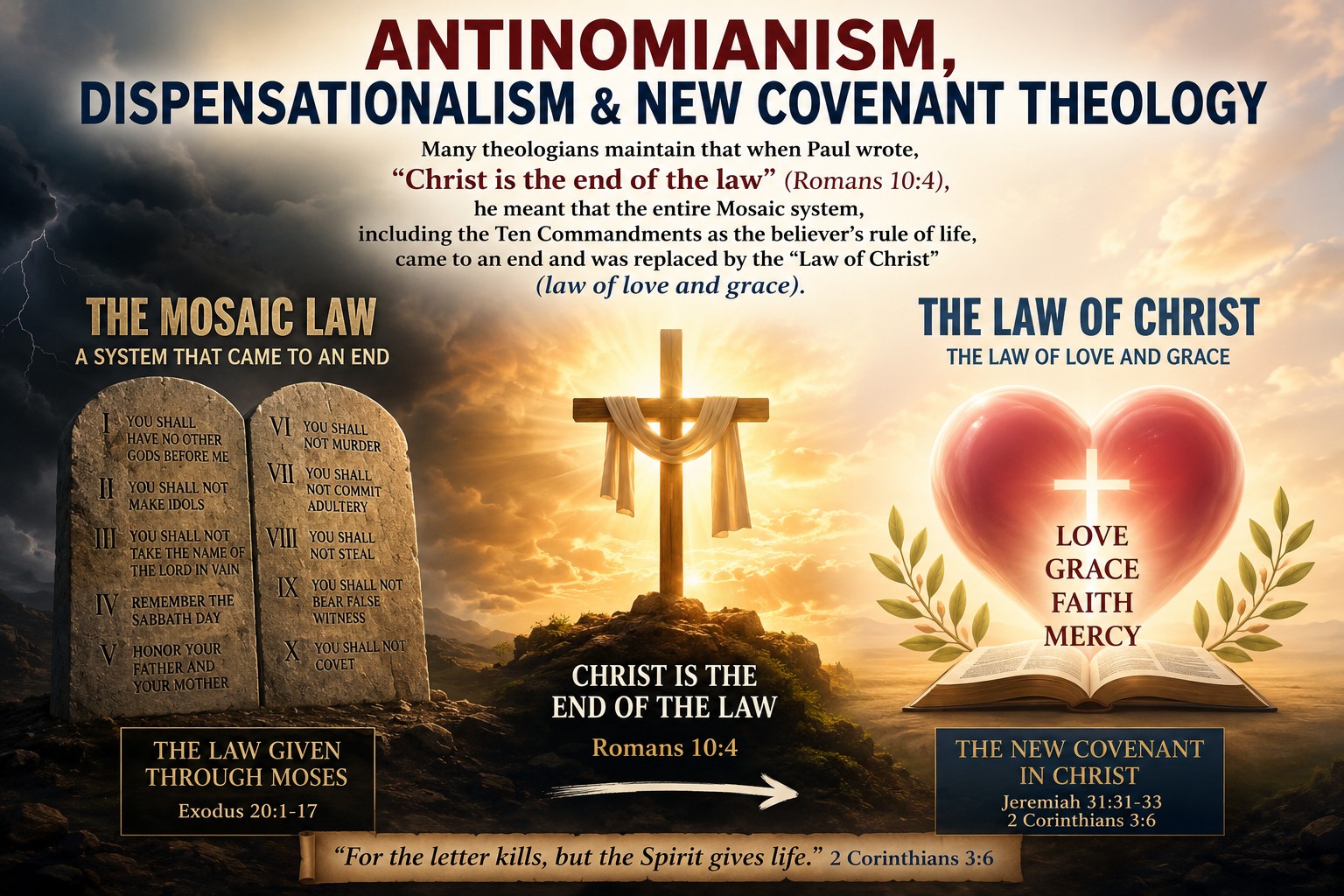
Within several influential branches of evangelical theology, particularly Dispensationalism and New Covenant Theology (NCT), many theologians maintain that when Paul wrote, “Christ is the end of the law” (Romans 10:4), he meant that the entire Mosaic system, including the Ten Commandments as the believer’s rule of life, came to an end and was replaced by the “Law of Christ (law of love and grace).”
According to this view, Christians are no longer under the authority of the Decalogue but are guided instead by the Holy Spirit and the New Testament command to love. Below are a few well-known examples.
Thomas R. Schreiner: “Believers are no longer under the Mosaic covenant, including the Ten Commandments as covenant law, but under the law of Christ.” (40 Questions About Christians and Biblical Law, Kregel Publications.) “Believers are no longer under the Mosaic covenant, including the Ten Commandments as covenant stipulations, though nine of the Ten Commandments are reaffirmed under the law of Christ.” (40 Questions About Christians and Biblical Law)
John MacArthur: “The Mosaic law was one unified law. It is impossible to separate it into ceremonial, judicial, and moral parts. Thus, if the Mosaic law has been set aside, then all of it has been set aside, including the Ten Commandments as a legal code.” (The MacArthur New Testament Commentary: Galatians, comments on Galatians 3.) “Christians are not under the Mosaic law in any sense, including the Ten Commandments as the covenant code given to Israel. They are under the law of Christ.” (The MacArthur Study Bible, notes on Romans 10:4; Galatians 3:24–25.)
Lewis Sperry Chafer: “The law of Moses, as a complete system, has been done away. It is not a rule of life for the believer. This includes the Decalogue as a governing legal system.” (Systematic Theology, Vol. 4.)
Douglas J. Moo: “Christ has brought the Mosaic law to its end as a salvation-historical authority over the people of God.” (The Epistle to the Romans, New International Commentary on the New Testament, Romans 10:4.) “Paul regards the Mosaic law as a single entity. Christians are no longer under its authority. This means that even the Ten Commandments, as part of the Mosaic covenant, are no longer directly binding, though most are repeated within the law of Christ.” (Five Views on Law and Gospel) “The Mosaic law, including the commandments written on the stone tablets, has come to an end as covenantal legislation for God’s people.” (The Epistle to the Romans, NICNT, on Romans 10:4.)
Charles C. Ryrie: “The Mosaic Law was one indivisible code. Therefore, when it came to an end, the Ten Commandments also came to an end as a legal obligation.” (Basic Theology)
ESV Study Bible (comment on Romans 10:4): “‘End’ probably includes the idea of both goal and termination. The Mosaic law has reached its goal in Christ, and the law is no longer binding upon Christians (the old covenant has ended). Since Christ is the goal and end of the law, righteousness belongs to all who trust in Christ.” (ESV Study Bible, note on Romans 10:4.)
CSB Study Bible Notes (comment on Romans 10:4): “Christ is the end of the law in being both its fulfilment and its termination. Any system of salvation based on performance is excluded.” (CSB Study Bible Notes, note on Romans 10:4.)
JOSEPH PRINCE: ANTINOMIAN WHO CLAIMS NOT TO BE AN ANTINOMIAN

Joseph Prince (born Xenonamandar Jegahusiee Singh on May 15, 1963, in Singapore) is a highly prominent international evangelist, author, and the senior pastor of New Creation Church, a non-denominational megachurch in Singapore.
Prince does not have any formal theological education or degrees from a seminary; he is entirely self-taught, developing his theological perspective through personal scripture study and what he credits as direct spiritual revelations.
Today, he commands a massive global influence, primarily known for his focus on the “Word of Grace”. Under his leadership, his home church has grown from roughly 150 members to over 31,000 attendees, while his international footprint spans worldwide through bestselling books and his broadcast program Destined to Reign, which reaches viewers across Asia, North America, Australia, and Africa.
Joseph Prince is one of the world’s most vocal and explicit proponents of the view that New Testament believers are completely free from the obligation of the Ten Commandments. In his books, devotionals, and sermons, his specific stance relies on several core arguments:
-
Prince frequently addresses the objection, “Don’t we need God’s laws to be holy?” He points directly to 2 Corinthians 3:7–9, where Paul refers to a ministry “written and engraved on stones” as the “ministry of death” and “ministry of condemnation.” Prince highlights that only the Ten Commandments were engraved on stones (not the ceremonial or civil laws), arguing that preaching them brings spiritual death, guilt, and condemnation rather than holiness.
-
When addressing Hebrews 8:10 (“I will put My laws in their mind and write them on their hearts“), Prince explicitly writes: “He was certainly not referring to the Ten Commandments.” Instead, he argues that God writes the royal law of love, the perfect law of liberty, and the law of faith onto the believer’s heart.
-
Prince heavily rejects the label of “antinomianism” or lawlessness. He argues that trying to keep the law actually gives sin its power (citing Romans 6:14 and 1 Corinthians 15:56). His core philosophy is that when a believer is fully established in grace and realizes they are completely forgiven of all sins (past, present, and future), the Holy Spirit transforms them from the inside out. As a result, they naturally fulfill and exceed the moral standards of the law out of love, rather than out of fear of punishment.
IS KEEPING THE MORAL LAW A “MINISTRY OF DEATH”?
Joseph Prince correctly observes that 2 Corinthians 3:7 refers specifically to the Ten Commandments because they alone were written by God on tablets of stone. However, he draws a conclusion that Paul himself never draws.
Paul does not say that the Ten Commandments are evil, poisonous or opposed to holiness. He calls the old covenant administration centred upon the stone tablets “the ministry of death” and “the ministry of condemnation” because the law could identify sin, pronounce the sinner guilty and sentence the transgressor, but it could neither forgive the sinner nor transform the human heart.
This distinction is evident in Paul’s exact language. He does not write that the commandments were death, but that there was a “ministry of death, written and engraved on stones” and a “ministry of condemnation” (2 Corinthians 3:7, 9). The Greek word diakonia means ministry, service or administration. Paul is therefore comparing two ministries or covenantal administrations: the ministry of condemnation associated with Moses and the ministry of righteousness and the Spirit brought through Christ.
Many evangelical scholars recognise that the contrast is between the old covenant ministry and the new covenant ministry, not between an evil law and a good gospel. See, for example, Colin G. Kruse, 2 Corinthians (Tyndale New Testament Commentaries); Murray J. Harris, The Second Epistle to the Corinthians (NIGTC); David E. Garland, 2 Corinthians (NAC); Philip E. Hughes, Paul’s Second Epistle to the Corinthians.
Paul himself explains why the law is called a ministry of death in Romans 7. He writes, “The commandment, which was to bring life, I found to bring death” (Romans 7:10). If someone stopped reading there, Prince’s conclusion might seem reasonable. But Paul immediately explains his meaning: “Therefore the law is holy, and the commandment holy and just and good” (Romans 7:12).
He then asks, “Has then what is good become death to me? Certainly not! But sin, that it might appear sin, was producing death in me through what is good” (Romans 7:13).
This is probably the strongest biblical answer to Prince’s interpretation. Paul explicitly says that the commandment itself did not become death. Sin produced death through the good commandment. The law exposed, condemned and sentenced the sinner, but the cause of death was sin, not a defect in God’s commandments.
Paul makes the same point elsewhere when he writes, “The sting of death is sin, and the strength of sin is the law” (1 Corinthians 15:56). The law gives sin its condemning force because it defines transgression and holds the sinner accountable. However, that does not make the law evil any more than a righteous judge becomes evil by pronouncing a just sentence upon a guilty criminal. The law condemns because human beings have broken it, not because there is anything wrong with the law itself.
The immediate context of 2 Corinthians 3 also strongly supports this understanding. Before mentioning the ministry engraved on stone, Paul says that believers are Christ’s letter, “written not with ink but by the Spirit of the living God, not on tablets of stone but on tablets of flesh, that is, of the heart” (2 Corinthians 3:3). Paul is clearly alluding to the New Covenant promises in Jeremiah and Ezekiel. God had promised, “I will put My law in their minds, and write it on their hearts” (Jeremiah 31:33). Likewise, He declared, “I will put My Spirit within you and cause you to walk in My statutes, and you will keep My judgments and do them” (Ezekiel 36:27). The movement is therefore not from law to no law, but from law written externally on stone to God’s law written internally on the heart by the Holy Spirit.
This understanding also explains Paul’s statement, “The letter kills, but the Spirit gives life” (2 Corinthians 3:6). The “letter” is not simply every written command of God, otherwise the written New Testament would also kill merely because it consists of written words. Rather, Paul is contrasting an external code that can reveal sin and condemn the sinner with the life-giving work of the Holy Spirit, who changes the heart and enables genuine obedience. The problem is not the commandments themselves but the inability of fallen human nature to keep them apart from God’s transforming grace.
Romans 8 confirms this interpretation. Paul explains that Christ came not to abolish God’s righteous standard but to accomplish what the law itself could never do because of human weakness. He writes that Christ condemned sin in the flesh “that the righteous requirement of the law might be fulfilled in us who do not walk according to the flesh but according to the Spirit” (Romans 8:4). The law remains righteous, but only the Holy Spirit can produce the obedience that the law requires.
Prince’s interpretation also creates a serious contradiction within Paul’s own writings. After the cross, Paul repeatedly quotes the Ten Commandments as binding moral instruction for Christians. He writes, “Children, obey your parents in the Lord, for this is right. ‘Honour your father and mother,’ which is the first commandment with promise” (Ephesians 6:1-2). Paul clearly sees the fifth commandment as relevant for Christian believers. Likewise, he writes, “‘You shall not commit adultery,’ ‘You shall not murder,’ ‘You shall not steal,’ ‘You shall not covet,’ and if there is any other commandment, are all summed up in this saying, namely, ‘You shall love your neighbour as yourself‘” (Romans 13:9). He immediately concludes, “Love is the fulfilment of the law” (Romans 13:10). Love does not replace the commandments; it fulfils them because genuine love naturally avoids adultery, murder, theft, coveting and every other violation of God’s moral law.
James teaches exactly the same principle. After quoting the commandments against adultery and murder, he tells believers, “So speak and so act as those who will be judged by the law of liberty” (James 2:12). The very commandments that condemn the unrepentant sinner become the law of liberty for those who have been forgiven and whose hearts have been renewed by the Holy Spirit.
The fundamental weakness in Prince’s interpretation is that it confuses three distinct biblical concepts: the moral content of God’s law, the Mosaic covenant as a covenantal administration, and the condemning function of the law toward guilty sinners. The Mosaic covenant has indeed been superseded by the New Covenant in Christ. Christians are not justified through the Sinai covenant, its priesthood or its sacrificial system. Nevertheless, it does not follow that the moral principles expressed in the Ten Commandments have become harmful or opposed to grace. The New Testament repeatedly reaffirms those commandments as God’s standard of holy living while teaching that obedience now flows from a transformed heart rather than from an attempt to earn salvation.
A simple courtroom illustration demonstrates Paul’s point. A perfectly just law becomes a ministry of condemnation for a guilty criminal because it exposes guilt and pronounces a righteous sentence. The solution is not to abolish the law or declare it evil but to provide pardon and transformation. This is exactly what Christ has done. He bore the condemnation of the law on behalf of sinners, grants complete justification to all who believe, and gives the Holy Spirit to write God’s law upon their hearts so that they delight in doing His will.
Paul does not teach that the Ten Commandments are a message of spiritual death which Christians should no longer proclaim. He teaches that God’s holy law, functioning under the old covenant, became a ministry of condemnation because sinful people stood guilty before it. Romans 7:13 explicitly states that the good commandment itself did not become death; rather, sin produced death through what was good. Under the New Covenant, Christ removes condemnation, and the Holy Spirit writes God’s law upon the heart so that “the righteous requirement of the law might be fulfilled in us” (Romans 8:4). The contrast is therefore not between law and grace but between condemnation without transforming power and forgiveness with Spirit-empowered obedience.
Perhaps the most difficult question for Joseph Prince’s interpretation is this: If the Ten Commandments themselves are a deadly message that Christians should not preach, why does Paul, after the cross, describe the commandment as “holy and just and good” (Romans 7:12), call it “spiritual” (Romans 7:14), quote the fifth commandment directly to Christian children (Ephesians 6:1-2), quote the commandments against adultery, murder, theft and coveting as binding Christian ethics (Romans 13:9), and teach that the Holy Spirit enables believers to fulfil “the righteous requirement of the law” (Romans 8:4)? These passages are difficult to reconcile with the claim that preaching the Ten Commandments inevitably brings spiritual death rather than holiness.
TRUE MOTIVATION BEHIND REJECTING THE MORAL LAW AS STANDARD OF CHRISTIAN LIVING
One reason why antinomian theology appeals to so many Christians is that it fits the natural tendency of the fallen human heart to seek the blessings of salvation while resisting God’s complete moral authority. Our sinful nature does not naturally enjoy self-denial or wholehearted obedience. It is much easier to accept a vague command to “love” than to submit to God’s specific moral commandments, including keeping the seventh-day Sabbath holy from sunset to sunset, guarding our thoughts against covetousness, or allowing every area of life to come under Christ’s lordship.
This does not mean that every Christian who accepts antinomian teaching consciously rejects God’s will. Rather, Scripture teaches that the human heart naturally resists God’s law (Romans 8:7). For this reason, teachings that minimise the continuing authority of God’s moral law often attract large numbers of followers because they appear to offer freedom without the full demands of discipleship.
Many respected non-Adventist Protestant theologians, including John Stott, Brooke Foss Westcott, Anders Nygren and Thomas F. Torrance, rejected the idea that Christians are released from God’s moral law after conversion. They argued that Paul opposed legalism—using the law as a means of salvation—but never rejected the moral law as the standard of Christian living. According to them, Christians are called to keep not merely the two great commandments of love but the entire moral law, because the Ten Commandments reveal what genuine love looks like in practice.
Love by itself can easily become subjective. People may sincerely believe they are acting lovingly while following their own feelings, culture or personal opinions instead of God’s revealed will. The Ten Commandments provide God’s objective definition of love. They show us how to love God by worshipping Him alone, honouring His name and remembering His holy Sabbath, and how to love our neighbour by honouring parents, protecting life, remaining faithful in marriage, respecting the property of others, speaking the truth and refusing to covet.
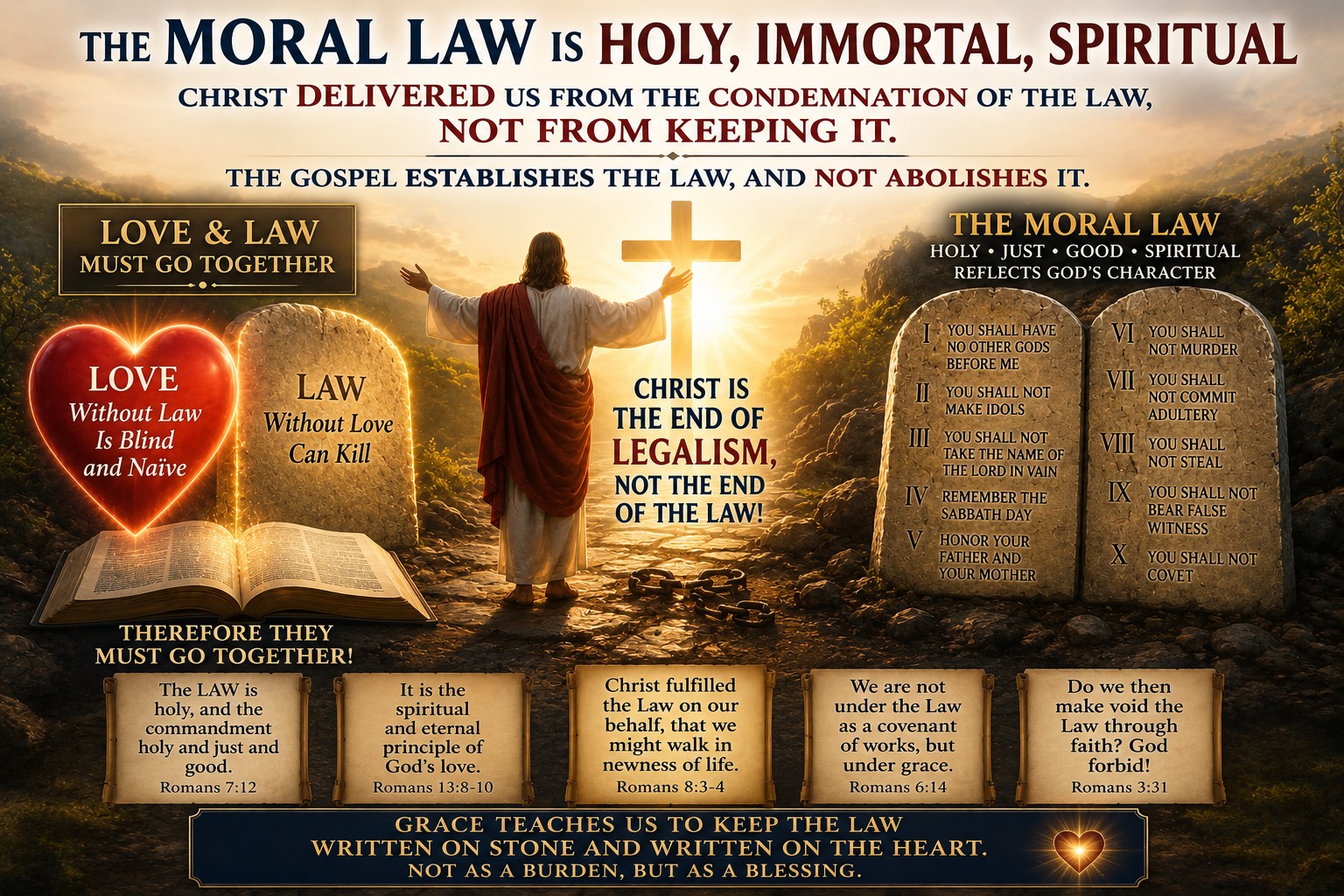
At the same time, the Ten Commandments must never be separated from genuine love. Obedience without love becomes cold legalism, while love without God’s commandments becomes sentimental, subjective and easily deceived. The Bible never places these two in opposition. Instead, it joins them together. Love fulfils the law, and the law gives love its practical expression. True Christian obedience is therefore loving obedience, produced by the indwelling Christ through the Holy Spirit.
JOSEPH PRINCE’S SERIOUS ERRORS
Prince does not encourage murder, adultery or theft. He says that grace produces moral living. Nevertheless, his position is inconsistent: he accepts the morality expressed by the Ten Commandments while denying that Christians are expected to keep the commandments themselves. The Bible teaches a clearer and more balanced truth: the law cannot save us, but Christ saves us from sin and, through the Holy Spirit, brings us into loving obedience to God’s eternal commandments.
The strongest argument is God’s own description of the New Covenant: “I will put My laws in their mind and write them on their hearts.” — Hebrews 8:10. God does not say, “I will abolish My law.” He says that He will write it upon the hearts of His people. The problem was never that God’s commandments were defective. The problem was the sinful human heart. The New Covenant changes our hearts instead of changing God’s moral standard.
Under the old covenant, the law confronted sinners externally and condemned them. Under the New Covenant, God forgives believers, gives them the Holy Spirit and places His law within them. Adventist biblical scholarship therefore identifies the Decalogue as the law internalised in the believer under the New Covenant. A law written on the heart is still a law. It is now obeyed from love rather than from fear or an attempt to earn salvation.
Paul directly answers the claim that justification by faith makes God’s law unnecessary: “Do we then make void the law through faith? Certainly not! On the contrary, we establish the law.” — Romans 3:31.
Righteousness by faith does not abolish the law, it establishes it! The gospel establishes the law because Christ had to bear its condemnation against our sins. Had God’s moral law been temporary or changeable, He could simply have abolished it instead of allowing His Son to die. The cross demonstrates both the seriousness of sin and the permanence of God’s law. Christ delivers us from the law’s condemnation, but He does not deliver us from loyalty to the God whose law we transgressed.
Prince often emphasises Paul’s statement: “You are not under law but under grace.” — Romans 6:14. However, the next verse explains what Paul does not mean: “Shall we sin (by breaking Ten Commandments) because we are not under law but under grace? Certainly not!” — Romans 6:15. To be “under law” means to stand under its condemnation or to depend upon obedience as a way of earning righteousness. To be “under grace” means that we are accepted through Christ and freed from both the guilt and ruling power of sin.
Paul says that believers now obey God “from the heart” and become “slaves of righteousness” rather than slaves of sin. Therefore, freedom under grace is freedom to obey, not freedom to disregard God’s commandments.
If Christians were expected to follow only a general moral principle rather than the actual Ten Commandments, Paul would not have quoted them when instructing believers: “‘You shall not commit adultery,’ ‘You shall not murder,’ ‘You shall not steal,’ ‘You shall not bear false witness,’ ‘You shall not covet’ … are all summed up in this saying, namely, ‘You shall love your neighbour as yourself.’” — Romans 13:9.
Paul does not say that love replaces the commandments. He says that love fulfils them. The commandments explain what genuine love looks like. Love does not murder, commit adultery, steal, lie or covet. A summary does not abolish what it summarises. “Love your neighbour” summarises these commandments but does not remove their authority.
The gospel gives us much more than forgiveness. God also gives us the Holy Spirit and the indwelling life of Christ. Paul explains why God sent His Son: “That the righteous requirement of the law might be fulfilled in us who do not walk according to the flesh but according to the Spirit.” — Romans 8:4.
Prince argues that the Christian’s commandment is to love as Christ loved. But Jesus never placed love in opposition to the Ten Commandments. Jesus said: “If you love Me, keep My commandments.” — John 14:15. Love and obedience belong together. The first four commandments explain how we love God: we recognise no other gods, reject idols, honour His name and remember Him as Creator. The final six explain how we love other people: we honour parents, preserve life, remain faithful in marriage, respect the property of others, speak truthfully and reject covetousness. Without God’s commandments, “love” can become whatever an individual wishes it to mean. The commandments provide an objective definition of love.
The final book of the Bible describes God’s faithful people (living before the return of Christ) in unmistakable language: “Here are those who keep the commandments of God and the faith of Jesus.” — Revelation 14:12. This verse presents the perfect balance. They have the faith of Jesus, so they are not legalists trying to save themselves. They keep the commandments of God, so they are not antinomians rejecting God’s moral authority. Revelation does not say that God’s final people merely live according to a general moral feeling. It says that they keep His commandments.
Legalism says: I must obey the commandments so that God will accept and save me. Antinomianism says: Because Christ has saved me, I am no longer expected to keep the literal Ten Commandments. The gospel says: God has already accepted and saved me entirely through Christ. Now Christ lives within me through the Holy Spirit and produces loving obedience to God’s commandments. We do not keep the Ten Commandments in order to be saved.
We keep the Ten Commandments because we have already been saved by grace, because God has written them upon our hearts and because Christ now lives within us. Grace does not abolish God’s law. Faith establishes it. Love fulfils it. The Holy Spirit writes it upon our hearts. And Christ living in us produces obedience to it.
Hebrews 8:10, Romans 3:31, Romans 6:14–17, Romans 8:4, Romans 13:9 and Revelation 14:12 are the passages that directly unite salvation by grace with obedience to God’s commandments.
JOHN STOTT ON GRACE AND LAW
Unfortunately, the sad truth is that the extremely important principle of combining love with truth has been forgotten by the vast majority of contemporary evangelical Christians. They claim that under the New Covenant only love matters, and the truth associated with the Decalogue (including the Sabbath commandment) is no longer binding upon us.
They commit a cardinal error by focusing exclusively on love and grace alone, whilst disregarding the whole truth.
And this is not merely my opinion, but such a view on the subject is currently expressed, among others, by one of the greatest authorities in the Protestant church, who is undoubtedly John Stott.
“For justification we look to the cross, not the law, and for sanctification we look to the Spirit, not the law. Legalists fear the law and are in bondage to it. Antinomianists hate the law and repudiate it. But the law-abiding free people love the law and fulfil it.” – Stott, J. R. W. (1994). The Message of Romans: God’s Good News for the World. The Bible Speaks Today, Chapter 7.
In the article “Grace and Law” he wrote the following statement:
“In these days, God’s call to moral obedience (that is, to keeping God’s Commandments) needs to be particularly emphasised, because at least two groups of people oppose it. The first are the defenders of the so-called ‘New Morality’ developed in the 1960s. They claim that the only and absolute commandment of God is the commandment of love, and all other laws have been abolished, and that love alone is a sufficient guide for a Christian’s conduct. They forget, however, that love needs directions, and it is precisely such directions that God’s commandments provide. Love does not abolish the law, it fulfils it (Rom 13: 8-10). Secondly, there are evangelical Christians who believe that Paul’s statements ‘Christ is the end of the law’ (Rom. 10:4) and ‘you are not under the law’ (Rom. 6:14) mean that Christians are no longer obligated to obey the moral law of God. Attempts to keep it, they claim, are ‘legalism’ which denies the freedom that Christ gave us. However, they misunderstand Paul. The ‘legalism’ that Paul rejected is not the law of God itself, but the attempt to gain God’s favour and forgiveness through obedience. He himself wrote that this is not possible, because ‘by the deeds of the law there shall no flesh be justified in his sight’ (Rom 3:20). Justified, however, solely by the grace of God, we are obligated to keep this law and we desire to do so. Therefore, our Christian freedom is a freedom to show obedience, not disobedience.”
This statement, whose author is not an Adventist but one of the world’s most prominent Protestant theologians, proves that the Protestant churches committed a cardinal error by separating love from truth. The Catholic Church, in turn, neglected both. We (SD Adventists), on the other hand, face yet another danger, which is that we may have a tendency to focus exclusively on the truth, whilst neglecting love and grace!
DAVID WILKERSON ON PREACHING LOVE WITHOUT LAW
Here is what the well-known Pentecostal preacher and evangelist David Wilkerson wrote in his article entitled “Love, Fear and Obedience”:
“Everywhere today you hear mostly messages on love. Pastors teach: ‘Just love Jesus with all your heart, and everything will be all right. We’re not under the law—we’re called to liberty! We all fail, but love covers all sin. So just learn to love. Love Jesus and the brethren, and you’ll be guaranteed heaven.’
These words sound pleasant to the ear, but they do not reflect the full teaching of God’s Word. You may ask, ‘But didn’t Jesus say that the two greatest commandments are founded on love—that we are to love God and love our neighbour?’ Yes, He did. However, true love is not merely an emotion or a feeling. It cannot be fully expressed simply through worship or words of praise, because genuine love means obedience to God’s commandments.
Sadly, many of us Protestants have attempted to dismiss Christ’s commandments by labelling them as “the Law.” Yet when Jesus and the apostles teach that we are not saved by the works of the law, they are speaking about something entirely different. They are referring to our attempts to **earn** salvation by our own efforts.
But let me ask you this: Which of the Ten Commandments can you deliberately break and still expect to enter heaven? Can you commit adultery? Can you lie? The New Testament plainly declares that “God will judge the adulterers”* (Hebrews 13:4)—those who break the seventh commandment—and that “all liars”—those who violate the ninth commandment—”will be consigned to the fiery lake of burning sulphur” (Revelation 21:8).
Jesus Himself declared that He did not come to abolish the Law but to fulfil it (Matthew 5:17). He also gave a most solemn warning that anyone who causes others to stumble would be better off having a great millstone hung around his neck and being thrown into the sea (Matthew 18:6).”
IN ROMANS 10:4 CHRIST IS THE END OF LEGALISM, NOT END OF MORAL LAW
JB Phillips, New Testament: “Christ means the end of the struggle for righteousness-by-the-Law for everyone who believes in him.”
Romans Parphrased by Jack Sequeira: “This righteousness, produced in Christ’s doing and dying, fully met the positive demands as well as the justice of God’s holy law, so that every believer stands perfect in Christ. Thus, Christ brought to an end our futile attempts to produce our own righteousness through legalism, because the righteousness man produces through his own efforts is never perfect. And Moses, through whom God gave His law, made it very clear: ‘Only the person who perfectly obeys God’s law in every detail has a right to live’ (Lev. 18:5; see also Gal. 3:10)”. – J. Sequeira Romans Paraphrased (link).
W. Barclay on Romans 10:4: “The whole Jewish approach was that, by this kind of obedience to the law, they earned credit with God… To this, Paul answers: ‘Christ is the end of the law.’ What he meant was: Christ is the end of legalism.” – Barclay, W. (2002). Letter to the Romans (3rd ed. fully rev. & updated, pp. 162–163).
LOVE AND TRUTH – SODIUM AND CHLORIDE (SALT)
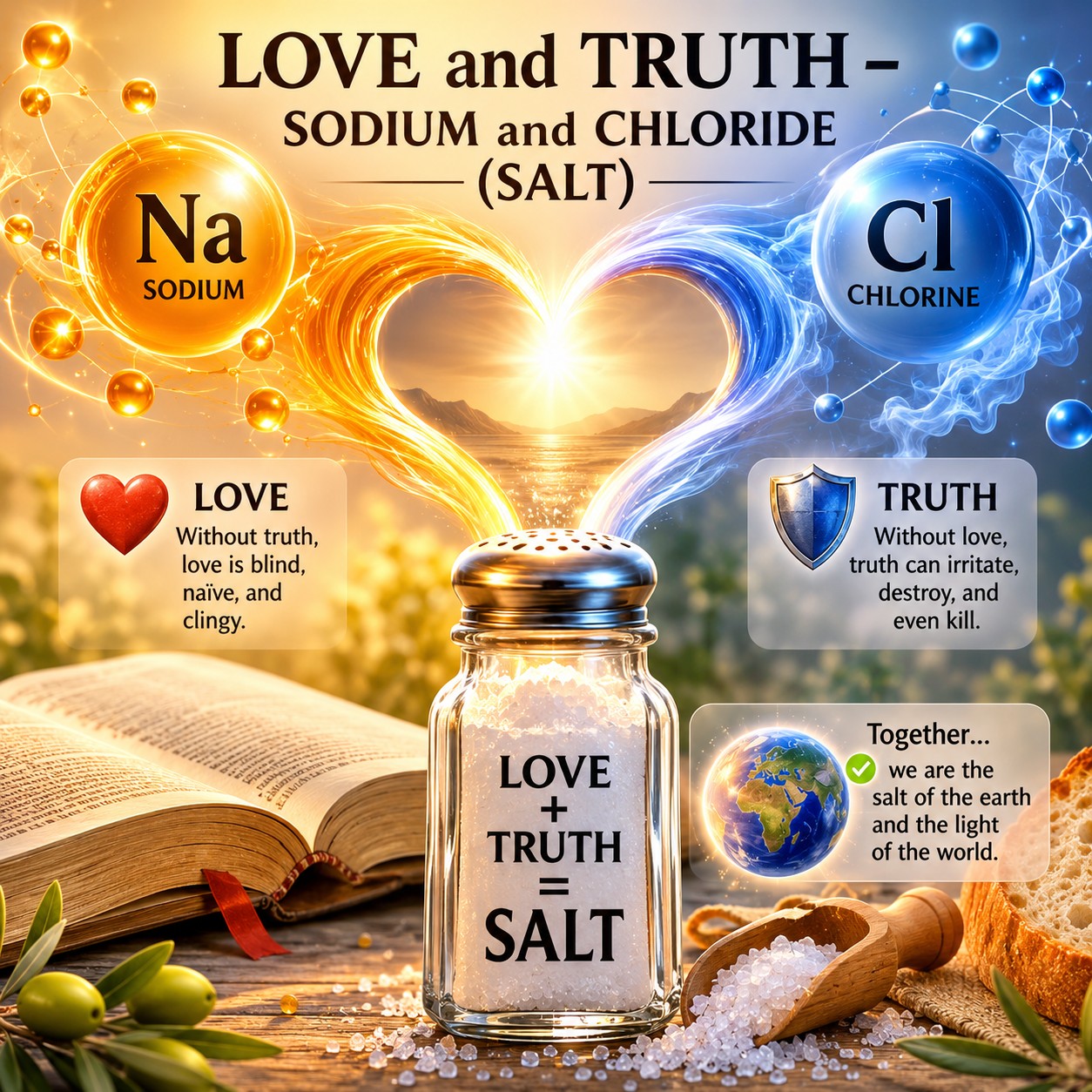
The truth must always be proclaimed with love and, conversely, true love should always be combined with truth because truth without love can kill while love without truth can be deceptive.
Very helpful in understanding this principle is the comparison of two elements, sodium and chlorine.
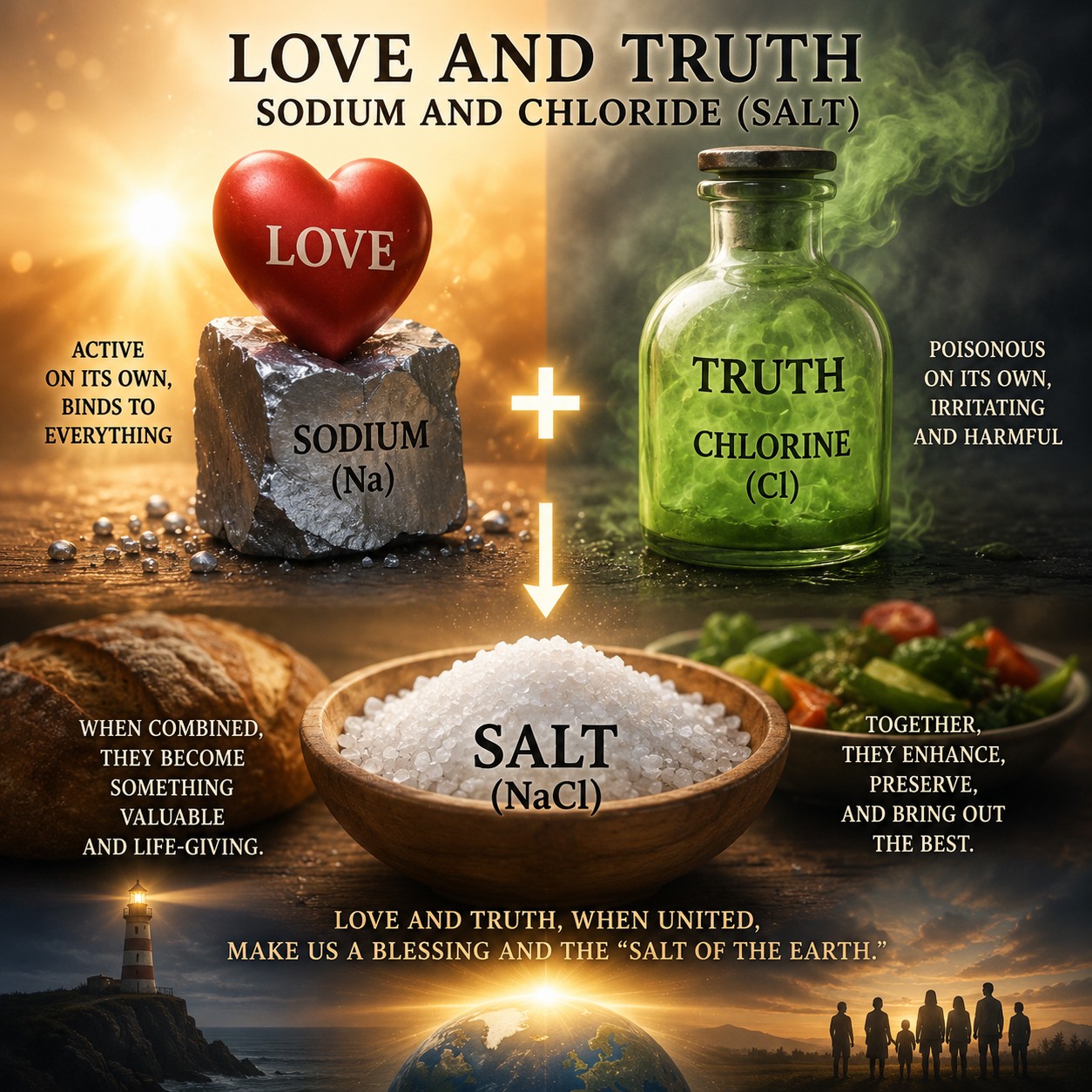
Sodium is an extremely active element, occurring in nature only as a compound and is always bound to other elements. Chlorine, on the other hand, is a poisonous gas with a characteristic sharp, irritating, and unpleasant smell. But when they combine, chlorine is transformed into chloride, and together they become sodium chloride (common salt), a stable compound that preserves food, enhances its flavour, and is essential for life.
It is similar with love and truth. Love and truth are like sodium and chlorine. Love without truth, just like sodium without chlorine, tends to bind itself to everything it encounters on its path. Without truth, love is careless, blind, and naive, and always tends to cling the first available theory or doctrine, even if it is false.
Truth without love, on the other hand, resembles chlorine without sodium, for truth alone proclaimed without love can irritate, destroy, and even kill. Truth alone proclaimed without love can cause people to turn away from God and the gospel, thus condemning themselves to death.
If, however, in our personal or church life, truth and love always constitute two inseparable components of our Christian life, then we will be the “light of the world”, a blessing, and what Christ called the “salt of the earth”.
ELLEN WHITE ON ANTINOMIANISM
“The doctrine is now largely taught that we have only to believe in Jesus Christ, and that faith is all-sufficient; that the righteousness of Christ is imputed to us, and that this fulfills the law for us, so that we are under no obligation to keep the law of God. This is the very essence of antinomianism.” — Signs of the Times, February 25, 1897
“Many in the Christian world do not see that it was only the ceremonial law which was abrogated at the death of Christ. They claim that the moral law was nailed to the cross. They may talk of Christ as their Saviour; but He will finally say to them, I know you not. You cannot have genuine faith in Me, for it was My mission to exalt God’s law.” — Selected Messages, book 1, p. 239.
“The law and the gospel go hand in hand. The one is the complement of the other. The law reveals sin; the gospel provides a remedy for sin. The law points out our duty; the gospel enables us to perform that duty. Grace does not cancel the law of God, but establishes it, providing a way whereby we may obey its precepts.” — Review and Herald, September 27, 1881
“No one who claims holiness is really holy while living in willful violation of God’s law. Those who think they can slide into heaven because Christ died for them, while they trample underfoot any one of the precepts of Jehovah, are under a terrible delusion. Christ said, ‘Think not that I am come to destroy the law, or the prophets: I am not come to destroy, but to fulfill’.” — The Sanctified Life, p. 65
“The law of God is not a severe, unyielding code of restrictions, designed to bring death and condemnation; it is a hedge built around His people to protect them from the deadly results of transgression. It is holy, just, and good. When the Spirit of God takes possession of the heart, it transforms the human agent so that he delights to do the will of God, and the law becomes his song in the house of his pilgrimage.” — Manuscript Releases, Vol. 3, p. 194
READ ABOUT SABBATH VS SUNDAY
HEART-FELT OBEDIENCE VS CHEAP GRACE
Only those who embrace what Dietrich Bonhoeffer called “cheap grace” conclude that, under the New Covenant, Christians are no longer called to keep God’s Ten Commandments. They want salvation without revealing the fruit of the Spirit or allowing Christ to reproduce His life within them.
To support this view, they often quote passages such as Romans 10:4, Romans 6:14 and Romans 7:6. However, many of the greatest non-Adventist Protestant theologians, including John Stott, Brooke Foss Westcott, Anders Nygren and Thomas F. Torrance, clearly explained that Paul never meant that Christians who have been justified, perfected in Christ and freed from condemnation are no longer expected to keep God’s moral law as the standard of Christian living.
According to these theologians, in passages such as Romans 10:4, Romans 6:14 and Romans 7:6, Paul teaches that believers are free from the condemnation of the law and from legalism—the false idea that we can earn salvation by keeping the law. He does not teach that believers are free from obeying God’s moral law through the power of the indwelling Holy Spirit. Paul opposed legalism, but he never opposed obedience to God’s law as the fruit of salvation and the evidence of the transforming power of the gospel.
Any honest and careful student of Paul’s writings should reach this conclusion. The purpose of the law is not to save us. Its purpose is to reveal our sinfulness, expose our guilt and keep us under condemnation until we come to Christ as our only hope of salvation.
But what happens after we accept Christ? The moment we accept Christ’s perfect righteousness as our own, we are justified by grace, freed from the condemnation of the law and are no longer under law but under grace. Does Christ then lead us away from God’s law?
Quite the opposite. He leads us back to God’s law—not so that we may be saved by keeping it, because we are already saved by His grace, but so that we may keep it as the fruit of our salvation.
How is this possible? Because Christ Himself comes to live in us through the Holy Spirit. The same Jesus who perfectly obeyed God’s law in our fallen human nature two thousand years ago now reproduces that same victorious life in every believer who abides in Him.
We therefore obey God’s commandments, not out of fear of condemnation, but out of love. Since we are united with Christ, the law no longer condemns us, even though we are still growing and have not yet reached perfection in our daily experience.
The gospel is the glorious message of complete freedom in Christ. But it is not freedom to break God’s commandments. It is freedom from the guilt, condemnation and power of sin, so that Christ can live His obedient life in us through the Holy Spirit.
As Paul wrote: “Do we then make void the law through faith? Certainly not! On the contrary, we establish the law.” (Romans 3:31) Grace does not abolish God’s law. Grace establishes it, writes it on our hearts, and gives us the power to obey it through the indwelling Christ.
PARADOX OF HYPER-GRACE: JOSEPH PRINCE, ETERNAL TORMENT, AND THE EVANGELICAL SHIFT TOWARD CONDITIONAL IMMORTALITY
It is highly contradictory that Joseph Prince dedicates his entire global ministry to proclaiming the boundless depth of God’s unconditional love, radical grace, and unmerited favor, yet simultaneously maintains that this very same loving God will subject unrepentant sinners to unending, conscious torment.
For a theology that prides itself on revealing a Father who refuses to count people’s sins against them and who offers a “Grace Revolution,” it seems completely irreconcilable to assert that the alternative to accepting this gift is an inescapable chamber of eternal torture.
Prince explicitly enforces this harsh reality in his teachings, stating, “Some grace preachers teach that there is no hell. They are universalists. They say that hell is temporary and that it is restorative. No, my friend. Don’t be deceived. The Bible says that hell is eternal. ‘Everlasting’ is aionios in Greek, which means eternal. When someone is sentenced to the lake of fire, it is for eternity” (Joseph Prince, Grace Revolution, Chapter 11).
This traditional view of eternal torment has been heavily rejected as unbiblical by a growing number of highly respected evangelical scholars who argue that it completely misrepresents the character of a loving God.
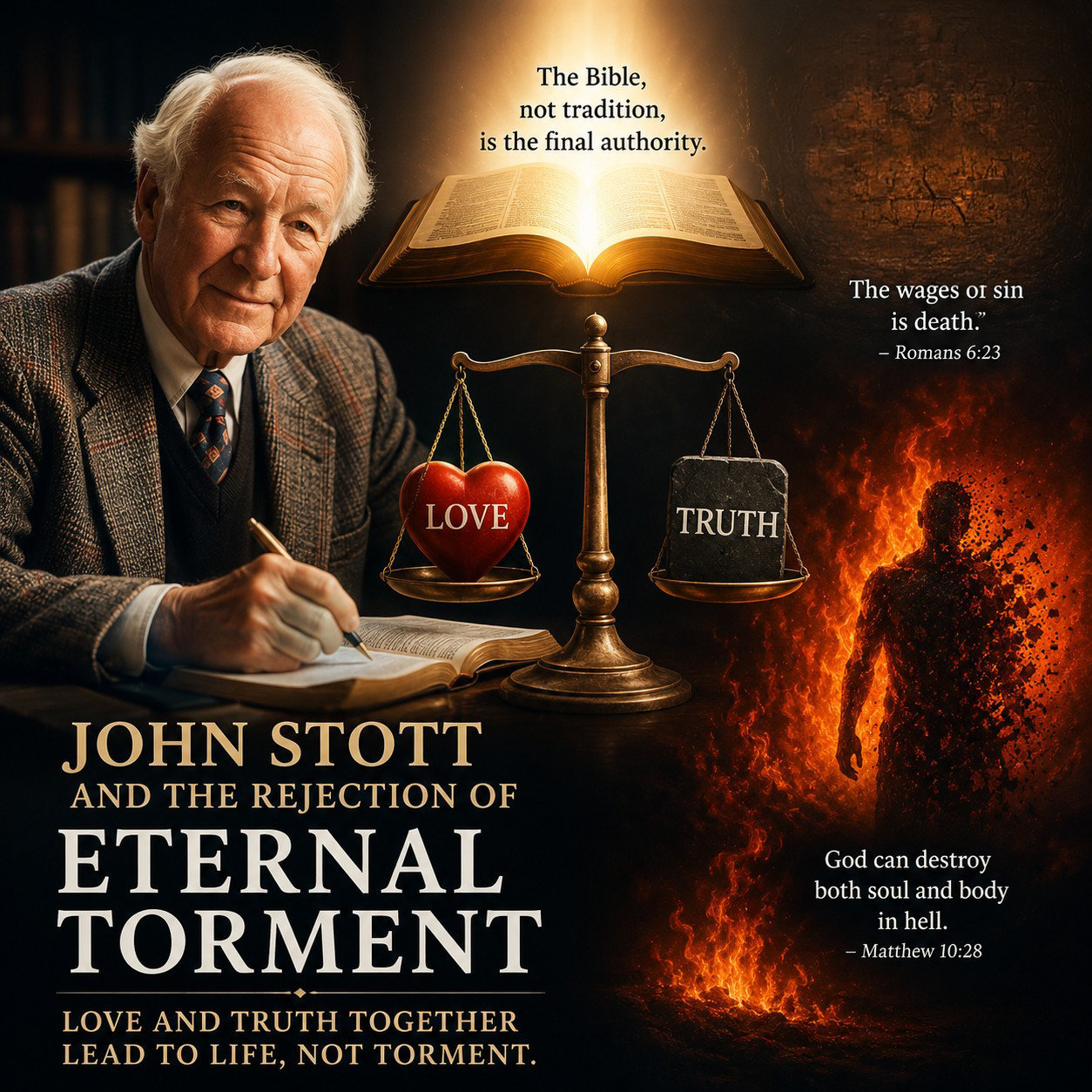
The renowned theologian John Stott famously questioned the morality and biblical validity of eternal torment, arguing that the concept of conscious torment spanning across trillions of years is emotionally intolerable and structurally unsupported by Scripture, famously stating that “the ultimate elimination of the wicked” via annihilation makes far better biblical sense.
Similarly, the evangelical scholar Edward Fudge dedicated his life’s research to proving that the biblical terms “hell” and “the lake of fire” point to conditional immortality, meaning that the wicked are completely destroyed—consumed body and soul—rather than kept alive forever to be tortured.
Other prominent evangelicals, such as Clark Pinnock, Philip Hughes, and F.F. Bruce, have likewise argued that the concept of eternal torment is a Greek philosophical import rather than a true biblical doctrine, asserting that a genuinely holy and loving God will ultimately destroy the wicked out of existence rather than sustain their consciousness in everlasting agony.
READ ABOUT FIRE THAT CONSUMES: JOHN STOTT, EDWARD FUDGE, AND THE EVANGELICAL CRISIS OVER HELL