Forgotten Power of Biblical Fasting
Slawomir Gromadzki
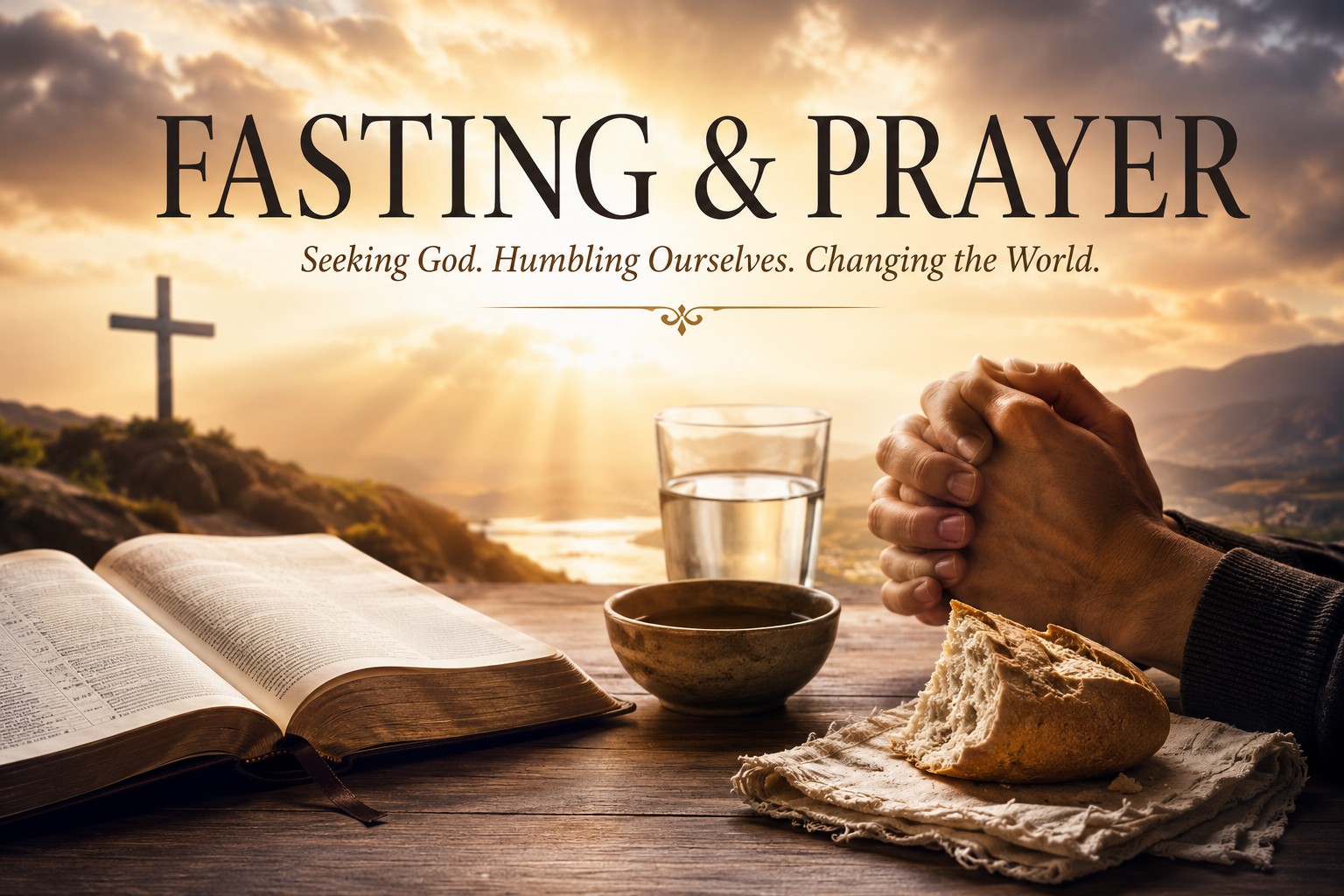
The biblical sacred fast is a subject that has been greatly neglected and ignored among us. Yet in the Bible, fasting is an extremely important subject. We find many examples of prayers accompanied by fasting to which God responded in extraordinary ways.
FASTING, PRAYER, AND PRAISE — JEHOSHAPHAT’S MIRACULOUS VICTORY
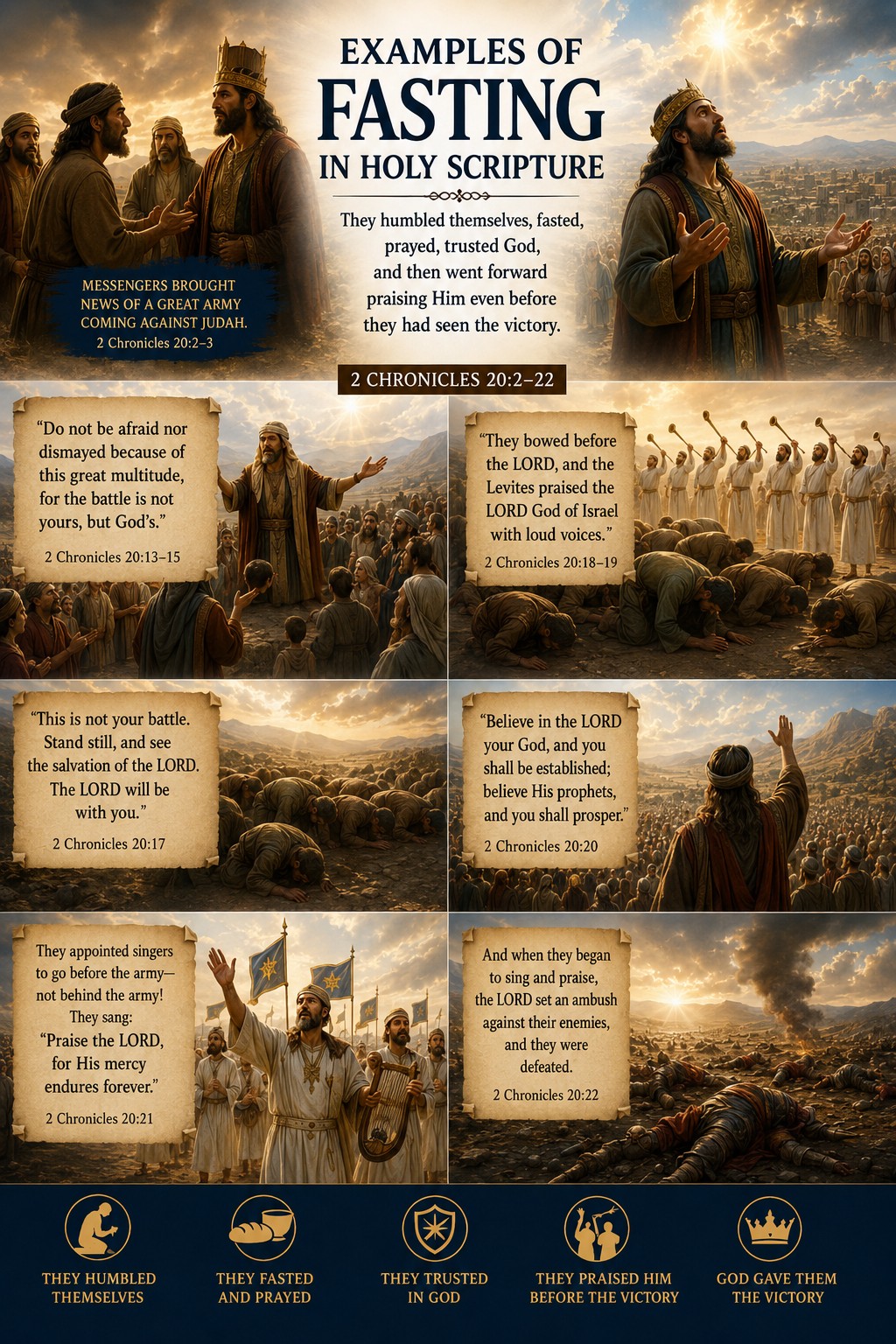
One remarkable example is found in 2 Chronicles 20. Messengers came to Jehoshaphat with alarming news: a great multitude was coming against him from beyond the sea. Jehoshaphat was afraid, but instead of relying merely upon military power, he determined to seek the Lord and proclaimed a fast throughout Judah. 2 Chronicles 20:2–3.
Jehoshaphat stood before the assembly and prayed: “O our God, will You not judge them? For we have no power against this great multitude that is coming against us; nor do we know what to do, but our eyes are upon You.” 2 Chronicles 20:12, NKJV.
Meanwhile, all Judah stood before the Lord with their little ones, their wives, and their children. Then the Spirit of the Lord came upon Jahaziel, the son of Zechariah, in the midst of the assembly. He said: “Listen, all you of Judah and you inhabitants of Jerusalem, and you, King Jehoshaphat! Thus says the LORD to you: ‘Do not be afraid nor dismayed because of this great multitude, for the battle is not yours, but God’s.’” 2 Chronicles 20:13–15, NKJV.
God told them that they would not need to fight this battle themselves. They were to position themselves, stand still, and see the salvation of the Lord. They were not to be afraid or dismayed, because the Lord would be with them. 2 Chronicles 20:17.
Jehoshaphat then bowed his head with his face to the ground, and all Judah and the inhabitants of Jerusalem bowed before the Lord and worshipped Him. Then the Levites stood up and praised the Lord God of Israel with loud voices. 2 Chronicles 20:18–19.
Early the following morning, they went out into the Wilderness of Tekoa. Jehoshaphat stood before them and said: “Believe in the LORD your God, and you shall be established; believe His prophets, and you shall prosper.” 2 Chronicles 20:20, NKJV.
Then something remarkable happened. Jehoshaphat appointed singers to praise the Lord as they went before the army—not behind the army! They sang: “Praise the LORD, for His mercy endures forever.” 2 Chronicles 20:21, NKJV.
And when they began to sing and praise, the Lord acted against the Ammonites, Moabites, and the people of Mount Seir who had come against Judah, and the enemy was defeated. 2 Chronicles 20:22.
What a lesson! They humbled themselves, fasted, prayed, trusted God, and then went forward praising Him even before they had seen the victory.
HEALING OF THE EPILEPTIC AND FASTING
In Matthew chapter 17, we read how a man fell on his knees before Christ, begging Him to heal his son, who suffered from epilepsy. Earlier, the disciples had tried to heal the boy, but without success.
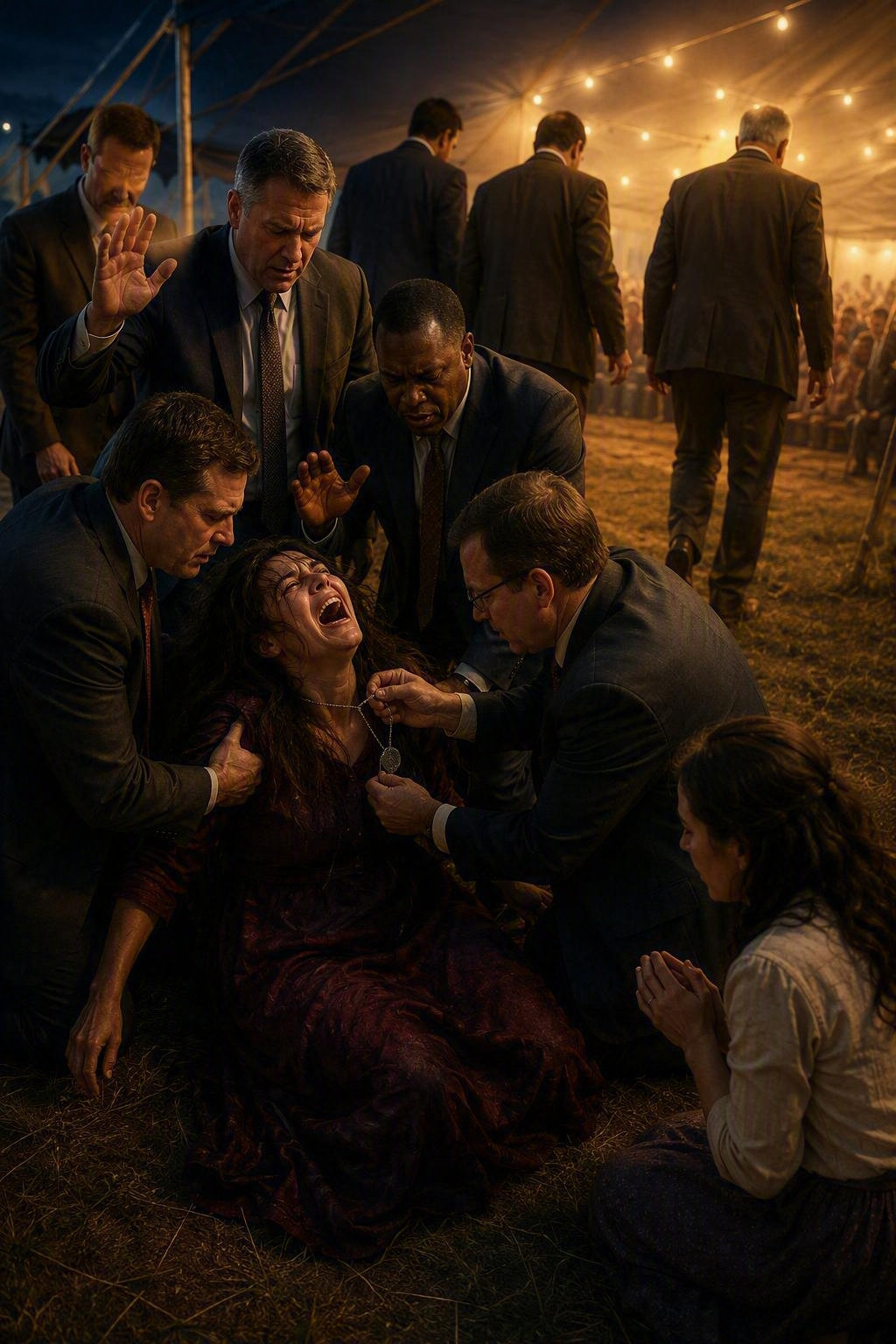
In 1990, when I participated in health training in America, one of our Adventist teachers told us about an incident that had taken place during a camp meeting there. A woman who appeared to be demon-possessed was causing a great disturbance. A group of pastors gathered around her and prayed for her, but at first without success. Then, to everyone’s surprise, instead of leaving her, the demon, speaking through the woman, began loudly announcing the sins of some of the pastors who were praying for her. As soon as they heard their own sins being publicly exposed, they left in shame. Only those who were consecrated remained, and they decided to pray again. Before doing so, they removed a necklace from the woman’s neck because they believed it represented her allegiance to Satan. Then they prayed again, and the demon came out of the woman, and she was delivered.
The disciples had a similar problem. They too were unable to heal the epileptic boy. Therefore, they came to Jesus privately and asked: “Why could we not cast it out?” Matthew 17:19. Christ pointed them to their unbelief and to the need for prayer and fasting in such a conflict. Matthew 17:20–21.
Does this statement of Christ mean that fasting has such powerful healing properties that through fasting alone someone could even be cured of epilepsy?
No. What role, then, was fasting supposed to play?
Ellen White explains: “Their faith must be strengthened by fervent prayer and fasting, and humiliation of heart. They must be emptied of self, and be filled with the Spirit and power of God.” Ellen G. White, The Desire of Ages, p. 431.
Fasting can have valuable health benefits, but in this particular case fasting itself certainly could not have solved the problem. Only God, by His power, could heal this boy. Fasting was intended to help the disciples humble themselves before God and strengthen their faith and dependence upon Him—the faith necessary for them to rely completely upon God’s power as they prayed for healing.

DID CHRIST HIMSELF FAST?
At the very beginning of His earthly ministry, Christ fasted for forty days. Does this mean that we, as His followers, should also fast for forty days? I have heard of people who fasted that long because they believed Christ expected the same thing from them.
Ellen White makes the matter very clear: “You are not called upon to fast forty days. The Lord bore that fast for you in the wilderness of temptation. There would be no virtue in such a fast; but there is virtue in the blood of Christ.” Ellen G. White, Counsels on Diet and Foods, p. 189.
This is extremely important. Fasting does not earn God’s favour. It gives us no merit, and it cannot force God to answer our prayers. True fasting expresses exactly the opposite—our helplessness and complete dependence upon God.
Ellen White beautifully summarises the entire subject: “The spirit of true fasting and prayer is the spirit which yields mind, heart, and will to God.” Ellen G. White, Counsels on Diet and Foods, p. 189.
For what purpose, then, did the Lord Jesus fast?
“When Christ was the most fiercely beset by temptation, He ate nothing. He committed Himself to God and, through earnest prayer and perfect submission to the will of His Father, came off conqueror.” Ellen G. White, Testimonies for the Church, vol. 2, p. 202.
She then adds that those who profess the truth for these last days, above other professed Christians, should imitate Christ’s great example in prayer. Ellen G. White, Testimonies for the Church, vol. 2, p. 202.

Christ’s forty-day fast was an extraordinary experience and should not be regarded as a command for us to do the same. Even a fast lasting a week may be dangerous for some people, depending on their age, health, nutritional condition, medications and other individual factors.
For most people who are able to fast safely, shorter fasts of about one to three days, practised from time to time, are generally a more sensible approach than attempting very long fasts. There is usually no need to imitate Christ’s forty-day fast in order to receive the spiritual benefits of fasting. Even a single day devoted to fasting, prayer and seeking God can be very meaningful.
It is also extremely important to understand that how a prolonged fast is ended can be just as important as the fast itself. After several days or longer without food, suddenly returning to large or heavy meals can be dangerous. In susceptible individuals it may even cause refeeding syndrome, a potentially serious disturbance of electrolytes and metabolism. Food should therefore be reintroduced gradually after prolonged fasting.
The spiritual value of fasting is not measured by how many days we can survive without food. Its purpose is to humble ourselves before God, seek Him earnestly in prayer, and become more receptive to His will.
JESUS EXPECT HIS FOLLOWERS TO FAST
Jesus Himself showed that fasting would continue to have a place in the lives of His followers. In the Sermon on the Mount He did not merely say if you fast. He said, “Moreover, when you fast…” Matthew 6:16, NKJV.
But He immediately warned against turning fasting into a religious performance. The hypocrites deliberately made themselves look miserable so that other people would notice how spiritual they were. Jesus told His followers not to fast in this way. Instead, they were to behave normally so that their fasting would be primarily between themselves and their heavenly Father (Matthew 6:16–18).
Therefore, genuine fasting is not performed to impress other people or demonstrate how spiritual we are. The purpose is not to make others admire our sacrifice. True fasting draws our attention away from ourselves and directs it toward God.
THE FAST THAT PLEASES GOD
What kind of fast is pleasing to God? In Isaiah 58, God’s people complained: “Why have we fasted… and You have not seen?” (Isaiah 58:3).
Here is how God Himself answers the question. He asks whether merely bowing one’s head like a bulrush and outwardly afflicting oneself is really the fast He has chosen:
“Is this not the fast that I have chosen: To loose the bonds of wickedness, to undo the heavy burdens, to let the oppressed go free, and that you break every yoke?” (Isaiah 58:6).
What does it mean to let the oppressed go free?
Christ said: “The Spirit of the LORD is upon Me, because He has anointed Me to preach the gospel to the poor… to proclaim liberty to the captives… to set at liberty those who are oppressed” (Luke 4:18).

Can we today participate in setting the oppressed free?
If we want our fast to be pleasing to God, we should allow God to use us for setting the oppressed free!
In what way?
By preaching to them the gospel of freedom! The wonderful good news that those who believe in Christ can receive freedom from sin and from the condemnation and ultimate penalty of sin, which is death.
Let us continue reading Isaiah chapter 58 to discover what kind of fast is pleasing to God.
God’s chosen fast includes sharing our bread with the hungry, bringing the poor and homeless into our homes, clothing the naked, and refusing to turn away from the needs of our fellow human beings (Isaiah 58:7).
Then comes the wonderful promise that our light will break forth like the morning, our healing will spring forth speedily, our righteousness—the righteousness that the Lord Jesus has granted us—will go before us, and the glory of the Lord will be our rear guard (Isaiah 58:8).
“Then you shall call, and the LORD will answer” (Isaiah 58:9).
Thus true fasting is not merely about what we stop putting into our mouths. It is also about what comes out of our hearts and how we treat other people.
HUMILITY IN FASTING
The Hebrew verb tsum means to fast or abstain from food. Strong’s also connects its root idea with covering or closing the mouth which refers to humility.
In Isaiah chapter 53, describing the humility of the Son of God, the prophet wrote: “He was oppressed and He was afflicted, yet He opened not His mouth” (Isaiah 53:7).
What is one of the best ways for our proud mouths to be shut and make us humble?
In Romans 3:19, Paul says that God gave us the law to make “every mouth” to be stopped or shut and to brings the whole world under accountability before God:
“Now we know that whatever the Law says, it speaks to those who are under the Law, so that every mouth may be shut and the whole world may become subject to God’s judgment” (Romans 3:19, NET).
When we look honestly into God’s holy law, boasting disappears. We realise that none of us has anything of which to be proud. We all need the righteousness and grace of Jesus Christ.
A TINY CATERPILLAR AND BACTERIA DID WHAT HUMAN POWER COULD NOT
At the end of the eighteenth century, a type of cactus called Opuntia, or prickly pear, was introduced into Australia. Eventually this plant spread so extensively, occupying larger and larger areas, that it became a serious economic plague.
People began fighting this weed—which could grow up to about five metres tall—using fire, axes, chemicals, and other methods, but without success. The plant continued spreading into new areas.
Eventually, what proud and intelligent human beings had been unable to accomplish by force was achieved with the help of a small and seemingly insignificant insect—the Cactoblastis moth.
The caterpillars of this insect burrowed into and damaged the prickly pear. The wounds were then attacked by bacteria which helped complete the work of destruction.
The dangerous invasion was finally brought under control, and tens of millions of hectares of land affected by prickly pear could eventually be reclaimed.
Grateful Australians even erected a memorial connected with the Cactoblastis caterpillar that contributed to controlling the Opuntia. And we might humorously ask: Is it not a pity that nobody erected a monument to the tiny bacteria, which, according to this account, also played their part in fighting the weed?
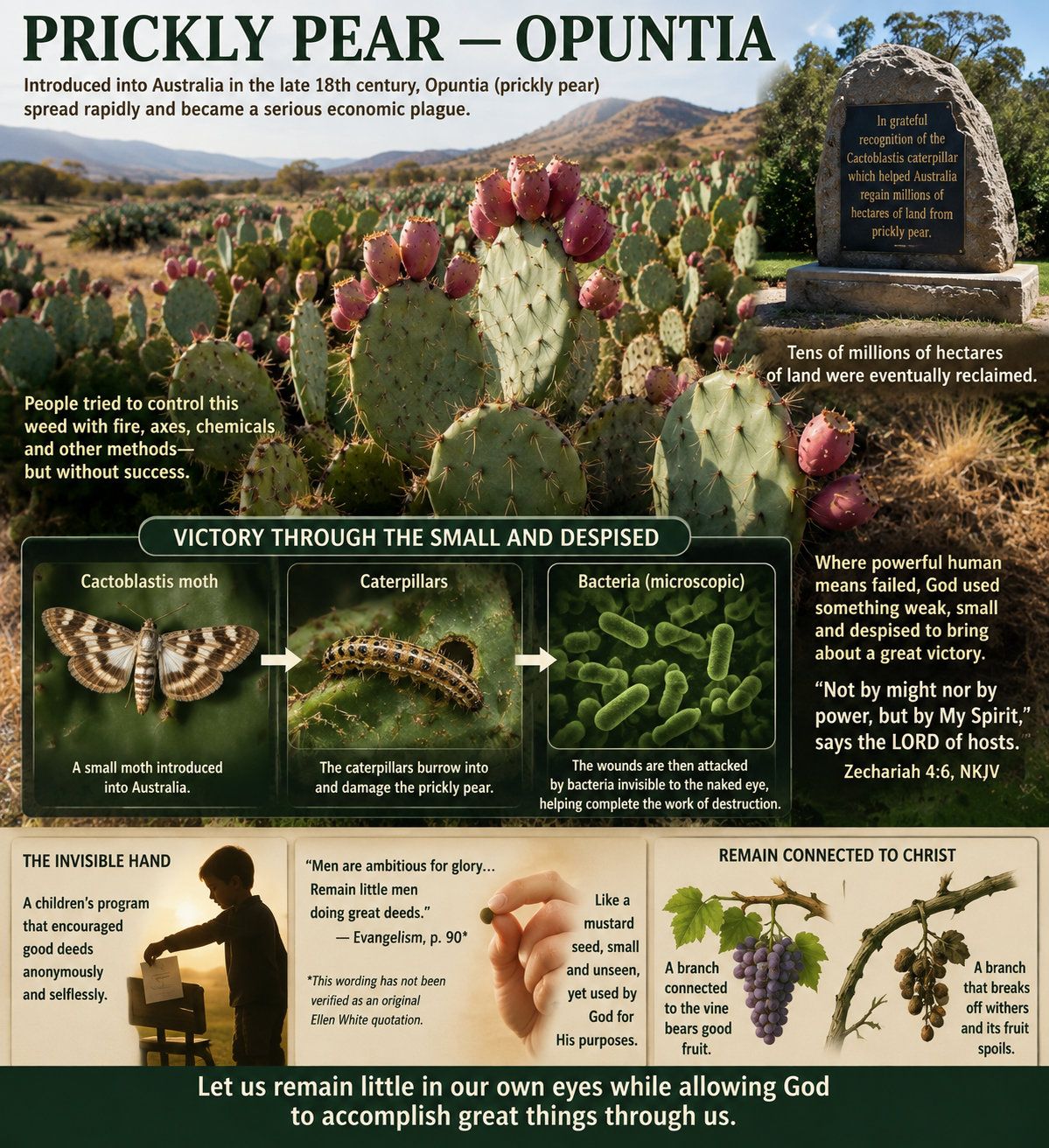
Where other seemingly powerful means had failed, something weak, small, and despised in the eyes of the world—a tiny worm and invisible bacteria—achieved the victory.
This reminds us of God’s words through Zechariah: “‘Not by might nor by power, but by My Spirit,’ says the LORD of hosts” (Zechariah 4:6).
Let us therefore be willing to become like those invisible humble instruments—not seeking attention or praise, but quietly allowing God to accomplish good and great things through us.
THE INVISIBLE HAND
I remember that when I was growing up in Poland, there was a popular television initiative for children called The Invisible Hand (Niewidzialna Ręka). It was performed by young members of the Polish scouting movement – similar to Pathfinders in the Seventh-day Adventist Church.
They secretly help people in need without expecting praise or reward. They might help an elderly or poor person prepare coal for the winter, repair a broken fence, do some work around the house, or secretly leave a bag of food at someone’s door.
And after completing their good deed, instead of revealing who had done it, they would leave behind the sign of a hand—the symbol of the “Invisible Hand.” The person receiving the help knew that somebody cared, but did not know who had helped them.

I think there was something beautiful in that idea. Perhaps children sometimes understand better than adults that we can do something good without making sure everybody knows that we did it!
And this is exactly the spirit Christ taught: “But when you give to the needy, do not let your left hand know what your right hand is doing, so that your giving may be in secret. Then your Father, who sees what is done in secret, will reward you” (Matthew 6:3–4, NIV).
In my old Polish notes I found this beautiful quote from unknown source: “Men are ambitious for glory… Remain little men doing great deeds!”
Quotes by EGW on the same subject:
“Be willing to be little men handling great subjects.” — Evangelism, p. 134.
“I saw that the strength of the children of God is in their humility. When they are little in their own eyes, Jesus will be to them their strength and their righteousness, and God will prosper their labors.” — Testimonies for the Church, vol. 3, p. 307.
“Our only safety is to lie low at the foot of the cross, be little in our own eyes, and trust in God; for He alone has power to make us great.” — Testimonies for the Church, vol. 4, p. 607.
“In self-love, self-exaltation, and pride there is great weakness; but in humility there is great strength.” — Testimonies for the Church, vol. 3, p. 476.
“The only greatness is the greatness of humility.” — The Desire of Ages, p. 650.
“To fill a high place before men, Heaven chooses the worker who, like John the Baptist, takes a lowly place before God.” — The Desire of Ages, p. 436.
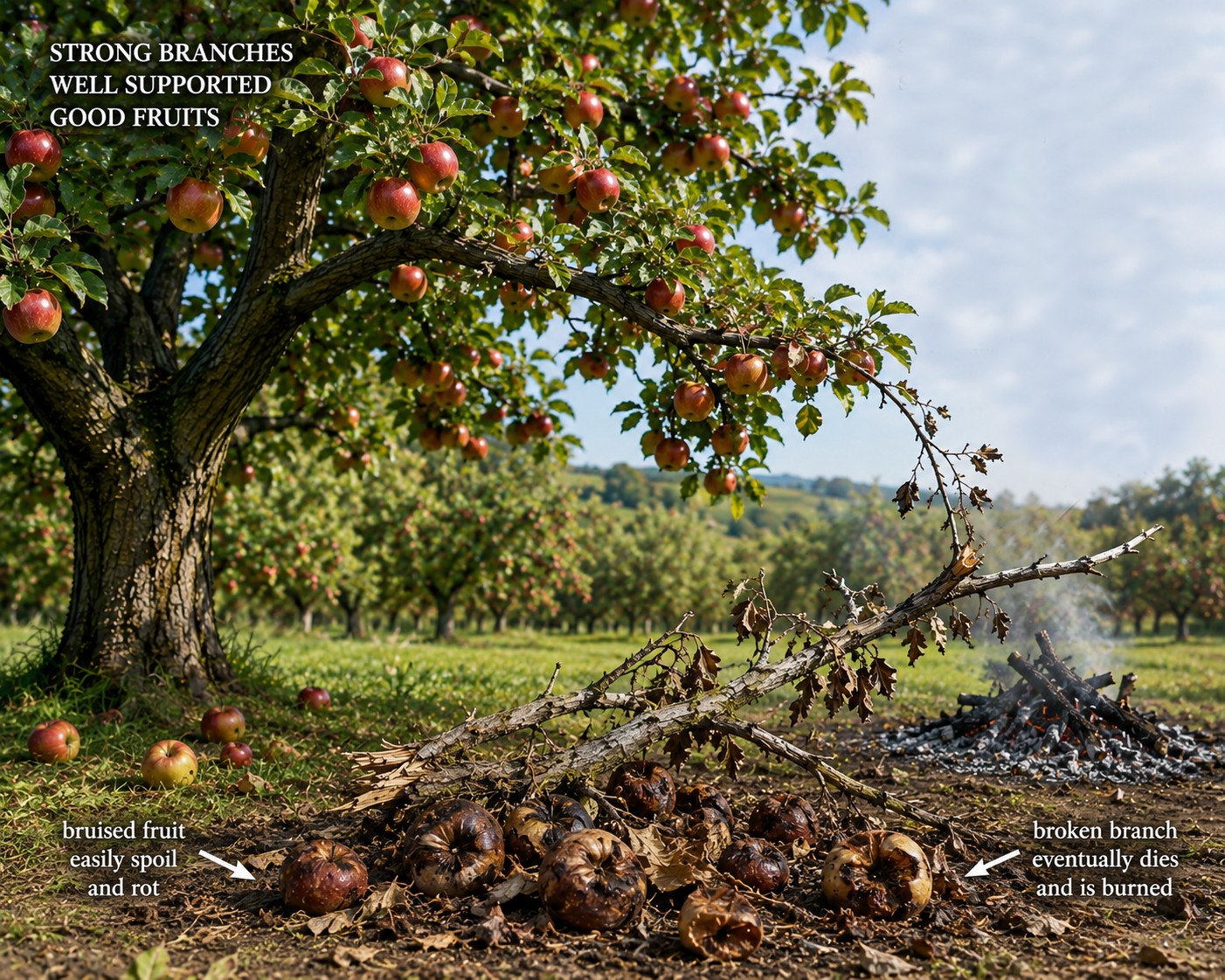
Let us remain little in our own eyes while allowing God to accomplish great things through us. Let us remember that we are called to bear the fruit of the Holy Spirit, not our own fruit.
And as a warning, let us remember that if a branch does not have sufficient support from the trunk of the tree, it may break under the weight of its own fruit. Bruised fruit then easily spoil and rot, while the broken branch itself eventually dies and is burned. We therefore need to remain completely connected with Christ.
GLUTTONY
What is the opposite of fasting?
Gluttony.
We often condemn sins such as drunkenness, adultery, and murder, but we can easily forget that lack of self-control in appetite is also a serious matter.
“Put a knife to your throat if you are a man given to appetite” Proverbs 23:2.
“Many live as enemies of the cross of Christ. Their destiny is destruction, their god is their stomach” Philippians 3:18–19.
“For such people are not serving our Lord Christ, but their own appetites” Romans 16:18.
Ellen White spoke very strongly about uncontrolled appetite. Describing people who destroyed their health through gluttony and were nevertheless praised by their friends and ministers as though they were going directly to heaven, she exclaimed: “What a thought! Gluttons in heaven! No, no…” Ellen G. White, Counsels on Diet and Foods, p. 125.
Her language is deliberately strong because she wanted Christians to understand that habitual self-indulgence is not an insignificant matter.
She also warned that people continually eat more than they should and that overeating frequently causes sickness. Such sickness should not be blamed upon God when it results from our own violation of the laws of health.
For some people, she even recommended occasional short periods of fasting: “There are some who would be benefited more by abstinence from food for a day or two every week than by any amount of treatment or medical advice.” She added that fasting one day a week would be of incalculable benefit to them. Counsels on Diet and Foods, p. 189.
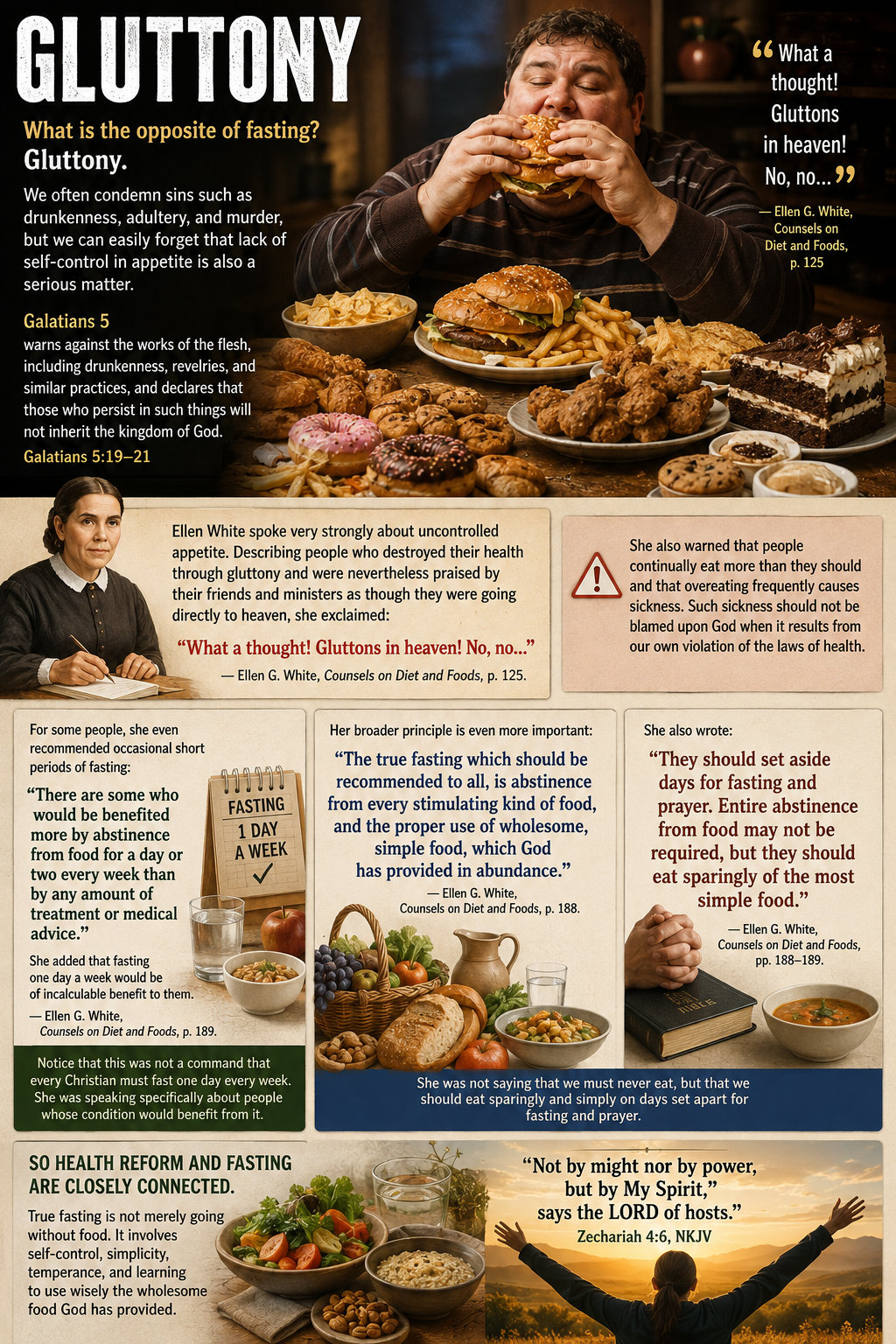
Notice that this was not a command that every Christian must fast one day every week. She was speaking specifically about people whose condition would benefit from it.
Her broader principle is even more important: “The true fasting which should be recommended to all, is abstinence from every stimulating kind of food, and the proper use of wholesome, simple food, which God has provided in abundance.” Ellen G. White, Counsels on Diet and Foods, p. 188.
She also wrote: “They should set aside days for fasting and prayer. Entire abstinence from food may not be required, but they should eat sparingly of the most simple food.” Ellen G. White, Counsels on Diet and Foods, pp. 188–189.
So health reform and fasting are closely connected. True fasting is not merely going without food. It involves self-control, simplicity, temperance, and learning to use wisely the wholesome food God has provided.
FASTING AND PRAYER
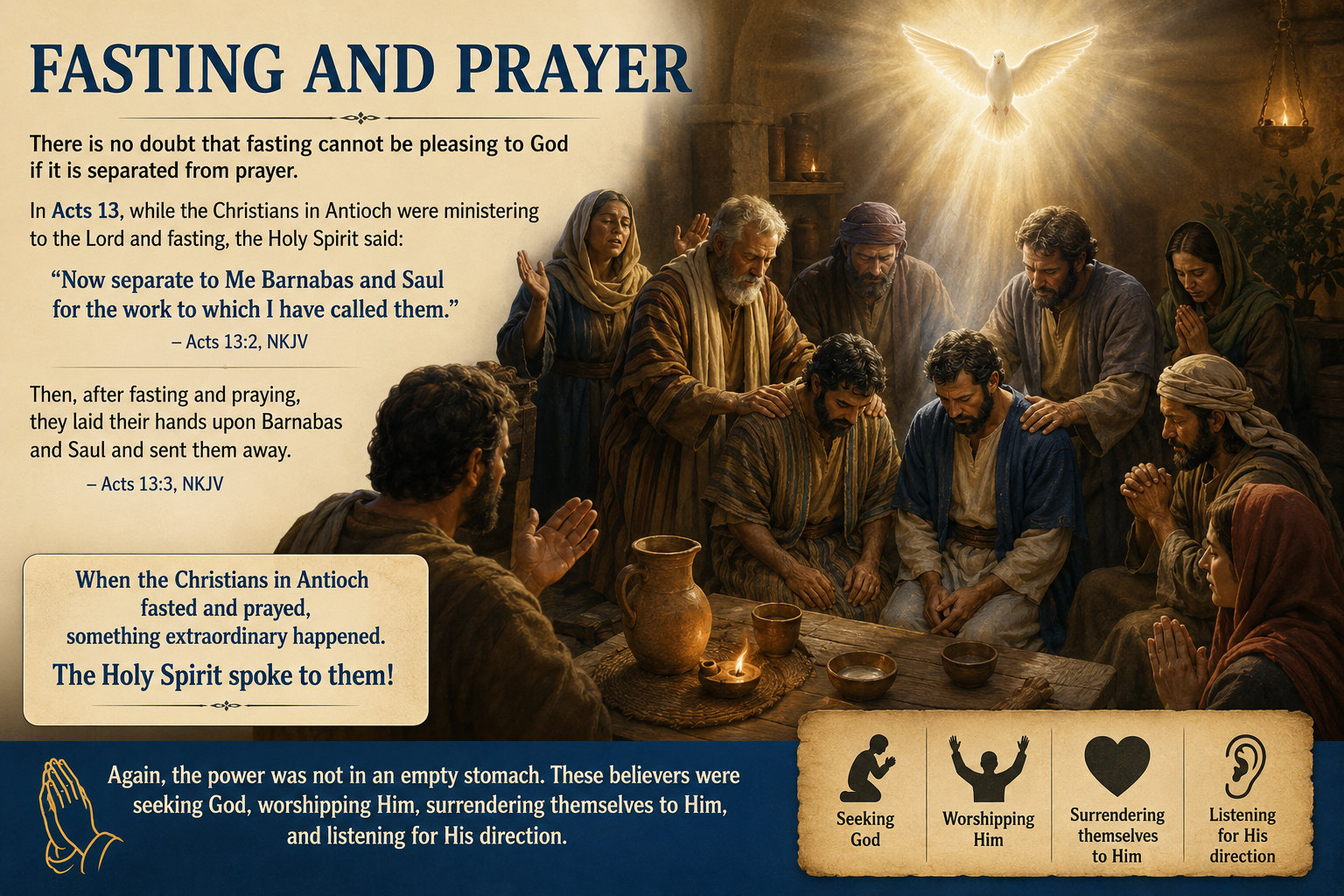
There is no doubt that fasting cannot be pleasing to God if it is separated from prayer.
When the Christians in Antioch fasted and prayed, something extraordinary happened.
The Holy Spirit spoke to them!
“While they were worshiping the Lord and fasting, the Holy Spirit said, ‘Set apart for me Barnabas and Saul for the work to which I have called them.’ So after they had fasted and prayed, they placed their hands on them and sent them off” (Acts 13:2–3).
Again, the power was not in an empty stomach. These believers were seeking God, worshipping Him, fasting and making themselves humble and dependent on God, surrendering themselves to Him, praying and waiting for His instructions.
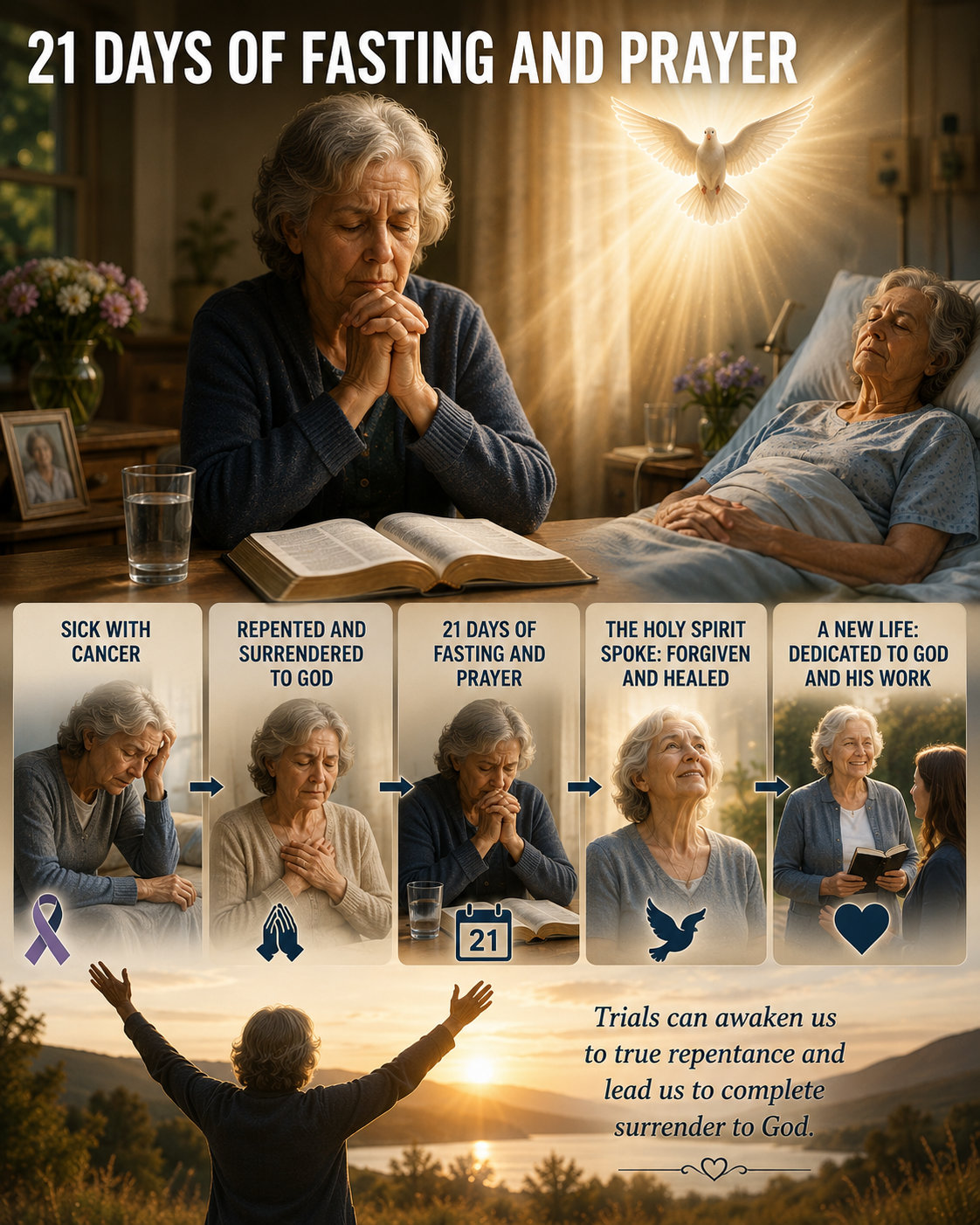
A SISTER SICK WITH CANCER — 21 DAYS OF FASTING
At one time, an Adventist friend told me about an elderly sister from his church who prayed and fasted and who believed that the Holy Spirit spoke to her.
For many years she had been a Christian, but she was not very serious about her faith. Things changed, however, when she went through a very painful experience. She became seriously ill with what, if I remember correctly, was cancer, and it appeared that her days were numbered.
She finally realised that up to that point she had been dishonouring God by her behaviour. She turned to God in sincere repentance and earnestly asked for His forgiveness. Eventually she decided that she would continue praying and fasting until God Himself somehow gave her assurance that her sin had been forgiven.
She fasted for three weeks. According to the account I was given, precisely on the twenty-first day of fasting and prayer, while she was praying, the Holy Spirit spoke to her and told her to end the fast, assuring her that she had been forgiven and that she would recover.
From that time onward, a profound change took place in her life. She recovered from her illness, but something even more important happened—her spiritual life underwent a complete transformation.
As the Adventist who told me the story assured me, this sister became the member of the congregation most dedicated to God and most active in evangelistic work.
This true story reminds us that painful experiences can sometimes awaken us to recognise our true spiritual condition and lead us to genuine repentance and complete surrender to God.
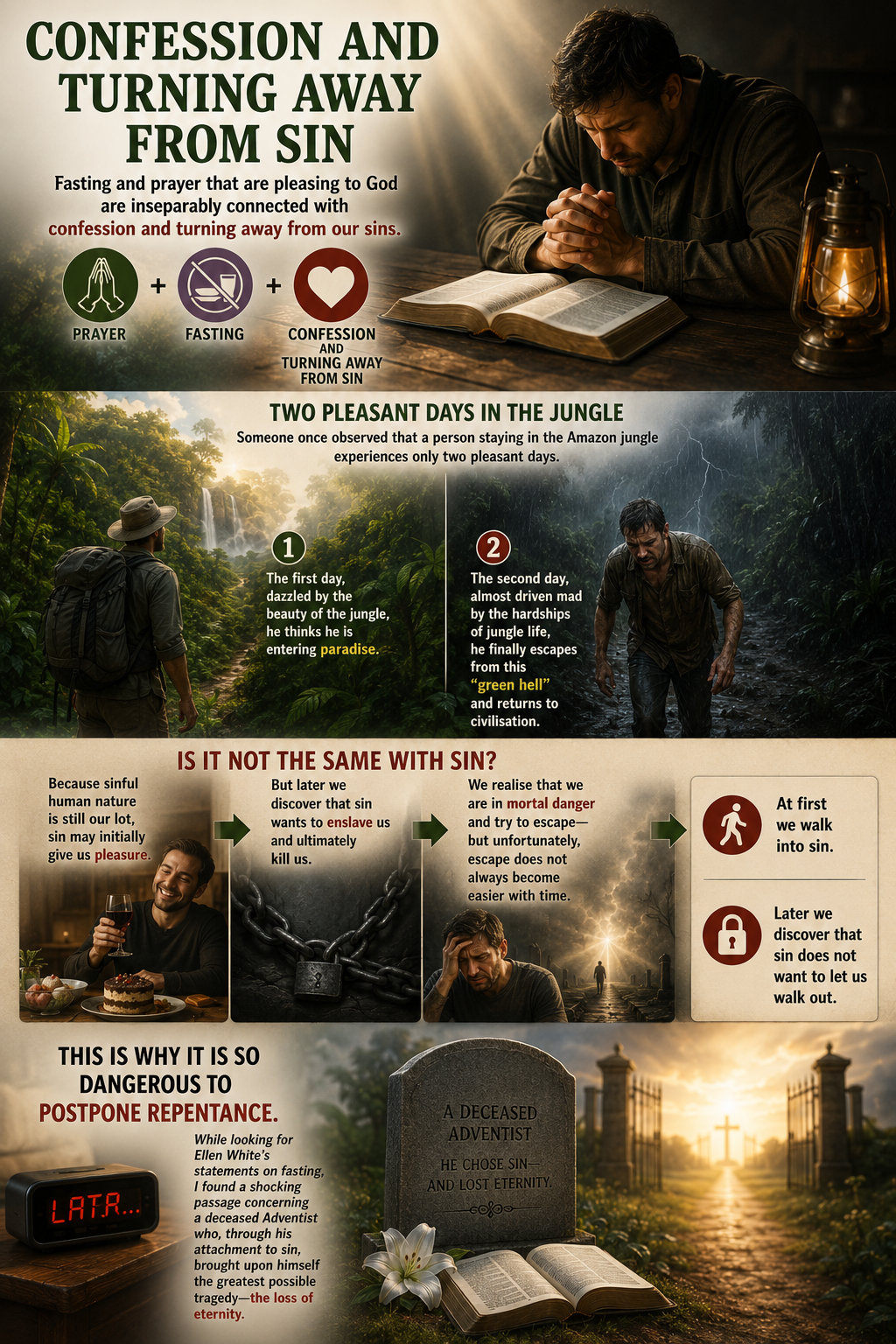
CONFESSION AND TURNING AWAY FROM SIN
Fasting and prayer that are pleasing to God are inseparably connected with confession and turning away from our sins.
Someone once observed that a person staying in the Amazon jungle experiences only two pleasant days. The first is when, dazzled by the beauty of the jungle, he thinks he is entering paradise. The second is the final day when, almost driven mad by the hardships of jungle life, he finally escapes from this “green hell” and returns to civilisation.
Is it not the same with sin?
Because we still have a sinful human nature, sin is attractive to us and gives us pleasure. But that pleasure does not last. What begins with enjoyment gradually takes control. Sin forms habits, habits become chains, and eventually we discover that what once gave us pleasure has made us slaves.
Then we begin to realise the terrible nature of sin. It does not merely want to please us—it wants to control us, enslave us and ultimately destroy us. We realise that we are in mortal danger and desperately want to escape. But by then the chains may have become strong, because the longer we surrender to sin, the harder it becomes to break free from its power.
At first we walk into sin. Later we discover that sin does not want to let us walk out. This is why it is so dangerous to postpone repentance.
While looking for Ellen White’s statements on fasting, I found a shocking passage concerning an Adventist who, through his addiction to sin, brought upon himself the greatest possible tragedy—the loss of eternity:
“This man had gone so far he seemed to be left of God. He would go into the woods and spend days and nights in fasting and prayer that he might overcome this great sin, and then would return to his old habits. God did not hear his prayers. He asked God to do for him what had been in his power to do for himself.” Ellen G. White, An Appeal to Mothers, p. 27.
She continues by explaining that he repeatedly made vows to God, repeatedly broke those vows, and continually surrendered himself again to his corrupt desires until God finally left him to continue the course of ruin he had chosen.
She then gives the solemn warning that this man had brought about his own destruction, that the purity of heaven would never be corrupted by his presence, and that those who persist in destroying the health and life God has entrusted to them demonstrate that they would not make proper use of immortal life in God’s eternal kingdom.
These are undoubtedly strong and frightening words, but such warnings are sometimes necessary so that we realise once again that the wages of persisting in sin is death and that Christ saves us from sin, not in sin.
ROCK-BORER (DATE MUSSEL) — DIGGING OWN GRAVE
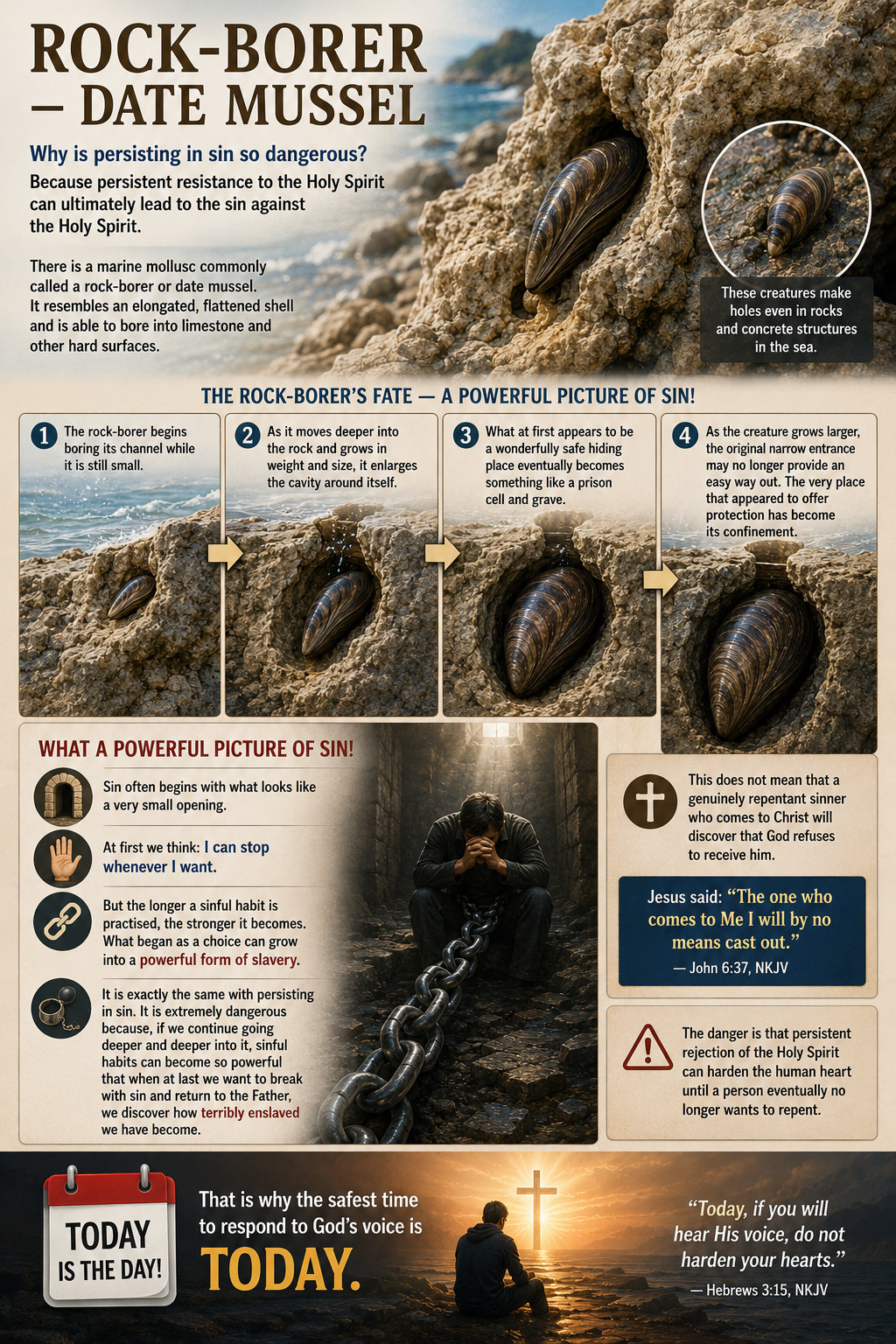
Why is persisting in sin so dangerous?
Because persistent resistance to the Holy Spirit can ultimately lead to the sin against the Holy Spirit.
There is a marine mollusc commonly called a rock-borer or date mussel. It resembles an elongated, flattened shell and is able to bore into limestone and other hard surfaces, including rocks and concrete structures in the sea.
The rock-borer begins boring its channel while it is still small. As it moves deeper into the rock and grows in weight and size, it enlarges the cavity around itself. What at first appears to be a wonderfully safe hiding place eventually becomes something like a prison cell and grave.
As the creature grows larger, the original narrow entrance may no longer provide an easy way out. The very place that appeared to offer protection has become its confinement.
What a powerful picture of sin! Sin often begins with what looks like a very small opening. At first we think: I can stop whenever I want. But the longer a sinful habit is practised, the stronger it becomes. What began as a choice can grow into a powerful form of slavery.
It is exactly the same with persisting in sin. It is extremely dangerous because, if we continue going deeper and deeper into it, sinful habits can become so powerful that when at last we want to break with sin and return to the Father, we discover how terribly enslaved we have become.
This does not mean that a genuinely repentant sinner who comes to Christ will discover that God refuses to receive him. Jesus said: “The one who comes to Me I will by no means cast out” (John 6:37).
The danger is that persistent rejection of the Holy Spirit can harden the human heart until a person eventually no longer wants to repent. That is why the safest time to respond to God’s voice is today.
DURIAN – FRUIT THAT TASTES LIKE HEAVEN AND SMELLS LIKE HELL
I once read about an unusual fruit called durian. Its pale, creamy flesh is considered by many people to be exceptionally delicious and has even been compared with the finest rich French creams. Unfortunately, at the same time, this fruit produces such a powerful and unpleasant smell that it has been compared with rotten onions, sweat, and decaying flesh. Someone said about durian that it tastes like heaven but smells like hell.
What is worse, the unpleasant smell can linger for a long time after the fruit has been eaten.
The strength of the odour can be seen from the fact that durian enthusiasts had sometimes been refused entry to ships or aeroplanes despite having valid tickets. The taste and smell of durian had sometimes contributed to marital arguments or even divorce—that some people preferred giving up their marriage to giving up their beloved durian!
Reading about this, I thought to myself that sin can be very similar. Sin may taste good, but at the same time it stinks!
If sin gave us no pleasure, temptation would have very little power over us. Sin attracts us because it promises pleasure. But behind that pleasure leads to corruption, slavery, suffering, and ultimately death.
In the same way, a person may have a valid ticket and still be refused entry because of something he is carrying. Likewise, we cannot assume that baptism alone guarantees our entrance into Christ’s kingdom if we deliberately continue to hold on to sin.
The reason is simple: sin would destroy the happiness and peace of heaven. God cannot allow sin to enter His eternal kingdom and begin the same terrible story all over again.
God, therefore, is not only preparing a place for us; He is also preparing us for that place. He wants to free us from everything that would make heaven impossible to enjoy and transform us into people who will be truly happy living in His presence forever.

WHEN DOES THE LORD BECOME “IMPATIENT OVER THE MISERY OF ISRAEL”
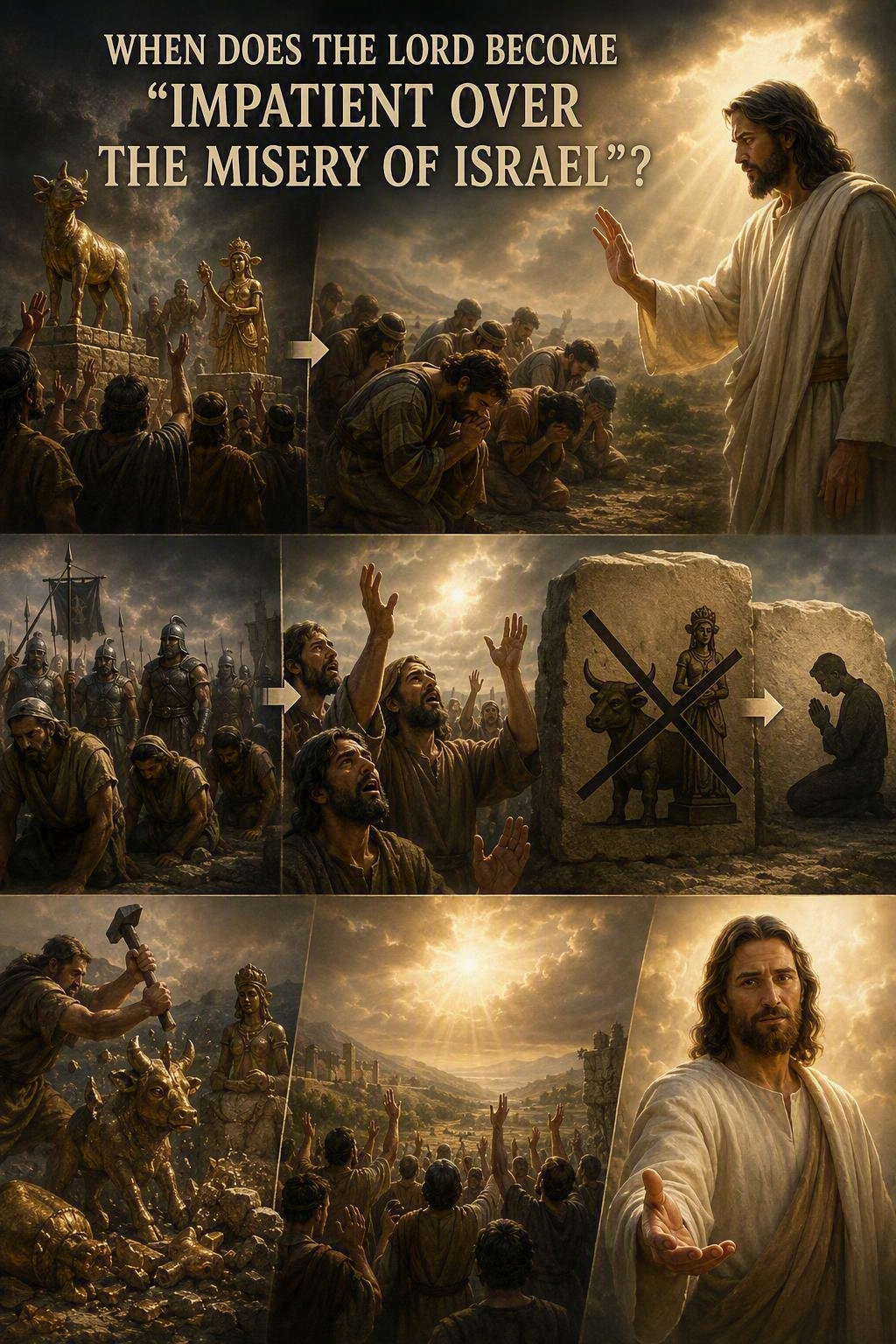
Judges chapter 10 gives us another powerful lesson. The children of Israel again did evil in the sight of the Lord and served the Baals and the Ashtoreths. God’s anger was kindled against Israel, and He allowed them to fall into the hands of the Philistines and the Ammonites (Judges 10:6–7).
Eventually the Israelites cried out: “We have sinned against You, because we have both forsaken our God and served the Baals!” (Judges 10:10).
The Lord reminded them how repeatedly He had delivered them from their enemies—the Egyptians, Amorites, Ammonites, Philistines, and others—whenever they had cried out to Him (Judges 10:11–12).
And then He said: “Yet you have forsaken Me and served other gods. Therefore I will deliver you no more” (Judges 10:13).
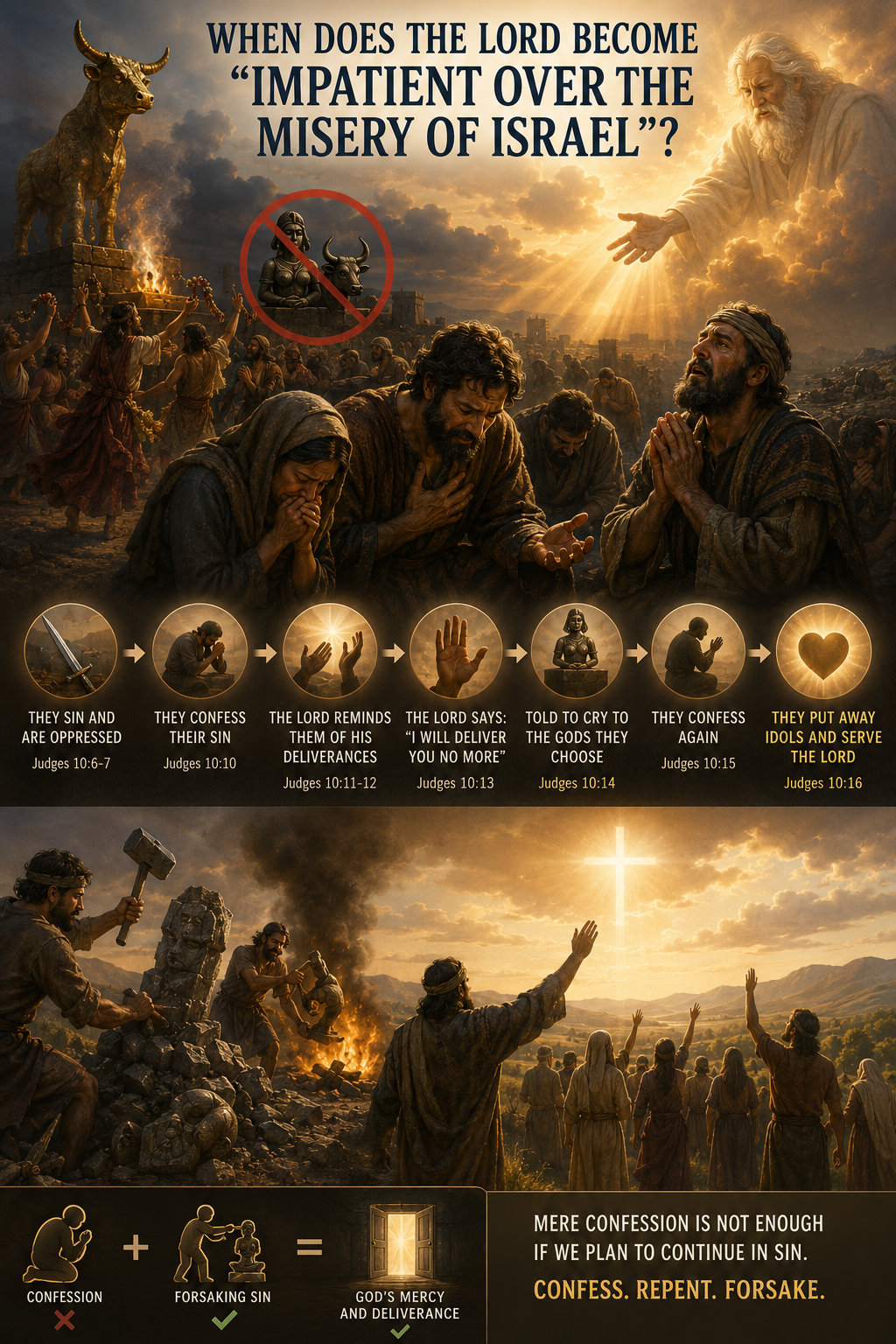
God told them, “I will deliver you no more” (Judges 10:13). He told them to go and cry to the gods they had chosen and let those gods save them in their time of distress (Judges 10:14).
The Israelites responded: “We have sinned! Do to us whatever seems best to You; only deliver us this day, we pray” (Judges 10:15).
But this time they did more than simply confess their sin:
“So they put away the foreign gods from among them and served the LORD” (Judges 10:16).
Their actions now demonstrated that their repentance was genuine. They did not merely say, “We have sinned”—they put away their idols and returned to the Lord.
And then comes one of the most beautiful statements about the heart of God:
“And His soul could no longer endure the misery of Israel” (Judges 10:16).
What a wonderful picture of God! He had just told them, “I will deliver you no more” (Judges 10:13). Yet when they truly repented, abandoned their idols and surrendered themselves to Him, His great love and compassion could no longer endure seeing them suffer!
It is almost as though God could not hold Himself back from coming to their rescue! Such is the heart of our heavenly Father, Lord Jesus and Holy Spirit. He does not delight in punishment. He longs to forgive, restore and save. They had confessed before. But now they put away their idols.
This teaches us an important lesson: true repentance is more than saying, “I am sorry” or “I have sinned.” Genuine repentance produces a change of direction. We confess our sin, turn away from it, surrender ourselves to God and, by His grace, begin to walk in a different direction.
When repentance is genuine, we discover that God is far more eager to forgive and save us than we sometimes imagine.
SUMMARY
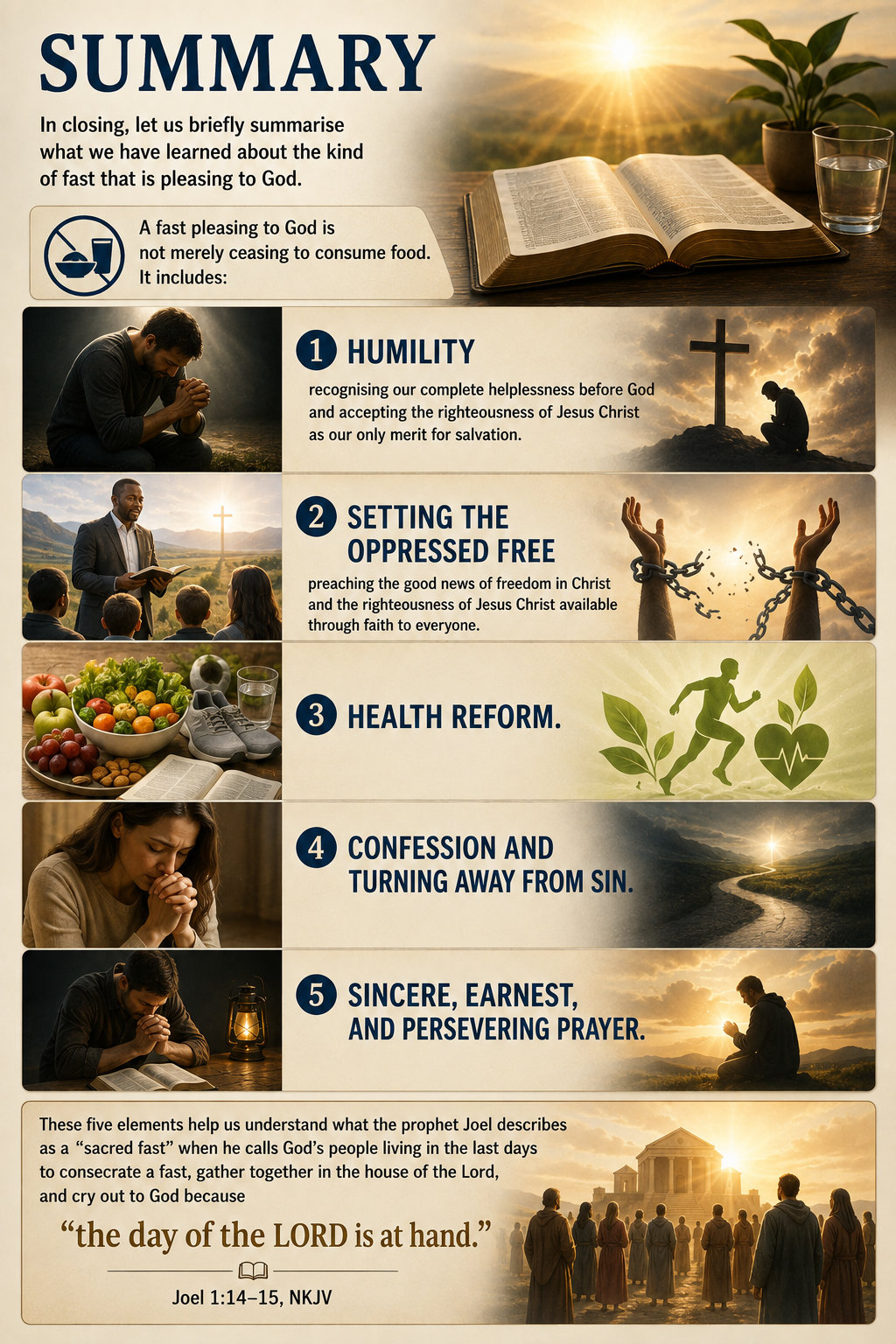
In closing, let us briefly summarise what we have learned about the kind of fast that is pleasing to God.
A fast pleasing to God is not merely ceasing to consume food. It includes:
1. HUMILITY — recognising our complete helplessness before God and accepting the righteousness of Jesus Christ as our only merit for salvation
2. SETTING THE OPPRESSED FREE — preaching the good news of freedom in Christ and the righteousness of Jesus Christ available through faith to everyone
3. HEALTH REFORM
4. CONFESSION AND TURNING AWAY FROM SIN
5. SINCERE, EARNEST, AND PERSEVERING PRAYER
These five elements help us understand what the prophet Joel describes as a “sacred fast” when he calls God’s people living in the last days to consecrate a fast, gather together in the house of the Lord, and cry out to God because “the day of the LORD is at hand” (Joel 1:14–15).
REND YOUR HEART, NOT YOUR GARMENTS
Joel then reveals the very heart of genuine fasting.
God says: “Turn to Me with all your heart, with fasting, with weeping, and with mourning” Joel 2:12.
And then comes the crucial statement:
“Rend your heart, and not your garments” Joel 2:13.
This is the heart of true fasting.
Not merely an empty stomach. Not merely an outward ceremony. Not merely appearing sorrowful. Not merely saying, “Lord, I am sorry.”
God wants the heart. True fasting is a heart turning completely back to God.
“For the eyes of the Lord roam throughout the whole earth, to strongly support those whose heart is completely His” (2 Chronicles 16:9).
FINAL APPEAL
If we desire revival, if we want to proclaim the final message with power, then first of all we should humble ourselves before the Lord.
If we think that personally we do not need to do this, let us remember the attitude of the prophet Daniel.
Daniel received assurance from an angel that he was greatly beloved by God. He could therefore have thought that it was the other Israelites—not he—who needed to humble themselves before God and confess their sins.
But Daniel did not separate himself from the guilty. He identified himself with them and pleaded before God as though he himself were among the transgressors:
“Then I set my face toward the Lord God to make request by prayer and supplications, with fasting, sackcloth, and ashes.” Daniel 9:3, NKJV.
Daniel prayed to the Lord, acknowledged God’s greatness, faithfulness, and mercy, and then confessed:
“We have sinned and committed iniquity, we have done wickedly and rebelled” Daniel 9:5.
Notice that Daniel did not say, “They have sinned.” He said, “We have sinned.”
Today there is a great need for people who are completely dedicated to God as Daniel was. How greatly we need righteous men and women who, in prayer and fasting, identify themselves with God’s people and plead before Him for forgiveness, mercy, revival, and grace.
We should all humble ourselves before the Lord and cry out to Him.
GIROLAMO SAVONAROLA
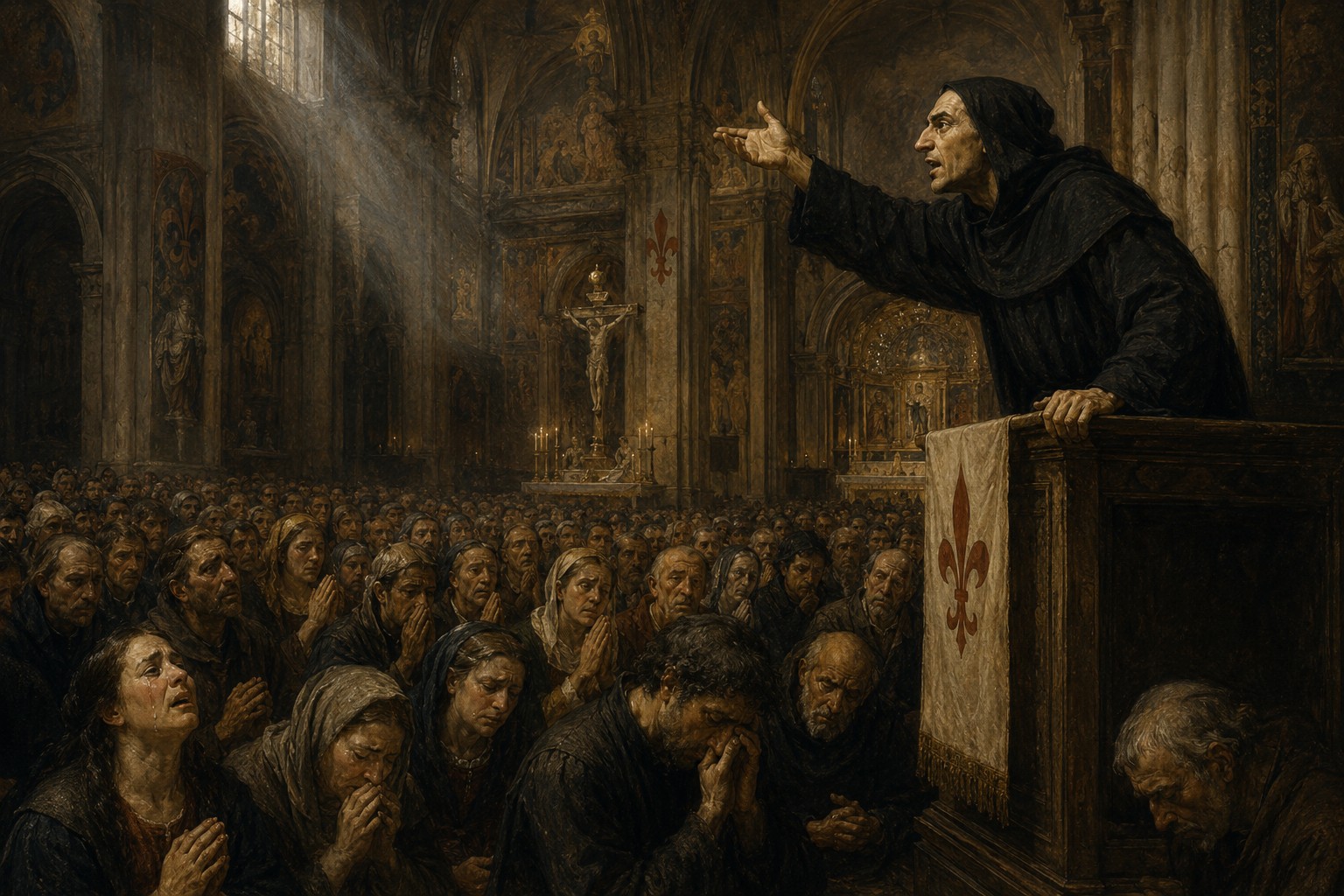
Girolamo Savonarola, the famous Florentine preacher and reformer who was eventually condemned to death and hanged after his conflict with the religious and political authorities of Florence and pope, called people to repentance with the following heart-felt words:
“Weep, my heart, weep, my soul, weep, my eyes! Weep with me, all of you—great and small, women and men, sinful and righteous.”
According to the account preserved in my original notes, as Savonarola spoke these words from the pulpit, the organ played a soft, mournful song, and all the people wept and beat their breasts.
But tears alone are not enough. Fasting alone is not enough. Prayer alone, if deliberately separated from surrender, is not enough.
If we sincerely confess our sins and turn away from them byt the power of Holy Spirit, removing the foreign gods from among us, and give all our hearts to God, then we may confidently plead for the Lord to look with compassion upon the misery of His people.
Then may finally come what we have waited for so long—the powerful outpouring of the Holy Spirit and the second coming of our Saviour!
But let us remember one final thing.
Let us not turn away from sin merely because we are afraid of punishment. Let us turn away from sin because we love Him.
Amen
EGW QUOTES ON FASTING
Ellen White explains: “Their faith must be strengthened by fervent prayer and fasting, and humiliation of heart. They must be emptied of self, and be filled with the Spirit and power of God.” Ellen G. White, The Desire of Ages, p. 431.
“In many cases of sickness, the very best remedy is for the patient to fast for a meal or two, that the overworked organs of digestion may have an opportunity to rest.” — The Ministry of Healing, p. 235.
“Many times a short period of entire abstinence from food, followed by simple, moderate eating, has led to recovery through nature’s own recuperative effort.” — The Ministry of Healing, p. 235.
“For certain things fasting and prayer are recommended and appropriate. In the hand of God they are a means of cleansing the heart and promoting a receptive frame of mind. We obtain answers to our prayers because we humble our souls before God.” — Medical Ministry, p. 283.
“With heart-searching, confession of sin, and earnest prayer, and often fasting for a time, they should entreat that God would especially help them.” — Testimonies for the Church, vol. 1, p. 624.
“They should set aside days for fasting and prayer. Entire abstinence from food may not be required, but they should eat sparingly of the most simple food.” — The Review and Herald, February 11, 1904; Counsels on Diet and Foods, p. 188.
“Often we fasted, that we might be better fitted to understand the truth.” — The Review and Herald, July 26, 1892; Counsels on Diet and Foods, p. 187.
“The true fasting which should be recommended to all, is abstinence from every stimulating kind of food, and the proper use of wholesome simple food, which God has provided in abundance.” — Medical Ministry, p. 283.