Vindication and Exaltation of Humanity In Christ
Slawomir Gromadzki
Even among believers, some ask, “Why did God allow sin to enter our world? Why must we suffer because of Adam’s choice?” These are honest and understandable questions. Yet the apostle Paul repeatedly assures us that although humanity lost much through Adam, God has given us infinitely more through Christ.
Adam’s sin brought condemnation, suffering, and death upon the human race. Death became a merciless tyrant from whose grasp no one could escape. But God did not abandon His fallen children. In His infinite love, He entered our broken world in the person of His Son. Christ united Himself with humanity, bore our condemnation, conquered sin and death, and recovered far more than Adam ever lost:
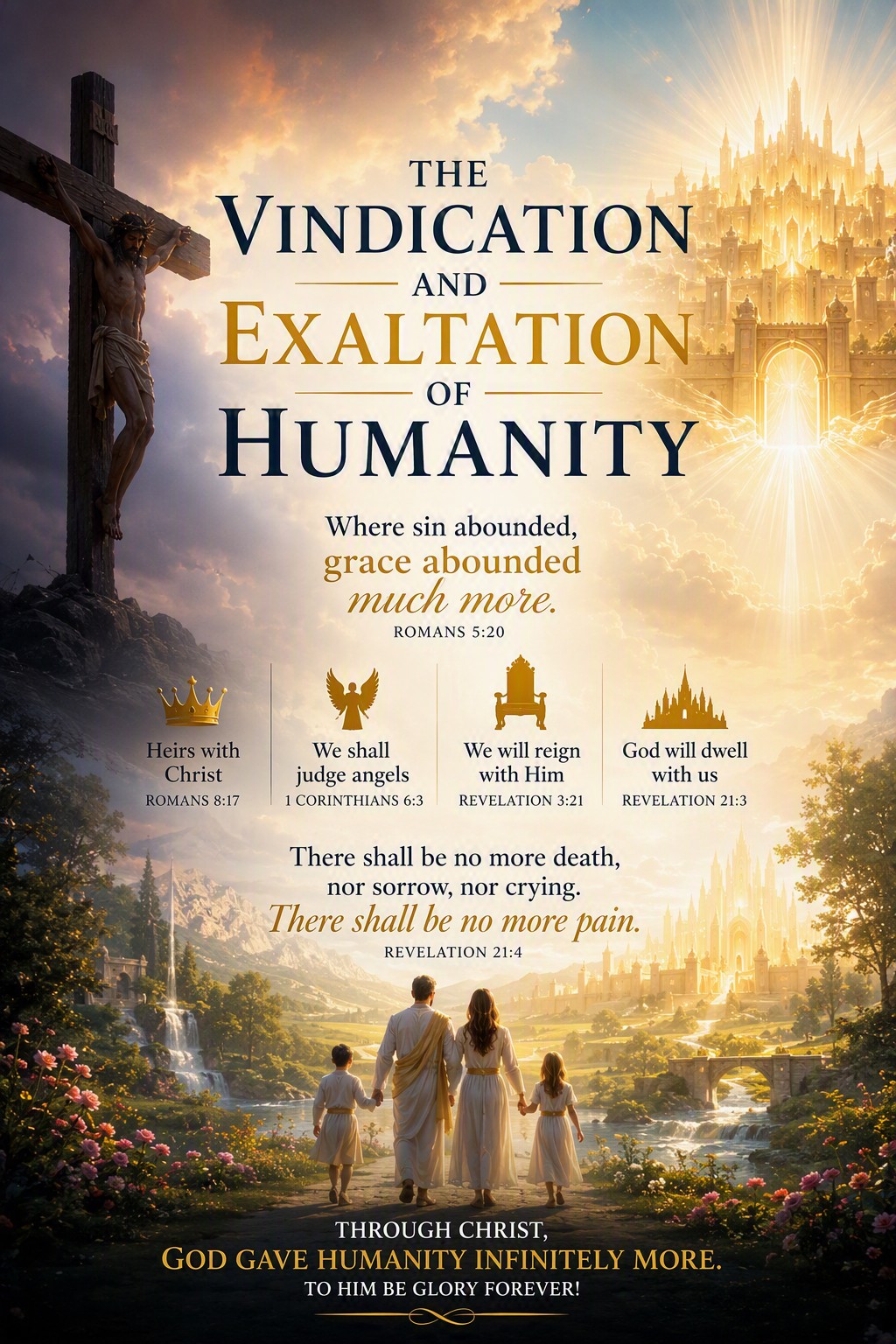
“Where sin abounded, grace abounded much more.” Romans 5:20
Human beings were originally created “a little lower than the angels” (Hebrews 2:7). Yet in Christ, God has elevated redeemed humanity to an honour almost beyond comprehension. We are adopted into His family, united with His beloved Son, and made heirs of His eternal kingdom. Jesus is not ashamed to call us His brothers and sisters (Hebrews 2:11). We will be crowned with glory, judge angels, and share Christ’s throne:
“If children, then heirs—heirs of God and joint heirs with Christ.” Romans 8:17
“Do you not know that we shall judge angels?” 1 Corinthians 6:3
“To him who overcomes I will grant to sit with Me on My throne.” Revelation 3:21
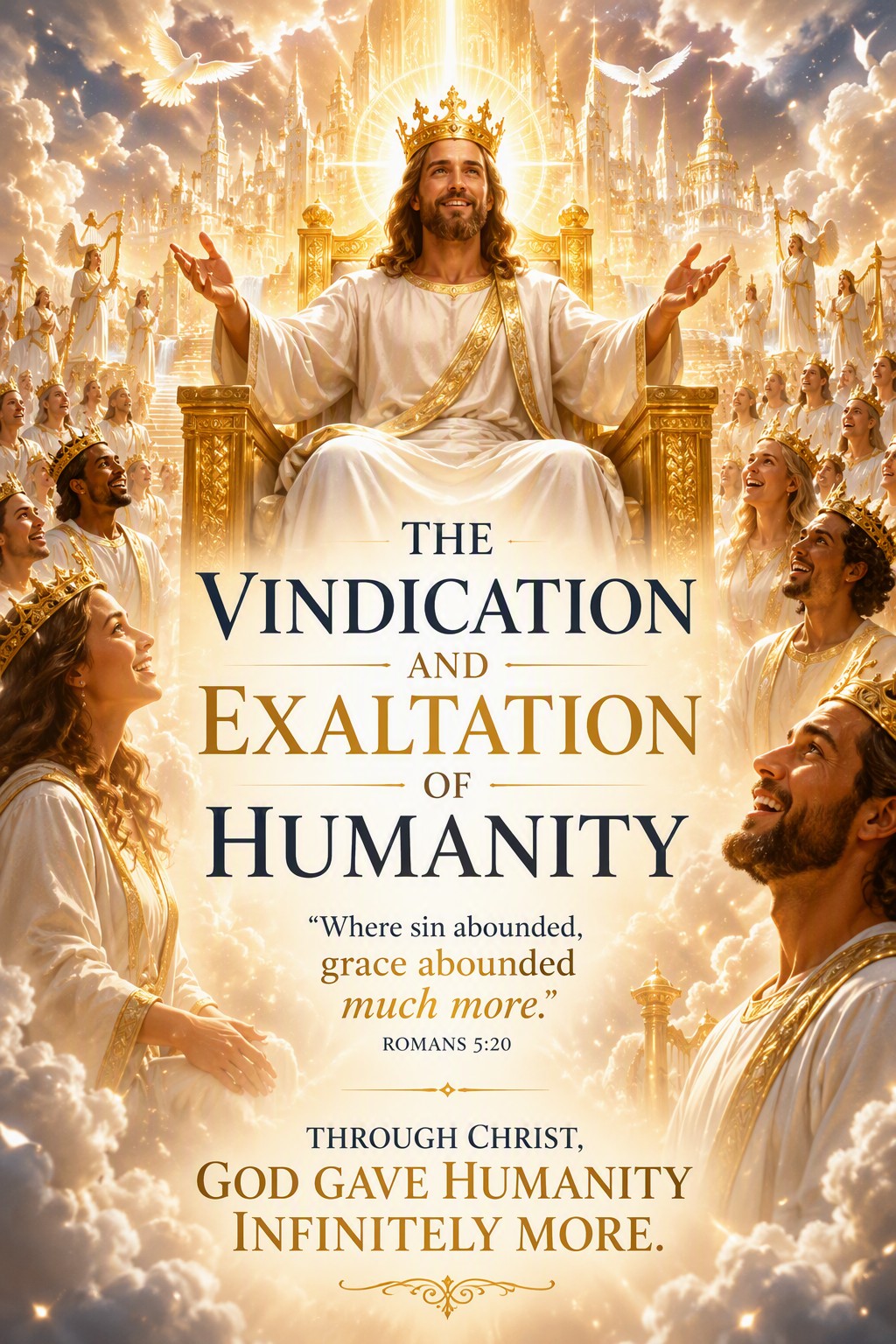
Through Adam’s sin, death reigned over humanity. But those who receive God’s abundant grace and the gift of Christ’s righteousness will not merely be delivered from death; they will “reign in life” through Jesus Christ (Romans 5:17). They will live and reign with Him throughout the endless ages of eternity (Revelation 20:6; 22:5). This is not merely grace—it is grace beyond measure, superabundant grace.
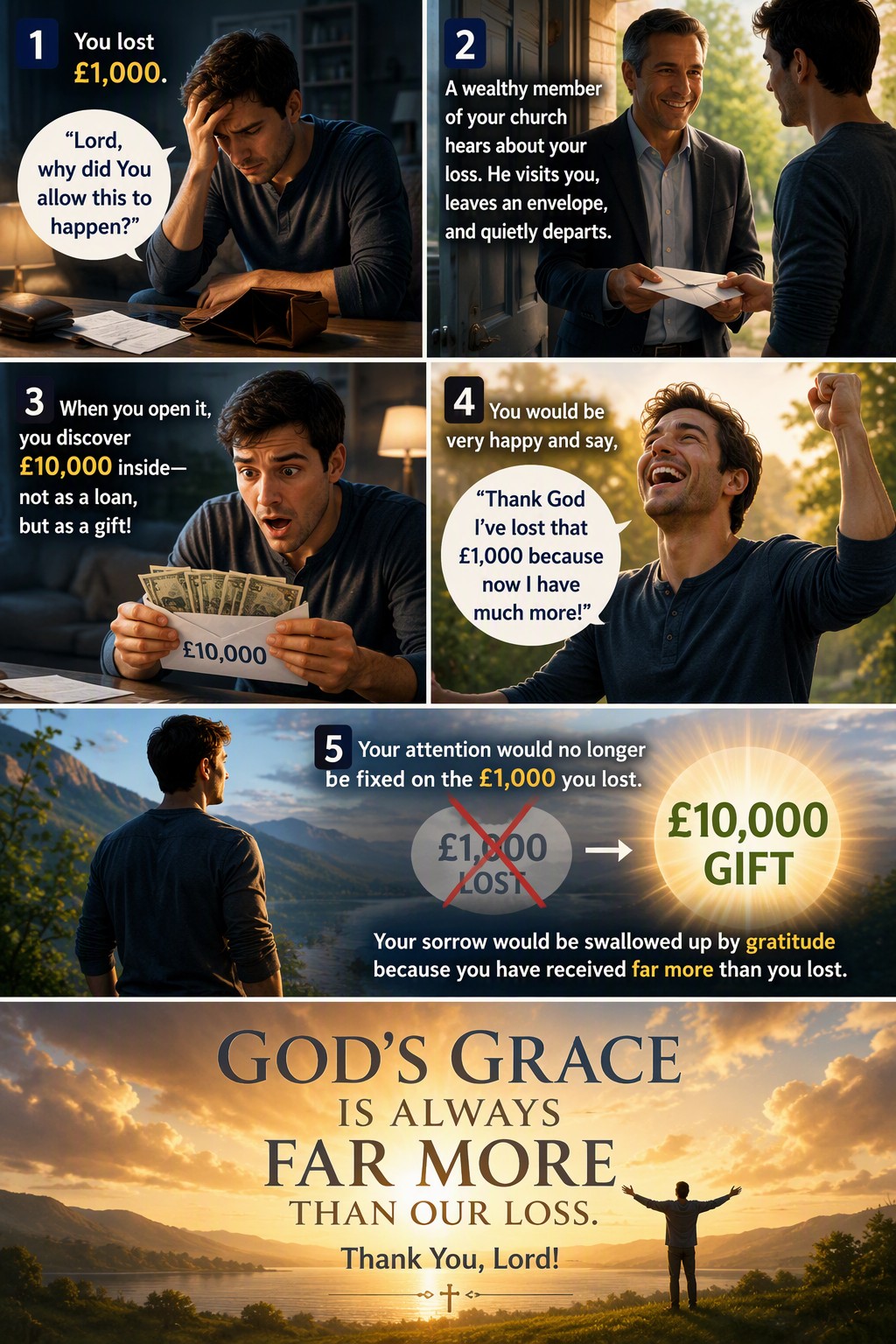
Imagine that you lost £1,000. Because that is a substantial sum for you, you would be deeply distressed and ask, “Lord, why did You allow this to happen?” Then a wealthy member of your church hears about your loss. He visits you, leaves an envelope, and quietly departs. When you open it, you discover £10,000 inside—not as a loan, but as a gift. What would be your reaction? You would be very happy and say, “Thank God I’ve lost that £1,000 because now I have much more!” My attention would no longer be fixed on the £1,000 I had lost. My sorrow would be swallowed up by gratitude because I had received far more than I had lost.

This does not mean the loss itself was good. Nor does it suggest that sin and suffering are blessings. Rather, it illustrates that God’s grace is so great that He can bring forth an outcome infinitely greater than all that sin has taken from us. We will never praise Adam for his sin, but throughout eternity we will praise God for transforming humanity’s tragedy into an everlasting revelation of His love.
This is Paul’s glorious message. He does not dismiss our pain or tell us to pretend that suffering does not hurt. Instead, he directs our gaze beyond present sorrow to the incomparable future God has prepared for His people:
“The sufferings of this present time are not worthy to be compared with the glory which shall be revealed in us.” Romans 8:18
Among all the unfallen worlds in God’s vast universe, rebellion took root here on earth, bringing suffering and death. This was neither God’s will nor His fault. Sin entered because created beings misused the freedom that divine love had given them. Genuine love cannot be forced, programmed, or compelled.
Yet God did not remain distant from our suffering. In Christ, He entered into it. The Creator became one with His fallen creatures. He carried our griefs, bore our condemnation, and gave Himself to save those who had become His enemies. At the cross, God demonstrated that He would rather suffer for us than abandon us.
God will not merely restore what humanity lost in Adam; He will bestow upon the redeemed immeasurably more in Christ. Every wound will be healed, every injustice set right, and every tear wiped away:
“There shall be no more death, nor sorrow, nor crying. There shall be no more pain.” Revelation 21:4
After the millennium, God will make this restored earth the centre of His eternal kingdom. The New Jerusalem will descend, and God Himself will dwell among His redeemed children (Revelation 21:2–3). The world once devastated by Satan’s rebellion will become the location of God’s throne:
“The throne of God and of the Lamb shall be in it.” Revelation 22:3
What an astonishing reversal! The earth that witnessed humanity’s fall will witness humanity’s glorification. The place where Christ was rejected and crucified will become the place from which He reigns. Those who were once sinful, condemned, and dying will be forgiven, transformed, crowned, and seated with Christ upon His throne.
Soon Jesus will return and bring an existence beyond anything we can now imagine—a life free from fear, separation, ageing, pain, and death; a life of unending discovery, breathtaking beauty, perfect relationships, abiding joy, and ever-deepening fellowship with God.
Only then will we fully understand that God did not merely recover what Adam lost. Through Christ, He has given humanity infinitely more. Throughout eternity, the redeemed and all the unfallen worlds will look upon the history of this earth and behold the clearest revelation of God’s character. The great controversy will conclude with God’s love fully vindicated, humanity gloriously exalted, and the universe eternally secure. Sin will have no final victory. God will transform humanity’s greatest tragedy into the everlasting display of His infinite love, superabundant grace, and unfailing goodness.

SHORT VERSION
Even among believers, some complain that God allowed sin to enter our planet, with all the suffering and death that followed. Referring to this, however, the apostle Paul repeatedly explains that although we lost much through Adam’s sin, we should not complain, because through Christ we will receive infinitely more!
In Adam, we occupied a lower position in the universe: first God, then the angels, and then humanity together with the inhabitants of the other worlds created by God. But in Christ, God will exalt redeemed humanity above the angels. He will place crowns upon our heads, make us heirs with Christ, and seat us with Him upon His throne! (Romans 8:17; Revelation 3:21; 20:6; 22:5).
Imagine that I lost £1,000. Because this is a substantial amount for me, I would be deeply distressed and ask God why He had allowed it to happen. Then a wealthy member of my church heard about my loss and came to see me. He said, “I heard that you lost £1,000,” handed me an envelope, and left. When I opened it, I discovered £10,000 inside—not as a loan, but as a gift! How would I react? I would be overjoyed and say, “Thank God I lost that £1,000, because now I have so much more!”
This is exactly what Paul meant. He tells to stop complaining about what we lost in Adam because now in Christ we have much more! us not to become discouraged by our present difficulties, problems, and suffering, because they are only temporary. Soon Christ will return and introduce an entirely new and eternal existence filled with unimaginable wonder, constant joy, breathtaking beauty, and pure delight.
In the entire boundless universe, with its countless planets and unfallen worlds, sin arose only here on Earth, bringing suffering and death. Although it was not God’s fault that sin entered our world, He will abundantly compensate the redeemed for everything they have suffered. In Christ, He will give them infinitely more than they ever lost in Adam.