
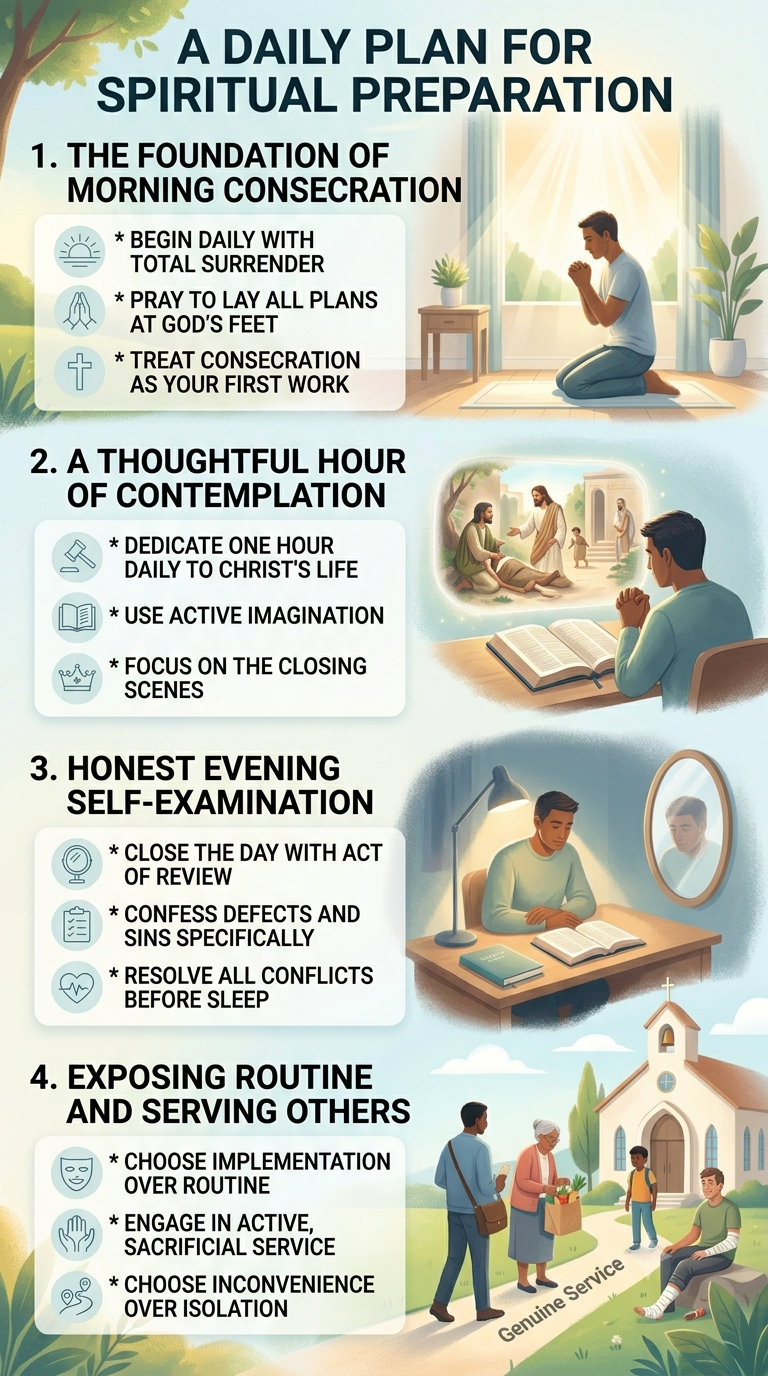
Foundation of Morning Consecration
Ellen White’s daily preparation plan contains specific, non-negotiable elements treated not as suggestions for the exceptionally devoted, but as essential practices for readiness. The first and most fundamental is the morning consecration. This requires beginning every day, before any worldly input enters the mind, with a specific focus on total surrender.
“Consecrate yourself to God in the morning; make this your very first work. Let your prayer be, ‘Take me, O Lord, as wholly Thine. I lay all my plans at Thy feet. Use me today in Thy service. Abide with me, and let all my work be wrought in Thee.’ This is a daily matter. Each morning consecrate yourself to God for that day. Surrender all your plans to Him, to be carried out or given up as His providence shall indicate. Thus day by day you may be giving your life into the hands of God, and thus your life will be molded more and more after the life of Christ.” Steps to Christ, 70
On the very first morning, praying this prayer before checking a phone or starting the day revealed an immediate shift. The words carry a different weight when consciously laying plans at God’s feet, rather than pursuing a personal agenda and asking Him to bless it. This moment of actual surrender highlighted how often past days had been started without true alignment.
Thoughtful Hour of Contemplation
The second element emphasized in the spirit of prophecy is spending a dedicated, uninterrupted period in contemplation of Christ’s life.
“It would be well for us to spend a thoughtful hour each day in contemplation of the life of Christ. We should take it point by point, and let the imagination grasp each scene, especially the closing ones.” The Desire of Ages, 83
Though this passage is familiar to many, actually dedicating an hour to this practice changes everything. This is not systematic reading for information or a standard study plan; it is sitting with a scene from the Gospels and allowing the mind to be fully present in it. By the third day, this practice produced a profound awareness of the gap between Christ’s responses to pressure and typical daily reactions. It moved from abstract theology to a concrete recognition of how He handled opposition, inconvenience, and trial.
This article on Christ’s sufferings will help you to implement this element of the daily plan: SUFFERINGS AND THE CROSS OF CHRIST

Honest Evening Self-Examination
The third daily practice involves a thorough evening review, closing each day by evaluating where character has fallen short and confessing those areas specifically.
“We should close every day with a review of our actions during the past hours, and see if we have anything against anyone, or if anyone has ought against us.” Manuscript Releases, Volume 12, 114
True self-examination is not a superficial checklist or an exercise in self-condemnation. It is a deliberate, quiet process where we ask the Holy Spirit to reveal the true condition of our hearts. We must bring the day’s words, thoughts, motives, and actions into the light of God’s presence, hiding nothing.
“Let there be a closest self-examination. Go to God; let the heart be laid open before Him. Let the prayer go up from unfeigned lips, ‘Search me, O God, and know my heart: try me, and know my thoughts: and see if there be any wicked way in me, and lead me in the way everlasting.'” The Review and Herald, December 18, 1888
This means reviewing our interactions one by one. Did we speak impatiently to a family member? Did we harbor resentment when criticized? Did we choose self-interest over service? We are to confess these findings specifically, asking not only for forgiveness but for the power to overcome them.
We cannot overcome character defects that we refuse to honestly identify. Daily examination prevents us from carrying accumulated, unconfessed sins into the next day, which gradually hardens the conscience and blinds us to our true spiritual state. In these final days, a superficial work is fatal; our characters must be thoroughly purified.
“Now, while our great High Priest is making the atonement for us, we should seek to become perfect in Christ. Not even by a thought could our Saviour be brought to yield to the power of temptation… This is the condition in which those must be found who shall stand in the time of trouble.” The Great Controversy, 623
If we neglect this thorough evening review, we risk being deceived by a form of godliness while retaining the very character traits that will disqualify us from receiving the seal of God. Daily self-examination breaks our self-sufficiency, keeps our relationship with Christ entirely transparent, and allows His grace to reshape our defaults before we sleep.
Character Transformation Through Beholding
While this daily review is essential, we must completely avoid exaggeration or spending too much time dwelling on our imperfections and sins. Constant self-centering leads only to discouragement and spiritual weakness. We do not look to ourselves for healing, nor do we try to carry the burden of our failures. We simply need to be aware of our defects, confess them promptly, and immediately request the Holy Spirit to empower us to avoid them in the future. Instead of micro-analyzing our own fallen nature, our minds must be occupied with the perfection of Christ.
“We should not make self the center and indulge anxiety and fear as to whether we shall be saved. All this turns the soul away from the Source of our strength. Commit the keeping of your soul to God, and trust in Him. Talk and think of Jesus. Let self be lost in Him. Put away all doubt; dismiss your fears… If we keep our minds dwelled upon our sins and imperfections, we shall become discouraged and full of doubt. We must look away from self to Jesus.” Steps to Christ, 71
“By beholding we become changed. This is a law of the mind. Contemplate heavenly themes, and your mind will be drawn to them. If it dwells on earthly themes, you will become earthly. If you think of Christ, your mind will be elevated; you will become more and more like Christ in character.” Testimonies for the Church, Volume 5, 744
The law of the mind is precise. Sustained contemplation gradually reshapes default reactions. For instance, encountering criticism—which previously triggered defensiveness and internal justification—was met instead with genuine curiosity, an acknowledgment of truth, and gratitude for the correction.
“He who has learned of Christ is made free from the pride and self-sufficiency which close the heart against the truth. He does not resist reproof, for he has learned that reproof is often needed to keep him in the path of righteousness.” The Review and Herald, June 5, 1894
Freedom from defensive self-protection becomes real when the daily contemplation of Christ replaces natural, self-defending patterns.
Enduring Reproach and Finding Rest
“Those who follow Christ are to expect to meet with the same treatment he received. The servant is not above his master. If they persecuted me, they will also persecute you. Blessed are they which are persecuted for righteousness’ sake. It is a very small thing to be judged of man’s judgment, when we know that God’s approval rests upon us.” The Sanctified Life, 80
“If we keep the Lord ever before us, allowing our hearts to go out in thanksgiving and praise to him, we shall have a continual freshness in our religious life. Our prayers will take the form of a conversation with God, as we would talk with a friend. He will speak his mysteries to us personally. Often there will come to us a sweet, joyful sense of the presence of Jesus. Often our hearts will burn within us as he draws nigh to commune with us as he did with Enoch.” Christ’s Object Lessons, 129
Establishing Permanent Patterns
The true measure of spiritual preparation is not what occurs during an intentional experiment, but what becomes embedded as a permanent default pattern. Three changes must remain. First, the morning consecration changes from a discipline into an absolute necessity.
“Each morning consecrate yourself to God for that day. Surrender all your plans to him, to be carried out or given up as his providence shall indicate. Thus day by day you may be giving your life into the hands of God, and thus your life will be molded more and more after the life of Christ.” Steps to Christ, 70
Attempting to start a day without this surrender produces a distinct spiritual disorientation. Second, the vague general sense of one’s spiritual condition is permanently replaced by a current, concrete awareness of exactly where character is developing and where it falls short. You cannot address what you refuse to honestly identify.
Third, the daily contemplation of Christ produces a genuine love for Him that motivates obedience as a natural response to a relationship, rather than out of legalistic duty.
“When the heart is filled with love for Christ, it cannot keep silent; it must speak of the wonderful Redeemer.” The Review and Herald, May 24, 1892
Committing to Practical Implementation
These principles were never designed as a temporary experiment; they are daily necessities for anyone serious about readiness. The danger lies in continuing a pattern of knowing without doing, which leads to being genuinely unprepared despite years of sincere religious activity.
True preparation requires systematic, daily implementation rather than inspired intentions that fade. Commitment begins on a single morning, before any other input enters the mind, by slowly and intentionally praying the prayer of consecration, spending unhurried time beholding Christ, and closing the day with an honest review.
“Those who take Christ at his word, and surrender their souls to his keeping, their lives to his ordering, will find peace and quietude. Nothing of the world can make them sad when Jesus makes them glad by his presence. In perfect acquiescence there is perfect rest.” The Desire of Ages, 331
This peace, quietude, and transformation are available through daily cooperation with divine grace. The journey toward true readiness begins with the choice to implement these steps tomorrow morning.